“Scary” 1929 Chart Says Little About the Future

On February 11, 2014, Mark Hulbert of MarketWatch.com posted an article titled “Scary 1929 Market Chart Gains Traction (found here)”.  In the article, Hulbert suggests that the critics of the chart, which shows a parallel between the current market action since July 2012 and 1928-1929, are running out of explanations as to why the chart doesn’t have merit.

image

One aspect missing from the Hulbert article is what it takes to get from the most recent high of 16,588 to the 1,658 level on the Dow Jones Industrial Average.  In order to lose -89% in value, the Dow would need to decline first to 15k, 14k, 13k etc.  Leaving out these important hurdles on the downside ignores a wide swath of goings-on that needs to occur in between now and the doomsday low.  To fill the void that is unexamined by the Hulbert article, we’re going to review the various ways that the Dow Jones Industrial Average could decline to new lows.

Before offering our downside take on the market, we’d like to refer you to some basic issues that are mandatory to understanding how the stock market decline from 1929 was an anomaly, at best.  In previous work on the topic, we’ve addressed reasons why the 1929 stock market decline of -89% had more to do with reshuffling of the index by replacing stocks that had fallen significantly with new stocks that had appeared strong but were on the cusp of major declines.  Once the new stocks were added to the index they crashed hard while the stocks that were dropped from the index were at the beginning stages of recovery (2009 article found here).

In another piece, we outlined the fact that the decline of 1929 was followed by a recovery that was much faster than most investors know.  Our theory is that the multiple changes to the index artificially suppress the index on the way down and on the way up.  This resulted in the Dow taking 25 years to achieve breakeven status with 1929.  However, stocks that were not part of the index can be seen to achieve breakeven status on average by 1937.  One of our favorite examples is found in the chart of Monsanto Corp. below (2010 article found here).

Continue reading

Transaction Alert

On February 12, 2014, we carried out the following transaction(s):

Transaction Alert

On February 11, 2014, we carried out the following transaction(s):

Continue reading

U.S. Dividend Watch List: February 7, 2014

Watch List Performance Review

In our ongoing review of the NLO Dividend Watch List, we have taken the top five stocks on our list from February 8, 2013 and have checked their performance one year later. The top five companies on that list can be seen in the table below.

Symbol Name 2013 Price 2014 Price % change
MHFI McGraw Hill Financial, Inc. 42.67 79.97 87.4%
MSFT Microsoft Corporation 27.55 36.56 32.7%
LKFN Lakeland Financial Corp. 24.63 36.17 46.9%
SO Southern Company 43.85 41.10 -6.3%
WEYS Weyco Group 23.17 25.41 9.7%
      Average 34.1%
         
DJI Dow Jones Industrial 13,944.10 15,794.08 13.3%
SPX S&P 500 1,509.39 1,797.02 19.1%

NLO_02092014

McGraw Hill (MHFI) was the best performer and the key reason why the top five companies are up substantially more than the market in the last year.  At the time, we stated that the key reason why MHFI tumbled was because the U.S. government filed a civil lawsuit against the company on charges related to credit rating prior to the financial crisis.  The market apparently paid no attention to that lawsuit and MHFI skyrocketed upward.

U.S. Dividend Watch List: February 7, 2014

Below are 53 companies on our U.S. Dividend Watch List that are currently of interest to us.

Continue reading

Gold Stock Indicator: February 7, 2014

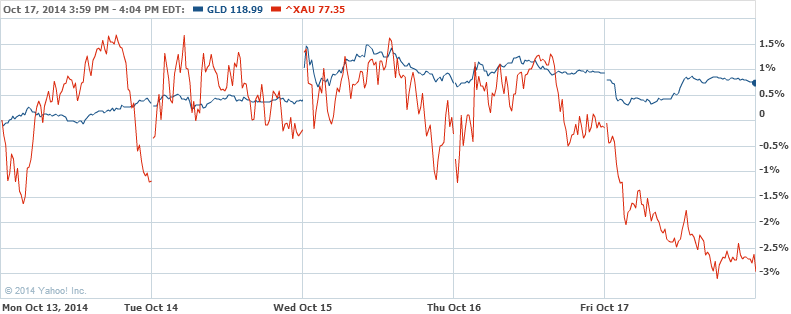
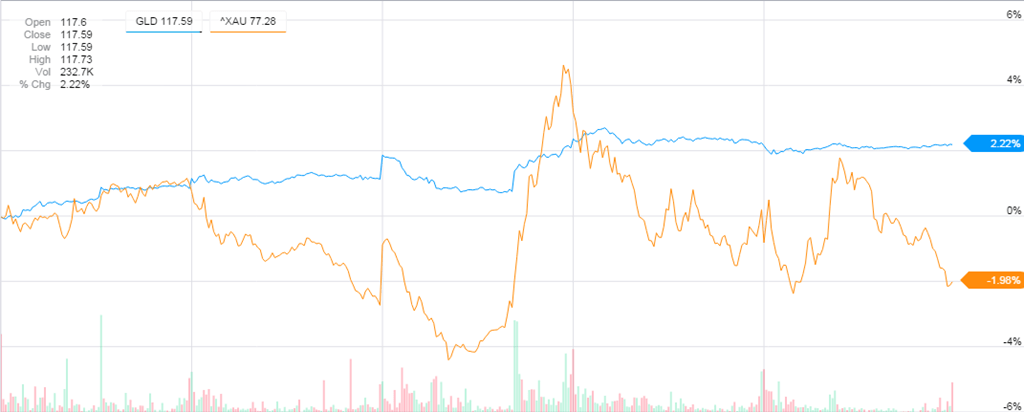
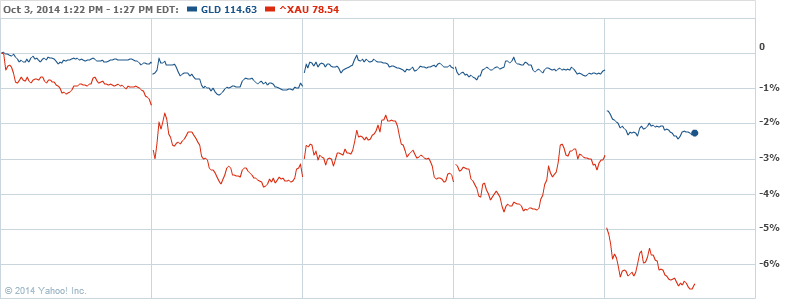
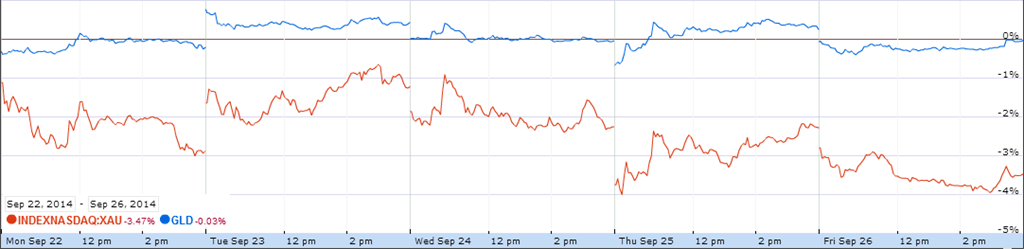
Gold (as represented by GLD) and the Gold & Silver Stock Index (XAU) finished the last week on a high note with gains of +1.45% and +1%, respectively. Although, it could be said that gold stocks took investors for a ride in order to achieve the +1% gain.  The XAU Index declined as much as –2.5% before regaining all of the lost ground of Tuesday and Thursday of this week.

image

Bitcoin: Retests Downside Targets

On December 18, 2013, we said the following of Bitcoin (found here):

“…in the last 24 hours, Bitcoin has declined as low as $455.  This suggests there there could be a significant appreciation from the current level as the conservative downside target has been achieved.”

The rise in Bitcoin from the low of $455 by +123% in less that one month seemed substantial enough.  However, the recent declines in Bitcoin require us to reassess the potential risks and rewards going forward.

image 

In the last few days, Bitcoin has experienced extreme volatility in its price when it fell -32.7% from the intermediate peak experienced on January 5, 2014 at $1,015. We’re now faced with the potential for Bitcoin to achieve the ascending downside target of $412.65 (now at approximately $570) followed by the worst case level of $200 (ascending red line). 

In many previous examples of Edson Gould’s Speed Resistance Lines, once at the extreme downside target of $412.65, the price usually reverses to the upside.  However, failure to do so (reverse at or above the extreme downside target) would mean that Bitcoin could reach $385 before reversing to the upside.  If the $385 level fails on the downside then $200 is assured.

Finally, the extreme upside target is $1,606.95 and the conservative upside target is $1,071.30.  These upside targets are only valid if the price of Bitcoin is on the rise above the $412.65 ascending line. 

***Anyone venturing into the world of Bitcoin for the purposes of speculation should assume that all funds put forth will be lost.

U.S. Dividend Watch List: January 31, 2014

Watch List Performance Review

In our ongoing review of the NLO Dividend Watch List, we have taken the top five stocks on our list from February 1, 2013 and have checked their performance one year later. The top five companies on that list can be seen in the table below.

Symbol Name 2013 Price 2014 Price % change
FDO Family Dollar Stores 56.09 61.82 10.2%
WEYS Weyco Group 23.20 26.42 13.9%
LKFN Lakeland Financial Corp. 24.74 36.63 48.1%
SO Southern Company 44.01 41.24 -6.3%
MSFT Microsoft Corporation 27.93 37.84 35.5%
      Average 20.3%
         
DJI Dow Jones Industrial 14,054.50 15,698.85 11.7%
SPX S&P 500 1,514.68 1,782.59 17.7%

NLO_1.31.14

In our review, we informed our readers that we’ve taken position in Dollar Tree (DLTR) instead of Family Dollar (FDO) which coincidently turned out to be a better purchase.  Year-to-date, Dollar Tree yielded a return of +26% and has risen as much as +50% in less than one year.  Family Dollar rose as far as +30% and has settled at a +10% gain one year later.  Our readers may recall that we had taken profits in Dollar Tree at 15% as its our strategy of seeking fair profits.

U.S. Dividend Watch List: January 31, 2014

The market volatility continued this week with the S&P 500 trading as low as 1,772 and as high as 1,798 which is a 1.5% swing.  By the end of the week, the market was down -0.5% and provided us with an additional 10 companies we could consider.

Below are 43 companies on our U.S. Dividend Watch List that are on our radar.

Continue reading

Gold Stock Indicator: January 31, 2014

This week, gold declined –1.31% and the Philadelphia Gold and Silver Stock Index (XAU) declined –1.48%.  Below is the Gold Stock Indicator:

Continue reading

Review: Lowry’s 90% Downside Days

On January 28, 2014, Barry Ritholtz did a Bloomberg piece titled “Friday was a 90/90 Day and What It Means (found here)”.  In that article, Ritholtz explains the “90/90” as follows:

“When markets experience a bout of intense selling -- those trading sessions when 90 percent of the volume is down, and nine out of 10 stocks close lower -- it can mark a short-term reversal in a bull run. Typically, it signifies a shift in psychology among larger institutions.”

“Looking at the past examples of deep 90/90 sell offs, we have seen only modest rebounds followed by more selling after days such as Friday.”

In general, Ritholtz gives a vague idea on the concept however a detailed explanation is found in the 2002 article by Paul Desmond of Lowry’s Reports titled “Identifying Bear Market Bottoms and New Bull Markets (found here).”  In the Desmond article, there are some key concepts that are outlined.  Foremost is the idea that “…Important market bottoms are preceded by, and result from, important market declines…(page 3)” and “…if an investor had a method for identifying and measuring panic selling, at least half the job of spotting major market bottoms would be at hand...(page 3)”.

In the pursuit of identifying and measuring panic selling, Desmond’s research found that “…almost all periods of significant market decline in the past 69 years have contained at least one, and usually more than one, day of panic selling in which Downside Volume equaled 90.0% or more of the total of Upside Volume plus Downside Volume, and Points Lost equaled 90.0% or more of the total of Points Gained plus Points Lost…(page 4)”.  Desmond’s work on the topic covers the period from 1960 to 2002 with every date that the Dow Jones Industrial Average experiences 90% Upside or Downside days.

Continue reading

U.S. Dividend Watch List: January 24, 2014

This was a tough week for the market as the S&P 500 pulled back by -3%.  The Dow pulled back by more than -3.25%.  However, this is great news for us as we enjoy searching for company under these conditions.

Below are 33 companies on our U.S. Dividend Watch List that are on our radar.

Continue reading

Insurance Watch List: January 24, 2014

Anyone who wishes to be successful in insurance stocks should read the book The Davis Dynasty by John Rothchild (found here). The book starts with Shelby Collum Davis investing approximately $50,000 to $100,000 that ultimately grew to $900 million after 47 years. The strategies employed by Davis seem highly accessible to average investors.  The following is a key insight from the book:

Gold Stock Indicator: January 24, 2014

Gold increased +2% in the last week while the Philadelphia Gold and Silver Stock Index declined –1%.  Below is the level of the Gold Stock Indicator:

Continue reading

Review: Dow Jones-UBS Commodity Index

Continue reading

Investment Observation: Fastenal (FAST) at $47.46

Continue reading

U.S. Dividend Watch List: January 17, 2014

Watch List Performance Review

In our ongoing review of the NLO Dividend Watch List, we have taken the top five stocks on our list from January 18, 2013 and have checked their performance one year later. The top five companies on that list can be seen in the table below.

Symbol Name 2013 Price 2014 Price % change
WEYS Weyco Group 22.75 27.96 22.9%
MSFT Microsoft Corporation 27.25 36.38 33.5%
ED Consolidated Edison 55.78 53.96 -3.3%
NJR New Jersey Resources Corp. 41.09 45.85 11.6%
YUM Yum! Brands 65.15 72.10 10.7%
      Average 15.1%
         
DJI Dow Jones Industrial 13,649.70 16,458.56 20.6%
SPX S&P 500 1,485.98 1,838.70 23.7%

NLO_1.17.2014

Several names from our top five performed exceptionally well while some in the utilities sector held the list back.  We believed that our commentary on the shoe manufacture, Weyco (WEYS), was accurate.  The following commentary was made:

“The earnings per share has been increasing at a steady pace, rising from $1.00 in 2009 to $1.55 presently.  That rise of earnings, 15% annually, isn’t reflective of the stock price.  The company has a strong balance sheet and should trade at much higher multiples than the current level of 14.  This may be a good starting point to do some research on this small cap company.”

The company earning rose 10% (from $1.54 to $1.70) while multiple expanded 11% (from 14.7 to 16.4).  These two key factors were the main reason why the stock rose 23%.

Similarly, we expected Microsoft (MSFT) to do well if the stock held its technical level and break out on the upside.  The following was our commentary:

“The fundamental picture hasn’t changed since last week (found here).  On the technical front, the stock has been on a declining trend since March 2012.  The current consolidation of MSFT in the last three months might signal a bottom of the stock price and  could decisively break above $27.70.”

U.S. Dividend Watch List: January 17, 2014

Below are 26 companies on our U.S. Dividend Watch List that are on our radar.

Continue reading