Gold Stock Indicator: March 7, 2014

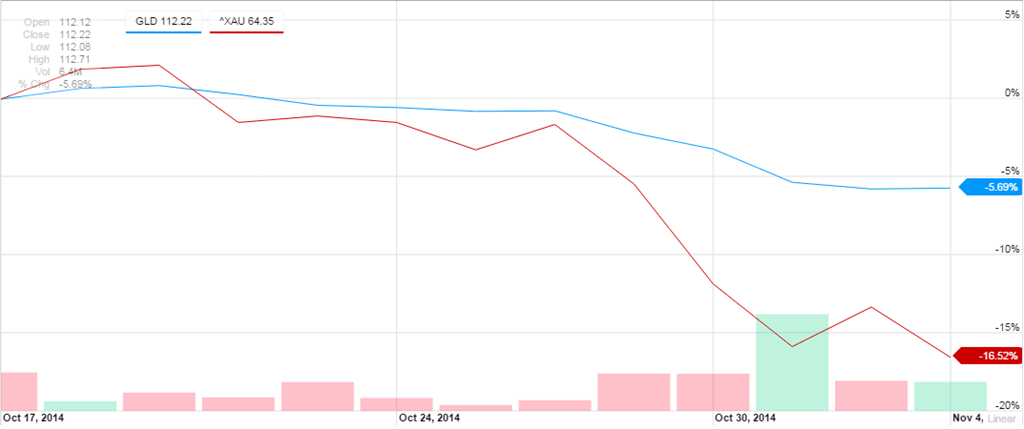
This past week, gold as represented by the SPDR Gold Shares ETF (GLD) declined –0.59%.  Gold stocks as represented by the Philadelphia Gold and Silver Stock index (XAU) declined by –1.38%.  Both GLD and the XAU are plotted below:

image

There is an interesting development in the Gold Stock Indicator (GSI) as applied to Barron’s Gold Mining Index (BGMI).  As seen in the charts below, the Barron’s Gold Mining Index is on the leading edge of what might be a new trend.

Transaction Alert

On March 3, 2014, we carried out the following transaction(s):

Insurance Watch List: February 28, 2014

Anyone who wishes to be successful in insurance stocks should read the book The Davis Dynasty by John Rothchild (found here). The book starts with Shelby Collum Davis investing approximately $50,000 to $100,000 that ultimately grew to $900 million after 47 years. The strategies employed by Davis seem highly accessible to average investors.  The following is a key insight from the book:

U.S. Dividend Watch List: February 28, 2014

Watch List Performance Review

In our ongoing review of the NLO Dividend Watch List, we have taken the top five stocks on our list from March 1, 2013 and have checked their performance one year later. The top five companies on that list can be seen in the table below.

Symbol Name 2013 Price 2014 Price % change
DBD Diebold 28.09 37.39 33.1%
JW-A John Wiley & Sons CL 'A' 36.24 58.03 60.1%
LKFN Lakeland Financial Corp. 24.71 38.00 53.8%
MSFT Microsoft Corporation 27.95 38.31 37.1%
WEYS Weyco Group 23.54 26.38 12.1%
      Average 39.2%
         
DJI Dow Jones Industrial 14,578.50 16,321.71 12.0%
SPX S&P 500 1,569.19 1,859.45 18.5%

Our top five companies outperformed the blue chip index by a wide margin.  Diebold (DBD) surprised us because while the stock swung to a loss, it continued to march higher in price.  Although we hate to point to any single catalyst, this one is worth noting.  An article in BloombergBusinessweek highlighted a potential driver for the stock being due to the looming software upgrade to ATM systems.

Continue reading

Gold Stock Indicator: February 28, 2014

In the past week, gold increased marginally while the Philadelphia Gold and Silver Stock Index (XAU) declined –3.23%.  Our Gold Stock Indicator had the following performance:

Transaction Alert

On February 26, 2014, we carried out the following transaction(s):

Nasdaq 100 Watch List: February 21, 2014

Performance Review

Below is the performance of the twelve stocks from the February 22, 2013 Nasdaq 100 watch list (found here) compared to the performance of the Nasdaq 100 Index gain of +33.80%.

symbol
Name 2013 2014 % change
GRMN Garmin Ltd. $35.00 51.97 48.49%
VOD Vodafone Group $25.01 39 55.94%
NUAN Nuance Communications $18.66 15.07 -19.24%
AAPL Apple Inc. $450.81 525.25 16.51%
BIDU Baidu, Inc. $89.18 172.66 93.61%
TEVA Teva Pharmaceutical $38.08 48.45 27.23%
MSFT Microsoft Corporation $27.76 37.98 36.82%
BBBY Bed Bath & Beyond Inc. $57.60 64.99 12.83%
LMCA Liberty Media Corporation $107.14 135.87 26.82%
INTC Intel Corporation $20.42 24.42 19.59%
WFM Whole Foods Market, Inc. $85.83 52.76 -38.53%
ALXN Alexion Pharmaceuticals, Inc. $87.44 181.52 107.59%
Average 32.30%

Below is the performance of the top five stocks on the watch list from last year.  The average gain was +39.06%.

image

Garmin (GRMN) was the stock of interest to us at the time.  We had the expectation that GRMN would decline to the $30 level, however, it never happened.  GRMN has consistently increased in value and recently achieved a new high.  Given the considerable increase in GRMN in the last year, selling the principal should be considered at this point.

The purpose of our work is to demonstrate that high quality stocks that appear down and out are worthy of consideration.

February 21, 2014 Nasdaq 100 Watch List

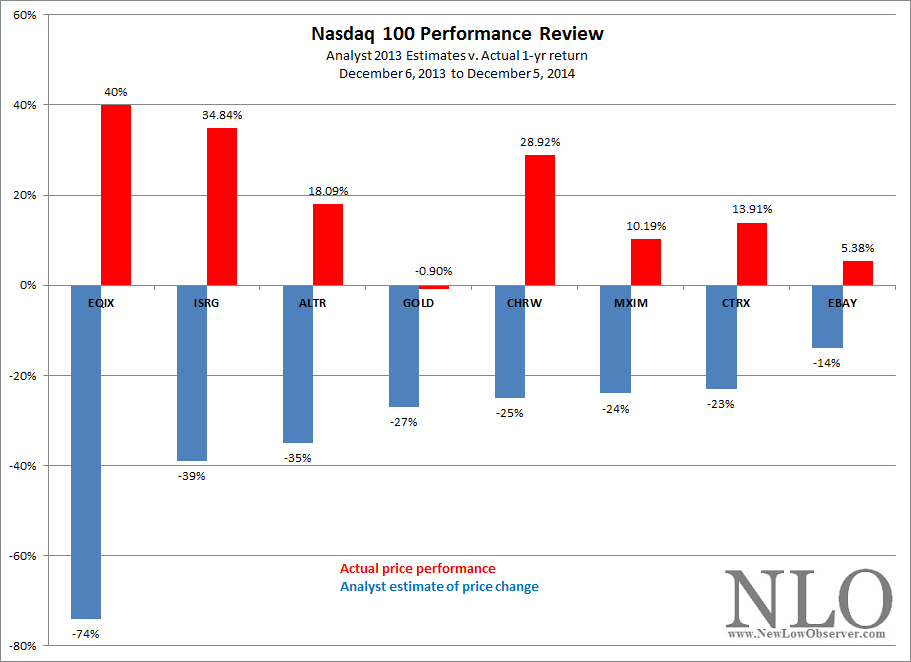
Below are the six Nasdaq 100 companies that are on our radar with the analyst estimates of downside risk for the coming year.

Continue reading

Gold Stock Indicator: February 21, 2014

On February 21, 2014, gold as represented by GLD has gained little ground in the last 5 days.  During the same time, the Philadelphia Gold and Silver Stock Index (XAU) has gained approximately +0.5%.

It’s All About the Dividends

A reader pointed out the high quality charts that are found at MarcoTrends.net.  One chart that is of interest is the inflation adjusted value of the Dow Jones Industrial Average from 1921-1948, 1948-1982 and 1982-present (found here).

image

We’re always curious about the display of charts that more accurately reflect the performance of the stock market.  After all, when discussing the merits of investing, people should know the real and nominal rates of return that are most realistic and probable for planning purposes.  What stands out about these three different periods is the magnitude of increase and decline over a given stock market cycle.

In the period from 1921 to 1948, the extent of the stock market increase, when adjusted for inflation, was approximately +469% before the long decline to the 1932 or 1942 low. In the period from 1948 to 1982, the inflation adjusted market only increased +320% and covered a period of nearly 33 years.  Finally, in the period from 1982 to January 2014, the stock market has risen nearly +731% covering a period of 31 years.

However, while the inflation-adjusted value of the Dow Jones Industrial Average reflects information that investors seldom see, it pales in comparison to what most professionals never get a glimpse of.  We’re talking about the Dow Jones Industrial Average adjusted for inflation including reinvestment of dividends along with the growth rate of dividends. Below are the same three periods with the adjustment for inflation and reinvestment of dividends plus the growth rate of the dividends.

image

All three periods include the adjustment for inflation and dividends (and dividend growth).  This concept of adjusting the Dow Jones Industrial Average for inflation and dividends was covered in a March 2, 2012 Wall Street Journal article titled “Dow 1,339,410: The Latest Milestone (found here)”.  At the time, the author of the  article quoted Meir Statman, a Santa Clara University professor, on his work on the topic of adjusting DJIA for inflation, dividends and taxes.  A more detailed review of this topic was outlined in the Winter 2000 Journal of Portfolio Management article by Meir Statman and Roger Clarke titled “The DJIA Crossed 652,230 in 1998 (PDF found here)”.

The conclusion about investing in stocks should be clear, dividends matter.  Unfortunately, the impact of dividends is not automatically reflected in any stock charts that we’ve had access to.  This results in a profound misunderstanding of the benefits of dividends, making it easy to ignore the impact.  All of the stocks found in our U.S. and Canadian Dividend Watch Lists (found here) attempt to draw investor attention to what matters most, dividends for the purposes of compounding.

Source:

  • Value Line Investment Survey. “A Long Term Perspective: 1920-2005”. 2006.
  • Meir Statman and Roger Clarke. "“The DJIA Crossed 652,230 in 1998”. Journal of Portfolio Management. Winter 2000.

Canadian Dividend Watch List: February 14, 2014

Below is the 1-year performance of the ten Canadian dividend stocks from our February 15, 2013 watch list (found here).

Symbol
Name 2013 2014 % change
JE.TO Just Energy 7.56 8.30 9.79%
FTS.TO Fortis, Inc. 33.04 30.71 -7.05%
CUF-UN.TO Cominar REIT 22.91 18.45 -19.47%
FFH.TO Fairfax Financial 376.98 434 15.13%
AX-UN.TO Artis REIT 15.84 15.53 -1.96%
CPG.TO Crescent Point Energy Corp 38.19 38.93 1.94%
IMO.TO Imperial Oil Ltd 42.39 47.71 12.55%
REI-UN.TO Riocan REIT 27.45 26.23 -4.44%
EMA.TO Emera, Inc. 34.95 32.65 -6.58%
CTC-A.TO Canadian Tire Corp 68.26 98.05 43.64%
Average 4.35%

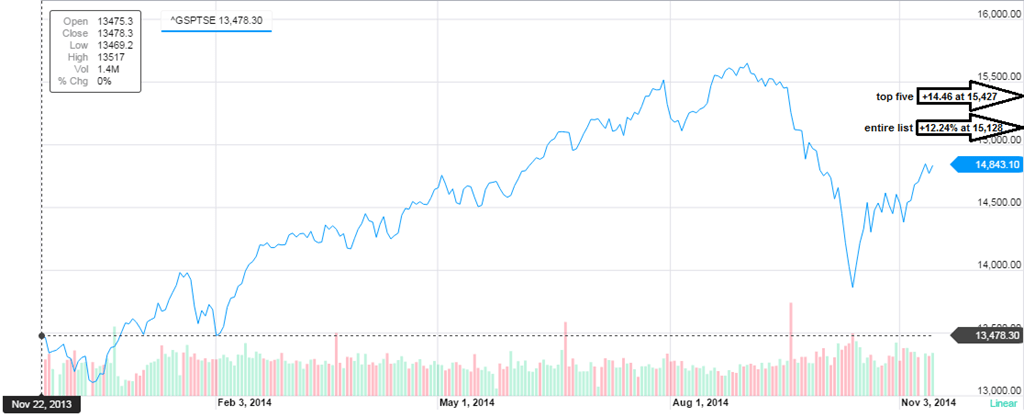
The entire list from last year gained +4.35% while the Toronto Stock Exchange gained +9.72%.  Among the top five stocks, the average gain was only +0.71%.  The stocks that interested us the most last year were Just Energy and Canadian Tire.  Regarding Just Energy we said the following:

“There appears to be tremendous technical support at the $6.00 level going all the way back to 2003.  If you’re interested in this stock, consideration of purchases of Just Energy should be entered into in three phases, once at $6.60, $6.00 and $4.00.  Naturally,  breaking below $6.00 on the downside suggests that the floor’s the limit.”

Just Energy’s support level of $6.00 seems to have held.  The stock has recently risen as high as $8.55 and finished the year with a gain of +9.79%.

On the other hand, our commentary regarding Canadian Tire Corp. was well short of the mark. Although Canadian Tire was of interest to us we said the following:

“While we’re interested in this company overall, the fact that it is within 10% of the new low is a bit misleading.  The stock has been trading in a range of $66 to $72 from December 2011 to the present.  According to Dow Theory, the price activity that has been exhibited by Canadian Tire is either accumulation or distribution of large shareholders.  The breaking above or below the ‘line’ is what will determine what has been taking place in the stock for the last year or so.  Our guess is that CTC-A.TO is in a distribution phase and should not be bought despite the current level in the stock.”

The mistake that was made with CTC-A.TO was that we didn’t adhere to Dow Theory’s rule of “Lines” which indicates that the trend must be broken before an inference about direction can be made.  Once CTC-A.TO broke above $72 the stock rose as high as $100 and currently sits with a gain of +43% since our February 2013 Watch List.

Continue reading

Is the Fed Responsible for the Stock Market Rise Since 2009?

The phrase “this time is different” is often associated with a misunderstanding of the past and an unwillingness to accept time tested facts. Most often this phrase is uttered at stock market tops as an indication that basic rules of economics no longer apply. Unfortunately, there is a back door reference to “this time being different” when market analysts, of the bearish perspective, make claims that this “exceptional” market run is being fueled by the Federal Reserve Bank.

The thought is that, with all the printing of money and “quantitative easing”, the only reason that the market could possibly rise as much as it has (only +123% from the March 9, 2009 low) is because of the Federal Reserve. In this piece, we’re going to show that Fed or not, the market, after a large decline of -40% or more, retracing +50% to +100% of the prior losses is typical market behavior.

To best demonstrate our point, we’re going to start by examining the stock market at a time when there wasn’t a central bank in the U.S. from 1836 to 1914.  After all, if there wasn’t a central bank to “control” the economy then the stock market should have acted in a “certain” fashion.

The Second Bank of the United States charter ended January 1836 and was not allowed to be renewed.  However, it is important to point out that the index of leading railroad stocks had already peaked in 1835 at the level of 42 and was already in an established downtrend.  By 1842, the railroad stock index had declined to 11, or a loss of -73%.  From the low at 11 in 1842, the railroad index increased to 37 by the end of 1852, this was an increase of +236% and a recovery of +83% in the prior decline.

image

From the peak of rail stocks in late 1852 at the 37 level, a decline to the 13 level by mid-1857 resulted in a loss of -64%. However, the subsequent rise from the 1857 low at 13 was followed by the rail index peaking at the 50 level by 1864, a gain of +284%.

The subsequent decline from the 50 level in 1864 to as low as 21 incurred a loss of -58% by 1877. The following rise, from 21 in 1877 to the level of 62 in 1881 was an increase of over +195%.

image After the 1881 peak in the ten leading stocks at the 62 level, the stock average promptly dropped to the 45 level in 1885, a loss of over -27%. However, the rise in stocks from the bottom in 1884 took the index to 127 in 1902, or an increase of +182%.

image

The peak of 1902 at 127 was quickly followed by a decline of the leading rail stocks to 90 by 1903, a decline of -29%.  From the 1903 low of 90, the index of rail stocks peaked in 1906 at 137 for a gain of +52%.  After the peak in 1906, the index declined -37% to the low in 1907.  From the low in 1907, the index climbed to the 130 level in 1909 for a gain of +52%.  After the 1909 peak, the index declined -46% to the 69 level in 1921.  As we all know, the subsequent peak in 1929 was at the 189 level for a gain of +169%.

The most important concept that should be taken away from all this data is that a central bank did not exist from 1836-1914. There was no way to ascribe the gains of the market to the Federal Reserve. All iterations of a central bank with the First Bank of the United States (1791-1811) and the Second Bank of the United States (1816-1836) did not have any effect on the data sets that we have provided from the period of 1836 to 1914. In order for the claim that the current market run is based on the monetary policies of the Federal Reserve, we’d need to be able to demonstrate that the stock market would have behaved differently without the existence of a Federal Reserve.

Unfortunately, those that claim “this time is different”, as in the Fed is manipulating the market higher, aren’t trying hard enough to prove their claim false. A cursory review of market data during the periods from 1836 to 1914 makes it clear that declines of nearly -40% or more are likely to retrace +66% to +100%, if not more. This pattern has been easily demonstrated in the periods after January 1914 when the current Federal Reserve system started operations. However, we’ve taken our claim about market declines and have extended it to periods when there wasn’t a central bank to show that the Federal Reserve’s role as the leading cause of the current +121% retracement of the prior decline (2007-2009) is false.

Finally, if the Dow Jones Industrial Average were to increase at the average of the gains indicated above (+236%, +284%, +195%, +182%, +52%, +52, +169%), the index would increase to 17,500 level (+167%).

Note: The above piece is an updated article that was originally posted in 2011 with the data and charts to support our latest revision (original article found here).  The difference between this posting and the one done in 2011 is that all the data is drawn from a single and separate source.  This distinction is significant since it reflects that multiple sources demonstrate similar information about how the stock market performed even when a Central Bank didn’t exist.

See Also:

Source:

  • Arthur H. Cole and Edwin Frickey. “The Course of Stock Prices, 1825-66”. The Review of Economics and Statistics. Vol. 10, No. 3, August 1928. page 117-139.
  • data and article retrieval from JSTOR. www.jstor.org

U.S. Dividend Watch List: February 14, 2014

Watch List Performance Review

In our ongoing review of the NLO Dividend Watch List, we have taken the top five stocks on our list from February 15, 2013 and have checked their performance one year later. The top five companies on that list can be seen in the table below.

Symbol Name 2013 Price 2014 Price % change
WEYS Weyco Group 23.03 25.66 11.4%
FDO Family Dollar Stores 55.94 63.43 13.4%
ED Consolidated Edison 56.58 55.16 -2.5%
SO Southern Company 44.11 42.52 -3.6%
LKFN Lakeland Financial Corp. 24.96 37.40 49.8%
      Average 13.7%
     
DJI Dow Jones Industrial 14,054.50 16,154.39 14.9%
SPX S&P 500 1,514.68 1,838.63 21.4%

NLO_2.14.2014

Last year we highlighted the fact that Weyco (WEYS) and Family Dollar (FDO) could be worth considering and expected the companies to raise their dividend.  Although share price performance didn’t keep up with the market, the stock did relatively well excluding dividend.  Weyco increased their dividend by nearly +6% from $0.17 to $0.18 per quarter.  Family Dollar, with an extremely low payout ratio, increased their payout by +23.8%.

Continue reading

Bitcoin: Downside Targets Met

On December 18, 2013 (found here), we gave an assessment of the downside risk for Bitcoin in the following commentary:

“With the conservative downside target being achieved, the extreme downside target of $412.65 and the worst case level of $152.83 are all that remains.”

On February 8, 2014 (found here), we reiterated downside targets for Bitcoin:

“In many previous examples of Edson Gould’s Speed Resistance Lines, once at the extreme downside target of $412.65, the price usually reverses to the upside.  However, failure to do so (reverse at or above the extreme downside target) would mean that Bitcoin could reach $385 before reversing to the upside.  If the $385 level fails on the downside then $200 is assured.”

As we speak, Bitcoin sits at the $246 level. 

image

The data that we’re using to plot the price is from Mt. Gox (found here).  However, Mt. Gox has put withdrawals on hold until security issues are resolve.  Because Mt. Gox put withdrawals on hold they likely avoided illegal activities like the most recent hack afflicting Silk Road 2 as reported by Techcrunch.com

While there are other Bitcoin exchanges offering higher bid and ask prices, they cannot avoid the reality of the problems that currently plague the Bitcoin market.  Leaving aside the possible arbitrage opportunity, Mt. Gox offers up the most extreme and negative price data and appears to be protecting their constituents.  These are necessary attributes that make the data being offered by Mt. Gox most realistic and applicable to our attempt at analysis.

In the final review, either the other Bitcoin exchanges will drop to the quoted Mt. Gox level or Mt. Gox quotes will rise appreciably.  Regardless, at the current level of $300-$200, Bitcoin is fairly valued.

Anyone venturing into the world of Bitcoin for the purposes of speculation should assume that all funds put forth will be lost.

Gold Stock Indicator: February 14, 2014

Gold (as represented by GLD) is on a relative tear of late.   In the last week, gold has increased +3.41%.  On the other side of the gold play, gold stocks (as represented by the Philadelphia Gold and Silver Stock Index [XAU]) gained +9.10%.

image 

Continue reading

Transaction Alert

On February 13, 2014 we made the following transaction(s):

Continue reading