

-
Topics
Archives
-
-
Recent Posts
-
-
-
-
Category Archives: dividends
Review: Conagra Brands
Posted in CAG, dividends, dividends canceled, LYB, PMI, Price Momentum
Tagged members
Dividend Cuts
On February 22, 2024, we saw the following posting that reminded us of the information that dividends convey:
U.S. Dividend Watch List: July 22, 2022
The market bounced back this week rising 1.7% pushing the S&P 500 closer to 4,000 mark. Since our bullish call on June 14, the S&P 500 is up 5.7%. Our focus remain on quality companies with strong balance sheet and our watch list below is a great place to start that research. Below is the watch list for the week. Continue reading
Posted in Dividend Achiever Watch List, Dividend Achievers, Dividend Watch List, dividends
Tagged members
Dividend Yield vs Dividend Growth
There are healthy debates on dividend yield versus dividend growth. Investors seeking income will automatically gravitate toward dividend yield by default. While that intuition is good, we should pay attention to other aspects such as growth rate of the payment. In our quick study, we attempt to compare companies with similar business model and strong dividend history. There is not better comparison in our mind that Coke (KO) and Pepsi (PEP). We extracted 5 years data (2016-2021) dividend and price data for both companies from Yahoo Finance. The conclusion speaks for itself, we should pay more attention to dividend growth as a key indicator for capital appreciation.

Coke has higher dividend yield that Pepsi in 2016 and 2021. If an investor was to choose an income producing asset in 2016, they would gravitate toward Coke with 3.22% yield while Pepsi yield of 2.86%.

Now we look dividend payment growth rate. Pepsi raised their payment by 43% while Coke increased their payment by 20%.

Finally we review what happened to the stock price. We took the average price of both stocks for 2016 and 2021. The performance is clear that Pepsi outperformed Coke by a wide margin. This finding is consistent with the teaching of Geraldine Weiss in Dividends Don’t Lie that dividend is a proxy for profit growth.
Posted in Dividend Achievers, dividends
Dividend Capture Strategy Analysis
Income investors seeking dividend may purchase and hold shares based on dividend yield. There is a strategy our team is curious about, one which involves buying shares just to capture the dividend using the shortest possible holding period.
It turns out, that the strategy is called the Dividend Capture Strategy. In short, this strategy is to purchase a dividend paying stock one day prior to the ex-dividend date and selling it on the ex-dividend date.
Critics of this strategy argue that stock prices often drop in accordance with the dividend amount that is paid. While this makes sense, we haven’t seen enough data to support this claim. That is, our team developed a model that can test this theory at the individual level. Below is an example of the Dividend Capture Strategy applied to AT&T (T).
The assumption is that we would buy AT&T one day prior to the last ex-dividend date, July 9, 2020, to capture the $0.52 in dividend. Continue reading
Stock Market Dividend Yield: 1871-2020
This from Barron’s on the U.S. stock market dividend yield from 1871-1996:

The Dow Jones Industrial Average dividend yield profile from 1920-2020: Continue reading
Posted in dividends, high yield, Low Yield, relative yield, Yield Profile
AT&T Yield Profile
AT&T stock has fallen -11% in 2020 yet it has outperformed the S&P 500 Index by 5%. Perhaps the largest driver for that could be the dividend yield.
As of the closing price on Friday March 13, 2020, the dividend yield for AT&T sits at 6.64%.
This leads us to do some comparative assessment of the AT&T dividend since 1984 until now. Not only will we look at the absolute yield but we will compare this to the risk-free guaranteed rate from the 10-year treasury. Continue reading
DJIA Yield Profile: March 12, 2020
This bear market has taken everything in its path down. Unless you are shorting the market, there is nowhere to hide. Perhaps the most scary thing is that this downturn is probably far from over.
The rate of change for new cases for COVID-19 continue to rise and even accelerate. Until we see a deceleration in the total cases for the US, the market will continue to fall.
The first chart comes from worldometers.info which we believe has better data than WHO (data from WHO shows 0 new cases over the past weekend).

Despite the bad news, we are persistent in keeping our focus on long-term investment opportunities. If and when this is behind us, there will be tremendous opportunity to purchase blue-chip companies that will provide you with higher than average income. Take the Dow Jones Industrial as example.
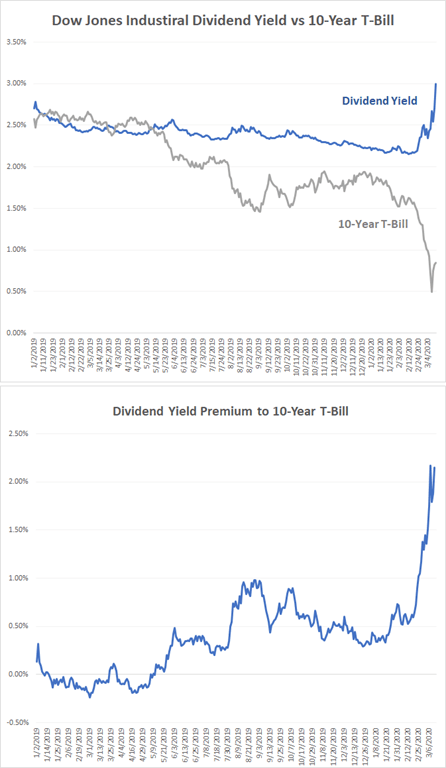
Based on the close of March 12, 2020, the dividend yield reached 3%. Contrast that with 10-year T-Bill which fell below 1%. The risk-premium on the Dow (based on yield) spike to 2%.
This is not an indication that a bottom is here or even near. However, from an investment perspective, investing $10,000 today in the Dow seems like a better bet than a bond that will mature in 2030.
This too shall pass and we can't wait until then. Please take care of yourself and those around you.
Posted in dividends, DJIA, Dow Industrials
Dow Altimeter Review
The Dow Altimeter, as constructed by Edson Gould, is based on dividend payments made by the constituents of the Dow Jones Industrial Average (DJIA) as reported in the Barron’s section titled “Indexes PEs and Yields.” The Dow Altimeter information provides a graphical representation of fundamental data.
On January 23, 2018, we said the following:
“While the market appears destine for higher ground, it is worth noting that the 24,223 level is the new support level for the DJIA. If the DJIA fails the support level at 24,223 then the next stop is the 18,373 level.”
Below we have updated the Dow Altimeter and included the coincidence of buy indications based on the dividend history of the Dow. We believe this history of dividend payments provides strong evidence of when a bear market has come to an end along with a fair estimate of when a recession should come to an end.
A recession and a bear market is coming. We don’t know when, however, we can prepare ourselves with the necessary insight to better call the bottom (better than our July 2009 call for the stock market, our August 2009 call for the end to the recession and our December 2010 call for the bottom in real estate.
National Dairy Products: 1927-1937
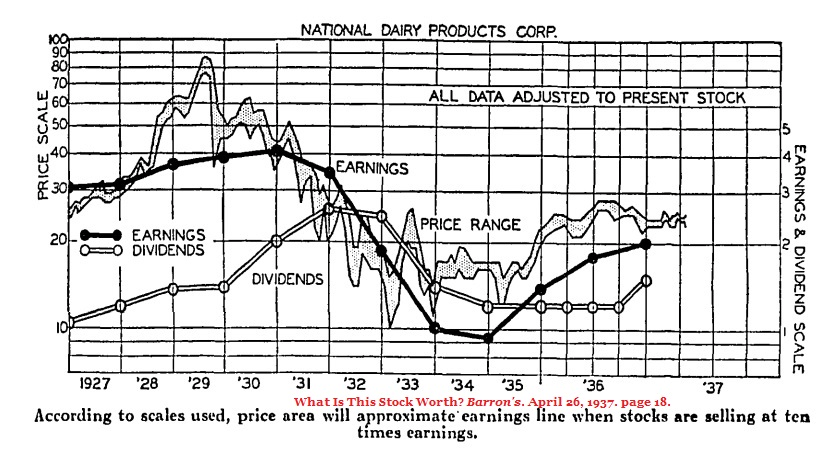
The chart below highlights two issues:
1) How long did it take for a stock to get to breakeven?
In the case of National Dairy Products, the stock did not get to breakeven by the 1937 peak. National Dairy declined approximately -90% in price from 1929 to 1933. From late 1933, National Dairy rose as much as +180% to the 1936 peak.
2) What happened to the dividend during the stock market crash and "Great" Depression?
In spite of the market decline from the 1929 peak, National Dairy’s earnings continued higher by the end of 1930. Once earnings started to slide in 1931, the pace of dividends continued to move higher. In 1932, it became apparent to management that the dividend policy had to be reduced. The pace of the decline in dividends tracked closely the decline in earnings. However, when earnings started to increase, the dividend was not pushed higher until two years after the trend reversed in earnings.
The change in dividend policy is a great example of management’s expectation of future prospects. However, when a policy of cutting the dividend started, in 1932, most dividend investors were probably becoming fearful of the prospects going forward and reacted by selling their stock. In reality, 1932-1933 was the time to start accumulating shares of the stock.
Posted in dividends, National Dairy Products
Borden: 1927-1937
The chart below highlights two issues:
1) How long did it take for a stock to get to breakeven?
In the case of Borden, the stock did not recover to the 1929 peak of $92 by the end of 1937. In fact, by 1954, Borden got as high as $74. Borden was later acquired in a KKR deal struck in September 1994. Buyers of Borden in 1934 did very well, however, recovery was only achieved in due time through the virtue of total return.
2) What happened to the dividend during the stock market crash and "Great" Depression?
The dividend was increased or maintained in 1929, 1930, and 1931. However, in the year of the stock market bottom, Borden pursued a dividend cutting campaign. In 1932 the full year dividend was $2.27. By 1939, the dividend was $1.27. In this case, the dividend cut ended at $1.27 which preceded the final decline in earnings. Earnings finally ascended in 1935. By 1954, the full year dividend was $2.64 This increase in earnings was later reflected in the growth of the dividend.

It’s All About the Dividends
A reader pointed out the high quality charts that are found at MarcoTrends.net. One chart that is of interest is the inflation adjusted value of the Dow Jones Industrial Average from 1921-1948, 1948-1982 and 1982-present (found here).
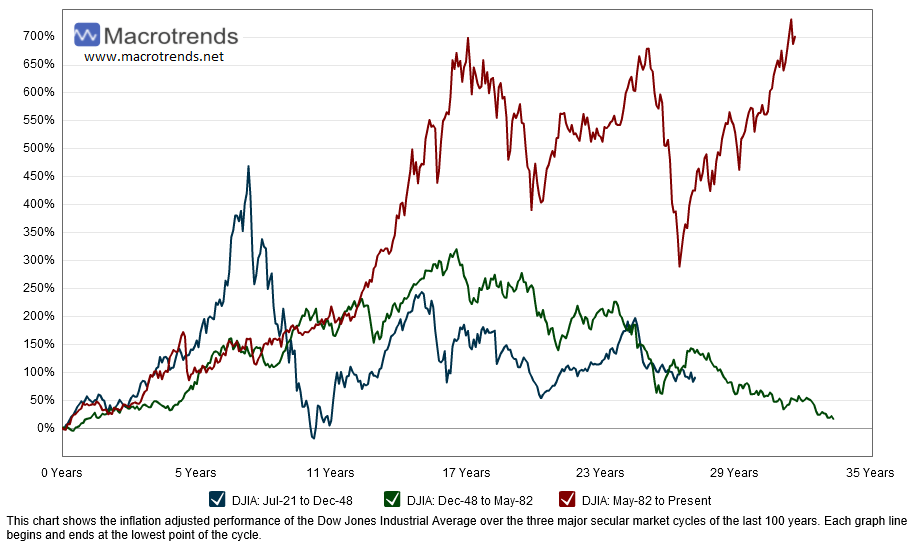
We’re always curious about the display of charts that more accurately reflect the performance of the stock market. After all, when discussing the merits of investing, people should know the real and nominal rates of return that are most realistic and probable for planning purposes. What stands out about these three different periods is the magnitude of increase and decline over a given stock market cycle.
In the period from 1921 to 1948, the extent of the stock market increase, when adjusted for inflation, was approximately +469% before the long decline to the 1932 or 1942 low. In the period from 1948 to 1982, the inflation adjusted market only increased +320% and covered a period of nearly 33 years. Finally, in the period from 1982 to January 2014, the stock market has risen nearly +731% covering a period of 31 years.
However, while the inflation-adjusted value of the Dow Jones Industrial Average reflects information that investors seldom see, it pales in comparison to what most professionals never get a glimpse of. We’re talking about the Dow Jones Industrial Average adjusted for inflation including reinvestment of dividends along with the growth rate of dividends. Below are the same three periods with the adjustment for inflation and reinvestment of dividends plus the growth rate of the dividends.
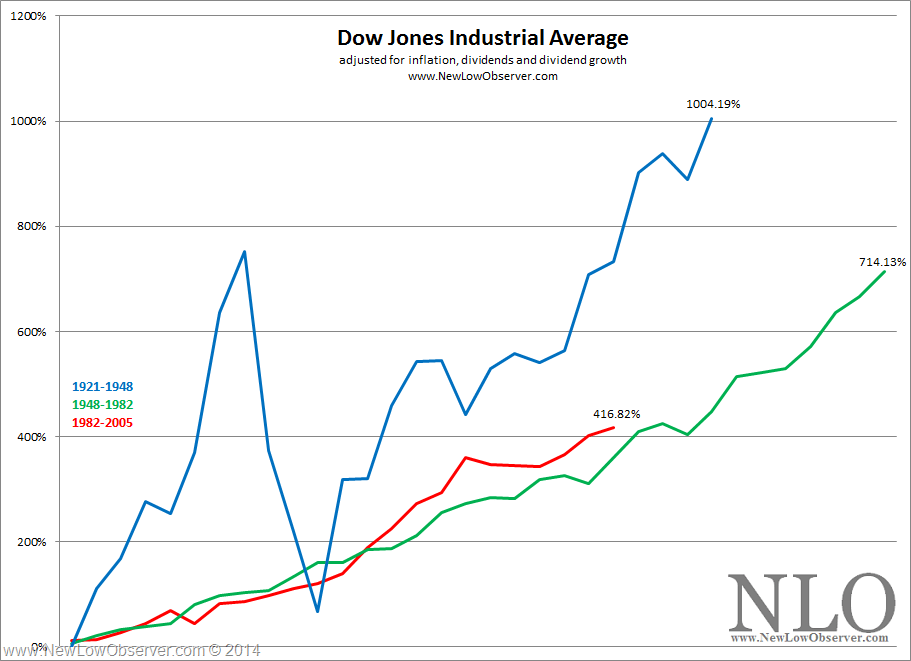
All three periods include the adjustment for inflation and dividends (and dividend growth). This concept of adjusting the Dow Jones Industrial Average for inflation and dividends was covered in a March 2, 2012 Wall Street Journal article titled “Dow 1,339,410: The Latest Milestone (found here)”. At the time, the author of the article quoted Meir Statman, a Santa Clara University professor, on his work on the topic of adjusting DJIA for inflation, dividends and taxes. A more detailed review of this topic was outlined in the Winter 2000 Journal of Portfolio Management article by Meir Statman and Roger Clarke titled “The DJIA Crossed 652,230 in 1998 (PDF found here)”.
The conclusion about investing in stocks should be clear, dividends matter. Unfortunately, the impact of dividends is not automatically reflected in any stock charts that we’ve had access to. This results in a profound misunderstanding of the benefits of dividends, making it easy to ignore the impact. All of the stocks found in our U.S. and Canadian Dividend Watch Lists (found here) attempt to draw investor attention to what matters most, dividends for the purposes of compounding.
Source:
-
Value Line Investment Survey. “A Long Term Perspective: 1920-2005”. 2006.
-
Meir Statman and Roger Clarke. "“The DJIA Crossed 652,230 in 1998”. Journal of Portfolio Management. Winter 2000.
Transaction Alert
On February 11, 2014, we carried out the following transaction(s):
Dividend Watch List: July 5, 2013
Below are the 12 companies on our U.S. Dividend Watch List that are within 11% of their respective 52-week lows. Stocks that appear on our watch lists are not recommendations to buy. Instead, they are the starting point for doing your research and determining the best company to buy. Ideally, a stock that is purchased from this list is done after a considerable decline in the price and rigorous due diligence.