Quick Take: W.R. Berkley

“If options aren’t a form of compensation, what are they?  If compensation isn’t an expense, what is it? And if expenses shouldn’t go into the calculation of earnings, where in the world should they go?” –Warren Buffett

source: Loomis, Carol J. Tap Dancing to Work. Portfolio/Penguin, New York. 2012. page 112. link found here.

Quick Take: Tootsie Roll

"Our holdings, which I always believe to be on the conservative side compared to general portfolios, tend to be more conservative as the general market level rises. At all times, I attempt to have a portion of our portfolio in securities at least partially insulated from the behavior of the market and this portion should increase as the market rises."  -Warren Buffett

Buffett Partnership, Ltd. July 22, 1961. page 1.

Quick Take: Family Dollar

“If my job was to pick a group of 10 stocks in the Dow Jones that would outperform the average itself, I would probably not start by trying to pick the 10 best. Instead, I would try to pick the 10 or 15 worst performers and take them out of the sample, and work with the residual.” -Warren Buffett

Source:

  • "Track Record Is Everything" by Warren Buffett, Across the Board, October 1991. The Conference Board.
  • Krass, Peter. The Book of Investment Wisdom. John Wiley & Sons. 1999. page 3. (found here)

U.S. Dividend Watch List: March 28, 2014

Watch List Performance Review

In our ongoing review of the NLO Dividend Watch List, we have taken the top five stocks on our list from March 29, 2013 and have checked the performance one year later. The top five companies on that list can be seen in the table below.

Symbol Name 2013 Price 2014 Price % change
CATO Cato Corp. 24.14 26.72 10.7%
EXPD Expeditors International 35.73 39.21 9.7%
SBSI Southside Bancshares 21.01 30.59 45.6%
FDS FactSet Research Systems 92.60 106.18 14.7%
MYE Myers Industries 13.96 19.73 41.3%
      Average 24.4%
         
DJI Dow Jones Industrial 14,572.90 16,323.06 12.0%
SPX S&P 500 1,562.17 1,857.62 18.9%

Our top five did amazingly well and outperformed the market by a good margin.  We made remarks in regards to Cato (CATO) and Expeditors (EXPD) both of which slightly underperformed the market at year end.  However, within the year, Cato gained as much as +40% while Expeditors gained as much as +30%, as seen in the chart below.

3-28-2014

An interesting observation should be noted about the price performance and earning per share growth.  It appeared that in some cases, earning per share growth or contraction has little correlation to the change in the stock price.  The table below highlights the matter.

Symbol Name 2013 EPS 2014 EPS % change
CATO Cato Corp. 2.18 1.86 -14.7%
EXPD Expeditors International 1.57 1.68 7.0%
SBSI Southside Bancshares 2.00 2.30 15.0%
FDS FactSet Research Systems 4.22 4.75 12.6%
MYE Myers Industries 0.88 0.76 -13.6%

U.S Dividend Watch List: March 28, 2014

Below are the 32 companies that are in our watch list this week.

Continue reading

March 28, 2014: Gold Stock Indicator

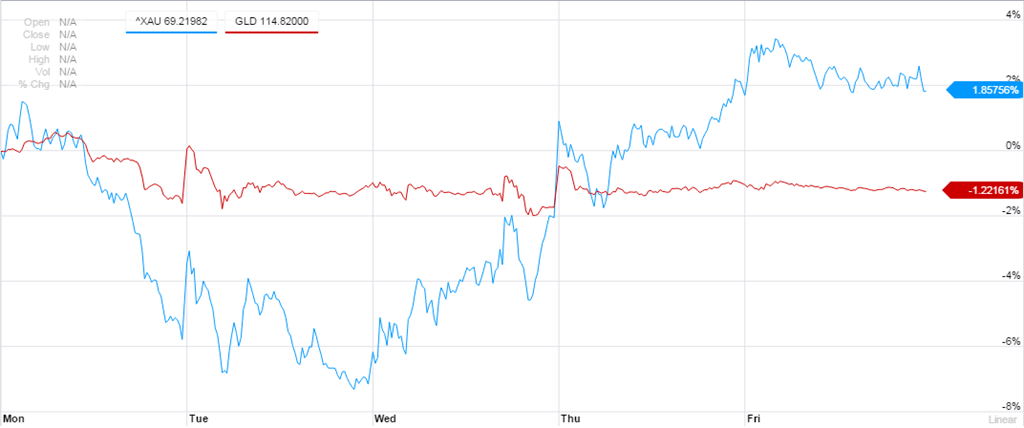
This is the second week in a row of declining gold and gold stocks.  The past week saw gold decline –1.86% while gold stocks fell –4.11%.

image

Continue reading

Reconsidering “Sell In May”

Below is the one year performance of our March Dividend Watch Lists for 2010, 2011, 2012 and 2013.  While the Wall Street adage says “Sell in May and Go Away,” we’d like to know what the market would look like if an investor bought our “Top Five” stocks before May and held for the following year.

First up is the March 26, 2010 watch list (found here).  The chart is organized based on the stocks nearest the new low on the left.  For the year, our Top Five stocks (XOM, FPL, MON, TMP, BRO) gained an average of +20.86% as compared to the Dow Jones Industrial Average gains of +12.63%.  In this example, the Top Five stocks provided above average gains.  Within the context of the gains that were made one year later, the Dow Jones Industrial Average experienced a decline of –14.60% from the April 2010 high to the July 2010 low.  As a note, FPL bought PGN and trades under a new symbol NEE.

image

Next up is the 2011 watch list (found here).  For the year, our Top Five stocks (SJW, SYY, WABC, PPL, TGT) gained an average of +8% as compared to the Dow Jones Industrial Average gains of +7.04%. In this example, the Top Five stocks provided moderate gains. Within the context of the gains that were made one year later, the Dow Jones Industrial Average experienced a decline of –19.19% from the May 2011 high to the October 2011 low. As a note, HGIC and TRH were both acquired.

image

The Dividend Watch list below is from March 23, 2012 (found here).  For the year, our Top Five stocks (TR, CHRW, CLX, ATO, CWT) gained an average of +18.32% as compared to the Dow Jones Industrial Average gains of +10.94%. In this example, the Top Five stocks provided exceptional gains. Within the context of the gains that were made one year later, the Dow Jones Industrial Average experienced a decline of –10.70% from the May 2012 high to the June 2012 low.  Additionally, the Dow Jones Industrial Average declined –8.71% from October 2012 to mid-November 2012.

image

The next Watch List is from March 22, 2013 (found here).  The Top Five stocks (CATO, FDS, CTWS, EXPD, BCR) gained an average of +20.78% which was below the +23.12% gained by the entire list.  During the same period of time, the Dow Jones Industrial Average gained +12.53%.

image 

Even with the view of “Sell in May and Go Away,” the Top Five stocks on our U.S. Dividend Watch List have performed quite well.  The average gain over the four periods reviewed was +16.99% compared to average gain of the Dow Industrials at +10.78%.

All good things must come to an end.  We do not expect that the stock market will be as forgiving in the next four years as it has in the last four years.  However, we recommend considering our Top Five stocks from the latest dividend watch list for potential short and long-term investment opportunities, even if the mantra is “Sell in May.”

Gold Stock Indicator: March 21, 2014

The gold and gold stock market appears to be deflating to more “respectable” levels.  Gold as represented by the ETF GLD declined –3.20% while the Philadelphia Gold and Silver Stock Index (XAU) declined –6.65%.

image

The expected decline has finally arrived.  Hopefully, the Gold Stock indicator can declined all the way to the June 2013 low.  At which point there should be additional accumulation of gold stocks.  Gold stocks are already at what we consider to be significant values compared to the historical “norm” and relative to the general equity market.  Any additional declines to prior lows is welcomed.

Continue reading

Review: Symantec (SYMC)

On February 22, 2014, we posted our Nasdaq 100 Watch List with the following commentary on Symantec (found here):

Symantec (SYMC) tops our watch list again.  SYMC was last recommended back on April 27, 2012.  In our June 10, 2012 posting, we said the following:

“‘In the case of Symantec and Electronic Arts, they have come full circle after a 2-year period. This cycle is not unusual for most of the stocks that we track. Even when the stock does not approach the prior low of a watch list, many stocks attain a 52-week low after 2 to 2.5 years (as in the NVDA example above). Be on the lookout for stocks that have similar cycles like EA, SYMC and NVDA since their ability to replicated such moves adds to the prospect that they could pull a repeat performance.

image

As can be seen in the chart above, the two year cycle that was observed appears to be asserting itself on SYMC.  We don’t see why the stock couldn’t decline a bit further until April or May.  As is usually the case, losses were incurred initially.  Also, our call to sell the principal was early.  However, the +46% gain that was achieved from April 27, 2012 to May 13, 2013 has been secured.”

Continue reading

Transaction Alert

On March 18th & March 20th, we carried out the following transaction(s):

Continue reading

Gold Stock Q&A: March 17, 2014

A reader asks:

“(Barrick Gold Corp) ABX has seen considerable gains since the time of your last two purchases. Have you considered taking profits at this time?”

Our response:

Transaction Alert

On March 14, 2014, we carried out the following transaction(s):

Continue reading

Canadian Dividend Watch List: March 14, 2014

Below is the 1-year performance of the Canadian dividend stocks from our March 2013 watch list (found here).

Name 2013 2014 % change
Just Energy 7 8.68 24.00%
Cominar REIT 22.45 18.21 -18.89%
Riocan REIT 27.16 26.48 -2.50%
Fortis 33.54 31.48 -6.14%
National Bank of Canada 38.14 43.6 14.32%
Artis REIT 16.06 15.67 -2.43%
TransAlta 15.02 12.68 -15.58%
Emera 34.8 33.5 -3.74%
Imperial Oil 43.27 51.07 18.03%
Laurentian Bank of Canada 44.58 45.73 2.58%
Average 0.96%

The performance of the stocks from last year was significantly below that of the Toronto Stock Exchange Composite index gain of +10.89%.  The entire list of stocks gained +0.96% and the top five stocks gained only +2.16%.  As previously noted, REITs were expected to underperform.

There were two stocks of interest to us last year, Just Energy and Cominar.  Of Just Energy, we said:

“Just Energy (JE.TO) has given up -7.40% since our February watch list.  This is almost half of the 16.40% dividend yield that was presented last month.  As we’ve said in our May 4, 2011 article titled “Price Decline Equals Dividend Canceled,”  a dividend can be taken away as quickly as it was issued simply based on the price of the stock declining.  As the stock of JE.TO continues to decline, we eagerly await whether or not the stock find price support at the $6.00 level.”

No sooner said than done in the case of Just Energy. Not only are dividend gains erased by the declines in the stock price, Just Energy cut the dividend by more than 30% starting in April 2013.  We have never been impressed with high dividend yields, the performance of Just Energy is a prime example.  Aside from the dividend concerns, Just Energy fell in line with our analysis.  Just Energy declined as low as $5.89 and subsequently increased as high as $9.09, a gain of +51% if purchased at the $6.00 level.

image

Regarding Cominar REIT we said:

“Cominar (CUF-UN.TO) is marginally changed since our January 2013 profile of the company.  Our analysis based on the stock remains the same as we said then, ‘the consistency of Cominar’s dividend history, given the economic environment, is a reflection of a responsible management team at the helm. Cominar should be considered at or below $18.25. Acceptance of downside risk to the $10.59 price should be built in for long-term investors.’”

Cominar has fallen in line  with our initial assessment, so for.  At the time, the stock was trading at $22.45 and we projected downside risk of -18.70% to $18.25.  On November 8, 2013, Cominar closed at $18.22 for the first time since November 2009.  Since November 2013, Cominar has traded in a tight range giving investors the opportunity to reassess the prospects for the company going forward (a requirement regardless of meeting prior expectations).

image

Canadian Dividend Watch List: March 14, 2014

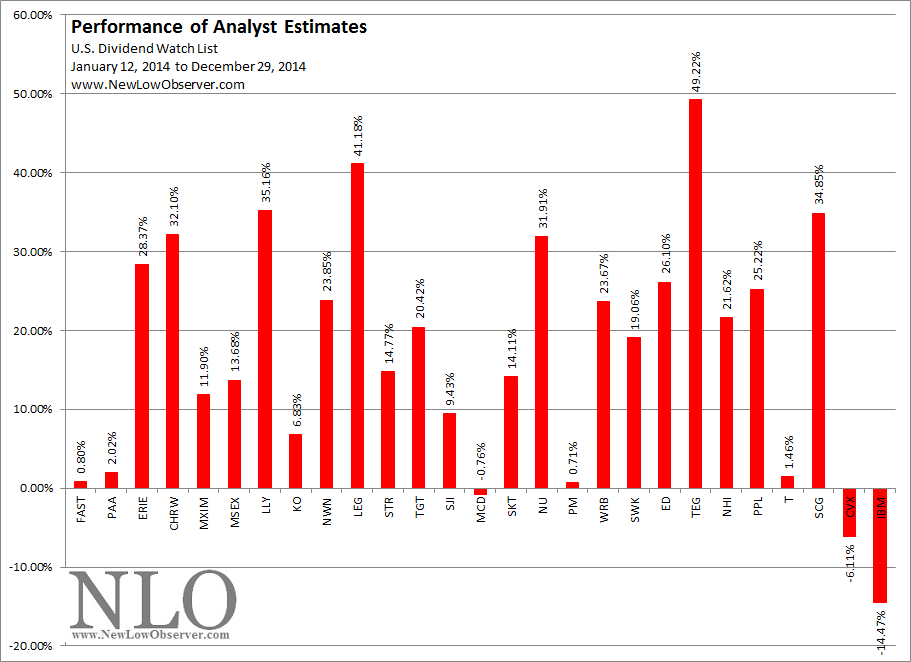
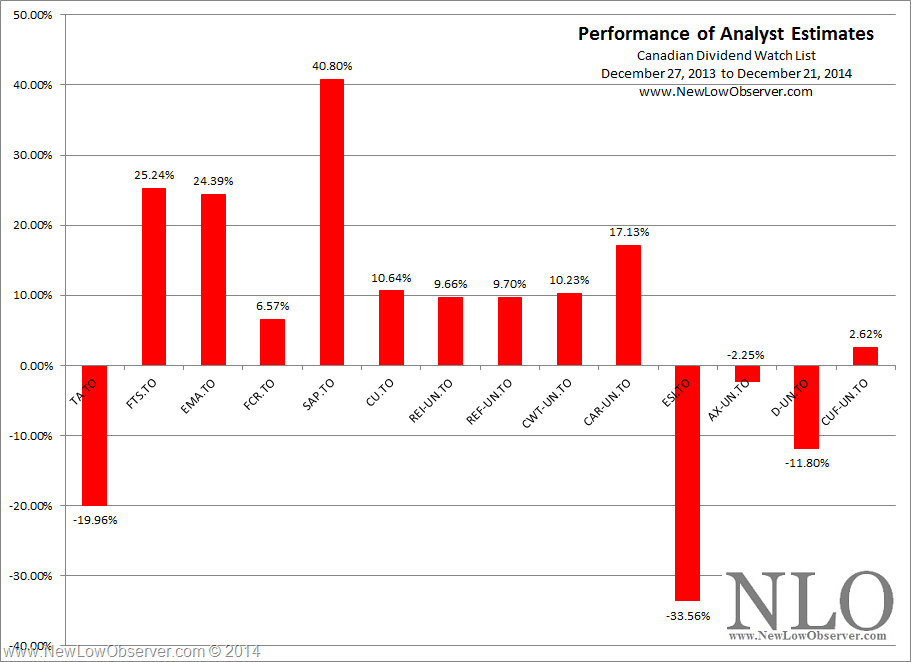
Below are the twelve Canadian stocks to be on the lookout for.  Additionally, we have included the analyst estimates of expected returns for the remainder of 2014.

U.S. Dividend Watch List: March 14, 2014

Watch List Performance Review

In our ongoing review of the NLO Dividend Watch List, we have taken the top five stocks on our list from March 15, 2013 and have checked the performance one year later. The top five companies on that list can be seen in the table below.

Symbol Name 2013 Price 2014 Price % change
CATO Cato Corp. 25.68 29.95 16.6%
DBD Diebold 28.83 38.91 35.0%
MSFT Microsoft Corporation 28.04 37.70 34.5%
NWN Northwest Natural Gas 43.85 43.18 -1.5%
SBSI Southside Bancshares 21.15 30.68 45.1%
      Average 25.9%
         
DJI Dow Jones Industrial 14,514.10 16,065.67 10.7%
SPX S&P 500 1,560.70 1,841.13 18.0%

Our five companies that topped our list last year had an amazing run, outperforming the market by nearly +7%.  Our assessment was that Diebold (DBD) was a bargain with the following commentary:

"Diebold (DBD) has been on our list on consistent basis for several weeks if not months.  The company’s main business comes from manufacturing and servicing ATM machine for regional banks.  Our valuation model suggests a buy at $33 and ‘bargain’ of $25.  Currently, the stock is trading just $3 above the ‘bargain’ level thus we are considering the possibly of adding this name as part of our portfolio."

Microsoft (MSFT) was noted with the following thoughts last year:

"The company [Microsoft] needs little introduction and some of you may know the reason why the stock is trading relatively weak compared to the Dow up +5% versus +10.75% YTD, respectively.  The new tablet, Surface, sales came in much lower than expected and the adoption rate isn’t very promising.  All that aside, the technical pattern is very bullish.  The stock has broken out of its range pattern (red box) and has established a higher-high/higher-low indicated by the green line.  The dividend yield of 3.28% and payout ratio of 51% should provide sufficient margin of safety."

Both stocks were considered to provide sufficient margin of safety to any long-term investor.  Not to be outdone has been our longstanding warnings that utilities like Northwestern Natural Gas (NWN) would not perform well in a low interest rate environment.  On this topic, we've had the following pointed thoughts:

"Those seeking yield have pushed many of the utilities companies, with some exception, below their historical low dividend yields.  Many utility companies, utilize the debt market (issuing bond) to operate their business.  The low interest rate cycle we are in has made many companies profitable via issuing low yielding bonds.  While such a cycle could remain for some time, it will not last forever.  Any long-term investor should beware of how higher interest rates will affect utility company (May 24, 2013)."

"The top two through four spots are utility companies, Northwest Natural Gas (NWN), Consolidated Edison (ED), and New Jersey Resources (NJR).  All of them yield more than 3.5% and two (NWN & ED) have yields north of 4%.  While that yield is attractive, utilities typically will reach much higher yield at the bottom of utility cycle (November 9, 2012)."

We hope that regular readers of our work have seen the same warnings regarding REITs and other interest rate sensitive sectors of the market.  With this in mind, it was of little surprise that Northwestern Natural Gas (NWN) would perform poorly in the last year.

U.S. Dividend Watch List: March 14, 2014

Our complete watch list contains more than 40 companies thus we will focus on the 17 companies below:

Continue reading

Nasdaq 100 Watch List: March 14, 2014

March 19, 2013 Performance Review

Below is the performance of the nine stocks from our March 19, 2013 Nasdaq 100 watch list (found here) compared to the performance of the Nasdaq 100 Index gain of +29.63% over the last year.

Symbol Name 2013 2014 % change
GRMN Garmin Ltd. 34.23 52.19 52.47%
BIDU Baidu, Inc. 84.81 160.59 89.35%
NUAN Nuance Communications, Inc. 18.51 15.95 -13.83%
ISRG Intuitive Surgical, Inc. 481.76 423.07 -12.18%
WFM Whole Foods Market, Inc. 43.07 53.93 25.21%
MSFT Microsoft Corporation 28.08 37.7 34.26%
ROST Ross Stores Inc. 55.81 72.67 30.21%
AAPL Apple Inc. 458.91 524.69 14.33%
LMCA Liberty Media Corporation 111.5 135.25 21.30%
Average +26.79%

Below is the performance of the top five stocks on the watch list from last year. The average gain was +28.20%.

image

Garmin (GRMN) was a stock of interest to us last year.  While we liked GRMN, we suggested that the stock had downside risk of –22%.  In retrospect, potentially losing –25% was a decent risk/reward proposition.  Last month we recommended that the principal be sold in GRMN in order to secure investment gains.  For now, the stock has declined marginally.

We highlighted Intuitive Surgical (ISRG) with a concern that the stock had price gains without the necessary rising trading volume.  We said the following:

“As with our observation on Apple’s (AAPL) contracting volume as the price rose, ISRG has experienced the same phenomenon (found here). In addition, as ISRG has declined recently, the amount of average volume has increased dramatically. This suggests that there may be support for the idea that this stock could fall much lower from the current levels.”

Dow Theory indicated that downside risk was to $426 and $342 levels.  Although ISRG easily achieved the $426 downside target the $342 target was missed by 2.5%. As seen in the performance chart above, ISRG declined as much as –26% within the last year and currently lingers with a –12% loss.

The last stock that we mentioned was Whole Foods Market (WFM).  We said the following of WFM:

“Finally, Whole Foods (WFM) is on our watch list for the first time since the July 23, 2009 Dow Theory bull market initiation of the New Low Observer.  In the run up to the 2005 peak and December 2008 bottom, Whole Foods had had increasing volume all the way.  However, as the stock price rose from the 2008 low, Whole Foods has had a continued decline in trading volume.  More recently though, the decline from the October 5, 2012 top has resulted in higher average volume indicating that those wishing to get out are doing it in “droves.”  Dow Theory suggests that the following downside targets are $70.25, $54.44 and $38.64.  Whole Foods falling to the $70.25 level could mean that the situation is dire, from a price standpoint.”

Since our commentary on Whole Foods, the stock has only increased in value.  In fact, March 19, 2013 marked a lull in the stock price before rising nearly +52%.

image

The performance of Whole Foods Market was in stark contrast to our analysis at the time.  This reiterates the importance of considering stocks on our watch list as a decent starting point for investment opportunities.

March 14, 2014 Nasdaq 100 Watch List

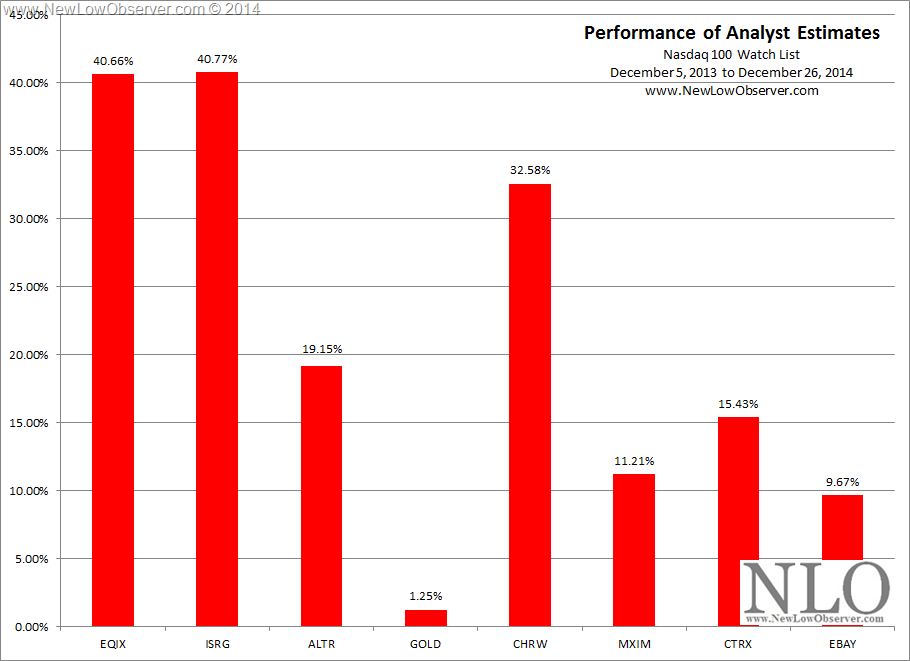
Below are the eight Nasdaq 100 stocks that are of interest to us.

Gold Stock Indicator: March 14, 2014

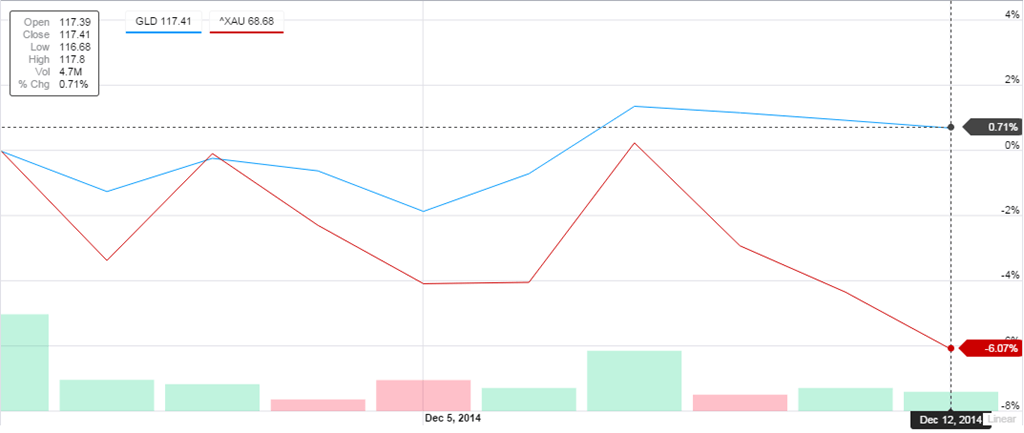
A brutal week for gold investors as the metal represented by the gold EFT has gained nearly +3% while the gold stock index (XAU) has gained nearly +5.50%.  These aren’t normal moves to the upside and we try to take these advances in stride.

image

The Gold Stock Indicator has prepared us well in advance of the current move as indicated in the chart below.