Canadian Dividend Watch List: August 15, 2014

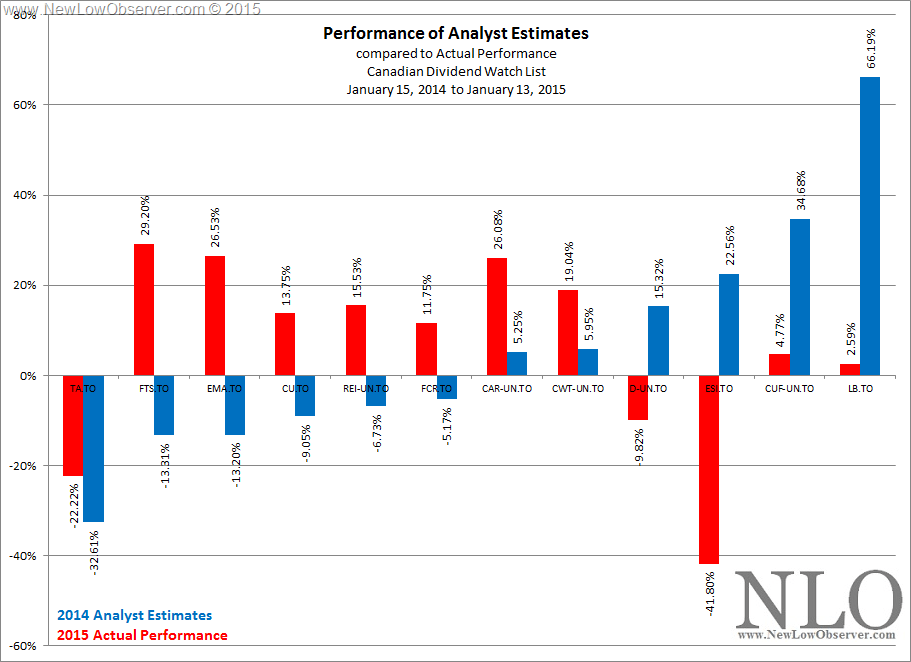
Below is the list of Canadian stocks that are currently on our radar along with the projected price appreciation:

Continue reading

Dow Theory: August 14, 2014

In our last Dow Theory posting on May 18, 2014, we revealed an issue with Dow Theory that had gone unaddressed since S.A. Nelson’s book The ABC of Stock Speculation coined the term “Dow’s Theory.” We believe the acknowledgment of this issue adds clarity to the writings of Charles H. Dow and may produce new insights that have not previously been explored.

Continue reading

U.S. Dividend Watch List: August 8, 2014

There’s an old saying, "Markets climb a wall of worry".

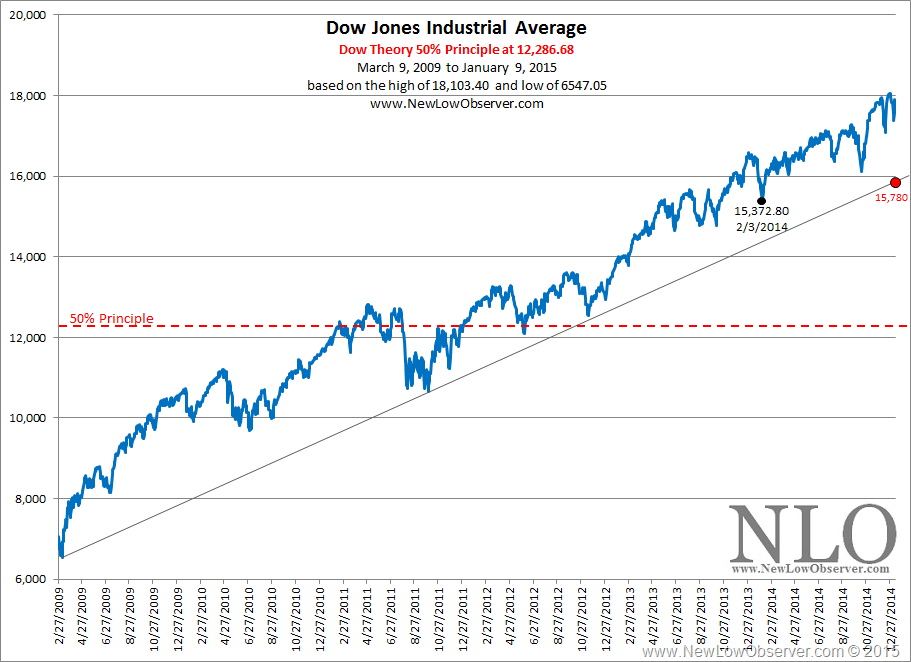
This week's market performance proved just that. Despite an order for air strikes on Iraq, the market managed a gain of +0.3%. For the market to continue higher, we believe that the Dow Jones Industrial Average would need to rise above 17,138 in conjunction with the Dow Jones Transport exceeding 8,468.

We're at an interesting juncture in the market. The recent highs were achieved with relatively weak market breadth. When the market reached its high one year ago (summer of 2013), we saw less than 10 companies that appeared on our dividend watch list. Currently, our list has more than ten times as many companies.

There are 104 companies on our watch list this week. We highly recommend everyone to take a more bearish view of the market at the current time while keeping a keen eye on the companies below.

Continue reading

Berkshire Hathaway Meets NLO Target

On May 6, 2012, we proposed that Berkshire Hathaway (BRK-A) was trading at a price that was well below its true value.  At the time, BRK-A was trading at $164,990 per share.  However, we proposed that Berkshire Hathaway should have been selling at much higher prices with upside targets of $175k, $197k and $219k in a 2-3 year timeframe.  As BRK-A sits within 1% of our mid-range target of $197,190 after two years, we believe it is time to reassess where Berkshire Hathaway sits within the context of Edson Gould’s Altimeter.

Chip Sector Cycle Says Sell

On December 6, 2012, we said the following of our Nasdaq 100 Watch List:

“We’ve highlighted the chip sector stocks to put emphasis on the fact that, as an industry group, the sector may be at or near a low.”

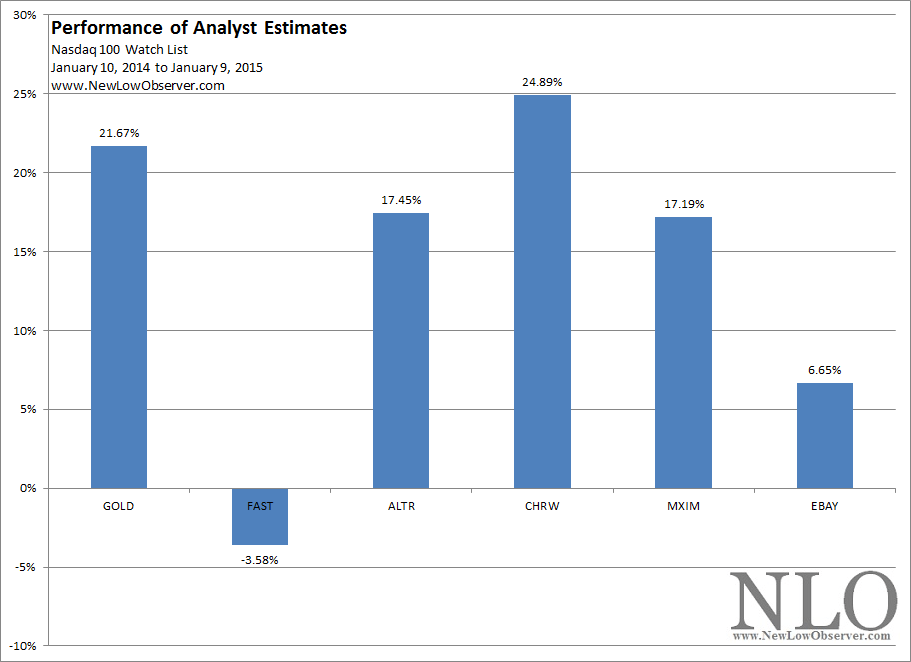
After a year and a half, the chip sector stocks have achieved all that we had anticipated when we wrote about them in late December 2012.  As seen in the chart below, all of the stocks except Altera (ALTR) achieved gains that beat the Nasdaq Composite growth of +46.22% in the same period.

image

The chip sector does run on a cycle and it is our belief that while this may not be the top it is time to sell the principal in those stocks that have had a decent run.  The profit portion should be allowed to compound until new relative lows are achieved. 

We’ve been fortunate to successfully identify two chip sector cycles lows on March 20, 2010 and December 6, 2012.  As we have in the past, we will notify subscribers of investment opportunities at the next cycle low.  Investors may want to consider rotating into sectors that we’ve identified as worth accumulating using the proceeds from the sell of chip sector stocks.

Gold Stock Indicator: August 8, 2014

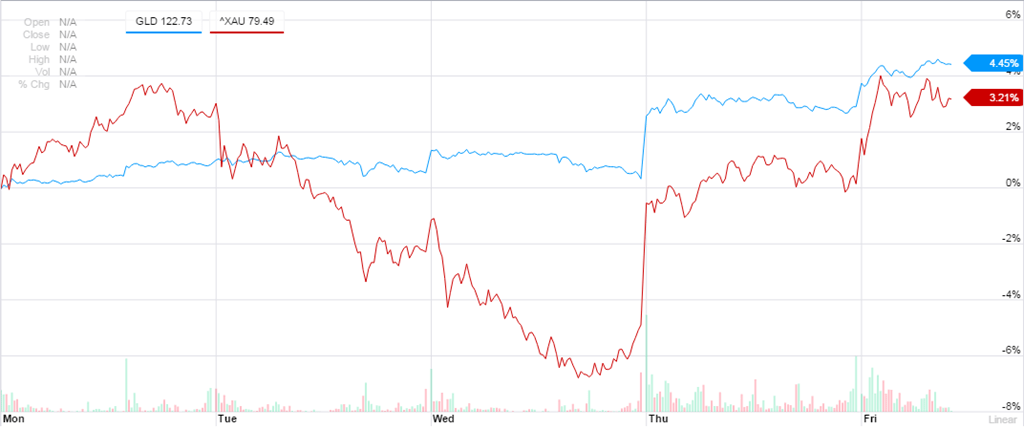
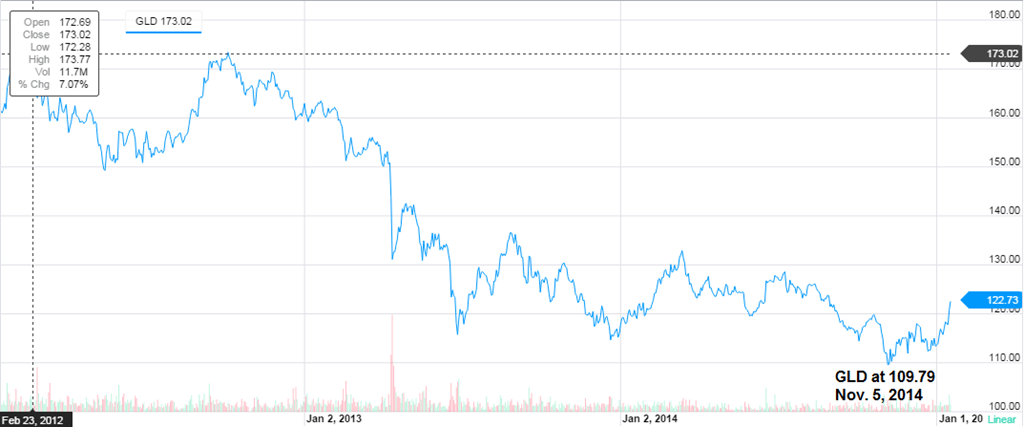
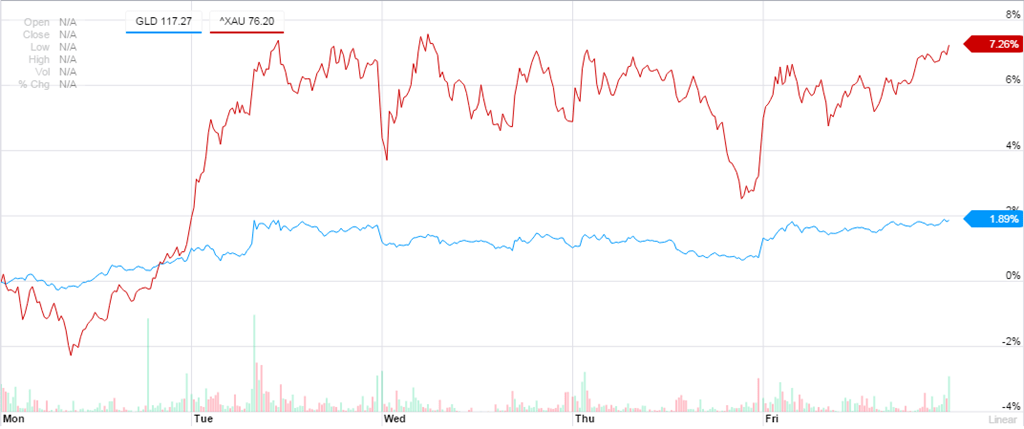
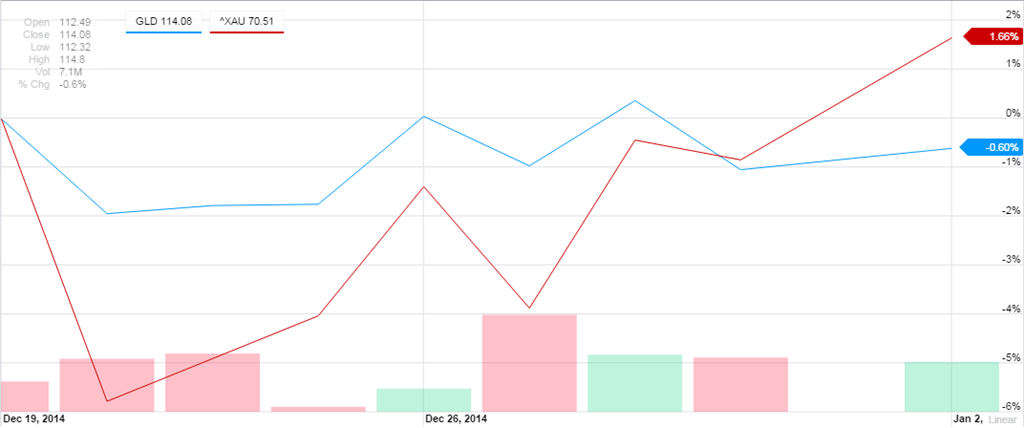
Gold and precious metal stocks continue their long road to nowhere with a minor increase of +1.32% in the SPDR Gold Share (GLD) during the last week.

image

Priceline.com Overpays for Ctrip.com

It was recently announced that Priceline.com (PCLN) would take a stake in Ctrip.com (CTRP) (found here).  However, we believe that PCLN is vastly overpaying for Ctrip.com as we recommended consideration of CTRP when the stock was trading at $23.10.  At the time, we suggested that Ctrip.com would decline to $14.16 level in our December 16, 2011 Nasdaq 100 Watch List with the following commentary (found here):

Ctrip.com International (CTRP) is on a pace to replicate the performance from the high in April 2008 to the low of January 2009 which equaled a loss of 72%. A similar decline in CTRP from the high of $50.57 would bring the price down to $14.16.Suffice to say, the stock “only” needs to decline another $8.94 or 38% from the current price of 23.10.This seems very easy considering the high volatility of Chinese stocks.We believe that unless CTRP is summarily dismissed from the Nasdaq 100 index, there may yet be life in this company.”

image

Ctrip.com achieved our downside target and is now trading nearly 3x the 14.16 level.  True to form, a company has stepped up to nibble at Ctrip.com just when, in our opinion, the stock is overpriced.  Obviously this is a boon for investors of Ctrip, however, this isn’t such a good deal for Priceline.com investors.  As can be seen in the chart below, Priceline has had ample opportunities in July 2013 and January-February 2014 to acquire two and three times the current amount (based on the relative price change of Priceline and Ctrip).

image

Dow’s Theory on when to consider a stock would have done Priceline.com shareholders a lot of good.  Now the shareholders of PCLN can only be expected to continue to pay up.

Insurance Watch List: August 6, 2014

“Many shall be restored that are now fallen and many shall fall that are in honor.”

Horace, Ars Poetica

Nu Skin Meets Our Downside Target

On January 16, 2014 at 8:40am EST, we said the following of Nu Skin Enterprises (NUS):

“If the stock closes below $79.28 then the price should vacillate at or below the rising conservative SRL in the medium-term.  If the stock manages to close above the $79.28 level then the upside target is $118.92.  Additionally, the extreme downside target of $46.83 is just on the horizon.  In theory, this stock should achieve the extreme downside level before hardened speculators will jump in.”

On August 6, 2014, NUS declined as low as $43.50 and closed at $46.52.  An updated Speed Resistance Line is included below:

image

NUS has met our January 2014 call for the extreme downside target of $46.83.  It is at this point that NUS becomes interesting to hardened speculators.  Based on Gould’s SRL, NUS has an upside targets of $82.73 and $118.92. 

Review: Family Dollar

Today it was announced that Dollar General (DG) is considering a bid for Family Dollar (FDO).  This recent indication only adds to the hype that has suddenly fallen upon FDO.  On March 31, 2014, we wrote a Quick Take on Family Dollar that had the following conclusion:

“Investors interested in FDO could break their investment into at least two purchases, the first being 60% of the intended amount now and the second purchase of 40% at either of the two indicated support levels at $44.95 or $34.83.”

It appears that our indication to consider FDO at the $57.88 range was appropriate as the stock never reverted to any of the suggested downside targets and now trades at $77.47 or +33% higher.  This is the second call in a row that FDO has delivered for us.  FDO appeared on our watch list of February 17, 2013 which prompted our research and subsequent purchase on March 5, 2013. There is significant room for fine tuning which we will eventually examine going forward with these recommendations.

image

Nasdaq 100 Watch List: August 1, 2014

Below is the performance of the six stocks from our August 9, 2013 Nasdaq 100 watch list (found here) compared to the Nasdaq 100 Index gain of +24.41% over the last year.

Symbol Name 2013 2014 % Change
BRCM Broadcom 26.06 38.19 +47%
CHRW Robinson Worldwide 56.79 67.7 +19%
EQIX Equinix 181.18 211.38 +17%
NUAN Nuance Comm. 19.11 17.83 -7%
SHLD Sears 41.35 37.27 -10%
ISRG Intuitive Surgical 391.87 453.17 +16%
average +14%
^NDX Nasdaq 100 Index +24.41%

The watch list underperformed the Nasdaq 100 by –10.41%.  However, the stock that we had a strong interest in, Broadcom (BRCM), garnered the following commentary:

“Broadcom (BRCM) tops our list this week and it is the stock that interests us the most, at the moment.  Right off the bat, we see that the stock has a price to book (P/B) ratio of 1.93.  Among the listed companies above, this is a compelling attribute.  Value Line Investment Survey says that the fair value for BRCM is 12 times cash flow.  Based on full year cash flow figures for 2012, BRCM is estimated to be fairly valued at $39.96 or +53% above to current price.

“Of concern with the data presented by Value Line is the fact that BRCM went from debt free in 2009 to nearly 15% of capital, as of the most recent reporting.  In one sense, corporate borrowing at low rates is a good thing.  However, we’re concerned that certain types of borrowing result in loss generating (is that possible) ventures that end up going nowhere.

“Broadcom has recently been slammed in the market based on reduced or declining guidance.  This from Investopedia.com:

‘A lot of what has worried Broadcom analysts and investors appeared to come home to roost with the company’s latest earnings report. Weak guidance has investors fearing that the company is losing more and more share to Qualcomm (QCOM), with an overall stagnation in high-end devices leading to fears that ASPs and margins are in danger. (Stephen D. Simpson. “Fear Dominating the Broadcom Story”. Investopedia. July 29, 2013. accessed August 10, 2013. link).’

“Dow Theory has the following downside targets:

  • $24.43
  • $20.61
  • $16.79
  • $12.97

“When we ran Edson Gould’s Speed Resistance Lines, we were only able to come up with an extreme downside target of $15.78.  It seems that the $24.43 target is highly achievable.”

On August 12, 2013 (one trading day later), our downside target of $24.43 was achieved on an intraday basis  as BRCM declined as low as $23.25.  After hitting our target low, BRCM trended higher to the tune of nearly +50% gains.

image

It should be noted that in the 2013 article cited above, investors and analysts were fearful due to anticipated lower profit margins.  Please note that the NLO team does not operate by the maxim “be fearful when others are greedy and greedy when others are fearful” as made famous by Warren Buffett.  Instead, we think in terms of the words of Dow Theorist William Peter Hamilton, the fourth editor of the Wall Street Journal, when he said the following:

The best way of reading the market is to read from the standpoint of values. The market is not like a balloon plunging hither and thither in the wind. As a whole, it represents a serious, well-considered effort on the part of farsighted and well-informed men to adjust prices to such values as exist or which are expected to exist in the not too remote future. The thought with great operators is not whether a price can be advanced, but whether the value of property which they propose to buy will lead investors and speculators six months hence to take stock at figures from ten to twenty points above present prices.

“In reading the market, therefore, the main point is to discover what a stock can be expected to be worth three months hence and then to see whether manipulators or investors are advancing the price of that stock toward those figures. It is often possible to read movements in the market very clearly in this way. To know values is to comprehend the meaning of movements in the market.

Source: Hamilton, William Peter. Stock Market Barometer. Page 38.

At the current price, Broadcom almost appears expensive when considered from where we thought investors should take an interest.  However, on August 1, 2014, widely followed market commentator and analyst Charles Payne came out with an article titled “Is It a Good Time to Buy Broadcom?”  According to Mr. Payne Broadcom is a compelling buy at the current price with an upside target of $47.  We believe that our work has adhered to the recognition of values as outlined by Charles Dow and reiterated by William Peter Hamilton.

We consider ourselves value investors.  This means buying stocks at intrinsically low valuations and never selling, regardless of market conditions.  In theory, individuals who sell stocks in periods from several days to 10 years are considered traders.  However, a different reality pervades our market experience.  Lacking a vast pool of resources, we can only operate with an eye for values and downside risk.  For those with a similar reality, we can only advise the best scenario that would ensure that the pool of investment resources is guarded against buyers remorse.  With this in mind and the nearly +50% gains in BRCM, we recommend selling only the principal while letting the profits compound into perpetuity.  This is our only remedy to dealing with our own personal fear of loss.  We hope this will prove useful to others.

Nasdaq 100 Watch List: August 1, 2014

Below are the Nasdaq 100 stocks that we’re following along with estimated price projections for the remainder of the reported fiscal year:

Gold Stock Indicator: July 31, 2014

Gold and gold stock continue to remain range-bound as indicated in the chart below.

image

Our Gold Stock Indicator appears to be registering an unprecedented pattern that has not occurred since the inception of the XAU Index.

U.S. Dividend Watch List: July 25, 2014

Top Five Watch List Performance Review

In our ongoing review of the NLO Dividend Watch List, we have taken the top five stocks on our list from July 26, 2013 and have checked the performance one year later. The top five companies on that list can be seen in the table below.

Symbol Name 2013 Price 2014 Price % change
CAT Caterpillar 82.06 104.85 27.8%
IBM IBM 197.35 194.40 -1.5%
PM Philip Morris International 88.88 84.85 -4.5%
SO Southern Company 45.34 44.74 -1.3%
T AT&T Inc 35.60 35.54 -0.2%
      Average 4.1%
         
DJI Dow Jones Industrial 15,555.61 16,960.57 9.0%
SPX S&P 500 1,690.25 1,978.34 17.0%

Out top five clearly have underperformed the market. We highlighted two companies on our list, Caterpillar (CAT) and IBM (IBM). Caterpillar did extremely well outperforming the market by 10% while IBM was flat year-over-year.

We stated the following about IBM last year:

Second on the list is another Dow 30 component, IBM (IBM).  One may want to note that IBM appears to be fairly priced according to Valueline which stated that this stock trades at roughly 9.5x its cash flow.  With 2013 expected cash flow of $20.35 per share, the stock fair value is $193.  Our valuation model has a fair value of $180 thus leaving virtually no margin of safety on the shares.

U.S. Dividend Watch List: July 25,2014

The market may be consolidating after reaching 1,990 mark. Our database of companies near the low continued to expand. At the beginning of June, we logged 30 companies on our list. That number has since exploded to 84 this week. If the market continue to make new high with many of the quality name lagging behing, it is a sign of trouble or that the speculative phase of the bull market has taken hold. Below are the companies on our watch list. Continue reading

Current Implication of Market Valuation

There's no denying that the current bull market has caught many professionals and individuals by surprise.  Many are pondering on the sideline as to when and if this bull market will ever end.

Our recent study of market return (Analysis of Long-Term Return from Equity Market) suggested that equity on average will provide a rate of return between 9% - 10%, but one should be caution of the year-to-year fluctuation.  Also, one should make a distinction between the return from the market and return to individual investor.  The ladder tend to be lower due to an error in market timing.  The biggest contributor that will determine your rate of return is the price you pay for any investment (mutual fund, ETF, real estate, or individual stock).  When we look at individual stock, there's a high correlation between them and the market.  That is, if the market appears to be overvalued and faces downward pressure, it would be difficult for an individual stock to break such trend.

This lead us to our next topic which is the current market valuation.  Where do we currently stand based on historical market valuation?  The data we've chosen to present is the data provided by Robert Shiller of Yale University (found here).  While his data set spans far beyond 1950, the inception of S&P 500, we will not be using them since we can't validate the accuracy of his conversion.

The two key elements of market valuation are price earning ratio (P/E) and dividend yield.  Let use inspect the first element, the P/E ratio.  The current market P/E is 19.  While one may say that the market is expensive, we need historical data to prove such claim.  Based on the data, the market will on average trade between P/E of 18 and 20 thus placing the current state at or near fair value.  The table below indicate frequencies in months that the market trade in specific P/E range.  At P/E of 20, the market is at 78th percentile which statistically imply that there is a 22% chance for the market to continue to advance beyond current level.

P/E Months Cumulative %
6 0 0%
8 52 7%
10 65 15%
12 78 25%
14 72 35%
16 79 45%
18 147 64%
20 110 78%
22 38 83%
24 32 87%
26 18 90%
28 18 92%
30 18 94%
32 10 96%
34 9 97%
36 3 97%
38 3 98%
More 19 100%

SP500-PE-1950_2014.jpg

Now let us look at dividend yield and its implication.  Current dividend yield is 1.9% which place the current valuation in the 80th percentile (dividend yield has inverse relationship on valuation, higher figure imply lower valuation and vice versa).  As such, there is less than 20% chance of market advancing beyond the current level.

Div Yield Months Cumulative %
1.0% 0 0.00%
1.5% 49 6.33%
2.0% 111 20.67%
2.5% 60 28.42%
3.0% 110 42.64%
3.5% 154 62.53%
4.0% 88 73.90%
4.5% 63 82.04%
5.0% 45 87.86%
5.5% 34 92.25%
6.0% 28 95.87%
6.5% 12 97.42%
7.0% 14 99.22%
>8% 6 100.00%

SP500-YIELD-1950_2014.jpg

To sum it all up, the market appears to be trading at or slightly above its fair value.  The market, however, does not simply trade up (or down) to the average then revert course in the opposite direction.  The fact that we have reached a valuation level not seen since the peak of 2007 hardly mean that the market can’t simply continue higher.  Our study simply suggests that the odd of that happening diminish with every single point increase in P/E ratio.  If we have to speculate, we would be incline to say that S&P 500 would reach 25 P/E before starting to taper off.  Even so, one need to understand the historical perspective and statistics of the market before putting their hard earn money to work at this level.

U.S. Dividend Watch List: July 11, 2014

Top Five Watch List Performance Review

In our ongoing review of the NLO Dividend Watch List, we have taken the top five stocks on our list from July 12, 2013 and have checked the performance one year later. The top five companies on that list can be seen in the table below.

Symbol Name 2013 Price 2014 Price % change
IBM IBM 192.07 188.00 -2.1%
CTWS Connecticut Water Service 29.26 32.72 11.8%
NWN Northwest Natural Gas 43.89 46.56 6.1%
SO Southern Company 44.99 44.53 -1.0%
BMO Bank of Montreal 60.52 74.34 22.8%
      Average 7.5%
         
DJI Dow Jones Industrial 15,464.30 16,943.81 9.6%
SPX S&P 500 1,680.19 1,967.57 17.1%

The top five under performed the market, particularly the S&P 500, by a wide margin. Three of the five companies are utility companies which we know is facing a strong headwind. Surprisingly Connecticut Water (CWT) managed to do relatively well. On the flip side, IBM (IBM) was the worse performer lossing 2%. However, we estimated the company's fair value to be at roughly $180. So for the stock to trade down from $192 to $188 didn't surprise us.

U.S. Dividend Watch List: July 11, 2014

The market gave up some ground this week as the S&P 500 lost 0.9%. The earning season kicked off this week so expect more volatility to come. In the mean time, we are seeing a large influx of companies onto out watch list. Our observation is that these stocks are trading in a narrow band within their 52-week range rather than drop down to a more appropriate discount level. The market is currently trading at a large premium at more than 19x so we this alone is a headwind for individual stock to move higher. While we are not suggesting that this bull market is coming to an end, we do feel that a digestion process is much needed for fundamental to catch up to the technical. Below are 31 companies on our watch list. Continue reading