Target: The Analysts and Risks

Contributor C.Cheng says:

“According to Morningstar, ‘increased competition from rivals such as Wal-Mart, Costco, and Amazon is an ongoing threat to Target's share of domestic retail sales.’ Furthermore, Target's expansion into Canada proved to be bumpier than predicted and they will probably not meet their projected targets. What are your concerns regarding these developments?

“Over the course of the past year, Target has reached its 52-week low and is currently hovering near it. Do you think this is a temporary development or an indication of a fundamental issue with the company? (found here)”

Our Response:

The primary concern seems to be how long Target can suffer from bad execution or will the company continue to spiral down.  The mention of Wal-Mart (WMT) reminds us of a previous review we did of the stock.  On June 8, 2009 (found here), we had the following to say of Wal-Mart:

“The price pattern [not increasing in value] on Wal-Mart reflects a concern by investors, starting in 2000, that the consumer economy was going to be in trouble. If the price goes above $70 or goes below $45 then we'll have some advanced warning about what may be around the corner for the U.S. and Chinese economy. Seems that this company is a leading or more reliable indicator (for the time being).

“In general, Wal-Mart's stock is not being recognized for the simple fact that the company can generate positive earnings. Although WMT's debt really bothers me, company management may be clever like a fox by amassing huge amounts of debt now to be paid off later with inflated dollars.”

Many investors were disappointed about the fact that for nearly 10 years, from 1999 to 2009, Wal-Mart’s stock price traded in a range from $40 to $65.  This is an example of the risk that a retailer like Target (TGT) might face, trading in a range for an extended period of time.

However, the premise of the 2009 Wal-Mart article was that if, over an extended period of time, the company can continue to maintain earnings, increase or retain margins, borrow prudently and decrease shares outstanding there is a good chance that value of the company will increase.  Not long after the 2009 Wal-Mart article, with the stock trading at $49.84, the shares of WMT broke out of the $65 resistance level and increased to the most recent high of $81.37, an increase of +63%.

Our purpose of tracking stocks that have a history of dividend increases, like Wal-Mart and Target, is to determine values and the competency of management.  The decision to increase dividends cannot be sustained over an extended period of time if management is incompetent, perpetuating fraud or willful negligence. When we acquire a stock like Target at depressed levels, we’re indicating that the problems faced by the company, although a current drag on the stock price, will be resolved in due time.  Keep in mind that downside risks should always be a consideration.

A secondary concern that is worth addressing is the source of analyst reviews and the quality of such reviews.  For example, Deutsche Bank Markets Research provided this analysis of an investment downgrade of Target on July 12, 2013, within 2 weeks of the top ($73.50) in the stock price on July 24, 2013.

image

Although DB was not in the position to offer a pure sell recommendation, a failing of most research shops, the downgrade with an upside target that was spot-on indicates the high quality of the research that was done.  We recommend you get a copy of this report to see what the risks were, according to DB, in advance of the subsequent decline that had ensued.

Contrast the Deutsche Bank downgrade on July 12, 2013 with the Piper Jaffray review on July 9, 2013 which gave Target the highest rating possible of Overweight, essentially a buy recommendation two weeks before the peak.

image

Piper Jaffray essentially gave a buy recommendation of the Target within 4% of the high.  Additionally, the stock was expected to increase to $80.  This is a report that is worth contrasting to the DB report.  We’d eliminate the points that are similar and focus on the differences as the defining piece to the quality of the analysis, in favor of DB.

A challenge with Morningstar reports is that they have a cookie cutter approach that is easy to identify the weaknesses.  Below is an excerpt from the Morningstar Report dated July 8, 2011 when Target was trading at what was later to be revealed the low in the stock price from the January 3, 2011 peak.

image

Just to highlight what was said by Morningstar, at the time:

“Increased competition from rivals such as Wal-Mart, Costco, and Amazon are ongoing threats to Target's share of domestic retail sales.”

It appears that Morningstar’s overall risk analysis does not change whether at a low in the price or at a high.  Because this was a general risk assessment we wouldn’t put much emphasis on this particular warning on the stock.  However, the most informative assessment of risk within a Morningstar report is usually the section titled “Bulls Say” and “Bears Say”.

Although normally a good summary of both sides of the matter, the case for and against Target, as made in the Morningstar report dated May 27, 2014 are essentially offsetting points as the “Bull Says” section indicates, “PFresh and REDcard should help to drive store traffic, delivering enough expense leverage to offset the negative impact on gross margins from those initiatives.” While the “Bear Says” section suggests, “Target's ROICs have declined since the PFresh initiative transitioned a larger portion of assets to lower-return food business.”  Usually, this section is better at outlining the risks and potential benefits of ownership of the stock.  For Target it wasn’t particularly enlightening.

Our own recommendation of Target on June 24, 2011 (found here), at the low, was as follows:

“Target (TGT) landed in the third spot after Fitch cut its debt rating.  They’ve taken the rating down from A to A- on claims that Target is aggressively buying back its own shares and remodeling stores in Canada.  We’ve said it before that shares of Target look attractive at a 2% yield but it’s even more attractive at a 2.59% yield.  This yield boost was because the company raised its dividend by 20%, from $0.25 to $0.30 per share.  Once again, IQTrend has estimated that Target is a good buy when it reaches a 1% yield.”

We believe that understanding the downside risks are vital to the success of any investment that is ever made.  Additionally, the quality and consistency of such assessments should line up a majority of the time.  In the particular case of Target, the risks are still out there, however, we believe that the history of the company’s management team ensures that the problems are being addressed which may include taking the losses by closing the Canadian stores and cutting or leaving the dividend unchanged.

U.S. Dividend Watch List: June 6, 2014

Top Five Watch List Performance Review

In our ongoing review of the NLO Dividend Watch List, we have taken the top five stocks on our list from June 7, 2013 and have checked the performance one year later. The top five companies on that list can be seen in the table below.

Symbol Name 2013 Price 2014 Price % change
CTWS Connecticut Water Service 28.36 32.52 14.7%
NWN Northwest Natural Gas 43.13 45.93 6.5%
SO Southern Company 44.44 43.89 -1.2%
ED Consolidated Edison 57.43 55.23 -3.8%
PPL PP&L Corporation 29.29 34.66 18.3%
      Average 6.9%
         
DJI Dow Jones Industrial 15,248.12 16,924.28 11.0%
SPX S&P 500 1,643.38 1,949.44 18.6%

All of the top five companies are utility companies and we kept pounding the table on the fact that they are likely to underperform in the rising rate environment. However, we did point out one company that standout in our view which was Caterpillar (CAT). We stated the following last year:

Caterpillar’s (CAT) target price was lowered by Goldman Sachs from $100 to $97. The analyst cut sales forecast by -7% in 2013-2015 because of mixed outlook in the mining machinery market. Valueline Investment Survey estimates that Caterpillar trades at 8x cash flow while the company expects their cash flow per share to be $10.90 in 2013. This means the company might be fairly valued at the current price. Our valuation model, however, placed CAT fair value at $100 which implies a +20% upside.

The stock last traded at $108 which equate to 27.8% gain based on the price from the list.

U.S. Dividend Watch List: June 6, 2014

The S&P 500 is only 2.5% shy of the 2,000 mark. At the current run rate, we might achieve that by the end of the coming week. Below are 30 companies on our list. Continue reading

Gold Stock Indicator: June 6, 2014

Gold Stock Indicator Review

On June 7, 2013 (found here), we said the following of gold and gold stocks:

“…the pattern has typically been that when the stock market swoons, so does gold stocks and to a greater degree.  If the Dow Jones Industrial Average cannot maintain the current level gold stocks will decline massively.”

For a brief moment, from June 7, 2013 to June 24, 2013, the Dow Jones Industrial Average declined approximately –3.5%.  In the same period of time, the price of gold declined –13% while the XAU gold stock index declined –22%.

image

On the whole, precious metals investors need to etch the following comments from Charles H. Dow into their mind:

“For the past 25 years the commodity market and the stock market have moved almost exactly together. The index number representing many commodities rose from 88 in 1878 to 120 in 1881. It dropped back to 90 in 1885, rose to 95 in 1891, dropped back to 73 in 1896, and recovered to 90 in 1900. Furthermore, index numbers kept in Europe and applied to quite different commodities had almost exactly the same movement in the same time. It is not necessary to say to anyone familiar with the course of the stock market that this has been exactly the course of stocks in the same period ( source: Dow, Charles. Review and Outlook. Wall Street Journal.February 21, 1901.)”

When Charles Dow speaks of commodities, gold and silver should be included in the category.  Accepting this reasoning will provide precious metal investors with the necessary risk planning thought process, hopefully before investing in the sector.  Even if the decline in the Dow Industrials does not lead to the decline in gold stocks in every instance, it is better to be prepared for an outcome that occurs a majority of the time.

At the time, our Gold Stock Indicator had the following trend:

image

Our GSI was at the “stage 3 buy” level and it looked like the upside resistance was to the “stage 2 buy” level.  However, we did hold out the possibility that the “stage 4 buy” signal was still on the horizon.  The “stage 4 buy” level was indicated on June 26, 2013 in our posting titled “Gold Stock Indicator: Now Is the Time” (found here).

Gold Stock Indicator: June 6, 2014

Coppock Curve: May 2014

The Coppock Curve is one of the technical indicators that we focus on for long-term buy signals for the stock market. The Coppock Curve is only useful as a BUY indicator when the chart goes from positive territory to the negative territory then turns decidedly upward. As previously indicated, the Coppock Curve does not provide SELL signals in any way.

Once the signal turns upward (while in the negative territory), investors should consider buying stocks at the beginning of the month. Our last “buy” indication came at the end of April 2009. Anyone who purchased the Dow Jones Industrial ETF (DIA) on the first trading day of May 2009, they would have gained +104% in the process (based on the closing price of May 2014).

Continue reading

U.S. Dividend Watch List: May 30, 2014

Top Five Watch List Performance Review

In our ongoing review of the NLO Dividend Watch List, we have taken the top five stocks on our list from May 31, 2013 and have checked the performance one year later. The top five companies on that list can be seen in the table below.

Symbol Name 2013 Price 2014 Price % change
CTWS Connecticut Water Service 28.37 32.07 13.0%
NWN Northwest Natural Gas 42.73 45.27 5.9%
SO Southern Company 43.90 43.78 -0.3%
FRS Frisch's Restaurants, Inc 16.73 23.31 39.3%
ED Consolidated Edison 57.07 55.01 -3.6%
      Average 10.9%
         
DJI Dow Jones Industrial 15,115.57 16,717.17 10.6%
SPX S&P 500 1,630.74 1,923.57 18.0%

Four of the top five companies on the last year’s list are utility companies.  We believe strongly that under the rising interest rate environment, these companies will face tremendous headwind.  Last year, we stated the following:

Last week we wrote a short commentary (here) on utility companies and low interest rate environments.  Four of the top five companies on our list are utilities.  Connecticut Water (CTWS), Northwest Natural Gas (NWN), Southern Company (SO), and Consolidated Edison (ED) should be assessed with the view that if interest rate rise, their margins can shrink dramatically.  Since the beginning of May, we’ve seen 10-year yields rise by 50 basis points (from 1.66% to 2.16%).  Below is the performance of these four companies in May.  We can’t draw to many conclusions or direct correlations that interest rate are the reason that caused the stocks to underperformed…yet.

image

The best performing company on our list was Carbo Ceramics (CRR). which gained 108%.  Ironically, the company was of heavy interest to us because of our position in the stock.  Below are our commentary about Carbo Ceramics.

Another company we’d like to highlight is Carbo Ceramics (CRR).  The stock has experienced tremendous move rising from $64, when we took position late last year (here), to peak out at $97.  It took the stock 8 months to rise 49% but less than 2 months to give it all back.  The stock now trades at $65.90.  It is worth noting that we wrote a follow up commentary on our action of buying and selling the stock (here).  Our risk averse and conservative approached was the reason we avoided such a collapse in price and may be looking to accumulate shares again at the current level.

U.S. Dividend Watch List: May 30, 2014

The market (S&P 500) has achieved its all-time high on Friday.  Despite such strong action in the market, companies in our database continue to lag the market.  By the end of the week, there are 49 companies on our list. Continue reading

Nasdaq 100 Watch List: May 30, 2014

Performance Review

In our Nasdaq 100 Watch List from May 24, 2013 (found here), we had the following performance of the top five stocks (May 24, 2013 to May 23, 2014):

Symbol Name 2013 2014 % change
TEVA Teva Pharmaceutical 39.34 51.77 31.60%
INTU Intuit Inc. 57.9 79.59 37.46%
NUAN Nuance Communications, Inc. 19.21 15.8 -17.75%
GRMN Garmin Ltd. 35.12 57.39 63.41%
ISRG Intuitive Surgical, Inc. 501.53 363.86 -27.45%
Average 17.45%
^NDX Nasdaq 100 Index 22.95%

The top five stocks underperformed the Nasdaq 100 by -5.50%.  However, the stock that we had a strong interest in, Teva Pharmaceutical (TEVA), garnered the following commentary:

“…Teva appears to have all of the attributes that we’re looking for in both the short and long-term.  Teva has earnings that can support a reasonable dividend with a margin for error if annual earnings were to decline -40%.  According to Value Line Investment Survey, Teva is selling 70% below fair value based on 2012 cash flow of $7.44 per share.  For all intents and purposes, we believe that Teva has long term viability…”

“…The strategy for taking advantage of the relative low in the price is to break the purchase of Teva into 2 or 3 stages.  In either scenario, buying now would be a reasonable reaction to the current price.”

TEVA never fell as low as we had expected.  However, the recommendation of purchasing TEVA at the price indicated was appropriate and has generated reasonable gains.

We’d like to add that while our overall list from last year didn’t exceed the market, it would have done much better had we excluded Intuitive Surgical (ISRG) and Nuance Communications (NUAN).  We believe that ISRG could be excluded because on March 19, 2013 (found here), we said the following of the stock:

“The next stock of interest is Intuitive Surgical (ISRG).  The last time the stock was our watch list was in November 26, 2010 at a price of $275.08 (found here).  As with our observation on Apple’s (AAPL) contracting volume as the price rose, ISRG has experienced the same phenomenon (found here). In addition, as ISRG has declined recently, the amount of average volume has increased dramatically. This suggests that there may be support for the idea that this stock could fall much lower from the current levels.

image

“According to Dow Theory, ISRG has downside targets of $426.91, $342.92 and $258.93.  We think that $426.91 AND $342.92 are a lock for the downside risk.  A decline below $342.92 suggests that $299 and below is the next target.”

We believe that pointing out the conflicting trend of price and volume was fair warning that ISRG was at risk of continuing the declining trend.  As recently as May 9, 2014, ISRG has decline as low as $346.46 or within 2% of our Dow Theory downside target.  Nuance Communications (NUAN) was not highlighted as a stock of interest to us within the last year.

On the opposite side of our “negative” view on ISRG or absence of interest with NUAN, our commentary on Intuit (INTU) is best represented in our review of the stock from our June 7, 2013 watch list (found here):

“While Garmin (GRMN) appears to be the best value on our Watch List this week, Intuit (INTU) seems the most compelling.  Applying Dow Theory to Intuit’s price we get the following downside targets:

  • $51.98
  • $44.03
  • $38.08

image

“Based on Dow Theory, Intuit has a minimum downside target to the 1/3 level ($51.98) which seems to have provided a surprising support level at the red arrows.  However, this is price action within a confirmed bull market.  What we want to know is what could happen if we enter a bear market.

“In the decline from the October 2006 peak to the December 2009 trough, Intuit fell as much as –43.54%.  If Intuit were to decline by a similar amount from peak to trough, the stock would fall as low as $38.62.  Our bear market calculation almost matches our lowest Dow Theory downside target of $38.08. Finally, if we assume a –43.54% decline from the current price of $59.46 we arrive at a price of $33.47, this is only 12.10% below the Dow Theory low.  The bottom line on Intuit is that the downside risk is fairly limited.”

Excluding the performance of NUAN and ISRG, our watch list would have gained +44.16%.  While we can’t take credit for all the coincidental postings and the subsequent performance, we hope that our measured approach to analyzing these stocks has broadened your perspective as an investor.

Nasdaq 100 Watch List: May 30, 2014

Below are the 14 stocks that we’re currently tracking from the Nasdaq 100:

Gold Stock Indicator: May 30, 2014

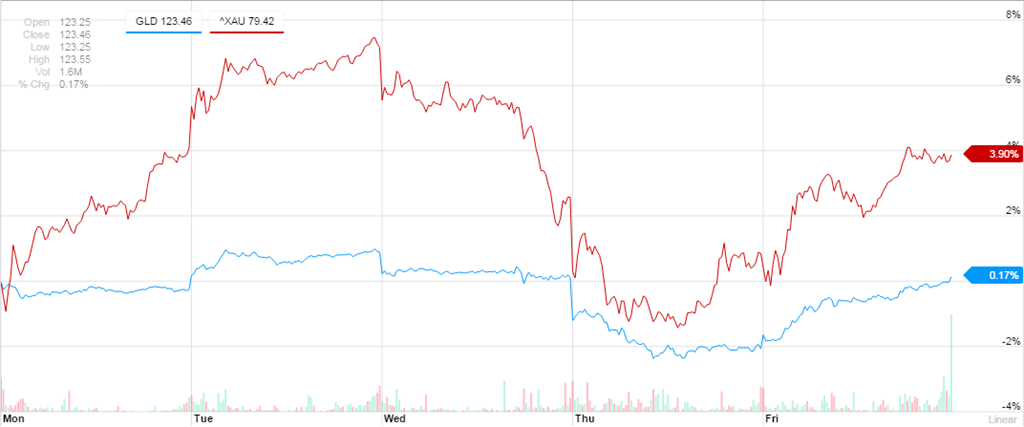
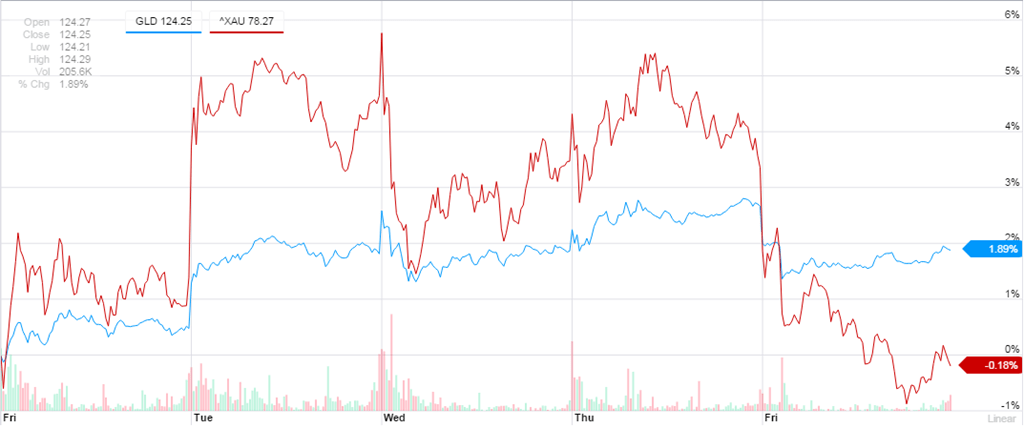
Since May 9, 2014, the gold ETF SPDR Gold Shares has declined –2.55% while the Philadelphia Gold and Silver Stock Index has declined –5.54%.

image

Below is the charting of the Gold Stock Indicator (GSI) since March 2012.

Continue reading

U.S. Dividend Watch List: May 23, 2014

Top Five Watch List Performance Review

In our ongoing review of the NLO Dividend Watch List, we have taken the top five stocks on our list from May 24, 2013 and have checked the performance one year later. The top five companies on that list can be seen in the table below.

Symbol Name 2013 Price 2014 Price % change
WEYS Weyco Group 23.76 27.17 14.4%
CTWS Connecticut Water Service 28.83 31.97 10.9%
NWN Northwest Natural Gas 43.77 44.52 1.7%
FRS Frisch's Restaurants, Inc 16.99 23.66 39.3%
SO Southern Company 45.20 43.08 -4.7%
      Average 12.3%
         
DJI Dow Jones Industrial 15,303.10 16,606.27 8.5%
SPX S&P 500 1,649.60 1,900.53 15.2%

Weyco (WEYS) gain of 14% didn't beat out the market gain of 15% but such performance is exceptional nonetheless. We stated that the stock was range bound and multiple was contracting. Such contraction allowed earnings to catch up and build a support on stock price. While earning fell 4%, multiple by nearly 20% which was the key gain in the stock.

Frisch's Restaurants (FRS) was the best performer on our list with gain of nearly 40%. The key driver was the rise in earning. A quick glance at last year data would suggest that EPS rose by 140% (from $0.66 to $1.60). On a fiscal year basis (ending in May) the company earned $1.35 per share in 2013.

We highlight one important key aspect about the second company on the list, Connecticut Water (CTWS) and that is to be aware of investment made in utilities companies during rising rate cycle. Although Connecticut Water did extremely well considering the circumstances, the majority of utility companies did not. The four utility companies average gain was 0% for the year with Consolidated Edison (ED) as the worse performer declining 7%.

U.S. Dividend Watch List: May 23, 2014

The S&P 500 reached its all time high and closed above the 1,900 mark.  Despite that, we are seeing large number of companies.  At the end of the week, there are 53 companies on our watch list.  Please see below for the complete list. Continue reading

Dow Altimeter Review

As the Dow Industrials meander near all-time highs, it is necessary to review Edson Gould’s Altimeter for the index.

Continue reading

Dow Theory

On September 30, 2013, we posted our Dow Theory analysis.  In that assessment, we acknowledged that our June 2013 review of Dow Theory was incorrect.  Additionally, we pointed out the importance of using Dow Theory as an asset allocation tool rather that a strict “buy” or “sell” indicator.  A couple of excerpts appear below:

“Since June 21st, as indicated in the chart below, the Dow Industrials and Dow Transports have managed to achieve successive new highs in early August 2013 and mid-September 2013.  In addition, the call for a bear market came slightly before the bottom in the market in late June 2013.”

“In short, we use Dow Theory indications as asset allocation signals rather than strict buy/sell signals.”

Accepting the reality that we were not in a bear market was challenging.  However, realizing it in enough time, along with the fact that Dow Theory is used as an allocation tool, has spared us excessive losses and/or missed opportunities.

Traditional Dow Theory

Recently Dow Theory has registered a confirmation of the bullish trend.  On May 12, 2014, the Dow Jones Industrial Average confirmed the new highs in the Dow Jones Transportation Average.  In fact, on the same day, both indexes made new all-time highs.

image

That this is still a bull market requires a review of various factors that could be at play, both positive and negative.  As an example, already the Dow Jones Industrial Average has increased +151% since the March 9, 2009 low.  The amount of the increase is less than the average for the period of 1836 to 1914, a time when the Federal Reserve never existed.  As stated in the article titled “Is the Fed Responsible for the Stock Market Rise Since 2009?” the average increase when the Federal Reserve didn’t exist was +167%.  This suggests that the current rise may have some room to go on the upside.

Dow Theory Reconsidered

There are many who follow the traditional Dow Theory which is really a refined version of William Peter Hamilton’s writings from his Wall Street Journal and Barron’s newspaper columns as well as his book Stock Market Barometer.  The theory itself is generally sound.  More often than not it is the interpreter of the theory that gets it wrong.  However, we can’t help but feel it necessary to point out the specific words of Charles H. Dow which possibly leads to a market theory slightly different from what the legions of modern Dow Theorists are willing to accept.

The following excerpts from the Wall Street Journal outline Dow’s theory on the role of the industrials as it originally was stated:

“This is preeminently the period of industrial speculation, yet the creation of industrial stocks has become pronounced only within a year.”

“…it follows that there must be a very strong body of [venture] capitalists prepared at present to resist anything like a collapse in the industrial market and to promote by every means in their power firm or advancing prices for the market as a whole.  and this effort on their part is being powerfully supported by the excellent conditions of practically all branches of trade.”

Dow, Charles H. Review and Outlook. Wall Street Journal. April 22, 1899.

Our interpretation of the preceding quotes is that industrial stocks were, in 1899, considered to be the equivalent to modern small cap stocks which are more speculative in nature and often prone to manipulation and collapse.  The best confirmation of this concept is found in the following New York Times quote:

“Our London correspondent, in yesterday’s Financial Supplement, gave expression to the feeling which the English investor or speculator very naturally has as to the securities that usually go under the title of industrials in our markets.  It is one of distrust and hesitation.  It would be very strange if it were not.

“As to the investor, we suppose that no one on this side of the water would claim that our industrials, taking them ‘by and large,’ the older with the new, the more solid with the more inflated, can be regarded as ‘investment’ securities.”

New York Times. “The Industrials and The Boom”. March 14, 1899. page 6.

By most measures, the New York Times article, from one month earlier in 1899, confirms our view that industrial stocks were of low quality.  Now we need to see what Dow intended for the role of transportation and industrial stocks.

“…railway [transportation] stocks generally occupy a position much stronger than that held by the industrials.”

“The growth of the business of the country accrues on the old stocks [transportation stocks].  The Industrial list occupies an entirely different position.  There has been a very large creation of securities [initial public offerings].  Stocks have been bought on very limited information as to the value of the property acquired.  Attack of these stocks brings selling from those who know little in regard to the worth of what they have bought; also from those who got in at low figures [company insiders] and who propose to get out as well as they can.  This is the ideal condition for bear attacks, checked only by the possibility of not being able to borrow stock [for short selling].  The thoughtfulness of promoters [investment banks] in providing ample capital relieves this danger to great extent and will relieve it altogether when the new Industrials come to be distributed.”

Dow, Charles H. Review and Outlook.  Wall Street Journal. May 31, 1899.

Our views is that Dow’s theory was intended to be based on blue chip high quality stocks to be compared against small cap speculative stocks.  At the time, railroad stocks were the “old stocks” that had a blue chip status while the industrials were the newer [non-railroad] more speculative stocks.  We no longer live in a world where railroad stocks dominate the landscape of companies to invest in. Also, transportation stocks generally don’t provide consistent and/or rising dividend payments as was the case of railroad stocks in the last quarter of the 1800’s.

What would be the equivalent indexes of Dow’s comparison between old blue chip stocks to newer more speculative stocks? We believe that the Dow Jones Industrial Average qualifies as the blue chip barometer and the Russell 2000 small cap index qualifies as the speculative barometer.  Using all of the other elements of Dow Theory except for the Dow Jones Transportation Average, we believe that we would be following Dow’s theory exactly as it was intended.

Just to reiterate, Dow was not specifically concerned with the comparison between industrial stocks because they made the goods and transportation stocks because they shipped those same goods, a popular and logical story that is expounded on what Dow had intended.  However, based on the quotes above, we believe Dow was comparing companies of older blue chip quality that were well established and could be relied upon for their dividends in contrast to newer companies with little in the way of verifiable earnings, nascent but unstable dividends and highly susceptible to manipulation (i.e. small illiquid stock).

If we look at a comparison between the Industrials and the Russell 2000 index, the picture is very different from the confirmation of the bullish trend in the review of the transportation and industrial index above.

image

As can be seen above, while the Dow Industrials has managed to exceed the previous peaks of December 2013 and April 2014, the Russell 2000 has not been able to exceed the peak of March 2014.  Under the rules of Dow Theory, this would be considered a non-confirmation of the rising trend.  However, this does not signal a new bear market.  Instead, it only suggests that investors remain cautious about new investments.

A bear market would be signaled if the Dow Industrials and Russell 2000 were to simultaneously decline below the previous retracement levels during the rise from the March 2009 low to the current market levels.  In the chart above, the initial warning would come if the Russell 2000 and Dow Industrials declined below their respective February 2014 lows.

U.S. Dividend Watch List: May 17, 2014

Top Five Watch List Performance Review

In our ongoing review of the NLO Dividend Watch List, we have taken the top five stocks on our list from May 17, 2013 and have checked the performance one year later. The top five companies on that list can be seen in the table below.

Symbol Name 2013 Price 2014 Price % change
WEYS Weyco Group 23.86 25.90 8.5%
FRS Frisch's Restaurants, Inc 16.90 23.51 39.1%
CTWS Connecticut Water Service 29.03 31.87 9.8%
AROW Arrow Financial Corp. 24.84 25.27 1.7%
NWN Northwest Natural Gas 44.90 44.58 -0.7%
      Average 11.7%
         
DJI Dow Jones Industrial 15,354.40 16,491.31 7.4%
SPX S&P 500 1,667.47 1,877.86 12.6%

We didn’t make specific highlights on any companies from the list.  The market pushed to its all-time high last year providing us with little opportunity to invest.  Despite this fact, our top five managed a double digit gain and nearly matched that of the S&P 500.  If we were to include the performance of John Wiley (JW-A), our average again would be +16.5% as John Wiley returned +40%, excluding dividends, in one year.

U.S. Dividend Watch List: May 17, 2014

When the market reached its peak last year, there were only 6 companies on our list.  This time around, there are 56 companies!  We don’t have any definitive answer to why this has occurred.  The implication of this, however, is that it could be a bearish sign.  Despite all this, we believe there are great companies to start researching for long-term investment and income opportunities.  Below are the 56 companies on our watch list.

Continue reading

Transaction Alert

On May 12, 2014, we carried out the following transaction(s) in our partnership:

Nasdaq 100 Watch List: May 9, 2014

Below is the watch list of stocks that we are following from the Nasdaq 100 Index.

U.S. Dividend Watch List: May 9, 2014

Top Five Watch List Performance Review

In our ongoing review of the NLO Dividend Watch List, we have taken the top five stocks on our list from May 10, 2013 and have checked the performance one year later. The top five companies on that list can be seen in the table below.

Symbol Name 2013 Price 2014 Price % change
IBKC IBERIABANK Corp. 46.80 62.01 32.5%
WEYS Weyco Group 23.68 25.41 7.3%
CTWS Connecticut Water Service 28.74 32.38 12.7%
FRS Frisch's Restaurants, Inc 16.90 23.55 39.3%
AROW Arrow Financial Corp. 24.69 25.54 3.4%
      Average 19.1%
         
DJI Dow Jones Industrial 15,118.49 16,583.34 9.7%
SPX S&P 500 1,633.70 1,878.48 15.0%

Iberiabank (IBKC) had a tremendous run over the last year.  Below is the commentary we made last year.

The company’s book value has increased at an annual rate of +11.5% over the past five years while the dividend has risen at +6% annually over the same period.  Countering the positives, earnings per share has fallen from the peak in 2006 at $3.57 to the bottom in 2009 at $0.19.  The current earnings per share is $2.59, which far from the bottom in 2009.  The company never cut its dividend through the credit crisis but it has yet to increase their payout.  The stock trades at a 10% discount to its book value and yields 2.9%.

The company’s dividend payment has remained unchanged at $1.36 per share.  Anyone who purchased shares at the 10% discount to book value would have done well as shares are now trading at 17% above book value.

Weyco (WEYS) was second on our list and did relatively well.  We highlighted the worrisome trend in the underlying fundamentals of the company.  Growth has slowed tremendously in both sales, profits, and cash flow.  The market appeared to be pricing in these factors.

U.S. Dividend Watch List: May 9, 2014

Minor divergence occurred between the blue-chip and the overall market as the Dow rose +0.4% compared with the S&P 500 falling -0.2%.  Below are 22 companies that are in our watch list this week.

Continue reading

Gold Stock Indicator: May 9, 2014

This week there was a lot of downside action for the price of gold and gold stocks as represented in the chart below.

image

The gold ETF declined –1.86% while gold stocks fell –4.51%.  The good news is that gold and gold stocks have traded in a range for the last year.  The bad news is that gold and gold stocks cannot seem to break above the previous peaks in that same one year range.