U.S. Dividend Watch List: July 25, 2014

Top Five Watch List Performance Review

In our ongoing review of the NLO Dividend Watch List, we have taken the top five stocks on our list from July 26, 2013 and have checked the performance one year later. The top five companies on that list can be seen in the table below.

Symbol Name 2013 Price 2014 Price % change
CAT Caterpillar 82.06 104.85 27.8%
IBM IBM 197.35 194.40 -1.5%
PM Philip Morris International 88.88 84.85 -4.5%
SO Southern Company 45.34 44.74 -1.3%
T AT&T Inc 35.60 35.54 -0.2%
      Average 4.1%
         
DJI Dow Jones Industrial 15,555.61 16,960.57 9.0%
SPX S&P 500 1,690.25 1,978.34 17.0%

Out top five clearly have underperformed the market. We highlighted two companies on our list, Caterpillar (CAT) and IBM (IBM). Caterpillar did extremely well outperforming the market by 10% while IBM was flat year-over-year.

We stated the following about IBM last year:

Second on the list is another Dow 30 component, IBM (IBM).  One may want to note that IBM appears to be fairly priced according to Valueline which stated that this stock trades at roughly 9.5x its cash flow.  With 2013 expected cash flow of $20.35 per share, the stock fair value is $193.  Our valuation model has a fair value of $180 thus leaving virtually no margin of safety on the shares.

U.S. Dividend Watch List: July 25,2014

The market may be consolidating after reaching 1,990 mark. Our database of companies near the low continued to expand. At the beginning of June, we logged 30 companies on our list. That number has since exploded to 84 this week. If the market continue to make new high with many of the quality name lagging behing, it is a sign of trouble or that the speculative phase of the bull market has taken hold. Below are the companies on our watch list. Continue reading

Current Implication of Market Valuation

There's no denying that the current bull market has caught many professionals and individuals by surprise.  Many are pondering on the sideline as to when and if this bull market will ever end.

Our recent study of market return (Analysis of Long-Term Return from Equity Market) suggested that equity on average will provide a rate of return between 9% - 10%, but one should be caution of the year-to-year fluctuation.  Also, one should make a distinction between the return from the market and return to individual investor.  The ladder tend to be lower due to an error in market timing.  The biggest contributor that will determine your rate of return is the price you pay for any investment (mutual fund, ETF, real estate, or individual stock).  When we look at individual stock, there's a high correlation between them and the market.  That is, if the market appears to be overvalued and faces downward pressure, it would be difficult for an individual stock to break such trend.

This lead us to our next topic which is the current market valuation.  Where do we currently stand based on historical market valuation?  The data we've chosen to present is the data provided by Robert Shiller of Yale University (found here).  While his data set spans far beyond 1950, the inception of S&P 500, we will not be using them since we can't validate the accuracy of his conversion.

The two key elements of market valuation are price earning ratio (P/E) and dividend yield.  Let use inspect the first element, the P/E ratio.  The current market P/E is 19.  While one may say that the market is expensive, we need historical data to prove such claim.  Based on the data, the market will on average trade between P/E of 18 and 20 thus placing the current state at or near fair value.  The table below indicate frequencies in months that the market trade in specific P/E range.  At P/E of 20, the market is at 78th percentile which statistically imply that there is a 22% chance for the market to continue to advance beyond current level.

P/E Months Cumulative %
6 0 0%
8 52 7%
10 65 15%
12 78 25%
14 72 35%
16 79 45%
18 147 64%
20 110 78%
22 38 83%
24 32 87%
26 18 90%
28 18 92%
30 18 94%
32 10 96%
34 9 97%
36 3 97%
38 3 98%
More 19 100%

SP500-PE-1950_2014.jpg

Now let us look at dividend yield and its implication.  Current dividend yield is 1.9% which place the current valuation in the 80th percentile (dividend yield has inverse relationship on valuation, higher figure imply lower valuation and vice versa).  As such, there is less than 20% chance of market advancing beyond the current level.

Div Yield Months Cumulative %
1.0% 0 0.00%
1.5% 49 6.33%
2.0% 111 20.67%
2.5% 60 28.42%
3.0% 110 42.64%
3.5% 154 62.53%
4.0% 88 73.90%
4.5% 63 82.04%
5.0% 45 87.86%
5.5% 34 92.25%
6.0% 28 95.87%
6.5% 12 97.42%
7.0% 14 99.22%
>8% 6 100.00%

SP500-YIELD-1950_2014.jpg

To sum it all up, the market appears to be trading at or slightly above its fair value.  The market, however, does not simply trade up (or down) to the average then revert course in the opposite direction.  The fact that we have reached a valuation level not seen since the peak of 2007 hardly mean that the market can’t simply continue higher.  Our study simply suggests that the odd of that happening diminish with every single point increase in P/E ratio.  If we have to speculate, we would be incline to say that S&P 500 would reach 25 P/E before starting to taper off.  Even so, one need to understand the historical perspective and statistics of the market before putting their hard earn money to work at this level.

U.S. Dividend Watch List: July 11, 2014

Top Five Watch List Performance Review

In our ongoing review of the NLO Dividend Watch List, we have taken the top five stocks on our list from July 12, 2013 and have checked the performance one year later. The top five companies on that list can be seen in the table below.

Symbol Name 2013 Price 2014 Price % change
IBM IBM 192.07 188.00 -2.1%
CTWS Connecticut Water Service 29.26 32.72 11.8%
NWN Northwest Natural Gas 43.89 46.56 6.1%
SO Southern Company 44.99 44.53 -1.0%
BMO Bank of Montreal 60.52 74.34 22.8%
      Average 7.5%
         
DJI Dow Jones Industrial 15,464.30 16,943.81 9.6%
SPX S&P 500 1,680.19 1,967.57 17.1%

The top five under performed the market, particularly the S&P 500, by a wide margin. Three of the five companies are utility companies which we know is facing a strong headwind. Surprisingly Connecticut Water (CWT) managed to do relatively well. On the flip side, IBM (IBM) was the worse performer lossing 2%. However, we estimated the company's fair value to be at roughly $180. So for the stock to trade down from $192 to $188 didn't surprise us.

U.S. Dividend Watch List: July 11, 2014

The market gave up some ground this week as the S&P 500 lost 0.9%. The earning season kicked off this week so expect more volatility to come. In the mean time, we are seeing a large influx of companies onto out watch list. Our observation is that these stocks are trading in a narrow band within their 52-week range rather than drop down to a more appropriate discount level. The market is currently trading at a large premium at more than 19x so we this alone is a headwind for individual stock to move higher. While we are not suggesting that this bull market is coming to an end, we do feel that a digestion process is much needed for fundamental to catch up to the technical. Below are 31 companies on our watch list. Continue reading

U.S. Dividend Watch List: June 27, 2014

Top Five Watch List Performance Review

In our ongoing review of the NLO Dividend Watch List, we have taken the top five stocks on our list from June 28, 2013 and have checked the performance one year later. The top five companies on that list can be seen in the table below.

Symbol Name 2013 Price 2014 Price % change
CTWS Connecticut Water Service 28.70 34.19 19.1%
NWN Northwest Natural Gas 42.48 47.03 10.7%
IBM IBM 191.11 181.71 -4.9%
CAT Caterpillar 82.49 108.78 31.9%
PM Philip Morris International 86.62 84.85 -2.0%
      Average 10.9%
         
DJI Dow Jones Industrial 14,909.60 16,851.84 13.0%
SPX S&P 500 1,606.28 1,960.96 22.1%

The top five companies returned an average 10.9%. The first company we highlighted was IBM (IBM) which we believed to be fairly priced. The excerpt below was taken from last year's post.

The third company, IBM (IBM), make for an interesting potential research.  Recall that Warren Buffett’s Berkshire Hathaway is a major shareholder of the company.  The company’s stock price plunged in mid April, recovered in May, but has given back all of the gain in June.  Because Buffett isn’t bothered by the short-term fluctuation in price, the recent actions means nothing to him.  One may want to note that IBM appears to be fairly priced according to Valueline which stated that this stock trades at roughly 9.5x its cash flow.  With 2013 expected cash flow of $20.35 per share, the stock fair value is $193.  Our valuation model has a fair value of $180 thus leaving virtually no margin of safety on the shares.

At the closing on Friday, IBM closed at $181 which was right on our target.

The second company was Caterpillar (CAT). We were more bullish on the shares and the stock rose more than 30%. Last year we stated the following.

This Dow Jones Industrial component has been in and out of our watch list for several months. This suggest some form of ‘line’ trading on the longer time frame. The stock yields 2.9% with 32% payout ratio. Earning estimates might have hit bottom as consensus now expects the company to earn $6.88 compared to $8.90 in the previous year. Cash flow should remain strong which will help the company retain, if not raise, their dividend payout or buyback shares.

U.S. Dividend Watch List: June 27, 2014

The market was virtually flat for the week. It appears that further consolidation may be needed if the S&P 500 is to break 2,000 mark and the Dow Jones Industrial Average to break the 17,000 level. The number of companies on our watch list remain somewhat elevated at 42 companies which is a sign that market breadth is relatively weak. Below are 42 companies on our list. Continue reading

Transaction Alert

On June 27, 2014, we carried out the following transaction(s) in our partnership:

Continue reading

Gold Stock Indicator: June 27, 2014

Gold and gold stocks had a lot of movement this past week but little to show for it.

image

Quick Take: North West Company

“A good analyst is wrong one-third of the time.  An average one is wrong half the time. A poor analyst is worse than a coin toss.”

source: Chase, C. David. Mugged on Wall Street. Simon and Schuster, New York. page 233.

North West Company (NWC.TO)

Nasdaq 100 Watch List: June 20, 2014

Below is the performance of the twelve stocks from our June 21, 2013 Nasdaq 100 watch list (found here) compared to the Nasdaq 100 Index gain of +32.13% over the last year.

Symbol Name 2013 2014 % change
FFIV F5 Networks, Inc. 70.92 108.81 53.43%
NUAN Nuance Communications 18.5 19.47 5.24%
GOLD Randgold Resources Limited 66.712 82.25 23.29%
INTU Intuit Inc. 57.86 79.5 37.40%
TEVA Teva Pharmaceutical 38.74 52.97 36.73%
CTXS Citrix Systems, Inc. 59.988 64.93 8.24%
GRMN Garmin Ltd. 34.69 60.05 73.10%
AAPL Apple Inc. 59.07 90.91 53.90%
CHRW CH Robinson Worldwide 54.79 63.92 16.66%
ALTR Altera Corp. 31.99 35.04 9.53%
ALXN Alexion Pharmaceuticals 88.492 165.46 86.98%
EXPD Expeditors Int’l of WA 37.05 44.49 20.08%
Average 35.38%

Standout performers were Alexion Pharmaceuticals, Garmin, Apple and F5 Networks.  The stocks that underperformed were Nuance Communications, Citrix Systems and Altera Corp.  The top 5 stocks on the list gained as average of only +31.22% in the last year which is less that the benchmark Nasdaq 100 Index.

Nasdaq 100 Watch List: June 20, 2014

Below is the latest watch and estimated targets.

Continue reading

Gold Stock Indicator: June 20, 2014

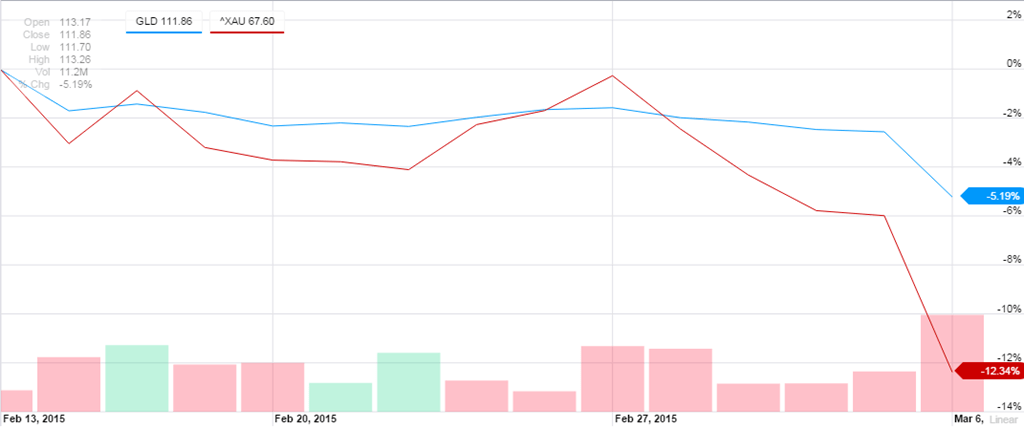
Gold and gold stock continued to climb higher in the last week.  The gold ETF (GLD) rose +2.90% in the last five days while the gold stock index (XAU) rose +6%.

image

The Gold Stock Indicator for the same period shows the critical levels that need to be exceeded on the upside.

Continue reading

Review: California Water Service

Contributor C. Cheng asks:

“Interesting that you should mention scarcity of water creating an upside cap on the company’s profitability. Now that California is dealing with drought conditions, how do you think this will factor into CWT’s performance?”

Our response:

On January 3, 2010 (found here), we posted an Investment Observation on California Water Service (CWT).  At that time we said that CWT has a 6-year pattern of trading in a range before breaking out to the upside, price is driven by the dividend with an upside target of $24.145 ($48.29).

Regarding the 6-year cycle, we said the following:

“CWT has had a pattern of trading in a range for approximately 6 years at a time before breaking out to a new and higher trading level. The following are the range in years that CWT traded before obtaining a new high:

  • 1976 to 1982
  • 1985 to 1993
  • 1993 to 1997
  • 1997 to 2004
  • 2005 to 2011 ???”

Our expectation was that at some point in 2011, CWT would ideally be bought for the pending breakout of the stock price.

image

The reality of the situation with CWT is that the stock finally broke out of the trading range in January 2013.  Again, the 6-year trading range was only the average.  However, while investors waited for the stock price to increase there was a sizable dividend being offered at the time.  Coincidentally, the price of CWT has peaked at $48.28 on a closing basis as recently as March 25, 2014.  This closing price is within $0.01 of our projected high set in 2010.

Our view is that only in hindsight will we know for sure the impact of water scarcity on CWT. However, below is the trend of quarterly earnings since our 2010 posting and it seems to reflect the fact that instead of being able to see higher earnings in the face of scarcity (the rational economic view) we’re seeing pre-drought earnings.

image

What we do know is that the price performance of the CWT has a lot to do with the price paid. Given that CWT currently trades at 25.8x earnings and yields “only” 2.8% (low for a utility), the odds of the stock outperforming in the long-run are slim.

In addition, utility companies generally issue bonds to fund their operations. With interest rates on the rise, their cost of funding will put more pressure on the future earnings. As such, our view on the risk/reward isn’t as rosy for CWT.

Canadian Dividend Watch List: June 13, 2014

Performance Review

Below is the 1-year performance of the Canadian dividend stocks from our June 2013 watch list (found here):

Symbol Name 2013 2014 % change
IMO.TO Imperial Oil Ltd. 39.51 55.76 41.13%
FTT.TO Finning International Inc. 22.01 28.88 31.21%
CPG.TO Crescent Point Energy Corp. 35.9 46.96 30.81%
CM.TO Canadian Imperial Bank of Commerce 77.18 97.1 25.81%
TD The Toronto-Dominion Bank 39.95 49.92 24.96%
NA.TO National Bank Canadian Equity SP 37.75 46.12 22.17%
IFC.TO Intact Financial Corporation 60.62 73.48 21.21%
BDT.TO BIRD CONSTR INC 12.08 13.6 12.58%
LB.TO Laurentian Bank of Canada 44.1 49.23 11.63%
BEI-UN.TO Boardwalk Real Estate Investment Trust 59.12 65.09 10.10%
CJR-B.TO Corus Entertainment Inc. 23.8 25.25 6.09%
CWT-UN.TO Calloway REIT 25.55 26.62 4.19%
REI-UN.TO Riocan Real Estate Investment Trust 26.21 26.86 2.48%
AX-UN.TO Artis Real Estate Investment Trust 15.33 15.38 0.33%
TLM.TO Talisman Energy Inc. 11.63 11.52 -0.95%
CAR-UN.TO Canadian Apartment Properties REIT 22.94 22.64 -1.31%
FCR.TO First Capital Realty Inc. 18.43 18.17 -1.41%
EMA.TO Emera Inc. 34.29 33.76 -1.55%
FTS.TO Fortis Inc. 33 31.75 -3.79%
TA.TO TransAlta Corp. 13.64 12.93 -5.21%
TMXXF TMX Group Limited 53.0417 48.5 -8.56%
CUF-UN.TO Cominar REIT 21.39 18.65 -12.81%
D-UN.TO Dundee REIT 33.15 28.9 -12.82%
    Average   8.54%

As described in our June 2013 watch list, the REIT sector was expected to underperform (highlighted in red above).  We said the following:

“What is most alarming about the most recent decline in these REITs is the fact that, unlike the large decline of 2011, the current decline has broken through the 2012 lows which is a huge technical failure.  In 2011, as the Canadian REIT industry was experiencing a hiccup, the price of the stocks did not decline below the 2010 support level (approximately October/November 2010).  In addition, as 2011 prices did not fall below 2010 lows, the REITs climbed above the 2011 peak (approximately April/May 2011).  Unfortunately, the most recent rise from the October/November 2012 low could not exceed the July 2012 peak.  These are classic Dow Theory indications of a sector that has further to go on the downside.”

Below is the performance of the five stocks that topped our list last year as compared to the Toronto Stock Exchange:

image

Canadian Dividend Watch List: June 13, 2014

Below is the June 2014 watch list of stocks that we think are worth your consideration and due diligence.

Gold Stock Indicator: June 13, 2014

A big week for gold and gold stocks.

image

The gold ETF, under the symbol GLD, increased +1.79% while the Philadelphia Gold and Silver Stock Index increased +6%. As a measure of the extreme in performance of gold stocks, Allied Nevada Gold (ANV) increased +22.41% in the last five days.  However, the real test of the current market in gold and gold stocks is revealed in the Gold Stock Indicator below.

Dow Doesn’t Deserve 17K Level?

In an article titled “3 reason the Dow doesn’t deserve to be at 17,000” (found here), author David Weidner outlines why “…the bull market in stocks is running for all the wrong reasons.”  The three reason that Mr. Weidner gives are lack of public participation, corporate earnings are flat and few alternatives investments for savers.

We actually believe the opposite is true, the Dow is short of the mark in terms of where it could or should be based on historical precedence.  On the topic of public participation, although Mr. Weidner is correct that the public isn’t as active in direct ownership of stocks, an alternative view could be that when and if the public does get involved, usually the late stage in a bull market, the Dow could easily over-shoot on the upside by a wide margin.

In our March 13, 2013 article (found here), we pointed out that the average trading volume has been in a declining trend since June 2, 2009.  Our concern was that with the decline in trading volume, indicating a lack of participation by the public, there may be a point at which stocks could not sustain their climb higher.  We said the following: 

“When the increase in volume arrives, the question then becomes, will there be a dramatic increase or decrease in stock market price?  Will the general public’s lack of participation be the catalyst that charges the market to move higher?  This situation has to be resolved at some point.”

As time has passed, we’re starting to believe that if the public finally does begin to participate, even on a marginal scale, the stock market could effectively skyrocket.

Continue reading

Review: Bank of Montreal

Contributor C. Cheng Asks:

“What are your concerns regarding the housing bubble forming in Canada and it’s potentially adverse effects on BMO?”

Our Response:

The timeliness of this comment regarding Bank of Montreal (BMO) is critical.  On June 7, 2012 (found here), we posted an Investment Observation on Bank of Montreal which was one of our leading considerations as an investment opportunity.  Keep in mind that our interest in BMO came after a 14-month declining trend in the stock’s price.

At that time we said the following of BMO:

“We are reticent to recommend any kind of banking institution due to the many unexpected risks that occur outside of the purview of regulators and accountants.  However, Bank of Montreal is a reasonable banking investment if bought at the right price.  We believe that the right price begins at $51.80 and below.”

Unfortunately, BMO never fell below $51.80.  In fact, the day that were did our write up on BMO it only fell below the $53.57 price on the five subsequent trading days immediately afterwards, with the lowest price being $52.15 on June 11, 2012.

At the moment, BMO’s stock price has retested the previous high set in November 2013.

image

If there is a concern that Canadian real estate is in a bubble then it would be wise to sell only the principal in BMO while leaving the profits to compound.  This would eliminate the guesswork associated with determining if there is a bubble.  The remaining funds would be allowed to compound at a 5.50% rate until BMO has sustain a similar decline in price from April 2011 to June 2012.

Continue reading

Analysis of Long-Term Return – Equity Market

Ask any market participate for their estimated long-term rate of return from equity market and majority of the time they will say 9%-10%.  That's a fact most of us know.  What market participants may not know is that the average is obtained through big volatility and market never return 10% year in and year out.  The nature of the market is to overshoot on the upside as well as the downside.

Let's take a look at the market return of the S&P 500 from the start of its inception in 1957 through 2013.  The average return for this time frame is 9% per year.  Interestingly, we rarely see returns in the range of 9% plus or minus 3% deviation.  Out of 64 years, we saw only 7 instances (11% of the time) when  the market registered a return between 6% to 12% (a 3% standard deviation).  We'd have to widen the range to 11.2% standard deviation to achieve a 50/50 split.  This mean that out of 64 years, the market had a gain/loss between -2% and 20% in 32 years.

Market 1950-2013

What does all of this mean?  Simply put, don't expect an average gain, of +10%, from the equity market in the short-term. As the chart shows, market return are nearly random with gains as high as 44% and losses as big as -38%.