Below are the Upside Resistance Targets for the Philadelphia Gold & Silver Stock Index (XAU) as of September 10, 2021: Continue reading
-
Topics
Archives
-
-
Recent Posts
-
-
-
-

Below are the Upside Resistance Targets for the Philadelphia Gold & Silver Stock Index (XAU) as of September 10, 2021: Continue reading
Review:
Upside targets:
Below are the upside targets for General Electric. The price targets indicate a range at which the price is expected to experience resistance before continuing the rising trend or before breaking down to the prior downside target.

Those willing to accepted the risk of the price declining to the prior low ($5.49) could strategically accumulate shares based on this approach.
Posted in Edson Gould, GE, upside target
Below are the upside resistance targets based on the work of Edson Gould and applied to the Nikkei 225 Index from 1989 to 2020.

As can be seen based on the conservative upside target of 22,983.45, once the level of the index got to the 22,937.60, there was a trading range established with a significant downside move before breaching the 28,401.78 mid-range target.
The new upside resistance level to watch for is 28,401.78. At this point, we should expect similar price action of trading in a range and/or declining sharply before the next surge to the upside.
Posted in Edson Gould, Japan, Nikkei, SRL, upside target
A question has come in about the use of upside resistance targets. Why bother looking at the upside targets? The case of Boeing (BA) should prove instructive.
On April 15, 2020, we posted upside speed resistance lines for Boeing (BA). At the time, the upside resistance targets were:

Upside resistance targets are reflected in both time and price on a relative basis where a stock, after falling from a major high, will likely experience resistance on the move higher.
Since our April 15, 2020 posting on Boeing, a meaningful reflection of what investors should look for when anticipating the increase in the stock price is highlighted below.
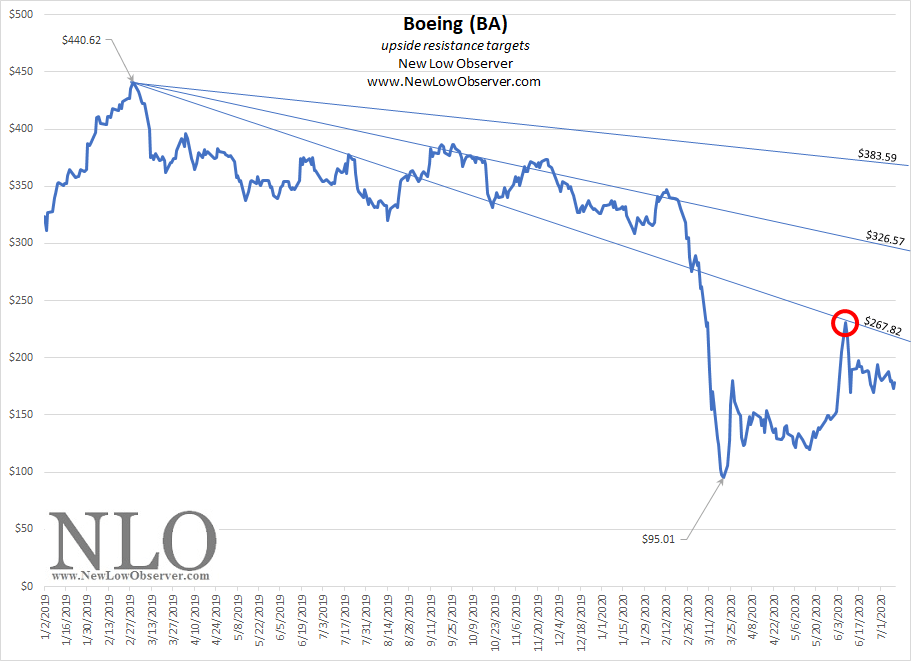
As Boeing has increased from the low of $95.01, the stock price achieved the first upside resistance target at $267.82. Circled in red is the anticipated resistance in the stock price. What this usually means is that the stock price would decline or trade in a range.
For those determined to buy Boeing, regardless of fundamentals, upside resistance targets are a great places to anticipate possible turning points. The flip side to this story is that we generally expect a re-test of the prior low or some semblance of a decline near that level.
Worth noting, when Boeing cracks the upside resistance target of $267.82 then $326.57 becomes the next resistance target and $267.82 becomes the next support level. Prices above the first upside resistance target is generally the best level to buy a stock if it is backed by the fundamental prospects.
The story for Boeing is still unfolding. We’ll update the April 15, 2020 posting at situation continues to evolve.
Posted in BA, Edson Gould, SRL, upside target
Below are the upside resistance targets for Brookfield Property Partners (BPY): Continue reading
Below are the upside resistance targets for Imperial Brands (IMBBY): Continue reading
Below are the upside resistance targets for Boeing (BA):

The upside resistance targets seem daunting. We’ve seen bigger and better companies bailed out and not able to recover from these levels. There is always a first.
Posted in BA, upside target
Markets are built on precedent. For this reason, we will display the downside targets in two prior periods to establish the history for Simon Property Group before getting to the most recent decline. We also provide the upside resistance targets for those hoping to “play” the move to the upside.
To get yourself familiar with the work of Edson Gould’s Speed Resistance Lines, we recommend that you review the our article titled “The Power and Lesson of Speed Resistance Lines” dated February 4, 2018. Since that article, approximately 90% of the Speed Resistance Lines that we have run have come to fruition.
Simon Property Group Downside Targets
1993-2000

The mid-range target is a point to watch as it generally defines the balance of the direction of the stock price. Notice how SPG managed to rise and then decline below the prior low.
1999-2009

As should be expected, the decline in the run from the 2007 peak was almost down to the prior starting point as the decline was generally a result of the malinvestment in the real estate sector. As noted in the chart, SPG managed to not replicated the prior cycle of decline from 1998 to 1999. However, it did get pretty close.
2008-2020

The decline from the 2016 peak should not be unfamiliar since it is almost a replication of the decline from 2007 to 2009. If the current decline were to replicated the 2007-2009 decline, it would bring the price of SPG to $34.16. This number is not too far from the $36.04 level indicated by the price-to-dividend ratio as outlined in the 10-Year Target that was previously posted.
Upside Resistance Targets
2016-2020

Assuming that the $34.16 price is the downside target and investors are willing to accept such a risk, the upside targets are very compelling. The first upside target is $135.81, or nearly 100% above the current price of $70. However, anyone willing to participate in the potential decline to $34.16 need to accept that rising to $197.31 is still within the declining trend which could conceivably result in a decline back to the $44.01 price.
Our primary concern is with downside risk and therefore if a real estate investment trust must be bought at this time then we’d prefer a position in the Vanguard Real Estate Index Fund (VNQ) over individual names where the volatility is far above our tolerance levels.
see also: U.S. Realty from 1918 to 1945
Posted in downside, REIT, Speed Resistance Lines, SPG, upside target
Based on the decline from the peak at $224.30, WorkDay Inc. (WDAY) has the following upside resistance levels:
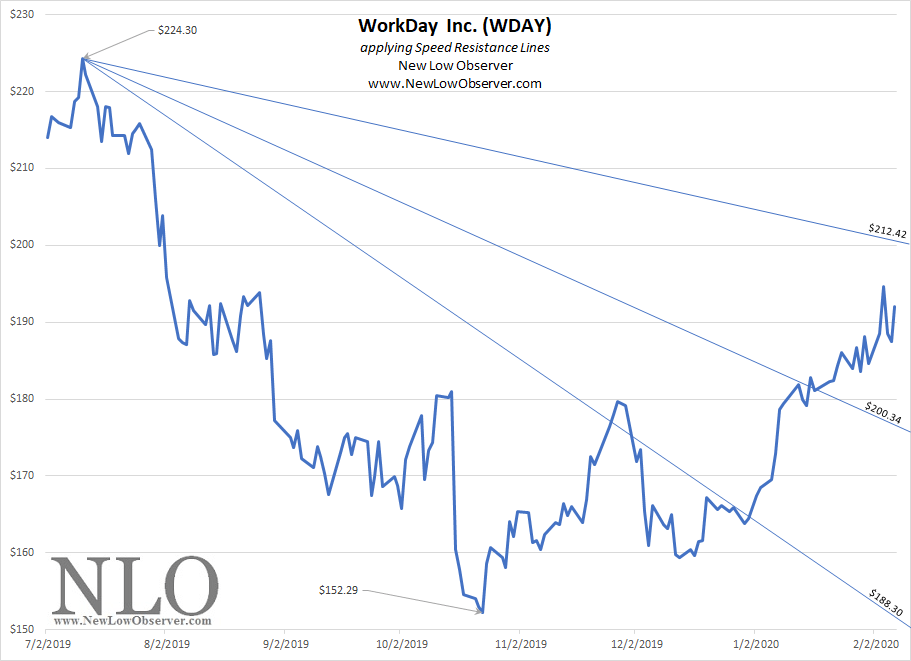
Based on the low of $152.29, WorkDay Inc. increased beyond the initial upside resistance target of $188.30 and then broke down below that level. However, the true test of any momentum is the ability to rise and then fall without going below the prior low, in this case $152.29.
Each of the levels indicated are critical resistance levels that should see a material decline in the stock price. Exceeding each level lends support to the stock price going to the next level. For this reason, we expect that the $212.42 price should see some resistance due to the rapid run-up from the December 13, 2019 low. In this case, resistance means a vacillation between the descending $212.42 and $200.34 price levels.
A rise to $224.30 means that a new bull run is in the cards and should be hedged according.
Posted in upside target
On September 14, 2018, we said the following of the downside targets for AeroVironment (AVAV), when the stock was trading at $116.24:
“The conservative downside target of $62.26 is a lock in our view. To put this in perspective, AVAV would have to increase to $160.62 before the $62.26 level isn’t a normal ‘dip.’”
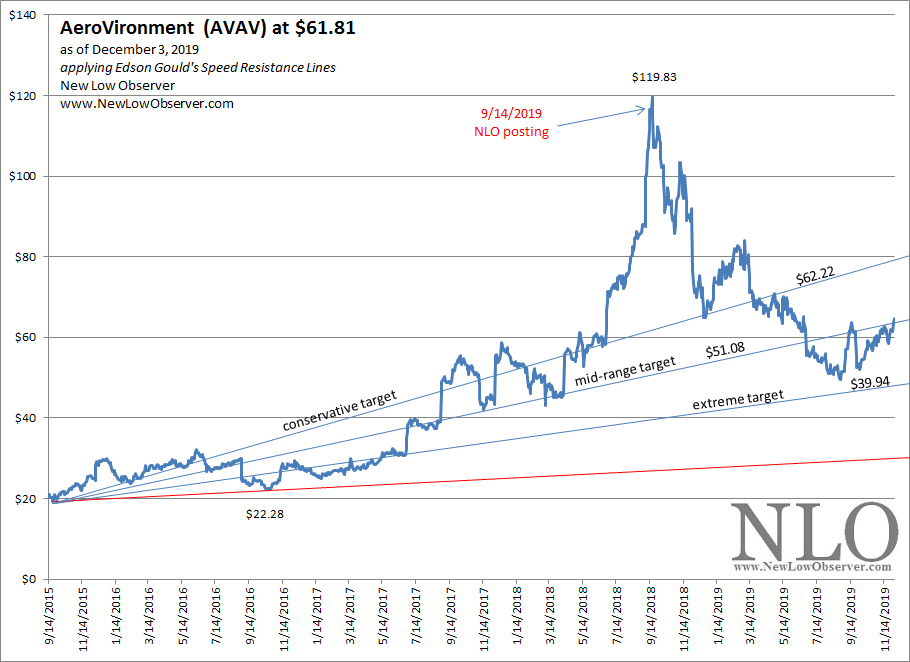
The numbers we based our downside targets on was with the assumption that AVAV could rise as high as $160.62, for a reasonable margin of error. Instead, AVAV peaked only two trading days later at $119.83 (the above chart has been adjusted to the peak).
The decline in AVAV has seen the stock fall as low as $49.54 on August 27, 2019, a drop of –58.65%. The most important element of the current decline is the ability of the stock price to remedy the preceding parabolic move. A drop of nearly-60% comes very close to fixing the previous disparity in the price.
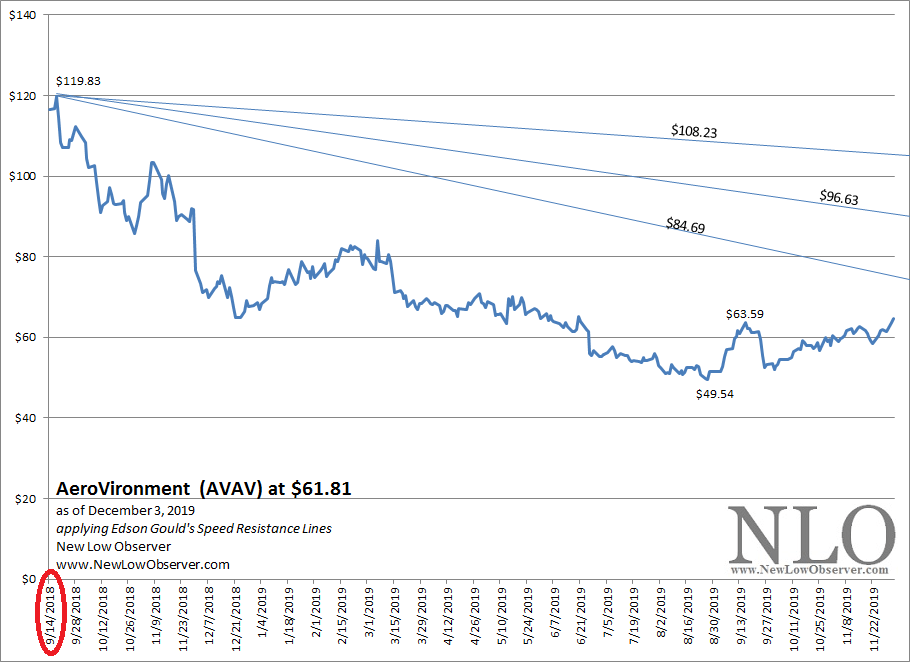
From the August low, AVAV has managed to rally to the latest price at $61.81. The power of the reversal is highlighted in the fact that the stock price rose from the $49.54 level then achieved the $63.59 price. From the $63.59, the stock declined but could not achieve a price lower than $49.54.
The upside resistance levels are as follows:
Speculators (as opposed to Investors) should take these levels to be the points when the continuation of the upside will reverse to the prior low, as a re-test. Investors, basing their assessment on the fundamentals, can strategically enter positions breaking their intended investments in thirds or halves.
Posted in AVAV, Edson Gould, parabolic, Speed Resistance Lines, upside target
History:
Revised GE Upside Targets
After demonstrating a history of consistency, in terms of the general trend in the stock price of General Electric, we must revise the Speed Resistance Lines that were issued in January 1, 2019 to more accurately reflect the changes that have occurred in the last 11 months.
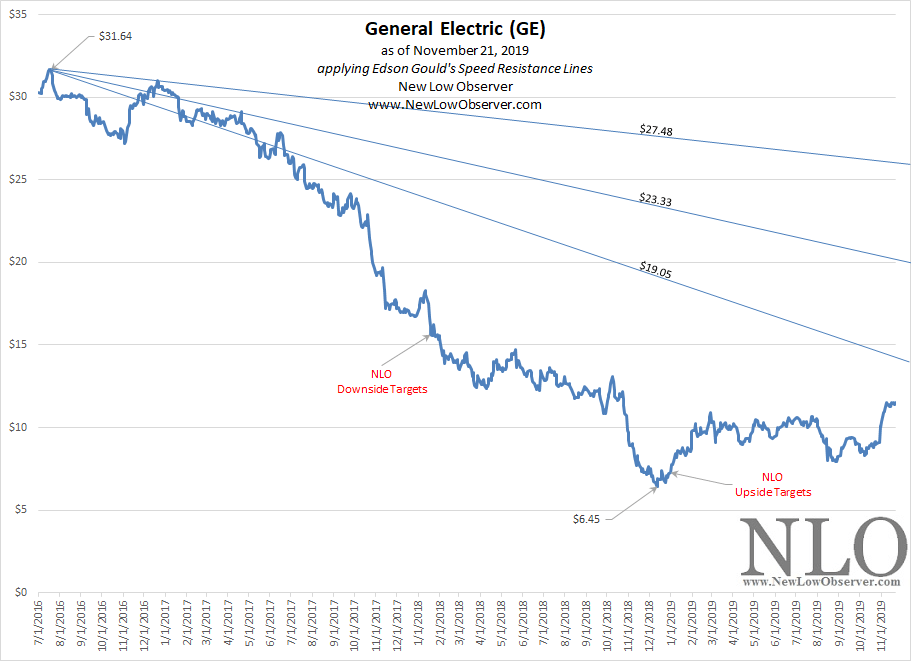
The upside resistance targets are as follows:
It would be a major coup for the price of General Electric to exceed the conservative upside resistance target at $19.05. For now, we will reiterate that almost all stocks achieve the conservative targets through either the passage of time or increase/decrease in price.
As was said in January 2019, “GE could achieve all of the designated upside resistance targets and still be in a declining trend.”
Posted in Edson Gould, GE, General Electric, upside target
Below are the upside resistance targets for the Shanghai Composite Index for both the short and long-term moves.
Short-Term Targets
Based on the price action since January 2019, the Shanghai Composite Index has conformed to the upside resistance targets ranging from 3,012.38 to 3,378.93.

The short-term upside resistance target determines market sentiment for achieving the 3,559.47. So far, the market appears on course to achieve a re-test of the prior low at 2,464.36. The theory of the re-test is known as a double top, or in this case a double bottom, as described by Charles H. Dow in 1901.
"Another method is what is called the theory of double tops. Records of trading show that in many cases when a stock reaches top it will have a moderate decline and then go back again to near the highest figures. If after such a move, the price again recedes, it is liable to decline some distance (Dow, Charles H. Wall Street Journal. July 20, 1901.)."
The expectation should be that after obtaining a new low or a new peak, the price will trend in the opposite direction and then re-test the prior extreme level. In this case, it is the 2,464.36. This makes the 3,012.38 upside resistance level a reasonable level for expectation on the way to the down from the current level as diagramed in the chart above.
Long-Term Targets
The most important factor to watch for is the long-term trend in the Shanghai Composite. The chart below outlines the long-term prospects for the index. Continue reading
Below are the upside and downside targets based on the work of Edson Gould’s Speed Resistance Lines. Continue reading
Posted in Crude Oil, Edson Gould, Speed Resistance Lines, upside target
Tagged members
Below are the remaining upside resistance targets for Uniti Group (UNIT).
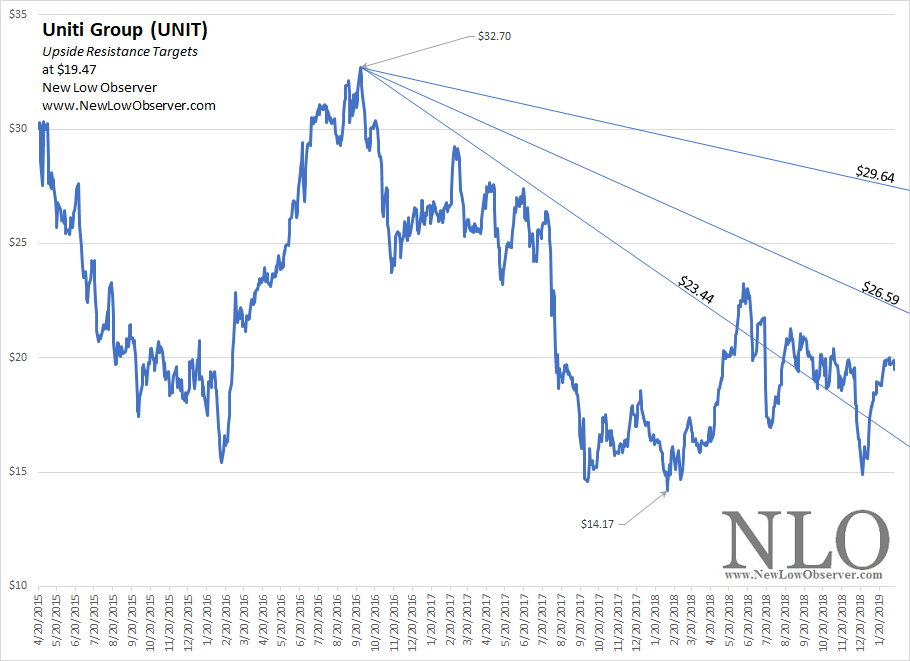
The next upside target is $26.59 for UNIT. However, at the moment, UNIT is showing a capitulation to the descending trend as seen with the peaks from March 2017 to July 2017 and June 2018 to the present.
A break above the descending $26.59 level would be a strong indication for upside action to retest the $32.70 level.
See also: Our 10-Year price targets (undervalue, fair value, and overvalued levels) of Canadian and American dividend paying stocks (found here).
Posted in REIT, UNIT, upside target
On January 1, 2019, we provided upside and downside targets for the Dow Jones Industrial Average. Below is the update to the upside targets for the DJIA. Continue reading