NLO Dividend Watch List: May 13, 2011

The market continues to struggle to move higher.  Most major indexes are virtually flat for the week.  Our watch list this week contains 24 companies that are within 11% of their 52-week low.  The following is our list for Friday the 13th.

May 13, 2011 Watch List

Symbol Name Price % Yr Low P/E EPS (ttm) Dividend Yield Payout Ratio
SJW SJW Corp. 22.44 0.85% 17.53 1.28 0.69 3.07% 54%
WEYS Weyco Group, Inc.  22.98 3.10% 19.98 1.15 0.64 2.79% 56%
WABC Westamerica BanCorp.  49.64 3.14% 15.61 3.18 1.44 2.90% 45%
HHS Harte-Hanks, Inc. 8.75 3.92% 11.08 0.79 0.32 3.66% 41%
CHFC Chemical Financial Corp.  19.67 4.68% 17.88 1.10 0.80 4.07% 73%
HGIC Harleysville Group Inc.  31.93 5.34% 11.44 2.79 1.44 4.51% 52%
BXS BanCorp.South Inc. 12.93 5.38% 80.81 0.16 0.04 0.31% 25%
HTLF Heartland Financial USA, Inc.  14.6 6.03% 13.64 1.07 0.40 2.74% 37%
SFNC Simmons First National Corp.  25.68 6.20% 11.94 2.15 0.76 2.96% 35%
BMI Badger Meter, Inc. 36.14 6.36% 20.42 1.77 0.56 1.55% 32%
NTRS Northern Trust Corp.  48.24 6.49% 17.80 2.71 1.12 2.32% 41%
TGT Target Corp. 51.52 6.82% 12.88 4.00 1.00 1.94% 25%
CALM Cal-Maine Foods, Inc. 28.04 6.90% 8.99 3.12 1.88 6.70% 60%
AWR American States Water Co. 33.52 7.30% 18.94 1.77 1.12 3.34% 63%
SYBT S.Y. BanCorp., Inc.  24.05 7.90% 14.06 1.71 0.72 2.99% 42%
TRH Transatlantic Holdings, Inc. 47.75 8.33% 15.60 3.06 0.84 1.76% 27%
CWT California Water Service 36.81 8.87% 20.34 1.81 1.23 3.34% 68%
WFSL Washington Federal, Inc.  15.27 9.31% 21.81 0.70 0.24 1.57% 34%
NWN Northwest Natural Gas Co. 45.87 9.47% 16.80 2.73 1.74 3.79% 64%
SHEN Shenandoah Telecom 16.98 9.55% 22.34 0.76 0.33 1.94% 43%
MCY Mercury General Corp. 40.87 9.60% 15.03 2.72 2.40 5.87% 88%
CMA Comerica, Inc. 36.39 9.91% 19.99 1.82 0.40 1.10% 22%
CTBI Community Trust BanCorp. 26.95 9.98% 11.62 2.32 1.22 4.53% 53%
TMP Tompkins Financial Corp. 39.72 10.55% 12.69 3.13 1.36 3.42% 43%
24 Companies


Watch List Summary

SJW Corp. or San Jose Water (SJW) remain at the top of our list but the price fell just slightly compared to our last posting. Again, the previous time this company appeared on our dividend watch list back on December 18, 2009. At that time, SJW was trading at $21.93 and had a P/E ratio of 24.42. SJW is now trading with a P/E ratio of 17.7 and a dividend yield of 3.05% despite having a higher absolute price. These numbers reflect that the company is able to consistently grow their earnings while increasing their dividends. After being on our list in December 2009, SJW rose above $27 and has steadily maintained a rising trend above $24 until recently.

Going down the list, we'd like to highlight Simmons First National (SFNC).  Our view of the company remains unchanged.  It is a play on farmland boom we expect to see down the road.  Read more on SFNC in our Investment Observation.

Target (TGT) is another name that the New Low team is focusing on.  With gas price above $4 for the most of the country,  the retail sector may not be the place to be.  But with Target's ability to bring their private label brand, Up & Up, with a variety of products, we think this is an overlooked area.  In addition, the credit card division within Target could possibly be a hidden value.  The 2% yield is at a historical high for the company and we think this is a good risk-reward opportunity.

This week we say goodbye to Sysco Foods (SYY) from our watch list.  It had been on our watch list since the beginning of the year and we've pounded the table several times about this stock.  Despite the negativity about pricing, the latest earnings report displayed the company's ability to manage the challenging environment.  For more on Sysco, click here.

Top Five Performance Review

In our ongoing review of the NLO Dividend Watch List, we have taken the top five stocks on our list from May 14, 2010 and have checked their performance one year later. The top five companies on that list can be seen in the table below.
Symbol Name 2010 Price 2011 Price % change
MON Monsanto Co. 54.61 63.79 16.81%
LLY Eli Lilly & Co. 33.92 38.95 14.83%
FRS Frisch's Restaurants, Inc 21.01 21.85 4.00%
FII Federated Investors Inc 23.16 26.14 12.87%
HSC Harsco Corp. 27.56 33.65 22.10%


Average 14.12%


DJI Dow Jones Industrial 10,620.16 12,595.75 18.60%
SPX S&P 500 1,135.68 1,337.77 17.79%
 

There are some interesting things to take from this chart.  First, noticed the ability for Harso (HSC) to rally from -30% to almost up 30%.  This company is in the steel / basic material sector and as we know, the sector has done quite well.  Monsanto (MON) may have tagged along for the ride.  Although there was heavy criticism of MON's key product, Roundup, that didn't stop the stock from rising above 30%.  With basic material costs rising, it's no wonder that Frisch's Restaurant (FRS) suffered.  A 15% hike in dividend back in September didn't do much either.  Typically, this stock is consider undervalued at 3% yield.  Our May watch list had FRS yielding 2.5%.

Disclaimer:
On our current list, we excluded companies that have no earnings. Stocks that appear on our watch lists are not recommendations to buy. Instead, they are the starting point for doing your research and determining the best company to buy. Ideally, a stock that is purchased from this list is done after a considerable decline in the price and extensive due diligence. We suggest that readers use the March 2009 low (or the companies' most distressed level in the last 2 years) as the downside projection for investing. Our view is to embrace the worse case scenario prior to investing. A minimum of 50% decline or the November 2008 to March 2009 low, whichever is lower, would fit that description. It is important to place these companies on your own watch list so that when the opportunity arises, you can purchase them with a greater margin of safety. It is our expectation that, at the most, only 1/3 of the companies that are part of our list will outperform the market over a one-year period.

Please revisit New Low Observer for edits and revisions to this post. Email us.

Top 5 on Watch List May Be Worth Selling

The September 10th Watch List has performed exceptionally and may require your attention if you bought any of the top 5. 

The worst performing of the top 5 in the last 8 months has been Tootsie Roll (TR) with 26.23%. Beckman Coulter (BEC) exceeded even our most conservatives estimates (article here).  Our recent assessment of West Pharmaceutical Services (WST) suggests that selling and seeking the next best alternative might be in order. 

Considering that this is a list of dividend stocks, I would say that our job is done here.

Please revisit New Low Observer for edits and revisions to this post. Email us.

Sysco (SYY) Earnings Report Breakdown

We'd like to share a reader's response to our most recent watch list on May 7, 2011. The reader commented / asked:
"I like SYY for their divi growth long term, but...any worry at all about the long summer and rising gas prices affecting the cost of running their trucking network? More $ to move their product and less $ for consumers to spend on eating out."
Our response:
"All those are great concerns but I think the important question is whether they are priced in or not. My parents run several restaurants and going through SYY is a must. Raising price is always harder in the short-term. But longer term, they should (will) be able to raise price. The article on restaurants lift prices is a first sign that they are passing this on to consumers. This should allow SYY to up their price.  Restaurants or any producers rarely lower price after they raise it. But the cost (raw materials) do fluctuate. Our family restaurants raised price in early 2008 when oil hit $100 but we never lower them despite correction in the commodities market. Our margin expanded, profit rose, and cash built. It's hard to predict where SYY is at this moment but we believe that you are not paying up at this level, especially when its dividend yield is higher than historical average."
We actually didn't consider that Sysco (SYY) would be reporting their earnings today!  However, that didn't matter much because they beat earnings estimates ($0.44 vs $0.41) which sent the stock up 10% today.  Investors should ponder how is it possible that a food stock can move up 10% despite rising raw material costs?  Although it doesn't seem to make sense, let us try to explain the why or how this could occur.
Consensus Swings Wildly
Sysco (SYY) appeared in the top 5 of our watch list back in February 11, 2011.  At the time, many doubts and fears circled the stock.  The table below, from CNBC, shows that there were only two recommendations to buy versus six hold recommendations. This implies that with shares at the 52-wk low the risks may have been priced in.

It Seems Like Basic Economics
In the basic economics of supply and demand (the answer to almost all econ questions), we learned about price elasticity.  Many textbooks on the subject use food as an example of price elasticity which often states that food prices are inelastic in the short-term but over the long-run, they almost always correct.  This is the case with Sysco (SYY).  As I said in the above, "Raising price is always harder in the short-term. But longer term, they should (will) be able to raise price[s]."
To echo that thought, here's a quote from Barron's article "Though steep food-price inflation is an ongoing concern, Sysco management has effectively offset higher costs with higher prices, a process that will become easier as the restaurants that are its customers begin to raise prices themselves."  Stock prices reflect the short-term but if you can stick it out (this is where dividends are critical for long-term investors) for the long-term, you'll be rewarded for your patience.
Key Takeaway
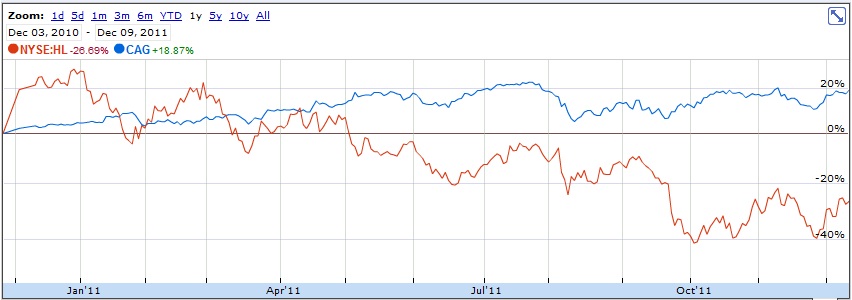
We spoke about Sysco several times in our watch list summary like in December 2008 and February 2011.  Whenever the stock appeared on our list, it represented a great starting point for research.  The New Low team often ignores (at our own peril) what analysts' say because more often than not we find that their outlook has been priced in.  Analysts fear that the company would have trouble not being able to pass price increases on obviously didn't look too hard for answer.  Once a company raise prices, they never lower them.  But typically the raw costs often fall.  This spread goes directly to the bottom line of producers.  We've seen this happen to Heinz (HNZ), Tootsie Roll (TR), and most recently, Conagra (CAG). 
Simply looking back at history may have proven useful.  Sysco was founded in 1969 right before the height of inflation in the 1970s.  They made it out alive then and our guess is that they will probably make it out again.

Please revisit New Low Observer for edits and revisions to this post. Email us.

Complete 2008 Transaction Summary

We are constantly reviewing our 2008 transactions to determine if there is anything new that we could learn about how a positive gain of 14.35% could be accomplished when major stock markets around the world had declined by 40% or more. 
It should be noted that for the portfolio in question, there were no material gains derived from precious metals stocks and short selling ETFs. Also worthy of mention is that by the end of September, the portfolio had gains of 36.35%.
Below are all of the opened and closed transactions for 2008 with the percentage realized gain or loss along with the percentage of the portfolio of each position.
Closed positions are those that were done after the purchase of the stock took place. Therefore, purchases that took place in 2007 may have been close in 2008 while purchases in late 2008 are reflected a gain or loss until 2009. As an example, FDO was purchased in late December 2007 and sold late January 2008.  Several transactions that took place after November 2008 were not closed until 2009 and are not listed.
All of these transactions took place within tax deferred accounts. After transaction costs, the total return in the portfolio for 2008 was 14.35%. The dividend yield received on the account was 2.53%, with the dividend accounting for 17.62% of the total change in the account value. 
Another tax deferred portfolio being managed at the same time did not include precious metals trades or short ETFs (wife's account) had an end of September gain of over 45%.
The general strategy that was utilized is based on our buying stocks at or near a new low and not hold for the "long term."  In addition, we pay strict attention to how much we might lose before buying the stock.  Our strategy is outlined in every Investment Observation and Sell Recommendation.  Comments and insights are appreciated since we are students of the market.   
Please revisit New Low Observer for edits and revisions to this post. Email us.

NLO Dividend Watch List

The market turned down this week which was possibly commodities driven.  As we've demonstrated statistically in our 2008 commentary on gold, and every since, that when the Dow declines by more than 10%, gold and gold stocks fall by a greater magnitude.  We're not there yet, however the precious metals and the Dow are tracking each other very closely.  The S&P fell roughly 1.7% while the Dow dropped slightly less at 1.3%.  The beginning of May is looking like the old saying, "sell in May and go away."
Our watch list this week contains 25 companies that are within 11% of their 52-week low.
May 6, 2011 Watch List
Symbol Name Price % Yr Low P/E EPS (ttm) Dividend Yield Payout Ratio
SJW SJW Corp. 22.53 1.26% 17.33 1.30 0.69 3.06% 53%
WABC Westamerica BanCorp.  49.6 3.05% 15.60 3.18 1.44 2.90% 45%
CHFC Chemical Financial Corp.  19.47 3.62% 17.70 1.10 0.80 4.11% 73%
WEYS Weyco Group, Inc.  23.1 3.63% 19.41 1.19 0.64 2.77% 54%
TGT Target Corp. 50.51 4.73% 12.63 4.00 1.00 1.98% 25%
SYY Sysco Corp. 28.51 5.09% 14.70 1.94 1.04 3.65% 54%
HGIC Harleysville Group Inc.  31.87 5.15% 13.17 2.42 1.44 4.52% 60%
HHS Harte-Hanks, Inc. 8.89 5.58% 11.25 0.79 0.32 3.60% 41%
HTLF Heartland Financial USA, Inc.  14.57 5.81% 13.62 1.07 0.40 2.75% 37%
CALM Cal-Maine Foods, Inc. 27.76 5.83% 8.90 3.12 1.88 6.77% 60%
NWN Northwest Natural Gas Co. 44.61 6.47% 16.34 2.73 1.74 3.90% 64%
SHEN Shenandoah Telecom 16.52 6.58% 21.74 0.76 0.33 2.00% 43%
NTRS Northern Trust Corp.  48.43 6.91% 17.87 2.71 1.12 2.31% 41%
SFNC Simmons First National Corp.  25.89 7.07% 12.04 2.15 0.76 2.94% 35%
BXS BanCorp.South Inc. 13.17 7.33% 82.31 0.16 0.04 0.30% 25%
BMI Badger Meter, Inc. 36.59 7.68% 20.67 1.77 0.56 1.53% 32%
AWR American States Water Co. 33.65 7.71% 19.01 1.77 1.12 3.33% 63%
SYBT S.Y. BanCorp., Inc.  24.01 7.72% 14.04 1.71 0.72 3.00% 42%
CWT California Water Service 36.49 7.93% 20.16 1.81 1.23 3.37% 68%
MCY Mercury General Corp. 40.78 9.36% 14.67 2.78 2.40 5.89% 86%
TRH Transatlantic Holdings, Inc. 48.35 9.69% 15.80 3.06 0.84 1.74% 27%
WFSL Washington Federal, Inc.  15.42 10.38% 22.03 0.70 0.24 1.56% 34%
AROW Arrow Financial Corp.  23.53 10.51% 12.13 1.94 1.00 4.25% 52%
CTBI Community Trust BanCorp. 27.08 10.53% 11.67 2.32 1.22 4.51% 53%
TMP Tompkins Financial Corp. 39.75 10.63% 12.70 3.13 1.36 3.42% 43%
25 Companies


Watch List Summary
SJW Corp. or San Jose Water (SJW) last appeared on our dividend watch list back on December 18, 2009. At that time, SJW was trading at $21.93 and had a P/E ratio of 24.42.  SJW is now trading with a P/E ratio of 17.7 and a dividend yield of 3.05% despite reflecting a higher absolute price. These numbers reflect that the company is able to consistently grow their earnings while increasing their dividends. After being on our list in December 2009, SJW rose above $27 and has steadily maintained a rising trend above $24 until recently.
Sysco Foods (SYY) was last on our dividend watch list July 2009. At the time of our 2009 watch list, SYY was trading at $21.51 with a P/E ratio of 12 and a dividend yield of 4.40%.  Currently, Sysco (SYY) is trading at $28.45 and has a P/E ratio of 14. The annual dividend has increased by 8% since July 2009. Concerns about Sysco not being able to pass on the increase commodity prices is finally percolating down to the consumer as reflected in the recent Bloomberg article “Restaurants Lift Prices as Inflation Hawks See Fed Behind Curve.”
New addition to this list is Cal-Maine Foods (CALM), a major egg producers.  We decided to track CALM after evaluating its dividend policy that was established in 2007.  Under CALM's guidelines, the company will payout one-third (1/3) of quarterly income. Essentially, this mean they have tied their distribution to the profitability of the company.  As such, the 6.7% dividend yield may not hold.  We believe that this is a very prudent way to manage dividend payouts. The result is extraordinary and can be seen here. Shares of CALM have gained 16% since the implementation of this dividend policy.
Top Five Performance Review
In our ongoing review of the NLO Dividend Watch List, we have taken the top five stocks on our list from May 7, 2010 and have checked their performance one year later. The top five companies on that list can be seen in the table below.
Symbol Name 2010 Price 2011 Price % change
MON Monsanto Co. 59.09 65.27 10.46%
HSC Harsco Corp. 26.38 34.29 29.98%
FRS Frisch's Restaurants, Inc 20.77 23.1 11.22%
SHEN Shenandoah Telecom 16.95 16.52 -2.54%
VIVO Meridian Bioscience Inc.  18.29 23.66 29.36%


Average 15.70%


DJI Dow Jones Industrial 10,380.43 12,638.74 21.76%
SPX S&P 500 1,110.88 1,340.20 20.64%
Chart
The average performance of our top five stocks underperformed the market. Shenandoah (SHEN) underperformed the market and its peer over one year but shares bumped the 10% gain several times through out the year.  Any investor looking into this stock should be aware that they pay dividend once a year during November. Please note that these figure exclude dividends and are based purely on price appreciation.
Disclaimer:
On our current list, we excluded companies that have no earnings. Stocks that appear on our watch lists are not recommendations to buy. Instead, they are the starting point for doing your research and determining the best company to buy. Ideally, a stock that is purchased from this list is done after a considerable decline in the price and extensive due diligence. We suggest that readers use the March 2009 low (or the companies' most distressed level in the last 2 years) as the downside projection for investing. Our view is to embrace the worse case scenario prior to investing. A minimum of 50% decline or the November 2008 to March 2009 low, whichever is lower, would fit that description. It is important to place these companies on your own watch list so that when the opportunity arises, you can purchase them with a greater margin of safety. It is our expectation that, at the most, only 1/3 of the companies that are part of our list will outperform the market over a one-year period.

Please revisit New Low Observer for edits and revisions to this post. Email us.

West Pharmaceutical Services (WST) Requires Your Attention

We couldn’t help but notice that West Pharmaceutical Services (WST) is now trading at $46 a share.  This is 28.86% above our investment observation on October 17, 2010, when West Pharmaceutical Services (WST) was at the $36 level.
Our recommendation of WST came after the stock price fell within 1% of the 52-week low and was at the top of our bi-weekly NLO Dividend Watch List for Friday, September 24, 2010.
Our sell recommendation of WST came on December 11, 2010.  In the sell recommendation, we indicated that the stock had upside resistance at the $44 and $52 level.  Our annualized return based on that sell recommendation was approximately 40% from October 17th to December 11th.
We believe that those who had bought WST on our NLO Dividend Watch List in September or our specific recommendation back in October should reconsider the merits of continuing to retain ownership of the stock.  From our original recommendation of the stock to the current price, the annualized return would be a little over 50%.  Putting this in perspective, the appreciation achieved so far is equivalent to 13 years of dividend income.  These gains could soon prove to be fleeting based on the signals provided by the recent stock activity.
In the chart below, you will find that West Pharmaceutical Services (WST) has come off of its high of $47.96 on May 2, 2011.  This activity is not dissimilar to the price activity that occurred in April of 2010.  The peaks experienced in April and May could reflect seasonal activity associated with this particular stock.
While the possibility of West Pharmaceutical Services (WST) going above the previous highs is not out of the question, we’d rather opt for readers of our site to preserve the gains that have been accomplished thus far.  We will have an updated NLO Dividend Watch List shortly and recommend rigorous due diligence on the new opportunities that are presented.
Please revisit New Low Observer for edits and revisions to this post. Email us.

iShares Silver Trust (SLV) Debrief

On April 14, 2011, we provided what we believed to be the downside target for the Philadelphia Gold and Silver Index (XAU) in anticipation of the current decline that is taking place using Edson Gould’s speed resistance lines (article here).  Although appearing to be very similar, there is a distinct difference between Gould’s resistance lines and Charles Dow’s 1/3 support levels.  Gould’s lines have support levels based on 1/3 of high while Dow’s support levels are based on 1/3 the difference between the prior bottom and the most recent high.


In this review we’re going to tackle the trading pattern of the very controversial iShares Silver Trust (SLV). In the chart below we have drawn the Dow Theory support levels where the price of iShares Silver Trust (SLV) is likely to revert to as part of a normal reaction.  As a point of clarification, according to Dow Theory, a bear market does not begin until the index or stock falls by at least 1/3 of the prior rise.  In the case of (SLV), today’s closing price at $33.72 heralds what is sufficiently below the first support $34.52 and should be considered to be a bear market. 


Although this could be considered a bear market based on Dow Theory, we only need to look back to 2008 to know how quickly and viciously a bear market in precious metals can begin and end.  The precious metals bear market of 2008 crushed the XAU gold and silver stock index with a 68% decline in eight months.  During the same time, the iShares Silver Trust (SLV) declined slightly more that 55%.  


Bear market or not, some observations are worth considering.  First, in the chart below, the overall pattern of the price decline in (SLV) for the Dow Theory indication numbered 1 (in green) is very similar to the current decline represented with the Dow Theory indication numbered 2 (in blue).  Since Dow Theory works on a relative basis, once initiated at a major low, the signals provided are not confused through the distortions of large or small numbers.  Headlines about SLV having declines of historic proportions are grossly exaggerated if there is no comparison on a percentage basis and compared to prior declines.

Second, at the beginning of each run at point 1 and 2, the price of SLV bounced off of the middle line B (also known as the 2/3 support line) before going parabolic. 

Finally, the decline from each peak was rapid and vicious.  One-third of the prior rise was wiped out in a matter of days after the peak.


What remains is a high level of uncertainty for (SLV) going forward.  However, in general, we should see SLV tread water for a brief period of time before falling back to the prior low which began with the current run back in November 2008.   Dow Theory suggests that a reasonable buying opportunity would exist at below line B (blue line B).  However, we wouldn’t jump in at the slightest move below line B.  Instead, we’d like to see the price decline to the dashed blue line at $15.41 or below.

Price Decline Equals Dividends Canceled

The question of retaining profits on quality dividend companies through the selling of a position seems to counter the whole point of dividend investing. After all, aren’t you supposed to allow the dividends to compound? In a small way, we described one approach and our rational for selling quality companies after small gains in yesterday’s article (Our Primary Concern: Retaining Profits).

However, there is another way to view the rationale behind selling a dividend stock after a “fair profit.”  In the early years of the Dow Theory Letters, Richard Russell would often cite a Robert Rhea quote about the impact of a stock decline.  Rhea said: 

“’Buying in bear markets is merely gambling and not very good gambling at that. Why not have cash instead of investments in bear markets? Why insist that one cannot afford to forego investment income when one day’s price shrinkage may cancel several years’ dividends?’”
Russell, Richard. Dow Theory Letter. May 10, 1960. Issue 103. page 2. www.dowtheoryletters.com.
The idea of canceling several years of dividends is at the forefront of our thinking when gains evaporate into losses.  In Richard Russell’s Dow Theory Letter dated November 23, 1960, he presents, in literal terms, the impact of price decline and the loss of years of dividend income in the process.  The table below is from Russell’s newsletter and needs little in the way of explanation.
Source: Richard Russell, Dow Theory Letters, http://www.dowtheoryletters.com/

Because stocks are not required to return principal with a stated yield as with many bonds, there is no assurance that the price will recover to the level that a purchase was initiated. Therefore, receiving short-term income on a dividend stock, although a necessary source of income for retired individuals, the prospect exists that an investor could end up with only a portion of the principal instead of the intended income plus principal.

The lack of assurance of principal and income with dividend stocks is why we believe people have become disenfranchised with technology stocks like Microsoft (MSFT) and Cisco Systems (CSCO).  If they’ve invested in the stocks with the belief that they’re in it forever, when the decline comes, absent any dividend, there is little recourse or hope of recovering lost funds or keeping up with inflation.

Even new investors to Microsoft and Cisco Systems, aware of their bold promises in 1999 and subsequent failure to deliver in 2011, are asking themselves, “is it really worth facing the prospect of no return?”  These questions are being asked when in some instances, especially with Microsoft, the timing probably couldn’t be better (especially now that they’re paying a dividend).  Our supplementary comments on Microsoft can be found here.

While we subscribe to the Graham/Buffett principles of investing (buying for the long-term, you’re buying a business, concentrate on values, etc.) we assume that since there are only a handful of billionaires hewn strictly from investing in stocks, we might do well to hedge our thinking and strategy.

Finally, further analysis of Robert Rhea’s claim on not being invested at all during bear markets is something that is at odds with Charles Dow and we’ve decided is not appropriate or necessary.  From our experience, bear markets are no guarantee of losses in your portfolio.  Charles H. Dow, founder of the Wall Street Journal, has said that:

"Even in a bear market, this method of trading will usually be found safe, although the profits taken should be less because of the liability of weak spots breaking out and checking the general rise."

Schultz, Harry D., A Treasury of Wall Street Wisdom, Investors' Press, (New Jersey, 1966). p. 12. Additional commentary here.

Evidence of the fact that bear markets don’t always equal destruction of wealth, while going long stocks, is demonstrated in our 2007, 2008 and 2009 performance review.  Naturally, 2008 is not expected to be replicated (having gains, while going long only, during a market decline of 40% or more).  However, we do know that being all in or timing the market to be all out during bear markets shouldn’t be the goal.  The goal, from our perspective, should be the preservation of gains whenever possible.

Please revisit New Low Observer for edits and revisions to this post.

The Jesse James of the Investment Industry?

It has been brought to our attention that the money belonging to the clients and shareholders of Glickenhaus & Co. hasn’t been treated well lately. In fact, the heir apparent to the Glickenhaus business has used client and shareholder money to finance his masters degree in reverse mergers, shell companies and organic “fertilizer.”

Apparently, 29-year old Jesse Glickenhaus wanted to bring the family firm into the modern era by investing in concepts like global warming and China. Unfortunately, the grandson of founder and senior partner SethGlickenhaus, is ahead of his time because the modern era of investing that he wished to introduce to his firm hasn’t arrived.

Jesse bought shares of fertilizer company China Agritech (CAGC) on the seemingly hot tip that Carlyle Group was already up to their armpits in the “stuff.” As well connected as the Carlyle Group is with a network of former heads of state and CEOs, how could you lose?

Being unclear what a shell company is, Jesse decided to dump $4 million dollars into China Agritech (CAGC). Well, as blind luck often works, not even six months after his investment, Jesse Glickenhaus found his shares to be worth approximately half of its initial value. To top it all off, the shares in organic “fertilizer” have been halted on the stock exchange since March 14, 2011.

To the relief of Jesse, having a family money management firm with $1.3 billion of assets under management makes a $2 million dollar loss seem like nothing at all. So it comes as no surprise that Jesse would say, “It would be easy to walk away at this point.” In his usually affable way, Jesse tries to clarify the prior thought with a well rehearsed but poorly chosen remark, “It’s not nothing, but it’s not a big deal for us financially.” The New Low Team isn’t known for quality craftsmanship with words however, we don’t think that such a flippant remark speaks well of the future holdings of Glickenhaus & Co.

With his education complete, Jesse has a new spring in his step and many lessons learned from his experience. What exactly did you learn, Jesse? “In the future, if I find a company in China, I’ll probably stick to those that have had a major, well-known auditor for several years. I learned it’s not that difficult to manipulate the market in a small-cap, publicly traded Chinese company.” Hmmm…that doesn’t sound all that unfamiliar to the methodology applied to China Agritech. Find a well-known company like Carlyle Group that already owned 22% of ChinaAgritech and jump right in.

What really brought down the share of China Agritech? According to Jesse, it was the short sellers. Short sellers are those curmudgeons who hate all that there is to do with free enterprise in the land of opportunity. We’re not sure who the opportunity is for in China, but we’re starting to get the picture. Jesse didn’t say anything about his breadth of knowledge on the topic of shell company listings in the U.S. Neither did he mention being the least bit perturbed that his “investment” has somehow become a sunk cost.

Things got so far out of hand that Jesse’s dad, James Glickenhaus, had to go to China to prove to himself that his son’s investment acumen hasn’t faltered in any way. Sure enough, James was able to confirm that his son is still very special, thank you for asking. James told the short selling neighbors next door to mind their own business and that his son is the best kid on the block by posting on YouTube a defense of his one time visit to the factories in China.

Dad, ever faithful to his son, went on to say that “[China Agritech] management has acted incompetently, there’s no question about it.” Somehow, dad was able to overlook the fact that if the executives of CAGC are inept then the conclusion should be that the investment decision wasn’t so hot either.

We’re not sure how dad’s visit will change the fact that China Agritech (CAGC) cannot be bought or sold since March 11th. Even those cantankerous short sellers can’t exploit poor ol’ CAGC. Stupid rule enforcement, prompted by the shorts, of the SEC and NASDAQ cut off the inevitable rise in the price of the stock.

In the glib fashion that Glickenhaus & Co. is famous for, dad says, “like sending him [Jesse] to business school.” Not to be outdone, Jesse closes with these parting thoughts, “I went into this with an open mind, I didn’t expect to enjoy it as much as I have.”

If the shareholders and clients of Glickenhaus & Co. aren’t somewhat alarmed at the on-record comments made by father and son, Jesse & James, then there should be little surprise at the potential underperformance of the invested funds going forward.

Please revisit New Low Observer for edits and revisions to this post. Email us.

Our Primary Concern: Retaining Profits

We have frequently claimed that our goal was never to have trading strategy while dealing with dividend paying stocks.  In fact, the whole purpose of mining the field of dividend stocks is to increase the odds that we can compound our investment income.
However, a recent example reminds us of the importance of being cognizant that “good” stock selecting isn’t enough.  Adherence to Charles H. Dow’s concept of recognizing values and seeking fair profits is critical to long-term success in the stock market.
In the article titled “When Timing Meets Opportunity,” we’ve outlined the importance of timing when selecting stocks.  That article demonstrated that a focus on stocks near a new one-year low was about as good as any time for starting investment research.  Stocks at a new low represent the best marker for determining values.  Keep in mind that our focus is on stocks that increase their dividend every year or members of the Nasdaq 100.  Thereafter, an individual would need to run through whichever fundamental and technical analysis necessary to make a decision that seems appropriate.  Our philosophy is to consider our portfolio allocation based on what Dow Theory indicates.  If we’re in a bull market we have a higher concentration in a single stock.  If we’re in a bear market then we have lower concentration in a single stock. In general, this addresses the “value” component according to Charles H. Dow.
The aspect regarding seeking fair profits, another Charles Dow tenet, was outlined in our article titled “Seeking Fair Profits in Investment Portfolios.”  That article specifically references quotes by Charles Dow regarding when to take a profit on a stock.  Strangely, Dow recommended taking “fair profits” of 5%.  The New Low Observer Team is a little more adventurous since we seek 10% or more.  However, the point remains that as investors we need to put our expectations in perspective before we commit our money.  Not after we’re stuck with large gains or losses.
A recent example that we have come across is the case of Northern Trust (NTRS).  Northern Trust (NTRS) typifies what usually happens to a well-timed play on values when the appreciation for “fair profits” isn’t understood.  Northern Trust was recommended on September 1, 2010.  This was almost literally at the one year low from the period of September 1, 2009 to September 1, 2010.
After receiving “only” 10.96% in a period of 64 days, we issued a Sell recommendation on Northern Trust (NTRS) feeling that an annualized gain of nearly 40% wasn’t worth quibbling about.  In the sell recommendation, we indicated that we expected the upside target to be first $56 and thereafter $59.  Almost as impossible as it seems, Northern Trust peaked at $56.86 and turned down from there.  Nearly 7 months on, Northern Trust (NTRS) has ranged from a 19% gains to the current 4%. In addition, this represents a loss of nearly half of the gain that was generated at the time of our sell recommendation.
The situation with Northern Trust typifies our experience and observation when investing in dividend increasing stocks.  Great companies with considerable qualitative elements rise for a moment and revert back to their prior low for inexplicable reasons.  In regards to the general ebb and flow of individual stocks, we’re primarily concerned with accepting what is reasonable and fair rather than what we typically want which is usually for the stock to got back to the previous one-year high.
As rudimentary as it seems, we feel that an understanding of values and seeking fair profits, as espoused by Charles Dow, is essential to long-term success in the stock market.
Please revisit New Low Observer for edits and revisions to this post. Email us.

Teva Pharmaceuticals (TEVA) Now Slated to Acquire Cephalon (CEPH)

The plot thickens with news that Teva Pharmaceuticals (TEVA) is going to buy Cephalon (CEPH) for $81.50 (article here).  Teva’s offer exceeds Valeant Pharmaceuticals’ (VRX) previous bid of $73. 

We originally recommended Cephalon (CEPH) in August of 2009.  After our August 2009 recommendation of Cephalon, we recommended selling the stock near the high of $71 in March 2010 before the decline to $56.  In February 2011 we recommended readers consider Cephalon at the $58 level.  From there the stock has appreciated 39% in less than 3 months.  The most recent run of Cephalon was followed by a sell recommendation on March 30, 2011 at slightly above $75.  We wagered that despite the prospect of getting a sweetened offer closer to the true value of the company, we didn’t need to argue with a nearly 200% annualized return.

Our recent recommendation of Teva Pharmaceuticals (TEVA) on April 5, 2011 puts a twist on our selling of Cephalon.  It has been reported that Cephalon’s board rejected the Valeant offer and has already accepted the Teva offer. 

Interestingly, both Teva Pharmaceuticals and Valeant Pharmaceuticals got a boost in their share price at the announcement of the acquisition of Cephalon.  Typically, the acquiring company shares would decline at the announcement of a major purchase.  This seems to indicates that the market recognizes the positive impact that Cephalon will have on the ultimate acquirer.

Investors seeking the qualitative elements of Cephalon but cannot justify the purchase at the current price can hedge their bets by buying Teva at the current undervalued levels and gain the growth prospects clout of both companies. Obviously, this assumes that the deal goes through between TEVA and CEPH. If the deal with Teva and Cephalon doesn’t go through, we still believe that Teva represents a solid value at the current price. 


Please revisit New Low Observer for edits and revisions to this post. Email us.

Nasdaq 100 Watch List: April 29, 2011

Below are the Nasdaq 100 companies that are within 19% of the 52-week low. This list is strictly for the purpose of researching whether or not the companies have viable business models. Although these companies are very risky, they provide significant opportunity to outperform the market in the coming year.

Symbol Name Price P/E EPS Yield P/B % from Low
AKAM Akamai Tech. 34.43 38.09 0.9 - 2.99 1.41%
TEVA Teva Pharma. 45.73 12.48 3.66 1.90% 1.89 1.94%
CSCO Cisco Systems 17.52 13.25 1.32 1.40% 2.1 6.05%
URBN Urban Outfitters 31.47 19.67 1.6 - 3.71 8.41%
MRVL Marvell Tech. 15.43 11.51 1.34 - 1.89 11.21%
AMGN Amgen Inc. 56.85 11.82 4.81 - 2.13 13.11%
ATVI Activision Blizzard 11.38 34.48 0.33 1.40% 1.34 13.91%
MSFT Microsoft 25.92 11.06 2.34 2.50% 4.63 14.03%
RIMM RIMM 48.65 7.67 6.34 - 3.3 14.39%
APOL Apollo Grp 40.03 15.07 2.66 - 4.34 18.61%

Watch List Summary

The deck has been reshuffled since our last Nasdaq list from April 15th.  New to our list are RIMM (RIMM) and Activision (ATVI).  There are five companies that are no long on our watch list.  Those five companies are Intel (INTC), Staples (SPLS), Infosys (INFY), Celgene (CELG) and Qiagen (QGEN).  Are these the next over-performing stocks for the coming year?  We're not sure but, technically speaking, the downside targets for these stocks are as follows:
  • QGEN-$17
  • INTC-$12
  • SPLS-$18
  • CELG-$48
  • INFY-$62

If you can handle the downside risk, then these might be opportune purchases.

Watch List Performance Review

The companies on our Watch List from a year ago did not hammer out any kind of investment performance to speak of.  Only two of the six companies did well, Qualcomm (QCOM) which rose 48.86% and Genzyme (GENZ) which got bought by SanofiAventis (SNY) for $74 a share.  As a group, the average gain was only 6.81% while the Nasdaq 100 Index rose 15.67% in the same one year period.

Symbol Name 4/24/2010 4/24/2011
% change
GILD Gilead Sciences 41.67 39.06
-6.26%
QCOM QUALCOMM 38.25 56.94
48.86%
GENZ Genzyme Corp 53.93 74.00
37.21%
ATVI Activision Blizzard 11.60 11.32
-2.41%
RYAAY Ryanair Holdings 29.19 29.43
0.82%
APOL Apollo Group 63.53 39.80
-37.35%
- - - Average
6.81%
^NDX Nasdaq 100 Index 2055.33 2377.3
15.67%

Please revisit New Low Observer for edits and revisions to this post. Email us.

Hudson City Bancorp (HCBK) Cut Dividend 46%

Hudson City Bancorp (HCBK) reported their 1Q11 earning results that were a little above the street view back on April 20th. This was exactly one week ago but we didn't see the earning report until today. While HCBK appeared on our 4/22 watch list, this is a great reminder to our readers that these lists are just a starting point.
Although the company reported a net loss of $1.13 per share and reduced their dividend to $0.08 from $0.15, a 46% reduction, shares are actually up roughly 1% (from 9.46 to 9.60).

Please revisit New Low Observer for edits and revisions to this post. Email us.

Dollar Down, Gold Up?

We're not the best observers of the dollar/gold relationship.  However, We have noticed some discussion of the idea that if the dollar declines then the price of gold will (continue to) rise.  This logic seem to make perfect sense, on the surface.  However, we couldn't help but notice that when viewed over a long period of time the idea of gold going up while the dollar is going down doesn't add up.
In the chart below, we see point A as the peak in the price of gold (red line) and point B as the trough.  Correspondingly, we have the trade weighted dollar (blue line) with point C being the peak and point D as the trough.  Because the period of time that lapsed was nearly ten years when the "price" of both the dollar and gold declined at the same time, it seems challenging to cling to the belief that if one falls the other rises in value.
1973-2001
Interestingly, in the period before point A, both indexes rose for a short while.  During points A-C and D-B there was an inverse relationship.  Additionally, the period from 2001 to the present has maintained an inverse relationship with the price of gold going up while the dollar has fallen.

Overall, the number of years that there is a correlation between the dollar and gold is almost the same as the inverse relationship.  Because of the inconsistency of the relationship between gold and the dollar, the "obvious" conclusion doesn't seem to fit.

Please revisit New Low Observer for edits and revisions to this post. Email us.

NLO Dividend Watch List

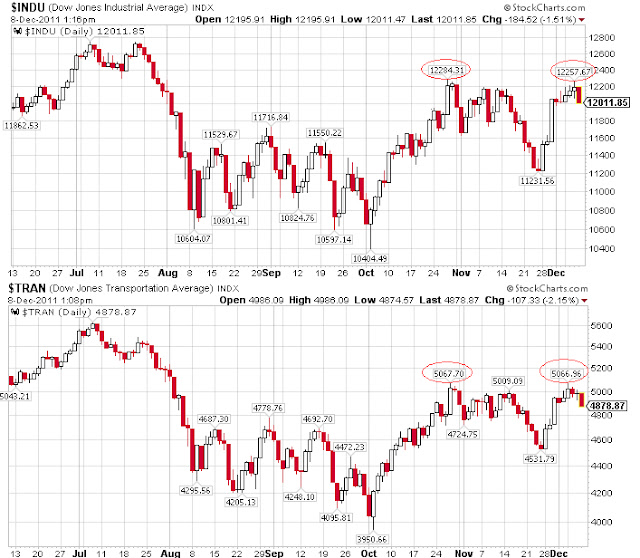
The market recovered this week and gained 1.3%. The Dow broke above its previous high of 12,426 but the Transports are about 88 points (1.6%) away from the high. Next week UPS (UPS) earnings could guide us with the direction of the transports.

Our watch list this week contains 23 companies that are within 11% of their 52-week low.

April 22, 2011 Watch List

Symbol Name Price % Yr Low P/E EPS (ttm) Dividend Yield Payout Ratio
WABC Westamerica BanCorp.  48.73 1.25% 15.18 3.21 1.44 2.96% 45%
HCBK Hudson City Bancorp, Inc. 9.46 1.94% 8.68 1.09 0.60 6.34% 55%
MCY Mercury General Corp. 38.47 3.16% 13.84 2.78 2.40 6.24% 86%
SJW SJW Corp. 22.96 3.19% 17.66 1.30 0.69 3.01% 53%
TGT Target Corp. 49.9 3.46% 12.48 4.00 1.00 2.00% 25%
HGIC Harleysville Group Inc.  31.82 4.98% 13.15 2.42 1.44 4.53% 60%
SFNC Simmons First National Corp.  25.66 6.12% 11.93 2.15 0.76 2.96% 35%
SYY Sysco Corp. 29 6.89% 14.95 1.94 1.04 3.59% 54%
BMI Badger Meter, Inc. 36.33 6.92% 20.53 1.77 0.56 1.54% 32%
CHFC Chemical Financial Corp.  20.11 7.05% 22.85 0.88 0.80 3.98% 91%
WEYS Weyco Group, Inc.  24.02 7.76% 20.18 1.19 0.64 2.66% 54%
NWN Northwest Natural Gas Co. 45.24 7.97% 16.57 2.73 1.74 3.85% 64%
TRH Transatlantic Holdings, Inc. 47.69 8.19% 7.70 6.19 0.84 1.76% 14%
SYBT S.Y. BanCorp., Inc.  24.2 8.57% 14.49 1.67 0.72 2.98% 43%
CWT California Water Service 36.73 8.64% 20.29 1.81 1.23 3.35% 68%
NTRS Northern Trust Corp.  49.38 9.01% 18.02 2.74 1.12 2.27% 41%
VLY Valley National BanCorp.  13.47 9.25% 16.63 0.81 0.72 5.35% 89%
HTLF Heartland Financial USA, Inc.  15.1 9.66% 13.36 1.13 0.40 2.65% 35%
CMA Comerica, Inc. 36.31 9.66% 41.26 0.88 0.40 1.10% 45%
AWR American States Water Co. 34.39 10.08% 19.43 1.77 1.04 3.02% 59%
CL Colgate-Palmolive Co. 80.65 10.30% 18.71 4.31 2.32 2.88% 54%
KMB Kimberly-Clark Corp. 66.05 10.88% 14.84 4.45 2.80 4.24% 63%
MRK Merck & Co., Inc 34.04 10.88% 121.57 0.28 1.52 4.47% 543%
23 Companies


Watch List Summary

On the top of our list this week is Westamerica BanCorp (WABC).  According to IQTrends (www.iqtrends.com), this stock is undervalued at 3.5% dividend yield. While the yield of 2.96% doesn't quite get us there, the price-to-book-value of 2.59 is rather interesting because this stock typically trade over 3x book value. See this chart for more details. In addition to that, dividends have been steady throughout this crisis and recovery (see chart).  The payout ratio of 45% implies that earnings can fall 50% and they would still be able to cover the dividend. With next year earnings estimate to be at $3.34 compared to $3.21, we can assume that a dividend cut is unlikely.

Another interesting name is Mercury General (MCY) which trades at a little above 1x book. This is far below the historical average (see chart).  IQTrends estimated that anytime this stock dividend yield reaches 4.5%, it becomes undervalued. The current yield of 6.24% provides almost 40% upside just to get back to undervalued range. This stock would have to rise 150% for it to reach the overvalued range.  The payout ratio of 86% is something to be concerned about.  However, 2009 saw the ratio exceed 100% and yet the company continued to keep the dividend moving along.

Top Five Performance Review

In our ongoing review of the NLO Dividend Watch List, we have taken the top five stocks on our list from April 23, 2010 and have checked their performance one year later. The top five companies on that list can be seen in the table below.
Symbol Name 2010 Price 2011 Price % change
MON Monsanto Co. 65.66 67.52 2.83%
XOM Exxon Mobil Corp.   69.24 86.36 24.73%
LLY Eli Lilly & Co. 35.46 36.26 2.26%
SHEN Shenandoah Telecom 18.00 17.78 -1.22%
T AT&T Inc 26.25 30.68 16.88%


Average 9.09%


DJI Dow Jones Industrial 11,204.28 12,505.99 11.62%
SPX S&P 500 1,217.28 1,337.38 9.87%

The average performance of our top five stocks almost matched the market's performance. Shenandoah (SHEN) underperformed the market and its peer, AT&T (T). This company pays a dividend once a year during November. Any investor looking into this stock should be aware of this. Please note that these figure exclude dividends and are based purely on price appreciation.

Disclaimer:

On our current list, we excluded companies that have no earnings. Stocks that appear on our watch lists are not recommendations to buy. Instead, they are the starting point for doing your research and determining the best company to buy. Ideally, a stock that is purchased from this list is done after a considerable decline in the price and extensive due diligence. We suggest that readers use the March 2009 low (or the companies' most distressed level in the last 2 years) as the downside projection for investing. Our view is to embrace the worse case scenario prior to investing. A minimum of 50% decline or the November 2008 to March 2009 low, whichever is lower, would fit that description. It is important to place these companies on your own watch list so that when the opportunity arises, you can purchase them with a greater margin of safety. It is our expectation that, at the most, only 1/3 of the companies that are part of our list will outperform the market over a one-year period.


Please revisit New Low Observer for edits and revisions to this post. Email us.