Canadian Dividend Watch List: January 13, 2015

Performance Review

Below is the performance of the stocks found on our January 15, 2014 watch list.

Symbol Name 2014 2015 % change
FTS.TO Fortis Inc. 30.41 39.29 29.20%
CUF-UN.TO Cominar REIT 18.43 19.31 4.77%
D-UN.TO Dundee REIT 29.63 26.72 -9.82%
FCR.TO First Capital Realty Inc. 17.45 19.5 11.75%
CWT-UN.TO Calloway REIT 25.32 30.14 19.04%
REI-UN.TO Riocan REIT 24.98 28.86 15.53%
ESI.TO Ensign Energy Services Inc. 16.22 9.44 -41.80%
CAR-UN.TO Canadian Apt Properties REIT 21.51 27.12 26.08%
EMA.TO Emera Incorporated 31.17 39.44 26.53%
TA.TO TransAlta Corp. 13.95 10.85 -22.22%
LB.TO Laurentian Bank of Canada 46.29 47.49 2.59%
CU.TO Canadian Utilities Ltd. 36.65 41.69 13.75%
Average 6.28%

At the time, we re-ranked the stocks based on the projected price change using analyst earnings estimates.  In our analysis we said the following:

“Through a process of elimination, we would start with the stocks that are expected to decline the most in value over the next year.”

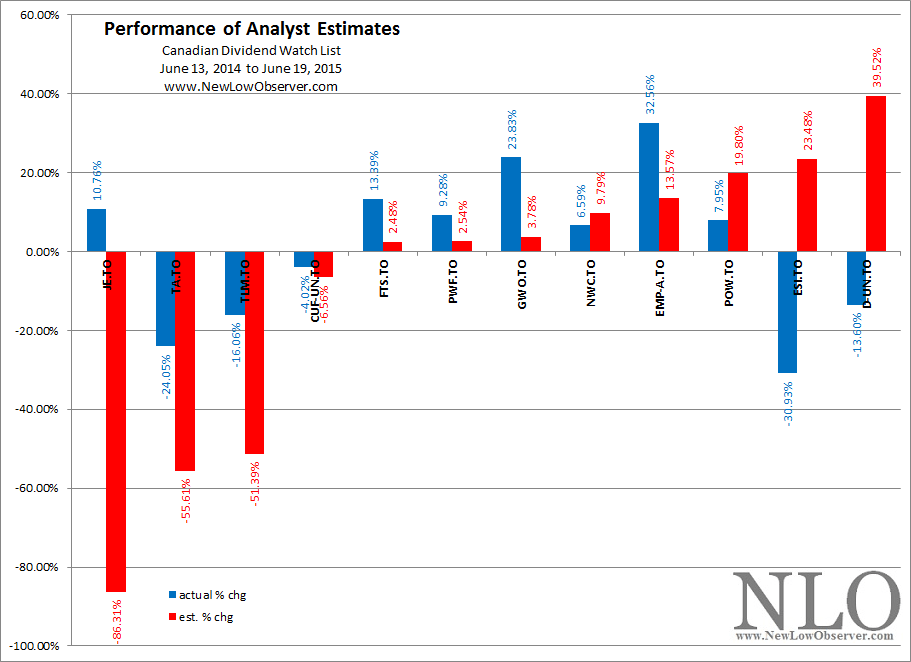
The chart below shows how the analyst estimates in blue varied dramatically compared to the actual performance in red after a year.

image

Again, the analyst estimates of earnings and our projections indicate that analysts will typically over-estimate the upside and downside prospects for a company.  In addition, analysts often mirror the current market sentiment for a company rather than take a view that comes in conflict with prevailing “wisdom.” In many respects, this allows for better anticipation of company prospects, provided the market retains its bullish mood.

Canadian Dividend Watch List: January 13, 2015

Below are the thirteen Canadian companies that are on our radar with the analyst estimates for the coming year.

Analyst Estimates

Below are the price projections based on analyst earnings estimates for the stocks on our recent Nasdaq 100 Watch List dated January 9, 2015.  These estimates project the 1 year price change for the respective stocks.

Consequences of Falling Oil Prices

Economic events never occur in a vacuum.  Usually there is a string of events that leads from one event to another. One big event can lead to an even bigger event that overshadows the prior calamities that triggered “The Big” event.  The February 9, 1983 issue of Richard Russell’s Dow Theory Letters covers  one market event that led to two major crises that happened at different periods in time.  The two events are joined at the hip based on the decline of oil prices.  This led two separate major bailouts that resulted in the structural shift in the way our brand of capitalism works.

The first event resulted in the Savings and Loan Crisis (S&L Crisis) and is thought to have begun in 1986 due to the Tax Reform Act of 1986 culminating in the bailout of many banks and the eventual bankruptcy of the Federal Savings and Loan Insurance Corporation (FSLIC).

The second event resulted in the Mexican Peso Crisis with the outcome that major banking institutions like Citibank and Goldman Sachs needed to be bailed out.  It is important to note that the Peso Crisis is considered to be as a result of the peso devaluation in 1994.

The true roots of both the S&L Crisis and the Peso Crisis is the decline of oil prices after the inflationary peak in 1980-1981.  Richard Russell’s Dow Theory Letter Issue 854 highlights the seeds of destruction that were going to be much larger than even Russell could have imagined. However, if anyone wishes to understand how the snowball got rolling then this issue highlights the beginning.

The very first quote is an amazing insight of the American dependence of the high price of oil, Richard Russell says the following:

“We’re facing a situation (ironically) where the US is all for holding oil prices at a high level. The banks have lent huge sums of money both to private corporations and to oil producing nations-loans based on rising oil prices. If the oil price cracks badly,  the banks are going to have major problems. On top of that, the US depends on oil taxes (so called “excess profits” tax) for huge chunks of tax income. If oil prices crack then the profits for the oil companies will dive (which they are already doing) and the tax short-fall will be horrendous. (page 1)”

This commentary is staggering in the fact that it was so prescient.  The cracks in the armor of the American oil industry began in Texas when the easy money stopped raining down on oil dependent cities like Houston and Dallas.  In a 1988 issue of Dow Theory Letters, Russell had the following to say:

“With oil prices caving in, Texas now has more people leaving the state than coming in.( Dow Theory Letters. March 9, 1988. page 6.)”

The decline in oil prices led to a decline of jobs for that industry which resulted in a decline in real estate prices as people left the state of Texas.  Loans made by savings and loan institutions in the southwest U.S., to businesses and real estate investors, all went bad at the same time leading to the Savings and Loan Crisis (S&L Crisis).  The S&L Crisis cost several hundreds of billions of dollars and still exist as an off-budget item as part of our national debt.

The decline in the price of oil also crushed foreign economies dependent on the commodity.  The Mexican Peso Crisis, although officially listed as beginning in 1994, had its roots in the early 1980’s.  The natural outcome of this crisis was the bailout of large banking institutions like Citibank and Goldman Sachs when the government stepped in and bought the bad debt held by the bank’s all in gamble.

Likewise, the current boom in commodity rich countries (although somewhat cooler at present) like Australia, Brazil, Russia, China and India could experience significant shocks to their system depending on the level of loans made as “investments” by foreign banking institutions based on the potential of future growth.

Few understood or believed the impact and importance of high oil prices to the American economy at the time.  Even fewer understood the direct reliance of the U.S. government to high oil prices.  Investors should watch for the potential fallout that may arise from the recent precipitous decline in the price of oil.  The troubles afflicting Russia and Brazil’s Petrobras may be early indications of where the pain may be felt.

Nasdaq 100 Watch List: January 9, 2015

Performance Review

Below is the performance of the seven stocks from the January 10, 2014 Nasdaq 100 watch list compared to the performance of the Nasdaq 100 Index in the last year.

Symbol Name 2014 2015 % change
ALTR Altera Corp. 31.47 36.96 17.45%
SHLD Sears Holdings 36.71 34.3 -6.56%
GOLD Randgold Resources 61.57 74.91 21.67%
MXIM Maxim Integrated Products 28.15 32.99 17.19%
CHRW CH Robinson Worldwide 57.7 72.06 24.89%
EBAY eBay Inc. 52.16 55.63 6.65%
FAST Fastenal Company 47.7 45.99 -3.58%
  Average change 11.10%
         
  Nasdaq 100     18.18%

As a group, the stocks on our list underperformed the Nasdaq 100 by a wide margin. The first five stocks on our list averaged a gain of +14.92%.  Two stocks that we took positions in at the time were Altera (ALTR) and Randgold (GOLD).

Analyst Review

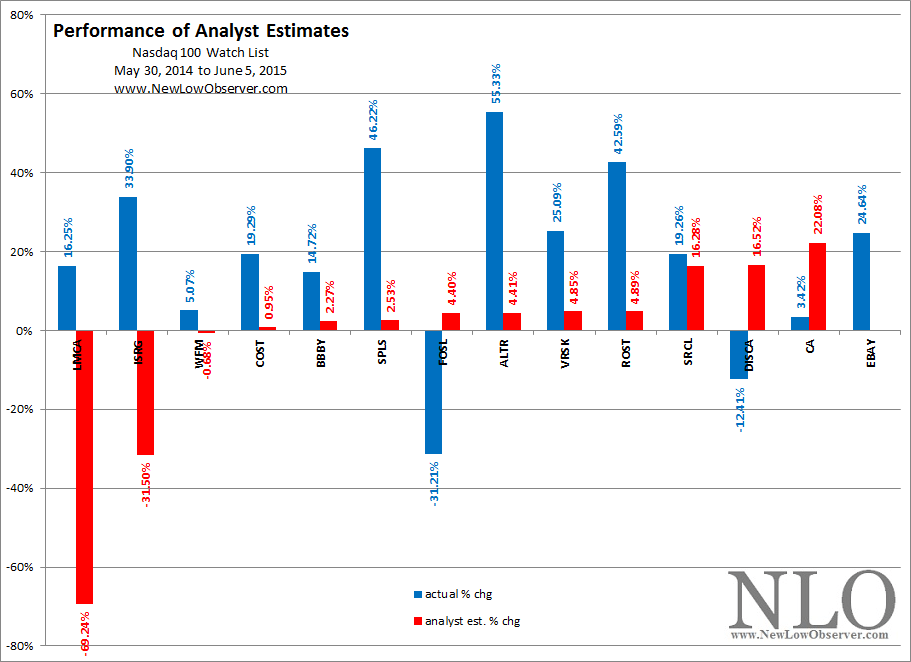
The chart below is what the analysts suggested the stocks would do…

image

…This is the graphical representation of what actually happened.

image

The observation of the data should be clear, the analysts expected declines for the coming year and the opposite occurred.  The projections were that Randgold (GOLD) would decline by nearly –50% and the stock increased by +21.67%.  From our perspective, the analysts provide a reasonable sound board for what to anticipate, as has been demonstrated with our Canadian and U.S. Watch Lists.

Nasdaq 100 Watch List: January 9, 2015

Below are the nine Nasdaq 100 companies that are on our radar.

Gold Stock Indicator: January 9, 2014

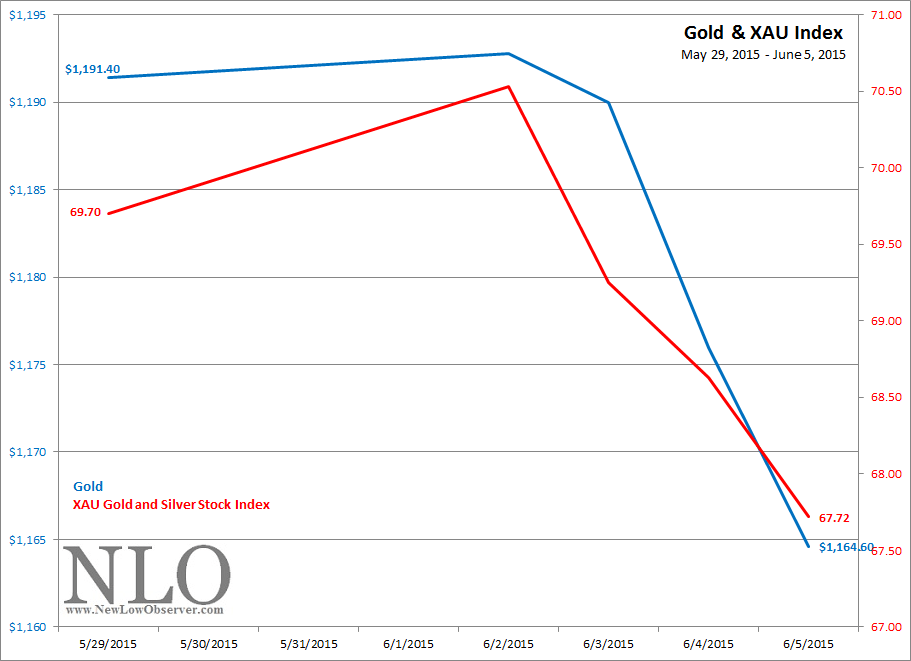
Gold, as represented by the SPDR Gold Trust (GLD), gained +1.89% while gold stocks, represented by the Philadelphia Gold and Silver Stock Index (XAU), gained +7.26% in the last week.

image 

Scary 1929 Chart Nearly One Year Later

In February of 2014, a widely publicized chart circulated about the similarity between a 1928-1929 stock chart and a 2012-2013 chart.  According to Tom McClellan of the McClellan Market Report:

“…between now [February 11, 2014] and May 2014, there is plenty of reason for caution.”

Since February 11, 2014, the Dow Jones Industrial Average has increased +11.06%.  In the period from February 11th to May 31st the index gained +4.52%.  So far, the scary 1929 chart has not held up to the lofty claim of presaging a bear market or a even a –10% decline.  We offered up our own interpretation regarding the chart and said the following:

“We love a declining stock market as much as the next value investor. However, implying that an -89% decline is in the works because the pattern appears similar to 1929 is ignoring the path to far more achievable downside targets.”

Our preliminary downside targets seemed reasonable at the time but were never achieved.  One downside target that we thought was important was the ascending trendline from the 2009 low.

image

We still think that investors should watch the ascending line in the chart above, which currently sits at the 15,780 level.  An additional downside target is the Dow Theory 50% Principle level of 12,286.68.

Commodity Index Review

On October 29, 2013, we did a review of the Dow Jones-UBS Commodity Index (now the Bloomberg Commodity Index [BCOM]) in which we concluded with the following commentary:

“Already we have indicated the extreme downside target for the commodity index at 79.32, based on the work of Edson Gould’s Speed Resistance Lines.  However, if we are in a commodity bull market, as we’ve made reference to in our January 1, 2009 article titled (found here), then there is a good chance that a bounce at the long-term technical support line would mark the end of the cyclical bear move in commodities.”

All along it had been our contention that if the commodity index bounced at the long-term technical support line then the declining trend would be over.  Unfortunately, that bounce never came to pass.  Only on a marginal basis did the price decline stall on or around mid-November 2014.

Since mid-November 2014, the Bloomberg Commodity Index has been in a free fall.  All that we can expect now is for the commodity index to decline to the following downside targets at 102, 83 and finally the extreme downside target of 79.26.

image

Oil and Gas Stock Index Downside Targets

In the period from 2002 to 2009, the NYSE Oil and Gas Stock Index (XOI) presents us with a possible template for what to expect in the current decline in the same index.  Below is Gould’s Speed Resistance Lines (SRL) for 2002 to 2009 of the XOI Index.

image

The above chart shows the conservative downside target of 1,326.48 and the extreme downside target of 543.36.  The mid-point of the downside targets is 934.92.  In the case of the XOI index, it managed to achieved the conservative and mid range for the index.  However, the extreme downside target was not achieved.  The full extent of the decline is indicated in red at the 761.30 level.

Our guess is that the XOI index will accomplish a similar pattern of “performance” on the downside in the current run as was the case in the 2002 to 2009 period.  We’ve charted the progress of the XOI Index in the period from 2008 to the present with Gould’s SRL.

image

The conservative downside target of 1,454.79 has been constructed while the mid-point of 1,015.10 is also indicated.  However, we did not include the extreme downside target of 575.41.  We did indicate in red the 812.08 level which was the extent of the decline in the period from the 2008 high to the 2009 low. 

Suffice to say that we expect the XOI index could easily fall to 1,015.10 and subsequently to the 812.08.  Those interested in the oil sector should start initiating positions at or below the ascending 1,015.10 level.  Two funds that trade in line with the XOI index are PowerShares DB Oil ETF (DBO) and Direxion Daily Energy Bull 3x (ERX).  One ETF that trades the opposite of the XOI index is the Direxion Daily Energy Bear 3x (ERY).

The Real Heavy Hitters of the Dow

On January 5, 2015, Yahoo!Finance published an article titled “CAT Crushing the Dow” in which it indicated:

“Caterpillar (CAT) is getting smacked down by nearly 4% adding considerably to the Dow's (^DJI) pain. The earth moving machine maker was downgraded to underweight from neutral by analysts atJPMorgan (JPM).  The team notes that crude is now down some 50% and that's probably going to be a headwind for companies like CAT that make machines that in part help other companies find oil. Beware of obvious downgrades in skittish tapes.”

On the surface, the fact that CAT ultimately closed down –5.28% clearly impacted the Dow.  In fact, CAT was the stock that had the largest percentage decline of all the stocks in the index.  However, looking at the stocks that are part of the Dow Jones Industrial Average and noting that it is a price weighted index we can easily see that far from “…adding considerably to the Dow’s pain…”, CAT was merely a footnote in the decline of the index.

Below is the ranking of the Dow stocks from the most impact to the least for January 5, 2015.

Symbol Name Price pt. decline % decline % impact on Dow
V Visa Inc. 259.17 -5.85 -2.21% 20.72%
GS Goldman Sachs Group, Inc. 188.34 -6.07 -3.12% 11.05%
MMM 3M Company 160.36 -3.7 -2.26% 7.94%
IBM IBM 159.51 -2.55 -1.57% 7.81%
BA Boeing Company 129.05 -0.9 -0.69% 5.06%
UTX United Technologies 113.12 -1.92 -1.67% 3.92%
CVX Chevron Corporation 108.08 -4.5 -4.00% 3.67%
TRV Travelers Companies, Inc. 104.17 -1.27 -1.20% 3.32%
JNJ Johnson & Johnson 103.79 -0.73 -0.70% 3.27%
HD Home Depot, Inc. 101.26 -2.17 -2.10% 3.16%
UNH UnitedHealth Group 99.12 -1.66 -1.65% 3.01%
NKE Nike, Inc. 93.5 -1.53 -1.61% 2.68%
DIS Disney Company 92.38 -1.37 -1.46% 2.62%
MCD McDonald's Corp. 92.23 -1.03 -1.10% 2.60%
AXP American Express Company 90.56 -2.46 -2.64% 2.54%
XOM Exxon Mobil Corporation 90.29 -2.54 -2.74% 2.53%
PG Procter & Gamble Company 90.01 -0.43 -0.48% 2.46%
CAT Caterpillar Inc. 87.03 -4.85 -5.28% 2.41%
WMT Wal-Mart Stores Inc. 85.65 -0.25 -0.29% 2.22%
DD du Pont de Nemours 71.72 -1.99 -2.70% 1.59%
JPM JPMorgan Chase & Co. 60.55 -1.94 -3.10% 1.14%
MRK Merck & Co. Inc. 58.04 0.85 1.49% 1.00%
VZ Verizon Communications Inc. 46.57 -0.39 -0.83% 0.66%
MSFT Microsoft Corporation 46.33 -0.43 -0.93% 0.65%
KO Coca-Cola Company 42.14 0 0.00% 0.54%
INTC Intel Corporation 35.95 -0.41 -1.13% 0.39%
T AT&T, Inc. 33.55 -0.32 -0.94% 0.34%
PFE Pfizer Inc. 31.16 -0.17 -0.54% 0.30%
CSCO Cisco Systems, Inc. 27.06 -0.55 -1.99% 0.22%
GE General Electric Company 24.6 -0.46 -1.84% 0.19%

Of the 30 stocks, CAT was ranked 18th in terms of impact on the decline in the index.  This is a far cry from dragging the Dow lower.  What is most interesting is that the decline of Boeing (BA) had nearly four times the impact on the index than did CAT even though BA declined only -0.69%. 

What investors really don’t want or need is for the first five stocks (V, GS, MMM, IBM, BA) to have a bad day at the same time as these stock comprise 52% of the Dow’s movement.

Best Buy’s New Normal

On January 17, 2014, we posted Edson Gould’s Speed Resistance Lines for Best Buy (BBY) in an attempt to determine what the extent of the decline might be.  From that posting we said the following:

“Best Buy has had a history of resting [at] the extreme downside target, currently at $14.78.  However, we have split the difference and placed an intermediate downside support level of $22.34.  Again, this is not a recommendation to buy or sell Best Buy, instead, it is an attempt to observe how closely the stock will adhere to the SRLs indicated in the chart.”

image 

Nearly one year later, we can see that although the historical trend had been for BBY to decline to the extreme downside target ( at $14.78), the estimate of $22.34 was a fair assessment of downside risk as the stock has managed to vacillate at or above the ascending $22.34 level seen below.

image

The quality of Gould’s SRL has been fairly consistent and reasonably accurate.  We look forward to introducing additional SRLs of stocks that have established a declining trend to determine downside targets.  The conservative upside target for BBY is $44.85.

Gold Stock Indicator: January 2, 2015

Overall, a quiet couple of weeks for gold and gold stocks as represented by the gold ETF and XAU index, respectively.

image

Continue reading

2015 Estimated Price Changes for Dow Industrials

Below are the estimated price changes for the components of the Dow Jones Industrial Average in the coming year.  The price estimates are based on the current analyst low expectation of annual earnings assuming the stock retains the p/e ratio at the end of 2014.

image

Our experience has been that stocks that are expected to underperform generally do much better than those stocks that are expected to increase in the coming year.

As a test, we’re comparing the performance of the “end of 2014 p/e ratio” against the performance of the stocks if they all had a p/e ratio of 15 as depicted below.

image

Dogs of the Dow – A Look Back at 2014 & Forward to 2015

As the year 2014 comes to an end, we can't help but review a strategy known as The "Dogs of the Dow" which suggests that investors buy the top ten highest yielding stocks from the Dow Jones Industrial Average at the beginning of the year. The table below highlights the performance of the 2014 "Dogs of the Dow."

Dog of the Dow 2014

Ticker Company Beginning of 2014 Price End of 2014 Price Dividend  Yield (1/1/2014) Dividend Yield (12/31/2014) YTD % Chg
T AT&T, Inc.  35.16    33.6 5.2% 5.5% -4.5%
VZ Verizon Communications Inc.  49.14    46.8 4.3% 4.6% -4.8%
MRK Merck & Co. Inc.  50.05    56.8 3.5% 3.1% 13.5%
INTC Intel Corporation  25.96    36.3 3.5% 2.5% 39.8%
PFE Pfizer Inc.  30.63    31.2 3.4% 3.3% 1.7%
MCD McDonald's Corp.  97.03    93.7 3.3% 3.5% -3.4%
CVX Chevron Corporation 124.91  112.2 3.2% 3.8% -10.2%
GE General Electric Company  28.03    25.3 3.1% 3.5% -9.8%
CSCO Cisco Systems, Inc.  22.43    27.8 3.0% 2.7% 24.0%
MSFT Microsoft Corporation  37.41    46.5 3.0% 2.5% 24.2%
  Dog of the Dow Average     3.56% 3.49% 7.04%
S&P 500 1831.98 2058.9 12.39%
Dow Jones Industrial Average 16441.35 17823.07 8.40%

The overall performance of the group was subpar when compared to the S&P 500 but nearly matched the performance of the Dow Jones Industrial Average.

Looking at the subgroup, within the top ten highest yielding stocks, you can clearly see that the big name technology companies outperformed the market, with Intel (INTC) gaining as much as +40%. Not only was Intel the best performer in the group but it was also the best performer in the entire index.

Cisco (CSCO) and Microsoft (MSFT) also had exceptional gains for the year, excluding dividend, of +24%. The worst performing was Chevron (CVX) which was hit by the large declines in the price of oil.

Looking broadly at the index, it was the energy sector and large industrial companies such as General Electric (GE) that was hit the hardest. Large telecoms like AT&T (T) and Verizon (VZ) didn't do as well but their large dividends provided enough of a buffer that the total return was in positive territory.

While we don't have a strong view of the strategy, whether it works or not, we are often curious about the actual performance of other strategies. As such, the table below highlight the 10 companies that are consider the Dogs of the Dow for 2015.

Ticker Company Beginning of 2015 Price Dividend  Yield (1/1/2015)
T AT&T, Inc.  33.59 5.5%
VZ Verizon Communications Inc.  46.78 4.6%
CVX Chevron Corporation 112.18 3.8%
GE General Electric Company  25.27 3.5%
MCD McDonald's Corp.  93.70 3.5%
PFE Pfizer Inc.  31.15 3.3%
MRK Merck & Co. Inc.  56.79 3.1%
XOM Exxon Mobil Corporation  92.45 2.9%
KO The Coca-Cola Company  42.22 2.9%
CAT Caterpillar Inc.  91.53 2.8%
  Dog of the Dow Average   3.59%

It shouldn't surprise anyone that many companies which appeared on the 2014 list are also in the 2015 list. Interestingly, this list consists of various sectors. The telecom sector generally has the largest payout of dividends which put AT&T (T) and Verizon (VZ) on the list by default.

The energy sector has two companies, Chevron (CVX) and Exxon (XOM). Sectors that rely heavily on consumer discretionary spending are McDonald's (MCD) and Coca-Cola (KO). If you believe in big pharma, look no further than Pfizer (PFE) and Merck (MRK). Last but not least are the large industrial names which are pegged to world growth, Caterpillar (CAT) and General Electric (GE).

It seems that investors can select a winner based on the sector that they believe to be the top "theme" for 2015 but a study of what has worked in 2014 may provide some edge to how one can maximize the use of this list.

Technology companies obviously did extremely well in 2014 and if you look back the normal dividend yield for the sector, you would see that they're in the range of 2.0% - 2.5% yield. At the beginning of 2014, Intel was yielding 3.5%, Microsoft and Cisco both yield 3.0%.

Clearly all companies were trading much higher than their historical average yield. As for the strategy highlighted in Dividend Don't Lie by Geraldine Weiss, we should really look at the relative yield rather than the absolute yield when assessing the valuation of a company.

Quick Take: Hyster-Yale Materials

On October 1, 2012, Hyster-Yale Materials (HY) was spun off from Nacco Industries (NC).  Nacco has been a company of particular interest to us since it has increased the dividend every year for nearly 29 years in a row.

Continue reading

Analyst Estimate: U.S. Dividend Watch List

Performance Review

On January 16, 2014, we posted a watch list with the analyst estimates for the expected performance for the coming year.  Below are the graphs with the estimated price changes…

image

…followed by the actual changes as of December 29, 2014.

image

Again, the stocks with the lowest expectations outperformed the stocks that had the highest expections, according to their analysts.

Below is a snapshot of the latest analysts low estimated earnings from our recent U.S. Dividend Watch List.