Below is a chart of Sysco Corp. (SYY) from 1974 to 2019 reflecting the year-over-year (YoY) percentage change.
- Japan
- Market Indicator
- Price Momentum Indicators
- Richard Russell
- Silver
- Speed Resistance Lines
- U.S. Dividend Watch List
Below is a chart of Sysco Corp. (SYY) from 1974 to 2019 reflecting the year-over-year (YoY) percentage change.
Below is a chart of Stock Yards Bancorp (SYBT) from 1994 to 2019 reflecting the year-over-year (YoY) percentage change.
Below is a chart of Everest Re Group (RE) from 1996 to 2019 reflecting the year-over-year (YoY) percentage change.
Below are the valuation targets for Everest Re Group (RE) over the next 10 years. Continue reading
Below are the valuation targets for Stock Yards Bancorp (SYBT) over the next 10 years. Continue reading
Below is a chart of Southern Company (SO) from 1982 to 2019 reflecting the year-over-year (YoY) percentage change.
Below are the valuation targets for Southern Company (SO) for the next 10 years. Continue reading
Below is a chart of Dominion Energy (D) from 1981 to 2019 reflecting the year-over-year (YoY) percentage change.
Below are the valuation targets for Dominion Energy (D) over the next 10 years.
Below is a chart of the Dow Jones Industrial Average from 1901 to 2019 reflecting the year-over-year (YoY) percentage change.
Please email us at "nloteam at newlowobserver dot com" for an updated to this chart.
The NLO team executed the following transaction(s): Continue reading
Nordstrom (JWN), a major luxury retailer, has been struggling this year. The stock has fallen -27% and we would like to explore a technical pattern call the Golden Cross to see how well the indicator holds up with Nordstrom.
Here’s a general overview of the Golden Cross as defined by Investopedia.
The golden cross is a candlestick pattern that is a bullish signal in which a relatively short-term moving average crosses above a long-term moving average. The golden cross is a bullish breakout pattern formed from a crossover involving a security's short-term moving average breaking above its long-term moving average or resistance level.
In our observation, we’ve chosen to use the 50 day moving average as the short-term period and the 200 day moving average as the long-term period of review. Based on our data going back to 1982, this strategy has produced positive returns approximately 65% of the time, assuming we sell the stock within 253 trading days (or approximately 1 year) after the signal is triggered. The table below provides the details. Continue reading
History:
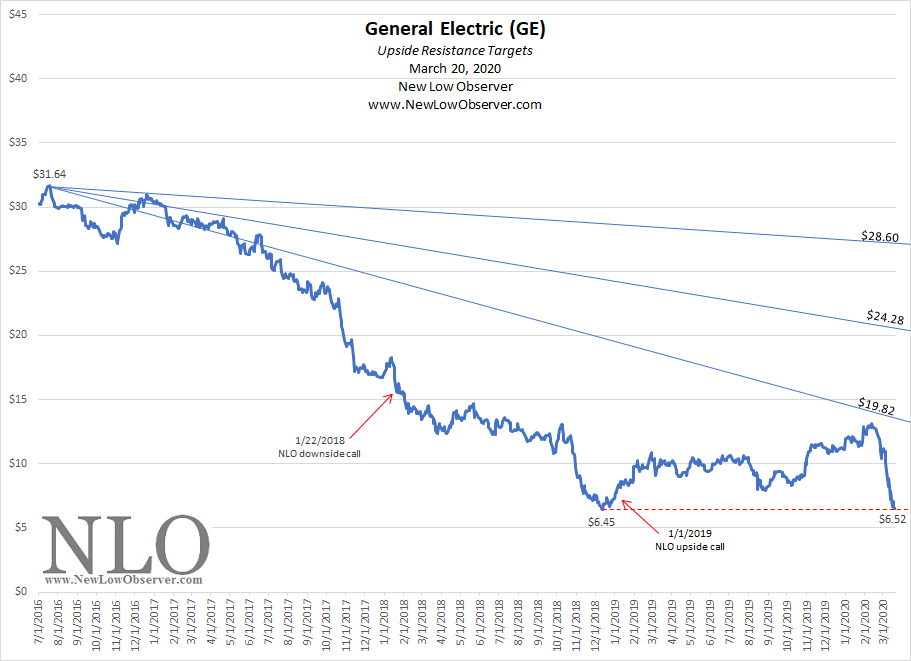
Revised GE Upside Targets
After demonstrating a history of consistency, in terms of the general trend in the stock price of General Electric, we must revise the Speed Resistance Lines that were issued in January 1, 2019 to more accurately reflect the changes that have occurred in the last 11 months.
The upside resistance targets are as follows:
It would be a major coup for the price of General Electric to exceed the conservative upside resistance target at $19.05. For now, we will reiterate that almost all stocks achieve the conservative targets through either the passage of time or increase/decrease in price.
As was said in January 2019, “GE could achieve all of the designated upside resistance targets and still be in a declining trend.”
Posted in Edson Gould, GE, General Electric, upside target
In our early October 2019 posting, we outlined the parameters for what we expected for the Hang Seng index. In spite of the recent increases, everything is lining up, so far. Continue reading
The NLO team executed the following transaction(s):