We executed the following transaction(s):
- Japan
- Market Indicator
- Price Momentum Indicators
- Richard Russell
- Silver
- Speed Resistance Lines
- U.S. Dividend Watch List
We executed the following transaction(s):
On August 31, 2015, we reviewed the Bloomberg Commodity Index had the following to say:
“While achieving the extreme downside target doesn’t mean that the decline in the index has ended, the majority of the decline from the 2008 peak is behind us.”
“We believe that those interested in the investment opportunities in commodity stocks should review the top tier stocks that have 7% or more individual commodity weighting in the Bloomberg Commodity Index.”
Based on that assessment, the following sectors would have been represented in individual commodity stocks:
What has been the sector ETF performance of the related categories? Below is the respective charts with percentage change:
The gold ETF rose as high as +117% and currently sits with gains of +75%. Notice that there was marginal downside action for the sector after September 4, 2015.
The copper miner ETF did not fair as well immediately after September 2015, falling as much as –40%. However, the recover has been dramatic with the ETF chalking up an “in-line” performance with the gold ETF at +68% gains.
The Teucrium Corn Fund has underperformed with a decline of –12.78% since the late August 2015 call on commodities. This may be the sector to watch as it may be an outperformer in the category, if market conditions continue.
The United States Oil Fund (USO) has suffered in a similar fashion as the corn fund but by a greater magnitude at a decline of –24%.
Getting crushed in this category was the United States Natural Gas Fund (UNG) with a decline of –42%.
Unsurprisingly, the individual stocks affected by the representative sectors have had much better performance than the sector ETFs with losses. As an example, our real-time purchases of Flowers Foods (FLO), Raven Industries (RAVN) and Helmerich & Payne (HP) had exceptional gains within the context of a declining sector at +36%, +63% and +74%, respectively. Each of these stocks are heavily impacted by the segments of the above sectors of the Bloomberg Commodity Index. The dichotomy between the commodity and the representative stocks explains why we have a long-held belief that the stocks are better for investors, in the short and long-term, rather than the pure play on the commodity itself.
Below is the updated review of the Bloomberg Commodity Index (BCOM) and our take on what to expect going forward.
On February 10, 2017, Sears (SHLD) CEO Eddie Lampert put out a press release indicating that the company will generate savings of $1 billion in 2017. The reaction by investors was a staggering +29% increase in the stock price.
Apparently, the timing of the news of “cost savings” managed to coincide with news that the same CEO of Sears just settled a $40 million conflict of interest lawsuit alleging that “…Lampert had stripped the company of its best assets to benefit himself and his hedge fund.” This news was also reported on February 10, 2017 but seemed to have been “overlooked” by the general public or institutional investors may have acted in unison to support the effort to look the other way.
Lampert’s claims that the current efforts will revive Sears fly in the face of overwhelming evidence to the contrary. While Sears continues to pile on debt, the bond rating agencies have negative outlooks on the actual repayment of that debt. Additionally, Sears stock price, since Lampert came on board as CEO, has been in perpetual decline, having fallen more than –80%.
The evidence suggest that the latest news of cost cutting is a cover for the settlement of the lawsuit. As always, “the defendants said in court papers that the $40 million settlement was not an admission that the lawsuit's claims are valid.” We hear this all the time, “I’m giving away $40 million of my assets but the plaintiffs claims are illegitimate.” However, the clear conflict of interest on this matter suggests that anyone who continues to hold their position in Sears will not be rewarded for the value that has been lost since Lampert came on board.
Posted in SHLD
On November 16, 2015, when Gilead Sciences (GILD) was trading at $99 per share, we posted the following long-term downside targets for the stock:
At the same time, we contrasted our downside targets with commentary from TheStreet.com to ensure that there was some balance to the perspective for our readers. TheStreet.com said the following of GILD:
“We rate GILEAD SCIENCES INC (GILD) a BUY. This is based on the convergence of positive investment measures, which should help this stock outperform the majority of stocks that we rate. The company's strengths can be seen in multiple areas, such as its robust revenue growth, notable return on equity, attractive valuation levels, expanding profit margins and good cash flow from operations. We feel its strengths outweigh the fact that the company has had generally high debt management risk by most measures that we evaluated. (TheStreet.com. Gilead Sciences (GILD) Stock Is the ‘Chart of the Day’. Albright, Amanada. November 16, 2015. ”
It is worth noting the buy rating that we gave to GILD on January 14, 2010. At the time, the fundamentals seemed to be supported by the technicals and warranted due diligence and possible acquisition. Below is our revised assessment of Gilead based on the technical attributes which is precipitated by investor reaction to the company fundamentals.
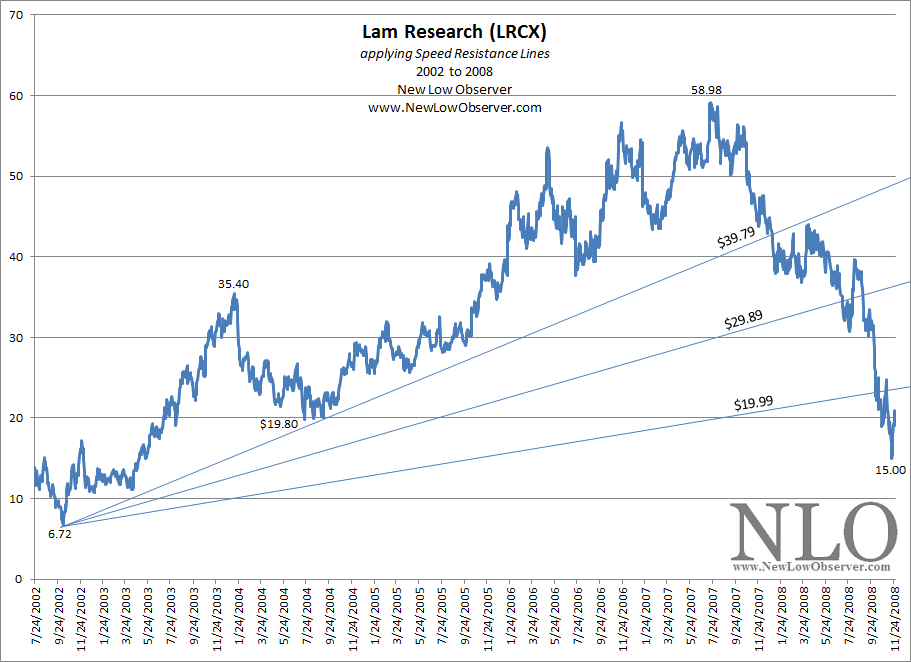
On February 25, 2015, we posted Edson Gould’s Speed Resistance Lines [SRL] for Lumber Liquidator (LL) and Boston Beer Company (SAM). Starting with LL, we said the following:
“Those interested in LL and willing to perform appropriate due diligence could engage in a three phase purchase plan beginning below $39.81, $31.64 and $23.47. Investors, as opposed to speculators, should be willing to accept that there is no compensation for the wait when holding LL and that the decline to the ascending $23.47 level is a real risk.”
Since February 2015, LL has declined to the current level of $15.64. While we might know the exact reasons why LL fell to the current level, we don’t know what to make of the dramatic decline other than the fact that the SRL gave every indication that this was possible. Below is the updated SRL on Lumber Liquidator.
Upon further reflection, we examined the price of Lumber Liquidator and attempted to propose an alternative view on the stock price decline. On March 3, 2015, we proposed the following thesis:
“The coincidence of Lumber Liquidator (LL) declining significantly at the same time as the futures price of lumber (as traded on the Chicago Mercantile Exchange) seems difficult to ignore. Investors should take note of the fact that in three prior periods indicated in blue, LL has lost a minimum of –35% and as much as –53% when the price of lumber declined –33% or more.
“So far, from December 2013 to March 2015, the price of lumber has declined –23% while LL has declined as much as –67.49%. Much of the decline in LL has been exacerbated by concerns related to quality and sourcing of the flooring. However, the current decline is only slightly out of alignment from what has happened in the past.”
Posted in Edson Gould, LL, SAM, SRL
Performance Review
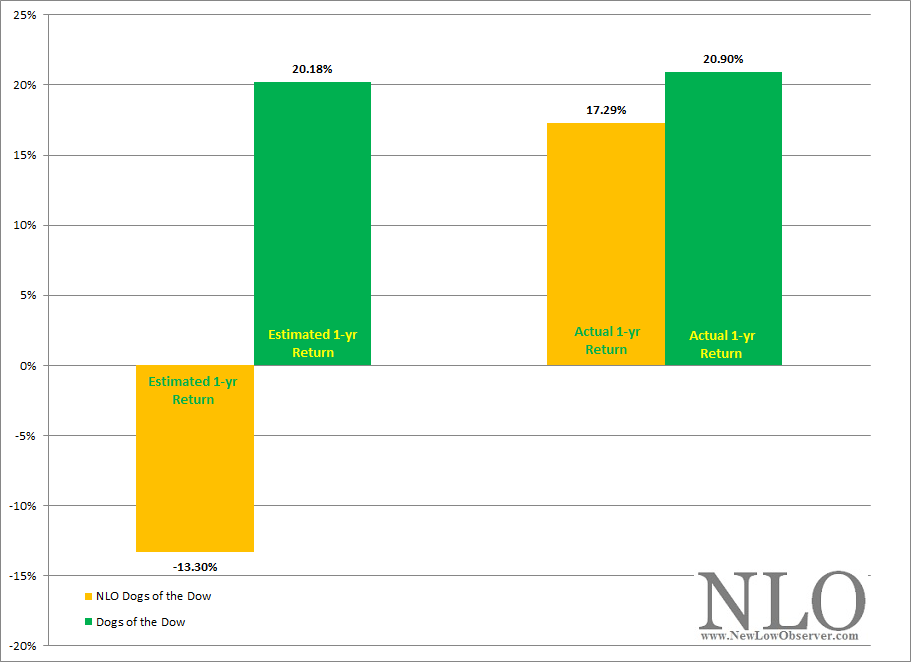
This is a review of the analyst estimates based on the U.S. Dividend Watch List dated February 12, 2016. Companies on the far left were expected by analysts to underperform while companies on the far right were expected to outperform.
This past year was a vindication to analysts and their generally rosy outlook for the stocks that they cover. Average gain for the entire list was 29.15%. In the categories that we have indicated (high return, average return and low return) the group that did the best was the “average prospects, average returns”.
Overall, the various categorizations of the watch list performed in line with our expectations and exceed the most major indexes except the S&P MidCap 400 and the Russell 2000. When an investor can managed to achieve small cap performance with tried & true mid to large-cap stocks, then we know that we’re on the right track.
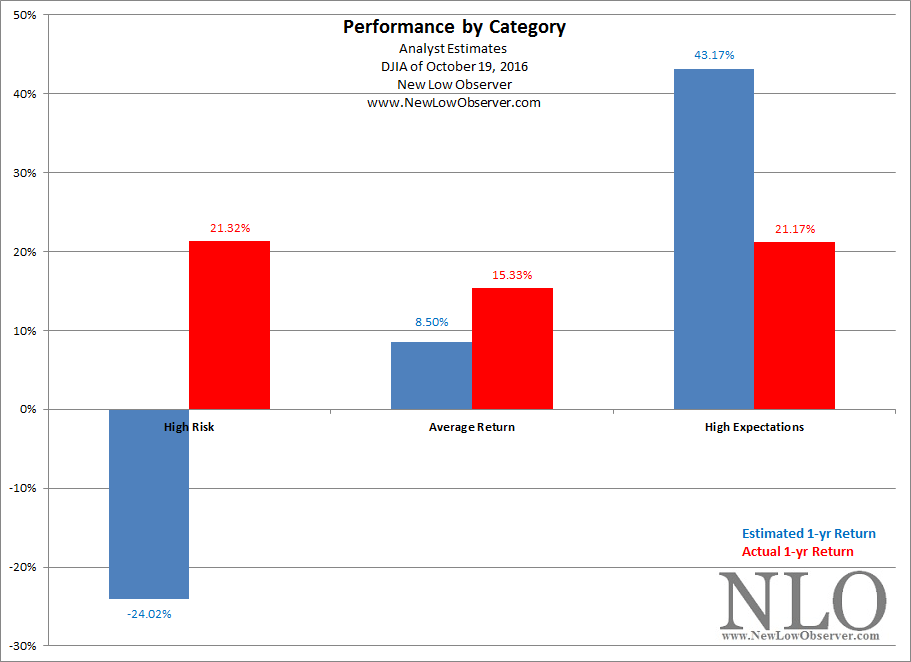
In our continuing effort to refine our investment process, we added a high and low confidence ranking of the analyst estimates of stocks on our watch list. Our thinking was that the low confidence stocks would outperform the high confidence stocks, on the theory that the analysts are usually wrong, most of the time. The actual performance, in the last year, provided resounding evidence that there may be credence to the level of confidence in the range in earnings estimates of the coming year.
Analyst Estimates
Below are the price projections based on analyst earnings estimates for on our recent U.S. Dividend Watch List dated February 3, 2017. These estimates project the price change for the respective stocks over the next 12 months. Additionally, we’ve included the high and low confidence stocks.
We executed the following transaction(s):
In our May 6, 2012 posting on Berkshire Hathaway (BRK-A) titled “Should Berkshire Hathaway Be Trading at 1995 Prices?”, we gave price projections based on Edson Gould’s Altimeter using very conservative estimates if BRK-A paid a dividend.
The data based on that 2012 article has proven to be accurate as we’ve managed to achieve all of the undervalued levels for Berkshire Hathaway since then.
| Year | Undervalued Price |
| 2012 | 158,030.31 |
| 2013 | 173,675.31 |
| 2014 | 190,869.16 |
| 2015 | 209,765.21 |
| 2016 | 230,531.97 |
Below is the remainder of the 10-year price where BRK-A would be considered undervalued. As of February 3, 2017, BRK-A closed at a price of $245,646. Additionally, we’ve included the fairvalue upside target for BRK-A in 2017.
Performance Review
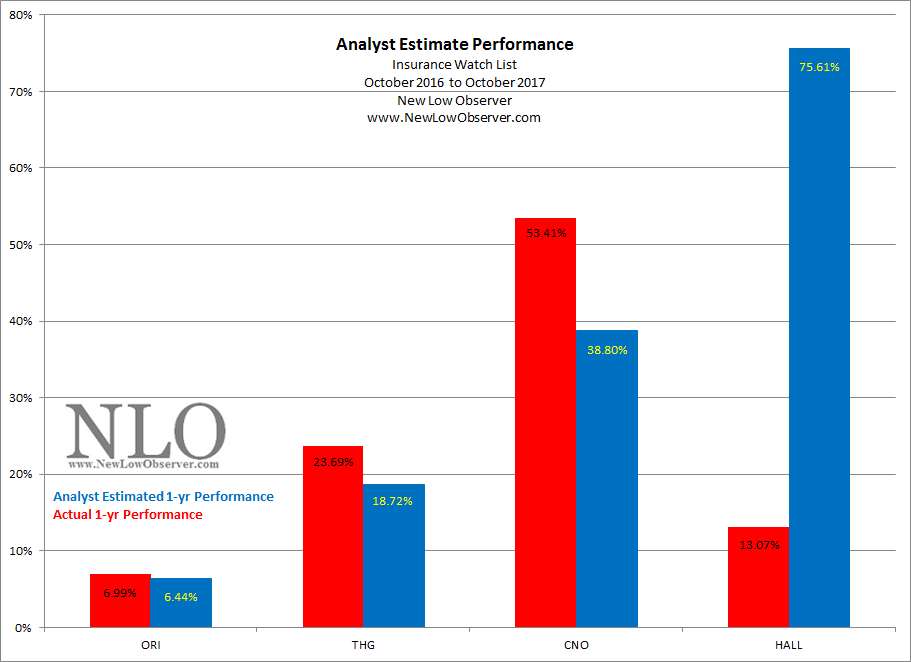
This is a review of the nearly 1-year performance of the Insurance Watch List from February 21, 2016.
On the whole, the analyst estimates for insurance stocks were on target. Although AmTrust Financial Services (AFSI) did not come close to the estimated gain projected on February 2016, at least the price of the stock did not register a loss in the period of time covered.
The bull is back in charge as of Friday and is looking to take the market back to its all-time high. Despite political turmoil and uncertainly, the market appears to be looking onward and forward. At the end of the week, there are 28 companies on our list. Continue reading
Posted in Dividend Achiever Watch List, Dividend Achievers, Dividend Watch List
Tagged members
Some stock market bears think that rising interest rates will end the bull market. History tells a different story. We take the worst case scenario and break it down at the following link (found here).
Posted in bearandbull, cartoon
On our February 17, 2016 Canadian Dividend Watch List we listed quite a few companies. This is a review of standout performers and what investors might want to look for going forward. The first company we’ll highlight is Ag Growth International (AFN.TO). At the time of the watch list, AFN.TO was trading at CAN$26.64. After just short of one year, the stock price for AFN.TO has doubled. Below we have set downside targets and take a look at the Altimeter to determine the best points to buy and sell.
Posted in Uncategorized
Since our last posting on gold and gold stocks (as represented by the Philadelphia Gold and Silver Stock Index [XAU]), the change in price has been +3.28% and +10.64%, respectively.
As of the most recent reading, gold stocks are saying something that has yet to be confirmed by the price of gold. With the price of the XAU increasing above 89.83 level set on November 9, 2016, gold stocks are saying that the trend should be higher. Unfortunately, the price of gold needs to confirm the direction as well. As we know, the price of gold typically lags gold and silver stock but in this case the lag is somewhat large.
On April 5, 2011, we said the following of the downside targets for Teva Pharmaceutical (TEVA):
“Charles H. Dow indicated that the fair value of a stock is the average price that is paid by investors. The fair value is the point at which an investor, as opposed to speculators, will consider buying or selling a stock. The fair value that we’ve arrived is based on the low of July 2006. If Teva were to decline below $47.06, the prospects for $29.77 become almost inevitable.”
Since that article, as TEVA declined below the $47.06 level, the stock eventually declined to the the ascending $29.77 level by November 2013 as seen in the chart below. After hitting the ascending $29.77 level, the price jumped to just north of $72.
We’ll have to accept that this is all mere coincidence and slight of hand rather than any kind of basis in facts. However, our claim has always been, if the target is achieved then review & decide whether to invest or if it is never achieved then move on to other opportunities.
Let’s review the prospects for TEVA under the current price structure which includes the periods since the November 2013 low to the present. But first, you need to see the July 12, 2013 Speed Resistance Lines that we posted for TEVA as it is instructive and in alignment with the Dow Theory targets.

The long-term downside targets for TEVA based on the SRL indicated that the $32.50 level was the time to consider acquisition of the stock. At that time we said the following:
“We could not determine a conservative downside target. Because of this, we had to run some calculations and came up with the trendline of $43.33 and $32.50 as tentative support levels.”
Since TEVA provided the best indications using Dow Theory and came close using Edson Gould’s Speed Resistance Lines, we’re going to give the Dow Theory perspective in the long and short run and see where it takes us.
The above chart indicates that at the current price Teva Pharmaceutical is considered below fair value ($38.23) as long as the fundamental data confirms what the price suggests. Additionally, TEVA seems poised to achieve the downside target of the ascending $26.86 level (approx. $28.50). Purchases of this stock are best made in stages with 50% of allotted funds at the current price and 25%+25% at predefined lower levels.
Posted in Dow Theory, Edson Gould, TEVA, Teva Pharmaceutical
Performance Review
This is a review of the 1-year performance of the watch list from January 29, 2016.
When we review our thesis on the analysts typically being wrong, this watch list is proof that analysts can get it right. Leaving aside the two companies on the far right and left, companies like NetApp, Qualcomm, Cisco, Apple and EBay tore the cover off the ball. The breakdown of our categorizations low, average and high return stocks had the following returns:
The Nasdaq 100, in the period since January 29, 2016, gained +20.38%.
Nasdaq 100 Watch List