Below are the S&P 600 Additions and Deletions from 2003 to 2016.
- Japan
- Market Indicator
- Price Momentum Indicators
- Richard Russell
- Silver
- Speed Resistance Lines
- U.S. Dividend Watch List

Below are the S&P 600 Additions and Deletions from 2003 to 2016.
Posted in S&P 600
Below are the S&P 400 Additions and Deletions from 2003 to 2016.
Posted in S&P 400
Below are the S&P 100 Additions and Deletions from 2004 to 2016. Continue reading
Posted in S&P 100
Below are the S&P 500 Additions and Deletions from 2003 to 2016.
Posted in S&P 500
On April 29, 2014, we posted a chart of Bed Bath & Beyond (BBBY) comparing the price performance of the stock from 2000-2008 and 2008-2014, as seen below:

At the time, we suggested that on a technical basis, BBBY might decline in the post-2008 period as much as the 2000-2008 period, on a percentage basis. Along with the technical perspective on BBBY, we provided downside buy targets based on Dow Theory. The Dow Theory perspective was woefully inadequate compared to the strictly technical downside target provided in the chart above. Below is the updated side-by-side comparison of the 2000-2008 period to the 2008-2017.
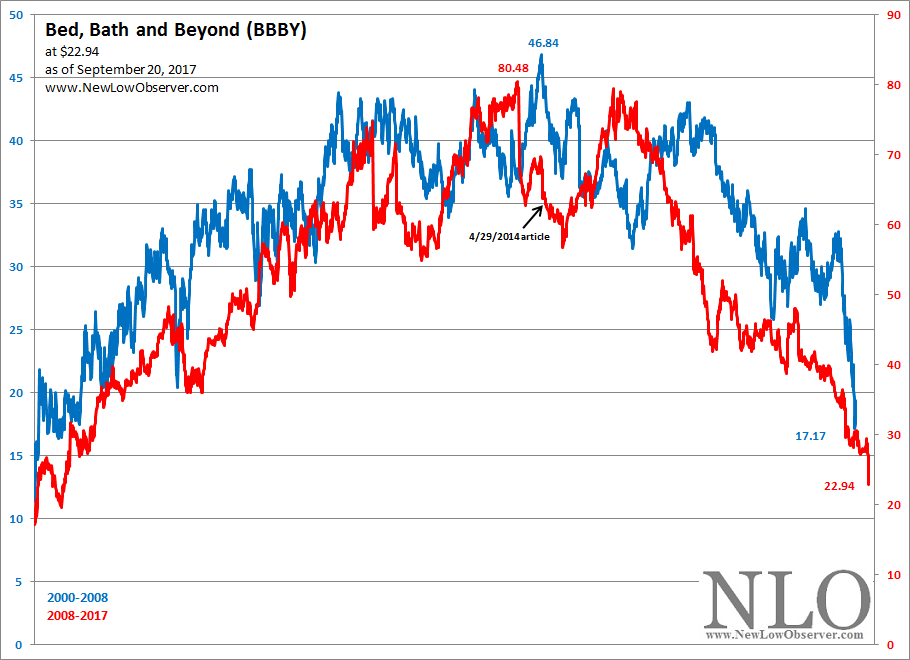
From what we can tell, history is repeating. Then as now, the peak in the price and the relative lows are occurring near each other, in timing. Sharpen your pencils and get your Value Line Investment Survey out, time to verify the numbers and invest accordingly.
Posted in BBBY
Since the beginning of the bull market in 2009, Synopsys Inc. (SNPS) is a stock that has perform in line with the Nasdaq Composite Index until early 2016. Since February 2016, SNPS has accelerated well outside of the historical trend for the stock. While there are many fundamental reasons for excessive gains in the last two years, the gains are still excessive and therefore should, at minimum, revert to the mean.
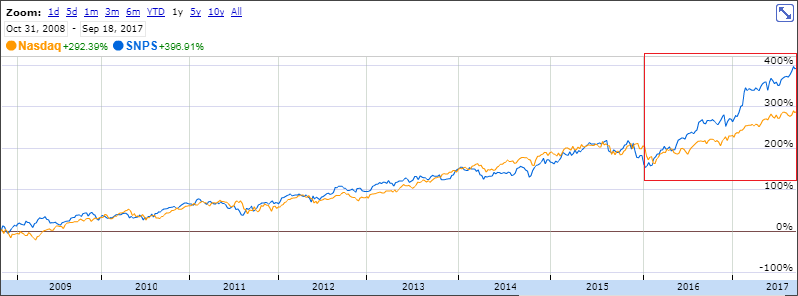
The challenge with reversion to the mean is that the stock price will likely overshoot on the downside. With this in mind we have provided the Speed Resistance Lines indicating the conservative, mid range, and extreme price targets below.
Posted in downside, Edson Gould, SNPS, speed resistance line, SRL
Performance Review
Below are the actual returns from our Canadian Dividend Watch List dated September 2016.
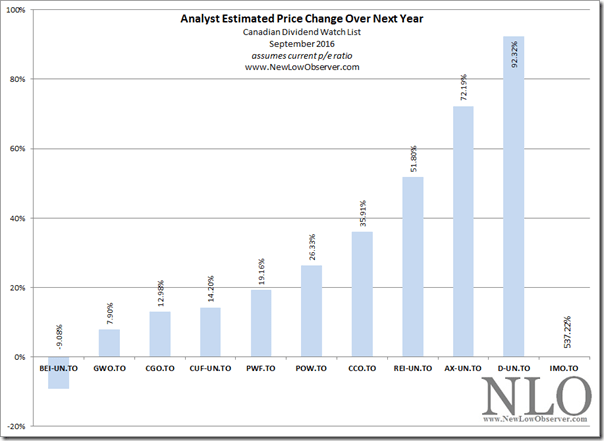
The companies are ranked based on their expected performance from worst (on the left) to best (on the right), click on the chart to see how the analysts expected the stocks to perform last year.
The standout performers from the analyst estimates were Dream Office REIT (D-UN.TO), Cogeco Inc. (CGO.TO), and Boardwalk REIT (BEI.UN.TO). These stock met or exceeded the analyst estimates. The stocks that underperformed analyst expectation were Imperial Oil (IMO.TO), Cominar REIT (CUF-UN.TO), and Riocan REIT (REI-UN.TO).
As compared to the Toronto Stock Exchange 1-year return of +4.67%, the watch list from last year gained +6.53%. Below is our watch list and analyst projections.
Dow Theory attempts to define and identify major moves in markets referenced here as the “primary trend.” In this piece, we will outline the price of gold according to Dow Theory.
We’re going to review and analyze the primary trend that extends from the September 2011 peak to the currently established low in the price of gold in December 2015. We believe that this information is critical to understanding where we are and where we might be going. This interpretation is based on the work of Charles H. Dow, co-founder of the Wall Street Journal and namesake to the longest continuous stock market indexes.
Keep in mind that all of the analysis that follows is done in generalities so that an individual who is curious about Dow Theory can refer to the technical manual on the topic titled The Dow Theory by Robert Rhea. However, the true heart of Dow’s theory is found in his original writing which covered the topic of earnings, dividends, effect of dilution of shares and economic outlook AND NOT lines on a chart. Two books that cover Charles H. Dow’s work as a fundamental analyst and an adept economist are titled Dow Theory: Unplugged and Charles H. Dow: Economist, respectively.
Lines on a Chart
Dow Theory has been synthesized down to a level of lines on a chart, which isn’t all bad. The lines still reflect fundamental economics. The challenge is the accurate interpretation of what is implied by the meaning of those lines.
Equifax is on a tear, to the downside. Let’s see what happened to the stock in the last decline from an all-time high and see if there is any precedence for what we can expect going forward.
2002-2009
In the period from 2002 to 2009, the price of Equifax (EFX) increased +158% to a high of $41.22. the decline that followed brought the stock to $17.80.
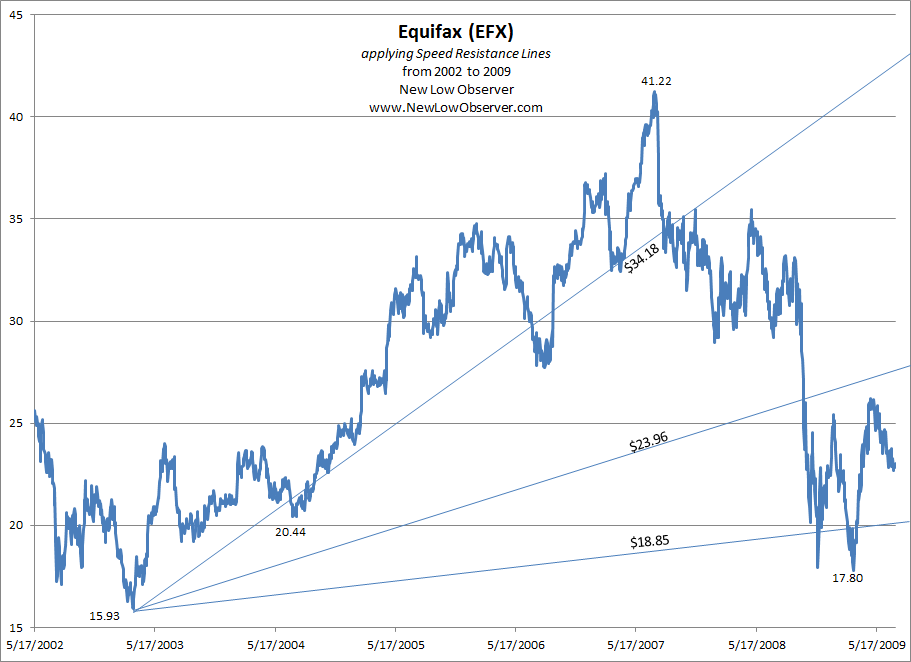
Equifax fell to the conservative downside target ($34.18) and the mid range downside target ($23.96). At the time, Equifax had an extreme downside target of ($13.74) but somehow didn’t manage to decline to that level, in spite of the fact that the housing crisis was co-opted by credit bureaus changing their standards which materially affected FICO scores.
“…the higher the credit score, the larger the increase in serious delinquency rates between 2005, 2006 and 2007. For example, for borrowers with the lowest credit scores (FICO scores between 500 and 600), the serious delinquency rate in 2007 was twice as large as in 2005—an increase of nearly 100 percent over the two years. For borrowers with the highest credit scores (FICO scores above 700), the serious delinquency rate in 2007 was almost four times as large as in 2005—an increase of nearly 300 percent. In addition, the serious delinquency rate in 2007 for the best-FICO group was almost the same as the rate in 2005 for the worst-FICO group.(Demyanyk, Yuliya. ‘Did Credit Scores Predict the Subprime Crisis?’ . Federal Reserve Bank of St. Louis. October 2008. link.).”
Bending of rules towards what was considered a prime rated credit score contributed significantly to lenders justifying the approval of home loans which later failed. With all this in mind, Equifax and their competitors should have fallen much more than they did. In fact, under normal conditions, at least one of the leading credit bureaus should have gone out of business.
Now, Equifax has declined based on a recent hack of their data systems. The resultant decline in the stock price seems natural. However, given the resilience of the stock price after the housing crisis, we have to default to the view that the company won’t go out of business but will be severely impacted in the short-term.
Posted in Edson Gould, EFX, speed resistance line, SRL
Review
The following is the pattern of price appreciation and decline for Activision Blizzard (ATVI) from 1993 to 2017 with the application of Speed Resistance Lines [SRL].
1993 to 1996
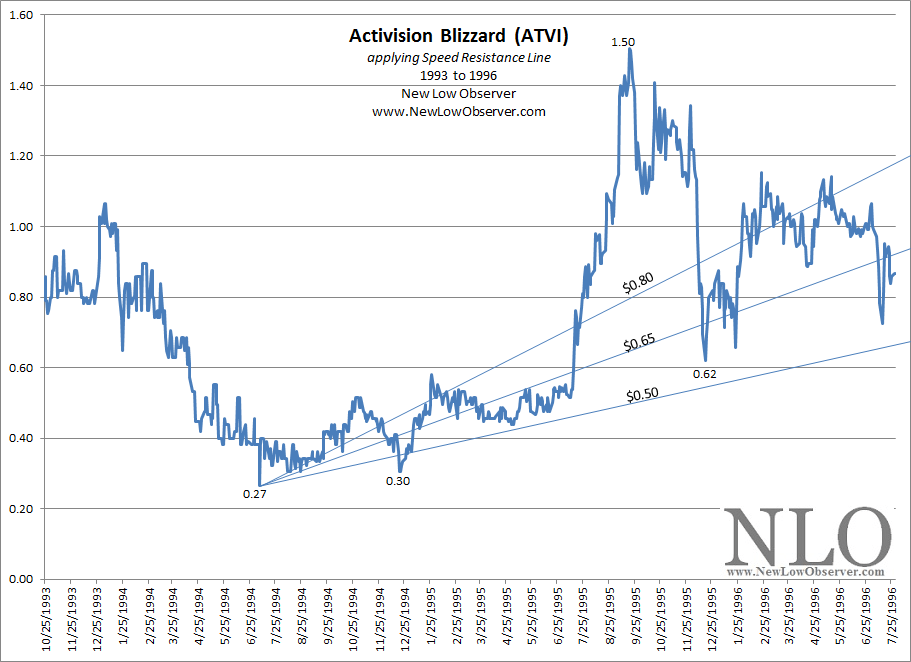
In the period from 1993 to 1996, we can see that Activision Blizzard (ATVI) increase from $0.27 to as high as $1.50 or a gain of +455%. The decline that followed saw ATVI fall –58%, achieving the conservative downside target of $0.80 and the mid range downside target of $0.65. Although the chart doesn’t show it, ATVI did not rises above the 1995 level and subsequently fell as low as $0.43 by 2000 and ultimately achieving the extreme downside target of $0.50 in the process.
1999 to 2003
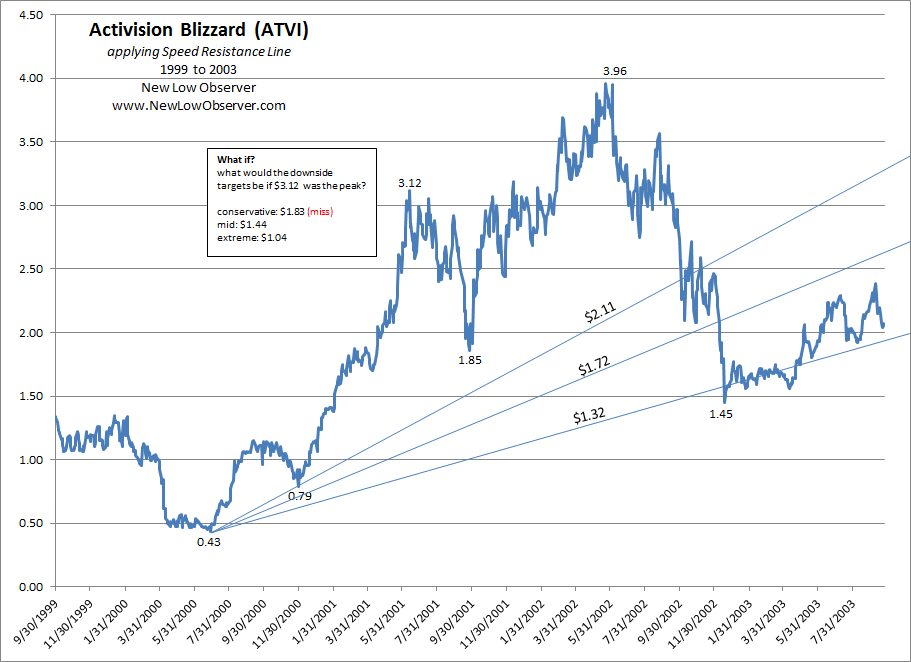
In the period from 1999 to 2003, ATVI rose from $0.43 to as high as $3.96, a gain of +821%. The resulting decline saw ATVI drop –63%. In the chart above we do note a possible scenario that the SRL is run on the stock at the $3.12 peak, assuming you don’t know where the ultimate peak would be. In such an instance, a conservative downside target of $1.83 and a mid range target of $1.44 were calculated.
In the big scheme of things, the conservative downside target was achieved and the mid range target was one penny short of the mark in 2002. The point of this exercise is to see, what would have been the outcome if there was an error in the timing of the calculation of the downside targets. As we shall see, these situations are all too real with outcomes that are generally surprising. However, in the immediate decline after the $3.12 price peak, the conservative downside target of $1.83 was $0.02 cents short of the $1.85 low set in September 2001.
2002 to 2009
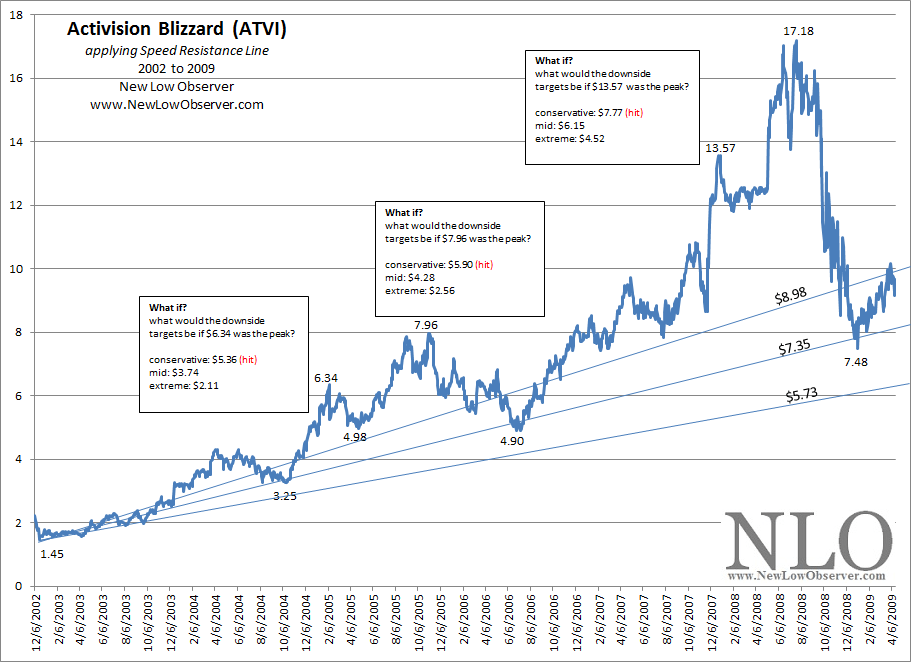
In the period from 2002 to 2009, ATVI increased in price by +1,084%. The decline that followed brought the stock down as much as –56% before a recovery ensued. Again, we have marked off the points where an error of early use of the SRL could have been applied. In each of the three examples, the conservative downside target was achieved. Suffice to say, in the case of the SRL and price peaks, the conservative downside target is a reasonable point of reference for consideration of ATVI.
2012 to 2017
The price action of ATVI has seen the stock price increase from a 2012 low of $10.08 to the 2017 high of $66.16. The gain in the stock price has been +556%. Our SRL has the following downside targets:
Bitcoin is going through the customary pullback in the price. The new threshold to watch for is –35.77% on the downside. This was the amount of loss that speculators and investors were willing to accept from the June 11, 2017 high of $3,018.55 to the July 16, 2017 low of $1,938.94 before a new bull run to the upside ensued. Most traditionalist say that a bear market starts at or near a decline of –20% or more. At which point, it takes some time before the “investment” gets back to the previous high (example: Nasdaq Composite took 15 years to get back to the 2000 high).
In this case, we’re not talking about a stodgy technology stock index, we’re talking about a potentially new currency mechanism which will likely supplant many existing currencies. Bitcoin is only one among many competing to be the final choice of a new money. However, in order to get that prize, Bitcoin will need to survive the high risk phase of speculative boom and bust.
Right now, we’re watching Bitcoin investors test their tolerance for pain as the price swoons from the high of $4,950.72, as report by Coindesk.com, to the current level of $3,390. As we said in our August 21, 2017 posting:
“…participants will accept even larger declines if the expectation is that it will exceed the prior peak. So far, Bitcoin participants accepted a –14.94% decline followed by a –35.76%. In each instance, these declines were followed by new highs in the price of Bitcoin. By our rationale, Bitcoin will now fall as much as –35% and possibly more as participants become inured to the pain of loss in anticipation of new highs.”
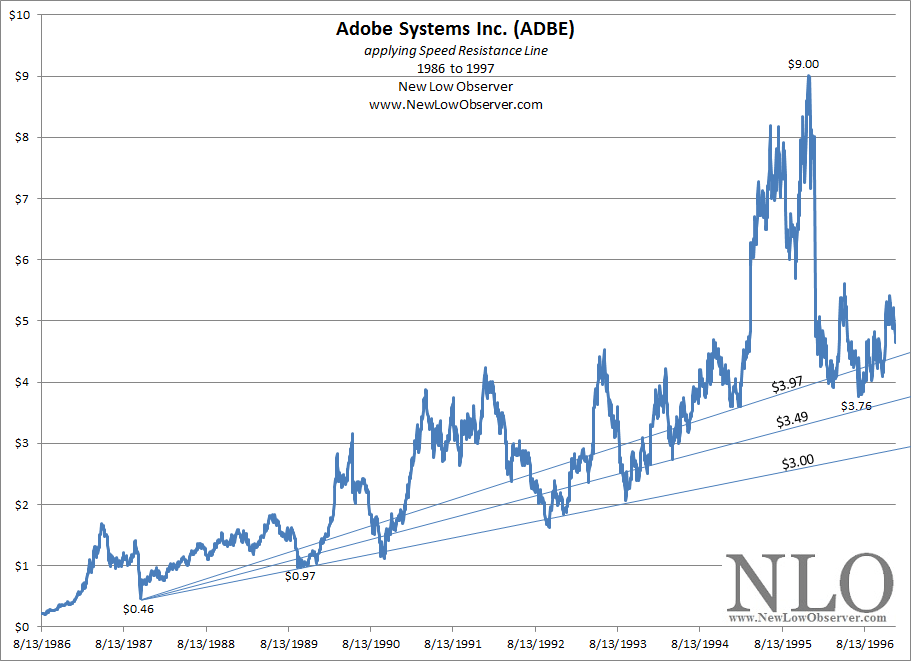
In determining downside targets for Adobe Systems Inc. (ADBE), we have applied Speed Resistance Lines [SRL] to the stock price over multiple periods of increase and subsequent decline. Starting in the 1986 to 1987 period, we see Adobe Systems Inc. increase from $0.21 to as high as $1.69. In the decline that followed, the SRL indicated that the downside targets from the peak price of $1.69 were as follows:
As seen in the chart below, ADBE declined as low as $0.46 from the $1.69 high.
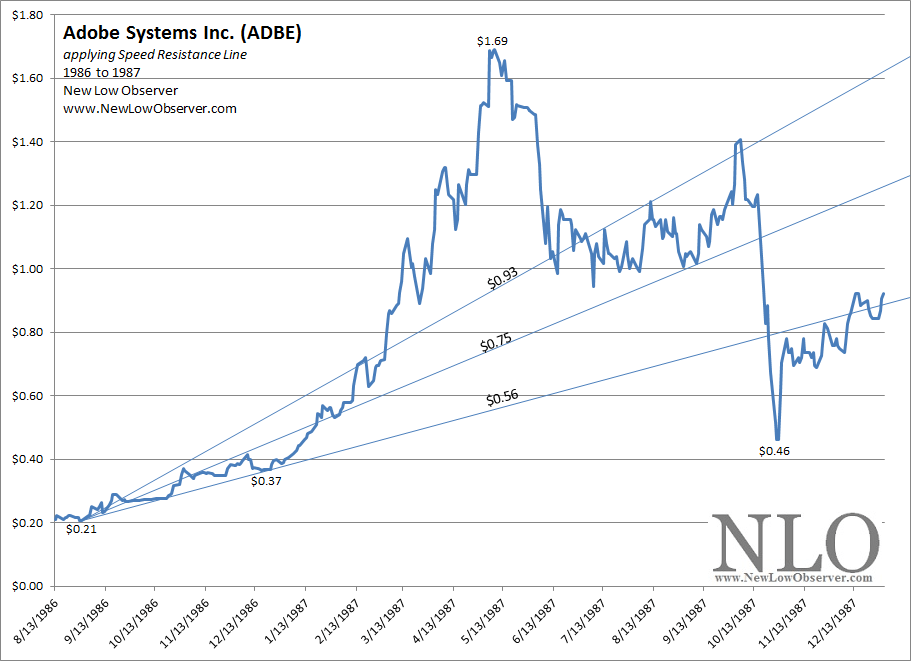
Much of the decline could have been attributed to a new company and speculative fervor for the stock taking it up +700%. However, the inevitable decline was due and took investors down –72% before a recovery was seen in the stock price. The stock achieved the conservative ($0.93), mid range ($0.75), and extreme ($0.56) downside targets.
In the period from 1987 to 1997, we see ADBE stock price increase from the $0.46 low to a high of $9.00, a whopping increase of +1,856%. In the subsequent decline, ADBE fell “only” –58% from 1995 to 1996. Adobe achieved only the conservative downside target ($3.97).
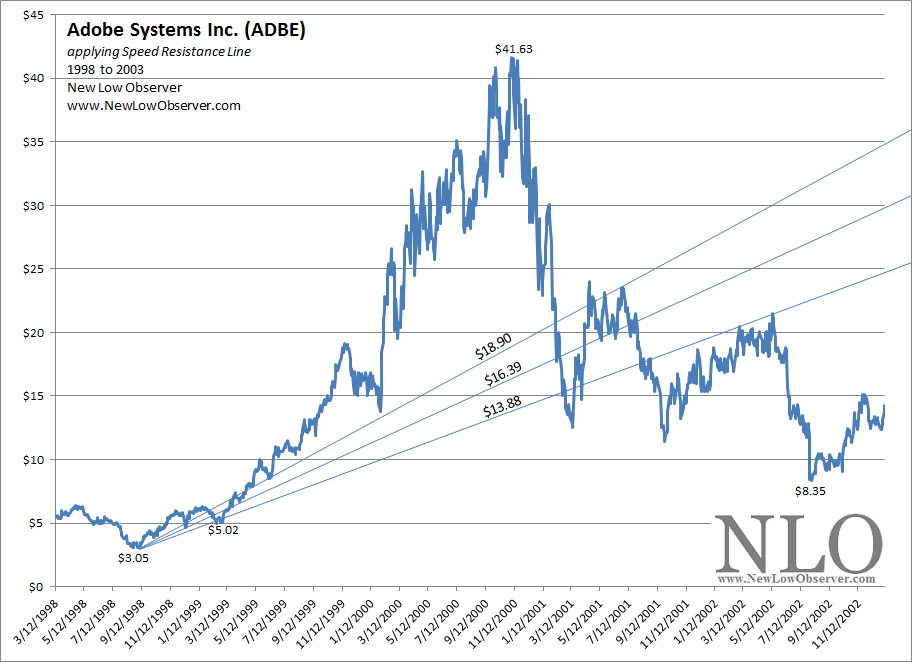
In the period from 1998 to 2002, Adobe rose as much as +1,264%. In the decline that followed, ADBE notched a –79% drop. In this instance, ADBE achieved all of the downside targets of $18.90 (conservative), $16.39 (mid range), and $13.88 (extreme).
The next period that we track is from 2002 to 2008. In that period, ADBE rose as much as +474%. The decline that followed saw Adobe slide –66%. Again, all downside targets achieved at $33.20 (conservative), $24.60 (mid range), and $16.00 (extreme).
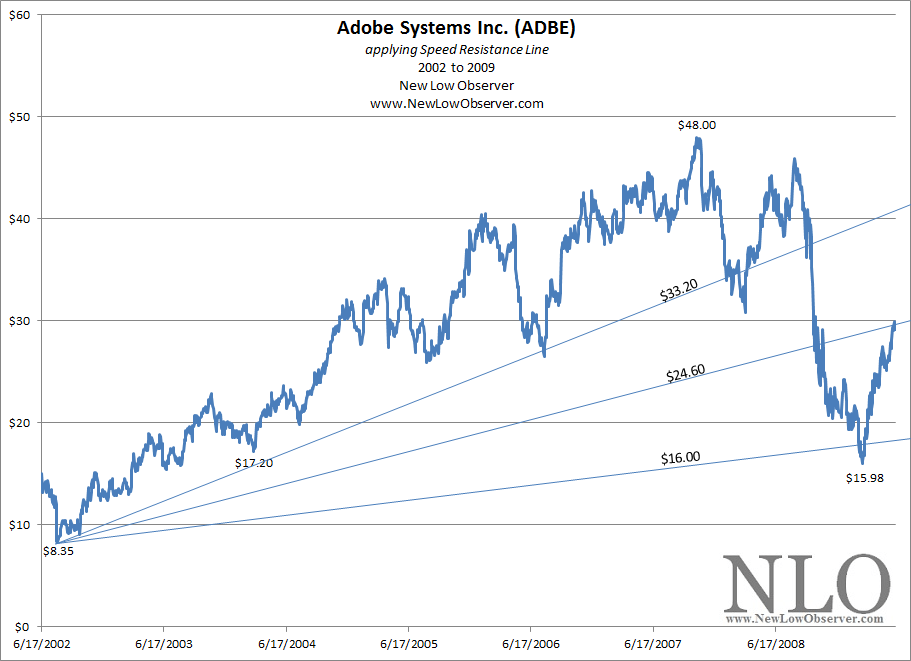
Worth noting is the fact that in all cases, Adobe Systems (ADBE) declined at least to the conservative downside target. Additionally, in 3 of the four cited examples, ADBE managed to fall to the extreme downside target as established by the Speed Resistance Lines.
Is the past a fair indication of what to expect in the future? What do we believe the future to hold?
Our take on the future prospects for ADBE stock price are that we can reasonably expect the price to decline to the conservative downside target in accordance with past declines. However, expecting that ADBE will achieve the extreme downside target is overly ambitious at present. After all, ADBE is a mature, well-established company that dominates several categories in their respective product lines (by a wide margin as compared to the next closest competitor).
With this in mind, after an increase in price of +881%, from the 2009 low, we have outlined the Speed Resistance Lines from 2009 to 2017.
In a posting on ZeroHedge there is mention of Swiss National Bank (SNBN) and the “bubble” that seems to be percolating in the stock. We don’t know whether or not the price of the stock is in a bubble. However, what does resonate with us is any sign of a parabolic rise in price. In the case of SNBN, we believe that we can attribute Speed Resistance Lines (SRL) that are consistent with viable downside targets.
First, whenever applying SRLs, we like to find out if there has been any precedence on the matter. In the case of SNBN, we have obtained data from Yahoo!Quotes (ChartIQ), which goes back to 1995. It is just our luck that there is a prior period when SNBN has a similar rise and subsequent decline.
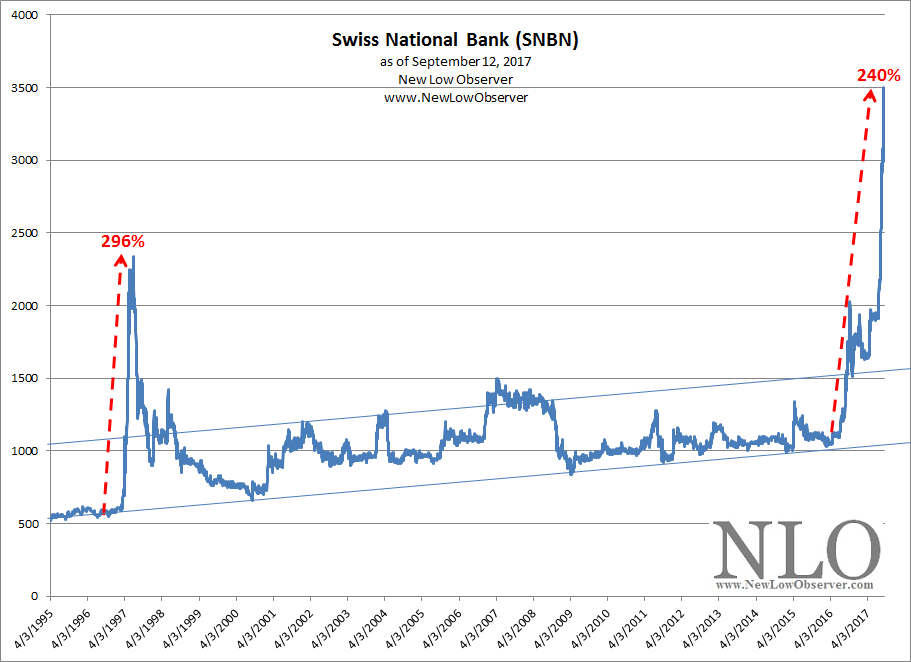
Considering that there is a reasonable amount of precedent in the stock price movement of SNBN in the period from 1995 to 1997, we have taken the liberty in projecting what the current level of price increase could result in, if history is any guide.
Posted in Edson Gould, entropy, parabolic, SNBN, speed resistance line, SRL
Below is the insurance watch list for the month of September 2017. In additions, we have included the analyst one year estimated returns and a review of watch list stock.
Carlisle Companies (CSL) is a stock we have been following for a long time. The company is described as a diversified manufacturing company and is headquartered in Scottsdale, Arizona. Our review will cover the Altimeter to determine where Carlisle appears to be currently and where the most ideal time to buy the stock.