Below is the dividend yield profile for ABM Industries (ABM) since 1982.

- Japan
- Market Indicator
- Price Momentum Indicators
- Richard Russell
- Silver
- Speed Resistance Lines
- U.S. Dividend Watch List

Below is the dividend yield profile for ABM Industries (ABM) since 1982.
Below is a revision to the Altimeter for ABM Industries (ABM). On May 21, 2018, we included the charting of the data. The potential downside targets have been changed to reflect the revision to the data.
According to Wikipedia, “Steinhoff International is a South African international retail holding company that is dual listed in Germany. Steinhoff deals mainly in furniture and household goods, and operates in Europe, Africa, Asia, the United States, Australia and New Zealand.” However, the stock chart tells us so much more about Steinhoff (SNH).

According to the Financial Times:
“…investigators are focusing on ‘certain off-balance sheet structures and transactions, including those with certain closely related parties’, and mostly involve Steinhoff's ‘central European’ business (Mark Vandevelde, Joseph Cotterill, and Dan McCrum. “Focus shifts to lending units in Steinhoff investigation”. Financial Times. London. April 9, 2018. page 15.).”
In this instances, it appears that an off-balance sheet vehicle has contributed to the insurmountable losses of a once thriving retail empire.
Performance Review
Below is the performance of our Canadian Watch List dated May 14, 2017:
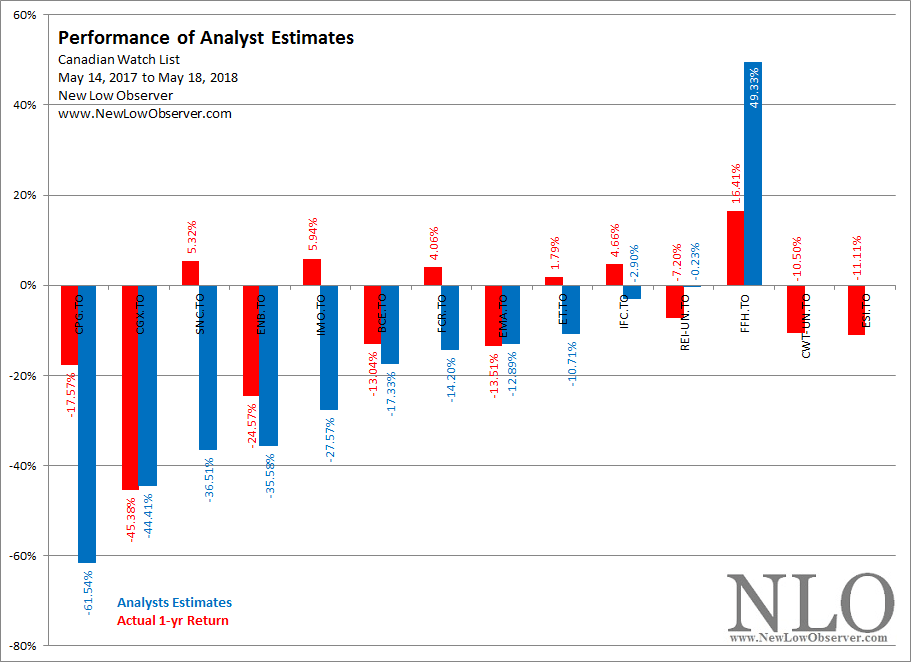
The average change of the entire watch list was –7.48% compared to the Toronto Stock Exchange gain of approximately +4.48% over the same period of time. Worth noting are the stocks that the analysts got right in the assessment last year. Those stocks are BCE Inc. (BCE.TO), Cineplex (CGX.TO), and Emera (EMA.TO).
This is how we always imagined the party to end. Somewhere and somehow, an accounting footnote known as an off-balance sheet entity or item becomes a front and center issue.
Searching the internet for a definition of “off-balance-sheet entity” you will find a fairly credible source in Investopedia. Their first sentence on the topic says it all, “Off-balance-sheet entities are complex transactions where theory and reality collide.”
“Off-balance-sheet entities are complex transactions where theory and reality collide.”
Looking any further on this topic and you’ll find many of the most infamous financial collapses centered around off-balance sheet entities or items, and emanating from the darkest corners of the corporate world. So when a municipality announces their inability to pay for an off-balance sheet item, it should get you interested.
Posted in off-balance sheet item, rating agency
On May 18, 2018, Consolidated Edison (ED) fell to a one year low. This is a stock that we had evaluated back in September 2014, when ED was trading at $57.60. At the time, we said the following:
“Based on the Altimeter, ED is considered to be fairly valued at $54.18. This fair value is strikingly similar to the Value Line [Investment Survey] assessment. Also, according to the Altimeter, ED is considered undervalued at or below $44.00. Since 1970, there have been six instances where ED has been undervalued and went to the opposite extreme of being overvalued.
Using the above Altimeter, our observation is that Consolidated Edison has had the tendency to decline from each peak to the corresponding undervalued level without exception. Naturally, this may be the occasion when the exception occurs. Until that time comes, we’re of the view that ED will decline to the lower ascending line by mid- to late 2015. By that time, ED could be undervalued at the $50 level.”
Fast forward to the new 52-week low and we see ED trading at $73.55. This begs the most obvious question, where did we go wrong? After all, we missed out in nearly +78% of total returns in 4 years. Below are the two most glaring errors that we made with many others waiting to be revealed.
According to the Fort Worth Star-Telegram, Enduro Resource Partners filed for bankruptcy reorganization on May 17, 2018.

In the article, it was mentioned that Enduro Royalty Trust (NDRO) was not included in the bankruptcy proceedings. Below is the adjusted and unadjusted price of NDRO since inceptions.
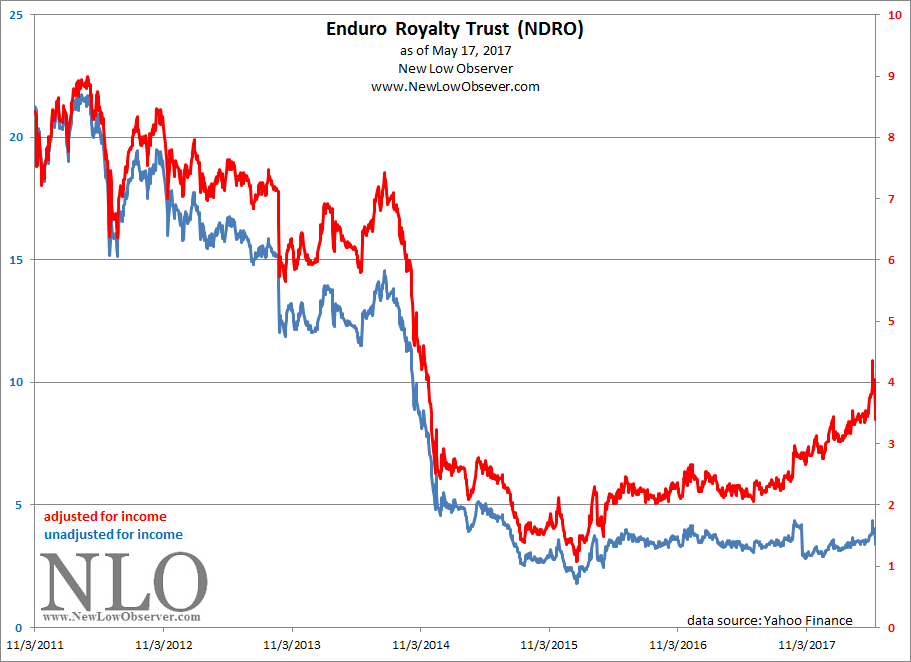
The adjusted price has declined by –59%. However, since the January 21, 2016 low, NDRO has increased +211%. It is worth noting that the decline in NDRO preceded the decline in West Texas Intermediate Oil (WTI), which did not collapse until mid-2014.
Posted in BK Watch
Below is the Altimeter for McKesson Corporation as well as the performance data based on the buy indication offered by the Altimeter. The average gain after six buy indications is +46.47%.
Below is a review of the Altimeter for Sanderson Farms.
Below are the revised downside targets base on the latest peak in interest rates.
On May 12, 2018, we presented the Altimeter for Unum Group (UNM). In this post we’ll present the Coppock Curve for UNM and the price of the stock one year after the buy indication is provided.
We’ve said many things about Unum Group (UNM) in the past. What matters the most for us is the practical application of theories that we have put forward, theories commonly found in the work of Charles H. Dow and Edson Gould. Below is a latest Altimeter for UNM and our useful prior commentary on the stock.
We saw this article on ValueWalk suggesting that Middlesex Water (MSEX) is overvalued.

After running the numbers found in Value Line Investment Survey from 1998 to the present, we couldn’t find a viable counter claim to the analysis of MSEX. It does appear as though MSEX is overvalued at the current price.
Below we have the Altimeter which reflects the relative value of the stock based on the history of dividend payments. We’ve included potential downside targets for the stock where a review of the company fundamentals should be considered.
In this posting we’ll outline the performance of the Dow Jones Industrial Average and the Dow Jones Transportation Average within the context of the Dow Theory. Additionally, we’ll see where we are in terms of the economy which Dow Theory is supposed to give some indication on.
Below is the performance of the individual Dow Jones Industrial Average constituents from December 29, 2017 to May 8, 2018 (intraday).
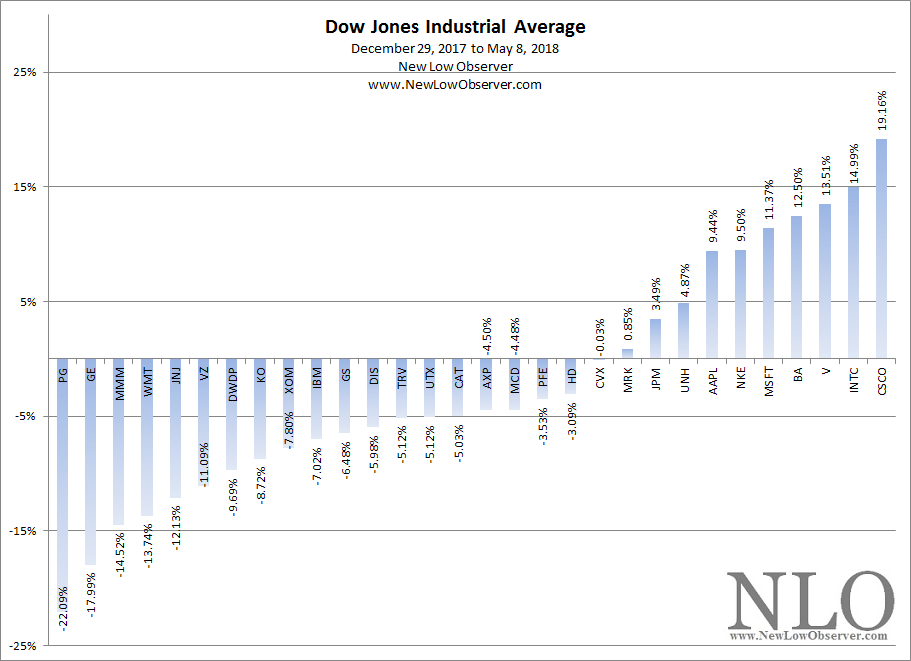
Our examination of the Dogs of the Dow concept has upended our prior thinking on how to approach this investment strategy. As we’ve seen, the original Dogs of the Dow has continued to prove an unfortunate investing process. In addition, the data below shows that there is much to be learned on the road to beating the index.