

- Japan
- Market Indicator
- Price Momentum Indicators
- Richard Russell
- Silver
- Speed Resistance Lines
- U.S. Dividend Watch List
Category Archives: Richard Russell Review
Market Forecasting Made Simple
Posted in DJIA in Review, Dow Industrials, Richard Russell Review, S&P 500
Tagged members
Richard Russell on the Transports & Dow Theory
Posted in Charles H. Dow, DJIA, DJT, Dow Theory, Richard Russell, Richard Russell Review
Tagged members
On This Date: Richard Russell
On this date in 1980, Richard Russell said:
If You Leap, You Will Fall
“Let’s trot out an old but very useful market adage. It is that a trend is taken to continue in force until proved otherwise. We can be suspicious, we can hate the market, we can be out of the market, we can talk the market down to our friends and neighbors, but brother, we better not put out shorts until we have hard evidence that the bull trend is over and the bear is firmly in command-that is if we want to stay solvent (Russell, Richard. Dow Theory Letters. Letter 777. February 27, 1980. page 1.).”
Another way of saying the above is as follows:
“The wish must never be allowed to father the thought (Rhea, Robert. The Dow Theory. 1932. Barron’s Publishing. page 26.).”
Obviously staying solvent should be the primary goal. However, you need not invest to “stay solvent.” For all intents and purposes, even a person who “saves” in the traditional sense loses money by way of inflation and taxes. However, the fact that someone would chose to invest requires accepting that some or all money invested can be lost.
Most investors seem to get into the stock market or a specific stock because they think their investment will do well. Seldom does an investor buy a stock hoping that it will lose money or languish. Warren Buffett is among that rare group of (successful) investors who could make that claim. In his annual report to shareholders, Buffett said the following:
“Our quiz for the day: What should a long-term shareholder, such as Berkshire, cheer for during that period? I won’t keep you in suspense. We should wish for IBM’s stock price to languish throughout the five years (source: 2011 Berkshire Hathaway Annual Report. page 6).”
Maybe Buffett can “afford” to have such a cavalier attitude about a technology stock like IBM after not buying any tech stocks which has cemented him as the world’s premier investor. However, we believe that having Buffett’s thought process could help in dealing with not allowing the wish to father the thought. Otherwise, the concept of investing and hoping becomes a feedback loop that ends with inaccurate conclusions such as, “I’m never investing in stocks again, it is a scam run by manipulators and thieves. I’m going to put my money with an advisor and let her deal with the headache when I start ‘losing’ money.”
Posted in Letter, On This Date, On This Day, Richard Russell Review
Market Rewind: S&P 3,384/Dow 3,384
On September 14, 2020, the S&P 500 Index closed at 3,383.54. To celebrate, we are going to review what Richard Russell’s Dow Theory Letters had to say about the market when the Dow Jones Industrial Average closed at 3,384.32 on August 4, 1992.
Russell said:
"...the nation's in a 'contained depression'."
"Interest rates have collapsed, consumers are gloomy, and nobody's taking out loans. That's exactly what happened during the Great Depression--with one big difference. Then the stock markets were crashing but today the markets are bullish. So how are the two periods different? As I interpret it, today's stock market is saying that somewhere ahead business is going to pick up and people will start buying again---unlike during the 1930s."
"for the first time since the Great Depression almost all the nations in the northern hemisphere are in various stages of a recession."
"...the widely publicized figure is that 40% of the 5,000 listed stocks have been downed by 30% or more. On that basis, some analysts are referring to 1992 as the 'year of the hidden bear market'..."
That was page one of six from the August 5, 1992 issue of Dow Theory Letters. Fascinating? History doesn’t need to repeat. However, good analysis starts with precedents first, as outlined by Charles H. Dow, and diverges afterward, not the other way around.
What was being said by other analysts is not too different from what we’re hearing today. We all know what has happened to the Dow since August 4, 1992.

Richard Russell Review: July 5, 1974
This from Dow Theory Letters on July 5, 1974.
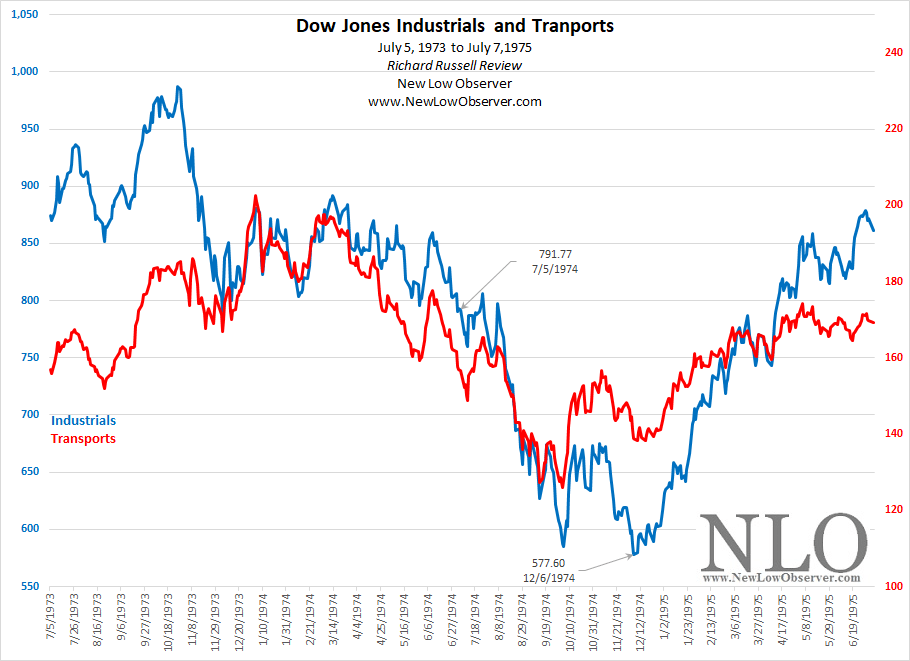
"What’s happening, what’s gone wrong? The answer: there's a giant squeeze in world liquidity, and it is scaring the devil out of investors, large and small, from one end of the globe to the other. Last week two German banks declared bankruptcy, while it was revealed (WSJ, June 26) that an oil-drilling "tax write-off" situation has turned into what may be the biggest swindle in US history. On June 27 trading in Westinghouse was halted at 12 1/8 (“you can be short if it’s Westinghouse”), and an hour later the President of the company announced that the outfit was solvent (all this while WX broke its 1962 low) (page 1)."
Those two German banks were Bankhaus I.D. Herstatt of Cologne and Bass & Herz Bankhaus. This was a situation where the failure of Herstatt led to the failure of Bass & Herz and a host of other substantial losses.
Chase Manhattan Bank was in possession of $156 million in Herstatt deposits. This meant that U.S. creditors (namely Citibank’s British banking unit of Hill, Samuel & Co.) were seeking claims on these funds even though Chase Manhattan had no authority to recognize the claims.
Seattle First National Bank (SeaFirst) was caught in a bind when they performed a $22.5 million transaction at their Swiss subsidiary and the funds were not transferred to the parent company hours before Herstatt was forced into bankruptcy.
In classic scam fashion, the oil-drilling "tax write-off" scheme was named Home-stake Production Company of Tulsa Oklahoma. Using the name “Homestake” tied the swindler with the success and stability of Homestake Mining while not having achieved anything of note.
What made this swindle exceptional is the fact that people like Liza Minelli, Candice Bergen, and Buddy Hackett (as well as Congressmen) were involved in the money losing fraud. The motivation for getting into these “tax write-off” schemes might have been inspired, at the peak, by articles like the following from Barron’s in March 1974.
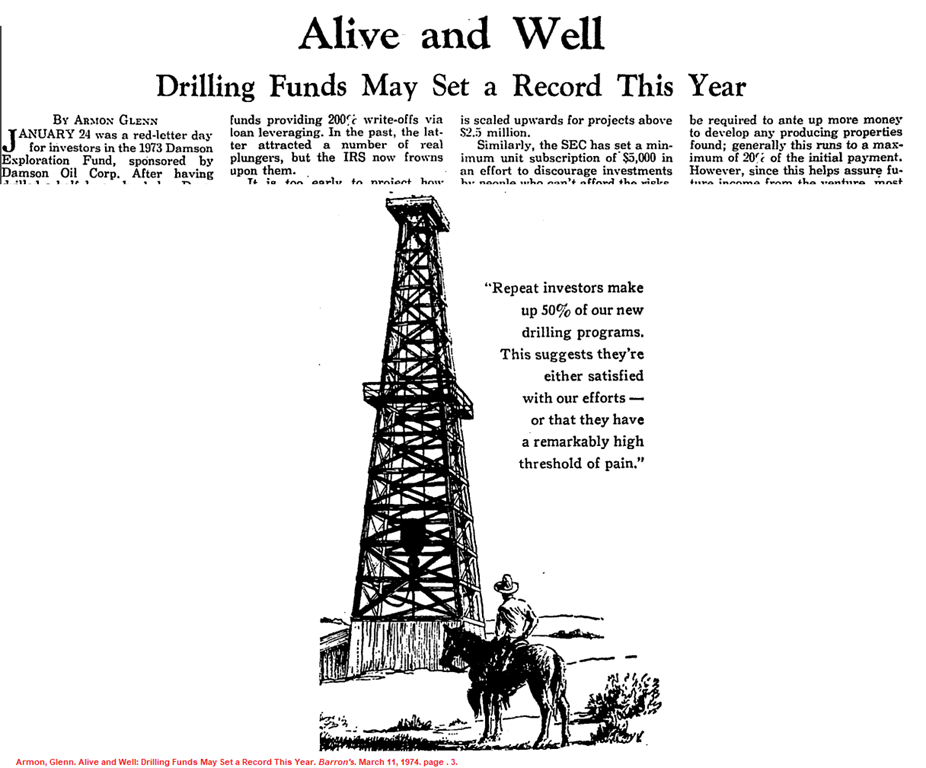
“Bank shares at 10% yields mean that investor are scared of the banks (page 2).”
It was not long before this comment was published on banks that banks were on a mad dash to lure investors and analysts. In a Barron’s article titled “Beautiful Balloon?” it was indicated that the 1970 amendment to the Bank Holding Company Act of 1956 led banks “…into related (and some not-so-related) financial areas.”
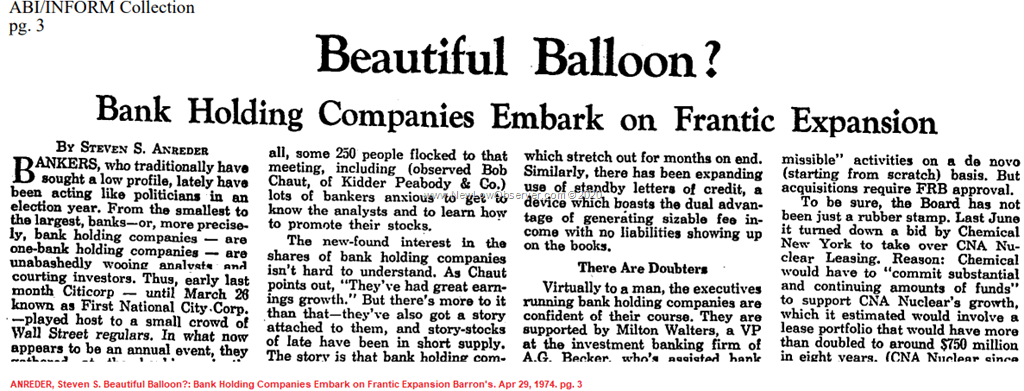
It was those related financial areas that banks had “…been heavily engaged in financing real estate activities, and, despite the debacle among REITs, thus far have escaped essentially unscathed.” It wasn’t long before those banks almost paid the price for their foray into REITs, until the government intervened. This article from Barron’s should have been titled “Beautiful Bubble” as the collapse was in the early stages at this time and by July 5, 1974, there was more pain until December 1974, to the tune of –27.04% in the Dow Jones Industrial Average.
see also: Homestake Mining: The Exception that Proves the Rule
Richard Russell Review: July 3, 1996
This from Dow Theory Letters on July 3, 1996.
"To conquer the beast, you must first learn to love it (page 1)."
When looking for similar quotes online, we found the following:
The last quote from Sun Tzu seems the most fitting and provides the appropriate context.
“The June 27 WSJ headlined an article, ‘Strong Summer Rally, Then a Plunge, Predicted by Four Technical Analysts.’ Maybe, but that sounds too pat to me. A strong summer rally would allow all those sophisticated analysts (and their followers) to exit the market handily. If, and I say IF, a bear market is just around the comer, it’s not going to happen that way (page 2).”
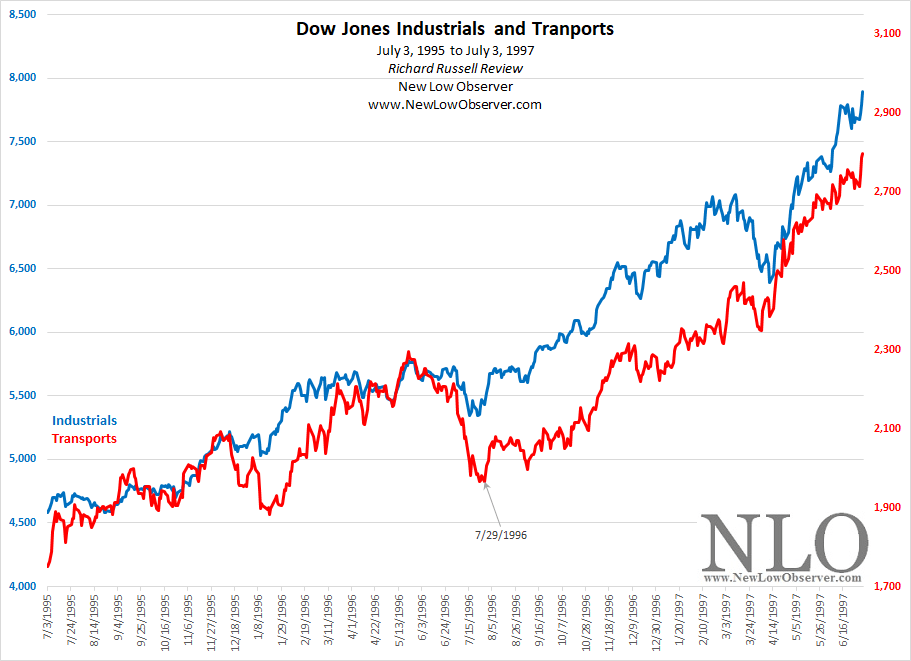
The July 29, 1996 low and subsequent rise proved Russell’s suspicions to be correct.
"Steve Briese, the sophisticated editor of the Bullish Review [(612) 423-4900] in his latest report notes that “turns in both Cotton and Copper have accompanied many important stock market tops -- far more than coincidence alone would explain (except to a bull wearing blinders) (page 3).”
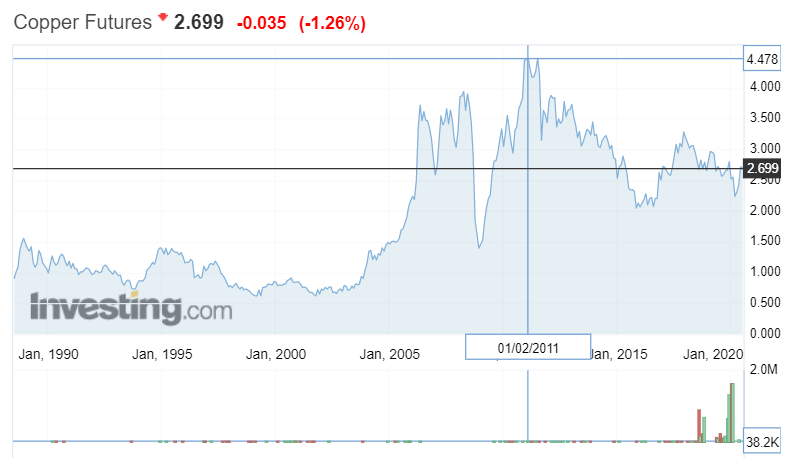
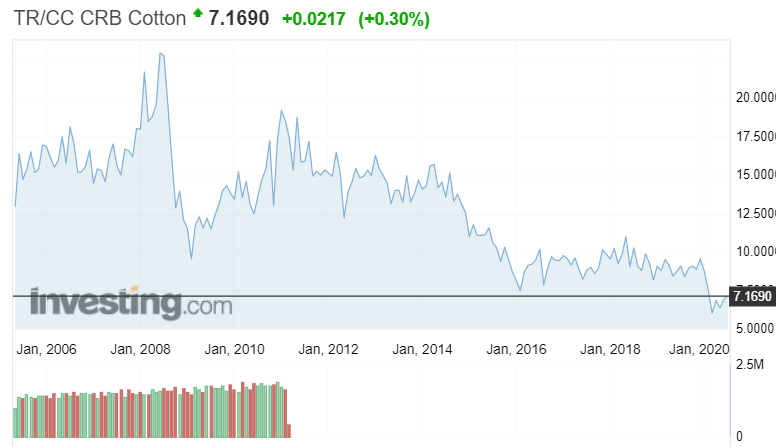
From the charts of cotton and copper below, we can see that copper makes a parabolic move then slowly declines to the low. It is the low that is most characteristic of a turn higher for the stock market rather than the turn lower which can drag out for a long period of time while the stock market continues to climb.
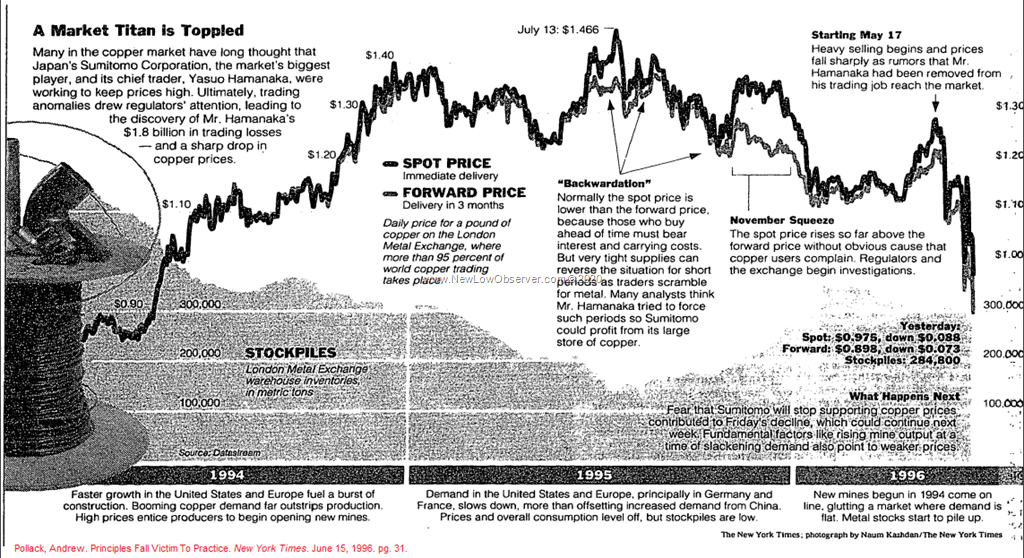
"The commodity world is still in shock from the incredible losses sustained by Sumitomo, losses stemming from 10 years of trading via their rogue trader, Yasuo Hamanaka. How could 10 years of wacky trading be hidden from authorities? Obviously, some people had suspicions (page 5)."
“Conclusion: The bull market appears to be intact. Time after time the market backs off and turns erratic. But each time the PTI bucks the trend and pushes up to a new high. When this pattern in the PTI reverses (and some day it will), the market will be in trouble. Until then. the bull remains in command.”
This conclusion, based on the PTI, was proven to be accurate as noted in the market performance above. There will be more to discuss based on Russell’s PTI going forward.
Posted in Briese, Hamanaka, Richard Russell Review, Sumitomo, Tzu
Richard Russell Review: Letter 859
On this date in 1983, Richard Russell published Issue 859 of the Dow Theory Letter [526]. At the time, the Dow Jones Industrial Average was at the 1,191.47 level and the Transportation Average was at 531.53.
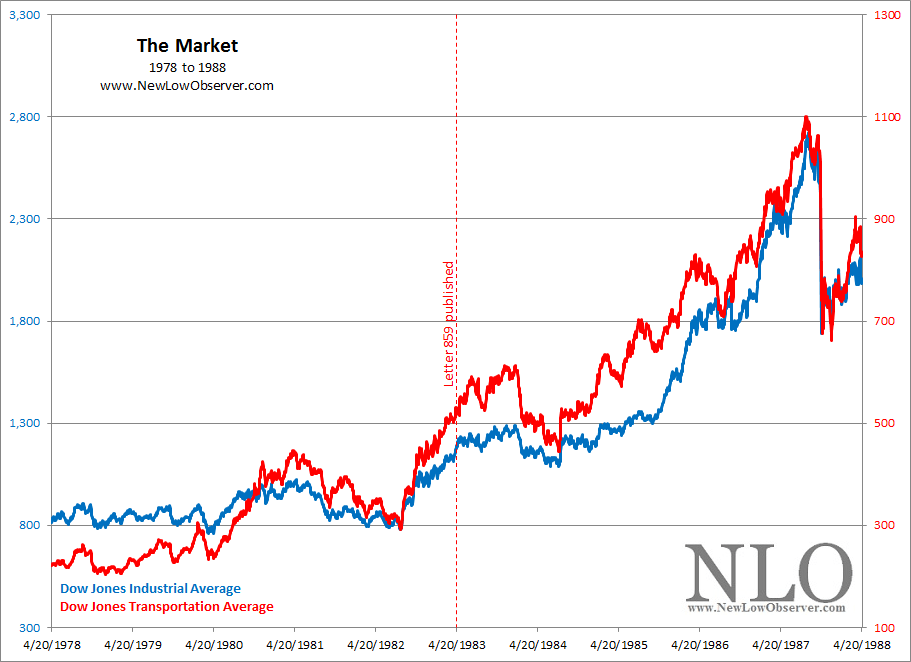
The following Richard Russell Review details the topics of the Elliott Wave and 50% Principles as outlined by A.J. Frost, Robert Prechter and Charles H. Dow.
Richard Russell Review: Letter 1248
On this date in 1998, Richard Russell published Issue 1248 of the Dow Theory Letter. At the time, the Dow Jones Industrial Average was at the 8,872.79 level and the Transportation Average was at 3,517.52.
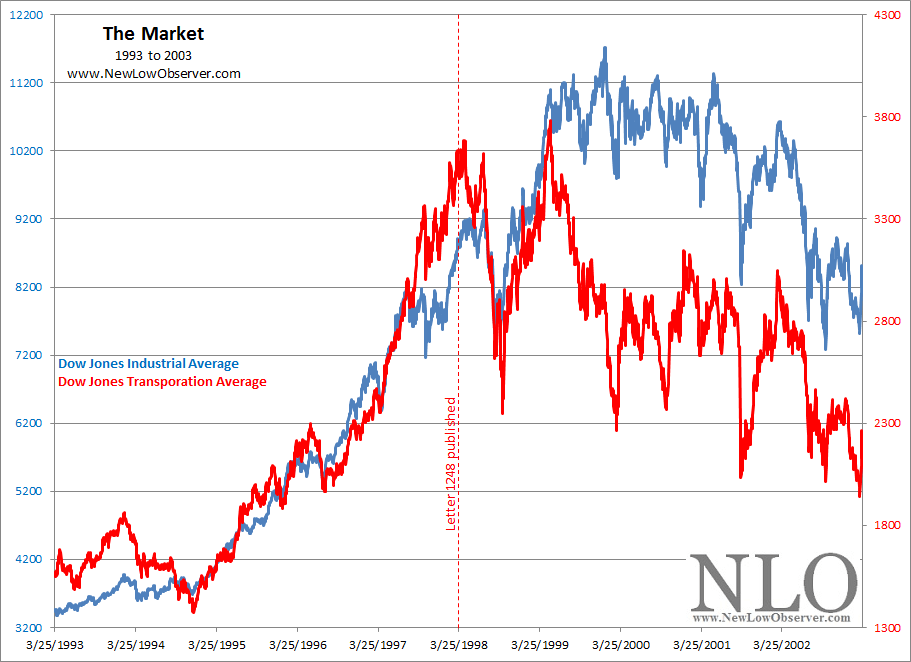
Russell opens his newsletter by pointing out the distinction between what the market “should be doing” versus what was actually happening. What was happening? The market was defying all long-term conventional norms. In Russell’s word’s, “The conclusion -- always -- is exhaustion.” Russell felt that the market’s rise was at a mania level and that investing in such a market was clearly a personal choice but that “values will out.”
Richard Russell Review: Letter 449
Bear Market Declines
“Historically, bear markets tend to last 1/3 to ½ as long as the preceding bull markets. Since this bear market is in the process of correcting the 17-year bull market of 1949 to 1966, a rough rule-of-thumb would be that the bear market could last five to eight years (and I will be optimistic in that I hope it lasts nearer to five than eight). However, the interesting part of the picture is that with four years out of the way, the worst the Dow Industrials have done is to decline from their 1966 peak of 995.15 to their 1966 low of 744.32, a total drop of 251 points (Russell, Richard. Dow Theory Letters. January 7, 1970. Letter 449. Page 1.).”
As a “rule-of-thumb”, the 1/3 to ½ (in terms of duration) extent of a bear market decline is pretty good and very consistent. The examples are many and the data is clear. First, let’s take the 1966 peak as the beginning of the bear market. From that time, the ultimate low in the stock market was December 1974. This was eight years from the 1966 peak. True stock market enthusiasts would argue that the bear market for stocks did not end until 1982, when the Dow Jones Industrial Average “permanently” broke above the mythical 1000 level and never looked back. Die hard market historians make a credible claim that the bear market did not end until the inflation-adjusted low achieved in 1978 or 1982.
However, based on the work of Jeremy Siegel (“The Nifty-Fifty Revisited: Do Growth Stocks Ultimately Justify Their Price?” [PDF download]), even if a person had bought the “Go-Go” or “Nifty Fifty” stocks at the 1966 or 1971 peak, investors would have achieved exceptional gains in spite of the high inflation rates until 1982 (by the end of 1995, in support of the “buy-and-hold” strategy).
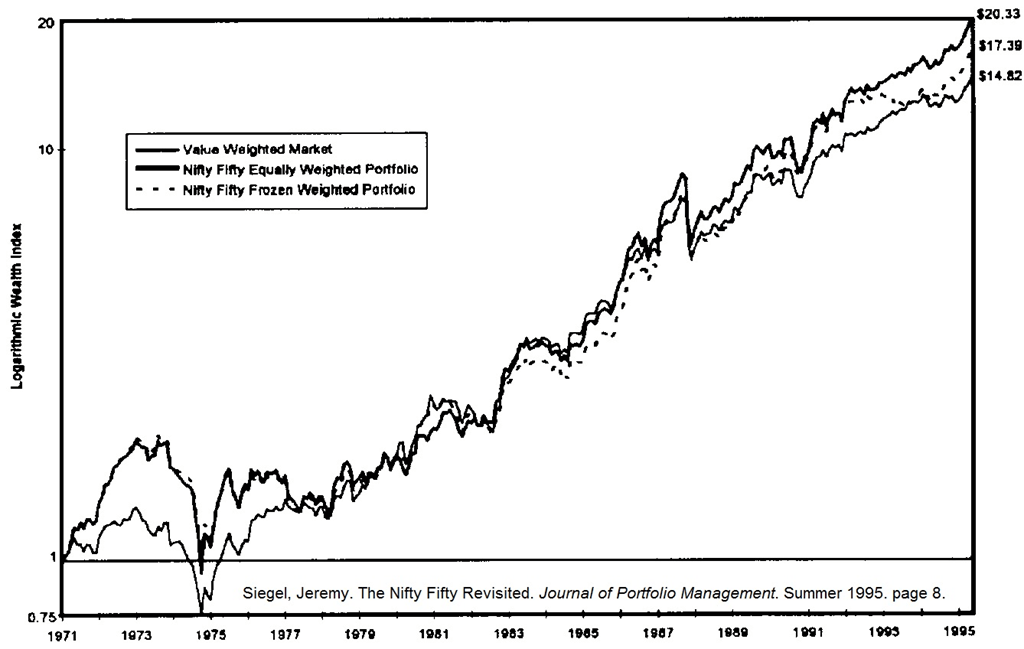
The amount of time that passed from the 2007 peak to the 2009 low was 18 months. This was 38% of the bull market that preceded it from 2003 to 2007. The decline was severe and few would be in the position to stomach the extent of the decline, however, the rebound was inevitable and equally as vicious.
Our default view generally gravitates towards the stock market crash of 1929 to 1932. Even our cautiously optimistic analysis should be thwarted by one of the worst bear markets in history. However, taking note of the fact that the bull market “officially” began in 1921 and unofficially in 1907 or 1915, it is clear that the rule-of-thumb holds up.
Market enthusiasts will often retort that the bear market ends when the market recovers beyond the previous peak as the majority of investors buy near the last market peak. This is a valid point and yet, investing is made better by understanding that the majority is usually wrong and therefore should fight the urge to commit 100% of their investment capital as the market climbs higher and ensure that saved funds are 100% invested as the market falls. There are many benchmarks for determining how low is low enough before 100% of funds are committed so being close enough is better than succumbing to the fear of a falling market.
Posted in Letter, Richard Russell Review
Consequences of Falling Oil Prices
Economic events never occur in a vacuum. Usually there is a string of events that leads from one event to another. One big event can lead to an even bigger event that overshadows the prior calamities that triggered “The Big” event. The February 9, 1983 issue of Richard Russell’s Dow Theory Letters covers one market event that led to two major crises that happened at different periods in time. The two events are joined at the hip based on the decline of oil prices. This led two separate major bailouts that resulted in the structural shift in the way our brand of capitalism works.
The first event resulted in the Savings and Loan Crisis (S&L Crisis) and is thought to have begun in 1986 due to the Tax Reform Act of 1986 culminating in the bailout of many banks and the eventual bankruptcy of the Federal Savings and Loan Insurance Corporation (FSLIC).
The second event resulted in the Mexican Peso Crisis with the outcome that major banking institutions like Citibank and Goldman Sachs needed to be bailed out. It is important to note that the Peso Crisis is considered to be as a result of the peso devaluation in 1994.
The true roots of both the S&L Crisis and the Peso Crisis is the decline of oil prices after the inflationary peak in 1980-1981. Richard Russell’s Dow Theory Letter Issue 854 highlights the seeds of destruction that were going to be much larger than even Russell could have imagined. However, if anyone wishes to understand how the snowball got rolling then this issue highlights the beginning.
The very first quote is an amazing insight of the American dependence of the high price of oil, Richard Russell says the following:
“We’re facing a situation (ironically) where the US is all for holding oil prices at a high level. The banks have lent huge sums of money both to private corporations and to oil producing nations-loans based on rising oil prices. If the oil price cracks badly, the banks are going to have major problems. On top of that, the US depends on oil taxes (so called “excess profits” tax) for huge chunks of tax income. If oil prices crack then the profits for the oil companies will dive (which they are already doing) and the tax short-fall will be horrendous. (page 1)”
This commentary is staggering in the fact that it was so prescient. The cracks in the armor of the American oil industry began in Texas when the easy money stopped raining down on oil dependent cities like Houston and Dallas. In a 1988 issue of Dow Theory Letters, Russell had the following to say:
“With oil prices caving in, Texas now has more people leaving the state than coming in.( Dow Theory Letters. March 9, 1988. page 6.)”
The decline in oil prices led to a decline of jobs for that industry which resulted in a decline in real estate prices as people left the state of Texas. Loans made by savings and loan institutions in the southwest U.S., to businesses and real estate investors, all went bad at the same time leading to the Savings and Loan Crisis (S&L Crisis). The S&L Crisis cost several hundreds of billions of dollars and still exist as an off-budget item as part of our national debt.
The decline in the price of oil also crushed foreign economies dependent on the commodity. The Mexican Peso Crisis, although officially listed as beginning in 1994, had its roots in the early 1980’s. The natural outcome of this crisis was the bailout of large banking institutions like Citibank and Goldman Sachs when the government stepped in and bought the bad debt held by the bank’s all in gamble.
Likewise, the current boom in commodity rich countries (although somewhat cooler at present) like Australia, Brazil, Russia, China and India could experience significant shocks to their system depending on the level of loans made as “investments” by foreign banking institutions based on the potential of future growth.
Few understood or believed the impact and importance of high oil prices to the American economy at the time. Even fewer understood the direct reliance of the U.S. government to high oil prices. Investors should watch for the potential fallout that may arise from the recent precipitous decline in the price of oil. The troubles afflicting Russia and Brazil’s Petrobras may be early indications of where the pain may be felt.
Review: Bank of Montreal
Contributor C. Cheng Asks:
“What are your concerns regarding the housing bubble forming in Canada and it’s potentially adverse effects on BMO?”
Our Response:
The timeliness of this comment regarding Bank of Montreal (BMO) is critical. On June 7, 2012 (found here), we posted an Investment Observation on Bank of Montreal which was one of our leading considerations as an investment opportunity. Keep in mind that our interest in BMO came after a 14-month declining trend in the stock’s price.
At that time we said the following of BMO:
“We are reticent to recommend any kind of banking institution due to the many unexpected risks that occur outside of the purview of regulators and accountants. However, Bank of Montreal is a reasonable banking investment if bought at the right price. We believe that the right price begins at $51.80 and below.”
Unfortunately, BMO never fell below $51.80. In fact, the day that were did our write up on BMO it only fell below the $53.57 price on the five subsequent trading days immediately afterwards, with the lowest price being $52.15 on June 11, 2012.
At the moment, BMO’s stock price has retested the previous high set in November 2013.
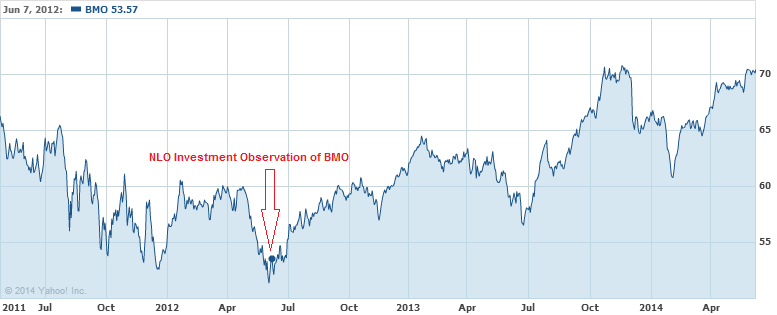
If there is a concern that Canadian real estate is in a bubble then it would be wise to sell only the principal in BMO while leaving the profits to compound. This would eliminate the guesswork associated with determining if there is a bubble. The remaining funds would be allowed to compound at a 5.50% rate until BMO has sustain a similar decline in price from April 2011 to June 2012.
Richard Russell Review: Letter 854
Richard Russell’s Dow Theory Letter Issue 854 was published on February 9, 1983. At the time, the Dow Jones Industrial Average was at the 1,067.42 level.
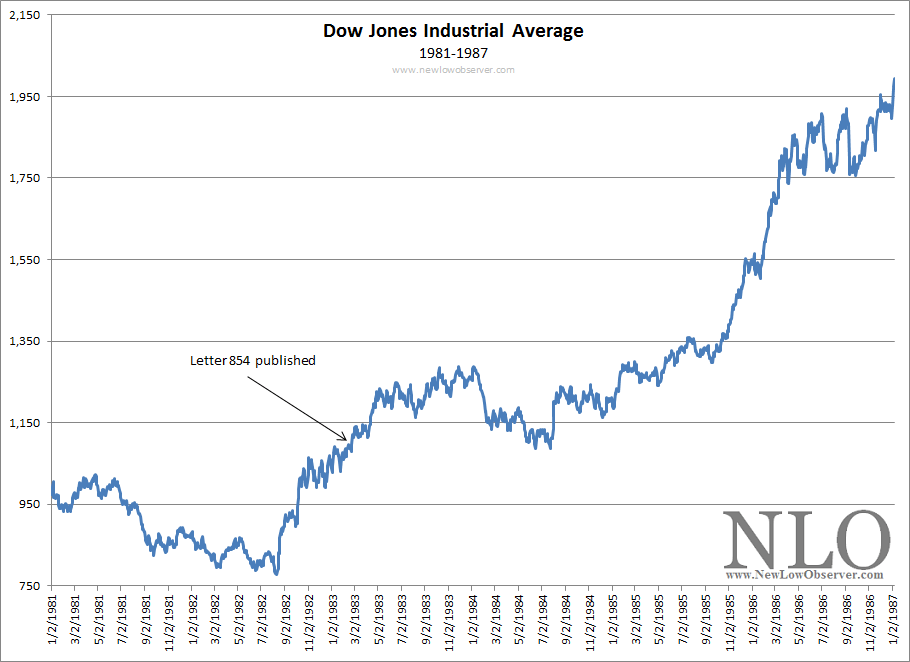
Economic events never occur in a vacuum. Usually there is a string of events that leads from one event to another. One big event can lead to an even bigger event that overshadows the prior calamities that triggered the “big” event. This issue of Richard Russell’s Dow Theory Letters covers one market event that led to major crises that happened at different periods in time. The two events are joined at the hip based on the decline of oil prices. This led two separate major bailouts that resulted in structural shift in the way our brand of capitalism works.
Also, this Russell review will cover the topic of cycles in corporate cash and corporate indebtedness. We'll discuss, in brief, where we might be in this cycle.
The first event resulted in the Savings and Loan Crisis and is thought to have begun in 1986 due to the Tax Reform Act of 1986 culminating in the bailout of many banks and the eventual bankruptcy of the Federal Savings and Loan Insurance Corporation (FSLIC).
The second event resulted in the Mexican Peso Crisis with the outcome that major banking institutions like Citibank and Goldman Sachs needed to be bailed out. It is important to note that the Peso Crisis is considered to be as a result of the peso devaluation in 1994.
The true roots of both the S&L Crisis and the Peso Crisis is the decline of oil prices after the inflationary peak in 1980-1981. Richard Russell’s Dow Theory Letter Issue 854 highlights the seeds of destruction that were going to be much larger than even Russell could have imagined. However, if anyone wishes to understand how the snowball got rolling then this issue highlights the beginning.
The very first quote is an amazing insight of the American dependence of the high price of oil, Richard Russell says the following:
“We’re facing a situation (ironically) where the US is all for holding oil prices at a high level. The banks have lent huge sums of money both to private corporations and to oil producing nations-loans based on rising oil prices. If the oil price cracks badly, the banks are going to have major problems. On top of that, the US depends on oil taxes (so called “excess profits” tax) for huge chunks of tax income. If oil prices crack then the profits for the oil companies will dive (which they are already doing) and the tax short-fall will be horrendous. (page 1)”
This commentary is staggering in the fact that it was so prescient. The cracks in the armor of the American oil industry began in Texas when the easy money stopped raining down on oil dependent cities like Houston and Dallas. In a 1988 issue of Dow Theory Letters, Russell had the following to say:
“With oil prices caving in, Texas now has more people leaving the state than coming in.( Dow Theory Letters. March 9, 1988. page 6.)”
The decline in oil prices led to a decline of jobs for that industry which resulted in a decline in real estate prices as people left the state of Texas. Loans made by savings and loan institutions in the southwest U.S., to businesses and real estate investors, all went bad at the same time leading to the Savings and Loan Crisis (S&L Crisis). The S&L Crisis cost several hundreds of billions of dollars and still exist as an off-budget item as part of our national debt.
The decline in the price of oil also crushed foreign economies dependent on the commodity. The Mexican Peso Crisis, although officially listed as beginning in 1994, had its roots in the early 1980’s. The natural outcome of this crisis was the bailout of large banking institutions like Citibank and Goldman Sachs when the government stepped in and bought the bad debt held by the bank’s all in gamble.
Likewise, the current boom in commodity rich countries (although somewhat cooler at present) like Australia, Brazil, Russia, China and India could experience significant shocks to their system depending on the level of loans made as “investments” by foreign banking institutions based on the potential of future growth.
Few understood or believed the impact and importance of high oil prices to the American economy at the time. Even fewer understood the direct reliance of the U.S. government to high oil prices. Then as now, the elevated level of the price of gold is being wagered on by the U.S. government in a similar way that it was done when we had high prices in oil. The excessive printing of money through quantitative easing and other accommodative policies by the Federal Reserve is based on the elevated level in gold prices.
If the price of gold were to collapse then all bets are off. Unfortunately, many believe that a collapse in gold couldn’t happen while the government is bent on printing money out of thin air. However, the problem is that commodities like gold are prone to dramatic declines, especially when all bets are that it can’t or won’t happen.
Many die-hard gold investors/speculators are not making the connection between the government’s reliance and expectation of higher prices in gold. Worse still, gold investors mistakenly believe that the U.S. government wants to see a lower price in gold and that the only direction is up due to accommodative policies. This is far from the reality, as found out the hard way by the likes of billionaire money manager John Paulson. Waiting in the wings are other big-time money managers who will likely get bailed out of their money losing bets on gold’s elevated levels. Those that have leveraged their bets on gold and other commodities will be bailed out using taxpayers money and hidden as an off-budget items as part of the national debt. Suffice to say, despite all the carnage in the period from 1980 to 2007, the stock market managed to climb over 12 times.
Next up is a comment on how U.S. corporations were strapped with debt. Russell says the following:
“In the shorter term, the argument for holding stocks is that a low rate of inflation will be bullish for stocks. But that argument was never used in a situation like the current one - a situation in which corporations are loaded with debt. Whether these corporations can survive with debt ridden structure during a period of deflation remains to be seen. (page 3)”
This commentary is interesting because it was at the early stages of a secular bull market when the Dow Jones Industrial Average went from 1,000 to the peak of 14,164, an increase of over 12 times in 24 years (and this was just the “average”). Now, we seem to be in the early stages of a secular bear market with just the opposite scenario. Today, we’re being told of the immense cash hoard that corporations happen to be sitting on (WSJ article here). Furthermore, interest rates are at or near zero and likely to rise as opposed to rates falling from double digit heights in 1980.
We’re not impressed with the claims of corporate strength based on off-shore cash hoards. We believe that what we’re witness to is the corporate equivalent of high tide which is inevitably going to be followed by low tide. It is only a matter of time that it will be revealed that the idle cash of today will be the debt-laden corporation of tomorrow. Those that are clamoring (in some cases suing) for companies to disgorge their coffers of excess cash in the form of “special” dividends will not think twice, twenty years from now, that they had unwittingly contributed to the decline of the company that they’ve targeted.
Posted in Citigroup, Goldman Sachs, Letter, Peso Crisis, Richard Russell Review, S&L Crisis
Richard Russell Review: Letter 554
Dow Theory Letters Issue 554 was written on February 7, 1973. At the time, the Dow Jones Industrial Average was indicated to be at the 968.32 level. This was at a point prior to the Dow Industrials declining –40% while the Dow Transports declined –37% to the late 1974 lows.