Reader J.P. asks:
“What is your recommendation for taking a position. All in, or 1/2 in and average up or down. I can't find anything on this on the website.”
Our Response:
Reader J.P. asks:
“What is your recommendation for taking a position. All in, or 1/2 in and average up or down. I can't find anything on this on the website.”
Our Response:
Comments Off on Dow Theory: Buying in Scales
Posted in Dow Theory, Scales, Value Investing, values
Tagged members
As early as May 5, 2011, when silver was trading at $35 an ounce, we’ve maintained the view that the prospect of silver, in the form of the exchange traded fund iShares Silver Trust (SLV), falling below $20 was well within the realm of possibility (article here). At the time, we said the following: Continue reading
Posted in Charles H. Dow, Dow Theory, Edson Gould, iShares Silver Trust, Silver, SLV, speed resistance line
Tagged members
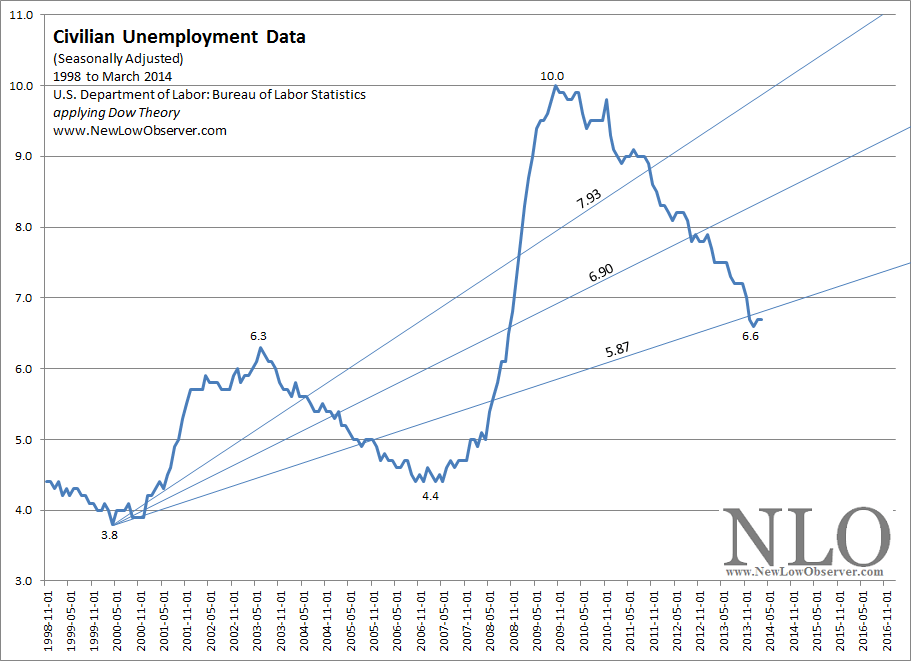
For some, the economy has not fully recovered until the unemployment rate is “back where it was” when the economy was booming. Unfortunately, there are key issues with this notion. Continue reading
Posted in Dow Theory, Unemployment
Subscriber R.G. asks:
“If emerging markets possess such a gambit due to their lack of similar history in the past how can we analyze the markets in order to capitalize on their surges of demand which quickly taper[s] off?”
Our general view on foreign and emerging markets is similar to that of Warren Buffett’s when he said:
“'If I can't make money in the $4 trillion US market, I shouldn't be in this business. I get $150 million earnings pass-through from the operations of Gillette and Coca-Cola. That's my international portfolio’ (source: Ellis, Charles D. Wall Street People. page 56. link here.)”
There seems to be little need to invest in foreign or emerging markets. However, if there is a desire to invest in foreign markets then Dow Theory provides a reasonable template for how to approach investing in such a market. In a section titled “Dow's Theory True of Any Stock Market,” William Peter Hamilton says the following:
“The law which governs the movement of the stock market, formulated here, would be equally true of the London Stock Exchange, the Paris Bourse or even the Berlin Boerse. But we may go further. The principles underlying that law would be true if those Stock Exchanges and ours were wiped out of existence. They would come into operation again, automatically and inevitably, with the re-establishment of a free market in securities in any great capital. So far as, I know, there has not been a record corresponding to the Dow-Jones averages kept by any of the London financial publications. But the stock market there would have the same quality of forecast which the New York market has if similar data were available. (source: Hamilton, William Peter. Stock Market Barometer. Harper & Brothers Publishers, New York. page 14. link here.)”
When we speak of Dow Theory, we are referring to the emphasis of values, fundamentals in relation to price as they pertain to individual stocks and the stock market. We are putting less emphasis on the strict technical analysis of the equivalent industrial and transportation indexes.
To be clear, because we live in the United States we emphasize investing in the U.S. However, according to Hamilton, it does not matter which country that you’re in, investors should embrace the comparative advantage of living in a country other than the United States and should become experts of value opportunities in that region.
Posted in Dow Fair Value, Dow Theory, Value Investing, values
It has been almost two months since our last Dow Theory posting. This is as it should be, since Dow Theory does not require a daily accounting of changes to the market. As indicated in Robert Rhea’s The Dow Theory:
“There are three movements of the averages, all of which may be in progress at one and the same time. The first, and most important, is the primary trend: the broad upward or downward movements known as bull or bear markets, which may be of several years’ duration. The second, and most deceptive movement, is the secondary reaction: an important decline in a primary bull market or rally in a primary bear market. These reactions usually last from three weeks to as many months. The third, and usually unimportant, movement is the daily fluctuation.” (source: Rhea, Robert. The Dow Theory. Barron’s, New York. 1932. Page 32.)
Posted in Dow Industrials, Dow Theory, Dow Theory Bull Market indication, Dow Transports, downside
Tagged members
Reader BlueIce comments (found here):
“So for the past four years, the NYSE is up but volume down…What is the root cause, if any? Bank Bernankski ?”
Our Response:
While there is considerable belief that the Federal Reserve has been the main driver in the financial markets since the March 2009 low, we believe that the Fed’s activity has NOT YET been felt in the stock market. First we’ll explain the two primary reasons we believe this. Afterwards, we’ll explain what we believe are the possible outcomes to the Fed’s current policies.
First, in our January 19, 2011 article titled “Federal Reserve Isn’t to Blame for the Current Market Run” (found here), we concluded with the following thought:
“A cursory review of market data during the periods from 1860 to 1914 makes it clear that declines of nearly -50% or more are likely to retrace +66% to +100% of prior declines. This pattern has been easily demonstrated in the periods after 1914. However, we’re only trying to illustrate that the acceptance of the Federal Reserve’s role as the leading cause of the current +69% retracement of the prior decline (2007-2009) is false.”
We’ve maintained the view that the Federal Reserve’s impact on the stock market has been muted so far.
Second, regarding the issue of manipulation of the markets, which is implicit in the discussion of the Federal Reserve’s involvement in the rise of the stock market, we take the Dow Theory view on the topic. Charles H. Dow was very specific about market manipulators and manipulation. Dow has said that manipulation is a factor of the market in the day-to-day movement. However, the long-term trend of the market cannot be manipulated as demonstrated in detail from the writings of William Peter Hamilton, former editor of the Wall Street Journal.
Hamilton says of manipulation:
“The market is always under more or less manipulation.”
“Even with manipulation, embracing not one but several leading stocks, the market is saying the same thing, and is bigger than the manipulation”
“Major Movements Are Unmanipulated-One of the greatest of misconceptions, that which has militated most against the usefulness of the stock market barometer, is the belief that manipulation can falsify stock market movements otherwise authoritative and instructive”
“These discussions [of manipulation] have been made in vain if they have failed to show that all the primary bull markets and every primary bear market have been vindicated, in the course of their development and before their close, by the facts of general business, however much over speculation or over-liquidation may have tended to excess, as they always do, in the last stage of the primary swing”
“It has been shown that, for all practical purposes, manipulation has, and can have, no real effect in the main or primary movement of the stock market, as reflected in the averages. In a primary bull or bear market the actuating forces are above and beyond manipulation. But in the other movements of Dow’s theory, a secondary reaction in a bull market or the corresponding secondary rally in a bear market, or in the third movement (the daily fluctuation) which goes on all the time, there is room for manipulation, but only in individual stocks, or in small groups, with a well-recognized leading issue”
(Source: Hamilton, William Peter, The Stock Market Barometer, Wiley & Sons, New York, 1922.)
The Fed and world central bank manipulation has an impact on the day-to-day and maybe the medium-term, however, the long term will exert itself regardless of the manipulation.
Finally, while we are skeptical about the Dow Theory secular bull market indication, we have to accept that it is real. As with most economic policy, the impact is felt long after the implementation. Dow Theory might be saying that we’re about to enter a phase hyper-activity in the stock market. If this is the case, then we just might see the impact of the Federal Reserve’s stimulus of the last several years finally kick in, catapulting the stock market to unbelievable heights.
The lack of trading volume in the stock market since 2009 reflects little or no participation on the part of the public. If this is true, then any meaningful rise in trading volume (on the buying side) due to added participation from the public could result in tremendous gains. This thought sits in the back of our mind as we strategize the best way to take advantage while not being over exposed.
When we say that the public hasn’t participated in the stock market’s rise, who cares? The answer is the very financial institutions that required bailouts in 2008. They have been trading amongst each other in a game of hot potato. If the public doesn’t jump in soon there could be major fireworks to the downside.
Again, if the Dow Theory bull market indication isn’t real then we’ll see another round of “too big to fail” institutions coming with hat in hand to the U.S. government. The most vulnerable institutions could be those that were forced to merge with companies like Bank of America/Merrill, Wells Fargo/Wachovia and JPMorgan/Bear Stearns. From our research on this topic, we’ve seen what happens when a sizable failed institution is forcibly merged with an ailing but salvageable company (i.e. our article on CreditAnstalt).
Comments Off on Dow Theory Q&A
Posted in Dow Theory, manipulation, Q and A, William Peter Hamilton
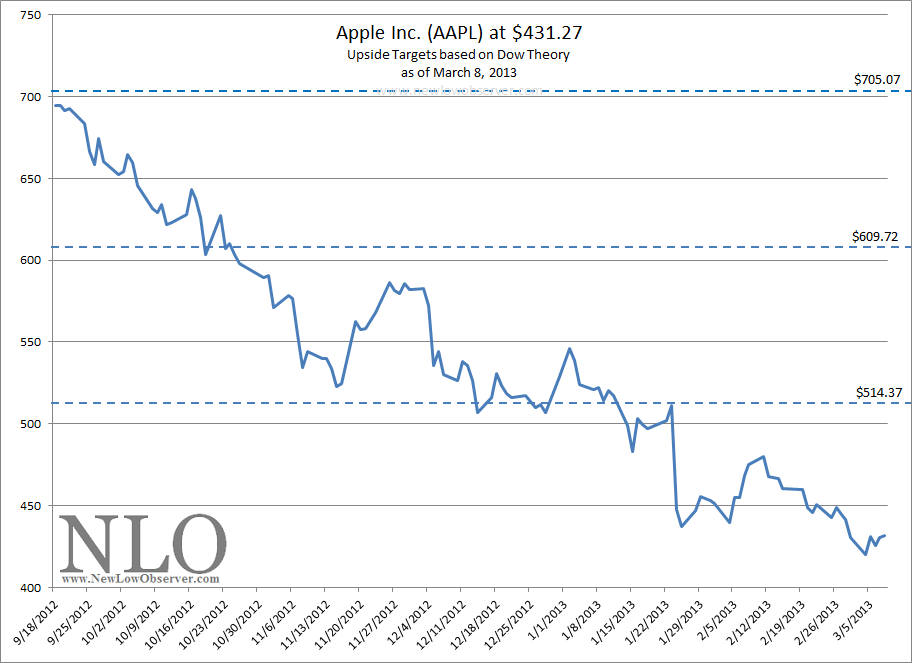
Since the bull market run began in 2009, Apple (AAPL) analysts have been making persuasive arguments for the stock. The fundamental case for Apple includes price-to-earnings, price-to-sales, cash reserves, China as an untapped market, etc. However, as investors have found out, it is the price that matters most as Apple’s stock has taken a hit from the high of $702 on September 19, 2012 to the current price of $443 (March 18, 2013). While fundamentals are important, there is one obvious problem and that is the trading volume.
In the section on Dow Theory, in the Edwards and Magee book Technical Analysis of Stock Trends, volume is interpreted in the following manner:
“…in a Bull Market, volume increases when prices rise and dwindles as prices decline; in Bear Markets, turnover [volume] increases when prices drop and [volume] dries up as they [prices] recover (33).”
When we compare the previous bullish moves in Apple’s stock price, we find that the most recent run-up stands out as trading volume has not only failed to increase with the stock price, it has been on a divergent path by declining. However, we need to see how different this most recent rise in the stock price is in contrast with the previous bullish moves.
In the bull market run of Apple from December 30, 1997 to February 29, 2000, the stock price rose +900% while average trading volume increased +1,000%.
In the bull market run of Apple from April 1, 2003 to December 30, 2007, the stock price rose over +1,400% while average trading volume increased +1,000%.
In the bull market run of Apple from January 21, 2009 to the present, the stock price rose nearly +900% while average trading volume decreased -51%.
The obvious problem with the current rise in the price of Apple from the January 21, 2009 low to the September 19, 2012 high is that while the stock price has increased dramatically, the trading volume has fallen precipitously. Already, Apple has inexplicably declined –36% from the high. There is little in the way to indicated that the blood-letting is over.
According to Robert Rhea, in his book The Dow Theory, “…the volume of trading has proved to be such a useful guide in attaining proficiency in the art of forecasting market trends that it is necessary to urge all students to study intently the relation of volume to price movement (88).”
It would be foolish for us to think that the decline in volume, from 2009 to the present, while the stock price increased wasn’t a warning sign. It is suggestive of the fact that all was not well and therefore the party had to end at some point in time. This is despite the otherwise glowing fundamentals that are associated with Apple.
Now, if the almighty Apple can decline –36% in spite of the glowing fundamentals as the Dow Industrials and Dow Transports keep going higher, then what is the fate of two main components of Dow Theory? By all indications, we should be considered to be in a bear market based on the fact that the price of the Industrials and Transports is increasing as the trading volume dries up.
From our vantage point, there are two distinct outcomes possible for the stock market, based on the above quoted sources. Either the stock market explodes higher than anyone has ever imagined possible or the stock market declines, –20% to –30% from the current level, as average trading volume skyrockets. However, our experience so far has been for volume to decrease as the price increased. Therefore, by our logic, when and if volume starts to increase it will be because institutions will be selling instead of buying the market.
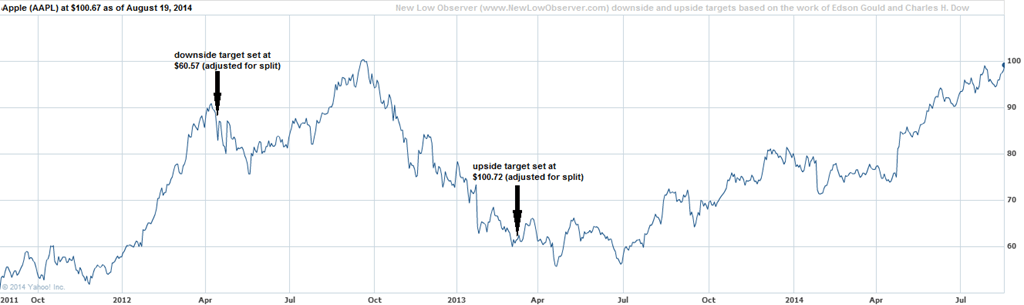
While we have constructed two possibilities, the probabilities are something else altogether. We think that the fact that volume has been in a clear declining trend, the probabilities favor a decline of the stock market over a sustained increase. To put this idea into perspective, when we wrote our April 14, 2012 article titled “Consider the Downside Prospects for Apple,” we said that Apple would decline to $424 (found here). After the article was written, Apple increased by +11%. However, after Apple peaked, the stock declined –30% from the price where our article was written. Our only question is, was it worth seeing a rise of +11% only to realize a loss of –30%?
Notes:
Comments Off on Apple’s Pain May Be a Warning for the Dow Indices
Posted in AAPL, Dow Industrials, Dow Theory, Dow Theory Non confirmation, Dow Transports
The world of Dow Theory was abuzz after the Dow Jones Industrial Average and the Dow Jones Transportation Average charged to all-time highs on March 5, 2013 (found here). At the time, the Dow Jones Industrial Average had finally capitulated to the inexorable forces that had long since propelled the Dow Jones Transportation Average above the 2011 all-time high. The confirmation of a Dow Theory bull market came when the Dow Jones Industrial Average finally exceeded the all-time high of 14,164 set in October 2007.
The action of the Dow Industrials and Transports has been so compelling that Dow Theorist Richard Russell acquiesced to the strength of the market on March 11, 2013 by saying the following:
“Yes, I know that this market is uncorrected during its long rise from the 2009 low, and I know that there are risks in buying an uncorrected advance that is becoming uncomfortably long in the tooth, but my suggestion is that my subscribers should take a chance (after all, Columbus took a chance) and take a position in the DIAs.”
In the same posting, Russell later punctuates the point by saying:
“I really believe that subscribers should take a flyer on this market. After all, after weeks of flirting with a new high in the Industrial Average, the Dow finally confirmed the previous record high of the Transportation Average. With the Industrials and the Transports both in record high territory, I think being in the market is justified under Dow Theory.”
By all indications, this Dow Theory bull market indication is the real deal, especially when it is endorsed by Russell’s 55 years of experience on the topic. The implications of this signal are significant for one very important reason, this time we’ve achieved a secular bull market indication (learn about cyclical and secular trends).
Throughout stock market history, cyclical primary bull markets tend to last 2-4 years. These bull markets require rapt attention to the nuances and vagaries of changes in the trend. The last indication of a cyclical primary bull market was on July 23, 2009, when the Dow Industrials traded at 9,069.29. Based on our interpretation of Dow Theory, we received a cyclical primary bear market indication on August 2, 2011 when the Dow Jones Industrial Average was at 11,866.62.
Secular bull markets, on the other hand, require very little attention and have typically lasted between 15 and 18 years. Secular bull markets are the proverbial sweet spot of investing with the trend, where “buy-and-hold” is the rule. The two most prominent secular bull markets resulted in the Dow Jones Industrial Average increasing by 10-fold or more. From 1942 to 1966, the Dow rose from 100 to 1000 and in the period from 1982 to 2000, the Dow went from 1,000 to 11,722. If the current implications are correct, we could be on the cusp of a run to Dow 100,000.
Volume: The Lone Holdout
The three major components of Dow Theory are the Industrials, Transports and trading volume. As described above, the Industrials and Transports have achieved the required all-time highs at (or near) the same time which would indicated that we are in a new cyclical AND secular bull market. However, volume has been the holdout in the current move higher.
In the seminal book on Dow Theory titled The Stock Market Barometer, written by William Peter Hamilton, it says the following about trading volume, “It is worth while to note here that the volume of trading is always larger in a bull market than in a bear market. It expands as prices go up and contracts as they decline.”
The average trading volume for the Industrials and Transports has been in a declining trend (contracting) since the 2009 low, as seen in the charts below.
In order for Dow Theory to have relevance, increasing volume needs to accompany the rise of the stock market to ensure that there is sufficient participation and interest. Unfortunately, average trading volume, as indicated in the above charts for the respective indexes, has been trending lower since 2009. This suggests that we could only be in an extended cyclical bull market, within a secular bear market, rather than at the beginning of a cyclical and secular bull market. The key to understanding trading volume and its interpretation are found in the table below.
| volume | price | interpretation |
| decrease | decrease | positive |
| decrease | increase | negative |
| increase | decrease | negative |
| increase | increase | positive |
In the days before volume was tabulated for the individual Dow indexes, the New York Stock Exchange trading volume was the proxy for the market trend in conjunction with the Industrials and Transports. Below is the 200-day average trading volume of the NYSE since 2001.
What is evident is the dramatic rise and peak of average trading volume during the decline of the stock market from the peak in 2007 to the bottom in 2009. However, once the market started taking off, the trading volume uncharacteristically plunged. To emphasis the point, below we have included the charts for the cyclical bull markets from 2001-2007 and 2009 to the present.
In the chart from 2001, we can see that NYSE average trading volume hit a peak in 2002 and then flat-lined for a couple of years until 2005. However, as the strength in the stock market grew, the trading volume accelerated to new highs. This was the hallmark of a true bull market run, rising prices and rising volume.
In the chart from 2008, the average trading volume for the NYSE has had a declining trend throughout the whole bull market run from 2009 to the present. As indicated in the table above, declining volume with increasing prices should be interpreted as a negative. After volume has been in a declining trend for so long, the only alternative is for a dramatic increase.
When the increase in volume arrives, the question then becomes, will there be a dramatic increase or decrease in stock market price? Will the general public’s lack of participation be the catalyst that charges the market to move higher? This situation has to be resolved at some point.
To round out our thoughts on the potential secular bull market signal that we recently received, we thought we would compare it to the last secular bull market change in trend. In the period from 1966 to 1982, the Dow Industrials never traded significantly above 1,000. However, that all ended in late 1982 when the stock market broke above 1,000 and never looked back.
Below is a chart of the Industrials, Transports and NYSE trading volume from March 1982 to November 1982:
The most important information to be gleaned from this chart is the fact that all three of the essential indicators for Dow Theory were confirming each other at a critical point in time. They all achieved clear bull market indications by rising in unison. The current divergence between the Dow indexes with the NYSE trading volume suggests that we will be witness to the greatest transition in the history of the stock market.
The above examination of trading volume, based on a what we believe to be reliable sources, has us concerned that a new secular bull market is not really what we’re witness to.
As William Peter Hamilton has said in The Stock Market Barometer:
“The professional speculator is no more superfluous than the pressure gauge of the steam-heating plant in your cellar. Wall Street is the great financial power house of the country, and it is indispensably necessary to know when the steam pressure is becoming more than the boilers can stand.”
The pressure in the market is building and we may be watching the beginning of the most spectacular stock market blow-off ever. Just before an even more astonishing decline.
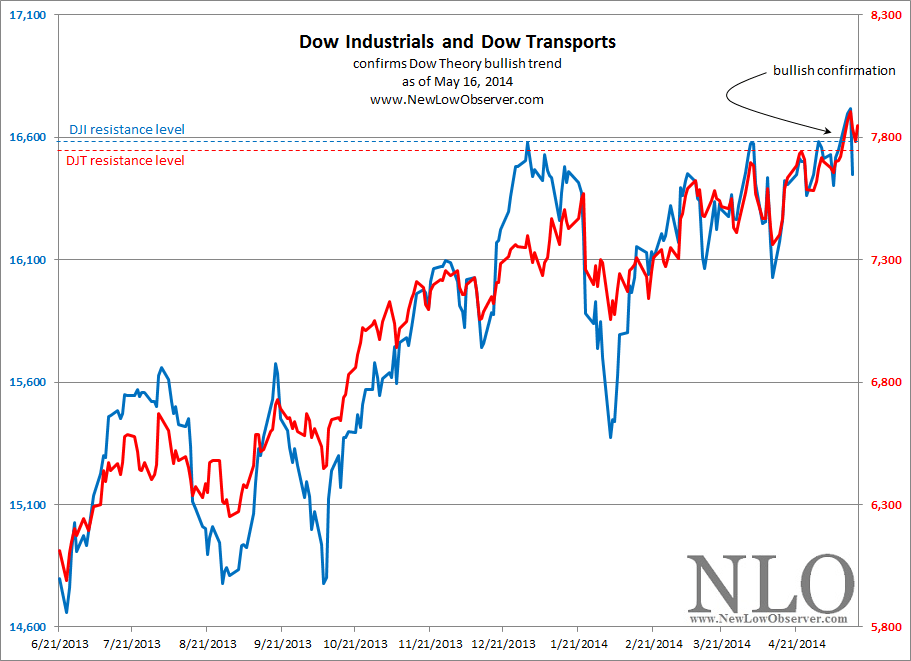
On March 5, 2013, we got a declarative indication from Dow Theory suggesting that we are now in a new primary bull market that has cyclical and secular implications. As seen in the chart below, both the Dow Jones Industrial Average and Dow Jones Transportation Average have reached new all-time highs, designated by going above the respective dashed lines.
Subscriber F.H. asks:
“[Have you] ever consider[ed] constructing a market trend indicator like Richard Russell’s PTI?”
Our Response:
This is a great question and one that we’ve examined in the past.
We are familiar with Russell's Primary Trend Indicator (PTI). In fact, we know the exact constituents of the indicator. According to Richard Russell, editor of The Dow Theory Letters since 1958( www.dowtheoryletters.com), the PTI is a “technical spectrum of the stock market” that cannot be manipulated. Russell goes on to say "...you can fool one or two of these technical items, but you can’t fool all eight of them, and that’s what the PTI is all about." The goal of the indicator is to provide solid indications of market direction that cannot be manipulated.
As a subscriber to Russell's Dow Theory Letters, you are well aware of the many times that the PTI was right and Russell was wrong about the direction of the stock market. However, we're more concerned with the fact of how much advantage does the PTI provide compared to simply using Dow Theory.
Here is what we’ve found. According to Dow Theory, on July 23, 2009 a new cyclical bull market began. At the time we recommended investing in the highest weighted stocks of either the Industrials or Transports index or the purchase of ETFs for the Industrials (DIA) or Transports (IYT) (article found here).
On the other hand, the Primary Trend Indicator (PTI) gave the first hint that we were in a cyclical bull market on August 25, 2009. In addition, the PTI didn’t give the “all clear”, in terms of being in a bull market, until November 30, 2009 (as seen in chart below). In fact, a good technical analyst would have had tremendous difficulty in getting a clear indication based on the PTI until after the December 8, 2009 rebound.
There is an alternative view on interpreting an earlier signal than the Dow Theory indication using the PTI. However, you would need to apply Dow’s theory in order to properly achieve the earlier signal based on the PTI movement. Using the purple line above, an individual could have interpreted that a cyclical bull market tentatively started as early as May 4, 2009, when the PTI exceeded the January 2009 peak. Subsequent to the May 4th peak, the PTI did not decline below the 89-day moving average on May 27, 2009, suggesting that more upside existed.
However, when we refer back to Russell’s June 3, 2009 issue there is no indication that a tentative new bull market was in play. No mention that May 4, 2009 or May 27, 2009 were possible indications of a new bull market in stocks. In fact, Russell commented that “…ridiculous but unseen green shoots is now repeated everywhere. I’ve stated that a true bear market bottom usually requires many weeks or even months before the crowd turns bullish.” This comment along with the picture of a bear at the top of his newsletter was the only indication that we had that we were still in a bear market, according to Richard Russell.
Because we have studied the PTI in detail, we've determined that it is not worth including in our work. In fact, we’ve found that it is more noise on the market when compared to correct, albeit conservative, interpretation of Dow Theory. If we get Dow Theory right, then we don’t need another indicator to follow that could potentially confuse our primary indications based on Dow’s work. Yes, we will take in as many views as possible, however, we will rely on Dow Theory as the primary indicator for market direction.
Finally, to create an indicator that is supposed to be impervious to manipulation while at the same time practicing Dow Theory is doubling the effort necessary in watching the movements of the market. We’ve outlined in extensive detail the role that manipulation plays in the stock market and how the interpretation of Dow Theory mitigates the most extensive manipulation possible (found here).
Subscriber F.H. Asks:
In regards to our recent posting of the 2012 Portfolio Performance Review F.H. asks, “…I am wondering if the methodology will allow this streak to continue. the process, as I understand it, is to buy stocks at their lows, hold them for a significant gain, and then sell a portion of the position but retain some % of original principal in the investment. won’t the portfolio eventually have such a large percentage of these residual holdings that the incremental effect on returns from the new positions will be overwhelmed?”
Our Response:
In theory, the primary drawback would be that we’ll be working with the same amount of cash over an extended period of time whenever we sell the principal. However, we’re comfortable with continually adding new cash to the portfolio so that we are not faced with the very real potential of our residual holdings dwarfing our capital base.
Our strategy is the literal application of a concept that is outlined in the book Rocking Wall Street by Gary Marks. In an interview on June 2, 2007 with Financial Sense Newshour host Jim Puplava (found here), Marks gives insight as to the reasons why an investor might want to employ the strategy that we’ve outlined with selling the principal and letting the profits run. The interview is so good that we’ve indexed the various topics covered in the interview below.
| minutes | topic | |
| 3:57-4:57 | Art and Craft of Investing | |
| 6:48-8:25 | Investing is About Less Risk Over Time | |
| 16.03-17:13 | Emotional Risk causes Gambling Modality | |
| 17:15-19:28 | Myth of Tax Savings from Buy and Hold | |
| 19:29-21:39 | Myth of Buy and Hold | |
| 25:32-28:10 | Risk to Real Estate | |
| 28:11-31:57 | Cash as a Hedge | |
| 38:58-42:05 | portfolio construction & life balance |
The discussion of the “Art and Craft of Investing,” as described by Marks, is exactly what we’re practicing and what we believe will give any investor the benefits that are claimed that the stock market can offer. Our approach is in stark contrast to the belief that if you practice Dow Theory you must go all in when the signal is bullish and sell everything when the signal is bearish, but at the same time you’re supposed to compound your way to investment wealth.
We agree with 95% of the strategies described by Marks in the Financial Sense interview. After weighing the merits of various investing approaches, we’ve tried to responsibly provide methods for investing while limiting the risk of excessive loss.
Comments Off on NLO Q&A
Posted in Dow Theory, PTI, Richard Russell