We executed the following transaction(s): Continue reading
-
Topics
Archives
-
-
Recent Posts
-
-
-
-

We executed the following transaction(s): Continue reading
On October 5, 2019, we said the following of the Hang Seng Index:
“By all accounts, the failure of the Hang Seng Index to meaningfully exceed the 23,264.43 level indicates that the range of 24,585.53 to 21,616.14 is a lock.”
As seen in the chart below, the Hang Seng Index achieved a low of 21,696.13 on March 23, 2020.

There is more room for downside risk, as plainly seen in the Dow Theory target of 19,967.86. Hand over fist buying should be considered at levels below the ascending 19,967.86 trend line.
see also:
Posted in Dow Theory, Hang Seng Index, HSI, Target Achieved
Source
Krugman, Paul. "A Trade Pact for Chips: Just a fancy form of Protectionism." New York Times. August 10, 1986. F2.
Claims
Prediction
“...in the future, we will see many proposals to extend the pattern of sugar, autos and textiles to other industries.”
Posted in Krugman
Below are the valuation targets for RLI Corp. (RLI) for the next 10 years. Continue reading
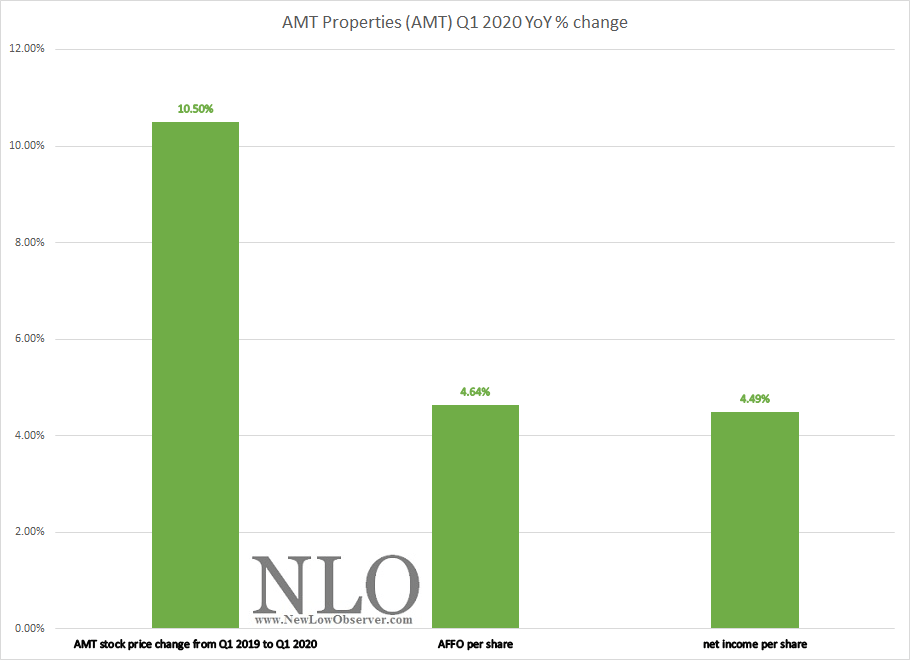
Industry representatives say that steadiness of AFFO is more reflective of a REIT’s health. For the purposes of determining the future direction of the stock price, we prefer the wide variability of the net income figure. (data source)
see also:
As we enter the bailout phase of Boeing, there is one chart that should alarm all investors.
Since the low in the stock market on March 9, 2009, Boeing (BA), (as of March 20, 2020) has gained approximately +206%.
In the same period of time (March 9, 2009-March 20, 2020), the Dow Jones Industrial Average has increased +192%.
Let that sink in for a minute. We are about to bail out a company that as of March 20, 2020 has exceeded the gains of the Dow Jones Industrial Average since the March 2009 low.
Now, Let’s look at the chart that should be causing dread for all investors.
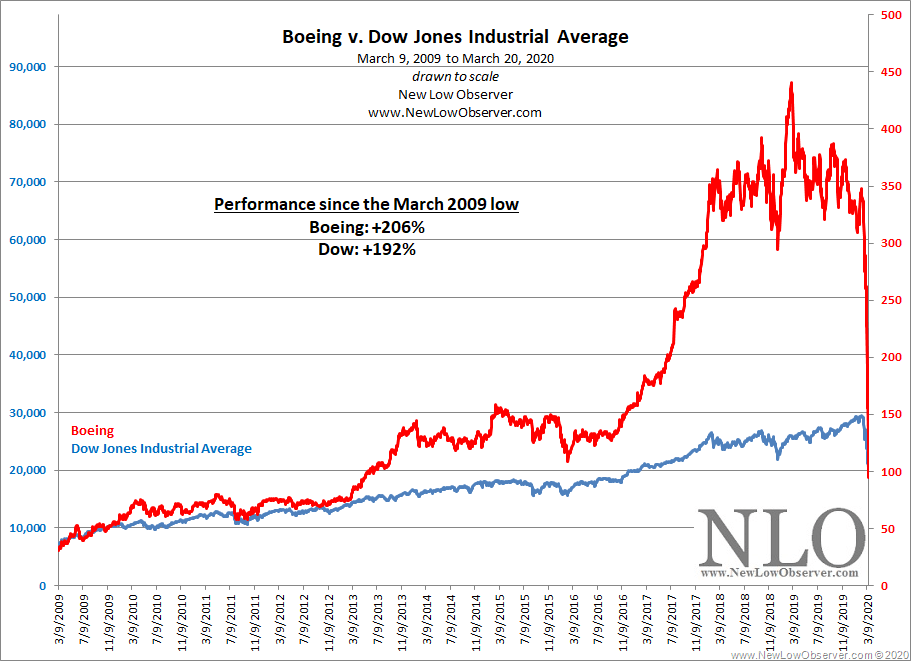
The comparison between Boeing and the Dow Jones Industrial Average, when drawn on a relative basis, shows the extent of the bubble in the price of Boeing stock.
Defenders of the Boeing bailout say that the total shutdown of the airline industry and the coronavirus are the reasons that Boeing is suffering more than usual. However, when viewed on a relative basis against the Dow Jones Industrial Average, which Boeing is a part of, we can only conclude that Boeing is only reverting to the mean.
As noted above (206% v. 192%), the mean has not been reached and as Charles H. Dow has said, the reaction will swing to the opposite direction before being resting at the mean.
On January 30, 2019, we said the following:
“The rebound has been exceptional but requires one last step in the process of confirming that the trend is actually up. In order for the trend to be CONFIRMED as up, the price of TPL needs to retest the $409 level and hold. Without holding at the $409 level, TPL would be expected to test the ascending $290.66 target, at minimum.”
Since January 30, 2019, Texas Pacific Land has had the following activity:
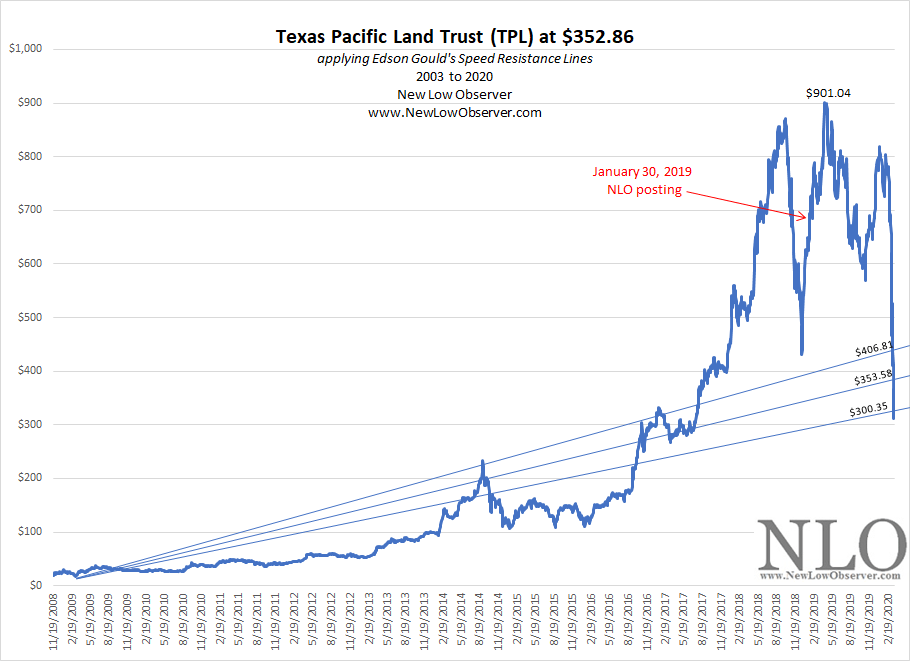
We’ve updated the Speed Resistance Lines because the peak in the price increased from our prior level at $871.99 to $901.04. Unsurprisingly, TPL has achieved our lowest downside target after bouncing at the $410 level.
Now our concern is how far below the $300 level that TPL might go. We seem to be in the early stages of the current market decline so we’ll have to update the downside risk as we go.
Posted in Edson Gould, SRL, TPL
Review:
Update
Before the full year of 2020 was under way, General Electric had managed to give back all ofthe 2019 gains. The era of forgiving has been quickly forgotten.
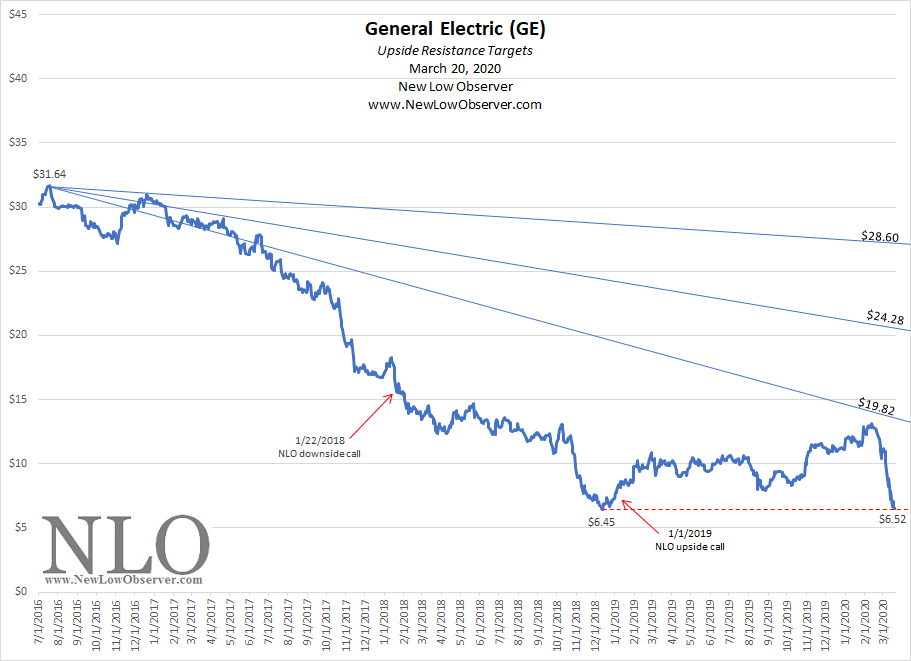
Now that General Electric sits on the cusp of the 2018 low, the questions becomes, can the stock recover and retest the 2020 peak? We don’t think so for two primary reasons.
The fact that the price could rise as expected and the falter at the very resistance target that was highlighted near the 2018 low suggests that there are powerful forces at work.
The reality is that a recession is on the way. the depth and length is the only unknown. However, we have always maintained that if General Electric couldn’t do well during a booming economy then what should be expected during a recession?
We advise caution as the market seems bound and determined to expose failings and frauds which will result in collateral damage to companies like General Electric.
Posted in GE, General Electric
Advocates for the bailout of Boeing (BA) are citing the “black swan” event of COVID-19 as the reason the company has reached the tipping point of failure. These same people are saying that, in spite of Boeing:
The company is too big to fail because the cascade of job losses throughout the entire U.S. economy would be catastrophic.
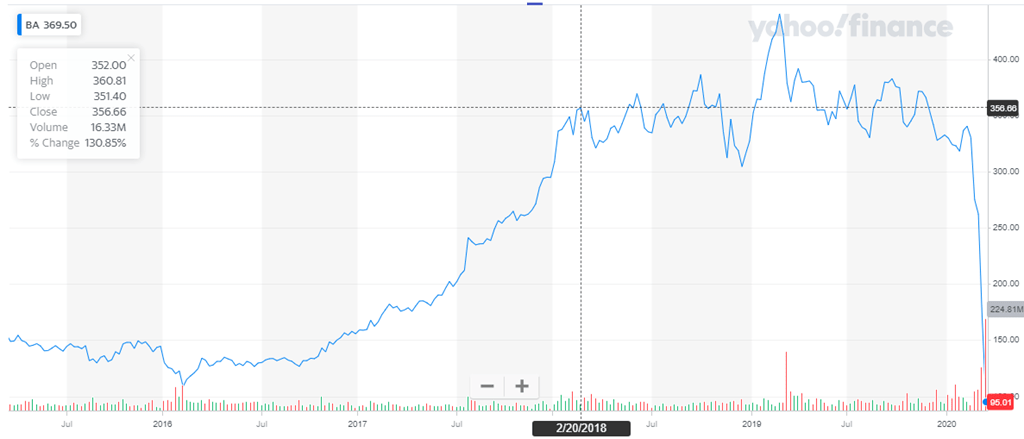
We’d argue that demise of Boeing began near the February 20, 2018 period. We don’t know why it occurred at that time, However, the stock had run out of upside momentum and vacillated between the $356.66 price since that time.
The most recent decline is the culmination of the collective wisdom of the markets which decided after March 4, 2019 that the fate of the company had been determined.
As with the bank and auto bailouts of 2008, the belief is that there doesn’t exist the capacity of the largest and most broadly developed economy in the world to absorb the loss of such a big company. Thanks to the bailout to come, we will continue to never know.
Below are the downside targets for the SPDR Gold Shares (GLD).
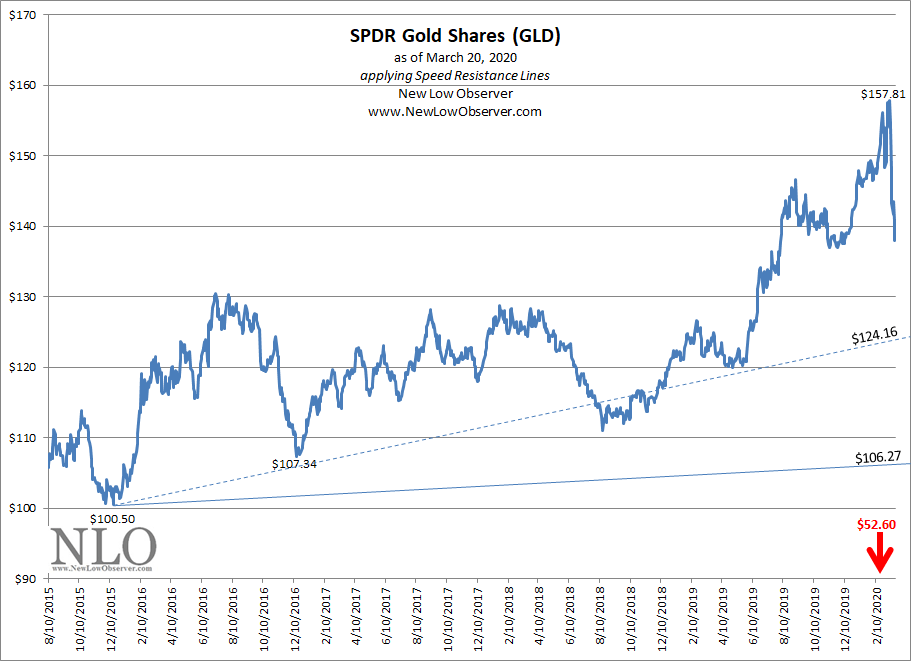
The $124.16 level is not an “official” downside level as it is only an intermediate point on the way to the actual level of $106.27. As we’ve seen in the past, the extreme downside target is always the concern. For GLD the extreme downside target is $52.60.
Top three stocks, commodities, or indexes that achieved our downside targets by year:
2020
2019
2018
2017
2016
How do we use Speed Resistance Lines? Once a target is achieved we assess the possibility of investment. If the target is not achieved we move on to the next stock.
There are approximately 15% to 20% of the SRLs that we’ve run that haven’t come to fruition, yet. However, in this current market decline, many that weren’t fulfilled are now getting completed.
Posted in Edson Gould, GLD, Speed Resistance Lines, SRL
When Tesla (TSLA) was trading at $734.70, we said the following:
“Parabolic increases rarely go unchecked. This typically means that a decline to the conservative downside target is the norm, at minimum. However, Tesla has had a history of defying the “norm” when it comes to price change.”
At that time, February 5, 2020, we provided the following downside targets:
Seventeen days after our downside price targets, the price of TSLA increased as high as $917.42 on a closing basis. The increase in price marginally affected the downside targets for TSLA. So far, Tesla has achieved two of the three downside targets and looks to easily achieve the last target (extreme downside target).
Below are the updated downside targets for Tesla Inc. (TSLA).
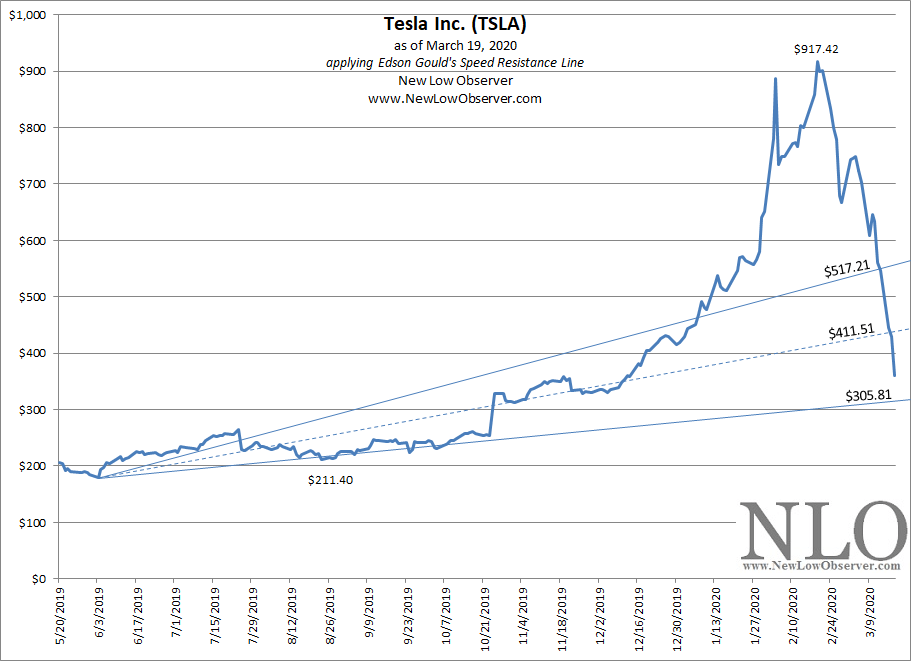
Pendulums swing from one extreme to another. We’ll watch to see if the extreme to the upside is matched on the downside.
Posted in Speed Resistance Lines, SRL, TSLA
In our last Gold Stock Indicator, published October 28, 2018, we offered up $1,755.41 as the extreme upside resistance level for gold. When the same level is drawn to the most recent price, we find that gold has struggled at the $1,755.41 resistance line.
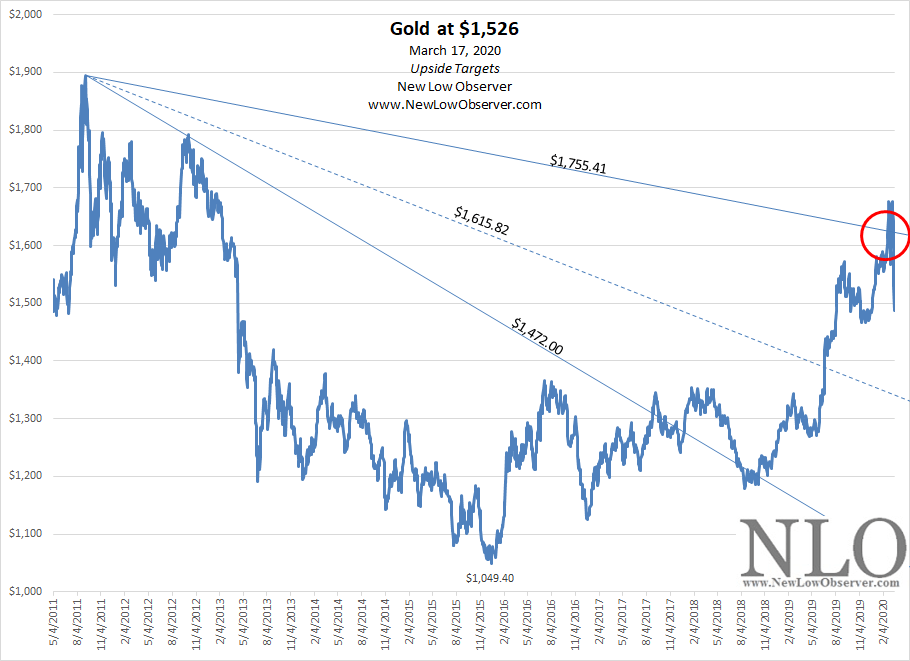
It is one thing to struggle but it is an entirely different situation to collapse below the last remaining upside resistance level. Ordinarily, the price action above the descending $1,755.41 line would have assured us of a rise to the previous peak. Now, with the latest collapse, the price of gold is slated to bounce at the descending $1,615.82 level. That descending line is the equivalent of the $1,343.75 price.
Looking at the Philadelphia Gold and Silver Mining Stock Index (XAU) leads us believe that the $1,343.75 level in gold, although a very extreme level on the downside, could be a realistic target.
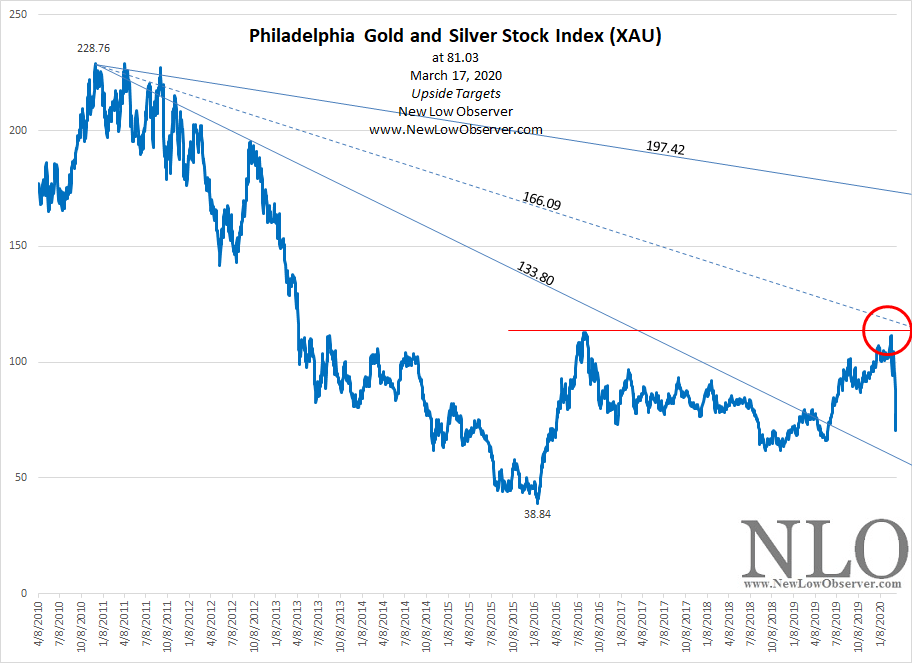
Notice that the XAU index could not exceed the upside resistance target of 166.09 AND the prior peak set in August 2016. That is a significant hurdle that should have been breached on the upside. Instead, the failure puts emphasis on the downside target.
The XAU index stands to re-test the 133.80 level which is the equivalent of 52.00. It should be noted that the XAU is the leading indicator for the direction that the price of gold should go. If you didn’t notice the rise in gold stocks from the late-2015 low then you shouldn’t notice it now.
The latest upside action of double digit percentage increases is a warning of more downside risk rather than a resurgence to the 2010 peak at 228.76 (our April 2011 call that the XAU would decline -66% [it lost -83%] found here).
Below is the monthly New York Times Recession/Depression Index from January 2000 to mid-March 2020.
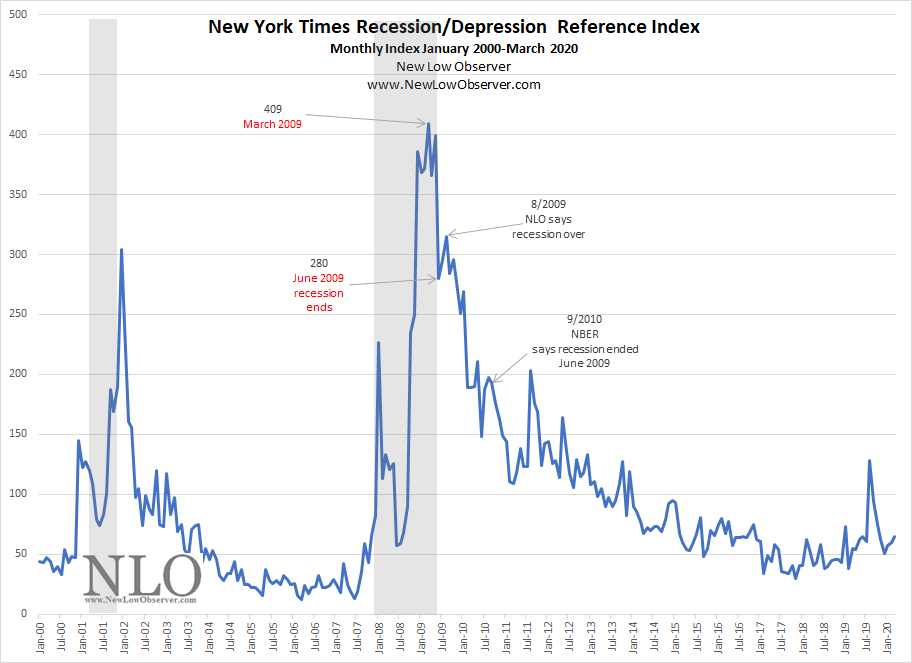
We think the corner has turned on the New York Times Recession/Depression Index. This means that we think that the U.S. economy is about to enter a recessionary period as designated by the National Bureau of Economic Research (NBER).
What about the Federal Reserve’s recent implementation of an emergency rate reduction to zero percent and QE? What about the president’s actions in declaring a national emergency? This may reverse the trend from the November 2017 low.
We’ll gladly take in any new information that can reverse or change the index numbers going forward.
Visit our December 30, 2018 explanation of this index (found here) which goes back to 1851.
In a July 1999 issue of Investment Quality Trends published by Geraldine Weiss, it was observed that a dynamic shift in the history of the Dow Jones Industrial Average may have been in the process. Weiss said the following:
“For more than 100 years, the benchmarks of value for the Dow Jones Industrial Average have been 3.0% at Overvalue and 6.0% at Undervalue. Now, the venerable D.J.I.A. has climbed so extremely high, it’s dividend yield has dropped to 1.5%…the lowest in history. The situation intrigues us and causes us to wonder if the Dow is establishing a new profile of value between dividend yield extremes of 1.5% at Overvalued (where stocks should be sold) and 3.0% at the former Overvalued level (where stocks can be bought). Throughout history, there has been a 100% differential between the high and low dividend yields at historical extremes. The D.J.I.A. now is 100% above its historic benchmark of Overvalue.
“If in fact the profile of value has changed from the Dow Jones Industrial Average (time will tell), then it is reasonable to assume that some blue chip stocks which also have climbed far beyond their historic levels of Overvalue, may be experiencing a similar fundamental change in their profiles of value. We saw the other side of the coin in 1982, when interest rates rose to unprecedented levels and some interest rate sensitive stocks established extremes of high yield at Undervalue. (Weiss, Geraldine. Should Some Overvalued Stocks Be Re-Evaluated? Investment Quality Trends. Mid-July 1999. page 12.).”
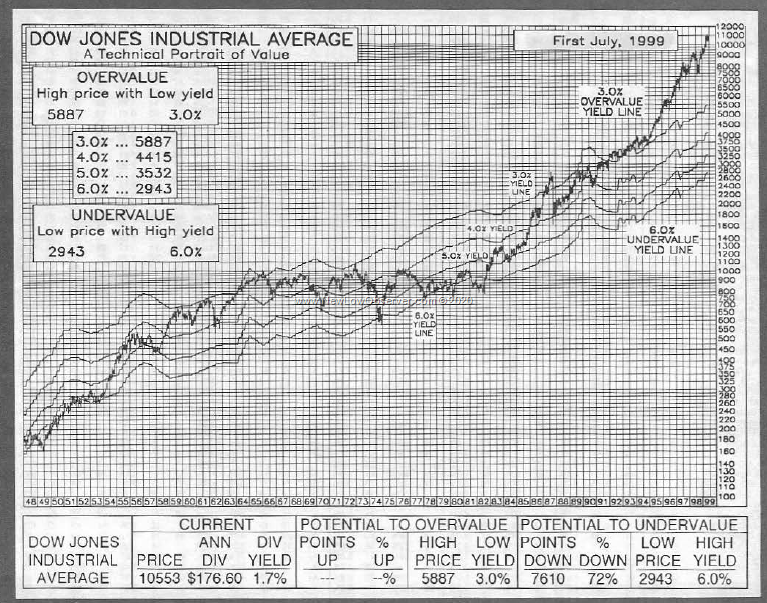
1983-2010
Our updated dividend yield profile for the Dow Jones Industrial Average since Weiss’ 1999 observation is below:
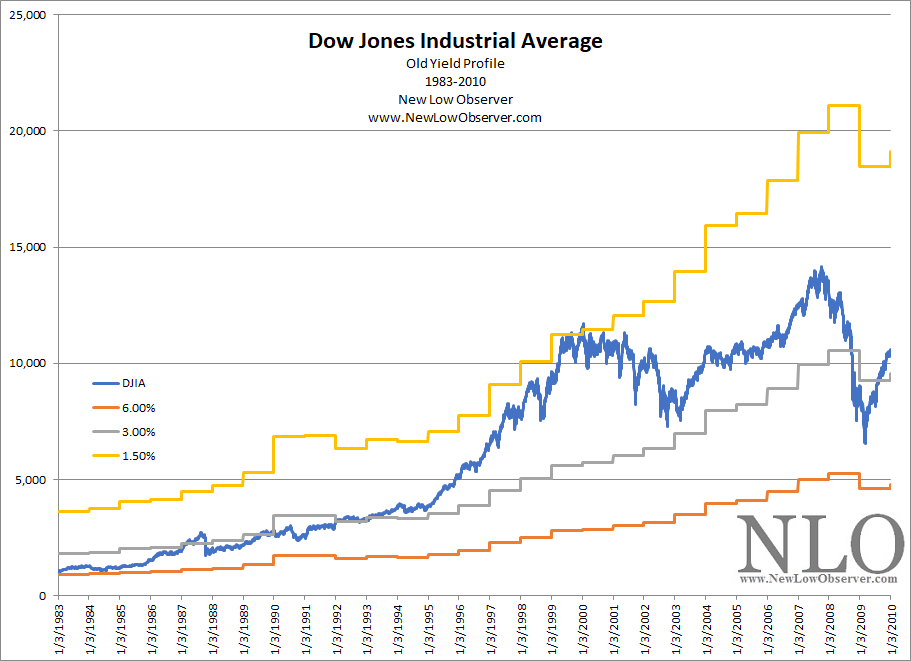
We’ve included the old high yield of 6% and old low yield of 3% with the new 1.50% overvalued level for contrast.
Because the March 2009 low fell short of the 6% dividend yield on the Dow Jones Industrial Average, many market analysts were not willing to accept the fact that the market would turn to the upside. They waited and waited with the view that the rebound was a Fed induced rise rather than a fundamentals and values based increase. Those same analyst were forces to wait out the most hated bull market in history, claiming a crash was coming for over 10 years.
1983-2043 Continue reading
Below are the valuation targets for Cisco Systems (CSCO) for the next 10 years. Continue reading