Canadian Dividend Achievers

This list of Canadian Dividend Achievers, published by Mergent's, includes current and former Canadian Dividend Achievers and then ranking the companies based on those closest to the 52-week low as of August 20, 2010. We've updated the stock symbol to connect to the Financial Post, one of Canada's top business publications. You'll find the most complete fundamental information on these companies at the FP website. However, Yahoo!Finance probably has the better long-term charts and historical dividend data. Enjoy.

FP Symbol Yahoo Symbol Name Price Pct from Yr Low
ESI ESI.TO ENSIGN ENERGY SERVICES INC. $11.90 1.45%
IMO IMO.TO IMPERIAL OIL $38.88 2.99%
POW POW.TO POWER CORP CDA $26.03 3.50%
RBA RBA.TO RITCHIE BROS AUCTIONEERS INC. $18.94 4.64%
PWF PWF.TO POWER FINANCIAL CORP. $28.07 4.93%
GWO GWO.TO GREAT-WEST LIFECO INC $24.50 6.48%
IGM IGM.TO IGM FINANCIAL INC. $39.15 6.65%
CTC.A CTC-A.TO CANADIAN TIRE CORP $54.81 7.77%
SU SU.TO SUNCOR ENERGY INC. $32.68 9.26%
TLM TLM.TO TALISMAN ENERGY INC. $17.25 9.80%
CNQ CNQ.TO CDN NATURAL RES $33.75 11.29%
IAG IAG.TO INDUSTRIAL ALLIANCE $30.40 11.85%
SNC SNC.TO SNC-LAVALIN SV $46.65 12.17%
TRI TRI.TO THOMSON REUTERS $36.80 12.47%
TD TD.TO TORONTO-DOMINION BANK $70.52 15.29%
BNS BNS.TO BANK OF NOVA SCOTIA $50.85 18.37%
Watch List Summary
Below are the best and worst performing Canadian Dividend Achievers in the period from August 6, 2010 to August 20, 2010.
    Leaders:
    • Toromont (TIH.TO) rose 8.52%.
    • Pason Systems (PSI.TO) rose 7.43%.
    • Ag Growth International (AFN.TO) rose 6.73%.
    Laggards:
    • Transcontinental Inc. (TCL-A.TO) fell -12.30%.
    • Methanex Corp. (MX.TO) fell -8.07%.
    • Canadian Natural Resources (CNQ) fell -7.38% 

    Robert Rodriguez Review: September 1994

    One person that the New Low Observer team truly admires in the world of investing is Robert Rodriguez. Mr. Rodriguez had an investment strategy that is very close to the approach that we have employed by examining quality stocks near a new low. The beauty of Rodriguez’s work is that he has an unparalleled investment record in the realm of small and mid-cap companies. From my perspective, there are so many challenges working against companies with a market capitalization of $1 billion or less. However, Rodriguez made it look easy even though we’re certain that it wasn’t. According to GuruFocus, during his time as the manager of the FPA Capital funds, Rodriguez “…has achieved an annualized return of 16.91% as of 9/30/2007. In the same period S&P 500 has returned 13.17% annually.”  (related FPA performance data)

    In the Letter to Shareholders dated September 30, 1994 (PDF), Rodriguez says a couple of things that I feel are worth repeating. In the first excerpt, Rodriguez compares the market declines of 1987, 1990 and 1994. Rodriguez speculates as to the reasons why 1994 was different from 1987 and 1990. He mentioned that in 1987 the stock market crash was due to computer selling while in 1990 the prospect of war became a reality.
    In 1987, Rodriguez thought that the ability to make the decision to sell stocks was easy. The unfamiliarity of computer selling made the choice to sell academic. Likewise, the prospect of war in 1990 was clearly bad so selling stocks wasn’t an issue for average investors.

    According to Rodriguez, 1994 was different because of the following:
    The Fed has shifted to a tighter monetary policy. Interest rates are rising while inflation fears are growing. Will these factors lead to a possible recession in 1995? All are situations that most investors have faced before; therefore, they have created a longer period of investor uncertainty.
    This leads Rodriguez to conclude:
    In this type of an environment, an individual stock’s characteristics tend to play a greater role than any one single event. Stock picking has a potentially higher probability of being a successful strategy and this is where we feel our strength lies.
    My thoughts are that when compared to a market crash or a war, the prospect of a recession is a 50/50 proposition. This causes investors to waver as to whether they should buy or sell stocks. Undecided investors cause the market to become range bound allowing for companies to collect earnings that, in turn, builds value into the price of the stock creating unique value opportunities. This is not unlike the current investment environment where there market has fluctuated in a range due to the agonizing over the threat of a “double dip” recession. Whether a recession materializes, occurring shortly after a small uptick, is a topic for another day.

    Rodriguez ends the September 1994 Letter to Shareholders with a quote that can’t be beat:

    Thank goodness we focus on individual stocks rather than trying to forecast the stock market. The former is far more rewarding and predictable.
    This last quote by Rodriguez explains why the New Low Observer team places so much emphasis on individual stocks rather than mutual funds, index funds and ETFs. With all of the aforementioned products, if a selling spree ensues, the fund can decline despite the quality of the holdings.
    • Hand wringing over the threat of recessions helps to create value in the market.
    • Individual stocks, not funds, have a greater probability of generating higher investment returns.

    Intel Buys McAfee, New Low Gets it Right…Again

    Today it was announced that Intel (INTC) agreed to buy McAfee (MFE) for $7.68 billion.  In a series of articles that started on March 20, 2010 (article link), the New Low Observer team bubbled with excitement over the fact that the chip sector, as broad as it is, was severely undervalued.  On March 20th we said:
    "...it is noted that the majority of the companies that pay a dividend are related to the chip sector. Clustering of companies in a specific industry may indicate that the entire sector is undervalued."
    On March 22, 2010 (article link), the New Low team answered a reader question about Applied Material (AMAT).  In that article, titled "Applied Materials and the Chip Sector Should Be on Your Radar," we said:
    "Our opinion is that the chip sector is ripe for mergers and acquisitions."
     Finally, on March 22, 2010 (article link), the New Low team, prompted by the purchase of Techwell Corp. (TWLL) by Intersil Corp. (ISIL), pointed out specific reasons why we thought that the chip sector was ripe for mergers, acquisitions and/or extremely undervalued in the following quote:
    "...the fact that the purchase was done with cash is a testament to the fact that the chip manufacturers have abundant cash or are under priced and undervalued."
    We closed our March 22, 2010 (article link) article with a quote that we hope ever reader of our website will put to the test.
    "Once it can be verified that companies in a specific industry are undervalued, you can rest assured that the mergers and acquisitions will begin. The fact that cash is being used to buy up companies is the final nail in the coffin on the theory of an undervalued sector."
    Since we started the New Low Observer, we have been able to identify the water sector, the biotech/pharma sector, the medical device sector and now the chip sector as undervalued before acquisitions or substantial price gains occurred. It should be noted that we don't have any special skills, just the willingness to carefully observe and sometimes buy companies that have fallen to a new low. Get the research going for the companies that are part of the chip sector, and never chase a stock that has a rising price.

    Richard Russell Review: China in the ’60s

    The genius of Richard Russell can be found in his ability to observe.  At least 30 years before China was on the lips of yet to be born hedge fund managers and venture capitalists,  Richard Russell was providing clarity on the future of China while it was in the throes of Communist power.  The following are excerpts of Russell's commentary on China during the 1960's.  Russell himself never touts his record on his prescient views specifically on China, consider this among the first.

    July 25, 1962. Issue Number 188. page 4.
    In this issue, Russell compares the conventional wisdom with what ultimately became the outcome which tended to be counter, or opposite, to the prevailing view. One comparison that was made was from the period of 1958-1961.  Russell said: “Russia [was] way ahead of U.S. in space. Communists taking over the world and apparently unstoppable. Everything [was] going Russia’s way.” The final reality was that by 1962 “Russian space progress greatly exaggerated. Russia runs into economic trouble. The rise of China as the possible great threat.”
    May 25, 1965. Issue Number 289. page 4.
    “A fascinating aside on the gold picture is the news that Red China has now joined Russia as an interested accumulator of gold. According to the New York Times, China has recently purchased over $60 million of gold through the London Gold pool.”
    December 21, 1965. Issue Number 309. page 2.
    “A strong, competitive, aggressive country tend to accumulate gold, while a country which is plagued by inflation, rising costs, ineffective budget control and political ineptitudes tends to lose gold.”
    December 21, 1965. Issue Number 309. page 4.
    “China obviously wants to prolong the war [with Viet Nam], and it is this writer’s opinion that China sees the war as part of her economic battle with the U.S. China knows that continuation of the war will have the effect of bleeding this nation dry.”
    January 11, 1966. Issue Number 311. page 2.
    “As I see it, China is very much afraid of war with the U.S. (see Sundry Comments), and the fact is that China has backed away from real confrontation with the U.S. whenever that possibility has arisen. On the other hand, I believe Russia would like the keep the war expanding in the hopes that the U.S. will ultimately turn her nuclear capabilities against China (note the reports of new giant Russian-made mortars in the hands of Vietcong). If Russia can bring this off, she will have rid herself of the Chinese nuclear and population explosion threat, and she will have emerged as the second or greatest power on earth.”
    February 1, 1966, Issue Number 313. page 2.
    “It is well to remember that the Communists (ironically) view capitalism from an orthodox (pre-Keynesian) standpoint, and the Chinese in particular have always been fiscal conservatives.”
     “An interesting aside is that renewed gold buying has come in from Red China (in the London Market). This prompted the London Economist to note ‘The buying represents not a switch out of sterlings, but out of Swiss francs. China has apparently been accumulating them in greater quantity than was generally suspected.’ This gold buying fits in with the writer’s thesis that China is fighting an economic war with the U.S., and that she wants ultimately to compete with capitalism in the marketplace. China’s unannounced motto might be, ‘Keep buying gold while the U.S. loses her own gold.’”
    September 21, 1966, Issue Number 335. page 3.
    “The Third World force is to be China, the looming giant of the East. In time, thinks DeGaulle, the buffer force will be ‘cemented’ and grow powerful, in time China will be a superpower to be reckoned with…”
    “Russia and China are fully aware of the power of the yellow metal, and both are making every effort to bolster their holdings. The scene is set for drama over Africa. But in this writer’s opinion, history will favor those who understand the old adage, ‘Gold will win.’”
    February 17, 1967, Issue Number 349. page 2.
    “…Russia wants the war to continue, since it keep the U.S. ‘aimed’ continually at Russia’s real enemy, China.”

     
    As with the first entry on July 25, 1962, it may be necessary to reflect on the conventional wisdom to determine if things going forward may not turn out as many analysts expect. 
     
    Citation Note:

    Highest Yielding Nasdaq 100 Stocks

    Below are the Nasdaq 100 companies that are within 20% of their respective 52-week lows and ranked by highest dividend yield. Stocks that appear on our watch lists are not recommendations to buy. Instead, they are the starting point for doing your research and determining the best company to buy. Ideally, a stock that is purchased from this list is done after a considerable decline in the price and considerable due diligence.
    Symbol
    Name
    Price
    P/E
    EPS
    Yield
    P/B
    % from Low
    Garmin Ltd.
    $27.05
    8.17
    $3.31
    5.40%
    2.09
    1.92%
    Paychex, Inc.
    $24.97
    18.93
    $1.32
    5.00%
    6.39
    1.30%
    Maxim Integrated Products
    $16.75
    68.93
    $0.24
    5.00%
    2.12
    6.01%
    KLA-Tencor Corporation
    $29.10
    23.72
    $1.23
    3.40%
    2.18
    9.03%
    Intel Corporation
    $19.15
    11.46
    $1.67
    3.20%
    2.36
    4.59%
    Linear Technology
    $29.25
    18.52
    $1.58
    3.10%
    170.06
    14.44%
    Applied Materials, Inc.
    $11.17
    34.91
    $0.32
    2.50%
    2.05
    2.10%
    Steel Dynamics, Inc.
    $13.69
    14.35
    $0.95
    2.20%
    1.44
    6.21%
    Microsoft Corporation
    $24.40
    11.61
    $2.10
    2.10%
    4.60
    7.35%
    QUALCOMM
    $37.95
    19.96
    $1.90
    2.00%
    3.09
    19.98%
    Staples, Inc.
    $19.11
    17.68
    $1.08
    1.90%
    2.08
    1.54%
    Cintas Corporation
    $25.84
    18.31
    $1.41
    1.80%
    1.57
    11.86%
    Patterson Companies Inc.
    $26.66
    14.97
    $1.78
    1.50%
    2.29
    10.48%
    Costco Wholesale
    $55.31
    19.79
    $2.80
    1.50%
    2.21
    17.43%
    Activision Blizzard, Inc
    $10.87
    42.13
    $0.26
    1.40%
    1.22
    9.47%
    Teva Pharmaceutical Industries
    $49.97
    17.75
    $2.82
    1.30%
    2.35
    6.34%
    Ross Stores, Inc.
    $49.03
    12.31
    $3.98
    1.30%
    4.93
    15.91%
    Sigma-Aldrich Corporation
    $53.84
    17.65
    $3.05
    1.20%
    3.85
    15.78%
    CA Inc.
    $18.32
    12.04
    $1.52
    0.90%
    1.83
    2.92%
    Oracle Corporation
    $22.66
    18.74
    $1.21
    0.90%
    3.74
    12.74%
    DENTSPLY International Inc.
    $30.24
    16.32
    $1.85
    0.70%
    2.62
    6.86%
    Watch List Summary
    The best performing stock from our July 30th Nasdaq 100 Watch List was Vertex Pharmceuticals (VRTX) which increased +7.52% .  Much of Vertex's gain can be attributed to a study which indicated that the hepatitis C drug may allow for a shorter treatment time (Forbes article).  Vertex's main competetitor in this area is Merck.
    The worst performing stock from July 30th was Seagate Technology (STX).  Seagate fell -10.92% on news of a downgrade from Barclays Capital (Barron's article).  The expectation is that weak demand will impair profit margins at least until the end of 2010.
    This week's list makes it challenging to ignore Paychex (PAYX) and Garmin (GRMN).  The arguments that are made for PAYX increase each day the price declines.  According to Valueline, PAYX normally trades at fair value around 22 times the cash flow per share.  If this were the case, PAYX would be trading around $35.20 or 29% higher than Friday August 13th closing price based on 2010 estimated cash flow.   The primary concern with PAYX is the dividend payout ratio which is very high.  GRMN wouldn't be so difficult of an investment  if they paid a quarterly dividend.  However, Valueline has GRMN priced at fair value around $44.10 or 63% above the current price.

    International Dividend High Fliers

    Below are the top ten current and former international dividend high fliers (ranked by dividend yield) that trade as ADRs on the New York Stock Exchange. These are companies that have had a history of dividend increases over the last several years in a row. While this list contains the top ten companies, the full list of 40 companies within 20% of the 52-week low can be found here.
    Symbol Name Price P/E EPS Yield P/B % from Low
    CRH CRH PLC $19.17 16.98 1.13 5.50% 1.1 1.29%
    CWCO Consolidated Water $9.68 21.37 0.45 3.00% 1.14 1.79%
    SNY Sanofi-Aventis SA $28.64 9.65 2.97 3.80% 1.13 2.25%
    ALTE Alterra Capital Holdings Ltd $17.65 4.79 3.68 2.60% 0.73 2.26%
    UL Unilever PLC $26.66 15.37 1.73 4.10% 4.77 3.57%
    DEG Etablissements Delhaize Freres $66.30 10.05 6.6 2.00% 1.22 3.74%
    UN Unilever NV $27.02 15.58 1.73 4.00% 4.82 3.84%
    PRE PartnerRe Ltd. $72.55 4.75 15.28 2.70% 0.78 4.95%
    TEVA Teva Pharmaceutical Industries $49.97 17.75 2.82 1.30% 2.35 6.34%
    ESLT Elbit Systems Ltd. $52.10 0 0 0 0 7.42%
    STO Statoil ASA $19.84 13.35 1.49 3.90% 1.92 7.59%
    SYT Syngenta AG $46.84 17.94 2.61 2.00% 3.25 9.11%
    RNR RenaissanceRe Holdings $55.86 4.02 13.9 1.80% 0.98 10.70%
    AXS Axis Capital Holdings $30.40 8.77 3.47 2.80% 0.73 11.68%
    KYO Kyocera Corp $87.80 19.5 4.5 N/A 1.05 13.07%
    ACE Ace Limited $53.42 6.3 8.48 2.50% 0.84 13.44%
    ASR Grupo Aeroportuario del Sureste $44.89 15.52 2.89 4.10% 1.2 13.70%
    TMX Telefonos de Mexico $14.83 9.51 1.56 5.10% 4.09 14.08%
    SU Suncor Energy Inc $31.59 19.51 1.62 1.20% 1.49 14.25%
    PBR Petroleo Brasileiro S.A. $35.87 N/A - - N/A 14.93%
    NGG National Grid $42.38 9.71 4.37 8.50% 3.18 15.41%
    NVS Novartis AG $50.19 11.75 4.27 3.30% 2.05 15.43%
    TOT Total S.A. $49.76 8.95 5.56 4.70% 1.43 15.53%
    SNN Smith & Nephew SNATS, $44.32 14.25 3.11 1.30% 3.43 15.72%
    SLB Schlumberger  $58.76 23.16 2.54 1.40% 3.58 16.31%
    CCH COCA COLA HELLENIC BOTTLING $23.12 15.56 1.49 1.40% 2.47 17.06%
    EOC Empresa Nacional de Electricida $49.99 13.89 3.6 3.00% 3.15 17.71%
    GSK GlaxoSmithKline PLC $38.14 15.59 2.45 5.00% 7.04 18.63%
    CHL China Mobile Limited $52.69 12.59 4.18 3.20% 2.87 18.64%
    BG Bunge Limited $54.19 3.92 13.83 1.70% 0.76 19.47%
    AMX America Movil, S.A.B. $49.53 13.99 3.54 0.50% 4.75 19.81%
    WSH Willis Group Holdings $29.92 11.31 2.65 3.40% 2.12 19.82%
    Please be sure to calculate the payout ratios before buying these stocks. Payout ratios above 70% are cutting it close if you're not prepared for the potential downside risk. The stock symbols next to the company names take you directly to the history of dividend payments. As always, only buy these stocks if you're willing to accept losing at 50%, otherwise, the risk may outweigh the reward. Thanks again to the author of The Stock Market Advantage for the suggestion on including international stocks.

    Watch List summary

    Below are the companies that appeared on our international list for May 30, 2010.

    Symbol Name May 30, 2010 August 13, 2010 % change
    NGG National Grid $40.54 $42.38 4.54%
    GSK GlaxoSmithKline $33.46 $38.14 13.99%
    TEF Telefonica $57.37 $66.93 16.66%
    AZN AstraZeneca $42.25 $51.39 21.63%
    RUK Reed Elsevier $27.99 $33.42 19.40%
    BP British Petroleum $42.95 $38.93 -9.36%
    TMX Telefonos de Mexico $14.07 $14.83 5.40%
    TOT Total S.A. $46.63 $49.76 6.71%
    BTI British American Tobacco $58.55 $70.36 20.17%
    STD Banco Santander $10.15 $12.07 18.92%
    Average gain 11.81%
    Double digit gains were pronounced for this group except the usual suspect BP along with Total, Telefonos de Mexico and National Grid. The previous list was ranked by dividend yield instead of those closest to the new low. However, all companies on the May 30th list were all within 10% of their respective 52%-week low.
    Email our team here.

    From Macro to Micro, Cree Follow Up

    We wrote an article titled "It's a Matter of Economics, Cree is Overpriced" back in early June. The purpose of that article was not urging investors to short Cree or the market but to observe what happen to company with overly optimistic expectations. We felt that Cree (CREE) was a perfect case in point. So where are we with CREE?
    Yesterday Cree reported earnings that exceeded expectations but revenue guidance missed the consensus view. As a result, UBS analyst took the target price down to $64 from $83. The target price of $83 was reached in April and since the stock has been trading in $60 and $75 range.
    Fundamental
    The data looks good for Cree. Revenue rose 79% year-over-year while earnings per share exploded 348%! Operating margin expanded to 25.9% from 19.7% mentioned in the last article. These are amazing figures but how is it possible that such a great quarter shares could be down more than 10%?  Possible explanation is that all the good news have been discounted into the stock as suggested by Dow Theory.
    Another piece of interesting data to support our argument was from the equipment side of the LED market. We mentioned that Kulicke & Soffa (KLIC) had a tremendous amount of booking (equipment orders) from the LED side of the market. Prior to that, they didn't have any business in that segment. Additional data point came another research firm, Displaybank, which claimed that the Blue LED capacity is to double. The equipments mentioned are the Metal-Organic Chemical Vapor Deposition (MOCVD) systems which is the primary method of depositing film onto wafers in the LED making process. The front-end of the market (depositing films) has now confirmed with back-end (assembly).
    Technical Picture
    The up-trend was established beginning December 2008. As the market (Dow Jones Industrial Average) made a lower-low in March of 2009, Cree held above their December 2008 low pointing to a sustained rally. Through out 2009 and the most of 2010, it held above the 50 days moving average and 200 days moving average. The collapse in price today established an opening price below the 200 days moving average which we use as a long-term trend of the stock.

    Summary
    Today's fallout of Cree could simply be just another pull back then resume the rally. We're not quite so sure. At this rate, we wouldn't touch it with a 10-foot pole. Once again, we don't encourage shorting. Shares of Cree could easily move back to $80 as it retraces the old high. The purpose is to point out the obvious fact that when things are rosy and analyst are upping their forecasts inflating the P/E, investors should be looking for the exit sign. The macro view of margin contraction and entrance of competition are nature of business which affect the micro view in the long run. The short run of the stock market could be anything but the long run are often determined by value. After the fall of today, Cree trailing P/E will be around 35, much lower than 60 we observed in June. Even if earning exploded, multiple (P/E) contraction will be the key to share price going forward.

    Sources:
    It's a Matter of Economics, Cree is Overpriced
    Report: Blue LED capacity set to double
    Cree Swoons On Disappointing Guidance; UBS Cuts Rating
    Cree Reports Record Revenue and Net Income for the Fourth Quarter and Fiscal Year 2010

    Email our team here.

    Canadian Dividend Achievers

    This list of Canadian Dividend Achievers, published by Mergent's, includes current and former Canadian Dividend Achievers and then ranking the companies based on those closest to the 52-week low as of August 6, 2010. We've updated the stock symbol to connect to the Financial Post, one of Canada's top business publications. You'll find the most complete fundamental information on these companies at the FP website. However, Yahoo!Finance probably has the better long-term charts and historical dividend data. Enjoy.
    FP Yahoo!Finance Name Price % from Low
    RBA RBA.TO RITCHIE BROS AUCTIONEERS INC. $18.51 2.27%
    ESI ESI.TO ENSIGN ENERGY SERVICES INC. $12.70 4.35%
    PWF PWF.TO POWER FINANCIAL CORP. $28.29 5.76%
    IMO IMO.TO IMPERIAL OIL $40.15 6.36%
    POW POW.TO POWER CORP CDA $26.98 7.28%
    GWO GWO.TO GREAT-WEST LIFECO INC $24.76 7.61%
    IGM IGM.TO IGM FINANCIAL INC. $40.18 9.45%
    CTC.A CTC-A.TO CANADIAN TIRE CORP $56.99 12.05%
    SU SU.TO SUNCOR ENERGY INC. $34.11 14.04%
    TIH TIH.TO TOROMONT IND $24.88 14.18%
    SNC SNC.TO SNC-LAVALIN SV $47.76 14.84%
    TLM TLM.TO TALISMAN ENERGY INC. $18.15 15.53%
    TRI TRI.TO THOMSON REUTERS CORP. $37.85 15.68%
    PSI PSI.TO PASON SYSTEMS INC. $11.03 16.11%
    BNS BNS.TO BANK OF NOVA SCOTIA $50.88 18.44%
    TD TD.TO TORONTO-DOMINION BANK $73.09 19.51%
    IAG IAG.TO INDUSTRIAL ALLIANCE $32.53 19.68%

    Watch List Summary
    Below are the best and worst performing Canadian Dividend Achievers in the period from July 23, 2010 to August 6, 2010.
      Leaders:
      • Canaccord Genuity and Raymond James upgraded Talisman Energy on August 4, 2010. Shares of Talisman Energy rose +8.49%.
      • Cameco Corporation rose +6.43%.
      • Finning International was appointed as the Caterpillar dealer for Northern Ireland on August 2, 2010. Shares of Finning International rose +6.96%.
      Laggards:
      • Corus Entertainment fell –8.40%.
      • Industrial Alliance fell –7.35%.
      • Ritchie Brothers Auctioneers fell –3.14%.

      Next Week:

      • Nasdaq 100 Watch List
      • International Dividend Achievers

      Dividend Achiever Watch List

      At the end of the week, our watch list contracted to 30 companies. Here is the watch list which ranks current and former Dividend Achievers that are within 10% of their respective 52-week low for August 6, 2010. We filtered out companies that has no earning and payout ratio in excess of 100%. Stocks that appear on our watch lists are not recommendations to buy. Instead, they are the starting point for doing your research and determining the best company to buy. Ideally, a stock that is purchased from this list is done after a considerable decline in the price and extensive due diligence.

      Symbol Name Price % Yr Low P/E EPS (ttm) Div/Shr Yield Payout Ratio
      PBI Pitney Bowes Inc   20.71 1.02% 10.79 1.92 1.46 7.05% 76%
      WST West Pharmaceutical Services, Inc. 35.26 2.23% 15.81 2.23 0.64 1.82% 29%
      PAYX Paychex, Inc.  25.56 2.69% 19.36 1.32 1.24 4.85% 94%
      HGIC Harleysville Group Inc.  30.90 2.83% 11.24 2.75 1.30 4.21% 47%
      CWT California Water Service Group 34.97 3.43% 18.90 1.85 1.19 3.40% 64%
      BEC Beckman Coulter, Inc. 46.12 3.87% 21.96 2.10 0.72 1.56% 34%
      FFIN First Financial Bankshares, Inc.  47.88 4.82% 18.34 2.61 1.36 2.84% 52%
      DNB Dun & Bradstreet Corp. 68.96 5.28% 14.86 4.64 1.40 2.03% 30%
      FII Federated Investors Inc 21.35 5.38% 11.18 1.91 0.96 4.50% 50%
      JNJ Johnson & Johnson   59.96 5.45% 12.39 4.84 2.16 3.60% 45%
      LOW Lowe's Companies Inc 20.28 5.90% 16.62 1.22 0.44 2.17% 36%
      TR Tootsie Roll Industries Inc  24.58 6.09% 26.15 0.94 0.32 1.30% 34%
      BBT BB&T Corp. 25.20 6.11% 23.77 1.06 0.60 2.38% 57%
      UMBF UMB Financial Corp.  36.69 6.13% 15.29 2.40 0.74 2.02% 31%
      AWR American States Water Co. 33.24 6.54% 18.57 1.79 1.04 3.13% 58%
      WAG Walgreen Co. 28.00 6.63% 13.46 2.08 0.70 2.50% 34%
      NTRS Northern Trust Corp.  48.57 6.86% 15.92 3.05 1.12 2.31% 37%
      SFNC Simmons First National Corp.  26.25 7.14% 15.35 1.71 0.76 2.90% 44%
      CSL Carlisle Companies Inc. 32.75 7.17% 14.06 2.33 0.64 1.95% 27%
      MDT Medtronic, Inc. 37.81 7.63% 13.55 2.79 0.90 2.38% 32%
      UVV Universal Corp. 37.78 7.70% 6.65 5.68 1.88 4.98% 33%
      UFPI Universal Forest Products, Inc.  30.92 8.15% 25.14 1.23 0.40 1.29% 33%
      TRH Transatlantic Holdings, Inc. 47.38 8.40% 7.54 6.28 0.84 1.77% 13%
      WMT Wal-Mart Stores, Inc. 51.79 8.42% 13.59 3.81 1.21 2.34% 32%
      CL Colgate-Palmolive Co. 76.50 8.59% 18.26 4.19 2.12 2.77% 51%
      ALL Allstate Corp.   28.98 8.70% 12.60 2.30 0.80 2.76% 35%
      HCC HCC Insurance Holdings, Inc. 25.98 8.93% 8.66 3.00 0.54 2.08% 18%
      MSA Mine Safety Appliances Co 24.55 9.60% 21.92 1.12 1.00 4.07% 89%
      SBSI Southside Bancshares, Inc.  19.08 9.72% 7.23 2.64 0.68 3.56% 26%
      HSC Harsco Corp. 23.15 9.92% 19.13 1.21 0.82 3.54% 68%
      OMI Owens & Minor, Inc. 28.08 10.03% 14.25 1.97 0.71 2.53% 36%
      30 Companies


      Watch List Summary
      The best performing stock from the previous list was Pfizer (PFE) which rose 11.4%  The worst performing stock was State Auto Financial (STFC) which fell 6.3%.  Because our list has more than a handful of great companies, We urged investors to filter for companies with less than 50% payout ratio. This should minimized the risk of dividend reductions if earnings are to fall by half. If you understand the companies' history and their ability to pay the dividend, then payout ratios in excess of 50% may be considered.

      Pitney Bowes (PBI) fell like a rock on Thursday after missing analyst estimates on their earnings along with a a credit rating downgrade from S&P. Strangely, PBI's price action this week replicated last year's price action after they reported their earnings. The New Low team highlighted that price action on July 31, 2009. As a result, we are beginning to dig deeper into the details of this company in light of recent event.

      After a heart-stopping drop of 15%, we took a position in Beckman Coulter (BEC). Because we're confident that BEC will fall further, we implemented the first of 3 purchases that we're expecting to make.  We're ready and excited to make the next two purchases if they happened to be triggered at much lower levels.

      Johnson & Johnson (JNJ) is still interesting at this level.  Based on IQTrends (http://www.iqtrends.com/), JNJ is undervalued at or near 3.5% yield. With current yield of 3.60%, we suggest readers adding JNJ to your investment watch list.

      Once again, we suggest readers use the March 2009 low (or companies' most distressed level in the last 2 years) as the downside projection for investing.  Our view is to embrace the worse case scenario prior to investing.  The November 2008 or March 2009 low fits that description.  Although we use the one year (52-week low) time frame, the past year was nothing but a major bull run and anyone who bought at or near the low could, and should, be taking profits.  It is important to place these companies in your own watch list so that when the opportunity arises, you can purchase them with a greater margin of safety.

      Next Week:

      • Nasdaq 100 Watch List
      • International Dividend Achievers

      Email our team here.

      Dow Theory, Stock Markets and Economic Forecasting

      A reader writes:
      In a recent Time Magazine article dated July 27, 2010, David Rosenberg said the following:
       

      "…But the market gets it wrong as often as it gets it right – it was wrong to forecast a recession in the fall of 1987, again in the summer of 1998 and again in the winter of 2003. It was wrong to forecast sustained growth in the summer of 2000, a recovery in the winter of 2002, an avoidance of recession in the fall of 2007 and the end of the downturn in the spring of 2008. It may be a discounting mechanism, but the stock market has a spotty record – let's remind ourselves of that."

      Does this mean that the Dow Theory was not giving the right signals for the stock market during all the periods Rosenberg mentions above? Can you tell me what was Russell saying with regards to the stock market's and the economy's trend as forecasted by the Dow Theory during those periods?
       
      To put it another way, there are two separate issues involved here:
       
      • First, does the Dow Theory correctly forecast the bull/bear trend reversals in the stock market? (Answer seems yes, though with a considerable lag.)
      • Second, does the stock market correctly forecast recoveries/recessions in the economy? (Some say No!)
      Our Response:
      To address the preceding questions, we’ll first cover the role of Dow Theory from our perspective. Then we’ll address the aspect of modern usage of Dow Theory from the leading proponents with the widest following. Then we’ll circle round to address Dow Theory and how to make it useful regardless of its obvious shortcomings. We’ll address Richard Russell’s take on Dow Theory and what he was saying about the market using Dow Theory. We’ll make comments on David Rosenberg’s assessment that the stock market “…gets it wrong as often as it gets it right” by comparing the periods of recession with the Dow Jones Industrial Average.
       
      When thinking in terms of Dow Theory, the New Low Observer team doesn’t take the conventional view on how it should be used. To us, Dow Theory isn’t a market forecasting tool as much as it is an allocation indicator. When there is a bull market indication then we have a target allocation of 33% or more for a single stock. When there is a bear market indication then we have a target allocation of 25% or less for an individual stock.
       
      Some take Dow Theory too seriously and extrapolate far beyond even the most rudimentary use and allow it to become a make or break approach for buying or selling stocks. The most useful, but least understood, element of Dow Theory is Charles Dow’s discussion of values. Subsequent writing on the topic of values, in the context of Dow Theory, by Nelson, Hamilton, Rhea, Collins, Shumate, Schaefer, Russell and Schennep are worth heaps more than any successful market call of a top or bottom. In fact, the Dow Theory understanding of values trumps all market signals since great values can exist in both bull and bear markets.
       
      Aside from ignoring the emphasis on values, the two most common mistakes that are made when thinking about Dow Theory are misinterpretation and misapplication. Accurate interpretation is the primary goal of every Dow Theorist. However, it becomes easy to get overwhelmed with current market conditions. This makes the acceptance of what the indicator is saying very challenging. Front load a few personal experiences from the “Great” Depression and WWII and it become impossible to see the market from the trees. Renowned Dow Theorist Robert Rhea once cautioned those trying to interpret the markets (especially Dow Theory) that, “the wish must not father the thought.” In many cases, it becomes too easy for the wish to supercede the judgment of markets.
       
      The linked article written on June 16, 2010 on MarketWatch.com titled “Avoiding a Death Sentence” by Mark Hulbert provides a perfect example of misinterpretation and misapplication when trying to use Dow Theory. We get misapplication by trying to recommend selling stocks based on the misinterpretation of a potential bear market indication.
       
      In the article, Hulbert highlights opinions on Dow Theory from the most prominent Dow Theorists today starting with Richard Russell, Jack Schannep and Richard Moroney. The basic view in the article was that the stock market was grasping at the last straws of a bull market and it was only a matter of time before a sell signal would to be given.
      Richard Russell was the only one of the three Dow Theorists who was unwavering in his view that a sell signal had already been registered. The article quotes Russell as saying that, “the curse is cast. …[The breaking of the May lows] means that the primary bear market is resuming. The monster is creeping towards Bethlehem.”
       
      Schannep and Moroney seemed to be in agreement that a violation of the June 7th low would be what they needed to see in order for them to officially declare that a sell signal had been indicated, according to Dow Theory. As it happens, the June 7th lows were violated for both the Dow Industrials and Dow Transports (on a closing basis) which means that both Dow Theorists would have given sell recommendations to their newsletter subscribers.
       
      The misinterpretation of Dow Theory that was executed by these three theorists was a function of two distinct issues. First, there wasn’t a focus on prior action as suggest by Charles H. Dow. Our May 13th article on Dow Theory outlined the specific action that should be watched for prior to the occurrence based on the Dow Industrials movement from January 19th to February 5th. The next item that was misinterpreted was the May 6th “flash crash.” The fact that the Dow Industrials and Dow Transports had similar closing lows of May 6th made the otherwise technically significant closing price unimportant in comparison to the intra-day low. The intra-day low reflected either the psychological influence needed to fall as much as it did or the psychological influence needed to recover from such a low.
       
      These are the factors that I think contributed to the misinterpretation of the signals given. Some Dow Theorists have said that because they take an arms length approach to the market (i.e. not invested personally in stocks) that their interpretation is not clouded by the desires for financial gain. However, those same Dow Theorists manage to get it wrong just as often as anybody else.
       
      Next is the issue of the misapplication of Dow Theory. William Peter Hamilton was correct in titling his book on Dow Theory The Stock Market Barometer. Like a weather barometer, Dow Theory was intended to be a guide to the direction of the market on a short-term basis. The readings from a weather barometer tell you to either bring an umbrella or leave it at home. The barometer never tells you to stay at home if it is going to rain. Telling investors that a bear market has been signaled and therefore you need to sell all or some of your stocks is the equivalent of saying, “its going to rain today, you’d better stay home.”
       
      Again, Dow Theory wasn’t intended to generate a buy or sell indication. Instead, it was created to tell investors what the current conditions of the market are with a 3-month, 6-month, or 9-month peek at what might lay ahead. If the indication is that we’re in a bear market then we could expect that the market will decline further. If the indication is that we’re in a bull market then we could expect that the market will rise. What an investor does with this information is something else altogether. In many respects, buy and sell reactions based on Dow Theory bull and bear market indications are misapplications of the theory.
       
      Throughout the writings by Rhea and Hamilton, it has been noted that Dow Theory is not a “get rich quick” way to make money in the stock market. Neither is the theory infallible. Because misinterpretation of Dow Theory is so easy to accomplish, the New Low Observer team attempts to focus more attention on values and the application of Dow Theory as an asset allocation tool rather than being right about the big picture or primary trend.
       
      When you combine the effects of misinterpretation with misapplication by some of the most renowned Dow Theorists, it is no wonder that critics complain that Dow Theory is archaic. However, put in its proper context, observations in Dow Theory can provide better judgment in selecting individual stocks at appropriate times with proper allocations. Although Dow Theory generally gets it right about the stock market direction on a short term basis, I personally wouldn’t rely on the market calls as much as I do with Dow’s writings on values.
       
      Like most market participants, we don’t necessarily know values in the way that someone as smart as Warren Buffett might. However, everyone is clear on the fact that well established companies with consistent dividend increasing histories near a new 52-week low are most likely to be closer to “real” value propositions instead of stocks in a well established rising trend or at a new high. Charles Dow was very clear that values, above all else, determine the direction of the market. This includes the values that can be found within a bull or bear market.
       
      In regards to Richard Russell’s commentary on Dow Theory, it is necessary to take Russell’s bias into account when determining whether he was wrong or right about the markets in 1987, 2000, 2002, 2003, 2007, and 2008. Russell’s bias is infinitely and always to the downside and this bias has grown as time has passed. This is what makes his late 1974, early 1975 call of a market bottom so amazing and worth studying.
       
      Despite being right at the time, it is next to impossible to say whether Russell truly called the tops of 1987, 2000, 2007, and 2008 or was continuing with his downside bias (false positives). However, what we can gather from each call of a market top are the nuances that are very distinct from the other times that Russell was bearish. You’d have to read all of his letters from the beginning of a rising market to the peak to know the distinctions.
       
      How biased against the upside is Richard Russell, despite what Dow Theory and his proprietary Primary Trend Indicator says? The following quote should summarize Russell’s attitude.
       
      In his latest mailing, Steve [Leuthold] talks about secular bear markets. What’s a secular bear market? They are the really big ones. Steve tells us that the dictionary defines secular as ‘coming once in an age.’ Steve Leuthold says that in 46 years in this business, he has only seen two secular bear markets, the bear market of 1969 to 1974, and the bear market of 1999 to 2002. Fair enough. But I disagree. Writing at the time, I called the bear market as starting in 1966, not 1969, but Steve and I both agree that the secular bear market ended with the crushing market collapse of 1973-1974. We both agree that another secular bear market began in 1999. Steve believes that bear market ended in 2002. But I believe the bear market that started in 1999 is still in force, although it’s been extended due to the manipulations of the Federal Reserve under Alan Greenspan.”
      Richard Russell. http://www.dowtheoryletters.com, staff2@dowtheoryletters.com, Letter 1378, November 17, 2004, Page 3
      Even though the market bottomed in October 2002 and Dow Theory signaled a bull market in June 2003, Russell stuck to his bearish view. In his July 19, 2006 letter, Russell said, “The Big, Big Picture is this-the bear market that began in January 2000 never ended.” Russell did not indicate that we were in a bull market until January 2009. Russell managed to ignore the Dow Theory signal that was given in June 2003 at around the 9000 level for the Dow Industrials all the way to the peak in 2007 at 14,100. A span of 4 years and 55% wasn’t enough to convince Russell that the last bear market had ended. As I mentioned before, out of the blue we got the January 2009 bull market call by Russell, which seemed, at the time, to defy all available data and logic.
       
      The comment posed by David Rosenberg, in the July 27th issue of Time Magazine, “that the markets continuously get it wrong,” is certainly a matter of subjectivity. Rosenberg’s assessment could be very accurate if viewed from the perspective that the popular media outlet’s parade of talking heads, representing the voice of the market, got it all wrong beforehand. However, if viewed from a Dow Theory perspective, especially in retrospect, the message that the market was sending was very clear and quite accurate, albeit somewhat delayed. Naturally, Dow Theory isn’t perfect but the consistency, as compared to the alternatives, is enough to give a general overview of future market activity that is later support by some, not necessarily all, economic indicators.
       
      To be specific with Rosenberg’s contention, let us get the data portion on recessions during secular bull and bear markets out of the way. Below is a side-by-side comparison of the National Bureau of Economic Research (NBER) account of economic peaks to troughs (recessions) and the Dow Jones Industrial Average of peaks to troughs (bear markets).
       
      Peak Trough DJIA peak DJIA trough DJIA % change Coincidence
      June 1899(III) December 1900 (IV) 4/4/1899 6/23/1900 -29.40% YES
      September 1902(IV) August 1904 (III) 9/19/1902 11/9/1903 -37.80% YES
      May 1907(II) June 1908 (II) 1/19/1906 11/15/1907 -48.50% YES
      January 1910(I) January 1912 (IV) 11/19/1909 7/26/1910 -26.80% YES
      January 1913(I) December 1914 (IV) 9/30/1912 12/24/1914 -43.50% YES
      August 1918(III) March 1919 (I) no coincidence no coincidence no coincidence NO
      January 1920(I) July 1921 (III) 11/3/1919 8/24/1921 -46.60% YES
      May 1923(II) July 1924 (III) 10/14/1922 7/31/1923 -16.00% YES
      October 1926(III) November 1927 (IV) no coincidence no coincidence no coincidence NO
      August 1929(III) March 1933 (I) 9/12/1929 7/8/1932 -89.20% YES
      May 1937(II) June 1938 (II) 3/10/1937 3/31/1938 -49.10% YES
      February 1945(I) October 1945 (IV) no coincidence no coincidence no coincidence NO
      November 1948(IV) October 1949 (IV) 6/15/1948 6/13/1949 -16.30% YES
      July 1953(II) May 1954 (II) 1/5/1953 9/14/1953 -13.00% YES
      August 1957(III) April 1958 (II) 4/6/1956 10/22/1957 -19.40% YES
      April 1960(II) February 1961 (I) 8/3/1959 10/25/1960 -16.50% YES
      December 1969(IV) November 1970 (IV) 12/3/1968 5/26/1970 -35.90% YES
      November 1973(IV) March 1975 (I) 5/26/1972 10/4/1974 -39.80% YES
      January 1980(I) July 1980 (III) no coincidence no coincidence no coincidence NO
      July 1981(III) November 1982 (IV) 4/27/1981 8/12/1982 -24.10% YES
      July 1990(III) March1991(I) 10/9/1989 10/11/1990 -15.30% YES
      March 2001(I) November2001 (IV) 1/14/2000 10/10/2002 -35.75% YES
      December 2007 (IV) no trough announced 10/9/2007 3/9/2009 -53.38% YES
      For the sake of all the economists out there, we will only view stock market declines with recessions as a coincidence indicator. We cannot know when a sustained market decline is a simple correction or an indicator of a coming recession. However, in the table above, we can see that 19 out of 24 occurrences of a recession were led, or accompanied, by a decline in the stock market. The far right column indicates if there was no coincidence or an/or the percentage change of the market when there was coincidence.
       
      I’m willing to submit to the view that the answer to this question is yes, stock markets lead or coincided with economic contractions. However, the nature of the recover may not meet the expectations of some, if not many, of the participants of the economy in question. During a secular bear market, the frequency and length of recessions will be longer and occur more often than during a secular bull market. The opposite is true during a secular bull market.
       
      It is important to note that the designation of a recession often occurs months and sometimes year(s) after the fact. For example, the indication of the December 2007 recession was given by the NBER exactly one year later. At the same time, the coincidence of the market corresponding with or leading a recession has occurred in real time. Dow Theory gave a confirmed indication of a bear market in the month of December 2007.
       
      During a secular bear market, only certain aspects of the economy will experience growth while other elements will continue to wane or hold in a range. The recession from 2007 to 2009 is just such an example. Housing and employment has not “enjoyed” the tepid growth in the economy that has occurred since the March 2009 bottom. The government has had a crowding out effect with preferential stimulus in housing and jobs, which has only prolonged the uncertainty of the “real” numbers in foreclosures and unemployment. After all, why pay your mortgage when there is a program set up to keep you in the house? Why take any old job when you could hold out for that “ideal” job because you’re getting another extension of unemployment benefits? These aren’t artificial attributes of the rising stock market and economy as some Austrian economists argue. Instead, stimulus and printing of money simply adds to the complexity within an overall secular bear market.
       
      During a secular bull market, the impact of a recession will not be as deep or broad in its scope or as long as in a secular bear market. Most elements in the economy will thrive despite a build up of otherwise dire conditions (which result in severe recessions and bear markets). One industry’s fall will not impair the breadth of the economy. Corruption and scandal, in business and politics, is looked upon as isolated incidents. There is less of a demand for a complete change of the entire system when problems are revealed. Cyclical bear markets within a bull market allow for a healthy purging of excesses and reinforce the view that prior excesses were justified somehow.
       
      Sources:

      Nasdaq 100 Watch List

      Below are the Nasdaq 100 companies that are within 10% of their respective 52-week lows. Keep in mind that the March 2009 low or the November 2008 low should be your downside target for the worst case scenario.
      Symbol Name Price P/E EPS Yield P/B % from Low
      SYMC Symantec Corp. $12.97 14.87 0.87 0.00% 2.29 1.17%
      AMAT Applied Materials $11.80 36.88 0.32 2.30% 2.19 2.79%
      NVDA NVIDIA Corp. $9.19 19.07 0.48 0.00% 1.83 3.03%
      TEVA Teva Pharma. $48.85 17.35 2.82 1.30% 2.19 3.96%
      PAYX Paychex, Inc. $25.99 19.7 1.32 4.60% 6.73 4.42%
      LIFE Life Technologies $42.99 36.04 1.19 0.00% 1.84 4.60%
      GILD Gilead Sciences $33.32 10.1 3.3 0.00% 4.4 5.01%
      XRAY DENTSPLY Intl $30.02 16.41 1.83 0.70% 2.35 6.08%
      HSIC Henry Schein, Inc. $52.49 15.11 3.47 0.00% 2.15 6.90%
      HOLX Hologic, Inc. $14.14 25.71 0.55 0.00% 1.3 6.96%
      CEPH Cephalon, Inc. $56.75 11.32 5.01 0.00% 1.79 6.97%
      GRMN Garmin Ltd. $28.51 8.28 3.44 5.00% 2.23 7.42%
      VRTX Vertex Pharma $33.66 N/A -3.5 0.00% 6.65 7.71%
      SPLS Staples, Inc. $20.33 18.81 1.08 1.80% 2.14 8.02%
      AMGN Amgen Inc. $54.53 11.57 4.71 0.00% 2.31 8.37%
      STX Seagate Tech. $12.55 4.01 3.13 0.00% 2.22 8.56%
      EBAY eBay Inc. $20.91 10.99 1.9 0.00% 1.92 9.71%
      CA CA Inc. $19.56 12.85 1.52 0.80% 1.94 9.89%

      Watch List Summary

      Of particular interest to us is Garmin Limited (GRMN) which happens to have the highest dividend yield.  We're suckers for high dividend yields which means we'll do just as much research as possible to determine if the yield is justified.  One approach that we used compares the dividend to the price as a ratio.  In this analysis, we were able to determine that the current price of $28.51, based on the current dividend, is the equivalent to the May 22, 2009 price of $19.74.  In addition, the earnings would have to decline 56% before the current dividend is no longer serviceable before borrowing, issuance of shares or the dividend is ultimately cut.  This appears to be a wide margin of safety for those concerned about earnings slippage going forward. 
      The caveat to all of this analysis on Garmin (GRMN) is that we're not sure if the company is truly committed to paying a dividend.  Since the history of dividend payments is so short (since 2003) it is hard to say whether or not the dividend will stick.  In addition, the company has an erratic dividend payment schedule.  I'd like to say that the payment is annually however we cannot be certain that the next dividend payment will occur at the same time next year as it did this year.  Finally, annual payments of the dividend requires nerves of steel in order to get through to the next dividend payment, if it arrives.
      For those drawn to the company for their dividend and the high visibility of their products, Garmin (GRMN) appears to be an interesting company to do follow-up research for the speculative portion of your portfolio.  In addition, Garmin (GRMN) might be underpriced at the current level and could be a possible takeover candidate due to their strong foothold in the niche business of GPS navigation.

      Genzyme Corp: Value is Finally Being Recognized

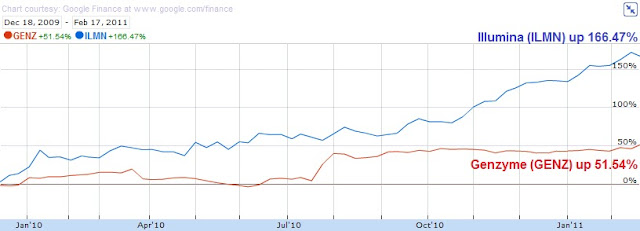
      There has been a lot of news about Genzyme (GENZ) being considered as a takeover candidate by Sanofi-Aventis (SNY). Typically, rumors are simply that, nothing more than prattle about a washed up company that has little or no life remaining. However, we have demonstrated that discussions of Genzyme (GENZ) being taken over are not so far fetched.
      On October 17, 2009 (article link), we had only four companies that were on our Nasdaq 100 Watch List that was within 20% of their respective 52-week lows. This was in contravention to the overall market; which was racing higher every day. So compelling were the companies on the list that we felt it was necessary to give mini-profiles on their value propositions.
      Genzyme (GENZ) was one such company that was on that list. We included Genzyme (GENZ) as the last company we profiled since we felt that it was “…a far superior value proposition.” This was despite the fact that Genzyme (GENZ) was the farthest from the new low among the companies on the list.
      On October 30, 2009 (article link), we weren’t surprised that drug and medical device makers dominated our list of companies near a new low. In that posting to our site we said, “The continued undervaluation of these companies makes them prime targets for acquisition…” Genzyme (GENZ) was on the list and trading at $50.60. The performance of the stocks that were on the on the October 30 watch list is as follows:

      The average gain for the group was 15.32% in 9 months. The worst performing stock has been Gilead Sciences (GILD) with a decline of 22.21%. The best performing stock has been Biogen (BIIB). Our sanguine view on Gilead Sciences (GILD) may be worth reviewing since it has fallen so much since October 30, 2009.
      Genzyme has already indicated that they’re not going to accept the Sanofi-Aventis (SNY). This opens the door for competing bids, which should push the price up. Our view at this time is that Genzyme is strictly a speculation, at best, given the rise of nearly 33% since our mention of being a takeover candidate in October 2009.

      Dividend Achiever Watch List

      At the end of the week, our watch list contracted to 30 companies. Here is the watch list which ranks current and former Dividend Achievers that are within 10% of the 52-week low for July 23, 2010. We filtered out companies that has no earning and payout ratio in excess of 100%.  Stocks that appear on our watch lists are not recommendations to buy.  Instead, they are the starting point for doing your research and determining the best company to buy.  Ideally, a stock that is purchased from this list is done after a considerable decline in the price and extensive due diligence.

      Symbol Name Price % Yr Low P/E EPS (ttm) Div/Shr Yield Payout Ratio
      BEC Beckman Coulter, Inc. 47.26 0.00% 19.77 2.39 0.72 1.52% 30%
      JNJ Johnson & Johnson   57.63 1.35% 11.91 4.84 2.16 3.75% 45%
      FRS Frisch's Restaurants, Inc 19.99 2.46% 10.10 1.98 0.52 2.60% 26%
      XRAY DENTSPLY International Inc.  29.26 3.39% 15.99 1.83 0.20 0.68% 11%
      WST West Pharmaceutical Services, Inc. 35.41 3.48% 15.88 2.23 0.64 1.81% 29%
      FII Federated Investors Inc 20.98 3.55% 10.70 1.96 0.96 4.58% 49%
      PFE Pfizer Inc 14.58 4.14% 13.50 1.08 0.72 4.94% 67%
      NTRS Northern Trust Corp.  47.51 4.53% 14.94 3.18 1.12 2.36% 35%
      BDX Becton, Dickinson and Co. 66.89 5.49% 12.84 5.21 1.48 2.21% 28%
      FFIN First Financial Bankshares, Inc.  48.49 6.15% 18.79 2.58 1.36 2.80% 53%
      XOM Exxon Mobil Corp.   59.72 6.76% 13.60 4.39 1.76 2.95% 40%
      UMBF UMB Financial Corp.  36.92 6.80% 16.05 2.30 0.74 2.00% 32%
      PAYX Paychex, Inc.  26.64 7.03% 20.18 1.32 1.24 4.65% 94%
      MDT Medtronic, Inc. 36.58 7.24% 13.11 2.79 0.90 2.46% 32%
      HCC HCC Insurance Holdings, Inc. 25.59 7.30% 8.53 3.00 0.54 2.11% 18%
      DNB Dun & Bradstreet Corp. 70.34 7.39% 14.10 4.99 1.40 1.99% 28%
      T AT&T Inc 25.54 7.40% 12.71 2.01 1.68 6.58% 84%
      STFC State Auto Financial Corp.  16.00 7.96% 17.20 0.93 0.60 3.75% 65%
      WMT Wal-Mart Stores, Inc. 51.67 8.16% 13.56 3.81 1.21 2.34% 32%
      MSA Mine Safety Appliances Co 24.24 8.21% 21.26 1.14 1.00 4.13% 88%
      OMI Owens & Minor, Inc. 27.67 8.42% 14.72 1.88 0.71 2.57% 38%
      AROW Arrow Financial Corp.  23.78 8.44% 12.26 1.94 1.00 4.21% 52%
      SVU SUPERVALU INC 11.28 8.46% 6.10 1.85 0.35 3.10% 19%
      CWT California Water Service Group 36.75 8.70% 19.04 1.93 1.19 3.24% 62%
      ITW Illinois Tool Works, Inc. 43.31 9.65% 14.34 3.02 1.24 2.86% 41%
      LLY Eli Lilly & Co. 35.17 9.84% 9.06 3.88 1.96 5.57% 51%
      LOW Lowe's Companies Inc 21.11 10.23% 17.30 1.22 0.44 2.08% 36%
      TRH Transatlantic Holdings, Inc. 48.22 10.32% 7.70 6.26 0.84 1.74% 13%
      CTWS Connecticut Water Service, Inc.  22.15 10.75% 18.77 1.18 0.91 4.11% 77%
      UFPI Universal Forest Products, Inc.  31.72 10.95% 25.79 1.23 0.40 1.26% 33%
      30 Companies


      Watch List Summary
      The best performing stock from the previous list was Matthews International (MATW) which rose 17%!  The worst performing stock was Johnson & Johnson (JNJ) which fell 4.8%.  Because our list has more than a handful of great companies, I urged investors to filter for companies with less than 50% payout ratio. This should minimized the risk of dividend reduction if earnings are to fall by half. If you understand the companies' history and their ability to pay the dividend, payout ratios in excess of 50% may be considered.
      Beckman Coulter (BEC) fell 21% on Friday and broke below its 52-week low. They are now withing 20% of their December 2008 low of $37. The company reported earnings that were 21% less than the analyst estimated. In addition, they took down their full year profit guidance by 10%. Our view is that the price action was not justified and we took a position in the name. We'll detail more about this company in the coming days.
      Johnson & Johnson (JNJ) is another name that is getting interesting at this level.  Based on IQTrends (http://www.iqtrends.com/), JNJ is undervalued at or around 3.5% yield. With current yield of 3.75%, we suggest readers add JNJ to your investment opportunities list.
      Once again, I suggest readers to use the March 2009 low (or companies' most distressed time) as the downside projection for investing.  Our conservative view is to embrace the worse case scenario prior to investing.  The March 2009 low fits that description.  Although we use the one year (52-week low) time frame, the past year was nothing but a major bull run and anyone who bought at or near the low could, and should, be taking profits.  It is important to place these companies in your own watch list so that when the opportunity arises, you can purchase them with a greater margin of safety.

      Email our team here.

      Richard Russell Review: Letter 762

      Letter 762 was published on August 1, 1979. At the time, the Dow Jones Industrial Average was indicated at 839.76. There were a couple of items that stood out as I read this newsletter.
      Richard Russell said:
      “As a matter of fact with Libya’s recent 10% cut in oil shipments and Algeria’s just announced 20% cut, I suspect that there’s an oil (and gas) glut building up now! The world is learning to cut back on fuel use—and fast, and this could turn out to be the shocker of 1979-1980.” Page 2.
      In fact, it wasn’t long before oil prices reflected the glut that Richard Russell spoke of. Under normal circumstances, it would be difficult to see beyond the present crisis and think that it will end at some point. It seems that Russell was cognizant of the prospect, as remote as it seemed at the time. Unfortunately, as indicated in the chart below, $15 oil would become a base, or floor, instead of a ceiling.
      One item that has been a longstanding issue with Richard Russell is reflected in the next quote.
      Russell said:
      “Last week I was asked this question: ‘Russell, if you could change any part of your stock approach over the past year, what would have done?’ My answer was, ‘There are many subscribers who are willing to speculate, and I think I have been too conservative and too stubborn on this issue. The change I would have made is that I would have offered speculative choices for those willing to assume the risk of buying in a market that is not over-sold and not in an ideal buying area.’” Page 2.
      In addition to the previous remark by Richard Russell, he also said:

      “I want to add that I personally am buying no shares here. I prefer to wait for the ‘ideal buying situation.’” Page 2.

      The two remarks above have been the biggest challenge to Russell’s ability to adhere to Dow Theory or even his Primary Trend Index which was created to avoid potential market manipulation. Russell is infinitely waiting for the “ideal buying situation” while ignore individual values along the way.
      Russell points out a fact that every investor should have ingrained in their mind before committing a single dollar to the stock market or any other potential investment opportunity. Russell said:
      “Every investment must ultimately be valued on its return. In the stock market that means dividends. Ultimately, dividends must be paid if a stock is to be worth anything.” Page 4.
      I thought that the following remark was profound.
      “Now here’s an interesting aside on inflation. One of the reasons it’s so insidious is that as soon as a man starts protecting himself against it, as soon as he buys a house or a load of gold coins or a painting or a stamp collection-that man wants his inflation hedge to go up. He becomes (deep in his heart) an inflationist. Take housing: the value of total housing in this nation is $2.2 trillion (two thirds of these houses have mortgages). The last thing these home-owners want is a declining market. They are secretly in favor of rising prices and inflation.” Page 4.
      Russell’s comment is right on target when it comes to the attitude of most people. It seems that everybody is an inflationist. There are few market participants or commentators who express the view that they hope their long position will decline in value. The NLO team happens to be among the few who, after going long a stock, are eagerly anticipating a decline in price. Shameless self-promotion aside, Russell’s commentary on the closet inflationists is truly profound.
      Russell points out that if you’re in commodities but not in precious metal then you could be losing your shirt. Russell says:
      “Commodity traders have had one of their roughest seasons in years. If you weren’t in the metals, you probably ‘got killed.’ For instance, the October cattle contract is now down from 74.45 to 61, a drop of almost 18%. One trader told me that ‘it looks like the country is vegetarian.’ Live hogs are much worse, with the October contract dropping from 51 to 32 a drop of 37%. On piggies I was told that they act like ‘the whole world is going Jewish!’” Page 5.
      This counters the belief that during inflationary periods, all commodities do well or go up in value. It should be noted that the declines that were mentioned by Russell could have been the equivalent of a temporary pullback or secondary reaction. Interestingly, monthly hog prices traded in a wide range from 1972 to 2004 as indicated in the chart below. Suffice to say, anyone involved in commodity trading should be willing to accept even greater losses than the 50% that we expect for long positions in stocks before seeing any gains.
      On the topic of interest rates Russell says the following:

      “To the casual observer, it looked like a world embroiled in an interest rate war. And the fact is that rising inflation is being fought all over Europe and Japan- via an interest rate squeeze. The US is a frightened and reluctant follower.

      “A few weeks ago Germany raised her bank rate. At the same time Britain boosted her borrowing rate a whopping 2%. Last week the US raised its discount rate an insufficient .5% to a record 10%. Canada immediately followed with a boost to 11.75% in her bank discount rate. The Japan jumped her lending fee to institutions a full 1%.” Page 5.
      My thoughts on this passage are that it seems fascinating that the US wasn’t taking the lead in interest rate policy. Especially in comparison to the countries that were mention. It may have been a purposeful attempt to adjust rates when it was absolutely necessary. Could you imagine interest rates jumping 2% at a time?
      Russell indicated that as the world’s leading power, the U.S. with its excessive printing of dollars cannot continue unabated. Russell said that foreign holders of dollars would become anxious and “move towards the exits.”
      Russell mentions the Gold/Stock ratio; which divides the price of gold by the value of the NYSE Composite. Of the rising trend of the ratio, indicating strength in the price of gold, Russell says:

      “Day after day the ratio climbs higher, and it is clear to me that shortly, SOMETHING IS GOING TO GIVE.” Page 5.

      With hindsight being 20/20, my thought is that what “gives” in this situation is high inflation unless Russell was proposing that all governments are going the way of hyperinflation. My observation is that what tends to break, when two normally divergent indicators are going in the same direction, is the one that appears to be the “strongest.” In this case the stronger component of the Gold/Stock ratio was gold which had been in a multi-year rising trend while the NYSE had been in a wide trading range for an extended period of time.
      I do have concerns about the sensibility of a gold/stock indicator since I have presented the view that gold and stocks usually follow each other rather than move counter to each other. For the most part, we have seen gold lag on declines and lead on rises in the stock market. One thing I’m certain of, if the price of gold rises then the stock market isn’t far behind. There may be an occasional divergence but the overall picture is that gold and stocks generally move in unison.
      More:

      H&R Block Rumors Fly, Attesting to Its Value

      Today it was announced that H&R Block (HRB) was a potential buyout candidate by Liberty Tax Service. On the news, HRB stock jumped 4.50% on trading volume that was 2½ times the 3-month average.
      In our opinion, it is no coincidence that the buyout offer, or talk of a buyout, from Liberty Tax Service would come in at or near the exact price that we initiated our research recommendation almost a year ago. Most recently, HRB has been on our Dividend Achiever Watch List since May 21, 2010. However, in a SeekingAlpha.com article on May 19, 2009, we suggested that HRB was an ideal research candidate at a price of $13.73.
      Our observation has been that although we recommended selling (HRB) literally days after our initial recommendation, thereby missing the nearly 45% increase in the stock price, if we had held the stock as “long-term” investors we’d have little reason to celebrate at an announced buyout. However, our policy of “seeking fair profits” at the risk of potential tax consequences especially for non-deferred accounts is a sound policy when properly implemented.
      An important point about our watch list is that companies may not be undervalued. However, we know for a fact that they are not overpriced. Some have accused the NLO team of “bottom fishing” rather than doing “real” analysis of stocks. However, our applied research and practical experience has demonstrated that when you choose to use fundamental analysis is almost as important as the stocks you us it on.
      As we’ve duly noted, all the fundamental analysis in the world will do no good when a stock has reached a new high. In fact, using fundamental analysis to justify a stock purchase that has reached a new high or even in a rising trend undermines the credibility of fundamental analysis. In effect, the numbers begin to lie regardless of the question that is asked.
      Based on the use of fundamental analysis, when a stock is rising, if the stock goes up in price then the buyer is convinced that their analysis was accurate. If the price falls then the buyer has to justify the reason why the stock should continue to be held typically on a basis that was may have been flawed from the beginning. If the stock falls out of proportion to all expectation then the buyer of the stock is left with the feeling that investing in stocks must be gambling and those who pursue this effort are fools. There are few valuable lessons to be learned when attempting to apply fundamental analysis to stocks in a rising trend.
      Applying fundamental analysis to stocks when they’ve reached a new low however, will quickly tell the investor/analyst whether they are wrong or right in their analysis. Not only can the soundness of the analysis be determined very quickly, you can also determine exactly where the analysis is flawed. All theory about the soundness of fundamental analysis becomes “obvious” to anyone who is willing to observe. For us it also doesn’t hurt that we expect, and look forward to, any recommendation or purchase to fall at least 50% as pointed out by Warren Buffet’s right hand man Charlie Munger.
      If the deal for H&R Block never goes through, we know that the company is under priced at the current level. It should be noted that our recommendation of HRB last year just happened to be at the lowest point since May 2001. In addition, our meager 11.50% gain in 18 days surpasses the absence of gains (saved for the annual dividend) since our May 19, 2009 recommendation.
      We think H&B Block is at fair valuation when it sells for $18.34. HRB would need to rise by 25% in order to reach fair valuation from today's closing price of $14.61. Any price above $18.34 would be considered a premium in our view.