Emerging Markets and Gold

Drawing from the work of Bhartia and Seto in the article titled "Present and Emerging Risks to the Gold Trade" (found here) and "Emerging Consumers Drive Gold Prices: Who Knew?" (found here) it is claimed that the driver for the price of gold since 2000 has been the emerging economies. 

From our perspective, we have struggled to jump on board the explanation that India and China, or emerging markets, are the primary contributing influence on the rise in the price of gold.  In our experience, when the small players (in any market) are piling in on a particular trade, it is worth examining the elements that are making it possible.

What stands out the most in our review of Bhartia and Seto’s work is the following comment:

“The impact of the Asian financial crisis is instructive. As the economies in the region fell into recession, the purchasing power of consumers in Southeast Asia declined commensurately. Thailand, Indonesia, and Korea all became netsellers of gold, albeit briefly (see Exhibit 1). In line with the drop in demand and the drop in the regional stock markets, gold prices fell 25% (see Exhibit 2).”

This is an instance where it appears that correlation of a select period of time has fit the argument more than explained the reasons why the price of gold has increased.  Unfortunately, this examination overlooks or omits the performance of the same regional stock markets from 1980 to 1993, a period that reflected massive gains in the respective emerging stock markets even as the price of gold crashed or was unchanged from the peak in 1980 to 1993, and ultimately to 2000. As an example:

  • The Thai Set Stock Index increased 16 times (16x) from 1980 to the 1993 peak (found here) & (confirmed here) In the same time frame (1980-1993), gold declined -61%.
  • In the case of the KOSPI or Korean stock index, it increased 11 times (11x) from 1980 to the 1993 peak (chart here). In the same time frame (1980-1993), gold declined -61%.
  • In the case of the Indonesian stock market, it increased 6 times (6x) from 1982 to 1992/1993 (chart here).  In the same timeframe, gold was unchanged.

Our belief is that the overall rise in the stock market reflects a general increase in economic wealth of the country.  Unfortunately, Bhartia and Seto cannot demonstrate that the emerging market consumer demand to push the price of gold higher in a period when the emerging economies grew from 1980 to 1993.  Nor could they demonstrate that currency collapse and a crashing economy had enough impact to move the price of gold higher.

If Bhartia and Seto are correct that emerging markets are moving the price of gold higher today, then the ability and opportunity, due to significant economic growth, to buy gold should have increased enough to move the needle in a positive direction from 1980 to 1993.  Unfortunately, when countries normally associated with a long tradition for appreciating the value of gold and/or high savings rate experienced substantial economic wealth, the price of gold did not increase.  In fact, from 1980 to 1993, the price of gold declined substantially. Also, as the respective currencies were on the brink of collapse in 1996 and 1997, gold managed to decline -37%.

The economic law of demand suggests that as prices go higher, demand will decline.  That has not been the case in emerging economies when it comes to gold, as demonstrated by Bhartia and Seto.  Worse still, when  emerging markets are piling into a trade (any trade), it may mean that the easy money has been made, in the short term.

Rather than considering emerging markets as leaders of a movement towards better investment decisions, we should be reassessing the role of that investment and its ability to generate reasonable risk-reward outcomes.

Gold Stock Indicator

Continue reading

Dividend Watch List: June 28, 2013

Below are the 11 companies on our U.S. Dividend Watch List that are within 11% of their respective 52-week lows. Stocks that appear on our watch lists are not recommendations to buy. Instead, they are the starting point for doing your research and determining the best company to buy. Ideally, a stock that is purchased from this list is done after a considerable decline in the price and rigorous due diligence.

Continue reading

1925 to 1932: A Question for Precious Metal Investors

Continue reading

Bitcoin: Downside Target Met

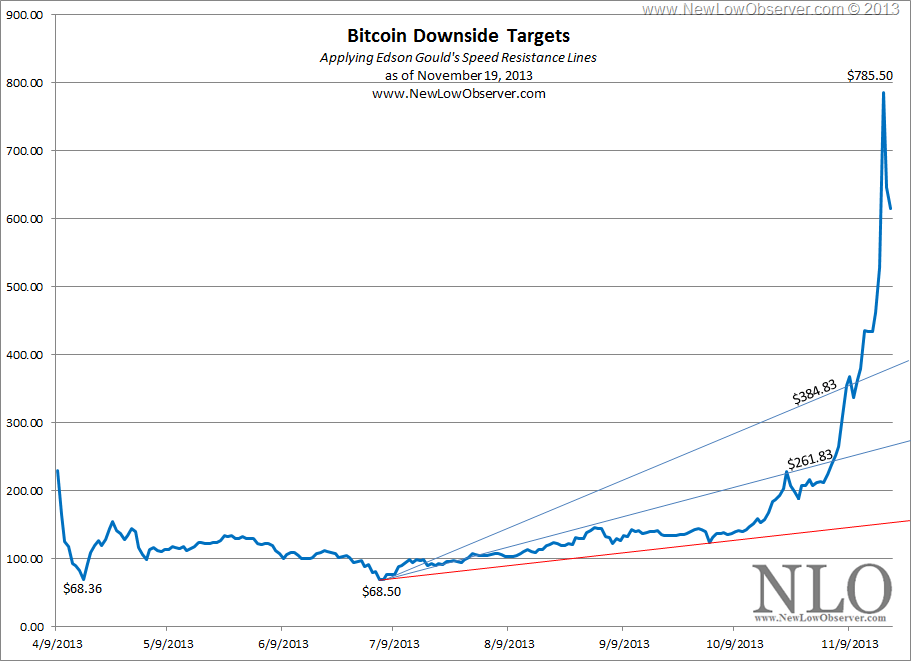
On April 10, 2013, we posted the SRL for Bitcoin, the electronic “currency” (found here). The goal was to was see if we could determine the downside target using Edson Gould’s Speed Resistance Lines (SRL). Based on the published chart, we had a conservative downside target of $92.57 and an extreme downside target of $79.18.  The chart below depicts the outcome, so far:

image

Depending on the source, on an intra-day basis, Bitcoin fell at or below the extreme downside target as projected.

Incorrect Interpretations of Market Peaks

In a MarketWatch article titled “7 Ways to Spot a Market Top” (found here), it is suggested that there are key ways to tell whether or not we are at a top in U.S. stock markets.  First, we’re going to selectively choose (cherry pick) the points that we can refute or demonstrate weaknesses.  Second, we’re going show how, even at a stock market peak, abandoning new investment opportunities can potentially be a mistake.

Starting with the first of the “7 Ways to Spot a Market Top” is the claim that:

While the U.S. stock market is trading at record highs, three blue-chip Chinese companies -- Petro China (PTR), China Mobile (CHL) and Yanzhou Coal are trading near 52-week lows, points out Brad Lamensdorf, chief investment officer of the Lamensdorf Market Timing Report. All three stocks peaked in January [2013]and have been skidding ever since. Given the key role China plays in the global economy, ‘this looks like a bad sign for US stocks,’ Lamensdorf said.

While it cuts us deep to suggest that a 52-low implies proof that a top in the market is at hand (don’t forget our vested interest on this topic), there are clear weaknesses in this argument.  First and foremost, look at the chart for the respective stocks.

image

For PetroChina (PTR) the stock peaked in April 2011.  Since then, the stock has been unable to exceed the prior peak.  A technical analyst would have immediately recognized this and would not make the basis of their analysis the 2013 peak because it is lower than the 2011 top.

image

In the case of China Mobile (CHL), the stock peaked in August 2012.

image

In the instance of Yanzhou Coal (YZC), the stock peaked in May of 2011.  If what Mr. Lamensdorf says is true, U.S. stocks should have shown more signs of weakness before the most recent declines.  Based on the information that we’ve provided, the first of 7 ways to spot a market top is very weak at best.

The second of 7 ways to spot a market top reflects on the performance of the Spanish stock market indexes.  Unfortunately, there is no PROOF that, based on the movement of the three indexes, that we’ve seen the top in the U.S. stock market.  Instead, it only reflects on what has happened in Spain.  In addition, the time span that is used is narrow at best.  What is a better alternative to indicate a possible top in the market?  First and foremost, Dow Theory could have been a better guide for consideration of when and if we were at a market top in advance of the actual peaks.  As an example, the Spanish IBEX 35 Index, is shown below from 2006 to the present.

image

From the peak of the IBEX 35 Index in 2007, the decline was down to the March 2009 low near 6,936.90.  The increase of the IBEX 35 Index could have been expected to increase at least half of the prior decline before giving clear indications of a change in direction in the market.  According to Dow Theory the best case scenario would be for the market to retrace 50% of the previous decline.

Our own example of a real-time application of Dow Theory projections in advance of a market top is our April 3, 2009 posting titled “Bear Market Rally Targets” (found here), when the Dow was at 8,017.59.  At that time, we said that the Dow Jones Industrials Average had an upside target of 10,360.02 based on the Dow Theory 50% principle.  Dow Theory clearly outlines how to interpret market direction based on the stock market movement after the retracement of the 50% principle.  Therefore, it would have been clear that the decline was in the cards and not helped by the European Financial crisis.

In our considered opinion, calling the top is easy after the fact, however the tools were in place to allow for understanding the potential upside limits beforehand.  Additionally, there is no proof that the Spanish markets have topped out, based on such a short time frame (June 2012 to June 2013).   In fact, according to the precepts of Dow Theory, the marginal top of January 2013 could not be considered to be “in” until the IBEX 35 declines below the 2012 low.

The third of 7 ways to spot a market top is based on the FTSE Europe relative strength index.  The indicator only shows the last year of movement.  The problem with this is that we don’t have a “relative” view on which to test the accuracy of this indication.  Although not the exact index and without the exact measure of time for which the indicator is at (a considerable weakness to leave out such information because we cannot independently test what should be widely available), we’ve outlined the Vanguard FTSE Europe ETF (VGK) with a relative strength indicator on a 28-period trailing interval.

image

As can be seen above, the RSI has not necessarily give a clear indication of where the top in the market is when reviewed over a period from 2006 to the present.  As an example, in 2012, the two RSI peaks resulted in higher market levels afterwards.  Likewise, the RSI low of 2010 resulted in an even lower level for the Vanguard ETF in 2012.  Worse still, the early 2008 low in the RSI was much lower than the early 2009 RSI low.  However, the 2009 low in price was a staggering –58% lower than the early 2008 price for the Vanguard ETF.

Again, without the source of the RSI provided and the exact index that was used over a substantial period of time to verify the quality of the indicator, it would be difficult to suggest that the information provided was enough to prove that we could use the information to identify a market top, or bottom.

The fourth of the 7 ways to spot a market top refers to the Schiller P/E or CAPE ratio valuation of global equity markets.  Again, this view only reflects the current point in time.  It leaves out the perspective of other times in history, relative to when the S&P 500 Index was at respective peaks and troughs in history, compared to the same countries.  However, we do have a good source to help see how this may not be the top, according to CAPE valuations.

image

The chart above is the Shiller P/E or CAPE ratio from GuruFocus.com (found here).  According to the chart, it would appear that on a historical basis, the U.S. stock market should trade back to the mean P/E level of 16.5 after trading to the historical peak level of 22.9.  However, there are two serious problems with this perspective.  First, it ignores the fact that at nearly 50% of the times that the S&P has been at the same level in the past, the market continued much higher than the current level in 1929 and 2000.  In the case of the year 2000, the market doubled the P/E level that we are currently at.  The second problem is that the S&P 500 index didn’t exist before 1957.  Therefore, anything before 1957 is based on a theoretical P/E ratio that is not even “real.”  In fact, everything prior to 1957 is based on the belief that an imaginary S&P 500 would have replicated the performance of the Dow Jones Industrial Average).  We’ve already pointed out the deceptiveness of P/E ratios and how they can be astronomical at market bottoms and miniscule at market tops in our article titled “P-E Ratios: Lessons from Confliction Indications” (found here).

In the fifth of the 7 ways to spot a market top, the article refers to the S&P 500 activity from 1996 to the present.  Yes, it is true that the S&P 500 has failed to exceed the prior peaks of 2000 and 2007 by a wide margin.  However, choosing the S&P 500 strictly fits the argument.  Additionally, it seems to be the point of the author that prior peaks are a indication of a market top.  However, if the Dow Jones Industrial Average were applied to the same period of time then it could be argued that you cannot pick a market top based on prior peaks.

image

In each instance of a peak for the Dow, the index went higher, as opposed to the S&P 500.  Furthermore, If we looked at the Nasdaq Composite Index, then we could say, based on the flawed logic of prior peaks being the top in the market, that we’re a long way from the top in the stock market, as seen in the chart below.

image

The sixth of 7 ways to spot a market top relates to the 50-moving average of the S&P 500 Index.  According to the article, Mark Luschini, chief investment strategist at Janney Montgomery Scott says:

“'As a matter of fact, with the S&P 500’s recent pullback to 1,600, it actually suggests an interim bottom,’ says Luschini. The index has bounced around and off of the 50-day moving average of 1,615, ‘so for the time being, that’s pretty good support for the market,’ he adds.”

Suffice to say, this wasn’t actually a way to spot a market top.  We’re not sure why this was included.

Finally, the seventh of the 7 ways to spot a market top discusses the price of oil but it doesn’t relate this back to the stock market as the previous 6 points attempted, somewhat.  Despite this fact, we have to point out the comment made by the analyst about the price of oil.  The article states:

“As crude gets more expensive, OPEC members have an incentive to ramp up production. But in such times, [Tim] Evans doesn’t view the higher prices as bullish.”

Unfortunately, in the chart that is included with Mr. Evans commentary, we can see that the price of oil increased from January 2007 and peaked June 2008 and collapsed to the April 2009 low.  Coincidentally, the stock market had a similar movement over the exact period of time. As Charles H. Dow, co-founder of the Wall Street Journal, said:

For the past 25 years the commodity market and the stock market have moved almost exactly together. The index number representing many commodities rose from 88 in 1878 to 120 in 1881. It dropped back to 90 in 1885, rose to 95 in 1891, dropped back to 73 in 1896, and recovered to 90 in 1900. Furthermore, index numbers kept in Europe and applied to quite different commodities had almost exactly the same movement in the same time. It is not necessary to say to anyone familiar with the course of the stock market that this has been exactly the course of stocks in the same period ( source: Dow, Charles. Review and Outlook. Wall Street Journal.February 21, 1901.)”

With this in mind, it is possible to suggest that because oil is relatively far from the peak, there may still be some upside left.  After all, in the period from 2007 to the present, whenever oil rose, so too did the stock market.  Why should we expect anything different going forward? Especially when the price for oil hasn’t exceed the 2008 peak.

Our next point is regarding the abandonment of investments if and when you “know” that the stock market has peaked.  In our posting titled “Complete 2008 Transaction Summary” (found here), we show every position that we took in 2008, the length of time that we held each position and the gain or loss for each position.  It is important to note that although the stock market was in the process of collapsing, we were able to make long only positions based on stocks from our U.S. Dividend Watch List and end the year with gains of +14% as opposed to Dow Industrials and S&P 500 declines of -38% and greater.

Another source for inspiration of investing in stocks at stock market peaks can be derived from the work of Jeremy Siegel’s article titled “Nifty Fifty Revisited” (PDF here).  In the article by Siegel, the highest P/E stocks (at a market peak; 1972) for that era were selected to determine their performance over a long-term basis (1972 to 1995). If, as a long-term investor, you’re interested in beating inflation by a wide margin, then avoiding new purchases at the peak in the market, because you think we’re at a peak, isn’t as rational as it would seem.  It might make sense if you have a well established system (that is profitable, of course) in place.  However, the work of Siegel suggests that for long-term investors, avoiding new purchases at market peak could be a costly trade off.

In our personal experience, a la 2008, we can’t suggest that our performance will be replicated again.  However, what we can claim is that, aside from dumb luck, abandoning investment opportunities because the market has peaked or is falling could be just as mistaken as calling market tops, and bottoms, based on spurious notions that are unsubstantiated.

Transaction Alert

Continue reading

Gold Stock Indicator: Now is the Time

On June 24, 2013, the Gold Stock Indicator (GSI) declined below the 2008 low for a brief moment.  Today, June 25, 2013, the GSI is at the 2008 low.

image

Any activity in the gold stock arena below the “stage 4 buy” level is uncharted waters for us.  We will continue to post transaction alerts based on our partnership account.  However, successfully navigating to this point without over-committing our resources was the ultimate goal of this exercise.  We hope this effort has been practical and saved our readers money they would have otherwise lost at much higher levels in gold stocks.

image

We would not be surprised to see a considerable sell-off in gold stocks in the near-term.  However, based on the GSI since 1983, now is a reasonable time to line up gold and silver stocks that are part of the Philadelphia Gold and Silver Index (found here) or the Amex Gold Bugs Index (found here) for investment opportunities.

Nasdaq 100 Watch List: June 21, 2013

Below are the Nasdaq 100 companies that are within 10% of their respective 52-week lows. Stocks that appear on our watch lists are not recommendations to buy. Instead, they are the starting point for doing your research and determining the best company to buy. Ideally, a stock that is purchased from this list is done after a considerable decline in the price and rigorous due diligence.

Continue reading

Dow Theory

Continue reading

Transaction Alert

Continue reading

Gold Stock Indicator

Continue reading

Analyst Estimate Review

Continue reading

Canadian Dividend Watch List: June 14, 2013

This is a list of Canadian dividend stocks that currently, or in the past, had a history of consecutive dividend increases. For those wishing to find the most complete fundamental information on these companies, we recommend visiting one of Canada’s leading financial websites, the Financial Post (found here). However, Yahoo!Finance probably has the better long-term charts and historical dividend data.

Continue reading

Gold Stocks Near New Low

This is the list of gold related equities that we track within 10% of the one year low.  We strongly recommend that you do your own research on these companies and assume that the downside risk is half of the current price, at minimum.

Continue reading