Gold Stock Indicator: March 13, 2015

Gold declined –1.37% while the index for gold stocks declined by –3.49% in the past week.  The closing numbers for gold stocks would be considered deceptive since the decline was much worse earlier in the week when the decline for the index was as much as –8%.

image

U.S. Dividend Watch List: March 6, 2015

The large market decline on Friday brought the Dow Jones Industrial average below 18,000 and the Nasdaq below 5,000. The key data point was from the Federal Reserve meeting and a sign that interest rate hike could come sooner rather than later. Even though the jobs report came out stronger-than-expected, the expectation that rate could rise as soon as June took the market by surprise. With that pull back, our watch list expanded to include 74 companies we will highlight the 25 companies which are at or near its 52-week low. Continue reading

Analyst Estimate: DJ Utility Average March 2015

Below are the price projections of the components to the Dow-Jones Utility Index based on analyst earnings estimates as of March 8, 2015.  These estimates project the price change for the respective stocks in the next 12 months.

Continue reading

Gold Stock Indicator: March 6, 2015

Gold, as represented by the SPDR Gold Shares (GLD), has registered a loss of –5.19% since our last posting on February 13, 2015.  At the same time, gold stocks, as represented by the Philadelphia Gold and Silver Stock index (XAU), have declined –12.34%.

image

A Different Perspective on Lumber Liquidator

On February 25, 2015, when Lumber Liquidator was trading at $57.23, we said the following:

“Those interested in LL and willing to perform appropriate due diligence could engage in a three phase purchase plan beginning below $39.81, $31.64 and $23.47.  Investors, as opposed to speculators, should be willing to accept that there is no compensation for the wait when holding LL and that the decline to the ascending $23.47 level is a real risk.”

In fact, Lumber Liquidator blasted below the $39.81 support level and has rested at the $31.64 support level and started to move higher as seen in the chart below.

image

We’ve intentionally left out the move up from $38.83 to highlight the extent of the decline and the high level of coincidence with the supports levels that we had outlined in the previous month.  All that remains is the decline to the $23.47 level.

While famous short-sellers have the ear of influential media to talk their book and ensure their profits, we only have price action to work from.  For this reason, it is well worth noting another coincidence that relates to Lumber Liquidator and futures price on lumber as seen in the chart below.

image

The coincidence of Lumber Liquidator (LL) declining significantly at the same time as the futures price of lumber (as traded on the Chicago Mercantile Exchange) seems difficult to ignore.  Investors should take note of the fact that in three prior periods indicated in blue, LL has lost a minimum of –35% and as much as –53% when the price of lumber declined –33% or more. 

So far, from December 2013 to March 2015, the price of lumber has declined –23% while LL has declined as much as –67.49%.  Much of the decline in LL has been exacerbated by concerns related to quality and sourcing of the flooring.  However,  the current decline is only slightly out of alignment from what has happened in the past. 

We say slightly because we’re excluding the peak in lumber at 395.50 when LL was trading at $62.19.  While lumber was trading lower and not to exceed the $395.50 (considered a bear market), LL gained another +92.05%.  If Lumber Liquidator’s decline was measured from the February 15, 2013 peak in lumber at $395.50, the decline in the stock price would equal –37.56%.

Assuming we aren’t on the cusp a new bear market, the decline in LL has been overdone and an individual willing to accept the downside risk to $23.47 should consider implementing a three phase purchase plan.  An investor must keep in mind that the conservative upside target is $80.53 which is the new “limit” for the stock instead of the previous $119.44.  In addition, the downside targets now act as upside resistance level as was the case when LL could not sustain the $53.68 level prior to the recent collapse.

Technical Take: LL & SAM

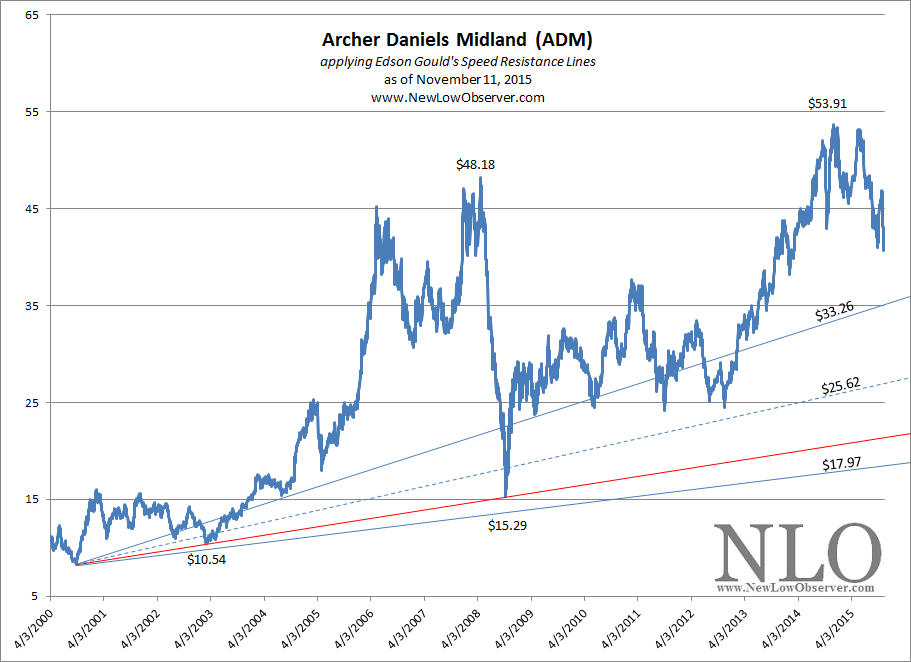
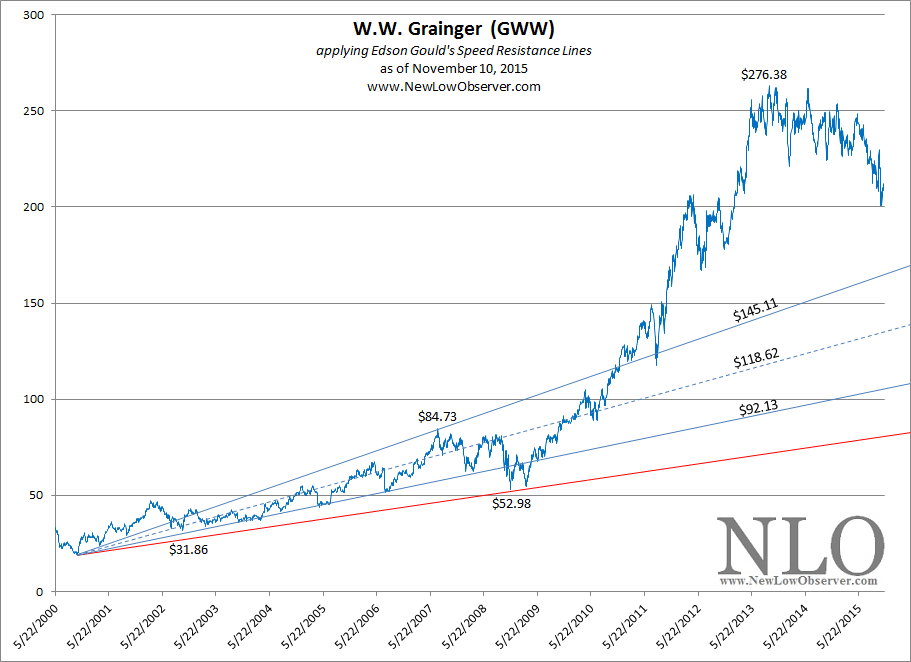
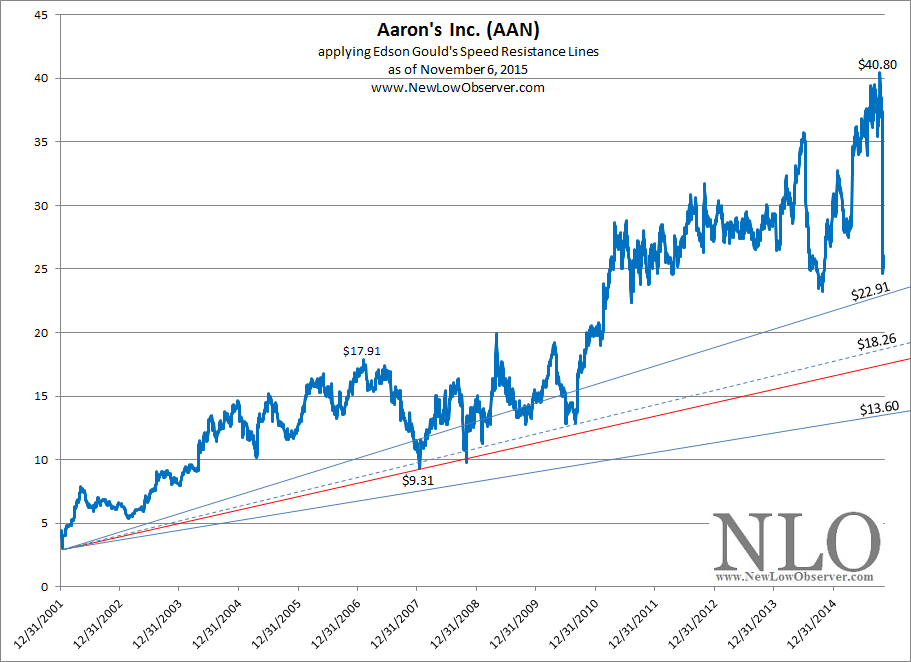
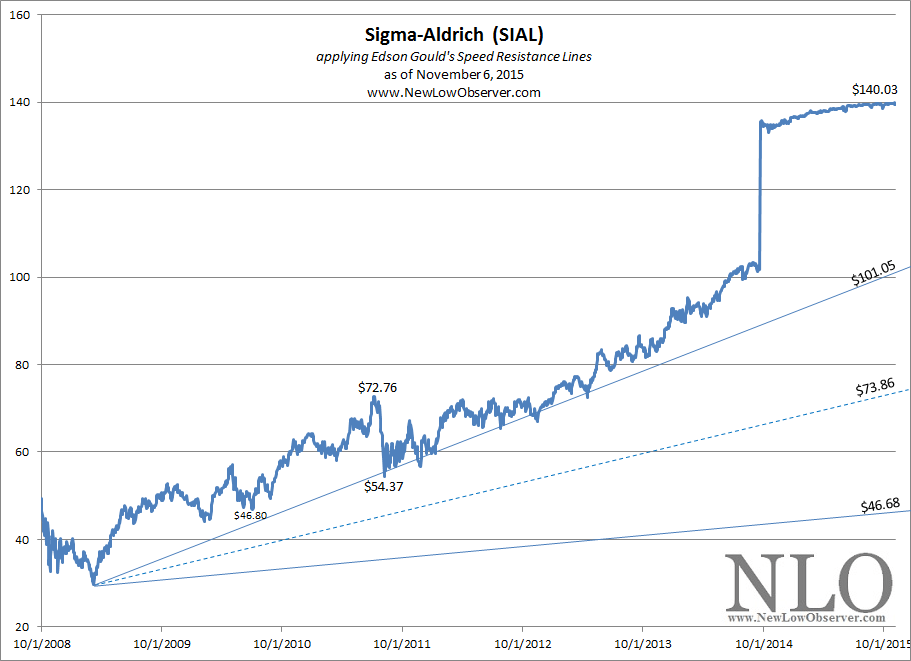
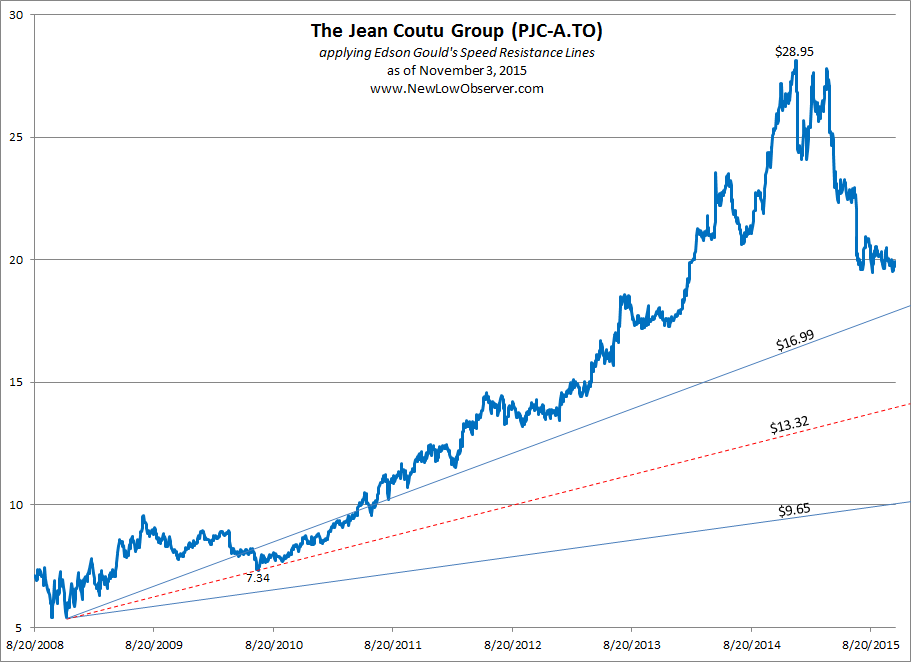
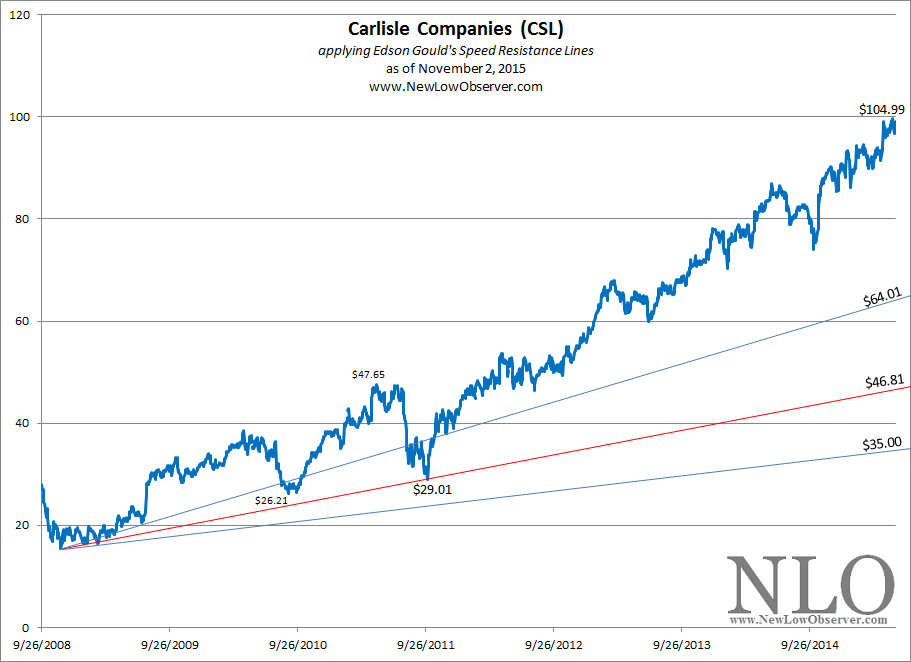
Below are the downside targets using Speed Resistance Lines [SRL] for Lumber Liquidator Holdings (LL) and Boston Beer Company (SAM) based on the work of Edson Gould.

Lumber Liquidator (LL) has declined from the peak of $119.44.  Gould’s SRLs suggest that from the peak price, LL has a conservative downside target of $53.68 and an extreme downside target of $39.81.

image

On February 25, 2015, LL was unable to sustain a price above the ascending $53.68 level with a decline of over –17%.  Our best guess is that LL will decline to the ascending $39.81 level, which currently approximates $49.50 price.  Those interested in LL and willing to perform appropriate due diligence could engage in a three phase purchase plan beginning below $39.81, $31.64 and $23.47.  Investors, as opposed to speculators, should be willing to accept that there is no compensation for the wait when holding LL and that the decline to the ascending $23.47 level is a real risk.

Boston Beer Company (SAM) is the brewer of Samuel Adams beer and a multitude of other “craft” beers.  Today SAM declined –10% on an earnings miss.  Below is the SRL for SAM.

image

Our expectations for SAM are not very high as the last time that the stock was able to achieve the conservative downside target of $70.13 was in 2011.  Since that time, SAM has faltered but not fallen.  In spite of this fact, we’ve outlined the conservative downside target of $180.12 and the extreme downside target of $107.99.  Investors should note that a decline to the ascending $180.12 level is an ideal buying target with a follow-up purchase below $141.25.  As with Lumber Liquidators, SAM is bet on growth in the stock price and not much else. 

The relative strength of each company (long-term viability) is what makes these stocks compelling and worth considering at the appropriate predetermined price.

Analyst Estimates: February 20, 2015

Below are the price projections based on analyst earnings estimates for the stocks on our recent U.S. Dividend Watch List dated February 20, 2015.  These estimates project the price change for the respective stocks in the next 12 months.  The stocks listed below are only a select group that was not shown on our January 19, 2015 or February 6, 2015 analyst estimates.

Transaction Alert

On February 23, 2015, we executed the following transactions:

Nasdaq 100 Watch List: February 20, 2015

Below are the seven Nasdaq 100 companies that are on our radar.  We will be adding to our current position in one of the stocks listed below.

U.S. Dividend Watch List: February 20, 2015

The market finished the week on a high note with the S&P 500 closing at all-time highs.  The blue chip Dow Industrial Average topped its all-time high as well, closing at 18,144.  The deal to extend Greece’s aid for four months may have been the catalyst but we believe that the market climbs a wall of worry.  Despite bullish market sentiment, our watch list contains 50 companies, suggesting that there is interal weakness in the market.  While not all fifty companies are worth considering, there are pockets of opportunity. Continue reading

Canadian Dividend Watch List: February 2015

Below are the eight Canadian companies that are on our radar with the analyst estimates for the coming year.

Transaction Alert

February 2014 Canadian Performance Review

Below is the performance of the nine stocks from the February 14, 2014 Canadian Dividend watch list compared to the Toronto Stock Exchange gain of +9.16%.

Symbol Name 2014 2015 % change
TLM.TO Talisman Energy 11.66 9.52 -18.35%
FCR.TO First Capital Realty 17.33 20.07 15.81%
FTS.TO Fortis Inc. 30.71 39.53 28.72%
CWT-UN.TO Calloway REIT 25.77 30.45 18.16%
CAR-UN.TO Canadian Apartment Properties 21.52 26.98 25.37%
D-UN.TO Dundee REIT 29.31 27.26 -6.99%
BNS.TO The Bank of Nova Scotia 63.29 67.4 6.49%
CUF-UN.TO Cominar REIT 18.45 19.65 6.50%
LB.TO Laurentian Bank of Canada 45.96 50.4 9.66%

The average gain for all of the stocks listed was +9.49%.  The best performing stock was Fortis (FTS.TO) with a gain of +28.72%.  Over the last year has made 4 dividend payments with a dividend increase of +6.25% with the latest payment on February 12, 2015.  The worst performing stock was Talisman Energy (TLM.TO) with a decline of –18.35%.

Analyst estimates for the listed stocks are compared to the actual performance in the chart below.

image

Talisman Energy (TLM.TO) was projected to have the worst decline and it did.  However, it could have been much worse as depicted in the chart below.  At one point, Talisman Energy stock price declined as much as –63% before Spanish oil giant Repsol (REP.MC) announced on December 15, 2014 the intention to buy TLM.TO.

image

Our commentary on the dire analyst expectations for Talisman Energy was:

“As far as we can tell, TLM.TO is not slated to be worth very much by the end of 2014.  We’ll have to see how this picture plays out.  However, if the stock market can keep its head above water for the next 10 months we wouldn’t be surprised to see TLM.TO to pull off a shocker.”

In the midst of a collapsing oil and stock prices, Talisman did pull off a shocker and just before the end of 2014.

Gold Stock Indicator: February 13, 2015

Since our January 30, 2015 posting, the price of gold, as represented by the SPDR Gold Shares (GLD), has declined –4.43% while the Philadelphia Gold and Silver Stock Index (XAU) has declined –2.87%. 

image

It is unusual that the price of the gold stock index would decline less than that of the price of gold.  Either the gold stock index needs to decline much further or the price of gold should rebound.  Remember that gold stocks are the sentiment indicator for the price of gold, therefore, the pricing action above might suggest that the gold declines aren’t sustainable.

The Gold Stock Indicator is reflecting this relative strength with the marginal declines as indicated in the chart below.

Takeover Rumors and Realities

On January 20, 2011, Morningstar.com presented an article titled “Morningstar Identifies Likely Takeover Candidates across Nine Sectors.” In that article, 20 companies were listed as potential takeover candidates.  Of the 20 companies listed, 7 were actually taken over between the January 2011 and February 2015 period.  Below is our general review of those transactions and the implications to an investor if they were to act on those suggestions.

The Methodology

According to Morningstar.com, there were two different methods for the determining the 20 companies.  The first method used the following methodology (identified 3 out of 10 companies that were taken over):

“Morningstar equity analysts identified approximately 100 takeover targets across nine sectors: banking, basic materials, consumer, energy, healthcare, industrials, technology/communication services, and utilities. Potential takeover candidates for each sector were determined by unique and proprietary scoring systems for each sector, based on industry-specific drivers of merger and acquisition activity as well as factors such as free cash flow, management, and capital structure.

“Morningstar then examined its list of potential takeover candidates to identify the most compelling stocks for 2011, selecting companies that are the most attractively priced based on their price/fair value ratio and ranking in their respective, sector-specific potential takeover candidate list.”

The second method as applied by Morningstar.com’s division Footnoted analysts used the following screening process (identified 5 out of 10 companies that were taken over, 1 company appeared in the Morningstar list above).

“Footnoted released a list of potential takeover candidates for 2011, based on its analysis of Securities and Exchange Commission (SEC) filings. Morningstar acquired the Footnoted business in February 2010.

“Footnoted analysts combed through SEC filings, looking for signals that could point to a potential deal, including seemingly innocuous items such as new employment contracts or director and executive changes.”

The Companies

The Morningstar.com team accurately identified 30% of the companies that would be taken over while the Footnoted team got 50% correct.  Overall, out of 20 companies listed, accurately identifying 35% as takeover candidates seems exceptional.

The seven companies that were taken over were:

  1. Clearwire Corp. (CLWR)
  2. Petrohawk Energy (HW)
  3. Leap Wireless (LEAP)
  4. Copano Energy (CPNO)
  5. Lawson Software (LWSN)
  6. Pride International (PDE)
  7. Smurfit-Stone (SSCC)

Data Source

Because the transactions for these stocks have been completed, there are few sources on the internet to track where the price of the stock was on January 20, 2011 and where they eventually ended up by the time the deal was completed.  However, we were able to find a website out of Germany (Ariva.de) that still had charting of the stock prices prior to the announcement and after the deals took place.

Of the seven companies listed above, we were not able to get accurate charting of the stock price for Lawson Software (LWSN).  However, the remaining six stocks provide interesting food for thought when it comes to the reality of buying stocks that are candidates for takeover.

The Results

The first stock on the list is Clearwire Corp.  At the time of the Morningstar.com article the stock was trading at slightly above $5.  However, by July 2012, CLWR was trading at $1.03 per share or down –80%.  Finally, by May 2013, CLWR received an offer from Sprint to be acquired for $5 a share.  Anyone buying CLWR based on the Morningstar article would have had to endure the pain of the decline, not likely, or see a breakeven deal go through nearly two years later.

image

The next company was Petrohawk Energy (HW).  At the time of the article, the stock had already experienced an increase from the low of about +36%.  Once the takeover by BHP Billiton was announced on July 14, 2011, HW climbed an additional +76%.  The timing of the article with the eventual takeover couldn’t have been better.  In spite of the takeover by BHP and the jump in the stock price, shares of BHP fell –44% from the July 14, 2011 announcement to February 13, 2015 leaving holders of Petrohawk at the equivalent of a breakeven price when the Morningstar article was issued.

image

image

The next company is Leap Wireless (LEAP).  The stock started off with a slight increase in price after the Morningstar.com article.  However, by July 2011 everything started to fall apart for the stock. LEAP fell by –66% to the low on April 2012.  It wasn’t until an announced takeover by AT&T before the stock price recovered all that was previously lost and tacked on an additional +34%.  Again, an investor would have to have significant resolve to weather a –66% decline to see any benefit of a takeover offer.  As is usually the case, anyone buying a stock with the hopes of a buyout must be willing to accept considerable downside risk.

image

Next is Copano Energy (CPNO).  Copano Energy took a slight dip of –26% before the stock recovered and then a deal was announced by Kinder Morgan to acquire CPNO.  The decline in CPNO was moderate and the eventual gain was equally so.  Kinder Morgan declined –20% shortly after the acquisition was completed in early May 2013.  As of February 13, 2015, Kinder Morgan sits at a +7% gain since the takeover of Copano Energy which is a considerable gain relative to most oil sector stocks and their performance in the last year.

image

Pride International (PDE) was next with a chart that shows the stock being acquired shortly after the Morningstar.com article.  However, the takeout price was “only” +15% above the January 20, 2011 date.  PDE was bought by Ensco and was announced on February 7, 2011. As is usually the case, Ensco fell –44% from the completion of the PDE acquisition leaving PDE holders with an equivalent price of $26.24.  This would be a loss of –22% from the level that PDE was at when the Morningstar article was published.

image

Smurfit-Stone (SSCC) was the last company on the list and it was acquired by Rock-Tenn.  The deal was slightly unusual because SSCC was larger than RKT.  This was the most lucrative takeover deal that we were able to track from the listed stocks in the Morningstar article.  Although SSCC only increased by +28.57% at the completion of the takeover by RKT the subsequent +90% gain in Rock-Tenn’s price justified the investment in SSCC.

image

Useful Lessons From Takeover Talk

  1. A recurring theme in most of the transactions is that the stocks were not acquired at the lows as most investors should expect.  This is a point worth repeating, corporate decisions to buy another company usually take place well after the stock of the acquired company has taken off.  Some might be surprised by this because corporations that have teams of analysts, strategists and accountants should be able to recognize when a company is undervalued and take advantage of that fact well before average investors in the market.
  2. The charts of Clearwire and Leap Wireless were alarming in that the stocks experienced tremendous declines but the acquirers could not take advantage of the bargains for some reason.  Sprint and AT&T aren’t spring chickens when it comes to the acquisition market yet they appeared to have overpaid compared to the lower prices that were previously listed.
  3. Also worth mentioning is the fact that companies that acquire another competitor usually do so near their relative peak price.  This could be a tipoff for those wanting the acquirer but not wanting to overpay.
  4. The energy related stocks (Petrohawk, Copano and Pride) ultimately were acquired at inflated prices when considered in the context of the crash that has taken place in the oil sector.  Below is the Oil Exploration and Production Index which best represents the nature of the acquired companies.  Petrohawk and Pride were clearly overpaid while Copano was probably purchased at fair value, which is not an undervalued price.  However, none of the companies were underpriced relative to the last five years, or even 10 years, of data.

image

Finally, the data that Footnoted provides is far better and accurate for takeover ideas. One out of every two stocks is an incredible record.  We would recommend looking out for similar recommendation by Footnoted in the future.