Charles H. Dow defines what Industrials stocks are
"The stocks of trust companies and banks are simply industrial stocks... (Dow, Charles H.Wall Street Journal. Review and Outlook. October 12, 1900)."
Charles H. Dow defines what Industrials stocks are
"The stocks of trust companies and banks are simply industrial stocks... (Dow, Charles H.Wall Street Journal. Review and Outlook. October 12, 1900)."
Posted in Dow's Value Theory
On April 26, 2012, we posted an article titled “A Warning For Chesapeake Energy Stockholders”. In that article we said the following:
“While it appears that Chesapeake Energy (CHK) has seen all the punishment that could possibly lay ahead, we’re concerned that the previous technical pattern in the period from 1993 to 1999 is about to repeat.”
The period from 1993 to 1999 saw (CHK) decline from as high as $27 to under $1.00. The 2012 article was written when CHK was at $18.10 and had already fallen more than –66%. So far, CHK is on track to replicate the decline achieved from 1993-1999. The next downside target for Chesapeake Energy is $4.50.
Posted in CHK, downside, Edson Gould, speed resistance line, SRL
In April 2012, we published an article titled, “What Does Warren Buffett See In IBM?” At the time we concluded the article with the following thought:
“…just imagine what IBM will look like after falling to a 52-week low.”
A reader of our article took exception to the idea of IBM declining in price with the remark:
“I have no idea why you think you could buy IBM on a 52 week low. There is nothing fundamental about the company that would lead one to think that might happen. IBM is a difficult company to short because people who own it primarily intend to hold it for a longer term, do not trade on margin, and do not sell their shares based on fear (Momintn. What Does Warren Buffett See in IBM? April 19, 2015. link.).”
Since our article, IBM has declined from $207 to $161 with upside movement being limited to $213.
In spite of the price decline of nearly –22% since 2012, IBM has increased the dividend by +53%. This has resulted in a situation where the price of IBM has becomes very compelling from a value perspective. As indicated in our original article on IBM, the growth of the dividend has become an overpowering force which is creating a stock that could eclipse all expectation for long-term investors. This leaves aside the topic of IBM share repurchases which Warren Buffett discussed in his 2011 shareholder letter.
Our premise of IBM’s valuation is narrowly perched on the work of Edson Gould’s Altimeter. Below is an update of Gould’s Altimeter since our April 2012 article.
According to Gould’s Altimeter, IBM is now undervalued below the levels of the 2008 low. We think that a value investor would have fun pouring over the data to determine the actual value of IBM. Gould’s Speed Resistance Lines [SRL] indicate that the conservative downside target for IBM is $130. However, we think a process of accumulation at the current price, and below, is a prudent long-term strategy.
Posted in Altimeter, Edson Gould, IBM, SRL
Performance Review
Below is the performance of the Canadian Dividend Watch List from July 2013:
| symbol | name | 2013 | 2015 | % chg |
| D-UN.TO | Dundee REIT | 31.77 | 24.7 | -22.25% |
| REI-UN.TO | Riocan Real Estate Investment Trust | 25.11 | 27.06 | 7.77% |
| CUF-UN.TO | Cominar REIT | 20.83 | 17.97 | -13.73% |
| CAR-UN.TO | Canadian Apartment Properties REIT | 22.31 | 28.45 | 27.52% |
| CWT-UN.TO | Calloway REIT | 26.09 | 30.17 | 15.64% |
| AX-UN.TO | Artis Real Estate Investment Trust | 15.1 | 13.68 | -9.40% |
| IFC.TO | Intact Financial Corporation | 57.53 | 90.17 | 56.74% |
| FCR.TO | First Capital Realty Inc. | 17.79 | 18.29 | 2.81% |
| FTS.TO | Fortis Inc. | 32.34 | 36.99 | 14.38% |
| BEI-UN.TO | Boardwalk Real Estate Investment Trust | 60.3 | 59.78 | -0.86% |
| EMA.TO | Emera Inc. | 33.75 | 42.55 | 26.07% |
| LB.TO | Laurentian Bank of Canada | 45.05 | 48 | 6.55% |
| TRP.TO | TransCanada Corp. | 46.77 | 49.34 | 5.49% |
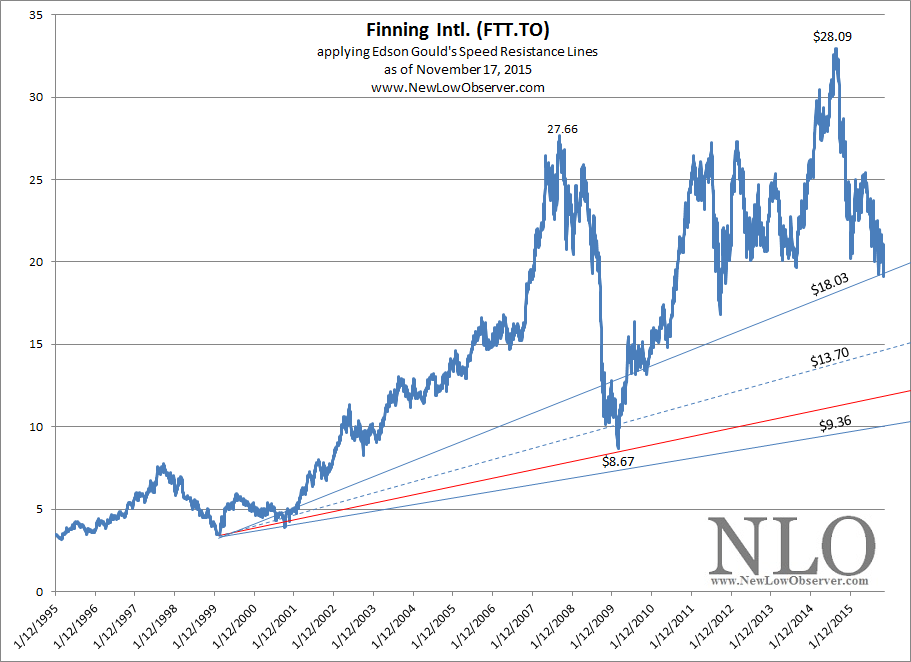
| FTT.TO | Finning International Inc. | 22.68 | 21.9 | -3.44% |
| NA.TO | National Bank Canadian Equity SP | 36.14 | 45.51 | 25.93% |
| CM.TO | Canadian Imperial Bank of Commerce | 77.15 | 91.18 | 18.19% |
The average return for the entire watch list was +9.84% compared to the Toronto Stock Exchange Composite index change of +13.33% in the period from July 19, 2013 to July 22, 2015. At the time, we said the following of the watch list:
“We recommend careful examination of the listed companies in the REIT arena as they have less upside potential than is ideal.”
Since July 2013, the REIT related companies on the watch list generated a return of +0.94% while companies not in the REIT sector gained an average of +18.94%.
July 2015 Canadian Dividend Watch List
Below is the Canadian stocks of interest:
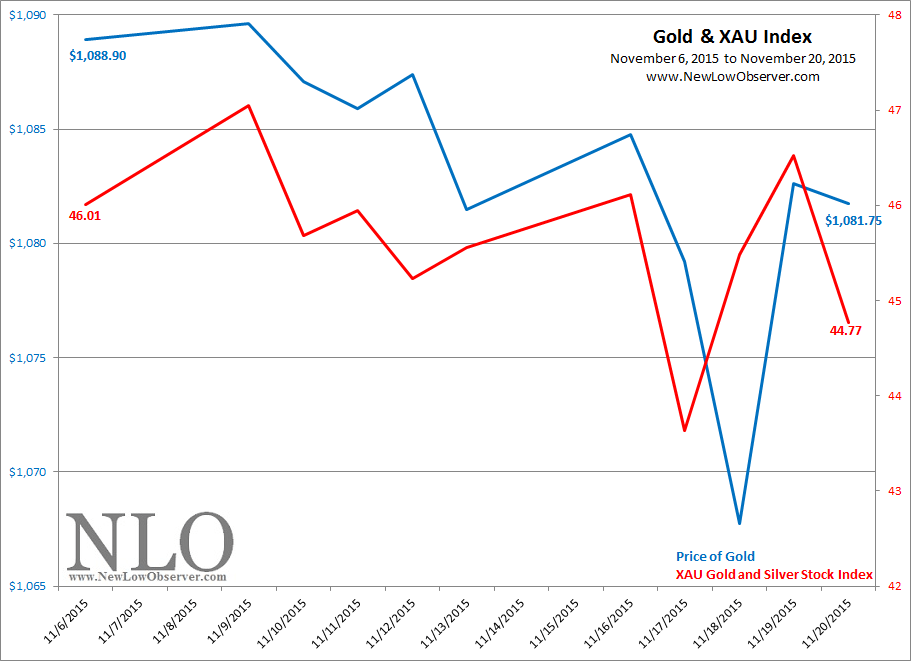
Since June 29, 2015, the price of gold has declined –3.67% while the gold and silver stock index (XAU) declined -15.19%.
The recent declines are nothing compared to the full extent of the carnage that has been witnessed since the 2010 peak in gold stocks which have fallen –76%. Meanwhile, the price of gold from the 2011 peak has declined -40.22%.
This decline is very much similar to the percentage declines experienced in the period from 1974 to 1976 when gold fell –44% and gold stocks fell –68%.
The following two quotes from Richard Russell (near the low in the gold market) seem appropriate given the current market conditions:
“The great fortunes have been made in the market by buying shares that no one wanted. S. African golds are nearing that point now. For those willing to "buy'em and put'em away," for those willing to write off a possible loss against a possible major gain, many of the marginal S. African gold shares are interesting now (Russell, Richard. Dow Theory Letters. April 2, 1976. page 6.).”
“In August of 1975 the golds fell out of the triangle and entered into one of the worst bear market collapses I have ever seen. By mid-1976 about 75% of all gold mine values were wiped out. Guessing at bear market bottoms for stock groups is always a hazardous occupation. Certainly, the action of the last month must be considered a panic in gold shares. Bear markets often end with downside panic action. Therefore, in view of the time element of the bear market, the severity of the recent chaotic panic action, and the current gold pessimism, I am guessing that we will see the lows for most gold shares in this area. But I would say that holding gold shares is an uninteresting proposition unless relative strength for the group turns bullish. It hasn’t yet (Russell, Richard. Dow Theory Letters. July 30, 1976. page 5.).”
“The problems of tomorrow are being created today as we write this letter. Furthermore, there are risks in the balance sheets that we cannot see. Companies such as Fannie Mae (FNM), Freddie Mac (FRE) and American International Group (AIG) are now showing financial strains from previous actions taken to enhance the look of their financial reports. We are also concerned that many of these companies have used financial derivatives that are totally unanalyzable by outsiders, since there is insufficient information disclosed in their financial statements for a risk assessment.”
Robert L. Rodriguez. Letter to Shareholders. April 16, 2005. Page 4.
Posted in AIG, Fannie Mae, FNM, FRE, Freddie Mac, Robert Rodriguez
Top Five Watch List Performance Review
In our ongoing review of the NLO Dividend Watch List, we have taken the top five stocks on our list from July 11, 2014 and have checked the performance one year later. The top five companies on that list can be seen in the table below.
| Symbol | Name | 2013 Price | 2014 Price | % change |
| ROST | Ross Stores | 32.90 | 50.86 | 54.6% |
| FCBC | First Community Bancshares | 14.14 | 18.39 | 30.1% |
| SCL | Stepan | 52.80 | 50.50 | -4.4% |
| CHFC | Chemical Financial Corp. | 27.49 | 33.21 | 20.8% |
| WWW | Wolverine World Wide | 26.00 | 29.15 | 12.1% |
| Average | 22.6% | |||
| DJI | Dow Jones Industrial | 16,943.81 | 17,760.41 | 4.8% |
| SPX | S&P 500 | 1,967.57 | 2,076.62 | 5.5% |
The top five companies combined for an average gain of +22.6%, far exceed the performance of the market. The biggest gainer was Ross Stores (ROST) which gained +54.6%, split adjusted. The worse performer was Stepan (SCL) which lost -4.4% over the year.
U.S. Dividend Watch List: July 10, 2015
This week, we highlight 27 companies that are on our dividend watch list. Continue reading
Charles H. Dow says slow and steady wins the race
"Confidence has to be earned and has been truthfully pronounced a plant of slow growth (Dow, Charles H. Wall Street Journal. Review and Outlook. October 12, 1900)."
Posted in Dow's Value Theory
The chart below highlights two issues:
1) How long did it take for a stock to get to breakeven?
In the case of National Dairy Products, the stock did not get to breakeven by the 1937 peak. National Dairy declined approximately -90% in price from 1929 to 1933. From late 1933, National Dairy rose as much as +180% to the 1936 peak.
2) What happened to the dividend during the stock market crash and "Great" Depression?
In spite of the market decline from the 1929 peak, National Dairy’s earnings continued higher by the end of 1930. Once earnings started to slide in 1931, the pace of dividends continued to move higher. In 1932, it became apparent to management that the dividend policy had to be reduced. The pace of the decline in dividends tracked closely the decline in earnings. However, when earnings started to increase, the dividend was not pushed higher until two years after the trend reversed in earnings.
The change in dividend policy is a great example of management’s expectation of future prospects. However, when a policy of cutting the dividend started, in 1932, most dividend investors were probably becoming fearful of the prospects going forward and reacted by selling their stock. In reality, 1932-1933 was the time to start accumulating shares of the stock.
Posted in dividends, National Dairy Products
Below is the performance of the stocks from our June 20, 2014 Nasdaq 100 watch list compared to the Nasdaq 100 Index gain of +17.84% over the last year.
| Symbol | 2014 | 2015 | actual chg |
| LMCA | 35.07 | 37.26 | 6.24% |
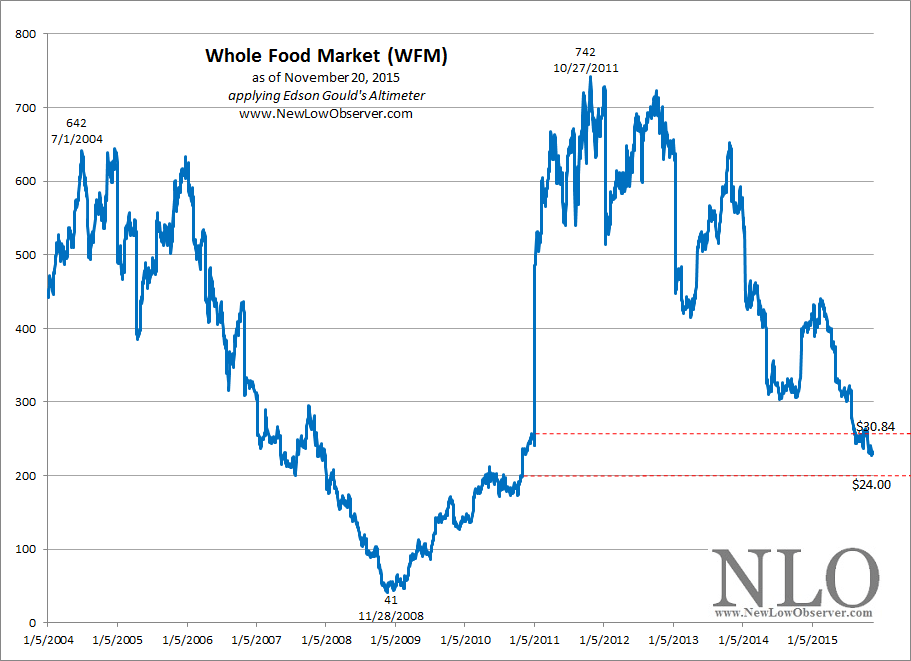
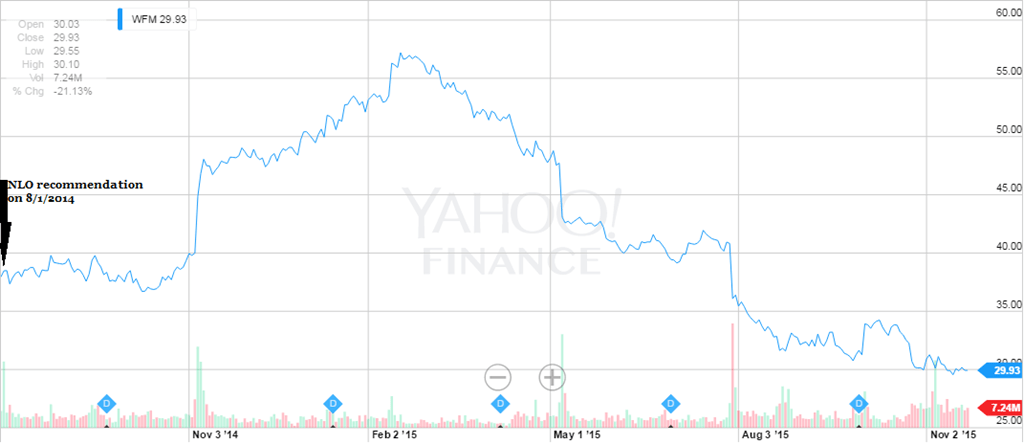
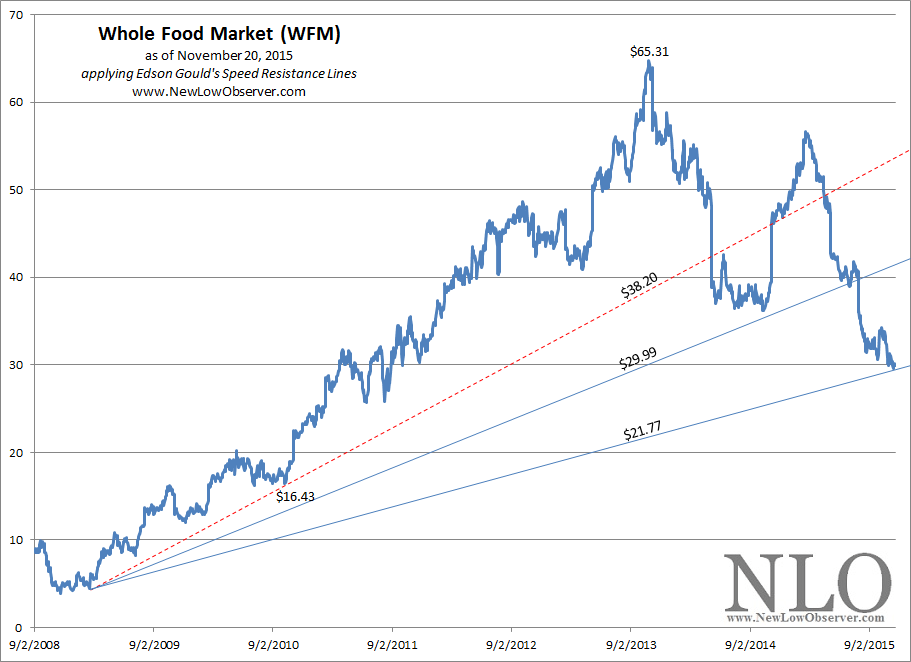
| WFM | 39.22 | 40.35 | 2.88% |
| COST | 115.36 | 138.06 | 19.68% |
| BBBY | 60.07 | 71.11 | 18.38% |
| SPLS | 11.19 | 16.05 | 43.43% |
| FOSL | 105.6 | 71.79 | -32.02% |
| VRSK | 60.46 | 74.51 | 23.24% |
| ROST | 33.65 | 50.27 | 49.39% |
| DLTR | 53.68 | 81.66 | 52.12% |
| EBAY | 49.34 | 61.03 | 23.69% |
| DISCA | 37.71 | 33.84 | -10.26% |
| CA | 28.73 | 29.89 | 4.04% |
| NTAP | 35.79 | 32.36 | -9.58% |
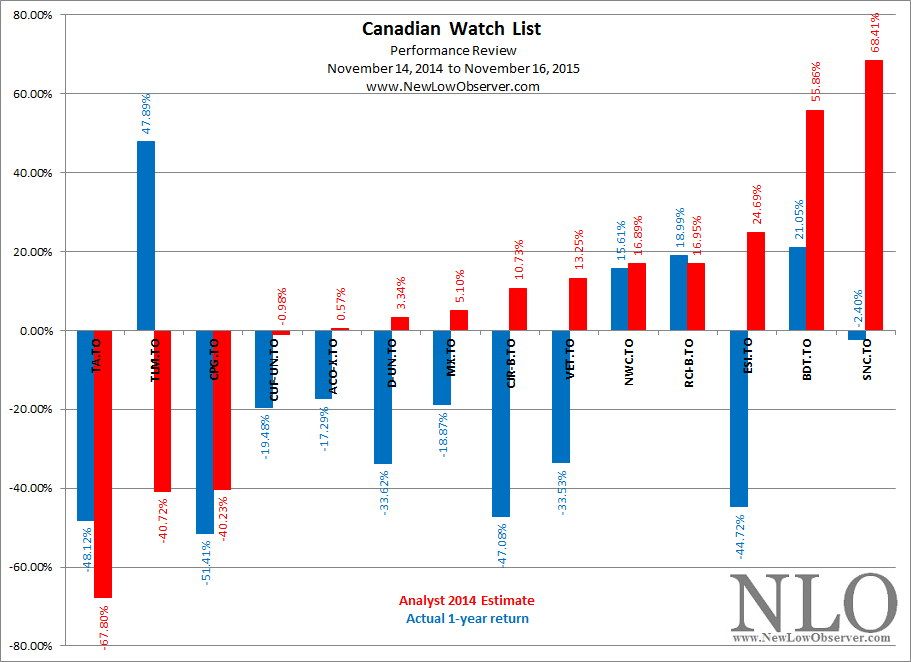
Below is the analyst estimates from last year compared to the actual performance of the stocks.
At the extremes we see that Liberty Media (LMCA), Whole Foods (WFM), Fossil (FOSL), Discovery Communications (DISCA) and NetApp (NTAP) went in opposite directions of the analysts. At the same time, the expectations for the remaining stocks didn’t quite come as close as anticipated. The lone exception is Ebay (EBAY) which was expected to gain +16.34% as opposed to +23.69% of actual change.
Nasdaq 100 Watch List
Below is the latest list of stocks that we believe present the best investment opportunities from the Nasdaq 100 Index.
Top Five Watch List Performance Review
In our ongoing review of the NLO Dividend Watch List, we have taken the top five stocks on our list from June 27, 2014 and have checked the performance one year later. The top five companies on that list can be seen in the table below.
| Symbol | Name | 2013 Price | 2014 Price | % change |
| ROST | Ross Stores | 32.90 | 50.27 | 52.8% |
| SCL | Stepan | 52.35 | 55.00 | 5.1% |
| C | Citigroup Inc | 47.14 | 56.34 | 19.5% |
| WWW | Wolverine World Wide | 26.19 | 29.34 | 12.0% |
| FCBC | First Community Bancshares | 14.38 | 18.52 | 28.8% |
| Average | 23.6% | |||
| DJI | Dow Jones Industrial | 16,851.84 | 17,946.68 | 6.5% |
| SPX | S&P 500 | 1,960.96 | 2,101.61 | 7.2% |
Out top five companies surpassed the market performance by a wide margin. The overall gain was +23.60% compared with +7.20% for the S&P 500.
Ross Stores (ROST) was the largest contributor with a +52.8% gain. ROST also did a 2-to-1 split on June 12th of this year. Our assessment of Ross was inaccurate when we said that the stock doesn't have enough margin of safety at the current level. However, we may have identified a key attribute for stocks that may outperform the market. One of the biggest takeaway is the fact that ROST raised its dividend by +17% while maintaining a low payout ratio of 19%. The fact that the dividend yield was only 1.12% confirms our theory that the dividend growth and sustainability is more important than absolute yield.
Of the top five, Stepan (SCL) was the worst performer. The street had an optimistic view of the stock and expected it to grow net income by +36%. This made Stepan's forward P/E of 9 very attractive. However, that all depended on one important fact, that the net income must rise by more than a third. Because the stock was trading at its 5-year high on P/E, any earnings miss would not be good. When Stepan reported earnings in October 2014, the street expected EPS to come in at $0.89 but the actual result was $0.68. The stock fell from $52 to $38. Next, the inevitable event occurred, analysts revised their estimate downward. Stepan's EPS came in at $0.38 in the February quarter, above the street's estimate of $0.35. Three months later, EPS came in at $0.90 when the street's estimate was $0.68. Shares rose back from $38 to $55. ![]()
U.S. Dividend Watch List: June 26, 2015
There are 33 companies on our watch list. Continue reading
Since our last Gold Stock Indicator posting, the price of gold has increased <1% while the Philadelphia Gold and Silver Stock Index (XAU) declined –4.49%.
Below are is the GSI for Barron’s Gold Mining Index from 1973 and XAU Index from 1983. Based on these two charts, an investors can easily discern where we are from a valuation perspective.
On Friday June 26, 2015, we executed the following transactions:
The chart below highlights two issues:
1) How long did it take for a stock to get to breakeven?
In the case of Borden, the stock did not recover to the 1929 peak of $92 by the end of 1937. In fact, by 1954, Borden got as high as $74. Borden was later acquired in a KKR deal struck in September 1994. Buyers of Borden in 1934 did very well, however, recovery was only achieved in due time through the virtue of total return.
2) What happened to the dividend during the stock market crash and "Great" Depression?
The dividend was increased or maintained in 1929, 1930, and 1931. However, in the year of the stock market bottom, Borden pursued a dividend cutting campaign. In 1932 the full year dividend was $2.27. By 1939, the dividend was $1.27. In this case, the dividend cut ended at $1.27 which preceded the final decline in earnings. Earnings finally ascended in 1935. By 1954, the full year dividend was $2.64 This increase in earnings was later reflected in the growth of the dividend.
The chart below highlights two issues:
1) How long did it take for a stock to get to breakeven?
In the case of Union Carbide, the stock nearly recovered all of its losses by 1937 before the next major stock market decline. The loss of nearly -90% was difficult for anyone to experience so it is assumed that most investors would have sold the stock at or near the depths of the decline in 1932.
2) What happened to the dividend during the stock market crash and "Great" Depression?
The dividend tracked earnings with a lag of 9 to 12 months. As earnings bottomed in 1932, so too did the dividend. However, in spite of being in a "Great" Depression, earnings steadily grew for Union Carbide until the 1937 peak. This increase in earnings was reflected in the growth of the dividend.
Posted in Union Carbide