Will rates go up in today’s meeting at the Federal Reserve?
- Japan
- Market Indicator
- Price Momentum Indicators
- Richard Russell
- Silver
- Speed Resistance Lines
- U.S. Dividend Watch List

Will rates go up in today’s meeting at the Federal Reserve?
Below is the performance of the individual Dow Jones Industrial Average constituents from December 29, 2017 to March 19, 2018.
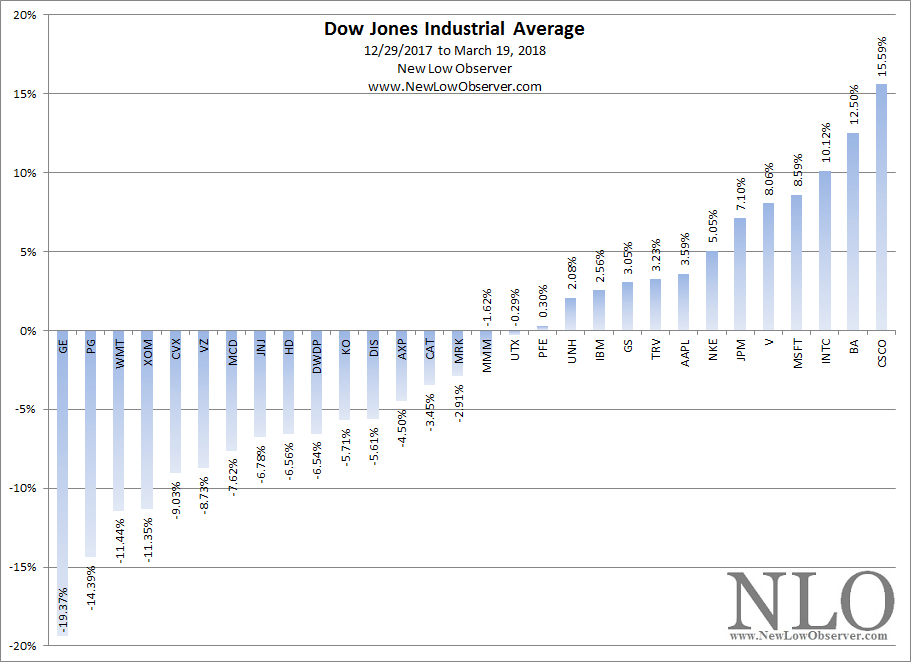
The Dogs of the Dow continue to underperform the Dow Jones Industrial Average by a considerable margin.
Performance Review
Below we have provided the performance of the respective categories to show the difference between selecting the stocks that are in either the top 1st, 2nd, and 3rd ranking as opposed to selecting those stocks that are 2nd, 3rd and 4th ranking.
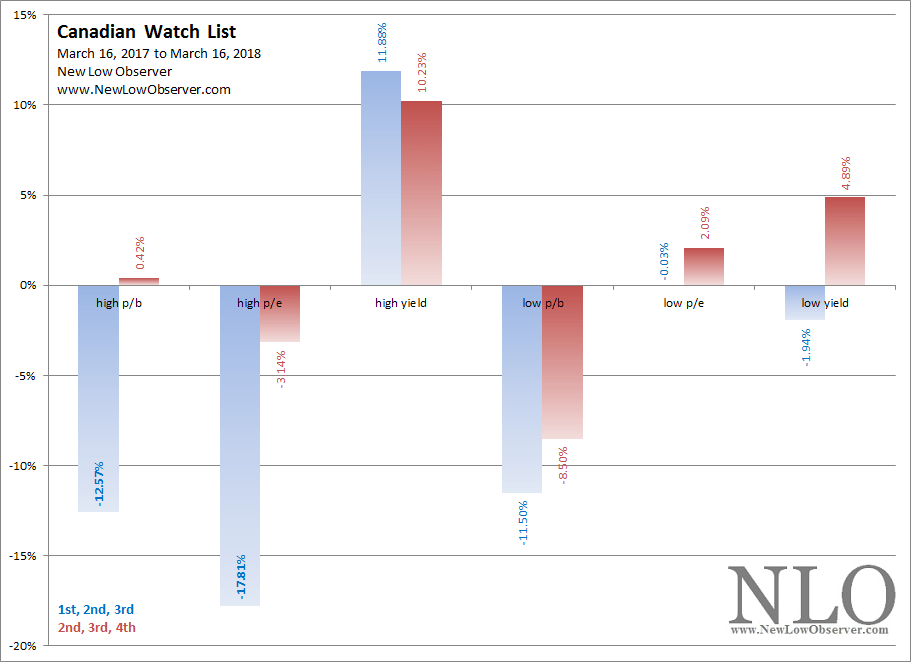
We find the results interesting as there is a material difference in performance. the largest difference gained was in the high p/e stocks where the selection changed the performance from –17.81% to –3.14%. Although not a gain, the improvement was substantial. In fact, all categories gained except the high yield group where the gain was reduced from +11.88% down to +10.23%.
As a group, the entire watch list lost –1.20% on a total return basis as compared to the Toronto Stock Exchange change of +1.32% in the same period of time. The best performing stock was Jean Coutu Group (PJC-A.TO) which gained +23.96% and was our strong interest stock of February 27, 2017. The worst performing stock was Cineplex Inc (CGX.TO) which fell –36.33%.
Top Five Watch List Performance Review
In our ongoing review of the NLO Dividend Watch List, we have taken the top five stocks on our list from March 17, 2017 and have checked the performance one year later. The top five companies on that list can be seen in the table below.
| Symbol | Name | 2015 Price | 2016 Price | % change |
| TGT | Target Corp. | 54.29 | 70.99 | 30.8% |
| MAC | Macerich | 64.15 | 58.93 | -8.1% |
| BMS | Bemis Co Inc | 49.22 | 44.98 | -8.6% |
| SCG | SCANA Corporation | 67.88 | 40.21 | -40.8% |
| CATO | Cato Corp. | 21.92 | 13.27 | -39.5% |
| Average | -13.2% | |||
| DJI | Dow Jones Industrial | 20,914.62 | 24,946.51 | 19.3% |
| SPX | S&P 500 | 2,378.25 | 2,752.01 | 15.7% |
The top five companies average return was -13.20% largely driven by SCANA (SCG) and Cato (CATO) which lost -40.80% and -39.50%, respectively. A gain of +30.80% from Target (TGT) wasn't enough to offset the loss incurred from the other four companies. The good news for us is that we were bullish about Target and acted on our intuition.
Other notable companies mentioned were Hormel Foods (HRL), Coca-Cola (KO), and Genuine Parts (GPC). The average change for the three companies are -2% compared to the S&P 500 gain of +15.70%. Although these companies are part of an elite group call Dividend Aristocrats, that doesn't mean they will outperform the market. Even when our valuation model point to potential upside, in the case of Hormel Foods and Coca-Cola, they didn't come to fruition.
U.S. Dividend Watch List: March 16, 2018
Below are 54 companies on our watch list for this week. Continue reading
Posted in Dividend Achiever Watch List, Dividend Achievers, Dividend Watch List
Tagged members
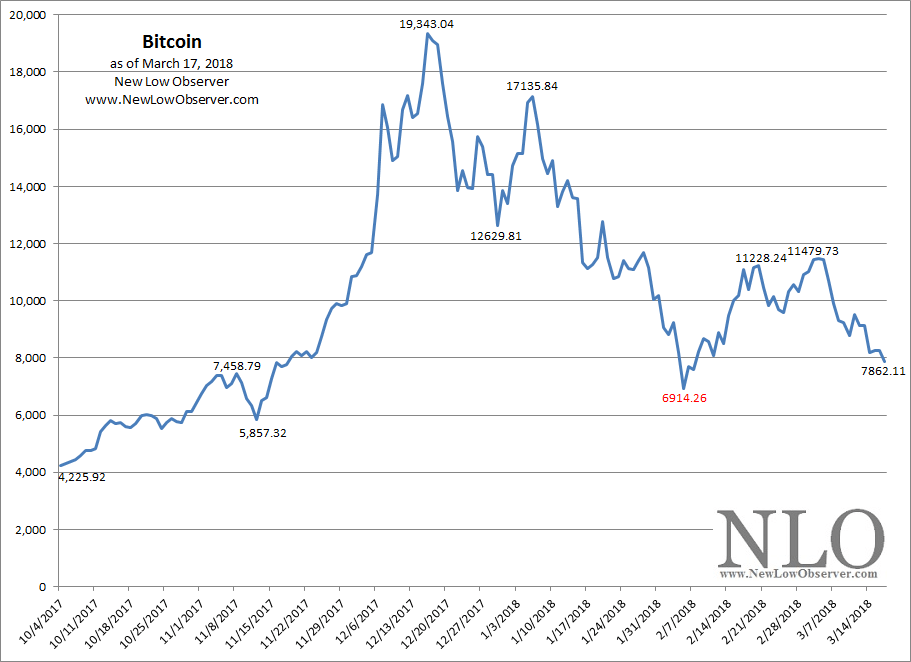
On February 17, 2018, we said of Bitcoin:
“…before a new high (substantially above the $19,343) is achieved, we expected a retest of the $6,914.26 level (or something close, like, $7,000-$7,200).”
We arrived the conclusion that the price should have a retest of the initial low of $6,914.26 after reviewing the three prior peaks and the subsequent declines and the retesting of the initial declines.
| peak | peak date | initial low | initial low date | % change | retest date | final low | total % decline |
| 29.60 | 6/8/2011 | 14.65 | 6/11/2011 | -50.51% | 7/4/2011 | 2.05 | -93.07% |
| 230.00 | 4/9/2013 | 68.36 | 4/16/2013 | -70.28% | 7/5/2013 | 66.34 | -71.16% |
| 1,147.25 | 12/4/2013 | 522.23 | 12/18/2013 | -54.48% | 2/25/214 | 177.28 | -84.55% |
| 19,343.04 | 12/16/2017 | 6,914.26 | 2/5/2018 | -64.25% | ??? | ??? | ??? |
It (retest) doesn’t have to happen, however, according to Dow Theory, it would be wise to expect a retest of the prior peak or a prior low. A retest of a low or high is also known as a double top when a new bear market is indicated or double bottom when a new bull market begins. For those with a bullish bias on Bitcoin, the following thoughts are appropriate for the current price action of the last two months.
"...before you can get a bull move, you have to establish a strong base -- and you have to test and retest that base many times." (source: Russell, Richard. Dow Theory Letters. October 18, 1989. Issue 1028. page 6.)
"Records of trading show that in many cases when a stock reaches top it will have a moderate decline and then go back again to near the highest figures. If after such a move, the price again recedes, it is liable to decline some distance.” (source: Hamilton, William Peter. Stock Market Barometer. Harper and Brothers. 1922. page 36.)
We think that the based on the price action we’ve seen with Bitcoin, there is going to be retest of the prior low at $6,914.26. In addition, the failure or success of holding at the retest level will go a long way in determining the direction of the price, in a dramatic fashion.
Posted in Uncategorized
On February 16, 2018, we said the following of Ethereum:
“Failure of the price of Ethereum to achieve the $1,040.05 by a substantial amount ($1,111 or more) would be an indication that the price will retest the $695.08 level. A retest of the $695.08 level without falling below the level would be constructive for a new bull market. It would be a second failure to decline below the $692.99 level. According to Dow Theory, this would one of the most constructive bullish indications going forward. Alternatively, if Ethereum fell below $692.99 then the expectation is that $617.09 is the minimum downside target.”
Unfortunately, Ethereum did not managed to exceed the $1,040.05 level. In addition to achieving the $695.08 level, Ethereum has fallen below the conservative downside target of $617.09, as mentioned in our February 5, 2018 posting.
In a Bloomberg article dated March 14, 2018, it cites a prevailing theme about utilities and interest rates.
“The popular ‘buy banks, sell utility stocks’ strategy, built in anticipation of higher interest rates, is unraveling.
“Utilities were the only gainers in the S&P 500 Index on Wednesday, with the industry that’s seen hurt most by rising Treasury yields heading for its longest rally since November. Financial shares, beneficiaries of higher borrowing costs, sank 1.4 percent for a third day of declines.”

While this is a small timeframe to measure the performance of any industry, it does shed some light on the popular interpretations about what a rising interest rate cycle will bring to the market. One of the most pervasive claims is the interest rate sensitive utilities will suffer with the advent of rising interest rates.
As pointed out in our September 4, 2014 article titled “Utility Stocks and Rising Interest Rates”, we said the following:
“Investors anticipating a general rise in interest rates should feel some comfort in knowing that most manager in the utility sector are ready for what is to come. Rising interest rates are not an automatic death sentence for utility stock prices or earnings. In fact, the early stages of rising interest rates may see utility stocks match or exceed the returns of non-interest rate sensitive stocks, on a total return basis. Only when the outlook is cloudy will it become difficult to offer projections that are in line with prior expectations.”
So far the market is in agreement with our long established thesis that utilities do well in the early stages of the secular rise in interest rates.
Charles H. Dow, co-founder of the Wall Street Journal, once said:
“For the past 25 years the commodity market and the stock market have moved almost exactly together. The index number representing many commodities rose from 88 in 1878 to 120 in 1881. It dropped back to 90 in 1885, rose to 95 in 1891, dropped back to 73 in 1896, and recovered to 90 in 1900. Furthermore, index numbers kept in Europe and applied to quite different commodities had almost exactly the same movement in the same time. It is not necessary to say to anyone familiar with the course of the stock market that this has been exactly the course of stocks in the same period ( source: Dow, Charles. Review and Outlook. Wall Street Journal.February 21, 1901.)”
There is no exactness between the relative percentage change in the Dow Jones Industrial Average and the price of a commodity like gold. However, since the January 26, 2018 peak in the DJIA, there has been a lot of sympathy moves in the price of gold and the DJIA.

Posted in Charles H. Dow, DJIA, gold
In past articles, we have pointed to the fact that government stimulus directed at the economy or the stock market has little effect (2016, 2014, 2011, 2009). So it is with little wonder that we look at the situation of the Shanghai Composite Index for indications of the effectiveness of direct stock market intervention by the Chinese government.
On June 27, 2015, after the Shanghai Index had declined more than –20%, the government stepped in to shore up the stock market with a surprise interest rate cut. That rate cut and many other actions that followed was cause for many analysts to carry on with the superstitious belief that government intervention could stop stock market declines and actually boost the market. Many analysts were openly recommending Chinese stocks since the government had openly declared a goal to stop the stock market decline.
The following is a list of known interventions that was presented by Quartz Media writers Heather Timmons and Lily Kuo published on July 28, 2015 in an article titled “A complete list of the Chinese government’s stock-market stimulus”:
Since the initiation of these government actions to prop up the stock market, the Shanghai Composite Index declined an additional –34.40% to the low of January 28, 2016 and three years later lingers at a loss of –18.40% based on the starting point of the market stimulus of June 27, 2015. In total, the Shanghai Index is down –35.98% from the peak on June 12, 2015.
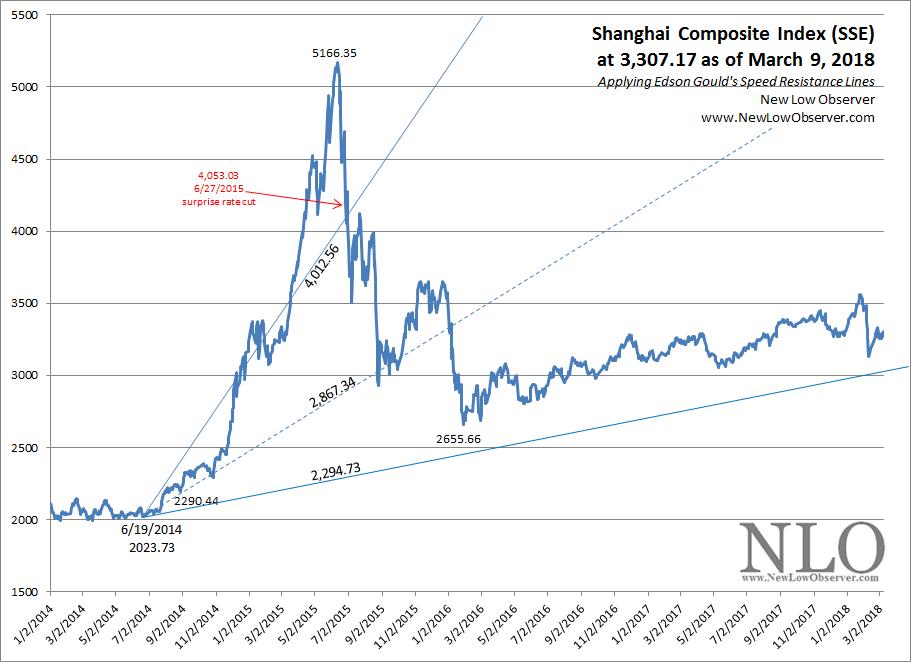
We cannot emphasis enough how government stimulus has marginal long-term impact on the direction of the stock market and the economy. Interestingly, buyers of Chinese ETFs at the current levels would be considered value investors as opposed to those buying in 2015 based on government promises to prop the market.
Posted in Shanghai Composite Index
Top Five Watch List Performance Review
In our ongoing review of the NLO Dividend Watch List, we have taken the top five stocks on our list from March 3, 2017 and have checked the performance one year later. The top five companies on that list can be seen in the table below.
| Symbol | Name | 2015 Price | 2016 Price | % change |
| TGT | Target Corp. | 57.35 | 75.15 | 31.0% |
| CATO | Cato Corp. | 23.65 | 11.82 | -50.0% |
| MAC | Macerich | 66.57 | 59.04 | -11.3% |
| SKT | Tanger Factory Outlet Centers | 33.34 | 22.70 | -31.9% |
| WRI | Weingarten Realty Investors | 34.73 | 27.60 | -20.5% |
| Average | -16.5% | |||
| DJI | Dow Jones Industrial | 21,005.71 | 24,538.06 | 16.8% |
| SPX | S&P 500 | 2,383.12 | 2,691.25 | 12.9% |
The top five companies on our list didn't fare as well as the market. The combined loss was 16.5% while the S&P 500 gained 12.9%. The only company with a positive gain was Target (TGT). If we look at the sector breakdown of these companies, one will identify a clear trend of sector performance. Three of these five companies below in REIT sectors and the average loss were 21.3%. Cato (CATO) which is a specialty retail store lost half of its market value in one year. Our team were bullish on Target but were early in our purchases. Shares rose more than 30% since last year which is almost 2x the return from the market.
The other company mentioned last year was VF Corp (VFC). Our team was bullish on shares at the right moment and walk away from with a profitable trade. Since our list last year, VF Corp shares rose 40%.
U.S. Dividend Watch List: March 2, 2018
The volatility trade is back on and the market continued to swing wildly. At the end of the week, the market lost 2% and the Dow Jones Industrial average broke below 25,000 mark. The result of this pull back is more companies are approaching the yearly low leading to more companies on our dividend list. Should one choose to utilize this pullback as an entry point, we urge our reader to start with high quality companies which have consistent dividend payments listed below. Continue reading
Posted in Dividend Achiever Watch List, Dividend Achievers, Dividend Watch List
Tagged members
Recent discussion of a trade war breaking out has left the financial press and popular analysts calling for a potential “black swan” in the financial markets.

What’s the problem? There is no such thing as an event that is currently being predicted that could possibly be a “black swan” event.
Posted in Black Swan
Below is the 8-year & 1-year total return performance of our Dividend Watch List from March 5, 2010 as compared to the Dow Jones Industrial Average. Included with the performance review is a look at a viable and consistent alternative to the simple “buy the top 10” or “buy the top three” stocks in the list.
If the saying that “you’re only as good as your weakest link” is true then investors need to pay attention to General Electric (GE). In the price-weighted Dow Jones Industrial Average (DJIA), GE has 0.38% of an impact on the DJIA. Such a low impact on the index makes the movement of GE on the index almost non-existent. However, the manner in which this ailment in the index is treated says a lot about the overall market.
Leaving aside the fact that General Electric has been in the Dow Jones Industrial Average since 1907, GE is the new, “As General Motors goes, so goes the nation.” It isn’t that GE is as broadly diversified in domestic manufacturing that is the issue, though it broadly impacts many industries, instead, it is the continued share decline and the impact on pensions, insurance, 401k, retirement plans, and bank funds that are being adversely affected by cross shareholding of GE as it has declined into what appears to be oblivion.
The current environment affecting GE reminds us of the spiraling feedback loop of cross-shareholding (zaibatsu) in the Japanese stock market from 1989 to the present. The fact that a clean cut could not be made with badly managed companies due to stock holding relationships only allowed the deferral of addressing the real problems within the market. what was the impact of cross-shareholding on the Nikkei stock index in Japan?
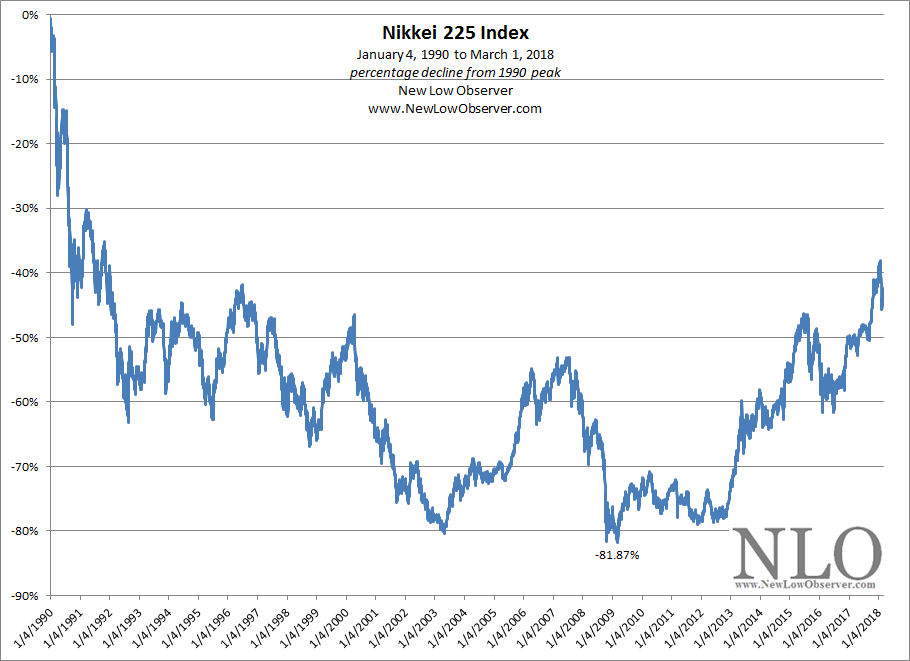
By all accounts, the decline in the Nikkei of –81.87% was due primarily because of the difficulty of disengaging the tangled web of cross-shareholding relationships. Ultimately, improved prospects of Japanese companies came in the form of divesting cross-shareholdings.
In our opinion, the situation is the same with General Electric. The managers of the Dow Jones Industrial Average have allowed the disparity between the top weighted Dow component (Boeing) to go far beyond the norm of the bottom component (General Electric), typically 10 times (before getting kicked out of the index) but now it is more than 24 times the value of GE.
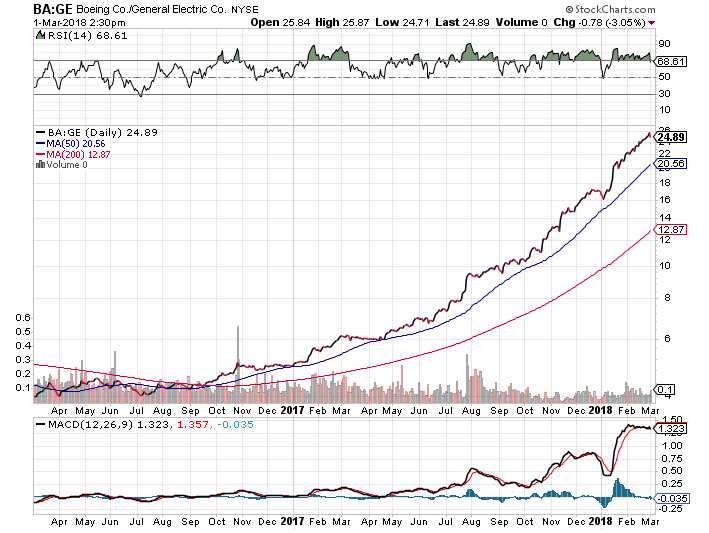
Had GE been removed from the Dow Jones Industrial Average at 10x the value of the highest priced stock in the index (Boeing), GE would have been removed from the index in late August 2017. The fact that GE has been allowed to remain in the index means that the managers of the DJIA are in denial of the problems at GE or are acting at the behest of fund managers hoping for a turnaround before dumping their shares.
Right now, the weakest link in the DJIA is allowed to stay afloat at the expense of millions of retirement funds who are required to hold “blue chip” stocks regardless of performance. GE cannot claim to be “blue chip” especially if it gets booted from the DJIA. Although, the accounting scandals and restatements since the Jack Welch era should have been the first indication that GE wasn’t a “blue chip” stock.
The cascading negative effect of not booting GE from the DJIA is far worse than the impact of kicking it to the curb.
Posted in DJIA, GE, General Electric
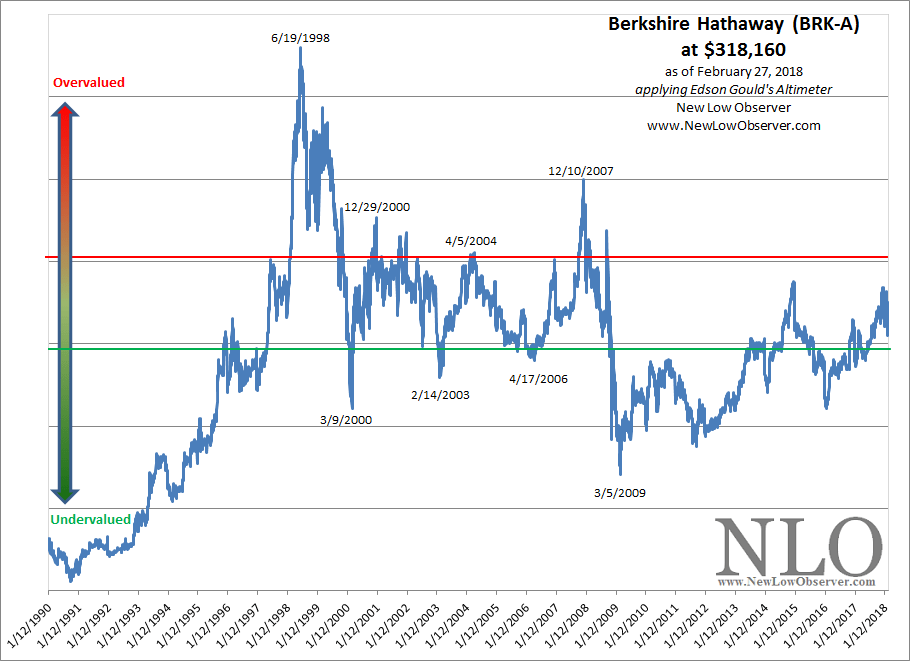
On May 6, 2012, we posted an article titled “Should Berkshire Hathaway Be Trading at 1995 Prices?” where we constructed an Altimeter for Berkshire Hathaway (BRK-A). At the time we said the following:
Based on the Altimeter, Berkshire is currently undervalued by at least 66% and below the 2007 peak by almost 95%. Those considering the acquisition of Berkshire Hathaway have the following upside targets to consider in the coming 2-3 years, all things being equal:
Since that time, the price of Berkshire increased the +95% by November 2016. The updated Altimeter is listed below:
Below is one of the most important charts of the Bloomberg Commodity Index (BCOM) you’ll ever see. The range of the chart is from late 2015 to the present.

Looking at this chart, can you tell what the overall trend of the index is? Do you suspect what might happen if the index declines below the June 2016, February 2017, or January 2018 levels?