Below are the valuation targets for Sysco Corp. (SYY) over the next 10 years. Continue reading
- Japan
- Market Indicator
- Price Momentum Indicators
- Richard Russell
- Silver
- Speed Resistance Lines
- U.S. Dividend Watch List

Below are the valuation targets for Sysco Corp. (SYY) over the next 10 years. Continue reading
Below is a chart of Sysco Corp. (SYY) from 1974 to 2019 reflecting the year-over-year (YoY) percentage change.
Below are the valuation targets for Sysco Corp. (SYY) for the next 10 years. Continue reading
Reader MC asks: “Curious to know your recent thoughts regarding SYY and the significant gains made in the stock since your March, 2015 purchase. Time to consider selling the principal portion again?”
Our Response:
On March 25, 2015, we bought Sysco Corp (SYY). The premise behind the purchase was outlined in our March 13, 2013 posting titled “Warren Buffett Leverages Up on Inflation Hedge”. In that 2013 posting we said the following:
“We cannot emphasis enough the fact that there are vastly superior alternatives to gold and gold stocks if you want to beat inflation. Additionally, investment in companies like Heinz will be richly rewarded even as the period of inflation comes to an end. This will not be the case for gold and gold stocks, as found out by gold permabulls in the period from 1980 to 1999. This explains why Warren Buffett would be involve in the Heinz transaction, it is the appropriate alternative to buying gold or gold stocks if runaway inflation is expected down the road.”
Our take is that the secular trend in interest rates is up. However, one challenge is the outsized gains that have been achieved with our purchase of Sysco Corp. To put the change in perspective, the chart below represents the increase in Sysco Corp. (blue) compared to the S&P 500 (red) and Nasdaq 100 (orange) indexes.
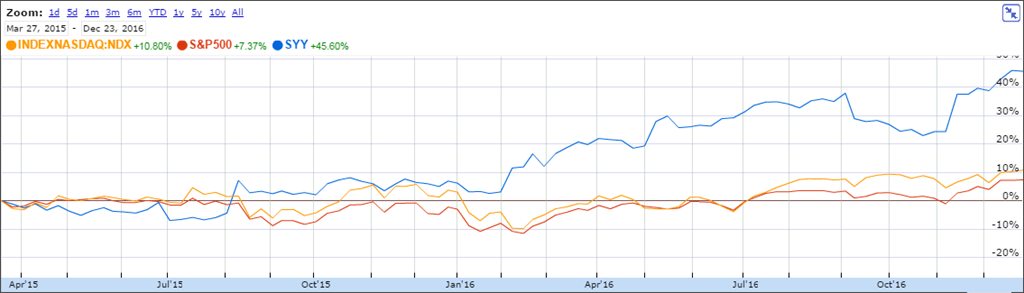
The gain of +45% in Sysco Corp. has outpaced the gains of the conservative S&P 500 at +7.37% and the far more volatile Nasdaq 100 at +10.80%.
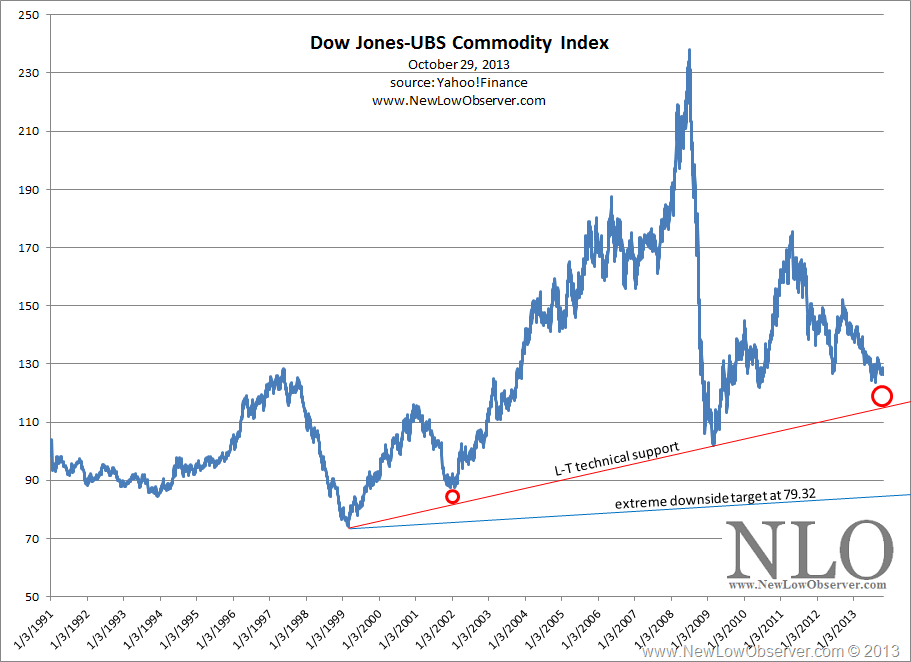
We’ve noticed an interesting pattern which may suggest that the Dow Jones-UBS Commodity Index is nearing the low. In the chart below, we show (at the red circles) the exact same percentage difference between the long-term technical support (red line) and the 2002 and 2013 low. That percentage difference, approximately 7% in both cases, is all that stands between the two low points and the support level. Our primary question is, will the most recent low sustain a double bottom as was the case in the 2001-2002 period?
Already we have indicated the extreme downside target for the commodity index at 79.32, based on the work of Edson Gould’s Speed Resistance Lines. However, if we are in a commodity bull market, as we’ve made reference to in our January 1, 2009 article titled (found here), then there is a good chance that a bounce at the long-term technical support line would mark the end of the cyclical bear move in commodities.
Comments Off on Has the Dow Jones-UBS Commodity Index Reached the Low?
Posted in Dow Jones-UBS, ExxonMobil, gold, gold bugs, Sysco, SYY, XOM
On February 14, 2013, Berkshire Hathaway and investment firm 3G announced a deal to buy H.J. Heinz (HNZ) for $28 billion, or $72.50 per share. Naturally, Warren Buffett, not being one to get the short end of any stick, is investing only $4.4 billion in Heinz common stock and another $8 billion in preferred shares yielding approximately 9%. The rest of the purchase is being financed through investment group 3G and bank borrowing.
According to the Wall Street Journal, Warren Buffett “…has previously expressed disdain for private-equity buyouts that employed excessive leverage.” However, as the details of the acquisition have unfolded, it becomes apparent that the leveraged nature of the transaction is on par with the deals that Buffett has spoken out against. So what is the motivation of Warren Buffett to engage in such a transaction? In this case, the allure of an inflation hedge that performs much better than gold in high inflation environments and that is proven to succeed after the high inflation period ends.
In the past, we have been outspoken on the matter of investing in food processing companies instead of gold and gold stocks if you want to beat inflation. On December 17, 2008, we pushed the idea that Sysco Corporation (SYY) is an inflation hedge that will beat gold and gold stocks. Our closing remark were, “…if you're of the mind that inflation is coming down the road, with all this liquidity being injected into the economy, then SYY might be a good "long-term" hedge against inflation (found here).”
In a December 1, 2010 article we re-iterated that value of inflation protection provided by food processors by comparing ConAgra (CAG), to Newmont Mining (NEM) during the gold bull market from 1974 to 1980. This was a time when ConAgra exceeded Newmont Mining by 10 times. Again, this was within the gold bull market from 1970 to 1980 (found here).
One article published as recently as September 20, 2012 was titled “Gold Stock Investors: To Beat Inflation Look to Food Processors, Producers and Distributors (found here).” In that article, we said, “As an alternative to the ‘mines’ of precious metal stock investing, we’ve recommended investing in food processors, producers and distributors that have a history prudent of dividend increasing policies to take advantage of the expectations of high inflation down the road.”
We cannot emphasis enough the fact that there are vastly superior alternatives to gold and gold stocks if you want to beat inflation. Additionally, investment in companies like Heinz will be richly rewarded even as the period of inflation comes to an end. This will not be the case for gold and gold stocks, as found out by gold permabulls in the period from 1980 to 1999. This explains why Warren Buffett would be involve in the Heinz transaction, it is the appropriate alternative to buying gold or gold stocks if runaway inflation is expected down the road.
Source:
"I like SYY for their divi growth long term, but...any worry at all about the long summer and rising gas prices affecting the cost of running their trucking network? More $ to move their product and less $ for consumers to spend on eating out."
"All those are great concerns but I think the important question is whether they are priced in or not. My parents run several restaurants and going through SYY is a must. Raising price is always harder in the short-term. But longer term, they should (will) be able to raise price. The article on restaurants lift prices is a first sign that they are passing this on to consumers. This should allow SYY to up their price. Restaurants or any producers rarely lower price after they raise it. But the cost (raw materials) do fluctuate. Our family restaurants raised price in early 2008 when oil hit $100 but we never lower them despite correction in the commodities market. Our margin expanded, profit rose, and cash built. It's hard to predict where SYY is at this moment but we believe that you are not paying up at this level, especially when its dividend yield is higher than historical average."
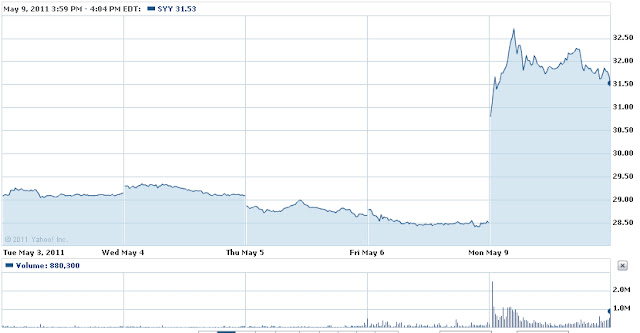
SYY has formed an upside down head and shoulders pattern which could indicate that the stock is headed much higher. SYY is the ultimate hedge against inflation and it may go as high as my first target price of $27.58. In the pursuit of "seeking fair profits" the returns that this stock has provided within the last 253 days say that it is necessary to consider alternative opportunities.
As I have indicated in the purposes and function of this site, the goal is to:
Research recommendations are intended to be a starting point for investigating a quality company at a reasonable price. It is hoped that after doing the background research you can buy the stock at a lower price. Ideally the stock should be held in a tax deferred account and should not consist of less than 20% of your holdings. Personally, I prefer holding only 2-3 stocks at a time.
Sell recommendations are intended to deal with the short term reality of the market. The tracking of the Sell recommendations are the worst case scenario if you happen to have bought a stock at the time the research recommendation was made (please avoid making this mistake.) I aim for mediocrity in my returns, therefore I am happy with 9-12% annual gains. However, since codifying my approach to investing in 2005, I have had annual returns of 14% and above every year since.
It is always recommended that when selling a stock, one should not place an order after hours or when the market is closed. This leaves the seller in the position of being vulnerable to the whims of the market makers. Instead, place your sell orders only as a market order during market hours. Some would complain that a market order during market hours might leave some profits on the table. However, I would rather leave some money on the table rather than have it taken away from me by the trades that are placed by institutions and market makers. Touc.
Please revisit Dividend Inc. for editing and revisions to this post.
Comments Off on Sell Sysco (SYY) at the Market
Posted in Sell Recommendations, SYY
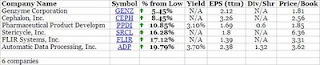 The companies that are within 10% of the low offer a great opportunity to do research and consider buying.