On February 22, 2024, we saw the following posting that reminded us of the information that dividends convey:
- Japan
- Market Indicator
- Price Momentum Indicators
- Richard Russell
- Silver
- Speed Resistance Lines
- U.S. Dividend Watch List

On February 22, 2024, we saw the following posting that reminded us of the information that dividends convey:
Below we review the Price Momentum for Newmont Mining from 1982 to 2024 under various scenarios.
Below is Newmont Mining (NEM) from 1984 to 2023 applying the Price Momentum Indicator.
Below is a chart of Newmont Mining Corp. from 1982 to 2022, reflecting Price Momentum data.
This is the list of gold related equities that we track within 10% of the one year low. We strongly recommend that you do your own research on these companies and assume that the downside risk is half of the current price, at minimum.
We’ve long maintained the view that in order for long-term investors to beat inflation, the conventional wisdom of investing in gold and silver stocks is not the most advantageous way to benefit from what almost everyone believes is coming as a consequence of QE4ever. While we favor the physical metals (especially silver) and their paper derivatives like (GLD) and (SLV), we’ve also claimed that a specific strategy is needed in order to get the most mileage out of gold and silver stock investing. However, in order to really beat inflation, forget gold and silver stocks and instead consider companies involved in food processing, producing and distribution industries.
Before we can tackle our food processors, producers and distributors, we need to examine the well documented wealth destruction that has occurred in the gold stock sector in the last year despite the relatively slight decline in the price of gold. Below is a table reflecting the percentage range that many gold and silver stocks have experienced between their one year high and low.
| Symbol | Name | 1-yr % range |
| NG | NovaGold Resources Inc. | -69.33% |
| MUX | McEwen Mining Inc. | -68.23% |
| SSRI | Silver Standard Resources Inc. | -57.35% |
| PAAS | Pan American Silver Corp. | -56.19% |
| KGC | Kinross Gold Corporation | -55.98% |
| BAA | Banro Corporation | -53.55% |
| AUQ | AuRico Gold Inc. | -53.13% |
| AEM | Agnico-Eagle Mines Ltd. | -51.78% |
| HMY | Harmony Gold Mining Co. Ltd. | -44.81% |
| ABX | Barrick Gold Corporation | -41.79% |
| GG | Goldcorp Inc. | -41.74% |
| NEM | Newmont Mining Corp. | -40.69% |
| AU | AngloGold Ashanti Ltd. | -37.81% |
| GFI | Gold Fields Ltd. | -36.32% |
| BVN | Compania de Minas Buenaventura SA | -34.03% |
| SLV | iShares Silver Trust | -30.46% |
| GLD | SPDR Gold Shares | -15.50% |
In all instances, those who had invested in these stocks did not expect that they’d face the prospect of –30% declines in value before they’d realize a gain. In fact, many of these stocks are not at a break-even point if purchased a year ago. Naturally, this should lead inflationistas and gold bugs to feeling a high level of frustration with the belief that gold stocks are a true inflation hedge.
Some perpetual gold bull analysts/marketers argue that gold junior and exploration companies provide better investment opportunities as compared to the many large cap gold stocks like Barrick Gold (ABX), Agnico-Eagle (AEM), and Newmont Mining (NEM). However, the last year has been unforgiving to the larger junior and exploration companies as represented by the Market Vectors Junior Gold Miners (GDXJ) in the chart below:
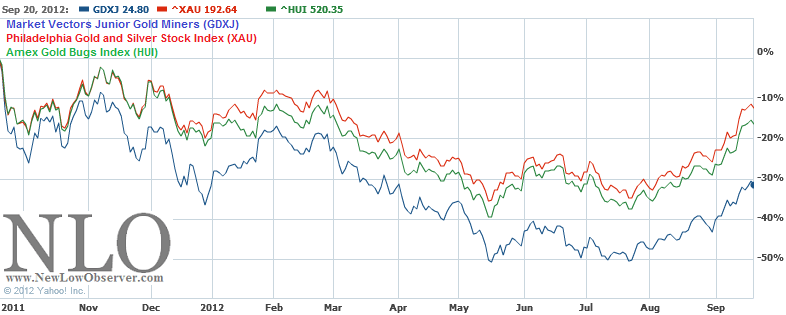
As early as 2008, in an article titled “Why Gold Will Decline More than the Markets,” we’ve cautioned gold stock investors to be prepared for gold stocks to decline by a greater percentage whenever the general stock market, as represented by the Dow Jones Industrial Average (DIA) or S&P 500 Index (SPY), declines -10% or more.
Within the last year, the closest the Dow Industrials and S&P 500 came to a -10% decline was from April 2nd to June 1st when the indexes fell –8.63% and –9.93%, respectively. Unfortunately, the Philadelphia Gold and Silver Stock Index (XAU) was already in a declining trend after having lost -22.85% from the April 8, 2011 high until April 2, 2012. Despite this fact, the XAU Index managed to lose an additional –20.87% from April 2, 2012 to the May 15, 2012 low.
As an alternative to the “mines” of precious metal stock investing, we’ve recommended investing in food processors, producers and distributors that have a history prudent of dividend increasing policies to take advantage of the expectations of high inflation down the road. Among the many companies that we’re currently following closely in this sector are Hershey (HSY), ConAgra (CAG), and Sysco Foods (SYY).
With all the unexplained pain in the precious metal sector in the last year, companies like ConAgra (CAG), Hershey (HSY) and Sysco Foods (SYY) have continued to increase shareholder value, dividend payments and see steady gains in their stock price. Although the last two years hasn’t been as favorable for Sysco Foods, HSY and CAG have managed to keep pace with the overall market.
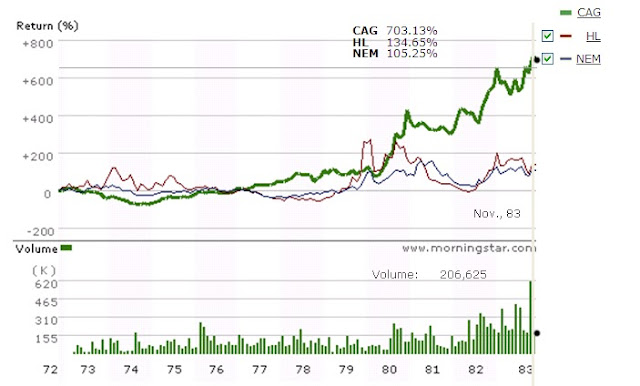
Our belief in the processors, producers and distributors is rooted in the performance of these stocks during the last precious metal bull market from 1970 to 1980 and beyond. In a piece titled “ConAgra: A History of Beating Precious Metals During a Commodity Bull Market,” we compared the performance of ConAgra to Newmont Mining (NEM) and Hecla Mining (HL) at the peak in the market in 1972, before the –42% decline in the Dow Industrials, and the subsequent peak in the commodity bull market in 1980.
What we found was that CAG matched the performance of NEM and HL by the end of the gold bull market in 1980 and went on to out-distance both stocks after the commodity bull market ended, by nearly seven time in 1983. As a follow-up to our initial ConAgra observation in November 21, 2010, we can see the performance of the same three stock in the chart below:
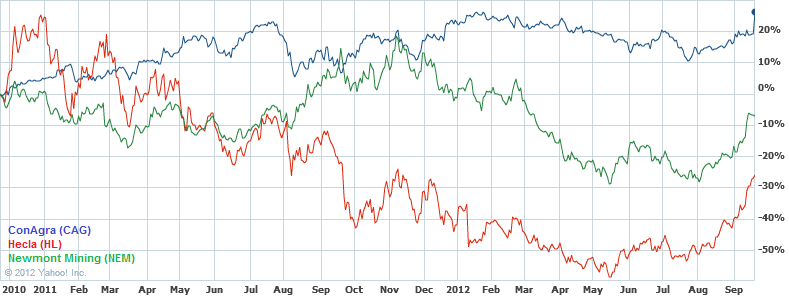
The performance of ConAgra over the last 2 years has been exceptional in comparison to Newmont Mining and Hecla Mining. Today, ConAgra reported that first quarter net doubled and raised their full year expected earnings. CAG’s stock was up +6.20% on the news. The news out of ConAgra suggests that processors, producers and distributors have much to gain from the coming inflation.
Precious metal enthusiasts will likely argue that the less than redeeming attributes of the companies selected (Newmont Mining and Hecla Mining) such as bad management, unprofitable properties, etc. contributed to the poor performance. Another common refrain is, “look how my gold stocks have done in the last 3 or 4 months.” We believe such arguments are the equivalent of whistling past the graveyard.
Consider the following data points, since June 30, 1972 CAG, HL and NEM have generated the following returns, according to Morningstar.com:
When viewed from the perspective of trying to beat inflation, during the only proven gold bull market in recent history, gold and silver stocks don’t have the durability to truly beat inflation. For those that are ardent long-term value investors, you don’t really need to wade into the dark pools of precious metal stock investing where a mine can flood, a strike will break out, management can be slightly off with their estimates or the cost of production increases causing a stock to collapse in the middle of widely recognized gold bull market. Instead, focus your research and due diligence in the food processors, producers and distributors that are trading near their respective new lows. You will be rewarded far beyond the high inflation period to come.
There are few times that we’ll actually recommend individual gold stocks because much of the available statistical data supports the view that gold stocks are inferior investments when compared to products like SPDR Gold Trust (GLD) or the iShares Silver Trust (SLV), let alone the peace of mind with ownership of the physical metals. The following are the three most prominent examples of when gold stocks didn’t make the grade.
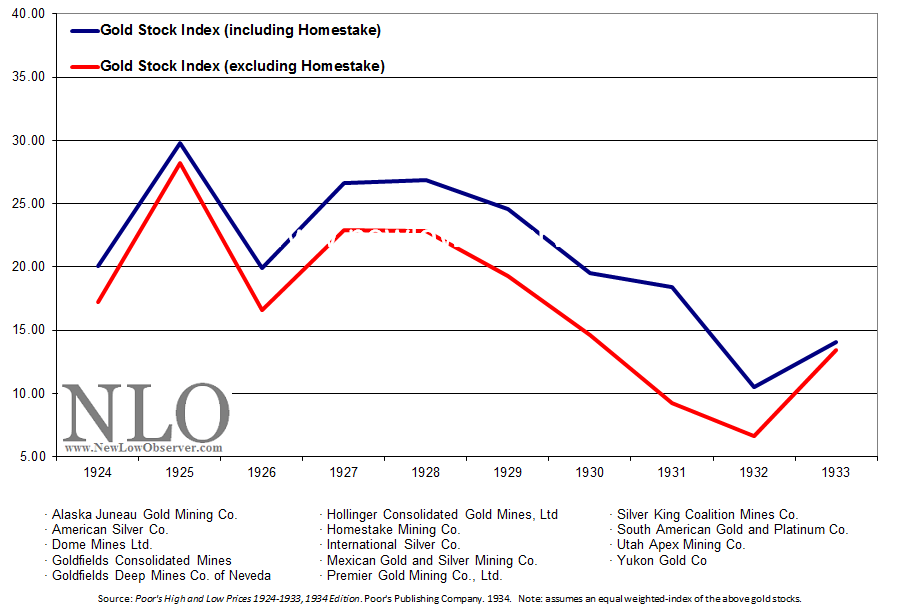
First, in the period from 1925 to 1932, a basket of gold stocks declined as much as -64.81% when Homestake Mining is included in the index. In a article titled “The Lessons of Homestake Mining in Gold Bull and Bear Markets,” we’ve outlined a majority of the reasons why Homestake did so well when other gold stocks didn’t. If we exclude Homestake Mining from the 1925-1932 period, gold stocks declined –76.47% in an equal-weighted gold stock index as reflected below.
Second, in the period from 1940 to 1960, although interest rates on the 10-year Treasury bond doubled from 2% to 4% and the 3-month Treasury bill increased nearly 800%, Barron’s Gold Stock Index was virtually unchanged in the same period of time. Additionally, investors who feared “the coming inflation” and stayed out of general equities missed an inflation adjusted gain of nearly 400% in the Dow Jones Industrial Average (DIA).
Third, in the middle of the raging gold bull market from 1971 to 1980, gold stocks routinely underperformed the price of gold. In our articles on Seeking Alpha titled “A Strategy Is Needed for Lagging Gold Stocks” and “Why Gold Will Decline More Than the Markets,” we reviewed the instances where gold stocks routinely underperformed the price of gold or the stock market in general. Worse still, Barron’s Gold Stock Index peaked in 1974 and declined -66% only to return to breakeven five years later, just before the blow-off stage in the gold bull market. We can now add the selloff from July 2011 to April 2012 to the long list of severe underperformance of gold stocks, during a bull market in gold.
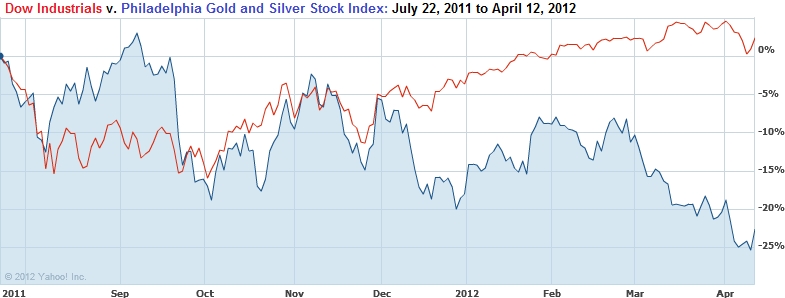
With the above facts in mind, it isn’t taken lightly that we would recommend gold stocks at this point. However, a strategy is needed in order to outmaneuver the gold stock gremlins. In a recent Seeking Alpha instablog, we outlined the short and long-term gold stock price activity using our Gold Stock Indicator (found here) which is nearing a dual “buy” indication.
In our last article on gold stocks to consider, we used Edson Gould’s Altimeter highlighting Agnico-Eagle (AEM) and Gold Fields (GFI). In this article we’re going to apply Gould’s Altimeter to Newmont Mining (NEM) and Barrick Gold Corp. (ABX). Gould’s Altimeter reflects the relative value of a stock based on the current dividend that is being paid. Although Newmont Mining and Barrick Gold Corp. are near one year lows and have consistent dividend policies, Gould’s Altimeter sheds a completely different light on matters, leaving only one company a compelling investment opportunity after additional due diligence.
According to Yahoo!Finance, Newmont Mining engages “in the acquisition, exploration, and production of gold and copper properties. The company’s assets or operations are located in the United States, Australia, Peru, Indonesia, Ghana, New Zealand, and Mexico.” There are a couple of fundamental attributes that are less than redeeming for Newmont Mining. First, Newmont has a price to earnings ratio of 67. This exceeds the norm for anyone who would buy a stock only if it had a p/e ratio of 20 or less. The next issue is Newmont’s dividend which exceeds the trailing twelve months earnings by 91%. This could be an issue down the road if earnings and the price of gold do not increase fast enough.
Considering these issues, Edson Gould’s Altimeter below suggests that, although the price of Newmont Mining (NEM) could decline from the current level, a purchase of the stock at or below $55 is considered a reasonable value.
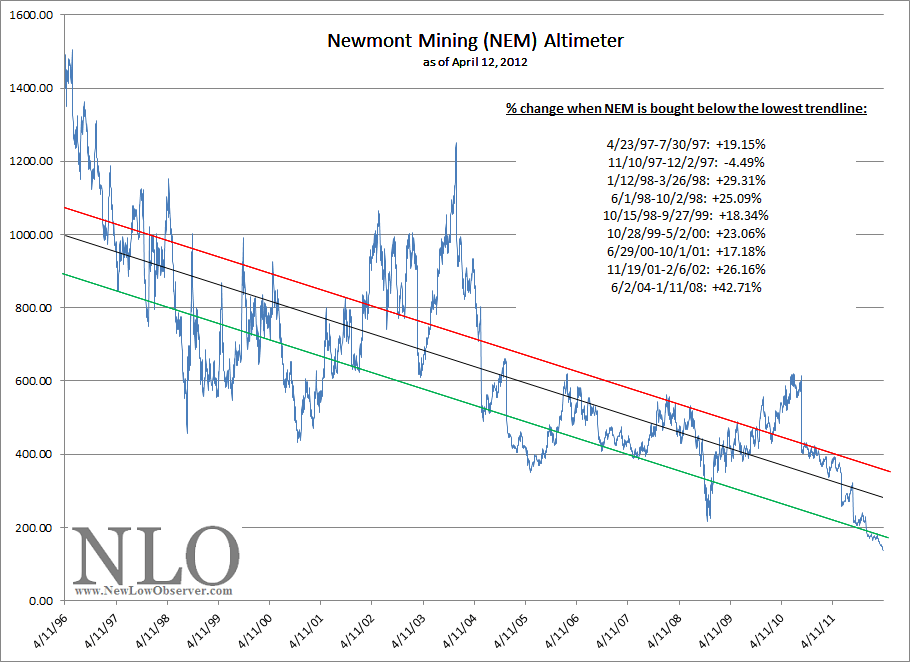
The most impressive aspect of Edson Gould’s Altimeter for Newmont Mining is the period from 1996 to 2000 when the stock was in a clear downtrend during the entire time. Despite this fact, the Altimeter gave clear indications of when Newmont was relatively “undervalued” (lowest trend line) and also overvalued (highest trend line).
The next stock is Barrick Gold Corp. (ABX). According to Yahoo!Finance, Barrick Gold is involved in “…the production and sale of gold and copper. The company has a portfolio of 26 operating mines, and exploration and development projects located in North America, South America, the Australia Pacific region, and Africa.” With Barrick’s earnings at $4.48 and a dividend of $0.60, the dividend payout ratio sits at a paltry 13.39% of earnings.
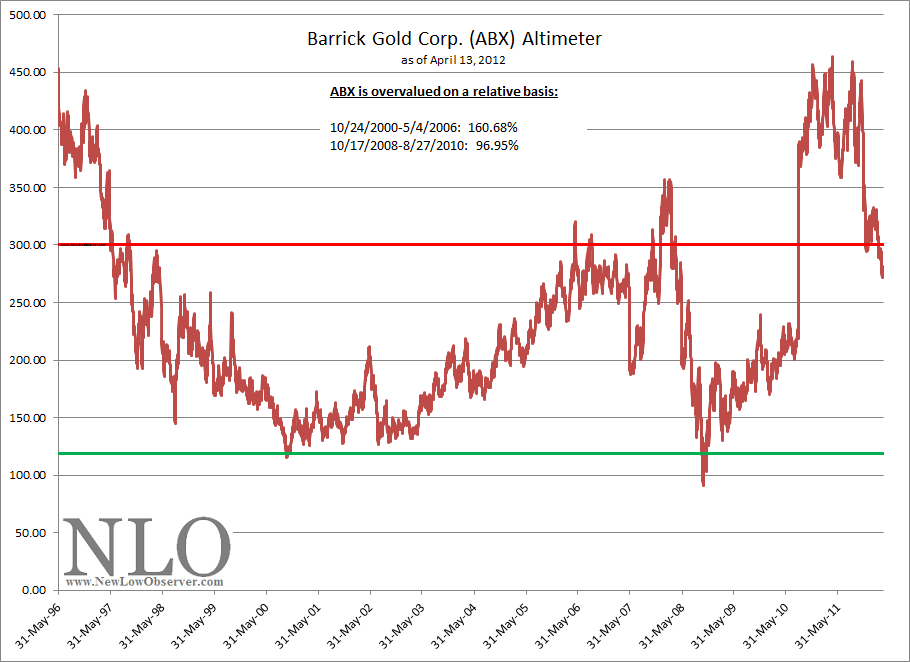
However, the reduction of the dividend near the middle of 2010 has had a major impact on how the Altimeter reflects Barrick’s relative value, which has played out in the movement in the stock price. Had the dividend not been cut, Barrick would be characterized as though it were undervalued at the current price. However, based on the Altimeter, Barrick is considered to be on a declining trend until the Altimeter falls below the 119 level.
In this instance, Newmont has the redeeming attributes that should carry the price much further than Barrick Gold Corp. based on the Altimeters above.
Note: As a word of warning, anyone compelled to invest in Newmont Mining should be mindful of the periods when the Altimeter declines by a wide margin from the lowest trend line (green). This suggest that, in the short term, there is considerable downside risk. However, the data in the chart for each period assumes that an investor were to buy at the moment the Altimeter first crosses below the lowest declining trend line.
Posted in Edson Gould, Gold Stock Indicator, Homestake Mining, kgc, NEM
“The enhanced policy will continue to link the quarterly dividend rate to changes in the gold price but will also provide an additional step up of 7.5 cents per share when the Company's realized gold price for a quarter exceeds $1,700 per ounce and a further step up of 2.5 cents per share (10 cents in total compared to the existing policy) when the Company's realized gold price for a quarter exceeds $2,000. At average realized gold prices below $1,700 per ounce, the current dividend policy remains unchanged. Newmont's quarterly gold price-linked dividend payments are based on the Company's average realized gold price for the preceding quarter.”
“The initial quarterly dividend under the policy is expected to be $0.03 per share of common stock ($0.12 per year), if Hecla's average realized silver price for the third quarter is $40.00 per ounce. All dividends, including those in the third quarter, would increase or decrease by $0.01 per share ($0.04 annually) for each $5.00 per ounce incremental increase or decrease in the average realized silver price in the preceding quarter.”
 |
| Source: Morningstar.com, date range: 11/20/1972 to 11/19/1983 |
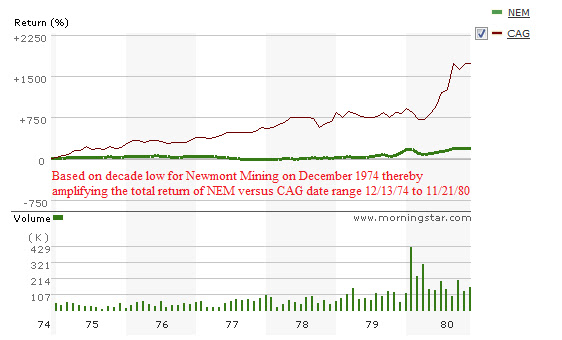
Below is a chart of CAG compared only to Newmont Mining (NEM) at the very lowest price of NEM on December 13, 1974 to the high of NEM at or near the peak of gold stocks. In this case, NEM has the bold green line while CAG has the thin red line. Note that CAG has a total return almost 17 times that of NEM.
|
Symbol
|
Close date
|
Total % Gain | % of Portfolio | |||
|
(FDO)
|
|
1/31/2008
|
|
10.65%
|
|
96.67%
|
|
(WSC)
|
|
2/11/2008
|
|
-3.93%
|
|
94.28%
|
|
(AIG)
|
|
2/28/2008
|
|
12.52%
|
|
82.65%
|
|
(CTAS)
|
|
3/13/2008
|
|
-3.81%
|
|
29.43%
|
|
(CDE)
|
|
3/13/2008
|
|
-12.42%
|
|
1.91%
|
|
(BSC)
|
|
3/14/2008
|
|
7.33%
|
|
26.10%
|
|
(HTX)
|
|
3/24/2008
|
|
1.73%
|
|
29.52%
|
|
(KGC)
|
|
3/24/2008
|
|
-16.73%
|
|
38.15%
|
|
(CTAS)
|
|
4/16/2008
|
|
-4.34%
|
|
31.11%
|
|
(GSS)
|
|
4/16/2008
|
|
-13.21%
|
|
1.77%
|
|
(NC)
|
|
7/23/2008
|
|
27.30%
|
|
32.11%
|
|
(MSA)
|
|
8/11/2008
|
|
19.02%
|
|
36.71%
|
|
(WIN)
|
|
8/14/2008
|
|
5.55%
|
|
27.27%
|
|
(BGG)
|
|
8/27/2008
|
|
1.27%
|
|
31.38%
|
|
(ANAT)
|
|
9/9/2008
|
|
-11.64%
|
|
28.26%
|
|
(EXPD)
|
|
9/9/2008
|
|
-5.51%
|
|
33.01%
|
|
(HPQ)
|
|
9/9/2008
|
|
115.03%
|
|
0.07%
|
|
(NSEC)
|
|
9/9/2008
|
|
-17.36%
|
|
3.08%
|
|
(TDS)
|
|
9/9/2008
|
|
-3.97%
|
|
38.10%
|
|
(NEM)
|
|
9/17/2008
|
|
3.27%
|
|
32.03%
|
|
(HL)
|
|
9/18/2008
|
|
5.70%
|
|
39.06%
|
|
(AIG)
|
|
9/23/2008
|
|
33.94%
|
|
38.27%
|
|
(ANAT)
|
|
9/29/2008
|
|
2.80%
|
|
29.25%
|
|
(ADM)
|
|
9/30/2008
|
|
-8.43%
|
|
20.77%
|
|
(WAG)
|
|
9/30/2008
|
|
-1.75%
|
|
44.09%
|
|
(TMR)
|
|
10/7/2008
|
|
-14.66%
|
|
11.36%
|
|
(NXG)
|
|
10/7/2008
|
|
-12.72%
|
|
11.40%
|
|
(AEM)
|
|
10/10/2008
|
|
-3.03%
|
|
15.58%
|
|
(FNM)
|
|
10/10/2008
|
|
-46.25%
|
|
7.14%
|
|
(GSS)
|
|
10/10/2008
|
|
-8.66%
|
|
12.11%
|
|
(JOF)
|
|
10/14/2008
|
|
2.34%
|
|
22.18%
|
|
(DOG)
|
|
10/15/2008
|
|
1.14%
|
|
43.23%
|
|
(AIG)
|
|
10/20/2008
|
|
-2.55%
|
|
66.35%
|
|
(BMI)
|
|
10/22/2008
|
|
-5.40%
|
|
35.38%
|
|
(EUM)
|
|
10/27/2008
|
|
5.26%
|
|
46.63%
|
|
(AEM)
|
|
10/28/2008
|
|
-4.08%
|
|
25.83%
|
|
(ABX)
|
|
10/28/2008
|
|
-2.92%
|
|
24.26%
|
|
(CTL)
|
|
10/31/2008
|
|
-9.93%
|
|
34.18%
|
|
(NC)
|
|
10/31/2008
|
|
-0.14%
|
|
43.42%
|
|
(NC)
|
|
11/7/2008
|
|
-12.16%
|
|
49.47%
|