
- Japan
- Market Indicator
- Price Momentum Indicators
- Richard Russell
- Silver
- Speed Resistance Lines
- U.S. Dividend Watch List
Category Archives: Dow Industrials
Market Forecasting Made Simple
Posted in DJIA in Review, Dow Industrials, Richard Russell Review, S&P 500
Tagged members
Buybacks, Maybe?
Q: “Maybe low yield out performs because instead of dividends they are doing buybacks?”
Dow Theory: Technical Take
We outline the current market conditions based on the technical attributes applying the work of Charles H. Dow.
Dow: Spanish Flu vs. Covid-19
A comparison between the Dow Jones Industrial Average during the Spanish Flu Pandemic and the Covid-19 Pandemic. Continue reading
Dow and S&P 500 Comparable Levels $SPX
This is an update to a comparison we did showing how alike the the two indexes, Dow Jones Industrial Average and S&P 500, are: Continue reading
Market Rewind: S&P 3,384/Dow 3,384
On September 14, 2020, the S&P 500 Index closed at 3,383.54. To celebrate, we are going to review what Richard Russell’s Dow Theory Letters had to say about the market when the Dow Jones Industrial Average closed at 3,384.32 on August 4, 1992.
Russell said:
"...the nation's in a 'contained depression'."
"Interest rates have collapsed, consumers are gloomy, and nobody's taking out loans. That's exactly what happened during the Great Depression--with one big difference. Then the stock markets were crashing but today the markets are bullish. So how are the two periods different? As I interpret it, today's stock market is saying that somewhere ahead business is going to pick up and people will start buying again---unlike during the 1930s."
"for the first time since the Great Depression almost all the nations in the northern hemisphere are in various stages of a recession."
"...the widely publicized figure is that 40% of the 5,000 listed stocks have been downed by 30% or more. On that basis, some analysts are referring to 1992 as the 'year of the hidden bear market'..."
That was page one of six from the August 5, 1992 issue of Dow Theory Letters. Fascinating? History doesn’t need to repeat. However, good analysis starts with precedents first, as outlined by Charles H. Dow, and diverges afterward, not the other way around.
What was being said by other analysts is not too different from what we’re hearing today. We all know what has happened to the Dow since August 4, 1992.

Implications of the Dow Doubling Rate
On August 21, 2020, we outlined the Dow Doubling Rate from 1900-2020. The data highlights a fundamental issue about how the doubling rate works. Continue reading
Dow Doubling Rate:1900-2020
In a August 18, 2020 MarketWatch.com article written by Brett Arends titled “Uh-oh: Investors predict ‘Dow 50,000’ — in just five years”, it states:
“…a sample of 1,500 people here in the U.S. who manage their portfolios, the average person expected the stock market to generate sky-high returns of 15.4% a year over the next five years.
“After accounting for dividends, that would mean stock prices would nearly double by 2025…”

The conclusion of the article:
“It is, ominously, generally near market peaks when investors are most bullish. Whether we’ll have a crash or a bear market is another matter.
“Yes, 15% could technically happen. But I wouldn’t bet on it.”
One element that is missing is the actual doubling rate data of the Dow Jones Industrial Average. Below is Doubling Rate of the Dow starting when the Dow Jones Industrial Average was at 55 on July 2, 1900 until 2020.

The actual doubling rate data suggests that the conclusions arrived by Mr. Arends are incorrect.
Our next article on this topic will break down the key elements to understand about the data presented which will make it clear that, doubling from the current level might be a modest proposal.
Posted in Charles H. Dow, Doubling Rate, Dow Industrials
1899-2020: Dow Industrials and Transports
Bear Markets for the Dow Jones Industrial & Transportation Averages from their peaks to their ultimate lows.

see also:
Consumer Sentiment: June 12, 2020
With today’s announcement from the University of Michigan’s Consumer Sentiment Survey we have updated our June 11, 2020 posting and contrasted it with the Dow Jones Industrial Average from 2007 to 2020.
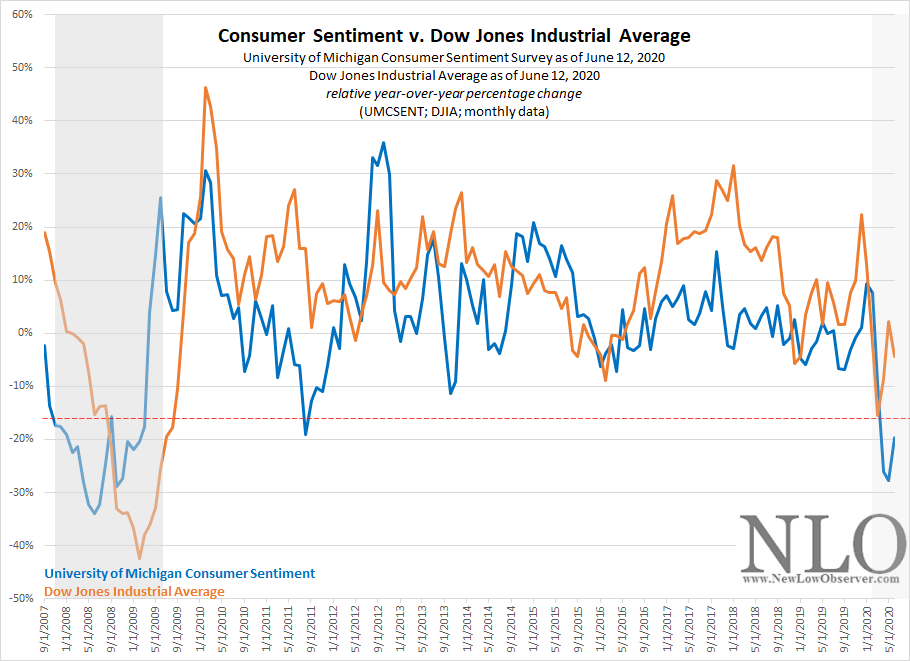
The recent reversal in the survey is reflecting what we saw in the low of the Dow Jones Industrial Average which occurred on March 23, 2020. This implies that the stock market (subject to zero revisions) leads the sentiment survey by more than 60 days. Whether this reversal is the low will be determined in due time.
Posted in Consumer Sentiment, Dow Industrials
DJIA Yield Profile: March 12, 2020
This bear market has taken everything in its path down. Unless you are shorting the market, there is nowhere to hide. Perhaps the most scary thing is that this downturn is probably far from over.
The rate of change for new cases for COVID-19 continue to rise and even accelerate. Until we see a deceleration in the total cases for the US, the market will continue to fall.
The first chart comes from worldometers.info which we believe has better data than WHO (data from WHO shows 0 new cases over the past weekend).

Despite the bad news, we are persistent in keeping our focus on long-term investment opportunities. If and when this is behind us, there will be tremendous opportunity to purchase blue-chip companies that will provide you with higher than average income. Take the Dow Jones Industrial as example.
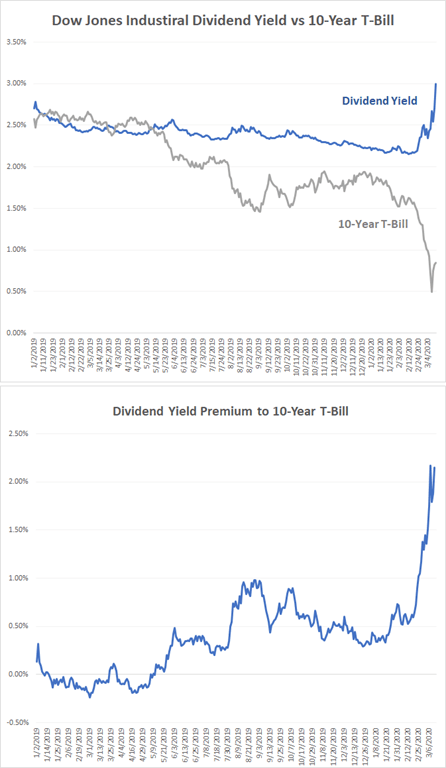
Based on the close of March 12, 2020, the dividend yield reached 3%. Contrast that with 10-year T-Bill which fell below 1%. The risk-premium on the Dow (based on yield) spike to 2%.
This is not an indication that a bottom is here or even near. However, from an investment perspective, investing $10,000 today in the Dow seems like a better bet than a bond that will mature in 2030.
This too shall pass and we can't wait until then. Please take care of yourself and those around you.
Posted in dividends, DJIA, Dow Industrials
Dow Theory: March 1, 2020
In our last Dow Theory assessment on October 4, 2019, we said the following:
“…[the] two indexes [DJIA & DJTA] as exhibiting bearish reversal patterns from the prior trend. The bear market continues until the dashed red and blue lines are exceeded to the upside.”
It didn’t feel like it but we were in a bear market at least since October 2019. How do we know? While the Dow Jones Industrial Average (DJIA) was moving to new highs, the Dow Jones Transportation Average was unable to exceed the prior peak set at 11,570.84 on September 14, 2018.
Below are the downside targets for the DJIA & DJTA based on Dow’s Theory. Continue reading
Posted in Dow Industrials, Dow Jones Transportation Average, Dow Theory
Tagged members
Consumer Sentiment: August 2019
Review
On April 1, 2019, we wrote an extensive piece on the work Charles H. Dow and how the Dow Jones Industrial Average is a consumer sentiment indicator that precedes the widely quoted University of Michigan Consumer Sentiment Survey.
When we say that the Dow Jones Industrial Average precedes the University of Michigan Consumer Sentiment Survey, an appropriate response should be that, when compared to the actual data, the University of Michigan Consumer Sentiment Survey generally peaks and troughs before the Dow Jones Industrial Average. As this is an accurate claim, we are required to point out that University of Michigan Consumer Sentiment Survey is delayed and revised every two weeks whereas the Dow Jones Industrial Average is instantaneous and unrevised.
Is a two week delay all that important in the big scheme of things? It is likely that the Dow Jones Industrial Average influences the outcome of the University of Michigan Consumer Sentiment Survey. As a reminder, the Consumer Sentiment Survey is a phone survey consisting of 50 questions across 500 or more individuals/households versus the stock market that reflects millions of transactions on a daily basis.
Current Take
In the chart of the Year-Over-Year comparison of the University of Michigan Consumer Sentiment Survey and the Dow Jones Industrial Average, we have included the current cycle from the recession of 2007-2009 to the present.

In the chart above, the current view is best reflected in the late-2017/early-2018 declining trend. We’ve highlighted, in a green circle, the Dow Jones Industrial Average as it reverses a rising trend and then starts to decline. Likewise, the Consumer Sentiment Survey starts to flatten rather than continue to move higher.
Forward View
A trend doesn’t define the future prospects. However, we believe that the declining trend has not completely played out. This means that we expect that the economy and stock market will languish, in the best case scenario.
Alternatively, if the Dow Jones Industrial Average can exceed the 28,750 level, the Consumer Sentiment Survey will reflect this change of direction and move above the short-term peak of May 2019.
Rates Up, Stocks Down? Nope!
There is a contingent of analysts and economists who stand in the way of progress in economic and financial understanding of how stock markets work. One prevailing view is that the rise of interest rates is followed by a decline in the stock market. Worse still, there is the belief that reducing interest rates is the Federal Reserve’s primary tool for dealing with slowing economic growth.
Below, we show how, in spite of a cyclical increase of the Federal Reserve’s discount rate, from early 1925 to mid-1929, the stock market defied modern analysts and economists claims.
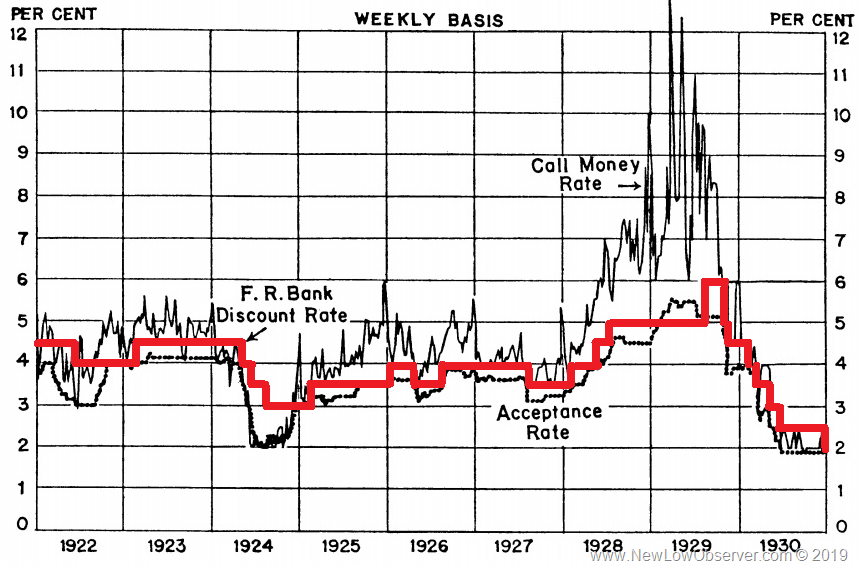
In the period from 1925 to 1929, the Federal Reserve embarked in a policy of increasing the discount rate. Below is the performance of the Dow Jones Industrial Average and Dow Jones Transportation Average in the period from 1925 to 1929.
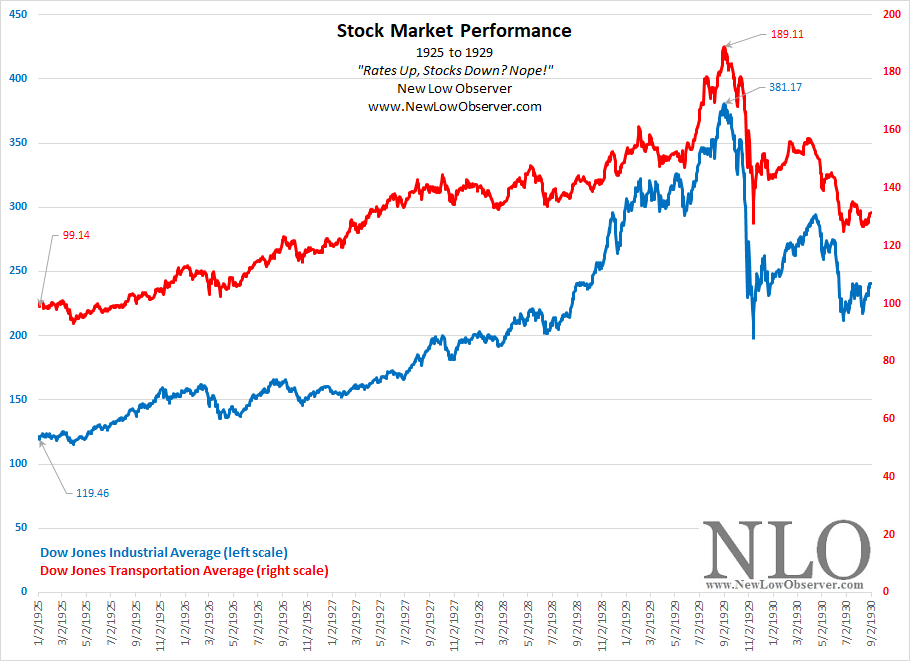
As we all know, the period that followed the peak in stock market in 1929 was declining interest rates and a subsequent stock market decline of nearly –90%.
Were we biased in our selection of the data? Absolutely! We chose the cyclical (short-term) period for one of the most notorious stock market rises and declines and added the cyclical period of rising interest rates to prove a point.
However, if you want to see how the stock market did during a secular (long-term) period of rising interest rates then see our posting titled “The False Narrative of Stocks and Interest Rates” published on January 7, 2019.
sources:
-
A.C. Miller. “Responsibility for Federal Reserve Policies: 1927-1929”. The American Economic Review. September 1935. pages 442-458. accessed 2/10/2019. JSTOR
Interest Rates and the Dow
The secular trend for interest rates is clearly up after declining since April 1981.
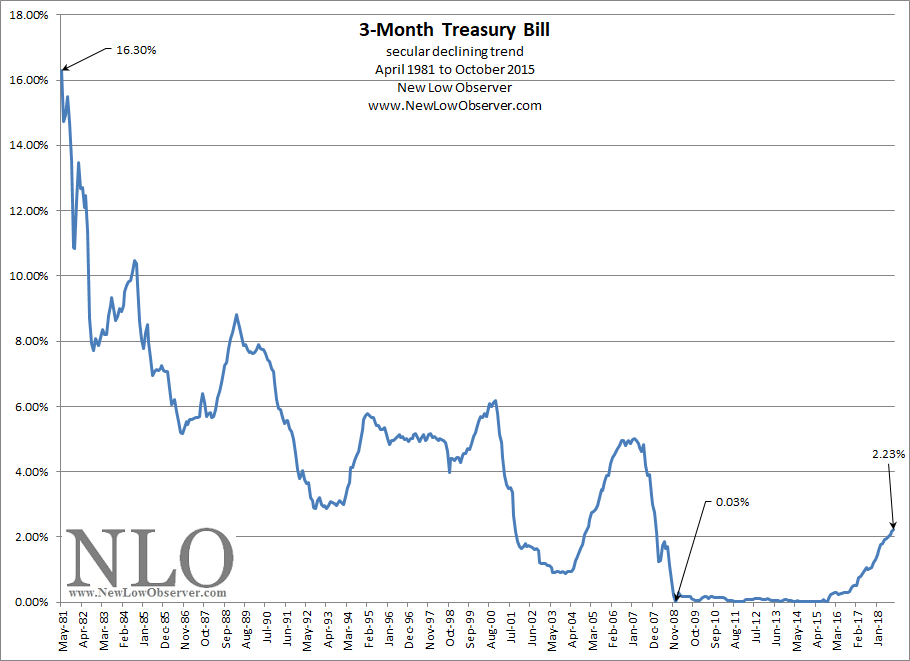
There are “experts” on the topic of interest rates and the stock market claiming that the Federal Reserve policy of “artificially low” interest rates is the reason the stock market is up since the low of 2009 and as a supplemental proof of their lack of knowledge, the “experts” include the Dow increase from the 2001-2003 lows as the devil’s handiwork. These same “experts” also claim that the stock market will crash if rates start to go up.
Yes, stocks can go down as a function of rising rates. However, this needs to be put in context of the overall market. As we start to emerge from a secular declining trend, from 1981 to 2008, to a secular rising trend, from 2008 to 2035, the only comparisons of the current rising trend can only be done to the last secular rising trend from 1942 to 1981.
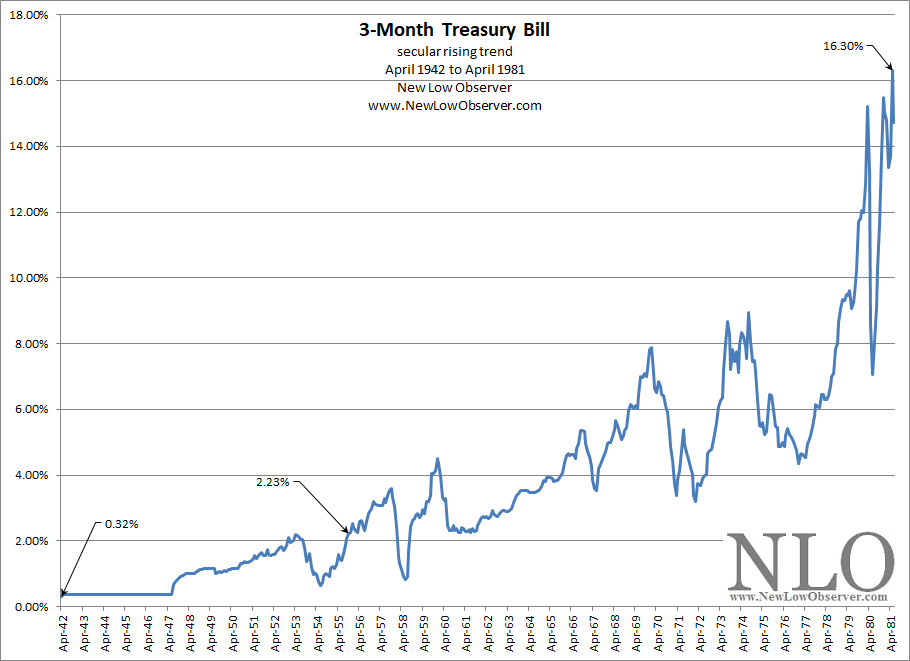
The “experts” claim this time is nothing like the postwar economy that led to the rate peak in 1981. We’ll have to wait and see, for now the following data stands in opposition of the “experts.” Continue reading