Category Archives: Altimeter

Carbo Ceramics is Worth Considering Now

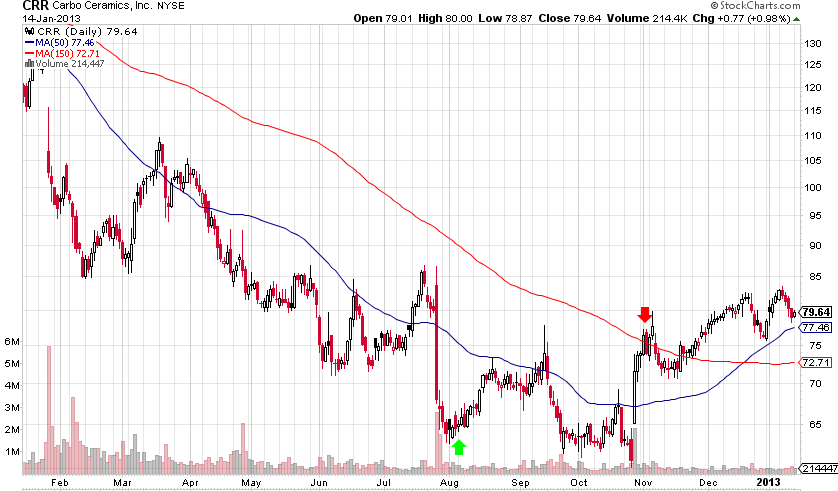
At the time that Carbo Ceramics (CRR) was trading at $82.79,  we said the following in our May 28, 2012 article (found here):

“Based on the current dividend for Carbo Ceramics, we have anticipated that the stock price will decline to $62.40 before the next buy indication is triggered.”

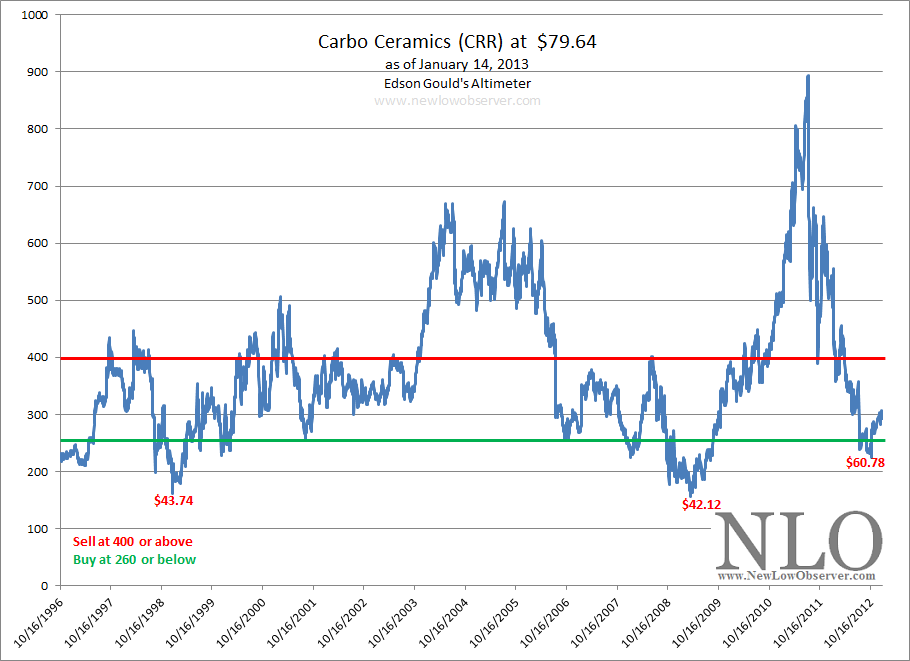
Interestingly, Carbo Ceramics fell as low as $62.41 on a closing basis on October 10, 2012.  Although this is one penny above the prior $62.40 buy indication, the recent increase of the dividend from $0.24 to $0.27 put the stock well within the buy range, as shown below.  Our estimate of $62.40 was based on Edson Gould’s Altimeter which has given reasonable buy and sell recommendations in the past.

image

As indicated in the chart, there are points where Carbo Ceramics has fallen well below the normal buy range.  On two prior occasions, Carbo Ceramics fell as low as the equivalent of today’s $43.74 and $42.12.  We are not putting it past this company to accomplish a similar decline this time around.  However, this is why we recommend the purchase of this stock in two phases.

image

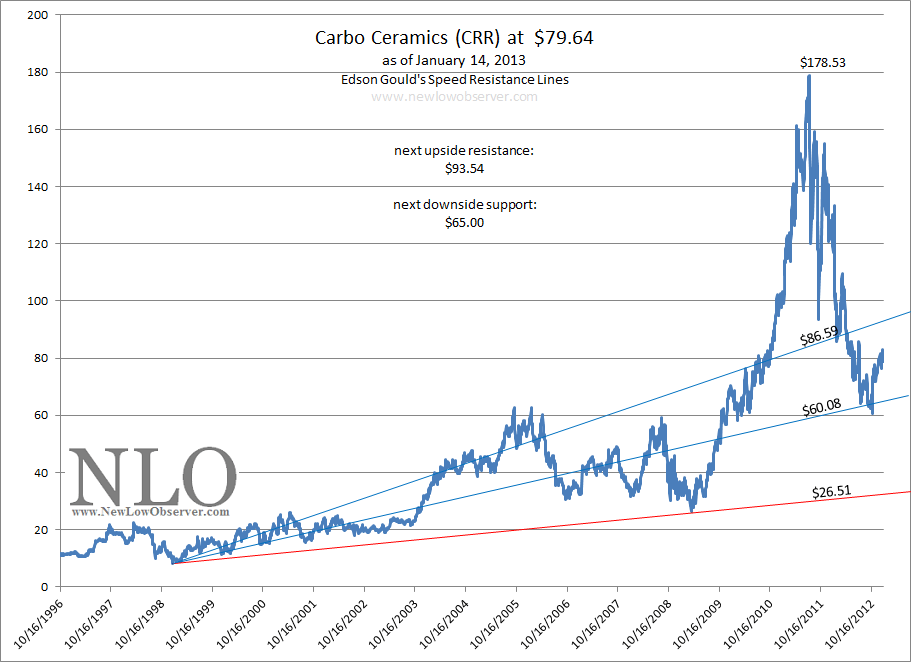
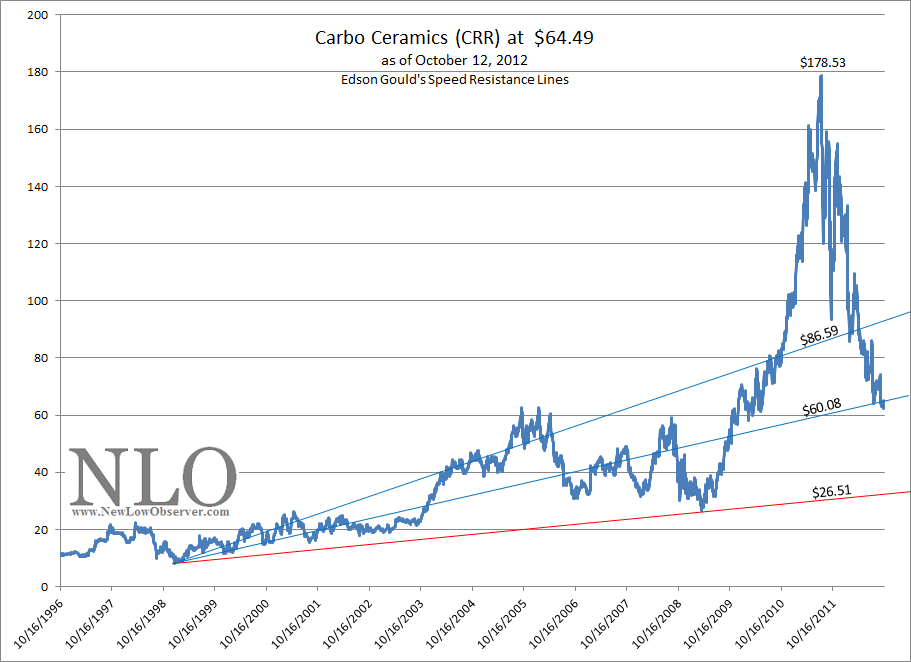
When Edson Gould’s Speed Resistance Lines [SRL] are applied to Carbo Ceramics we can see that the stock has taken back a majority of the gains that have accrued from the 2008 low to the most recent peak.   The SRL indicates that the extreme downside target of $60.08 is about to be reached shortly.  However, there does exist the possibility of going back to point where CRR established its critical support at $26.51.

According to Dow Theory, Carbo Ceramics has the following downside targets:

  • $60.29
  • $43.40
  • $26.51

As indicated in our portfolio (found here), we have already completed the first of the two purchases for CRR and are waiting for either the price to rise to the sell range or decline to the $43.74 level before implementing the next purchase.  The sell range currently stands at $96.

Note: This stock is worth considering only with the appropriate amount of due diligence by confirming the fundamental attributes and proper consideration of the downside risk as indicated above.

Dow Industrials Altimeter

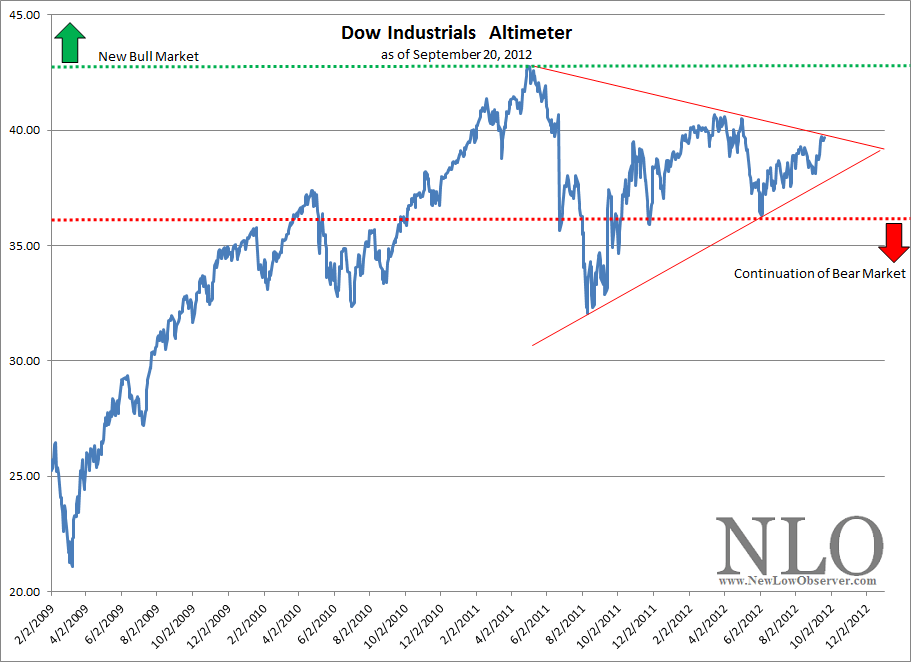
Below is a chart of the Dow Jones Industrial Average Altimeter.  Our best interpretation of the current altimeter pattern is that the Dow Industrials need to exceed the previous high set in April of 2011 in order for us to feel that a new bull market has emerged.

image

As we’ve described before, the Altimeter reflects the relative value of a stock or index compared to the dividend that is paid.  Those interested in knowing what the dividend for the Dow Industrials is can find that information in Barron’s Market Laboratory section under Indexes’ P/Es & Yields (found here).

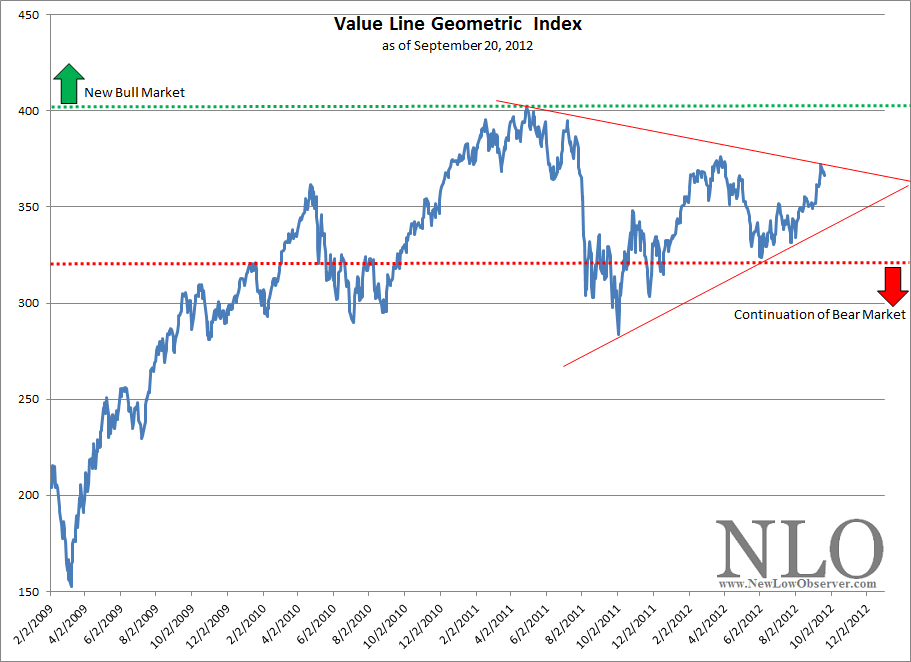
Surprisingly, the formation of the Dow Industrials Altimeter is exactly the same formation as the Value Line Geometric Index, as seen in the chart below:

image

In a previous article (found here), we talked about how the Value Line Geometric Index (VLIC) is an equal weighted index that reflects how all stocks are doing since the bull market began in the first quarter of 2009.  The fact that the Value Line Geometric Index has not achieve a new high suggests that there is limited participation by all stocks in the market. Therefore, confidence in new highs by large cap stocks, as reflected in the Dow Industrials and S&P 500, should not be trusted.

We believe that there is limited upside potential based on the Dow Theory non-confirmation (article found here) and the broader market as reflected in the VLIC Index.

Transaction Alert: Bought XEC at the Market

On July 17, 2012, we have bought Cimarex (XEC) at the market.

On June 8, 2012 (found here), we outlined our rational for buying XEC based on having good management and a consistent dividend policy.  Based on the Altimeter, XEC is considered worth purchasing at $72 and below.  At the current price of $56, XEC would have to increase +28% just to get back to the $72 level.

At the quarterly dividend rate of $0.12, we believe that XEC should be sold at a price of $123 or above. This will increase or decrease with the dividend policy.  Based on the previous Altimeter buy indications, investors should expect to hold XEC for 2 to 3 years before the next sell signal.

*NOTE: In our earlier transaction alert for UNM (found here), we indicated that we would allocate 10% of our portfolio to the stock.  Instead, we have reduced the allocation by half, to 5%, and bought XEC with the other 5%.  This allows us to take advantage of two opportunities which we fully expect to add to as the price declines.

Transaction Alert: Buying UNM at the market

On July 17, 2012, we will buy Unum Group (UNM) at the market.

On July 16, 2012, it was announced that Unum Group (UNM) is going to increase the quarterly dividend by +23.5%, from $0.10 to $0.13 (found here).  The increased dividend is payable to shareholders who hold the stock on or before July 26th. This increase of the quarterly dividend has brought UNM below the Altimeter level that would indicate that the stock should be bought.

On June 18, 2012, we pointed out the reasons why we like the dividend policy of UNM (found here).  Also, the Altimeter readings for UNM based on the new dividend indicates that, at the current price, the stock is relatively undervalued.

Those wishing to follow our strategy of buying UNM should understand that the stock is expected to decline from current levels.  This explains why we're only putting 10% of our portfolio into the stock at the present time.  Our goal is to accumulate more shares as the price declines.

At the quarterly dividend rate of $0.13, we believe that UNM should be sold at a price of $40.95 or above. This will increase or decrease with the dividend policy.  Based on the previous Altimeter buy indications, investors should expect to hold UNM for 3 to 6 years before the next sell signal.

Insurance Watch List: July 3, 2012

The following is one of our personal favorite watch lists. We started tracking the insurance industry in January 2011 and we’re very impressed with the results so far.

Anyone who wishes to be successful in insurance stocks should read the book The Davis Dynasty by John Rothchild. The book starts with Shelby Collum Davis investing approximately $50,000 to $100,000 that ultimately grew to $900 million after 47 years. The strategies employed by Davis seem more accessible to average investors as opposed to Warren Buffett’s leveraged strategies and education from Benjamin Graham.

Symbol Name Price P/E EPS Yield P/B % from low div/share payout ratio
MIG Meadowbrook Insurance 8.75 12.24 0.72 2.3 0.76 5.80% $0.20 27.78%
UNM Unum Group 19.58 25.76 0.76 2.2 0.68 6.59% $0.42 55.26%
WSH Willis Group Holdings 36.8 16.45 2.24 2.9 2.39 11.38% $1.08 48.21%
ORI Old Republic International 8.17 0 -0.5 8.7 0.55 14.27% $0.71 -142.00%
TWGP Tower Group Inc. 21.63 15.83 1.37 3.6 0.78 14.44% $0.75 54.74%
MFC Manulife Financial Corp 11.28 78.88 0.14 4.8 0.86 14.87% $0.52 371.43%
PRU Prudential Financial, Inc. 49 11.81 4.15 3 0.65 15.43% $1.45 34.94%
AIZ Assurant Inc. 35.61 5.94 5.99 2.4 0.61 16.18% $0.84 14.02%
FFG FBL Financial Group Inc. 29.17 39.8 0.73 1.4 0.7 19.06% $0.40 54.79%
XL XL Group plc 21.17 0 -0.23 2.1 0.68 19.67% $0.44 -191.30%

Watch List Summary

The first company on our watch list is Meadowbrook Insurance (MIG).  According to Yahoo!Finance, “…Meadowbrook Insurance Group, Inc., through its subsidiaries, operates as a specialty commercial insurance underwriter and insurance administration services company in the United States.”

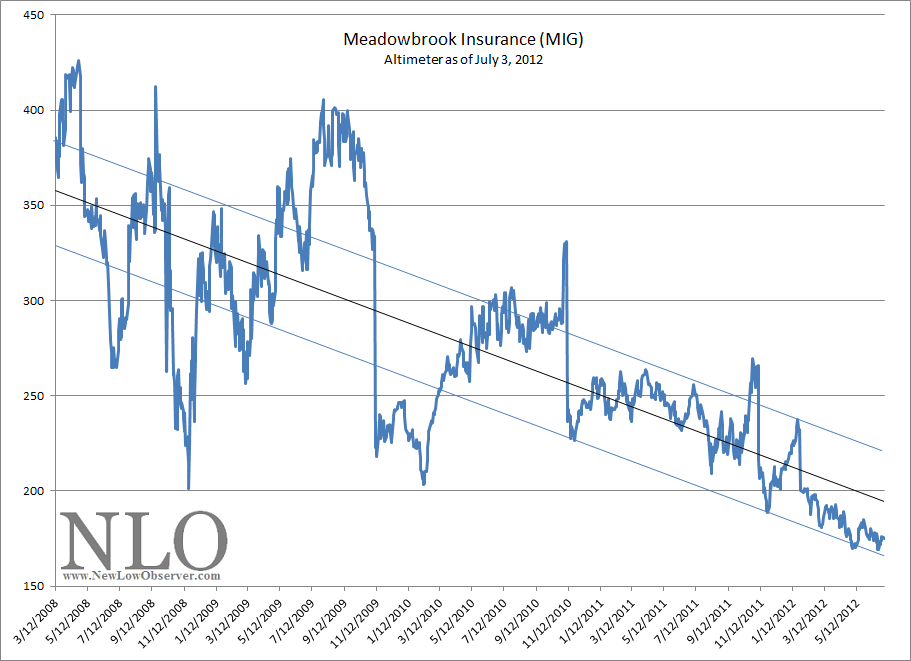
Meadowbrook has had a checkered dividend history.  However, since the reintroduction of the dividend in 2008, Meadowbrook has displayed a declining Altimeter with consistent buy and sell indications.  Below is the Altimeter since March 12, 2008:

image

Again, even though the Altimeter is in a declining trend the more important feature is the consistency of the decline.  Below is the buy and sell indications using this approach:

Date Close altimeter buy/sell % change
4/29/2008 7.45 373 sell -17.18%
6/20/2008 6.17 309 buy 20.58%
9/4/2008 7.44 372 sell -29.44%
10/9/2008 5.25 263 buy 32.76%
1/21/2009 6.97 349 sell -15.49%
2/13/2009 5.89 295 buy 16.30%
5/6/2009 6.85 343 sell -2.34%
11/10/2009 6.69 223 buy 34.38%
6/15/2010 8.99 300 sell 0.67%
11/23/2010 9.05 226 buy 9.94%
10/21/2011 9.95 249 sell -4.62%
11/23/2011 9.49 190 buy 21.92%
1/18/2012 11.57 231 sell -28.26%
estimate 8.3 166 buy 24.70%
estimate 10.35 207 sell  

From the table above we can see that all “buy” indications resulted in an average gain of +22.65%.  The average decline based on sell signals was not as consistent in helping investors avoid major losses as in the case of May 6, 2009 and June 15, 2010.  So far, it appears that if Meadowbrook declines to $8.30 and below it is considered a “buy.”   Based on the declining trend of the Altimeter, the next sell price would be at $10.35 and above.  This would result in a gain of +24.70% if acquired at the $8.30 price.

Meadowbrook has displayed a consistently growing book value since 2008.  Value Line Investment Survey indicates that Meadowbrook (MIG) has a 5-year growth rate of book value at 10.5%.  Although MIG has increased the book value nearly 100% since 2003, the shares outstanding has grown by approximately 80% in the same period of time.   With long-term debt at relatively low levels, Meadowbrook appears to be a reasonable purchase as long as the stock does not exceed 10% of portfolio value.  We are also drawn to MIG’s low payout ratio which allows for some wiggle room in case earnings decline.

Those interested in Unum Group (UNM) will find our view on the company at the following link.  We believe that UNM is a strong buy at $15.54 and below.

The next stock on our list is Willis Holdings Group Plc (WSH).  According to Yahoo!Finance, Willis Group Holdings is “…provides a range of insurance brokerage, reinsurance, and risk management consulting services to its clients worldwide.”

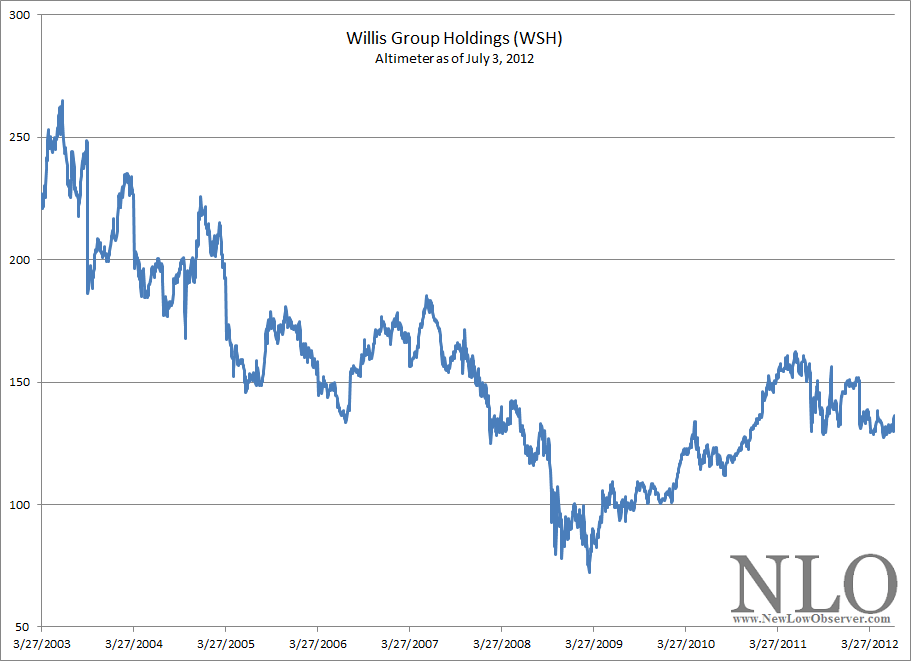
Below is the Altimeter for WSH:

image

Initially, there is very little to make of the movements in the Altimeter for Willis Group Holdings.  For this reason, we’ve applied Dow Theory to the 2009 low to the 2011 high.  According to Dow Theory, the downside targets, based on the Altimeter, are:

  • $35.64
  • $31.59 (fair value)
  • $27.54
  • $19.44

Willis Group Holdings’ ability to stay above the $35.64 would be very constructive.  However, at the current trading price of $37.64, we wouldn’t be surprised to see the stock decline to the $31.59 level before re-testing the $36.90 level.  According to Morningstar.com, Willis Group Holdings has had a steady dividend payment with reasonable increases in the last few years.  We would consider acquiring WSH at levels below $31.59.

Unum Group (UNM) is Closing in on New Low

The latest insurance stock that has caught our eye is Unum Group (UNM) which is closing in on a 3-year low.  Prior to 1998, Unum Group had a dividend increasing history of 11 years at a compounded annual growth rate of 17.66% according to Moody’s Handbook of Dividend Achievers.  After 1998, Unum was challenged significantly resulting in a deep reduction of the dividend.  Most important to investors is the fact that after the -50% reduction of the dividend in 2003, the annual dividend remained at $0.30 for six years until 2009.  Since 2009, UNM has increased the dividend each year thereafter.  The handling of the dividend policy is important for several reasons:

  1. Cutting the dividend in 2003 was an accurate move by management since the book value declined -31% from the 2002 high to the 2008 low.
  2. As a financial services company, keeping the dividend the same through the financial crisis of 2007 to 2009 meant that the management team believed that stability had returned to the company.
  3. Raising the dividend after the financial crisis means that the management team believed the prospects for the company were improving.  After 2008, the book value for UNM has increased +51% which supports management’s decision.

We welcome a dividend cut when appropriately applied, even if the conditions that brought on the cut were based on management’s prior “bad” decisions.  In our view, the true test of any management team is not always generating blowout earnings but handling errors in an appropriate fashion.  UNM’s management has done all the right things at all the right times relative to the economic backdrop that we’ve experienced.

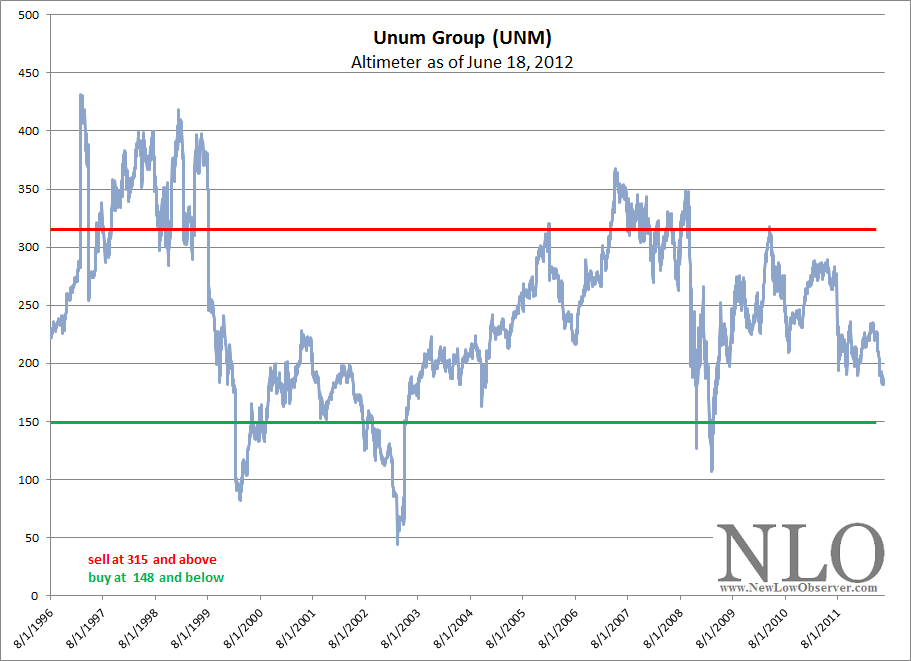
However, while we favor the actions of the management at Unum Group, we also need a sense of perspective on the most opportune time to actually buy the stock.  Two things that never change regarding the historical information on a stock is the dividend paid and the stock price.  This is why we prefer to look at Edson Gould’s Altimeter which reflects the stock price relative to the dividend that is paid.

image

From our perspective, the movements of Gould’s Altimeter indicate that the stock should be bought at or below 148 and sold above 315.  Each time UNM has traded below or above the respective range, the following increase or decline followed:

Date Altimeter stock price buy/sell % change
2/25/1997 431.69 39.5 sell -59.97%
2/10/2000 106.82 15.81 buy 52.12%
1/27/2006 320.67 24.05 sell -60.58%
11/20/2008 126.40 9.48 buy 178.59%
4/14/2010 318.19 26.41 sell ????????
????????? 148.00 15.54 buy  

While we can’t be certain that UNM will replicate prior declines, a decline to the projected level of $15.54 seems well within reach as the stock currently trades at $19.26.  This would only be a decline of -41%, which is far less than previous Altimeter lows of –59% and –60% in 1997 and 2006, respectively.

According to Dow Theory, UNM would reach the 50% level at a price of $17.33.  Typically, the 50% level is the “make or break” level in the stock’s price.  If the stock can manage to stay above $17.33, then a majority of the shareholders since the 2009 low would be satisfied enough not to abandon the stock.  However, if the stock falls materially below the $17.33 level (say $17 or $16.50) then it would mean that most “long-term” holders of the stock are experiencing a loss and are seriously contemplating selling the stock.  The Dow Theory downside targets are as follows:

  • $14.08
  • $10.84
  • $7.60

Although UNM could be bought at $15.54 based on Gould’s Altimeter, it should be understood that there are likely to be further declines.  Therefore, an investor should not become disenfranchised with Dow Theory downside targets.  Instead, investors need to allocate appropriate amounts of capital and break up the intended purchase into 2 or 3 transactions.

Buckle (BKE): A Review

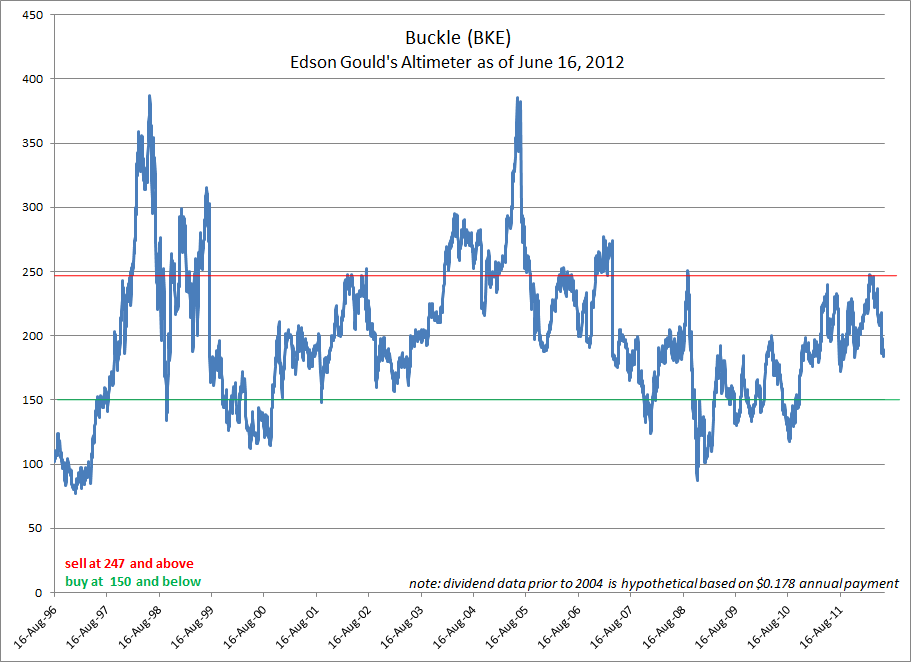
The following is a review of Buckle (BKE) using Edson Gould’s Altimeter.

image

Below is the performance of the buy and sell indications of Edson Gould’s Altimeter based on periods when the indicator first cross below 150 for buy indication, and above 247 for sell indications.

Date Price Altimeter buy/sell % change $1 invested
6/12/1997 6.57 148 buy 69% $1.69
1/28/1998 11.13 250 sell -47%  
10/8/1998 5.95 134 buy 85% $3.13
11/6/1998 11.01 248 sell -41%  
11/4/1999 6.51 146 buy 69% $5.30
3/19/2002 11.01 248 sell 120%  
11/19/2007 24.26 146 buy 72% $9.13
9/18/2008 41.78 251 sell -43%  
10/23/2008 23.94 144 buy 107% $18.90
3/9/2012 49.56 248 sell -39%  
????????? 30 150 buy ?????????  

The consistency of the indicator is amazing.  Only the sell indication of March 19, 2002 resulted in an outcome that was contrary to the desired result.  Even so, A person who only bought BKE based on the buy signal and sold based on the sell indication would have resulted in a gain of 1,890% from June 12, 1997 to the present.  This is compared to the buy and hold total return with reinvestment of dividends (including special dividends) of 766.21%.  Based on capital appreciation alone, the price of BKE rose 498% since June 12, 1997.

  • +1,890% (buy/sell Altimeter)
  • +766% (dividends reinvested)
  • +498% (based on price change only)

In the table above, the section in blue is the tentative estimate of when the next buy signal will be registered and the amount of decline necessary to get to the signal.  It appears that based on the sell indication from March 9, 2012 to the price of $30, BKE would have to decline -39% using the Altimeter.  Such a decline is well within the prior successful sell indications that resulted in losses.

We are very interested in this stock at the right price.  We believe that BKE will be a buy at $30 and below.  However, prior price movement based on Gould’s speed resistance lines indicated that the conservative downside target is $24.47 and the extreme downside target of $16.68.

Historically, based on prior Altimeters, a buy indication does not mean that the price decline has actually ended. Therefore, if the buy indication is triggered then be prepared by making your purchase of the stock in, at least, two stages. Once at the trigger price and again at any desirable price lower than the trigger level.

Investment Observation: Markel (MKL) at $433.72

According to Value Line Investment Survey, “Markel Corp. markets and underwrites specialty insurance products and programs to a variety of niche markets.” When reviewing the Value Line tear sheet on Markel, there are a couple of items that make the stock very compelling.

First, Value Line indicates that the company has a fair value of 1.5 times the book value. Using the most conservative full year data from 2011 provided by Value Line, Markel has a fair value of $528.15 which is a 20% premium above the current market price of $439.77. Value Line estimates that by 2017, Markel would have a book value of $447. This implies a fair value of $670.50. Assuming that Markel only achieves half of the projected growth in the book value, the fair value would be at $599. Considering that Markel typically trades above fair value, the prospects are reasonably favorable.

Next, Markel has increased their book value from $49.16 in 1996 to $352.10 in 2011. With Markel having the ability to consistently increase their book value at double digit rates is phenomenal in our view. As an added benefit, Markel has only increased the number of shares outstanding from 5.46 million to 9.62 million in the period from 1996 to 2011. This suggests that the growth of the company has not come at the expense of the shareholders.

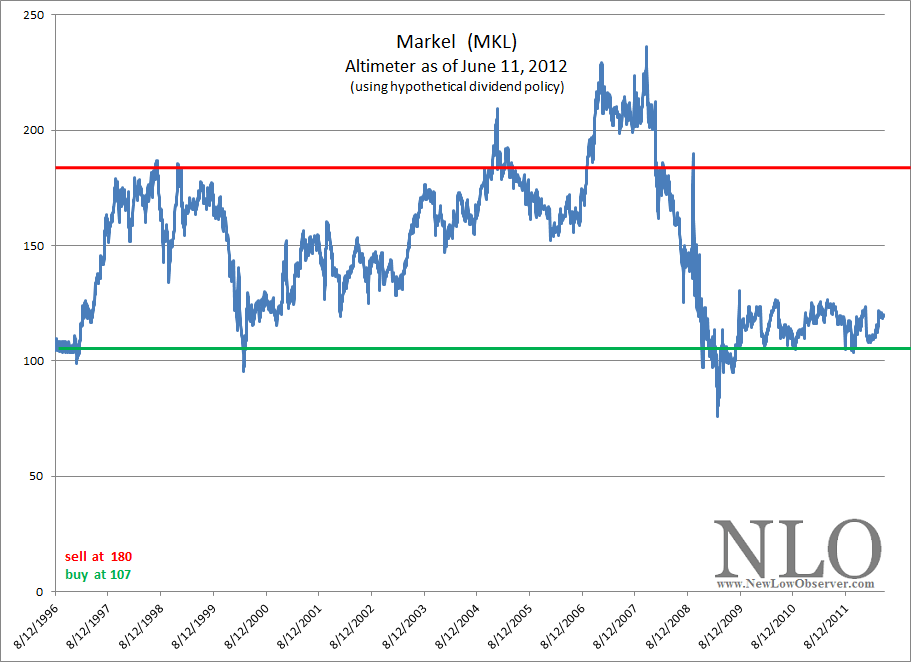
We have constructed an Altimeter for Markel (MKL) that is based on a hypothetical dividend assuming an average payout from earnings of 13%  and a compounded annual growth rate (CAGR) of the dividend at 9.9%.

image

Although hypothetical, our assumptions of a dividend policy is the most conservative possible.  We believe that, if compelled, Markel could easily maintain such a dividend policy while increasing the book value.  Whenever, the Altimeter is above 180, the stock should be sold and whenever it is below 107, MKL should be bought.  Below is the performance of the stock price when it falls within the parameters previously noted.

Date Price Altimeter buy/sell % change
2/23/1996 87 106 buy 106.61%
6/8/1998 179.75 182 sell -31.99%
3/6/2000 122.25 103 buy 157.67%
10/5/2004 315 181 sell -22.14%
11/20/2008 245.25 97 buy ????????

An alternative strategy, for investors with a long-term perspective, could be to accumulate the shares of Markel at or below 107 on the Altimeter (currently $395.90) without consideration of selling.  We feel this would be a prudent stance since the declines experienced by the stock at the “sell” indications are not meaningful enough to warrant actually selling the stock by the time the next “buy” indication is given.

Finally, our concern for the worst case scenario is always in the back of our mind.  For this reason, we assume that the lows of 2009 will be revisited and ask ourselves are we able to handle such a situation.  If based on the Altimeter low of 2009, Markel could decline as low as $281.20.  Our hope is that such a low is not visited again.  However, with the aid of Dow Theory, we are prepared to accumulate additional shares when, and if, such an opportunity arises.

Cimarex (XEC) at a New Low

Today, Cimarex (XEC) hit a new 1 and 2-year low as the energy sector continues to fall apart.  We like Cimarex (XEC) because it is a spin-off from Helmerich & Payne (HP) which has had a tremendous dividend increasing history.  Additionally, we have been very fortunate in being able to call most of the peaks and troughs in the price of Helmerich & Payne found at the links below:

Cimarex appears to be willing to continue the conservative management style that got Helmerich & Payne through hard times in the oil drilling industry during the 1980’s and 1990’s.  Therefore, we believe that Cimarex should be on your watch list as well.

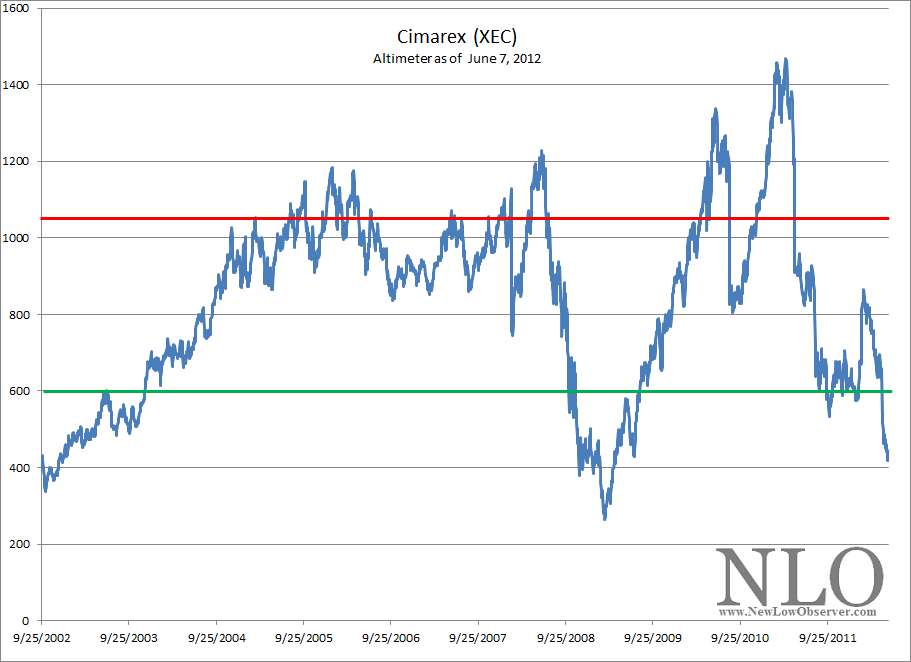
Below is the Altimeter for Cimarex since being spun off from Helmerich & Payne:

image

note: dividend data prior to 2006 is hypothetical based on $0.04 quarterly payment

We believe that whenever the Altimeter is trading at or above 1032 the stock should be sold.  Additionally, whenever Cimarex’s Altimeter is trading at 600 or below, the stock should be considered for acquisition.  Below is the performance of buy and sell indications based on the Altimeter levels just mentioned:

Date Price Altimeter buy/sell % change
6/26/2003 23.96 599 buy 72.29%
3/3/2005 41.28 1032 sell -47.25%
10/10/2008 32.66 544 buy 90.02%
3/11/2010 62.06 1034 sell -42.18%
8/22/2011 59.81 598 buy ??????????

Our expectation is that Cimarex may decline as low as, and possibly lower, than the 2009 level on the Altimeter.  That would equal a price of $31.80, or -30% from the current price.  A purchase of the stock at this time may be warranted, based on the Altimeter.  However, be prepared to buy more at lower prices.

Carbo Ceramics Altimeter

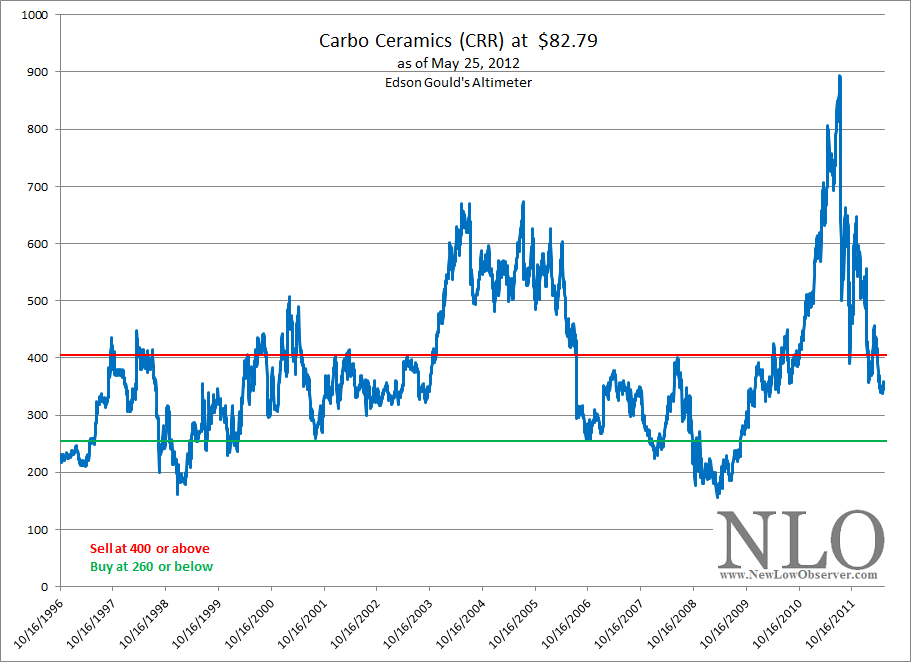
Below is the Altimeter for Carbo Ceramics (CRR) which is ranked number 7 on our May 25, 2012 U.S. Dividend Watch List (found here).  Using Edson Gould’s Altimeter, we have arrived at the conclusion that Carbo Ceramics (CRR) should be bought (green line) any time the Altimeter declines to 260 and below and should be sold (red line) whenever the Altimeter rises to 400 and above.

image

Below is a table which outlines the actual price and date when Carbo Ceramics’ Altimeter rises or falls to the indicated levels.

Date Altimeter level stock price buy/sell % change
6/13/1997 257.40 12.87 buy 59%
10/2/1997 410.80 20.54 sell -41%
8/27/1998 239.00 11.95 buy 67%
4/24/2000 399.60 19.98 sell -22%
8/20/2001 258.33 15.50 buy 56%
1/3/2002 403.00 24.20 sell 27%
10/3/2006 256.16 30.74 buy 82%
6/23/2008 401.50 56.21 sell -21%
10/6/2008 258.35 43.92 buy 65%
4/15/2010 403.55 72.64 sell ????????
???????? 260.00 62.40 buy  

Based on the current dividend for Carbo Ceramics, we have anticipated that the stock price will decline to $62.40 before the next buy indication is triggered.  However, as we’ll describe below, there are some careful considerations of what you give up when deciding to buy Carbo Ceramics based on Edson Gould’s Altimeter.

First, it is important to note that in all except one instance, January 3, 2002, Carbo Ceramics had reasonable gains when a buy indication was triggered and avoided losses when the sell indication was triggered.

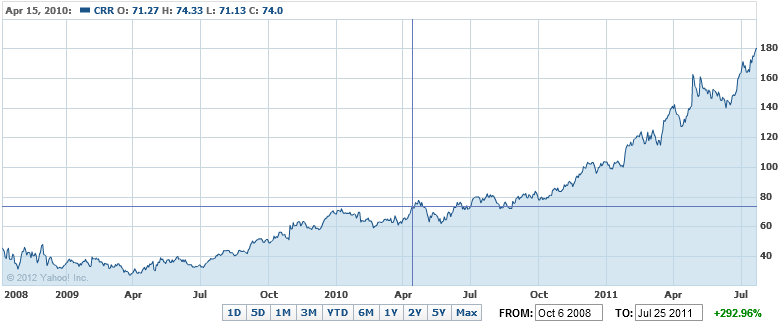
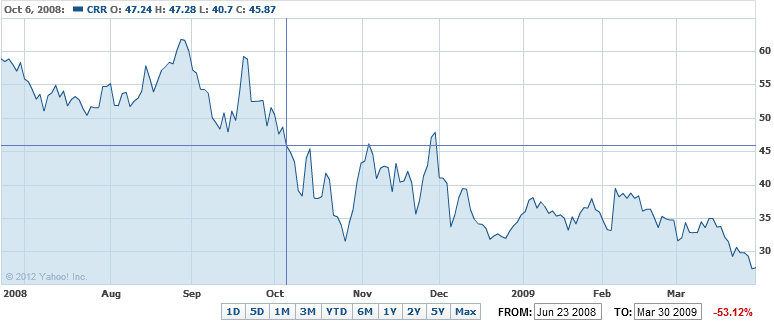
As an example, if you bought in October 6, 2008 and sold on April 15, 2010 (at crosshair below), you only gained 65% and you would have missed the additional 143% rise in the stock’s price, as seen in the following chart:

image

Likewise, the June 23, 2008 sell signal at $56.21 didn’t account for the –53% decline that occurred afterwards.  Instead,  Carbo Ceramics declined -21% from the $56.21 level by the time the next buy signal was indicated on October 6, 2008 (at crosshairs below).

image

So what does all this mean, “buy at the 160 level” and “sell at the 400 level” in the Altimeter?  For the New Low Team, it means that if we can gain an average of +60% in 1-1/2 years with each buy and sell cycle then we will do quite well if we can avoid all of the huge losses, at the expense of missing the huge gains.

Who is Edson Gould?

“Edson Gould spent over 60 years working in and studying financial markets. Gould studied the arts at Princeton, engineering at Lehigh (from where he graduated in 1922), and finance at New York University. In 1922, after working for a short time at Western Electric, he joined Moody’s Investor Service as an analyst and later was editor of Moody’s Stock Survey, Bond Survey, and Advisory Reports. In 1948, he began at Arthur Wiesenberger & Company, where he developed and edited the well-known Wiesenberger Investment Report and became a senior partner. He also was Research Director at E. B. Smith (which later became Smith Barney), and worked for Nuveen.”

(source: Market Technicians Association. Gould, Edson Beers, Knowledge Base. Accessed April 26, 2012. link MTA reference.)

“Market technician Edson Gould always laughed at the idea of having a significant influence on the stock market, but his predictions were the most precise around. He pinpointed major bull markets and prophesied bottom-out markets as if he had his own peephole into the future. But in place of a crystal ball and wacky off-the-cuff schemes, his were smart, intensely researched and time-tested theories that made him a legend in the investment community.”

(source: Fisher, Kenneth L.. 100 Minds That Made the Market. Business Classics, Woodside, CA. 1993. page 320.)

Should Berkshire Hathaway Be Trading at 1995 Prices?

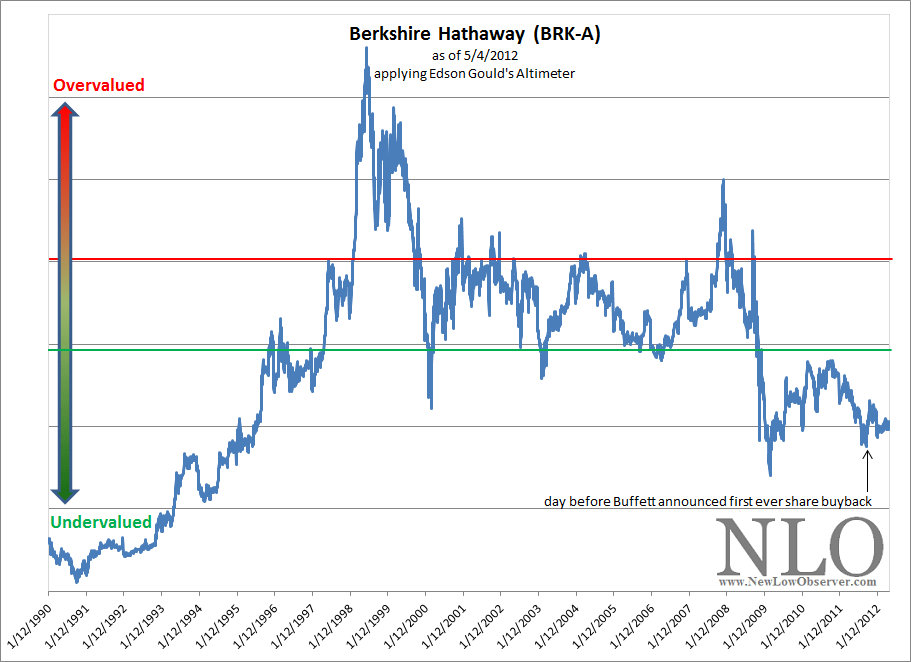
No, this isn’t an article about the prospect of Berkshire Hathaway falling from the current price of $121,950 to $32,100.  Instead, this is what Edson Gould’s Altimeter suggests that Berkshire Hathaway’s (BRK-A) stock price is currently trading at.

Edson Gould’s Altimeter compares the current stock price relative to the dividend that is paid by a company.  As we all know, Berkshire Hathaway does not pay a dividend.  So, how did we arrive at a dividend for Berkshire Hathaway?  We borrowed the dividend policy of Charlie Munger’s Wesco Financial (WSC).  We thought that there would be no better corporate dividend policy to replicate other than that of Warren Buffett’s right hand man.

Exactly what portion of Munger’s dividend policy did we replicate? First, we took WSC’s average dividend payout ratio of 13% from 1999-2010 and applied it to Berkshire Hathaway’s 1977 reported operating earnings of $22.54 per share.  This resulted in a dividend of $2.93.

Next, we compared the compound annual growth rate [CAGR] of the dividend for Wesco Financial which was slightly more than the book value from 1999-2010, at 3.37% and 3.01%, respectively.  Additionally, we took into consideration the fact that by 2010 Wesco Financial had a 38-year history of consecutive dividend increases.  Because Berkshire Hathaway has a 19.8% CAGR of their book value (2011 annual report), we opted to cut that figure in half and assign a dividend growth rate of 9.9%.  Our decision to cut the CAGR of the book value in half was in deference to Buffett’s desire to better deploy the capital in other investment opportunities and the possible diminished impact of the succession team upon Buffett’s “retirement.”

After borrowing the dividend policy from Buffett’s primary business partner and creating a hypothetical dividend and a compounded annual dividend growth rate, assuming regular dividend increases for the last 35 years, we believe that we have constructed a reasonable approximation of an Altimeter which is represented in the chart below.

image

Based on the Altimeter, our best guess is that the period from 1996 to 2008 provided consistent indications of when to add to your positions of Berkshire Hathaway (at or below green line).  The period from 2008 to 2009 provided exceptional opportunities for new investors to buy Berkshire Hathaway as the markets, economy and insurance industry were in crisis mode at the exact same time.

Once the recovery in stocks started it was off to the races for most investors.  Even Berkshire Hathaway was able to participate in the run-up from the 2009 low.  However, on a relative basis, Berkshire’s share price was not increasing  to a level that was reflective of its true value, this is in spite of getting within 10% of the 2007 high in late February 2010.  Based on the Altimeter, Berkshire is currently undervalued by at least 66% and below the 2007 peak by almost 95%.

Those considering the acquisition of Berkshire Hathaway have the following upside targets to consider in the coming 2-3 years, all things being equal:

  • $175,280
  • $197,190
  • $219,100

The following are the possible downside targets:

  • $120,767
  • $105,606

After constructing a fairly conservative dividend policy, the Altimeter clearly outlines the reasons why Warren Buffett would suggest that Berkshire Hathaway will “very aggressively” buy back shares even though the stock is well within striking distance of the all time high.

Who is Edson Gould?

"Edson Gould spent over 60 years working in and studying financial markets. Gould studied the arts at Princeton, engineering at Lehigh (from where he graduated in 1922), and finance at New York University. In 1922, after working for a short time at Western Electric, he joined Moody's Investor Service as an analyst and later was editor of Moody's Stock Survey, Bond Survey, and Advisory Reports. In 1948, he began at Arthur Wiesenberger & Company, where he developed and edited the well-known Wiesenberger Investment Report and became a senior partner. He also was Research Director at E. B. Smith (which later became Smith Barney), and worked for Nuveen."

(source: Market Technicians Association. Gould, Edson Beers, Knowledge Base. Accessed April 26, 2012. link MTA reference.)

"Market technician Edson Gould always laughed at the idea of having a significant influence on the stock market, but his predictions were the most precise around. He pinpointed major bull markets and prophesied bottom-out markets as if he had his own peephole into the future. But in place of a crystal ball and wacky off-the-cuff schemes, his were smart, intensely researched and time-tested theories that made him a legend in the investment community."

(source: Fisher, Kenneth L.. 100 Minds That Made the Market. Business Classics, Woodside, CA. 1993. page 320.)

What Does Warren Buffett See in IBM? Maybe This

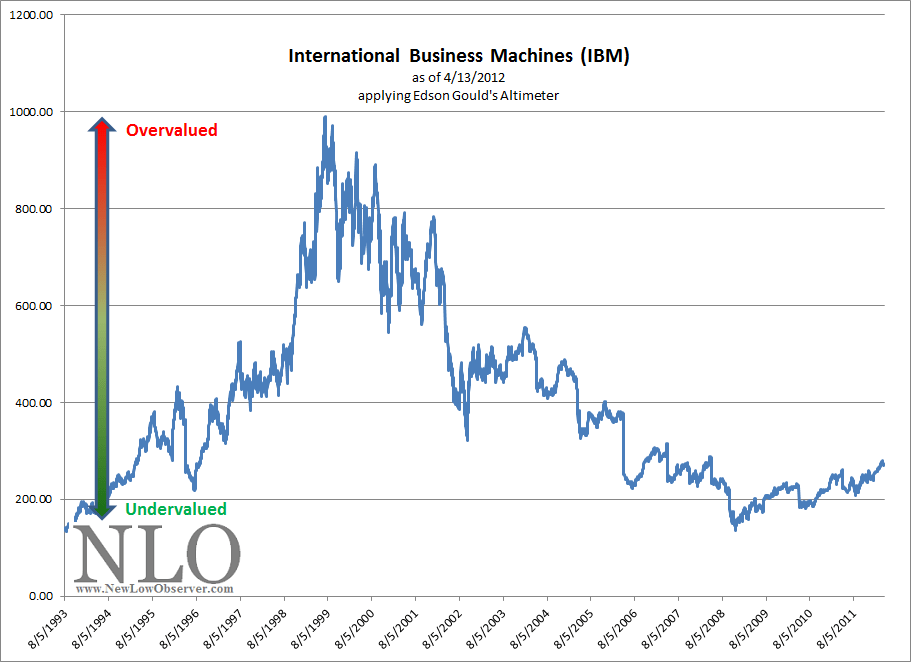
We don’t talk fundamentals much, if at all.  However, the chart below says a lot about why Warren Buffett might bother with buying IBM, a technology company, when the stock is trading near an all time high.

image

Buffett's latest annual report goes to great length in citing IBM's stock repurchase plan among other reasons why he bought the company's shares.  Buffett says the following:

"Let’s do the math. If IBM’s stock price averages, say, $200 during the period, the company will acquire 250 million shares for its $50 billion. There would consequently be 910 million shares outstanding, and we would own about 7% of the company. If the stock conversely sells for an average of $300 during the five-year period, IBM will acquire only 167 million shares. That would leave about 990 million shares outstanding after five years, of which we would own 6.5%.

"If IBM were to earn, say, $20 billion in the fifth year, our share of those earnings would be a full $100 million greater under the 'disappointing' scenario of a lower stock price than they would have been at the higher price. At some later point our shares would be worth perhaps $1.5 billion more than if the 'high-price' repurchase scenario had taken place." (Source: 2011 Berkshire Hathaway Annual Report. page 6)

In order for IBM to make ever increasing dividend payments and massive stock repurchases, IBM has to be generating serious cash flow.  The combination of the two are creating an undervalued situation that may not exist for quite some time in the future.

As we’ve said before, Edson Gould’s Altimeter is a summary of relative values for a stock's price which only requires additional fundamental information for support.  We saw a similar undervalued Altimeter in Transatlantic Holdings (TRH) and Wesco Financial (WSC) which prompted our articles titled "Transatlantic Holdings: A Value Proposition Worth Consideration" and "Wesco Financial: Fundamentals and Technicals Are Aligned" before Buffett made a bid for both companies.

In this case, the dividend has been rising much faster than the stock price, among the many reasons that Buffett might be interested in a technology stock near an all-time high.

Now, just imagine what the stock will look like after falling to a 52-week low.

Gold Stocks to Consider Based on Our Indicator

In light of our Gold Stock Indicator approaching the long term buy signal (found here), we have decided to go over the gold stocks that pay a dividend and are near their respective 52-week lows.  In this review, we’re going to cover Agnico-Eagle Mines Ltd. (AEM) and Gold Fields Ltd. (GFI).  When, and if, the Gold Stock Indicator actually reaches the long term buy indication it will be posted to our site.  The stocks that we cover here are for you to do additional due diligence before taking any action.

Agnico-Eagle Mines Ltd. (AEM) closed at $32.37 on Thursday April 5, 2012.  Agnico-Eagle is currently operating at an annual loss of -$3.36 according to Yahoo!Finance.  Contributing factors to Agnico-Eagle’s decline in price over the last year has been problems with the operation of their mines.

As described in many of our previous articles, Edson Gould’s Altimeter is based on the stock’s price relative to the actual dividend paid.  The Altimeter is a critical real-time assessment of value based on the company’s dividend.  Below is the altimeter for Agnico-Eagle:

image

In our assessment of Agnico-Eagle, we have compared the current level of the Altimeter at 161.85 and compared it to other times when Agnico-Eagle has trade at the same relative level, or below, and traded up to 400 on the indicator.  In the case of Agnico-Eagle there were two periods, before the bull market in gold stocks began, that the stock was selling at a low and was a great buy (based on the altimeter).  In the period from November 2, 1990 to July 3, 1993, Agnico-Eagle rose +174% and in the period from August 25, 1998 to October 4, 1999 rose +157%.

Since the gold bull market began, the only other time that Agnico-Eagle was selling below 161.85 and subsequently traded up to the 400 level was the period from October 21, 2008 to October 6, 2010 for a gain of 103%, this far exceeded the gains of the SPDR Gold Shares (GLD) over the exact same period of time.

Next in our review is Gold Fields Ltd. (GFI).  Gold Fields sports trailing earnings of $1.22 in the last twelve months  and a dividend of $0.61 with a dividend yield of 4.70%.  Yahoo!Finance indicates that Gold Fields operates “in South Africa, Peru, Ghana, and Australia.” Based on the majority of countries that Gold Fields operates, there is some political risk to this investment.  However, Gold Fields has exhibited amazing consistency in the Altimeter below:

image

Presently, Gold Fields is trading at the Altimeter level of 42.38.  The chart depicts the times when GFI was bought at the 42.38 level and sold whenever the Altimeter reached 100.  The results are amazing and provide clear evidence on how gold stocks can outperform the price of gold when combining Edson Gould’s Altimeter with our Gold Stock Indicator.

Our approach to buying these stocks is to purchase in two stages, once at, or near, current levels and a second time only if the stocks fall -20% below the initial purchase price.  As an example, if we have $10,000 that we’d like to invest then we buy $5,000 now and hold the remaining funds unless/until the stock declines by -20%.  We’re basically hedging with cash if we’re wrong.  If we’re right about our first investment (the stock price rises) then we can use the cash to buy another stock near a new low.

Before bothering with the first of many gold stocks that we’ll be covering based on our Gold Stock Indicator, please review the following questions and answers:

  • Is there downside risk to taking positions in gold stocks at this time? Yes, price declines can reach as much as -50% within the first two months of the purchase.
  • Are you comfortable with declines of -50% or more?  If not, then don’t bother with these stocks at this time.  If you’re wondering about the logic of recommending anything that might decline by as much as –50% then please read our view on the topic (found here).
  • Could these stocks have been held for the “long-term?”  Ideally, yes, however, we believe that history is not on the side of gold stocks relative to the price of gold as we described in greater detail in our article titled “A Strategy is Needed For Lagging Gold Stocks”.

We believe that Edson Gould’s Altimeter, when revealing consistent relative values, yields highly favorable results.  While we always seek to purchases at a relative low, we always set a target for selling at higher levels rather than “holding for the long term.”  Our analysis could change if the stocks mentioned above dramatically increase or decrease their dividend.

Apple Inc.: Edson Gould’s Altimeter as if AAPL were a Dividend Achiever

As Apple Inc. (AAPL) announces that it will be paying a dividend of $2.65 per quarter starting in July 2012, we wondered what Edson Gould’s Altimeter would look like if it were applied to AAPL after 1995, when AAPL eliminated their quarterly dividend.  We want to see how Gould’s Altimeter would react to Apple Inc. if the dividend were increased every year from 1996 to the present with the assumption that the 2013 annual dividend would be $10.60 per share.

The Altimeter was first described by Edson Gould in Barron's on February 21, 1968. Gould asserted that the relationship between the price and the dividends paid on that stock, or index, tell investors of under or overvaluation.  It is important to make the distinction between Edson Gould’s Altimeter analysis and his Speed Resistance Line [SRL] analysis.  Altimeters are based on the dividend payment relative to the stock price while the SRL is based strictly on the price movement.

In the case of Apple Inc. (AAPL), there hasn’t been a dividend paid since 1995.  To arrive at a dividend payment from 1996 to today, we calculated a gradual annual dividend increase as would be the case with any blue chip stock like a Dividend Achiever.  Dividend Achievers are stocks that have increased their dividend every year for 10 consecutive years in a row.

We're running on the assumption that the July 2012 $2.65 quarterly dividend would be the latest increase in a long string of dividend increases since 1996.  Below is the assumed dividend increases from 1996 to the present:

Year Annual Quarterly
1996 $0.52 $0.13
1997 $1.13 $0.28
1998 $1.76 $0.44
1999 $2.40 $0.60
2000 $3.00 $0.75
2001 $3.64 $0.91
2002 $4.42 $1.11
2003 $4.88 $1.22
2004 $5.52 $1.38
2005 $6.14 $1.54
2006 $6.76 $1.69
2007 $7.40 $1.85
2008 $8.02 $2.01
2009 $8.64 $2.16
2010 $9.28 $2.32
2011 $9.89 $2.47
2012 $10.48 $2.62
2013 $10.60 $2.65

Based on the proposed annual dividend increases, we can now view what Edson Gould’s Altimeter would look like for Apple Inc. (AAPL) stock.  Below is the Altimeter from 1996 to the present.

image

The first thing that is noticed, in the chart above, is the fact that from 1996 to 2007, Apple traded in a range of between 50 and 17 on the Altimeter (Altimeter level; not stock price).  Anytime AAPL was trading near 50 the stock was overvalued and when the stock traded around the 17 range the stock was considered undervalued.

However, the low of 2003 marked the beginning of a new relationship between Apple’s stock price and our hypothetical dividend that would have been received.  Starting in 2006, AAPL’s stock would decline, at minimum, to the previous Altimeter peak.  The decline from the 2006 peak stopped exactly at the 2005 peak.  The decline from the 2007 peak initially flirted with the 2006 peak but ultimately succumbed to the forces in play and fell well below the 2006 peak.

Our take on this “pattern,” based on hypothetical dividend increases every year from 1996 to the present, is that the next support level for Apple’s stock price would be at the 2007 peak, at minimum.  This suggests that APPL’s stock price could decline to $284.98.  Such a decline would constitute a –52.59% drop from the closing price of $601.10 on March 19, 2012.  Although the $284.98 level seems dismal, it is a far cry better than Edson Gould’s Speed Resistance Line [SRL] analysis which suggests that the extreme downside target is $201.66.  This is an increase from the February 5, 2012 downside [SRL] analysis done on Apple (found here).

Investment Observation: Northern Trust (NTRS) at $47.26

Today’s Investment Observation is Northern Trust (NTRS). Although Northern Trust has not increased the dividend in the last couple of years, the company has an exceptional dividend history given the turmoil that has transpired in the financial services industry for the last 3 years. According to Value Line Investment Survey, “Northern Trust is a leading provider of investment management, asset and fund administration, fiduciary and banking solutions for institutions and affluent individuals worldwide.”
Based on Value Line’s June 18, 2010 issue, Northern Trust (NTRS) has a fair value of $63. The stock has had an increase in the number of shares outstanding by 7% since 1999. However, the book value for NTRS has increased by slightly less than 3 times (286%) since 1999. Although Value Line has NTRS with a timeliness rating at the lowest end of the scale, NTRS is expected to increase in value to $70 by 2013, which is an annualized total return of 11%.
According to Dow Theory, Northern Trust (NTRS) has the following downside targets:
  • $44.48
  • $38.84
  • $33.20
At the current price, the worst-case scenario of NTRS falling to $33.20 is 27.17%. In our investment strategy, declines of 25% would initiate the second of 3 purchases for either short-term speculators or long-term investors. The upside targets for this stock are:
  • $58.58 (fair value)
  • $70.71
  • $83.95
Edson Gould’s Altimeter indicates that while Northern Trust (NTRS) isn’t at the all time low, it may be forming a base in the stock’s price. At the current price of $41.47, NTRS hit a critical base (blue line) in March 2003 and December 2008. The short-term upside target is $62 as represented by the blue circle. The $62 mark coincides with Value Line’s $63 fair value price and Dow Theory’s fair value of $58.58. The most optimistic outlook for NTRS is for the stock price to rise to $83.85 as indicated by the green circle.
As a side bar, if NTRS were to rise as high as the September 2000 peak the stock would be priced at $156. However, we cannot, at this time, take the position that NTRS would rise to such a level of overvaluation unless and until the stock exceeds the $83.85 level.
Our worst-case scenario is that NTRS declines to the $28 level as represented by the red circle. We are adamantly against investors ruling out the prospect of losing at least 50% of their position. For this reason, NTRS falling to $28 is just as real in our minds as the prospect of rising to the $62 level.
As a potential sign of things to come, it was announced on Tuesday August 31, 2010 that Northern Trust was granted a Beijing branch license. Although the prospects of China have been a topic of much debate since Columbus tried to do an end run around Marco Polo’s silk road, we believe that Northern Trust is methodically positioning itself to reap rewards regardless of the rumors of China’s opportunities.