Author Archives: NLObserver Team

Investment Observation: Supervalu (SVU) at $12.81

Supervalu (SVU) has been on our watch list since December 2009. After considerable analysis, I decided to pull the trigger today at $12.81, less than 5% within the 52-week low. My model showed the price of $12 to be the buy range and $15 to be the fair value. The negative earnings on the surface is a concern. However, a deeper investigation shows that the company was forced to take an impairment charge of $3,250 back in January of 2009 because of the Statement of Financial Accounting Standards (SFAS) No. 142 accounting rule. This resulted in a negative earning of $13.95 per share. The quote below was taken from the SEC filing.

For the third quarter of fiscal 2009 the Company’s stock price had a significant and sustained decline and book value per share substantially exceeded the stock price. Consistent with SFAS No. 142, the Company performed an interim impairment test of goodwill and indefinite-lived intangible assets at the end of the third quarter of fiscal 2009. Although this analysis has not been completed due to its complexity, based on the work performed to date the Company has recorded a preliminary estimate of impairment charges of $3,250, comprised of $3,000 of goodwill and $250 of indefinite-lived intangibles.

I recalled that SVU was trading at a 70% discount to book during the March low. After an adjustment, it has a book value of $12.79. I purchased the shares at book value.
Despite the consideration of these adjustments, not all is bright for SVU. The company's operating margin is 3.09%, very low compared to its competitors. A large amount of long-term debt ($8 billion) is a dark cloud that hangs over the company. Large capital expenditure will deplete their cash flow if the economy doesn't pick up. After 35 years of consecutive dividend increases, the company reduced their distribution by 50% and now pays out $0.35 or 2.8% annually. All of these factors contributed to SVU trading at such discounted level.

Forward P/E is at 6.64 times. The price-to-sales ratio is at a low of 0.06. Price-to-book value is at 1. Current dividend yield of 2.8% which exceeds the five year average yield of 2.5%. The current ratio of 1 means that the company can turn over their current assets at the same rate as their current liabilities. This is important for short-term viability concerns.

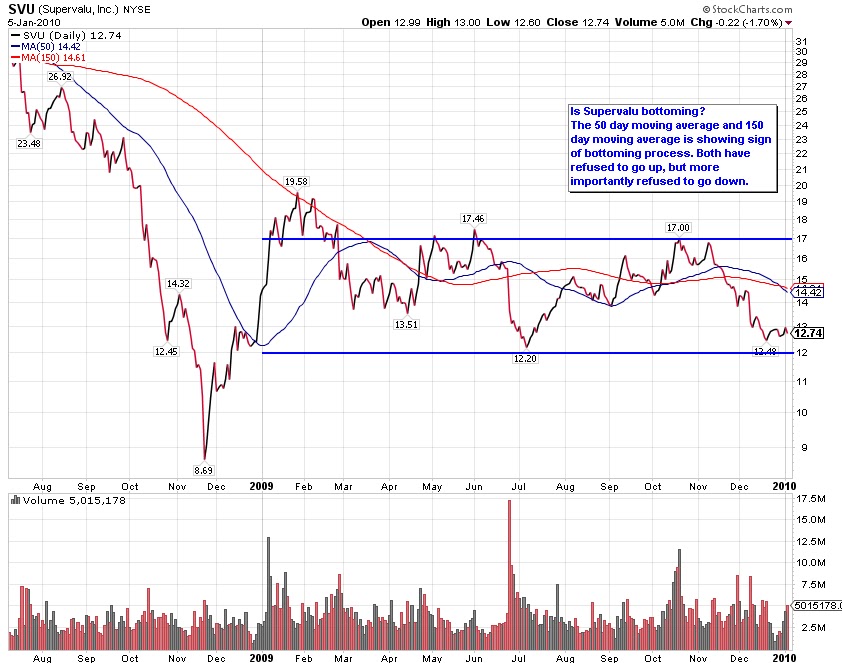
Fundamental aside, it was the technicals of SVU that prompted me to buy. From the chart below, you can see that for most of 2009 the stock trade within the $17 and $12 range. As business conditions improved and the company returned to profitability in the second half of the year, shares remained unchanged. The stock appears to be "bottoming" as it remains range bound. The moving averages are doing the same as well. A break below $12 would spell trouble and I would get out while a breakout above $17 will signal better times for SVU.
I bought the stock at $12.81 and will sell if it break below $12 (-7%). Profit will be taken around $15 (+17%).
The purpose of our investment observations is to point out quality Dividend Achievers and formers that are near a 52-week low. From this point begins the fundamental research to verify the quality of the stock for both short and long-term investing. These recommendations are within the context of the 3rd year of an 18-year secular bear market. A bear market that we expect could trade in a range between 16,000 and 5,000. The secular bear market will be considered over when the Dow Transports and Dow Industrials exceed their respective peaks on high volume or the dividend yield on the Dow exceeds 6% or higher. -Art

Real Estate Bottom is Calling

The great real estate analyst Roy Wenzlick may have called the bottom in real estate again...for the 10th time in a row for the last 78 years. Although he passed away in 1989, Roy Wenzlick gave significant credibility to the idea that real estate has an 18.3 year cycle. Wenzlick compiled data on real estate in St. Louis as well as the rest of the nation from 1932 until 1973 in his publication The Real Estate Analyst.In the diagram below, you will see Wenzlick's 18.3 year cycle displayed from 1795 until 1973.
 
It is important to note that if you add 18 years to 1973 you get the year 1991 as the next period for a low in the real estate market. Coincidentally, to some, 1991 was the last time we had a bottom in the real estate market. If you add another 18 years to 1991 then you get 2009. My tendency has been to include the years 2008 and 2010 just to play it safe.
 
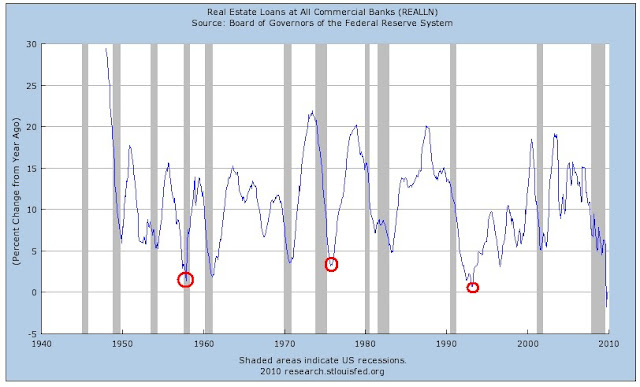
As a way to cross reference our perspective that the bottom is coming, I have included the Federal Reserve's data on real estate loans with the percentage change from the previous year. Although real estate loans by banks is a slightly lagging indicator it has tracked the performance of the real estate market in sync with the Wenzlick model.
 
If we haven't hit bottom yet it means that within the year 2010 we will have to go below the previous low prices of 2009. Such an occurrence would be a complete disaster for the financial markets. I am hopeful that the real estate market doesn't further devolve. However, the concern does rest in the back of my mind.
 
Barring any further crisis in real estate, I'm willing to go out on a limb and say that on the whole, as opposed to specific geographic regions, based on credible sources like Wenzlick, the bottom in real estate may be in.
 

Resources:

Relying On Analyst? Better Think Again

If you think an analyst can help guide you through investing, think again. Today's headline reads, "Bartels Drops ‘Correction’ Call, Sees Gains: Technical Analysis" Mary Ann Bartels, an analyst at Bank of America, predicted back in October 5th that the market would plunge 20%. Bartels was ranked second among analyst by Institutional Investor magazine’s most recent survey. The worse part about this is that being wrong, as an analyst, suffer no consequence. Bartels is now near-term bullish and saying that more gains are likely in the near term.
I wrote several articles about the market in October of 2009. The first one was on the 9th which showed a non-confirmation based on the Dow Theory. I suggested investors to stay long but flat and watch the Transport closely. On the 14th, the uptrend confirmation came and I said "The bull market confirmation came today when the Industrial and the Transport both closed above their previous high. I'll remain long until the market tells me to get out."
Art

Speculative Observation: Cephalon Inc. (CEPH) at $62.42

The new year brings new challenges and opportunities. The first opportunity for this year may come from Cephalon (CEPH) which engages in the discovery, development, and commercialization of products for central nervous system, inflammatory disease, pain, and oncology therapeutic areas. It competes against GlaxoSmithKline plc (GSK), Johnson & Johnson (JNJ), and Sepracor Inc. Because the company doesn't pay a dividend, the New Low Observer team has to classify such a security as a speculation.

CEPH came onto our radar when we began compiling the new low data back in July when the stock was trading around $57. This was 8% above the 52 week low of $52.55. At the low, CEPH was trading at less than 15 times earnings. Although appearing to be risky, selected stocks at or near their low offer investors the opportunity to investigate quality companies for potential price increases. Our concept is laid out in the "Buy Low, Sell High" article.

CEPH has a market cap of $4.6 billion dollar. The relatively small size compared to its rivals doesn't discourage us. We only care about the market cap as a means for liquidity when buying and selling the stock. CEPH earned $3.62 per share over the last 12 months and thus has a price to earnings ratio (P/E) of 17 and a forward P/E of 10, an extraordinarily low multiple. Low P/E multiples imply that investors are paying less for every dollar of earnings (more on our view of P/E). CEPH has a book value of $28.71 per share. At $62, price-to-book is north of 2. A positive operating cash flow of $232.48M is a plus but a negative free cash flow is one of my concern ($-12.71M).

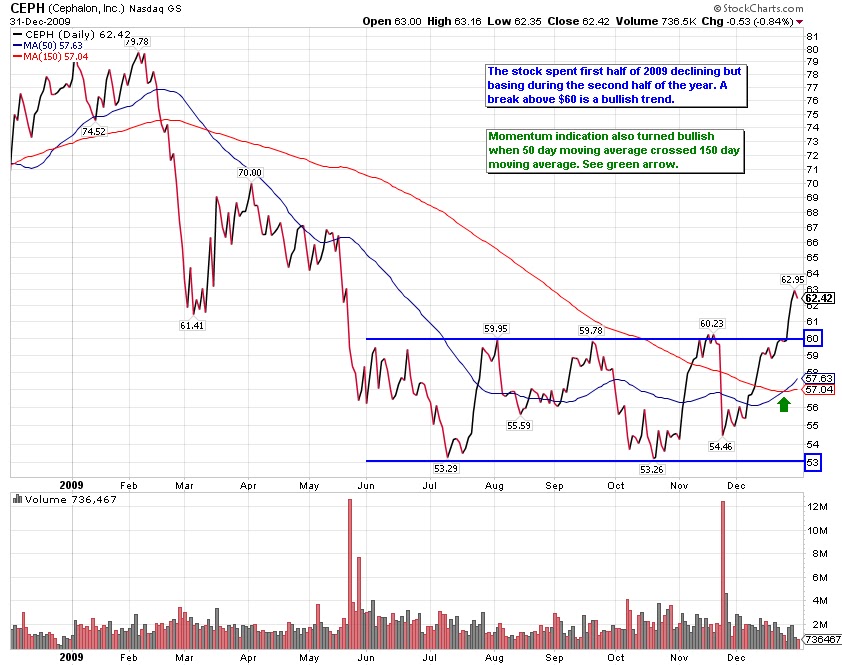
Fundamentals aside, the stock may have discounted all the negative news based on the chart pattern. In 2009, Cephalon dropped 19% as opposed to the Dow Industrials which rose 19%. Unlike the Dow which hit the yearly low in March, Cephalon bottomed in July and formed what appears to be a base. This pattern is prominent because it shows that the stock failed to move either up or down and traded in range between $60 and $53. Any break above $60 or below $53 will reveal its potential direction of the stock. Sure enough, the stock broke above $60 in late December and will look for that to be a support for the stock. The momentum indication also turned bullish as the 50-day moving average crossed the upward sloping 150-day moving average as indicated in the chart below.

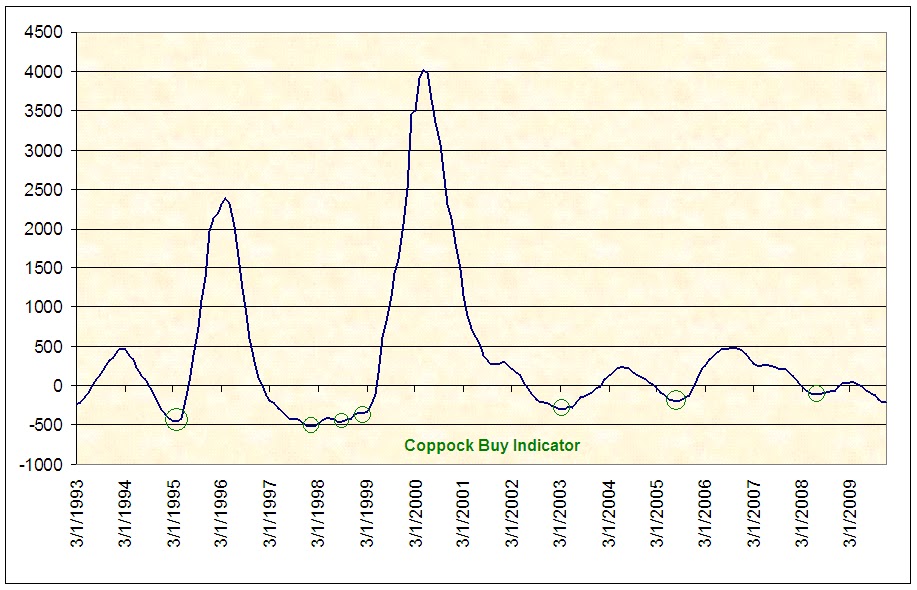
Another indicator I like to refer to is the Coppock Curve (click here for more on the Coppock Curve). For Cephalon, the curve dates back to 1993. The table below shows my findings.

Date Price 3 Mo After % Change
May-95 9.81 24.25 147%
Feb-98 12.00 10.63 -11%
Sep-98 7.31 9.00 23%
Mar-99 8.75 17.38 99%
May-03 45.16 44.35 -2%
Sep-05 46.42 64.74 39%
Aug-08 76.62 73.48 -4%

The average percentage gain if you sell three months after the buy indication is 42%. Excluding the 1995 data, it is 24%. We are waiting for the indicator to turn for a possible buy signal.

A buy strategy would be to purchase this stock as close as possible to $60 or the 50 day moving average which is dynamic and constantly changing. Use the Coppock indicator as another gauge to buy and watch your gains or losses closely. - Art

Investment Observation: California Water Service (CWT) at $36.82

The latest investment observation is on California Water Service Group (CWT). According to Yahoo!Finance, CWT "...engages in the production, purchase, storage, treatment, testing, distribution, and sale of water for domestic, industrial, public, and irrigation uses, as well as for fire protection."

As noted in our Dividend Achiever watch list dated January 1st, CWT is within 10% of the 52-week low. CWT has increased its dividend for 41 years in a row. The 10-year compounded growth rate of the dividend is an anemic level of less than 2%. Keep in mind that with a 41 year history of increased dividends, the odds favor the dividend remaining the same or being cut in the near future. A cut in the dividend would initiate the selling of the stock automatically, regardless of other fundamental attributes.

CWT has had a pattern of trading in a range for approximately 6 years at a time before breaking out to a new and higher trading level. The following are the range in years that CWT traded before obtaining a new high:

  • 1976 to 1982
  • 1985 to 1993
  • 1993 to 1997
  • 1997 to 2004
  • 2005 to 2011 ???
Because CWT has averaged 6 years before breaking out to a new higher price, we suspect that the current period, after trading in a range for the last 5 years, might provide relatively sizable capital appreciation over the next two and a half years. In addition, because the stock price has been range bound while the dividend has been increased each year, investors can feel comfortable knowing that either of two things are going to happen with the stock 1) the price increases or 2) the dividend yield increases. Either of these scenarios are likely if CWT can retain its overall financial standing.

According to Dow Theory, CWT has the following upside and downside targets.

Upside:

  • $48.29
  • $41.42 (fair value)

Downside:

  • $34.55
  • $27.40
  • $21.04

While we am hopeful of the upside prospects, potential investors need to consider their willingness to hold this stock through the possible downside targets. Personally, we would consider selling the stock if it fell below the $27.40 level. This means that we would be accepting the potential loss of 26% before deciding if we should continue to hold the stock. However, a lot depends on market conditions at the time that CWT falls to the respective downside targets. Our goal is to obtain CWT at a lower price than the current level and sell the stock at or near the $48 level.

To put our investment observation in perspective, IQTrends.com considers CWT undervalued when the stock trades for $16.85. According to Value Line Investment Survey, CWT trades at a mean price of:

  • $33.61 based on the 30-year treasury
  • $33.98 based on the 20-year treasury
  • $40.42 based on the 10-year treasury

Being as conservative as possible, both sources indicate that CWT is overvalued or fairly priced by as much as 54% and as little as 8.71%. In theory, a stock that is "fairly" priced has more of a chance of falling in value rather than increasing in value. Also of concern is the possibility of rising interest rates. It would be challenging to expect that the price of a utility can increase in a potentially rising interest rate environment that we might face in the long term.

As mentioned in our recommendation of AquaAmerica (WTR), although CWT is a water utility and water is critical to life, investors need to understand that companies in this industry aren't a "sure thing." The biggest reason for this is that when, and if, water becomes scarce, government regulators will step in to take over (nationalize) what should otherwise be sold at the most profitable price (thereby curbing wasteful consumption.) There is literally an upside cap on profitability to a company like this due to the critical importance of the resource being sold. Additionally, CWT should be considered a relatively risky stock because of its low daily trading volume. With a 3 month average volume of 100,000 shares, this stock may not be suitable for investors who need ready access to the cash on short notice.

The purpose of our investment observations is to point out quality Dividend Achievers that are near a 52-week low. From this point begins the fundamental research to verify the quality of the stock for both short and long-term investing. These recommendations are within the context of the 3rd year of an 18-year secular bear market. A bear market that we expect could trade in a range between 16,000 and 5,000. The secular bear market will be considered over when the Dow Transports and Dow Industrials exceed their respective peaks on high volume or the dividend yield on the Dow exceeds 6% or higher. -Touc

Dividend Achiever Watch List

At the end of the week, my watch list contains 17 companies, same amount of companies from the previous week. Here are the companies on my watch list as of January 1, 2010.

Symbol Name Price P/E % Yr Low Yield EPS Div/Shr Payout Ratio
SVU SUPERVALU INC 12.71 -0.91 4.78% 2.75% -13.99 0.35 -3%
CWT CALIFORNIA WATER SVC 36.82 18.41 9.94% 3.20% 2.00 1.18 59%
XOM EXXON MOBIL CP 68.19 15.90 10.23% 2.46% 4.29 1.68 39%
BCR BARD C R INC 77.90 15.61 13.00% 0.87% 4.99 0.68 14%
WTR AQUA AMERICA INC 17.51 23.04 13.78% 3.31% 0.76 0.58 76%
UGI U G I CP 24.19 10.25 14.43% 3.31% 2.36 0.80 34%
THFF First Financial Corporation Ind 30.52 16.68 15.04% 2.95% 1.83 0.90 49%
WMT WAL MART STORES 53.45 15.49 15.57% 2.04% 3.45 1.09 32%
FDO FAMILY DOLLAR STORES 27.83 13.44 15.86% 1.94% 2.07 0.54 26%
SRCE 1st Source Corporation 16.09 14.50 16.26% 3.98% 1.11 0.64 58%
SYBT S.Y. Bancorp, Inc. 21.35 15.81 16.73% 3.19% 1.35 0.68 50%
UMBF UMB Financial Corporation 39.35 18.74 16.94% 1.88% 2.10 0.74 35%
WGL WGL HOLDINGS INC 33.54 14.03 17.31% 4.38% 2.39 1.47 62%
WEYS Weyco Group, Inc. 23.64 23.64 17.55% 2.54% 1.00 0.60 60%
HSY THE HERSHEY COMPANY 35.79 20.93 18.24% 3.32% 1.71 1.19 70%
AWR AMER ST WATER 35.41 21.86 18.99% 2.94% 1.62 1.04 64%
NTRS Northern Trust Corporation 52.40 13.83 20.96% 2.14% 3.79 1.12 30%
17 Companies

Happy New Year
Art

Nasdaq 100 Watch List

Below are the Nasdaq 100 companies that are within 20% of the 52-week low. This list is strictly for the purpose of researching whether or not the companies have viable business models or are about to go out of business. These companies are deemed highly speculative unless otherwise noted. -Touc

Symbol Name Trade P/E EPS (ttm) Yield P/B Pct from Yr Low

GENZ

Genzyme

49.01

27.94

1.75

N/A

1.73

4.08%

GILD

Gilead

43.27

16.73

2.59

N/A

7.00

6.52%

APOL

Apollo

60.58

16.15

3.75

N/A

8.18

14.76%

CEPH

Cephalon

62.42

17.25

3.62

N/A

2.19

18.78%

The Language of Wall Street

  • The rich man does not know who is his friend.
  • A man gets no thanks for what he loses that play.
  • They who live in a worry invite death in a hurry.
  • Soft words and hard arguments catch the investor.
  • Put your eggs in one basket and watch the basket.
  • Every time the sheep bleats it loses a mouthful.
  • The rich are meanest when they buy small things.
  • The rich man is apt to be more generous than just.
  • He swears who is accustomed to his own false words.
  • Money easily made, easily goes; easy come, easy go.
  • If you do not hear reason, she will wrap your knuckles.
  • He who prates of his wisdom doth but conceal an ass.
  • Provide for the worst; the best will take care of itself.
  • It is an old maxim that accidents usually help the Bears.
  • Lend money without bond and you but make an enemy.
  • The advice of successful men only is worth application.
  • A man with long hair is generally rash and impetuous.
  • A man must make his opportunity as often as he finds it.
  • Things in motion sooner catch the eye than what not stirs.
  • He who sells what isn’t his, must buy it back or go to prison.
  • Sell and borrow only those stocks which have a wide market.
  • Some had rather guess that much then take pains to learn a little.
  • Men of wit and facts never need be driven to indirect courses.
  • To estimate a man’s wealth, divide the gossip estimates by four.
  • To grasp an opportunity with a firm decision marks an able man.
  • After advancing markets, and prices waiver, lower prices will come.
  • When prices are high, or there is a declining tendency, sell on rallies.
  • Much money made before 20 is apt to be lost in the reign of plenty.
  • He is rich enough to as no debts, and young enough who has health.
  • “Early information” and a big bank account will be the ruin of any man.
  • Moderate riches will carry you; if you have more, you must carry them.
  • The success of a manipulated market depends largely on sustained activity.
  • It is idle to wait for your ship to come in unless you have sent one out.
  • When prices close week without support, a rally would be in order next morning.
  • He who takes no care of little things will not have the care of great ones.
  • When prices are low, or there is an advancing tendency, buy fair concessions.
  • A lordly taste makes a beggar’s purse; a champagne appetite but a purse for beer.

Source: Nelson, Samuel A. The ABC of Stock Speculation. S.A. Nelson. 1902

A View on the "Buy Low, Sell High" Concept

As the old investment adage goes, "buy low and sell high." However, the act of buying low has a few complications which hasn't been easily resolved. One problem is knowing when a stock's price is actually at a low price or not. Most people confuse the absolute level of a stock price with being low. For example, if a stock is selling for $2 then a person might think that this is a great price to acquire the shares. However, if $2 is the new high for the price and one year ago the old low was $0.25 then $2 is actually very high.

One way that the New Low Observer (NLO) has managed to isolate whether a stock is at a low price is by waiting until the stock is within 20% of the new low. This approach isn't a cure for what ails the average investor. However, it does allow average market participants the opportunity to investigate quality companies for potential price increases. The new low of a stock automatically implies that value has been created especially if the company in question can survive as a going concern. This is counter to most information coming out of the Wall Street media machine. Typically, analysts on Wall Street recommend stocks that have risen far above the low before initiating coverage on a stock.

While there are 4336 individual stocks that can be bought on American stock exchanges, NLO has determined that there are basically only 383 companies that warrant your attention. The first group of companies are known as the Dividend Achievers (excel list of companies). These 283 companies are tracked by Mergent's based on their ability to increase their dividends every year for over 10 years in a row as a minimum requirement. It goes without saying that these companies pay some kind of dividend with yields that range from over 5% to less than 1%.

The second major group of companies tracked by NLO are the constituents of the Nasdaq 100. In our earlier forms as Dividend Inc. and Arti Invest, we believed that only Dividend Achievers were worth tracking since the dividend payment was verifiable regardless of "accounting" inconsistencies that are commonly found with "other" companies. The performance of this approach has been well documented and proven quite profitable.

However, the reality of the stock market dictates that we widen our perspective on companies that might afford significant opportunity with reduced risk. We, at NLO, decided that the Nasdaq 100 was the next obvious choice. After all, most mutual funds are bound to invest in these companies regardless of their unwillingness to pay dividend income. Additionally, companies in the Nasdaq 100 have solid reputations with higher prospects for growth over the long term.

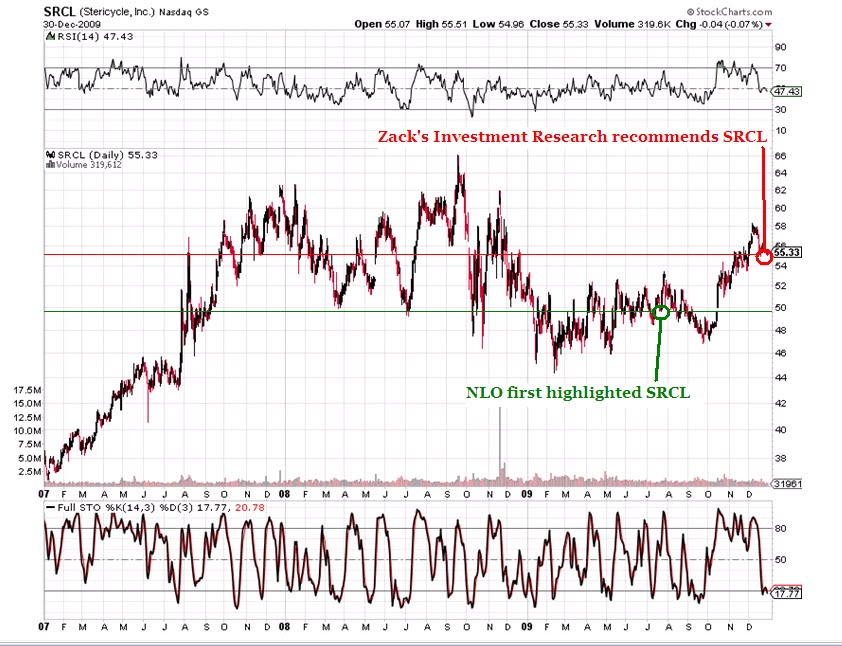
One recent example of the benefit of tracking and research companies posted on NLO, as opposed to those from the Wall Street media machine, is Stericycle (SRCL). SRCL last appeared on our Nasdaq 100 watch list on October 30th. After being on our watchlist since the July 24th initiation of our website, SRCL has managed to climb from the low of $47.76 to the most recent high of $58. This is an increase of 18% from the July low and 21% from the October low and 11.54% from the breakout above our watch list range of being within 20% of the 52-week low.

NLO can be easily contrasted with the recent short-term buy recommendation placed on SRCL by Zack's Investment Research. In a tiny blurb issued today, Zack's Investment Research indicated that SRCL's stock had been in an oversold state based on the stochastics which indicated or implied that the stock was likely to go higher in the near term.

Unfortunately, offering up information about SRCL long after the stock has risen by at least 18% doesn't serve the small investor. After all, isn't the mantra "buy low, sell high?" It is strange to note that no analysts covering SRCL (in the following link) issued a buy recommendation on the stock after February 2004, even though there has been tremendous opportunities to buy in October 2008, February 2009, May 2009 and October 2009.

SRCL is only one of the companies that has been on the NLO Nasdaq 100 Watchlist that performed exceptionally well after getting off the list. Below are other Nasdaq 100 companies and their performance since getting within 20% of the new low:

It should be noted that the above companies are almost the entire list of companies that have appeared on the Nasdaq 100 Watch List. So far, this implies that quality Nasdaq companies could be investigated for speculative opportunities near the new low. Hopefully this approach can provide a reasonable approach to buying low with the prospect of selling higher. Follow along with us as we continue to investigate the speculative opportunities of the Nasdaq 100. -Touc

Nasdaq 100 Watch List

Below are the Nasdaq 100 companies that are within 20% of the 52-week low. This list is strictly for the purpose of researching whether or not the companies have viable business models or are about to go out of business. These companies are deemed highly speculative unless otherwise noted. -Touc

Symbol

Name Trade P/E EPS (ttm) Yield P/B % Yr Low

GENZ

Genzyme Corporation

48.50

27.65

1.75

N/A

1.68

2.99%

GILD

Gilead Sciences, Inc.

43.00

16.63

2.59

N/A

6.87

5.86%

APOL

Apollo Group, Inc.

59.27

15.80

3.75

N/A

7.81

12.28%

CEPH

Cephalon, Inc.

59.88

16.55

3.62

N/A

2.08

13.95%

Dividend Achiever Watch List

At the end of the week, my watch list shrank to 17 companies compared to 20 companies from the previous week. Here are the companies on my watch list as of December 25, 2009.
Symbol Name Price P/E % Yr Low Yield EPS Div/Shr Payout Ratio
SVU SUPERVALU INC 12.90 -0.92 6.35% 2.71% -13.99 0.35 -3%
CWT CALIFORNIA WATER SVC 37.07 18.54 10.69% 3.18% 2.00 1.18 59%
XOM EXXON MOBIL CP 68.66 16.00 10.99% 2.45% 4.29 1.68 39%
BCR BARD C R INC 79.08 15.85 14.71% 0.86% 4.99 0.68 14%
WTR AQUA AMERICA INC 17.69 23.28 14.94% 3.28% 0.76 0.58 76%
UMBF UMB Financial Corporation 38.68 18.42 14.95% 1.91% 2.10 0.74 35%
WEYS Weyco Group, Inc. 23.13 23.13 15.02% 2.59% 1.00 0.60 60%
WMT WAL MART STORES 53.60 15.54 15.89% 2.03% 3.45 1.09 32%
FDO FAMILY DOLLAR STORES 28.02 13.54 16.75% 1.93% 2.07 0.54 26%
THFF First Financial Corporation 30.99 16.93 16.81% 2.90% 1.83 0.90 49%
SRCE 1st Source Corporation 16.25 14.64 17.41% 3.94% 1.11 0.64 58%
UGI U G I CP 25.05 10.61 18.50% 3.19% 2.36 0.80 34%
WGL WGL HOLDINGS INC 34.20 14.31 19.62% 4.30% 2.39 1.47 62%
SYBT S.Y. Bancorp, Inc. 21.89 16.21 19.68% 3.11% 1.35 0.68 50%
AWR AMER ST WATER 35.71 22.04 19.99% 2.91% 1.62 1.04 64%
NTRS Northern Trust Corporation 52.20 13.77 20.50% 2.15% 3.79 1.12 30%
HSY THE HERSHEY COMPANY 36.48 21.33 20.52% 3.26% 1.71 1.19 70%
17 Companies

Merry Christmas!

Sell American National Insurance (ANAT) at the market

It is now time to recommend that American National Insurance (ANAT) be sold at the market. The stock has performed below standard since the research recommendation was issued on April 10, 2008. It is highly recommended that anyone who bought the stock based on my research should re-read the posting. ANAT gave many opportunities to be bought well below the research recommendation price of $105. In fact, ANAT fell to as low as $34 by March 9, 2009. The subsequent rise in the price of 248.28% has been utterly amazing. In the pursuit of "seeking fair profits" the returns that this stock has provided within the last 630 days say that it is necessary to consider alternative opportunities.

Again, ANAT was recommended when it was trading at $105. As of December 21, 2009, ANAT was quoted at $117.51. The total return (including dividends) on ANAT since the recommendation date is 18.27%. On an annualized basis, this equals a total return (including dividends) of 10.59%.

As I have indicated in the purposes and function of this site, the goal is to:

  • maximize the annual yield of each trade.
  • reduce time between buying and selling of each stock.
  • exceed the annual yield of government guaranteed alternatives in each trade.

Research recommendations and investment observations are intended to be a starting point for investigating a quality company at a reasonable price. It is hoped that after doing the background research you can buy the stock at a lower price. Ideally the stock should be held in a tax deferred account and should not consist of less than 20% of your holdings. Personally, I prefer holding only 2-3 stocks at a time.

Sell recommendations are intended to deal with the short term reality of the market. The tracking of the Sell recommendations are the worst case scenario if you happen to have bought a stock at the time the research recommendation was made (please avoid making this mistake.) I aim for mediocrity in my returns, therefore I am happy with 9-12% annual gains. However, since codifying my approach to investing in 2005, I have had annual returns of 20% and above every year since.

It is always recommended that when selling a stock, one should not place stop orders, limit orders or orders after hours. This leaves the seller in the position of being vulnerable to the whims of the market makers. Instead, place your sell orders only as a market order during market hours. Some would complain that a market order during market hours might leave some profits on the table. However, I would rather leave some money on the table rather than have it taken away from me by the trades that are placed by institutions and market makers. -Touc

Sell Northwestern Natural Gas (NWN) at the Market

It is now time to recommend that Northwestern Natural Gas (NWN) be sold at the market. The stock has performed moderately since the research recommendation was issued on October 3, 2009 (. It is highly recommended that anyone who bought the stock based on my research should re-read the posting. Unfortunately, just as it was not possible to buy my AquaAmerica (WTR) recommendation it was the same for my recommendation of NWN, the price only went up from the date recommended.

NWN's stock price has gone nothing but up since the recommendation. However, in the pursuit of "seeking fair profits" the returns that this stock has provided within the last 80 days say that it is necessary to consider alternative opportunities.

NWN was recommended when it was trading at $40.94. As of December 21, 2009, NWN was quoted at $45.25. This equals a return of 10.53%. Selling this stock now generates a return of 2.6x greater than the amount of the dividend yield. Additionally, the 10.53% gain exceeds the return on a 30-year treasury purchased on October 2, 2009 by 2.63x.

Those not interested in following through with my sell recommendation can feel comfortable knowing that NWN is a great long-term holding with a 10.53% cushion since our research recommendation of October 3, 2009.

As I have indicated in the purposes and function of this site, the goal is to:

  • maximize the annual yield of each trade.
  • reduce time between buying and selling of each stock.
  • exceed the annual yield of government guaranteed alternatives in each trade.

Research recommendations and investment observations are intended to be a starting point for investigating a quality company at a reasonable price. It is hoped that after doing the background research you can buy the stock at a lower price. Ideally the stock should be held in a tax deferred account and should not consist of less than 20% of your holdings. Personally, I prefer holding only 2-3 stocks at a time.

Sell recommendations are intended to deal with the short term reality of the market. The tracking of the Sell recommendations are the worst case scenario if you happen to have bought a stock at the time the research recommendation was made (please avoid making this mistake.) I aim for mediocrity in my returns, therefore I am happy with 9-12% annual gains. However, since codifying my approach to investing in 2005, I have had annual returns of 20% and above every year since.

It is always recommended that when selling a stock, one should not place stop orders, limit orders or orders after hours. This leaves the seller in the position of being vulnerable to the whims of the market makers. Instead, place your sell orders only as a market order during market hours. Some would complain that a market order during market hours might leave some profits on the table. However, I would rather leave some money on the table rather than have it taken away from me by the trades that are placed by institutions and market makers. -Touc

Reinstating Glass-Steagall is a Fool’s Errand

In an effort to acquire political capital , Senator John McCain and Senator Maria Cantwell have proposed to reinstate the Glass-Steagall Act which was overturned by the signing of the Graham-Leach-Bliley Act by former President Bill Clinton in 1999. The belief is that, by bringing back the Glass-Steagall Act, all future financial instability will be banished somehow.

It should be remembered that before the passage of the Graham-Leach-Bliley Act, we had the debacle of the Savings and Loan (S&L) crisis. You'd think that with Glass-Steagall on the books, something like the S&L crisis would not have occurred. After all, S&Ls didn't have direct ties to investment banks and brokerage houses. Additionally, S&L regulators knew of the existence of Glass-Steagall. However, Glass-Steagall or not, when a mortgage crisis "happens" the impact on the economy is always devastating. In fact, the off budget costs of the S&L crisis still hasn't been paid for.

Maybe we could say that the S&L crisis occurred because of the accounting change required by FIRREA. Or perhaps the crisis happened because of the lax regulation by the Federal Savings and Loan Insurance Corporation (FSLIC). No matter, the crisis occurred despite all the regulatory agencies and requirements in place to avoid a crisis.

I'd love to use Japan as an example of the impact that a mortgage crisis has on an economy. However, some would argue that the crossholding of shares in banking and brokerage stocks led to a domino effect when the stock market collapsed. Others would argue that the Japanese have an opaque financial system that is run on close ties to the government and that that couldn't possibly happen here in the United States. Wait, that's exactly what happened here in the good ol' USA. Darn!!! That idea is out the window.

For some reason, I distinctly remember that Senator McCain was a "reluctant" participant in what was known as the Keating Five. McCain was the lone Republican Senator among four Democratic senators who acted on behalf of the failed Lincoln Savings and Loan chairman Charles Keating Jr. In his defense, McCain was later cleared of corruption charges but was criticized for using "poor judgment" in his relationship with Keating and Lincoln S&L. Although I'm all for learning from past failures, it seems odd that McCain would be leading the charge to go back to Glass-Steagall given his vote for the law that overturned the 1933 law (later revised in 1934.)

Just so you don't think that I'm Republican bashing, please read my article titled Autopsy of the Glass-Steagall Act. My distrust of politicians cuts right down the middle. After seeing where we've been, let alone where we are, I can't say that I'm impressed with either side of the same coin.

So why is the reinstating of Glass-Steagall such a fool's errand? Well, in order to understand the reasons why, you need to do a cursory review of the history of farming and securitization. Yes, my answer lies in a distinct understanding of how farms and securitization, err, don't really work well together.

You see, financial markets are replete with financial panics in the last quarter of the year (especially October) for a very good reason. In order to commence the fall harvest, farmers need to get the financing necessary to buy the tools to harvest crops and then ship the goods to cities and towns across the nation. Unfortunately, when one farmer needs funding to harvest crops so does a massive number of other farmers. The excessive demand for financing to feed a nation becomes a matter of national security. For this reason, various governments have taken to subsidizing the needs of farmers when banks and financial markets couldn't, can't, or won't. One of the most popular arrangements was known as a farm loan system.

One of the earliest forms of farm loan programs was called Landschaften and was instituted by Frederick II of Prussia after 1750. In this program, the equivalent of corporate farmers banded together by merging their adjacent lands and then issuing a bond using the value of the land as collateral. Interest on the bonds would be paid based on the income generated on the sale of the commodity grown on the land. Financial panics would ensue if, for example, there was an unwilling market for the bonds being sold or if there was too much or too little of a crop being brought to market.

Later iterations of a government sponsored program intended to support farmers was Credit Foncier (English version of website is here). Established in 1852 by Napoleon III, Credit Foncier was specifically chartered to aid the financing of farmers and then needs. Foncier was known as a mortgage bond bank because it securitized the bonds based on the value of the farm land. As an organization that, although not part of the government, had the implicit backing of the government allowed for significant influence. Such influence allowed Credit Foncier to expand well beyond meeting the needs of farmers. After some time, Credit Foncier started to providing a majority of their loans to communes and homeowners in Paris.

In my research of Credit Foncier, I found the following quotes from the New York Times to be quite revealing:

"In 1848, when specie payments were suspended at the Bank of France, one of the pet inflationist projects was such a society as the Credit Foncier, whose obligations to the public should take the form of compulsory paper money."

"But although made a legal tender [money issued by Credit Foncier] in all payments, duties on imports and the public debt not excepted, being inconvertible into specie and issued without regard to quantity, they all become utterly worthless."

“The Credit Foncier of France.” New York Times. June 12, 1876.

In seems interesting to me that Credit Foncier was intended to help inflate the financial system through the guise of helping farmers, but later inflated into oblivion the very "legal tender" that they had control over.

Another type of farm lending institution was known as Credit Agricole. Credit Agricole was unique in that it was advanced money from the government of France to give loans to farmers. When Credit Agricole ran out of the money that was advanced, the government would require the Bank of France to issue new money to Credit Agricole without charging interest on the injection of funds. Credit Agricole would then reprice loans, that had already been issued, with higher interest rates. Inevitiably, the more loans that were made the greater the loss that was incurred. Despite the fact that Credit Agricole was a increasingly money losing operation, when considering the merits of the situation, the New York Times had this to say:

"However, the system of Credit Agricole should be discussed in America, not so much from the standpoint of its defects in France as from the standpoint of the advisability of the American Government furnishing a subsidy to the farmer. In view of the facts, it is realized by those who have studied the subject on the ground in Europe that the advantages to be brought to the American farmer will consist of the ability to get plenty of the greatest possible convenience and at fair and reasonable but not abnormally low rates."

"Some Land Banks". New York Times. October 6, 1912

Credit Agricole, Credit Foncier and the Landschaften system were the early models of financing mechanisms set up to keep farmers well capitalized when the financial markets were not very accommodating. These models would later set the stage for what was thought to be the saving grace for farmers in America.

Farmers and farming has had a hallowed tradition in the U.S. Our government will stop at nothing to help America's farmers. In the past, it was believed that all farmers were necessary and vital to the economy. Currently, corporate farms are showered with funds to "help" them compete with foreign agribusiness. This tends to be at the exclusion of small farms, implying that not all farmers are valued in the same way.

In 1912, legislators began contemplating farm financing systems as a means to smooth out the panics and crashes in financial markets. Among those that were actively considered were the Credit Foncier, Credit Agricole and the Landschaften systems. Each approach had their own merit in the eyes of the legislators, and in fact all approaches would be applied to the American financial system initially for farmers and then later for homeowners.

It is no coincidence that the Federal Reserve Bank came along in 1913. It was built with the stated goal of providing safety and stability in the banking system with the use of monetary policy. Additionally, the Federal Farm Loan System (FFLS) was set up in 1916 to provide loans to the farming industry. Again, I cannot emphasis enough the point that the whole purpose of these institutions were set up to treat the symptom of recurrent panics and crashes associated with farming.

Despite the existence of the Federal Reserve Bank and the Federal Farm Loan system we still had a monumental crash of financial markets from 1929 to 1932. The answer to this reality was the creation of Reconstruction Finance Corporation (RFC) to clean up the foreclosure mess that followed the crash of 1929. With creation of the RFC, banks that should have failed due to imprudent lending practices were given a pass, chief among them were National City Bank also known as Citigoup (C).

Later, as part of the New Deal laws that were passed in 1938 (not so new by then), the Federal National Mortgage Association (Fannie Mae) (FNM) was created based on the Federal Farm Loan System concept which in turn was based on the Credit Foncier, Credit Agricole and Landschaften models. Later iterations of the same flawed farm subsidies applied to homes were Freddie Mac, Ginnie Mae, FHA and a whole host of programs.

The problem with constructing a housing system based on failed farming finance programs is that it never worked without the subsidies. In the case of housing, prices would fall tremendously if it weren't for the fact that interest deductions are given and that Fannie, Freddie (FRE), GNMA, VA, and FHA will buy up or guarantee mortgages so that banks can keep lending. Additionally, first time homebuyer incentives are liberally offered and have always been offered as indicated by the state housing finance agencies website.

Basically, the government schemes that currently exist to incentivize housing, will only ensure that we continue to have financial panics and crashes with variable winners and guaranteed losers. Having Glass-Steagall in place only marginally affects the inevitable outcome. In fact, the fallout from subsidizing the housing market was going to happen anyway. It just happen to coincided with the fact that Glass-Steagall wasn't in place.

Parenthetically, although Glass-Steagall officially died in 1999 when signed into law by Clinton, it was dead on arrival when Swiss Bank announced that was going to buy investment bank Dillion, Reed & Company on May 15, 1997. The Clinton signing the Graham-Leach-Bliley Act was merely a formality as noted in my posting on March 30, 2009. -Touc

Related Articles:

Sources:

  • Conant, Charles A. “Putting the Farmer in Command of Ready Money.” New York Times. September 8, 1912.
  • “The Credit Foncier of England—Another Exposure.” New York Times. August 6, 1868.
  • “The Credit Foncier of France.” New York Times. June 12, 1876.
  • Some Land Banks. New York Times. October 6, 1912.

Nasdaq 100 Watch List

Below are the Nasdaq 100 companies that are within 20% of the 52-week low. This list is strictly for the purpose of researching whether or not the companies have viable business models or are about to go out of business. These companies are deemed highly speculative unless otherwise noted.

Symbol

Name Price P/E EPS Yield P/B

% from Low

GENZ

Genzyme

48.78

27.81

1.75

N/A

1.68

3.59%

GILD

Gilead

42.83

16.56

2.59

N/A

6.90

5.44%

APOL

Apollo Grp

58.40

15.57

3.75

N/A

7.67

10.63%

CEPH

Cephalon

59.04

16.32

3.62

N/A

2.05

12.35%

ERTS

EA

16.72

N/A

-4.06

N/A

2.02

17.42%

ILMN

Illumina

27.88

38.78

0.72

N/A

3.40

19.71%

BIIB

Biogen

50.07

16.76

2.99

N/A

2.18

19.93%