Author Archives: NLObserver Team

How to Use the Jobs Indicator to Buy Apple Stock

There is a little known way that you can use the Jobs Indicator to determine the very best time to buy Apple (AAPL) stock.  Whenever Steve Jobs decides to sell a large portion of his stock, that is the ideal time to buy Apple (AAPL) stock. 
In the first chart, we can seen that Steve Jobs decides to sell a large portion of his stock 7 years after the peak in the price and 79.6% from the 1991 top.  Apparently, Microsoft (MSFT) seemed to think that AAPL was cheap at twice the price that Jobs sold out.  I don't know the exact reason Jobs sold at the bottom in 1997. However, you have to admit that as an indicator, Jobs selling the stock at the time was the greatest indication of when to buy Apple stock.  I wonder if Microsoft still has that $150 million investment in AAPL.  If MSFT still holds that position, the value of the Apple investment is now worth $5.7 billion.
In the charts below, you will see the other time that Jobs "sold" out of Apple (AAPL) stock.  This is a more controversial case of selling, surrendering or voluntarily giving up his options since it was later found that "...Jobs was granted 7.5 million stock options in 2001 without approval from the board of directors and documentation was falsified to indicate a full board meeting had taken place as required, according to a report."
Jobs was later cleared of possible criminal charges related to actually falsifying documents.  Instead, two of his most loyal staffers were thrown under the bus.  The reason for the ill-timed transaction in 2003 might not be reflective of Steve Jobs' "judgment."  However, whenever Jobs gives up a large portion of his holdings in Apple (AAPL), there seems to have been great opportunities to pick up shares in the stock on the cheap.
Email our team here.

Nasdaq 100 Watch List

Below are the Nasdaq 100 companies that are within 21% of their respective 52-week low. Stocks that appear on our watch lists are not recommendations to buy. Instead, they are the starting point for doing your research and determining the best company to buy. Ideally, a stock that is purchased from this list is done after a considerable decline in the price and considerable due diligence.

Name (SYMBOL) Price P/E EPS Yield P/B Pct from Yr Low
Activision Blizzard, Inc (ATVI) $10.69 45.49 0.24 1.40% 1.25 7.65%
Amgen Inc. (AMGN) $54.69 11.61 4.71 0.00% 2.42 15.14%
Apollo Group, Inc. (APOL) $52.78 13.2 4 0.00% 6.18 1.11%
Biogen Idec Inc (BIIB) $50.13 15.18 3.3 0.00% 2.32 20.07%
Cephalon, Inc. (CEPH) $60.69 12.1 5.01 0.00% 1.98 15.49%
Electronic Arts Inc. (ERTS) $17.42 0 -2.31 0.00% 2.28 10.96%
Genzyme Corporation (GENZ) $50.43 122.4 0.41 0.00% 1.83 7.09%
Gilead Sciences, Inc. (GILD) $37.78 12.12 3.12 0.00% 4.74 0.61%
Logitech (LOGI) $14.74 40.72 0.36 0.00% 2.69 14.89%
QUALCOMM (QCOM) $37.30 19.89 1.88 2.00% 3 5.88%
Ryanair Holdings plc (RYAAY) $24.72 0 0 0.00% 0 4.39%
Sigma-Aldrich (SIAL) $54.23 18.5 2.93 1.20% 4.01 21.00%
Staples, Inc. (SPLS) $22.12 21.62 1.02 1.60% 2.39 18.16%
Stericycle, Inc. (SRCL) $56.70 26.83 2.11 0.00% 5.49 21.00%
Symantec Corporation (SYMC) $16.12 18.49 0.87 0.00% 2.89 15.39%
Yahoo! Inc. (YHOO) $16.39 29.37 0.56 0.00% 1.84 17.32%

Watch List Summary

The stock that fell the most from last week's watch list was Apollo Group (APOL) which fell -3% for the week. Yahoo! (YHOO) gained the most for the week with 7.19%.

In all, the Nasdaq 100 Watch List of last week gained 1.15% as compared to the Nasdaq 100 index which gained 3.12%.  As quickly as Cintas (CTAS) got on the Watch List is as quickly as it came off the watch list.  Although CTAS is not on the watch list, I would still continue to follow the company for additional analysis and possible purchase at the right price. 
Email our team here.

Dividend Achiever Watch List

At the end of the week, our watch list contracted to 42 companies. Here is the watch list which ranks current and former Dividend Achievers that are within 20% of the 52-week low for May 14, 2010. Stocks that appear on our watch lists are not recommendations to buy.  Instead, they are the starting point for doing your research and determining the best company to buy.  Ideally, a stock that is purchased from this list is done after a considerable decline in the price and extensive due diligence.

Symbol Name Price % Yr Low P/E EPS Dividend Yield Payout Ratio
MON Monsanto Co. 54.61 0.98% 22.75 2.40 1.06 1.94% 44%
LLY Eli Lilly & Co. 33.92 5.37% 8.74 3.88 1.96 5.78% 51%
FRS Frisch's Restaurants, Inc 21.01 5.52% 10.61 1.98 0.52 2.48% 26%
FII Federated Investors Inc 23.16 7.22% 11.82 1.96 0.96 4.15% 49%
HSC Harsco Corp. 27.56 7.99% 20.57 1.34 0.82 2.98% 61%
VIVO Meridian Bioscience Inc.  18.73 8.20% 23.71 0.79 0.76 4.06% 96%
DNB Dun & Bradstreet Corp. 74.98 8.51% 15.06 4.98 1.40 1.87% 28%
XOM Exxon Mobil Corp.   63.60 8.79% 14.49 4.39 1.76 2.77% 40%
ADM Archer Daniels Midland Co. 26.77 9.31% 11.02 2.43 0.60 2.24% 25%
T AT&T Inc 25.40 9.53% 12.64 2.01 1.68 6.61% 84%
WMT Wal-Mart Stores, Inc. 52.12 10.07% 14.09 3.70 1.21 2.32% 33%
GS Goldman Sachs Group, Inc.   143.23 11.08% 5.97 24.01 1.40 0.98% 6%
HCC HCC Insurance Holdings, Inc. 25.74 11.53% 8.58 3.00 0.54 2.10% 18%
VVC Vectren Corp. 23.95 11.97% 14.60 1.64 1.36 5.68% 83%
SVU SUPERVALU Inc. 13.64 12.45% 7.37 1.85 0.35 2.57% 19%
ABT Abbott Laboratories 48.50 13.45% 14.22 3.41 1.76 3.63% 52%
BEC Beckman Coulter, Inc. 58.85 13.54% 24.62 2.39 0.72 1.22% 30%
NTRS Northern Trust Corp.  53.18 13.83% 16.72 3.18 1.12 2.11% 35%
PBI Pitney Bowes Inc   23.34 14.52% 12.16 1.92 1.46 6.26% 76%
UMBF UMB Financial Corp.  41.66 14.64% 18.03 2.31 0.74 1.78% 32%
FFIN First Financial Bankshares, Inc.  53.69 15.44% 20.81 2.58 1.36 2.53% 53%
BDX Becton, Dickinson and Co. 73.26 15.53% 14.06 5.21 1.48 2.02% 28%
APD Air Products & Chemicals, Inc. 69.57 15.85% 17.44 3.99 1.96 2.82% 49%
PX Praxair, Inc. 77.90 15.94% 19.05 4.09 1.80 2.31% 44%
PFE Pfizer Inc 16.20 16.21% 15.00 1.08 0.72 4.44% 67%
CTWS Connecticut Water Service, Inc.  22.64 16.34% 19.03 1.19 0.91 4.02% 76%
FPL FPL Group, Inc. 52.71 16.38% 11.93 4.42 2.00 3.79% 45%
CWT California Water Service 39.06 16.63% 20.24 1.93 1.19 3.05% 62%
MDU MDU Resources Group Inc. 19.44 16.76% 13.89 1.40 0.63 3.24% 45%
WTR Aqua America Inc 17.97 16.76% 22.75 0.79 0.58 3.23% 73%
NWN Northwest Natural Gas Co. 46.76 17.99% 17.38 2.69 1.66 3.55% 62%
PGN Progress Energy, Inc. 40.00 18.52% 14.71 2.72 2.48 6.20% 91%
JNJ Johnson & Johnson   63.97 18.77% 13.44 4.76 2.16 3.38% 45%
BCR CR Bard, Inc. 82.70 19.44% 17.48 4.73 0.68 0.82% 14%
WEYS Weyco Group, Inc.  24.92 19.69% 20.26 1.23 0.64 2.57% 52%
BRO Brown & Brown, Inc. 19.52 19.73% 18.59 1.05 0.31 1.59% 30%
AROW Arrow Financial Corp.  27.51 19.76% 14.71 1.87 1.00 3.64% 53%
ATO Atmos Energy Corp. 28.11 19.92% 13.51 2.08 1.34 4.77% 64%
SHEN Shenandoah Telecom 19.32 20.00% 30.19 0.64 0.32 1.66% 50%
SFNC Simmons First National Corp.  28.69 20.04% 17.49 1.64 0.76 2.65% 46%
THFF First Financial Corp. Indiana  30.49 20.37% 17.62 1.73 0.90 2.95% 52%
MRK Merck & Co., Inc 32.88 34.92% 7.10 4.63 1.52 4.62% 33%
42 Companies


Watch List Summary

The best performing stock from last week's list was Shenandoah Telecommunication (SHEN) which rose 14%. The worst performing stock was Monsanto (MON) which fell 7.6%. Overall, the Dividend Achiever watch list gained 2.6% versus the Dow which was up 2.25%.

I ran a new filter through this list using Graham rule of earning yield being higher than twice the long-term rate which I use 10 years T-bill. The result is that 19 companies passed the test. That's 40% of the companies on the list!

Again, I reiterate readers to use this list to your advantage. There are (and will be) great companies paying nice dividends with low payout ratios. Place these companies in your own watch list so that when opportunities arise, you can purchase them with greater margin of safety.
Email our team here.

Dow Theory

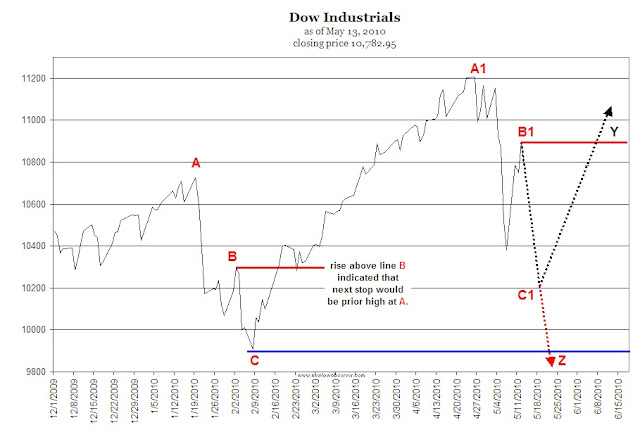
The decline from the intermediate high on May 12, 2010 is now putting in place the prospects for another classic secondary reaction of the Dow Industrials. According to Dow Theory, secondary reactions can range from 33% to 66% of the move upward from the previous low in the last secondary reaction.

In the chart below, you can see that the last secondary low took place at point C on February 5, 2010.

Depending on the point you choose (using the closing price or the intraday low), the Dow reached a low at 9822.83 on February 5th. From the low, the peak in the Dow occurred on April 26th at the intraday high of 11,308.95. Based on the difference of the low and the high, the next potential downside targets are as follows:
  • 10,565.89
  • 10,318.21
  • 9822.83
According to Charles H. Dow, analysis of market action needs to take in any periods that have similar characteristics. In this case, I believe that the Dow is tracing out exactly the same pattern as had happened from January 19th to February 5th. In the points A1, B1, and C1 we can see the pattern that might materialize according to Dow’s theory.
So far, we have already traced out the pattern from A1 to B1. The turn at B1 has laid the groundwork for what we can expect might happen next. The prospect is that we fall below 10,375 and possibly turn upward somewhere around 10,200. However, because of the extreme decline that occurred on May 6th, the Dow could fall as low as point C and still reverse back to the point B1.
If the Dow falls below the blue line at point C, then we can label the market trend as bearish. In addition, all of the moves in the Dow Industrials must be confirmed by the Transportation index. The ideal scenario is that the index goes back to B1 at the very least. However, with all the recent turmoil in the markets, I would not be surprised if we got a bear market signal below point Z.
It should be noted that although I have only discussed a bunch of lines going up and down, the ideas behind the concepts are rooted in fundamentals. The very same fundamentals that formed the basis for investors like Graham, Dodd and Buffett.

The Cloud of ETFs Looms Large

The mystery of the reason why ETFs were such a large proportion of the stock market free-fall on Thursday May 6, 2010 should come as no surprise to readers of this site. In 2009, we published a series of articles on ETF investments that didn’t paint a favorable picture.

The first article, titled “ETF: Mediocrity with No Pretense of Value,” referenced a very important section of the Federal Register which described the way in which ETFs are supposed to work. We offered up our own explanation of how we interpreted the description of the Federal Register text. Our closing remark to that article was the following:
“The blowback from something like this is on par with the unwinding of a derivative contract gone bad.”
The next article that we followed up with was titled “ETF: Indiscriminant Risk.” Our closing comment in that article was:
“As I hinted at before, ETFs pose a tremendous risk to the stock market and the portfolios of the respective ETF will be remembered for the fact that due to a liquidity drain all the stocks held will collapse regardless of value. With little cash on hand and an "automated" form of management there will be a crash on the most liquid stocks because the relatively illiquid stocks won't be able register a bid.”
In a SeekingAlpha.com article titled “U.S. Natural Gas Fund: The Beginning of the ETF Unwinding?”, we asked, “Are we on the cusp of seeing this situation with EFTs unravel?” In the same article we said, with considerable forethought:
“In their zeal to create hedging and leveraging opportunities to the retail investors, leveraged ETF distributors didn't emphasis enough the fact that the risk of loss was far beyond known market risk. Unfortunately, like the FIRREA rule change we could see painful unintended consequences.”
It is our assertion that all of the matters that we’ve raised are salient issues that need to be addressed. It is our view that instruments like ETFs should be left to the professionals exclusively or unwound altogether. The continued belief that retail investors need to invest in an ETF fund that issues “creation units” as described in the Federal Register is a definite recipe for disaster, if not now then at some point down the road.
The source citations from our “ETF: Mediocrity with No Pretense of Value” article and SeekingAlpha’s “U.S. Natural Gas Fund: The Beginning of the ETF Unwinding?” are well worth reviewing. Only after  reviewing all the sources mentioned will it be possible to come to the conclusions that we have regarding ETFs.
Investment Notes:

Email our team here.

Automatic Orders Don’t Provide Protection

The New Low Observer team is quite skeptical when it comes to strategies that are supposed to "protect" the investor from risk of loss. Such strategies as the use of stop orders, limit orders, and the many variations on the theme are supposed to protect an investor if their long-term holding of a stock suddenly declines to a level which would either generate a loss or significantly reduce a profit. Unfortunately, none of these "tools" will save a small investor when the market or an individual stock is under significant strain.
 
On Thursday May 6, 2010, we were given a prime example of why we are against using "protection" strategies offered by your broker to mitigate losses. The kind of collapse and recovery that was seen on May 6th occurs more frequently than most people think. While I admit that few stocks go from $40 to a penny (...or $0.0001 as one of my stock alerts from my broker told me) and then back to $40 in one day like Accenture (ACN) did. Many stocks drop 15% to 20% in a single day based on a larger than expected loss or missing their earnings target by a penny (that infamous penny again). Depending on the quality of the stock, in most cases, the price recovers the losses quite quickly in a matter of weeks or months. Since most people claim to be long term investors, automated orders force small investors out of a stock at unreasonable prices.
 
Some investors have explained that it is foolish not to use a stop loss order because they protect from losing "too" much. After all, wouldn't an investor want to get out of Proctor & Gamble (PG) (no pun intended) if it was bought at $60 then climbs to $62 and then falls all the way down to $55 during market hours? Under normal market conditions I would completely agree, however...it is safest to assume that there are never "normal" market conditions. On May 6th, Proctor and Gamble (PG) essentially recovered all of the losses except the 3% that was on par with the market indexes at the close for the day. If you had a trailing stop loss at $60 then more than likely you would have gotten out of (PG) at or near the lowest price if you held 1000 shares or less.
 
As any regular reader of our site knows, when we issue sell recommendations, we are specific in indicating that stop orders etc... are not to be utilized when selling a stock. Our boiler plate language for every sell recommendation is as follows:
 

"it is always recommended that when selling a stock, one should not place stop orders, limit orders or orders after hours. This leaves the seller in the position of being vulnerable to the whims of the market makers. Instead, place your sell orders only as a market order during market hours. Some would complain that a market order during market hours might leave some profits on the table. However, we would rather leave some money on the table rather than have it taken away from us by the trades that are placed by institutions and market makers."

Most uninformed or new market participants would like to blame computers trading for the rapid sell-off in stocks. However, stock market history suggests that market imbalances are as old as the day is long (this explains why "money" dominates the exchanges of goods and services instead of barter). There is ample evidence from all previous market panics in history to point out who gets the short end of the stick under "fast" market conditions. The use of protection strategies like stop loss orders, etc... usually doesn't work for small investors when it is needed the most.
 
The explanation of the reason why protection strategies don't work is simple and I'll do my best to articulate the concept. When an automatic order is triggered, the sale or purchase of a stock is triggered. However, if you are a small investor, your order to sell 100 shares does not get priority over the single order to sell 1 million shares. If you're a market maker, you're going to be forced to create a market for the million shares even though there are enough small trades equal to 1 million shares to match. However, it is less work and more efficient to match up the large orders first and then worry about the small orders later. It's like having $8 in cash to pay for your items at the grocery store. Five dollars are in ones and the rest is in pennies. Does the clerk start counting the pennies first or the dollar bills?
 
Naturally the million shares and others like them get priority to be cleared from the stock exchange thereby getting preferential pricing instantaneously. Sitting on the sidelines are the small trades that need to be matched up. However, if your 100 share automatic sell order has to wait for multiple million share orders to clear first, then by the time your order is ready to be placed the price of the stock would have fallen well below your original limit price. In some instances, I've seen where the smaller trades are executed 40% below the original trigger. The opposite is true of automatic orders to purchase stocks resulting in the all-too-familiar decline in the stock price immediately after the small investor buys.
 
We don't know how long it will take for small investors to realize the risk of automatic orders. Our position on this matter remains clear, automatic orders are fraught with problems with little in the way of recourse for an unlevel playing field.
 
Investment Notes:

A Comprehensive View On Valuing Earnings

When considering how to value a company, most people concentrate on the earnings and where those earnings will be down the road, either up or down and by how much are they expected to change. If a company happens to miss earnings by as little as a penny, depending on the mood of the market then it could spell doom for the stock price. The guidance given on earnings is often looked at when analysts decide to raise, lower or leave unchanged a buy recommendation (sell recommendation are hardly ever heard.)
 
To be honest, I never believe any of the earnings reports provided by companies. I automatically take the position that all earnings are suspect until proven otherwise. For me, the proof comes in the form of a dividend payment on a consistent basis. I know that this may be a narrow-minded view on the importance of earnings, however I know of no instance of where a dividend payment was retroactively revised lower or reclaimed by a corporation after the payment was made.
 
Given my cantankerous view on the value of earnings, I was surprised by the perspective on earnings presented by Thomas Au, author of A Modern Approach to Graham and Dodd Investing, on the FinancialSense Newshour with Jim Puplava. Mr. Au makes it clear that according to Graham and Dodd, because earnings are so volatile, even in the best-run companies, the primary focus on valuing a company should be on assets and dividends while earnings are a secondary consideration. The following is an excerpt from the interview with Jim Puplava on January 5, 2005:
 
“…The main problem with earnings is that earnings are a guess and relative to the other to components of Graham and Dodd investing [balance sheet and dividends] they are a speculation. Everyone can read a balance sheet and you can know what the balance sheet is, or at least was, as of the last quarterly report. Everyone can look at the dividend rate and the dividend rate conveys information because it is the board of directors best guess as to how much the company can pay out of its earnings while still retaining enough earnings to keep the company going. So you observe those two factors and you should base most of the value of the stock on those two factors. As far as I’m concerned, earnings are gravy or maybe it is the desert, assets and dividends are the dinner.
 
“But we live in a instant gratification society or what I call a junk food society, where everyone is so interested in the quality of desert, in this case earnings, that they forget to think about what the quality of dinner will be, in this case assets and dividends. The worst thing that happens with earnings is that you try to chain link them, instead of looking at the absolute earnings, you then tend to focus on the rates of change. When you start to look at the rates of change you create these instruments called derivatives. Which is very apt because these derivatives are really a play on the rate of change and not on the absolute levels or earnings, cash flow, dividends, or assets.
 
“The consequences [of derivatives] can be found with a gentleman by the name of Nick Leeson at Barings, he put a 200 year-old financial institution out of business or you could also think about Long Term Capital [Management] and you had a [two] Nobel Prize winner[s] on staff and he was thinking in calculus terms and the problem with these quant types is that they’re good at calculus but they forget arithmetic and algebra that the person on the street understands. So they get into the stratosphere and they come up with some arcane formula that is understandable only to others like them and they lose track of the real world. That’s the extreme version of looking at momentum and derivatives.”
I happen to agree with all that Thomas Au has to say about the impact of earnings and the relative importance that we should place on them. After all, Au is deriving his opinion from none other than Graham and Dodd. However, although I believe that earnings shouldn't be the primary focus of a company's financial standing, I do believe in the context under which earnings in a company should be analyzed. Charles H. Dow, founder of the Wall Street Journal and the famous indexes, has an amazing point about how to make earnings comparisons useful to the average investor. According to Dow:
 
"The point of importance for those who deal in industrial stocks is whether the capitalization of the companies into which they propose to buy is moderate or excessive, when compared with the aggregate earnings of the various concerns forming the combination in a period of depression. It is probable that consolidated companies will be able to earn as much in the next period of low prices as the companies forming the combine were able to earn in the last one; hence the very foundation of investments in industrials should be knowledge of what these companies earned, say in 1893 to 1896, making, perhaps, reasonable allowances for economies under consolidation. Where the earnings so shown would have provided dividends for industrials now active, the fact must be regarded as a very strong point in favor of those stocks."
It is important to note that the period of 1893 to 1896 had declines in the market as much as 40%. What is useful about Dow’s view on earnings is that they should be judged in comparison to the prior bear market lows for the company in question. In the instance of a company that experienced a low in earnings in a bear market or during a recessionary period, essentially Dow is advocating the use of the worst-case scenario.
 
The biggest challenge that we face in this regard is that we’ve had a secular bull market from 1982 until 2007. In addition, we’re still in the initial phase of a secular bear market and the dust hasn’t settled about corporate earnings in relation to the March 2009 low. However, it is possible to take data on a company that had a low period of earnings and use that information as the basis for the potential downside target going forward.
 
Earnings are still suspect in my book, however the thoughts of both Thomas Au and Charles Dow help to put the concept of earnings in their proper perspective.
 
Investment Notes:

Nasdaq 100 Watch List

Below are the Nasdaq 100 companies that are within 20% of their respective 52-week low.  Stocks that appear on our watch lists are not recommendations to buy.  Instead, they are the starting point for doing your research and determining the best company to buy.  Ideally, a stock that is purchased from this list is done after a considerable decline in the price and considerable due diligence.

Name Price P/E EPS Yield P/B Pct from Yr Low
Gilead Sciences, Inc. (GILD) $38.37 12.31 3.12 0.00% 4.71 0.95%
Apollo Group, Inc. (APOL) $54.41 13.61 4.00 0.00% 6.23 3.07%
QUALCOMM (QCOM) $36.50 19.47 1.88 2.10% 2.90 3.60%
Ryanair Holdings plc (RYAAY) $24.60 0.00 0.00 0.00% 0.00 3.89%
Activision (ATVI) $10.56 124.24 0.09 1.40% 1.22 6.34%
Yahoo! Inc. (YHOO) $15.29 27.40 0.56 0.00% 1.81 9.45%
Genzyme (GENZ) $51.77 125.66 0.41 0.00% 1.84 9.94%
Symantec  (SYMC) $15.62 40.57 0.39 0.00% 3.02 11.82%
Electronic Arts (ERTS) $17.63 0.00 0.00 0.00% 2.29 12.29%
Cephalon, Inc. (CEPH) $59.38 11.84 5.01 0.00% 1.90 13.00%
Logitech (LOGI) $14.63 40.41 0.36 0.00% 2.65 14.03%
Staples (SPLS) $21.66 21.17 1.02 1.60% 2.35 15.71%
Amgen Inc. (AMGN) $54.46 11.56 4.71 0.00% 2.37 17.22%
RIMM (RIMM) $64.92 0.00 0.00 0.00% 0.00 19.56%
Cintas (CTAS) $25.54 23.87 1.07 1.80% 1.61 19.91%

Watch List Summary

The stock that fell the most from last week's watch list was Ryanair Holdings (RYAAY) which fell -14.47% for the week. There were no stocks that had a gain from the previous week, however Genzyme (GENZ) lost the least at -2.80%. 

Company Change from Last Week
Gilead Sciences, Inc. (GILD) -3.49%
Apollo Group, Inc. (APOL) -5.51%
QUALCOMM (QCOM) -5.97%
Ryanair Holdings plc (RYAAY) -14.47%
Activision (ATVI) -4.92%
Yahoo! Inc. (YHOO) -8.11%
Genzyme (GENZ) -2.80%
Symantec (SYMC) -7.36%

In all, the Nasdaq 100 Watch List of last week lost -6.58% as compared to the Nasdaq 100 index which lost a total of -7.56%.  As with our Dividend Achiever Watch List, the smaller losses and larger gains make the Watch Lists a good place to start investigating your next investment opportunities.  Naturally, we expect that all investment decisions should be done with an eye for selectivity and a willingness to harbor a lot of patience.

New on our Nasdaq Watch List this week is Cintas (CTAS) which is also a Dividend Achiever.  Cintas (CTAS) will be closely followed in the days to come since the company has increased its dividend every year for 27 years in a row.  One caveat regarding the CTAS dividend is that it appears to be paid only once a year around the month of February.  This means that poorly timed purchases can result in large losses without being offset by quarterly dividend payments.
Email our team here.

Dividend Achiever Watch List

At the end of the week, our watch list ballooned to 62 companies. Here is the watch list which ranks current and former Dividend Achievers that are within 20% of the 52-week low for May 7, 2010. Stocks that appear on our watch lists are not recommendations to buy.  Instead, they are the starting point for doing your research and determining the best company to buy.  Ideally, a stock that is purchased from this list is done after a considerable decline in the price and extensive due diligence.

Symbol Name Price % Yr Low P/E EPS Div/Shr Yield Payout Ratio
MON Monsanto Co. 59.09 3.14% 24.62 2.40 1.06 1.79% 44%
HSC Harsco Corp. 26.38 3.37% 19.69 1.34 0.82 3.11% 61%
FRS Frisch's Restaurants, Inc 20.77 4.32% 10.49 1.98 0.52 2.50% 26%
SHEN Shenandoah Telecom 16.95 5.28% 26.48 0.64 0.32 1.89% 50%
VIVO Meridian Bioscience Inc.  18.29 5.66% 23.15 0.79 0.76 4.16% 96%
ADM Archer Daniels Midland Co. 25.94 6.97% 10.67 2.43 0.60 2.31% 25%
HCC HCC Insurance Holdings, Inc. 24.71 7.06% 7.95 3.11 0.54 2.19% 17%
DNB Dun & Bradstreet Corp. 74.10 7.24% 14.88 4.98 1.40 1.89% 28%
THFF First Financial Corp. Indiana  27.19 7.34% 15.72 1.73 0.90 3.31% 52%
LLY Lilly (Eli) & Co. 34.62 7.55% 8.92 3.88 1.96 5.66% 51%
OTTR Otter Tail Corp.  20.10 7.89% 28.31 0.71 1.19 5.92% 168%
T AT&T Inc 25.10 8.24% 12.49 2.01 1.68 6.69% 84%
CWT California Water Service Group 36.26 8.27% 18.79 1.93 1.19 3.28% 62%
VVC Vectren Corp. 23.25 8.70% 14.18 1.64 1.36 5.85% 83%
FII Federated Investors Inc 23.53 8.94% 12.01 1.96 0.96 4.08% 49%
XOM Exxon Mobil Corp.   63.70 8.96% 14.51 4.39 1.76 2.76% 40%
NWN Northwest Natural Gas Co. 43.50 9.77% 15.37 2.83 1.66 3.82% 59%
WEYS Weyco Group, Inc.  22.87 9.85% 20.60 1.11 0.64 2.80% 58%
SVU SUPERVALU INC 13.40 10.47% 7.24 1.85 0.35 2.61% 19%
WMT Wal-Mart Stores, Inc. 52.40 10.67% 14.16 3.70 1.21 2.31% 33%
FFIN First Financial Bankshares, Inc.  51.44 10.72% 19.94 2.58 1.36 2.64% 53%
CTWS Connecticut Water Service, Inc.  21.39 10.77% 17.97 1.19 0.91 4.25% 76%
NTRS Northern Trust Corp.  51.80 10.87% 16.29 3.18 1.12 2.16% 35%
MDU MDU Resources Group Inc. 18.47 10.93% 13.10 1.41 0.63 3.41% 45%
UHT Universal Health Realty Income 32.30 11.03% 20.84 1.55 2.40 7.43% 155%
UMBF UMB Financial Corp.  40.36 11.06% 17.47 2.31 0.74 1.83% 32%
TMP Tompkins Financial Corp. 38.60 11.41% 12.78 3.02 1.36 3.52% 45%
GS* Goldman Sachs Group, Inc.   142.99 11.66% 5.96 24.01 1.40 0.98% 6%
WTR Aqua America Inc 17.39 13.00% 22.58 0.77 0.58 3.34% 75%
SPH Suburban Propane Partners L.P. 44.10 13.08% 11.28 3.91 3.36 7.62% 86%
FPL FPL Group, Inc. 51.22 13.09% 11.59 4.42 2.00 3.90% 45%
AROW Arrow Financial Corp.  25.96 13.20% 13.88 1.87 1.00 3.85% 53%
STT State Street Corp. 41.34 13.73% -10.08 -4.10 0.04 0.10% -1%
ABT Abbott Laboratories 48.72 13.96% 14.29 3.41 1.76 3.61% 52%
BXS BanCorp.South Inc. 20.19 15.04% 27.28 0.74 0.88 4.36% 119%
PGN Progress Energy, Inc. 38.83 15.05% 14.33 2.71 2.48 6.39% 92%
PBI Pitney Bowes Inc   23.53 15.46% 12.26 1.92 1.46 6.20% 76%
NJR New Jersey Resources Corp. 35.76 15.54% 29.80 1.20 1.36 3.80% 113%
BEC Beckman Coulter, Inc. 60.12 15.99% 25.15 2.39 0.72 1.20% 30%
SYBT S.Y. BanCorp., Inc.  22.98 16.06% 18.99 1.21 0.68 2.96% 56%
TR Tootsie Roll Industries Inc  25.42 16.45% 27.33 0.93 0.32 1.26% 34%
BRO Brown & Brown, Inc. 19.01 16.48% 18.10 1.05 0.31 1.63% 30%
ATO Atmos Energy Corp. 27.33 16.60% 12.15 2.25 1.34 4.90% 60%
AWR American States Water Co. 36.12 17.20% 22.30 1.62 1.04 2.88% 64%
NUE Nucor Corp. 44.90 17.32% -187.08 -0.24 1.44 3.21% -600%
PX Praxair, Inc. 78.88 17.40% 19.29 4.09 1.80 2.28% 44%
SFNC Simmons First National Corp.  28.07 17.45% 17.12 1.64 0.76 2.71% 46%
BMI Badger Meter, Inc. 38.41 17.89% 17.70 2.17 0.48 1.25% 22%
HGIC Harleysville Group Inc.  30.76 17.90% 11.19 2.75 1.30 4.23% 47%
MATW Matthews International Corp.  32.51 18.13% 15.71 2.07 0.28 0.86% 14%
JNJ Johnson & Johnson   63.31 18.25% 13.30 4.76 2.16 3.41% 45%
SBSI Southside Bancshares, Inc.  20.61 18.51% 7.75 2.66 0.65 3.15% 24%
PFE Pfizer Inc 16.46 18.84% 13.38 1.23 0.72 4.37% 59%
APD Air Products & Chemicals, Inc. 70.98 19.09% 17.79 3.99 1.96 2.76% 49%
DBD Diebold, Inc. 28.92 19.26% 40.17 0.72 1.08 3.73% 150%
MLM Martin Marietta Materials, Inc. 88.14 19.46% 46.15 1.91 1.60 1.82% 84%
UGI UGI Corp. 26.47 19.72% 12.09 2.19 0.80 3.02% 37%
BCR CR Bard, Inc. 82.97 19.83% 17.54 4.73 0.68 0.82% 14%
CTAS Cintas Corp.  25.54 19.91% 23.87 1.07 0.48 1.88% 45%
MGEE MGE Energy Inc.  35.32 20.05% 15.98 2.21 1.47 4.16% 67%
BMS Bemis Co Inc 27.70 20.28% 21.47 1.29 0.92 3.32% 71%
WGL WGL Holdings, Inc. 34.44 20.46% 15.31 2.25 1.51 4.38% 67%
62 Companies

*Goldman Sachs isn't a former or current dividend achiever but I feel that it is worth watching because it could be the proxy of our financial system.


Watch List Summary

The best performing stock from last week's list was Simmons First National (SFNC) which was at break-even. The worst performing stock was Harsco (HSC) which fell 14.8%. Overall, the Dividend Achiever watch list lost 4.9% versus the Dow which was down 5.7%.

Never before have we seen this many companies on our watch list. Part of the reason could be because the 52-week time frame now ranges from May 2009 to May 2010. You may remember that when the market bottomed in March 2009, I suggest that investors look at the company's performance at its worse possible level, which in many cases was the March 2009 low. 
Use this list to your advantage. There are (and will be) great companies paying nice dividends with low payout ratios. Place these companies in your own watch list so that when opportunities arise, you can purchase them with a greater margin of safety.
Market Commentary
As you may have noticed from our watch list, the market took a turn similar to what happened in January when the Dow retraced about 7% from the peak. At the close of Friday at 10,380, we've pulled back 7% from the closing high. It is interesting to note that in January, the Greek tragedy was already known so this shouldn't have surprised us. Our only concern at this point is, will the Dow fail to hold above the 150-day moving average which has been a strong support level for the market since July. (see chart below)

After seeing what took place on Thursday, I have increased my requirement for a margin of safety in new investment stakes. For example, I may look at companies that are within 15% of a new low instead of 20%. In considering companies to buy or sell, I would aim for a deeper discount (lower price) if I plan to buy and take smaller "fair profits" if I plan to sell. Remember, the market isn't cheap by any standard. With the latest figures I calculated, based on the Friday close, the Dow is now trading at 15x trailing earnings and 11x forward earnings. This assume 36% earning growth for the Dow. On a yield basis, the Dow is trading at 2.76%. Using the Thursday low, the yield was close to 3%. - Art

Email our team here.

Nasdaq 100 Watch List

Below are the Nasdaq 100 companies that are within 21% of their respective 52-week low. Instead, they are the starting point for doing your research and determining the best company to buy.  Ideally, a stock that is purchased from this list is done after a considerable decline in the price and extensive due diligence.
Symbol Name Price P/E EPS Yield P/B % from low
GILD Gilead 39.71 12.74 3.12 0 4.86 0.40%
APOL Apollo 57.41 14.36 4 0 6.53 8.75%
QCOM QUALCOMM 38.68 20.63 1.88 2.00% 3.09 9.08%
ATVI Activision 11.08 130.35 0.09 1.40% 1.31 11.58%
GENZ Genzyme 53.22 129.17 0.41 0 1.91 13.02%
RYAAY Ryanair 28.16 0 0 0 0 13.46%
YHOO Yahoo! Inc. 16.53 29.62 0.56 0 1.93 18.84%
SYMC Symantec 16.77 43.56 0.39 0 3.13 20.04%
Watch List Summary
The best performing stock from last week's list was Qualcomm (QCOM) which rose 1.12%.  The worst performing stock was Apollo Group (APOL) which declined 9.63%.  Worth noting is the fact that Gilead Sciences (GILD) is moving very close to the October 10, 2008 adjust low price of $37.47.  If GILD falls below the $37 level then the next support level is $27 according to Dow Theory.
This is the first time that Yahoo! (YHOO) has appeared on our watchlist.  However, the most accurate low price should be the $8.95 low price that was attained in November 2008.  I would not be surprised to see YHOO become the subject of a takeover if the price falls any further.
While YHOO's price has gone relatively nowhere in the last year, potential acquirers have an expensive stock price on their hands.  This explains why Hewlett-Packard (HPQ) is buying Palm (PALM).  From the period of one year ago, HPQ's stock price has risen over 40% while PALM's had fallen by over 60% in the same time frame.  Stock prices are getting expensive and the only way to resolve this is by issuing more shares to raise capital or by acquiring another company.

Dividend Achiever Watch List

At the end of the week, our watch list contains 29 companies. Here is the watch list which ranks current and former Dividend Achievers that are within 20% of the 52-week low for April 30, 2010. Instead, they are the starting point for doing your research and determining the best company to buy.  Ideally, a stock that is purchased from this list is done after a considerable decline in the price and extensive due diligence.

Symbol Name Price % Yr Low P/E EPS Div/Shr Yield Payout Ratio
MON Monsanto Co. 63.06 1.40% 26.28 2.40 1.06 1.68% 44%
XOM Exxon Mobil Corp. 67.77 6.62% 17.03 3.98 1.68 2.48% 42%
LLY Eli Lilly and Co. 34.97 8.64% 9.01 3.88 1.96 5.60% 51%
FRS Frisch's Restaurants, Inc. 21.91 10.05% 11.07 1.98 0.52 2.37% 26%
SHEN Shenandoah Telecom 17.76 10.31% 27.75 0.64 0.32 1.80% 50%
DNB Dun & Bradstreet Corp. 76.97 11.39% 12.83 6.00 1.40 1.82% 23%
FII Federated Investors, Inc. 24.12 11.67% 12.31 1.96 0.96 3.98% 49%
T AT&T Inc. 26.06 12.38% 12.97 2.01 1.68 6.45% 84%
WMT Wal-Mart Stores, Inc. 53.64 13.28% 14.50 3.70 1.21 2.26% 33%
UHT Universal Health Realty 33.22 14.20% 21.43 1.55 2.40 7.22% 155%
FPL FPL Group, Inc. 52.05 14.93% 13.11 3.97 2.00 3.84% 50%
THFF First Financial Corp. 29.15 15.08% 16.85 1.73 0.90 3.09% 52%
FFIN First Financial Bankshares, Inc. 53.48 15.11% 20.73 2.58 1.36 2.54% 53%
CWT California Water Service 38.73 15.65% 19.86 1.95 1.19 3.07% 61%
HSC Harsco Corp. 30.96 16.00% 21.06 1.47 0.82 2.65% 56%
VIVO Meridian Bioscience Inc. 19.99 16.76% 25.30 0.79 0.76 3.80% 96%
VVC Vectren Corp. 25.01 16.92% 15.25 1.64 1.36 5.44% 83%
TMP Tompkins Financial Corp. 40.62 17.24% 13.45 3.02 1.36 3.35% 45%
WEYS Weyco Group, Inc. 24.44 17.39% 22.02 1.11 0.60 2.45% 54%
SFNC Simmons First National Corp. 28.08 17.49% 17.12 1.64 0.76 2.71% 46%
NTRS Northern Trust Corp. 54.98 17.68% 17.29 3.18 1.12 2.04% 35%
HCC HCC Insurance Holdings, Inc. 27.19 18.11% 8.74 3.11 0.54 1.99% 17%
PGN Progress Energy Inc. 39.92 18.28% 14.73 2.71 2.48 6.21% 92%
NUE Nucor Corp. 45.32 18.42% -188.83 -0.24 1.44 3.18% -600%
WTR Aqua America, Inc. 18.33 19.10% 23.81 0.77 0.58 3.16% 75%
OTTR Otter Tail Corp. 22.22 19.27% 31.30 0.71 1.19 5.36% 168%
ADM Archer-Daniels-Midland 27.94 19.50% 15.70 1.78 0.60 2.15% 34%
NWN Northwest Natural Gas Co. 47.39 19.58% 16.75 2.83 1.66 3.50% 59%
BEC Beckman Coulter, Inc. 62.40 20.77% 28.62 2.18 0.72 1.15% 33%
29 Companies


Watch List Summary

The best performing stock from last week's list was FPL Group (FPL) which rose 1.5%. The worst performing stock was Federated Investors (FII) which fell 6.9%. Overall, the Dividend Achiever watch list lost 1.8% versus the Dow which was down 1.75%.

No two ways about it, stocks got crushed. Monsanto (MON) continued to remain weak but the technical outlook turned rather positive when RSI diverge from the price. We'll have to see if this produce a short term rebound in price. Additionally, two positive notes came from Exxon (XOM) and Weyco (WEYS) which announced dividend increases.

Once again, the key to this list isn't to provide a winner but collectively, we hope that it can be a starting point for you to research these companies and hopefully provide lower volatility, margin of safety and  provide marginally higher return than the general market.

Related Links:
Email our team here.

Notable Dividend Increases

There were two notable dividend increases today from two of the companies on our watch list. The first came from Exxon Mobil (XOM) which raised their payout amount to $0.44 compared to $0.42. An increase of 4.7%. Another company raising payout is Weyco Group (WEYS). After announcing an amazing quarter where diluted earning per share rose 54% (from $0.22 to $0.34), the board approved a 7% dividend hike. Shareholders will  receive $0.16 per share compared to $0.15 per share from prior quarter. - Art
Email our team here.

Sour Grapes: Pharmceutical Product Development Inc. (PPDI)

Sometimes the only way to express your regret for missed opportunities is in the form of bitterness.  In this case the bitterness is in the form of sour grapes as described in Aesop's Fables.  Today's regrettable missed opportunity is Pharmaceutical Product Development (PPDI).  At the close, PPDI was up by 8.18% at a time when the Dow Industrials had fallen by 1.90%.
On July 23, 2009, I bought Pharmaceutical Product Development (PPDI) at $19.26.  I was at my smuggest when I sold the stock for a 9.78% gain in less than 2 weeks.  Suffice to say, had I held on to PPDI from July 2009 until today I would have a 43.5% gain on my hands.  On our February 13, 2010 Nasdaq 100 Watch List, we reiterated looking into PPDI since it had fallen within 21% of the new low.  February 16th, the first trading day after our watch list came out, happened to be in the lowest quintile for 2010 that you could have bought PPDI.  Had anyone followed up on the PPDI recommendation you would have snagged 27.7% in less than 4 months.
Oh well, at least my gain was 260% on an annualized basis as opposed to the annualized gain of 110% since February 2010.  Who needs a stock that goes up 8% when the rest of the market is cratering anyway.
-Touc
Email our team here.

After the Crash of 1929, Recovery was Quick

As a stock market historian, the single best benchmark for all market analysis is the years from 1929 to 1954. This is the period when the Dow Jones Industrial Average peaked at 381.10 in 1929 and fell to the astoundingly low level of 41.20, a decrease of 89.19% in a period less than three years. 1954 was the year when the Dow Jones Industrial Average finally went above the 381.10 level and never looked back.

In my article titled "Dow-Jones' Decline Largely Impacted by Index Changes" on SeekingAlpha.com, I explained that the Industrial Average probably would have never gone as low as it did nor would it have remained below the 1929 peak for as long as it did had it not been for the frequent changes to the index which resembled a trader’s mentality rather than a “long-term” investor. In the following article, I wish to demonstrate that, the market actually recovered much faster than most people think. Additionally, if we were to experience a similar 89% decline in the stock market, we probably can expect that the subsequent recovery would come faster than we think.

Below are a list of 28 companies that reflects their respective high price of 1929 and the low price of 1932. The percentage decline in some cases mirrors what happen to the Dow-Jones Industrial Average with all of the changes to the index during the same timeframe.

As we can see, many companies were dramatically impacted by the decline from 1929 to 1932. However, what is most surprising is the time it took to achieve the break-even point. Exactly half of the companies on the list managed to break even after only eight years in 1937. This is less than the time it took for our current market to get back to the 2000 break-even point. One of the more fantastic recoveries that I’ve seen is the price of Dow Chemical, which recovered all of its losses by 1933. This required a 233% gain in less than a year after hitting bottom.

Another point that can be made for these companies is that if taken as a group (similar to a stock index) it took an average of 12 years for the index to break even. This is in stark contrast to the Dow Industrials finally closing above the 1929 peak in 1954, some 25 years later. This also splashes considerable water on the theory that it was WWII that finally got the stock market (economy) out of the “Great” Depression. The break even of the market based on my calculations explains why 1941-1943 was the beginning of a new bull market according to Dow Theory (depending on the Dow Theorist that you want to believe). That bull market indication was in force until 1966.

If this data seems suspect, then it probably is. After all, I selected the companies that fit my model. Critics could also claim that my retrospective analysis works great in theory but doesn’t hold up to the real world. Others could say that changes to the Industrial Average was necessary and meant that the prior companies didn’t reflect the qualitative standards of a premier index of the Dow. However, a careful analysis of Poor’s High and Low Prices for the periods from 1924 to 1940 would show that an alarmingly large number of companies, both high and low quality, achieved a break even in their respective prices long before the year 1954.

see also:

Low Yielding Stocks Offer Exceptional Gains

As a reaction to the sting of the stock market decline from October 2007 to March 2009, there has been a mad rush by many investors to seek safety by investing in high yield stocks. The problem with investing in high yield stocks is that high yield almost literally means higher risk. This concept is especially true when an investor cannot differentiate between high and low quality stocks in general. What few investors realize is that stocks that generate “low” dividend yields tend to make up for it with above average price appreciation.
 
Unfortunately, a person who is bound and determined to get the highest yield possible is more likely to select a stock that will not stand the test of time as oppose to selecting a company that, although sporting a high yield, has a reputation of good management and a long history of dividend increases like my favorite Dividend Achievers from Mergent’s. Even more striking is the fact that low yielding, high quality, Dividend Achievers run circles around their high quality, high yielding brethren.
 
A great summary on the misguided effort of buying high yield stocks is titled “Investing in High-Yield Stocks” by Dividends4Life (D4L) at SeekingAlpha.com. In the article, the author cites data that shows the immense trade-offs when trying to obtain the highest yields available without regard to quality. D4L later goes on to name some of the very best high quality, high yielding stocks that are part of the Dividend Achiever index of stocks.
 
In an effort to demonstrate the power and conviction of the idea that high quality, low yielding stocks make up for what they lack in yield, I have compiled a list of current and former Dividend Achievers with dividend yields below 3% that have appreciated in value by at least 60%. This list does not include financial (banks, brokerage, and insurance) companies since most, if not all, increased in proportion to their exaggerated declines. Also, this list of stocks excludes non-financial companies that have increased in value more than 30% to 59%. Having so many companies on the list would only overstate the obvious.
 
Symbol
Name Price Yield % Up
XEC Cimarex Energy Co $64.42 0.50% 157.06%
HP Helmerich & Payne, Inc. $42.76 0.50% 60.51%
GCI Gannett Co., Inc. $18.28 0.90% 509.33%
HOG Harley-Davidson, Inc. $35.22 1.10% 134.96%
NDSN Nordson Corp $75.58 1.10% 120.80%
ROST Ross Stores, Inc. $58.40 1.10% 68.11%
HRC Hill-Rom Holdings Inc $31.55 1.30% 177.97%
SCL Stepan Co $74.79 1.30% 113.44%
TJX TJX Co, Inc. $47.69 1.30% 79.15%
TDS Tel and Data Systems, Inc $35.42 1.30% 60.93%
WWW Wolverine World Wide, Inc. $31.50 1.40% 75.00%
FO Fortune Brands, Inc. $53.73 1.40% 70.14%
FELE Franklin Electric Co., Inc. $35.40 1.40% 64.65%
JWN Nordstrom, Inc. $45.34 1.50% 149.81%
JCI Johnson Controls, Inc. $35.01 1.50% 100.98%
FAST Fastenal Co $55.71 1.50% 90.46%
AOS A.O. Smith Corp $52.87 1.50% 88.62%
PH Parker-Hannifin Corp $70.44 1.50% 78.19%
TNC Tennant Co $34.86 1.60% 147.76%
CSL Carlisle Companies $40.75 1.60% 100.54%
MAS Masco Corp $18.10 1.70% 122.09%
SWWC Southwest Water $10.55 1.90% 144.21%
BGG Briggs & Stratton Corp $22.57 2.00% 75.10%
SWK Stanley Black & Decker $63.00 2.10% 101.92%
BRC Brady Corp $33.29 2.10% 79.46%
TFX Teleflex Inc $64.46 2.10% 65.41%
PNR Pentair, Inc $37.85 2.10% 63.15%
AVY Avery Dennison Corp $38.57 2.10% 62.40%
HHS Harte-Hanks, Inc. $13.88 2.20% 112.88%
DOV Dover Corp $50.25 2.20% 70.05%
SJM J.M. Smucker Co $63.01 2.20% 67.71%
GD General Dynamics Corp $78.21 2.20% 64.27%
UTX United Technologies Corp $76.43 2.30% 65.22%
NC NACCO Industries, Inc. $86.59 2.40% 219.64%
FSS Federal Signal Corp $10.01 2.40% 84.35%
ITW Illinois Tool Works Inc. $52.35 2.40% 66.30%
CAT Caterpillar, Inc. $67.51 2.50% 124.96%
MDP Meredith Corp $37.01 2.50% 93.16%
ACO Amcol Intl $30.60 2.50% 89.47%
NFG National Fuel Gas Co $53.10 2.50% 73.76%
MMM 3M Co $86.05 2.50% 64.82%
EMR Emerson Electric Co $52.59 2.60% 73.34%
PII Polaris Industries Inc. $63.99 2.70% 141.11%
HD Home Depot, Inc. $35.72 2.70% 60.40%
KWR Quaker Chemical Corp $32.54 2.90% 211.98%
LYTS LSI Industries Inc. $6.89 2.90% 66.02%
VFC V.F. Corp Co. $86.84 2.90% 63.02%


The average performance of the above 47 low yielding stocks exceeded the 1-year gain (April 23, 2009 to April 23, 2010) in the Dow Industrials by 64%, the Nasdaq Composite by 53% and the S&P 500 Composite by 75%. Although all of the stocks on this list had much higher dividend yields one year ago, they certainly weren’t the “must have” high yield stocks that everyone was clamoring for.

It should be noted that there is a distinct difference between a high yield and a high paying out of company earnings to meet the quarterly dividend payments (also known as payout ratio.) A high dividend yield is derived from the amount of the dividend payment in relation to the current market price of the stock. If a stock is selling for $10 and earnings are $12 per share with the dividend payment at $2, then the dividend yield is 20% and the payout ratio is 16%. However, if the same company with the same dividend payment has earnings per share of $2.05, then the yield is still 20% but the payout ratio is 98%. Although a 20% dividend yield is extremely high, it is unclear how sustainable the dividend is, especially with earnings at $12 per share. However, with a payout ratio of 98%, the likelihood of the dividend being cut is almost guaranteed. It is just a matter of time.
 

Please note that the New Low Observer team does not endorse the purchase of the 47 companies mentioned above. Our strongest conviction lies in the selected companies that are on our Dividend Achiever Watch List for the week ending on April 23, 2010. 

Investing Notes:
  • Avoid stocks with high payout ratios
  • Don’t ignore low yielding, high quality stocks
Email our team here.