Transaction Alert

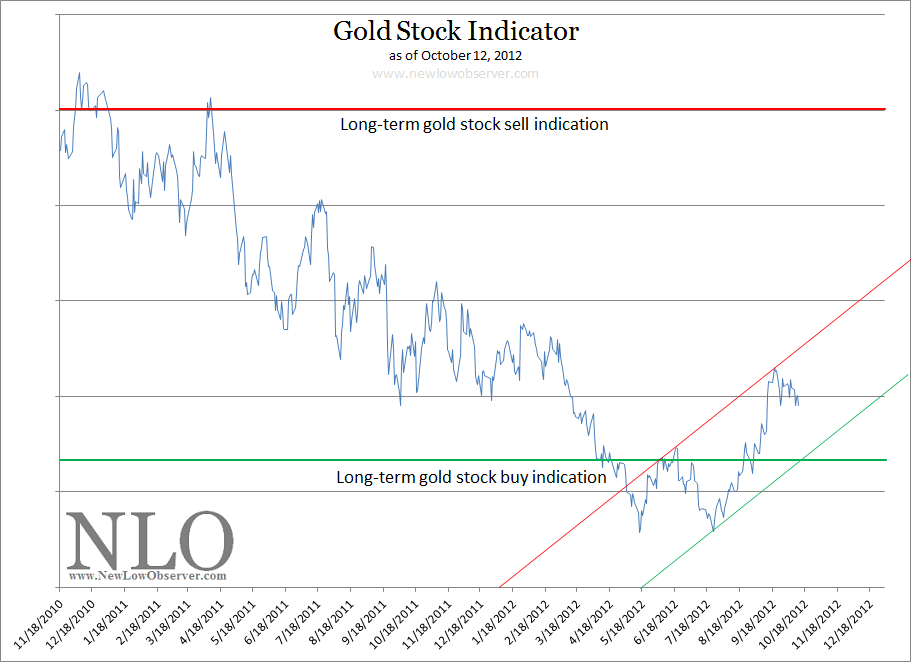
We've bought NUGT at the Market at 12:22pm EST.  We're doing the transaction in two stages:

  1. 50% of the amount we wish to invest now
  2. 50% of the amount we wish to invest after a decline of -10%
  3. we're exiting the transaction after a total loss of -20%
  4. we're exiting the transaction after a gain of +10%, anything above 10% is considered high risk

We bought NUGT based on the dual (short and long-term) indication from our Gold Stock Indicator as indicated in our April 4, 2012 article (found here).
Our preference for using Direxion Gold Miners Bull (NUGT) and Direxion Gold Miners Bear (DUST) ETFs aren’t for the risk averse.  DUST and NUGT are speculative vehicles and not investments meant to be held on a long term basis.

Downside Targets for Herbalife (HLF)

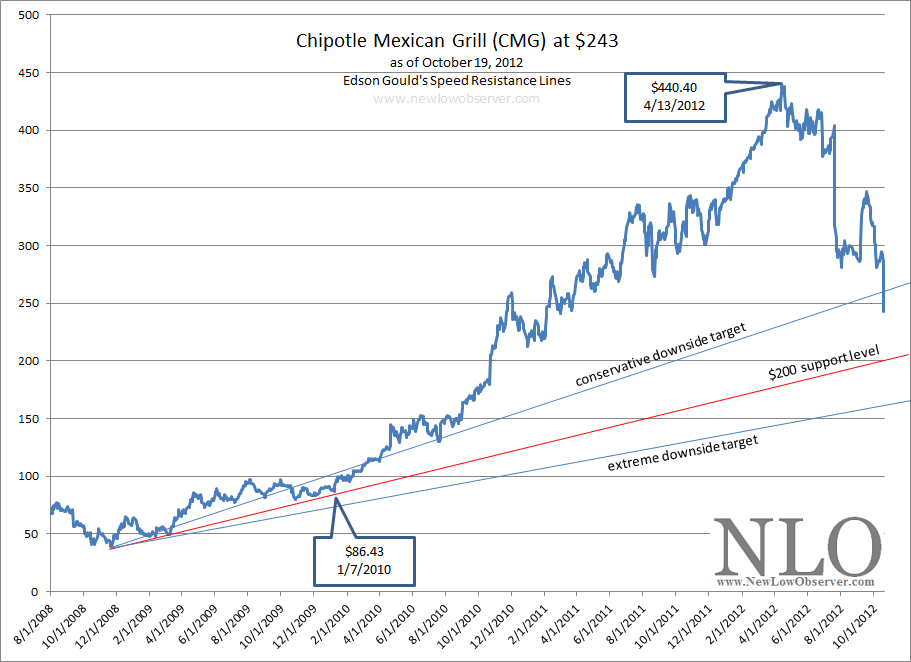
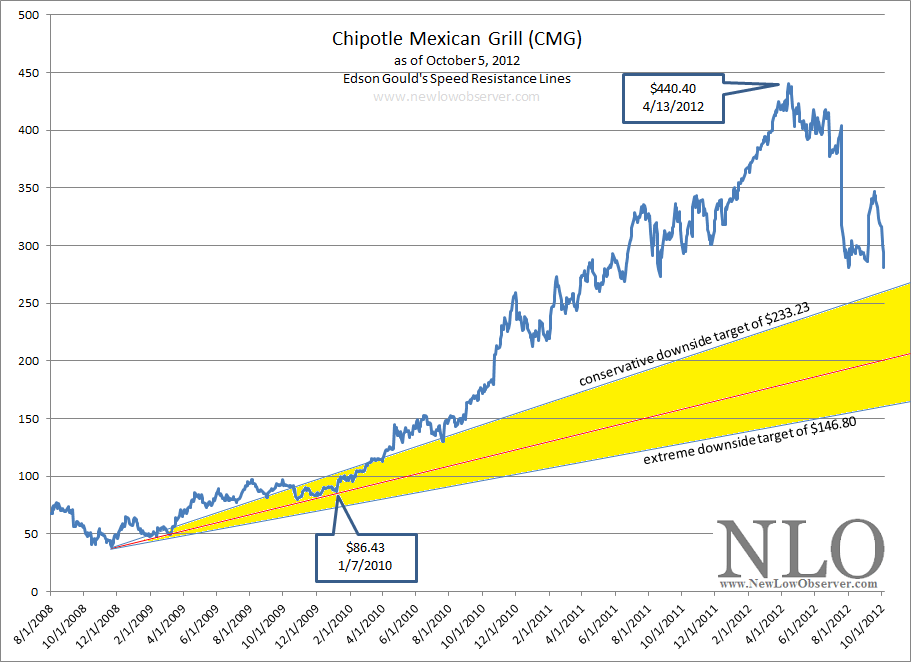
After the news of Herbalife (HLF) getting slammed, we were curious about what the downside targets for the stock might be using Edson Gould’s Speed Resistance Lines.  Below is a chart representing the conservative downside target of $45.45 and the extreme downside target of $24.33.

So far, HLF appears to have support for the stock price at $45.45.  However, if HLF falls below the $45.45 level, it would suggests that HLF will decline to, at minimum, $34.89 before finding stabilization in the stock price.  A decline $24.33 would mean that HLF could revisit the 2009 lows.

image

We believe that it is worth examining whether or not these downside targets are accomplished.  In our view, the downside targets are reasonable estimates of where the stocks could go before initiating new research on whether these companies have viable business models.

Disclaimer: This piece is a continuation of the examination of Edson Gould’s speed resistance lines as explained in prior articles. This is not an endorsement to sell short at the current levels nor buy these stocks once falling below the extreme downside targets.

Green Mountain Establishes New Downside Target

On October 25, 2011, we published a chart of Green Mountain Coffee Roasters (GMCR) that utilized Edson Gould’s Speed Resistance Lines [SRL] to determine what the possible downside targets might be.  At the time, Green Mountain Coffee Roasters was trading at $64.75.  However, our use of the SRL indicated GMCR had a conservative downside target of $59.63 and an extreme downside target of $37.21.

After reach the level of $59.63, GMCR’s stock price rose marginally before falling significantly to the downside resting at the $39.42 level.  Soon afterwards, GMCR rose as high as $70, but did not go above the SRL rising trend established at $59.63.

After reaching the $70 level, GMCR promptly fell to the $37.21 level which established what we believed to be a “support” level (green arrows; definition here).  Support levels, if broken, would result in the stock of GMCR going to the previous downside levels that helped to establish the upside trend at $22.53 and $8.30.

In after-hours trading on May 2, 2012, GMCR plummeted from the closing price of $49.52 to as low as $28.50, a loss of -42%.  We believe that GMCR  has a new support level of $22.53 and upside resistance (definition here) at $42.  If the price of GMCR falls significantly below $22.53 (i.e. $21) then we would expect that the new downside target of GMCR is $8.30.

image

As an investor, if you have a stop-loss order (definition here) at $45, then you’ll only be able to get out of the stock at the next best price.  This means that if GMCR opens at $30 tomorrow, you’re only able to get out of GMCR at $30, not $45-$44 under normal market conditions.  Right off the bat, you’ll lose 33% more than you had planned. 

Typically, when a stock crashes it would usually rebound to a higher level before continuing the declining trend (if it happens to be going lower).  The stop-loss order will trigger automatic selling of GMCR even though we expect that it might rebound from the $28.50 low of today to, at least, $35.50 tomorrow.  If nothing else, selling on the short-lived rebound would reduce the amount of loss while a stop-loss order typically ensures the maximum loss in the shortest period of time.

This explains why we are against the use to stop-loss orders as a means to avoid losses.  The best way to avoid significant lose is to consider the downside targets before buying a stock.  After considering the downside, we recommend putting an amount that you’re comfortable with even if the stock were to decline -50%.

Warner Chilcott up +50% Within Six Months

As we’ve described many times in the past, seeking specific companies at a new low inherently implies that value attributes are far greater than when a stock is trading at a new high.  This has been the case with a majority of stocks that appear on our watch list.

We’ve demonstrated this in the watch list summary section of our April 27, 2012 Nasdaq 100 watch list.  Furthermore, the recent acquisitions of Transatlantic Holdings (TRH) and Cephalon (CEPH) highlight our claim that quality companies invested in near the new low are the most likely candidates to be acquired by much larger companies.  A perfect example is found with news from Warner Chilcott (WCRX).

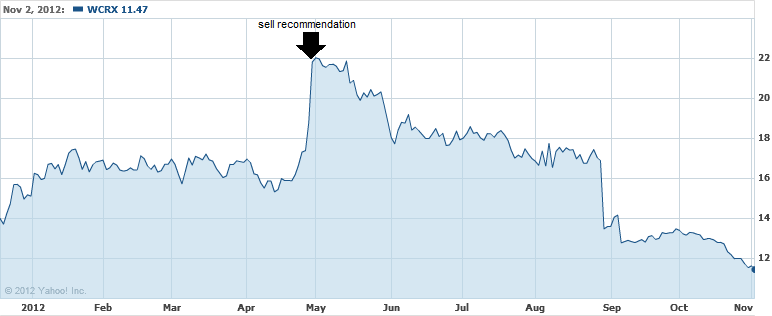
Today it was announced that Warner Chilcott (WCRX) was going to put itself up for sale as a means to “…enhance shareholder value.”  On the news, Warner Chilcott’s stock price rose as much as +20%.  However, as a member of the Nasdaq 100 Index, Warner Chilcott appeared on our December 16, 2011 at $14.02, when the stock was within 8.68% of the 1-year low.

image

On Friday, April 27, 2012, WCRX closed at a price of $18.79, which was already a gain of +34% above the December 16, 2011 watch list price.  Now, with WCRX trading around $22 per share, we believe that the value component of WCRX has been eliminated and recommend that those who own the stock should consider selling the principal, at the very minimum.

Nasdaq 100 Watch List: April 27, 2012

Below are the Nasdaq 100 companies that are within 20% of their respective 52-week lows. Stocks that appear on our watch lists are not recommendations to buy. Instead, they are the starting point for doing your research and determining the best company to buy. Ideally, a stock that is purchased from this list is done after a considerable decline in the price and rigorous due diligence.

Symbol Company Price P/E EPS Yield P/B % from Low
CHRW CH Robinson Worldwide 59.02 22.01 2.68 2.2 7.72 0.49%
FSLR First Solar, Inc. 18.35 0 -0.46 0 0.43 3.03%
EXPD Expeditors Int'l 39.9 22.29 1.79 1.3 4.27 4.31%
CTRP Ctrip.com Int'l 21.66 19.32 1.12 0 2.76 5.40%
EA Electronic Arts Inc. 15.32 0 -0.52 0 2.34 5.80%
INFY Infosys Ltd. 47.06 15.69 3 1.2 4.07 5.87%
APOL Apollo Group Inc. 35.78 7.79 4.6 0 3.99 6.14%
SYMC Symantec Corporation 16.48 15.86 1.04 0 2.58 10.31%
RIMM Research In Motion 14.03 6.32 2.22 0 0.72 12.69%
NVDA NVIDIA Corporation 12.98 13.81 0.94 0 1.93 13.16%
VOD Vodafone Group plc 27.93 12.64 2.21 3.4 1.06 14.89%
SNDK SanDisk Corp. 37.58 10.51 3.58 0 1.29 16.56%
ALTR Altera Corp. 35.56 17.6 2.02 0.9 3.73 17.01%
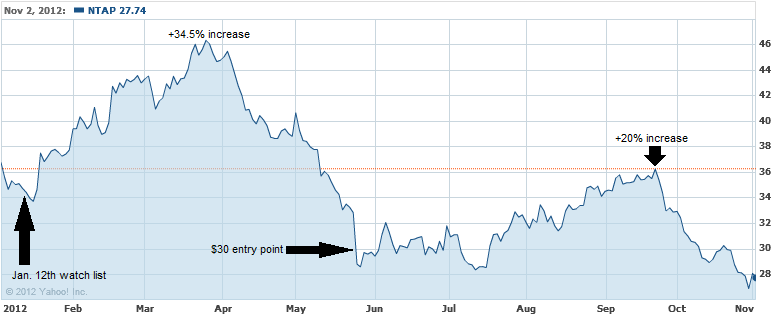
NTAP NetApp, Inc. 39.03 25.99 1.5 0 3.53 18.27%
ORCL Oracle Corporation 29.24 15.32 1.91 0.8 3.37 18.28%
VMED Virgin Media, Inc. 24.45 64.01 0.38 0.7 6.81 19.15%
SRCL Stericycle, Inc. 87.64 32.58 2.69 0 6.08 19.97%
^NDX NASDAQ-100 2,741.34 - - - - -

Watch List Summary

First on our list is Electronic Arts (EA).  the last time Electronic Arts was on our Watch list was on June 6, 2010.  At that time, Electronic Arts was trading at $15.81 with a per share earnings loss of –$2.08 and with a price-to-book ratio of 2.  By July of the next year, Electronic Arts increased in value by +58%.

image

Electronic Arts (EA) has the following downside targets:

  • $12.77
  • $10.22
  • $7.66

Ordinarily, we don’t have a preference for a stock that doesn’t have earnings, however, the reason we focus on the Nasdaq 100 is because we know that lacking any value attributes, companies won’t disappear from the index until the end of each year, unless an acquisition occurs.  This usually means that stocks in this index will likely appear  to rebound due to significant institutional support and the requirement to be invested in constituents of the index.

Next on our watch list is Infosys Ltd (INFY).  Infosys appeared on our  watch list on September 9, 2011 at the price of $47.17.  Less than two months later, Infosys (INFY) increased and peaked at +30% above the price of when it was on our watch list.  Below are the downside targets to consider if purchasing INFY: 

  • $38.43
  • $34.11
  • $29.80
  • $21.17

image

Finally, the next company on our list is Symantec (SYMC) which last appeared on our watch list on December 16, 2011.  At the time, SYMC had a P/E ratio of 17.59 and a price-to-book ratio of 2.49.

image 

Shortly after appearing on our December 16, 2011 watch list, SYMC rose +21%.  The following are the downside targets for anyone considering the purchase of SYMC:

  • $14.24
  • $13.26
  • $12.20
  • $10.05

Considering all of the companies on our watch list, we believe that the three that we’ve covered are reasonable investments at the current time, with money set aside for a second purchase if the stock price declines. 

Watch List Performance Review

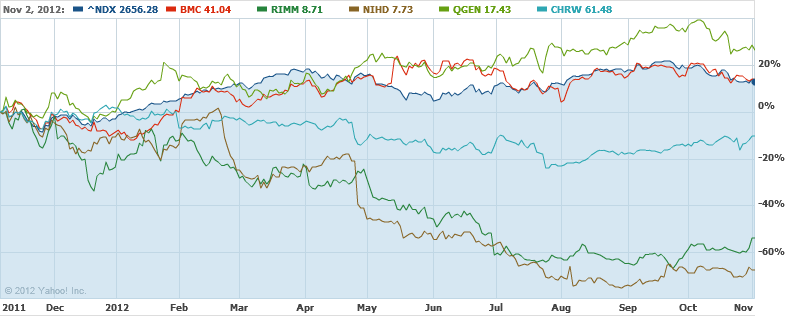
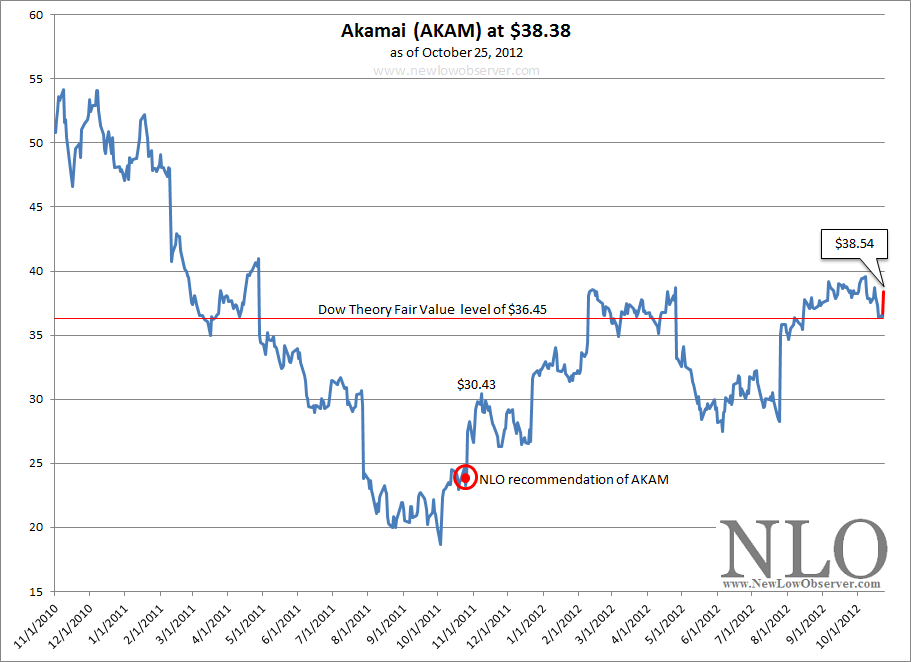
The top five stocks on our watch list from April 29, 2011 got hammered in the market decline from June to October 2011.  Hardest hit was Akamai which fell over –40%.  Only three stocks gained more than +10% within a year.  Right out the gate was TEVA in the first month.  Nearly 9 months after our watch list, CSCO and MRVL were able to gain +10%.  The average return of all five companies in the last year was –0.10%.

symbol Company 2011 2012 % change
Akamai Tech. 34.43 33.18 -3.63%
TEVA Teva Pharma. 45.73 45.63 -0.22%
CSCO Cisco Systems 17.52 19.98 14.04%
URBN Urban Outfitters 31.47 29.21 -7.18%
MRVL Marvell Tech. 15.43 14.89 -3.50%
      Average -0.10%

image

Insurance Watch List: April 27, 2012

The following is one of our personal favorite watch lists.  We started tracking the insurance industry in January 2011 and we’re very impressed with the results so far. 

Anyone who wishes to be successful in insurance stocks should read the book The Davis Dynasty by John Rothchild.  The book starts with Shelby Collum Davis investing approximately $50,000 to $100,000 that ultimately grew to $900 million after 47 years.  The strategies employed by Davis seem more accessible to average investors as opposed to Warren Buffett’s leveraged strategies and education from Benjamin Graham.

Symbol Name Price P/E EPS Yield P/B % from Low payout ratio
NWLI National Western Life Insurance 136.93 8.95 15.3 0.3 0.39 5.33% 2.35%
ANAT American National Insurance Co. 71.08 9.87 7.2 4.3 0.52 8.17% 42.78%
MIG Meadowbrook Insurance Group Inc. 9 10.84 0.83 2.2 0.77 8.83% 24.10%
AFFM Affirmative Insurance Holdings Inc. 0.46 0 -10.66 0 -0.1 9.52% 0.00%
ESGR Enstar Group Limited 96.1 8.89 10.81 0 1.13 11.03% 0.00%
WSH Willis Group Holdings 36.8 31.83 1.16 2.9 2.61 11.38% 93.10%
TWGP Tower Group Inc. 22.05 15 1.47 3.4 0.83 11.48% 51.02%
BWINA Baldwin & Lyons Inc. 23.02 0 -1.9 4.3 1.07 12.24% -52.63%
ASI American Safety Insurance Holdings 19.06 18.87 1.01 0 0.59 12.32% 0.00%
CISG Cninsure Inc. 5.9 0 -0.95 0 0.68 12.81% 0.00%
SAFT Safety Insurance Group Inc. 40.29 44.77 0.9 5 0.92 13.49% 222.22%
CRVL CorVel Corporation 43.72 21.22 2.06 0 4.45 14.93% 0.00%
UFCS United Fire Group, Inc 17 0 0 3.6 0.61 14.94% 0.00%
HTH Hilltop Holdings Inc. 7.93 0 -0.12 0 0.68 15.26% 0.00%
KCLI Kansas City Life Insurance Company 32.7 14.29 2.29 3.3 0.52 16.74% 47.16%
MHLD Maiden Holdings, Ltd. 8.27 21.21 0.39 3.9 0.76 18.31% 82.05%
NATL National Interstate Corporation 24.35 13.31 1.83 1.7 1.34 18.61% 21.86%
FSR Flagstone Reinsurance Holdings SA 7.62 0 -4.65 2.1 0.67 18.88% -3.44%
OB OneBeacon Insurance Group, Ltd. 14.28 24.58 0.58 5.9 1.24 19.00% 144.83%
LPHI Life Partners Holdings, Inc. 2.53 57.5 0.04 16.2 1.1 19.34% 1000.00%
FFG FBL Financial Group Inc. 29.24 29.24 1 1.4 0.7 19.35% 40.00%

Watch List Summary

The following are the most compelling insurance stocks that are currently on our watch list.  First among the companies is Willis Group Holdings (WSH).  According to Yahoo!Finance, Willis Group Holdings (WSH) “provides a range of insurance brokerage, reinsurance, and risk management consulting services to its clients worldwide.”  We believe that the reinsurance segment has the kind of allure that will quickly attract larger buyers.  Although Willis Group Holdings isn’t inexpensive, we believe that the technical conditions can help us determine reasonable prices to concentrate our purchases.

image

From a technical standpoint, Willis Group Holdings is considered fair value at $30.80.  If Willis Group Holdings (WSH) were to fall -50% (our benchmark for proper downside risk assessment), WSH would sell for $18.40 based on the April 27, 2012 closing price.  We believe a two phase purchase can take place at the current price and at any one of the following downside targets:

  • $27.00
  • $19.39
  • $15.39

Next up is Tower Group (TWGP) which “provides commercial, specialty, and personal property and casualty insurance products and services to businesses in various industries and to individuals in the United States” as described by Yahoo!Finance.

image

From the longest available chart, Tower Group (TWGP) has an interesting record.  Although the decline from the 2007 high to the bottom in 2009 was -58%, the stock price hasn’t gone gangbusters since the 2009 low.  At the same time, based on the more conservative data available from Value Line Investment Survey, Tower Group (TWGP) has seen its shares outstanding nearly double while the book value has declined by more than half.  For some reason, Yahoo!Finance indicates that the book value at $26.37, we don’t trust that number and recommend that you always assume the more conservative number.

Despite these concerns, we believe that Tower Group is in the early stages of recovery from the mistakes that were made in the period from 2007 to the present.  The technicals suggest that reasonable purchases in two stages should take place at or below the following downside targets:

  • $19.79
  • $15.76
  • $11.03

Finally, the next stock that we’re interested in from watch list above is American Safety Insurance Holdings (ASI) which “offers specialty insurance and reinsurance products to small and medium-sized businesses in the United States and internationally. Its Excess and Surplus Lines division provides environmental insurance products, such as general contractor pollution and/or professional liability coverage for contractors and consultants; primary general liability coverage for residential and commercial risks; excess and umbrella liability coverage in the construction and products liability areas; and property and packaged property and liability focused on fire exposed premises,” as indicated by Yahoo!Finance.

image

American Safety Insurance Holdings (ASI) is appealing for a couple of reasons.  First, the stock has increased both property/causality income and investment income consistently since 2003.  This performance has increased the book value of ASI by nearly double since 2003, making the company’s stock price appear undervalued by 40%.  A concern that may require some follow-up is the declining levels of underwriting income.

With the risks of a market decline, after the tremendous run from 2009 to the present, we would buy ASI at the current price and then again at the following downside targets spread over three different level:

  • $16.96
  • $11.53
  • $9.53

Insurance Watch List Performance Review

The following is the performance of the stocks that were on our last Insurance Watch List dated January 27, 2012.

Symbol Company 1/27/2012 4/27/2012 % change
Y Alleghany 288.05 340.97 18.37%
NWLI National Western Life Insurance 143.2 136.93 -4.38%
ANAT American National Insurance 71.88 71.08 -1.11%
TWGP Tower Group 21.72 22.05 1.52%
HCC HCC Insurance Holdings 27.8 31.92 14.82%
Average 5.84%
KIE S&P Insurance ETF 38.85 42.23 8.70%

image

So far, Alleghany (Y) and HCC Insurance Holdings (HCC) have torn the cover off the ball when compared to the S&P Insurance ETF (KIE).  Alleghany has gained +18% while HCC has gained +14%.   On the opposite end of the spectrum, National Western Life Insurance (NWLI), American National Insurance (ANAT) and Tower Group (TWGP) have underperformed the +8% gain of the S&P Insurance ETF (KIE).  Again, this has only been a 3-month period so the underperformance suggests that there should not be any alarm about the declines so far.

Transaction Alert: Sold NUGT

We have sold our positions of NUGT.

A Warning for Chesapeake Energy Stockholders

While it appears that Chesapeake Energy  (CHK) has seen all the punishment that could possibly lay ahead, we’re concerned that the previous technical pattern in the period from 1993 to 1999 is about to repeat.  In the chart below, we’ve applied Edson Gould’s Speed Resistance Lines [SRL] to the price of CHK in the period from 1993-1999 and 1999-2012.

image

Critical to our analysis using Edson Gould’s SRL is the fact that, so far, CHK has replicated every move that has occurred in the ‘93-‘99 period in the most recent price activity from ‘99-‘12.  While it would appear academic that the stock has been in a declining trend, we’re more concerned with the downside risk.

With this in mind, if CHK declines below the red line at x2, then we believe CHK will return to the pivot level of $4.94 with the possibility of declining all the way back to 1999 prices.  If CHK falls significantly below the $4.94 level, then the stock has a high likelihood of going all the way $0.67.  This would be a replication of CHK falling below x1, and returning to the previous pivot level of $2.00, set in 1994.

This “warning” does not suggest that CHK cannot go back to the prior highs at $55 (for now), instead, this review is strictly intended to consider the downside risk, which is our only concern.

Who is Edson Gould?

“Edson Gould spent over 60 years working in and studying financial markets. Gould studied the arts at Princeton, engineering at Lehigh (from where he graduated in 1922), and finance at New York University. In 1922, after working for a short time at Western Electric, he joined Moody’s Investor Service as an analyst and later was editor of Moody’s Stock Survey, Bond Survey, and Advisory Reports. In 1948, he began at Arthur Wiesenberger & Company, where he developed and edited the well-known Wiesenberger Investment Report and became a senior partner. He also was Research Director at E. B. Smith (which later became Smith Barney), and worked for Nuveen.”

(source: Market Technicians Association. Gould, Edson Beers, Knowledge Base. Accessed April 26, 2012. link MTA reference.)

“Market technician Edson Gould always laughed at the idea of having a significant influence on the stock market, but his predictions were the most precise around. He pinpointed major bull markets and prophesied bottom-out markets as if he had his own peephole into the future. But in place of a crystal ball and wacky off-the-cuff schemes, his were smart, intensely researched and time-tested theories that made him a legend in the investment community.”

(source: Fisher, Kenneth L.. 100 Minds That Made the Market. Business Classics, Woodside, CA. 1993. page 320.)

Transaction Alert: Sold AEM & GFI, Bought NUGT

We have sold our positions in AEM and GFI and used the proceeds from those transactions to buy NUGT.  We sold both AEM and GFI at a loss of slightly more than -5%. We decided not to over-concentrate  in one sector by adding a third gold position.

We bought NUGT based on the dual (short and long-term) indication from our Gold Stock Indicator as indicated in our April 4, 2012 article (found here).
Our preference for using Direxion Gold Miners Bull (NUGT) and Direxion Gold Miners Bear (DUST) ETFs aren’t for the risk averse.  DUST and NUGT are speculative vehicles and not investments meant to be held on a long term basis.

U.S. Dividend Watch List: April 20, 2012

Watch List Summary

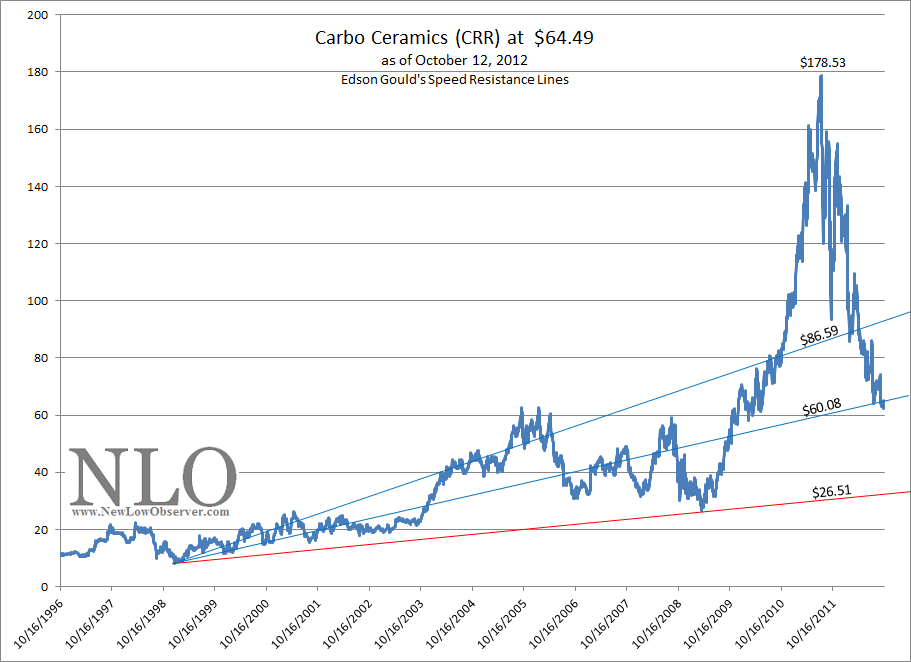
Carbo Ceramics (CRR) appears on our list again this week. The stock retested its low of $85 and broke that level to settle at a new low of $81.60. The closest breakout was $80 in 2008 so we’d look for that to be a good support level. Dividend yield of 1.2% isn’t enticing by any mean to income investor but historically speaking, it is closer to its upper band of the company dividend yield. Payout ratio of 17% all so provide large margin for safety. With oil price below $110, we believe it put pressure on the stock price. Driller will not seek to expand their capital expenditure if oil price remain at this level.

Johnson & Johnson (JNJ) made our list this week. There’s no need for introduction for this household name which offers 3.58% yield. Going back to our list from April 8, 2011you will noticed that JNJ traded at $59.46 and yield of 3.63% ($2.16/share). In the following month, the company announced a 5% rise in dividend to $2.28 per share. This served as a fundamental floor for JNJ price. Stock has risen by about 7% since, excluding dividend. With the month of May around the corner, we can certainly make an educated guess that JNJ will likely raise their dividend again, creating another “bottom” for the stock price. While the stock may no provide the excitement trader need, value investor can concentrate a large portion of their portfolio and get a good risk adjusted return from this company when purchased at the right moment.

For more information on companies such as Tootsie Roll (TR), C.H. Robinson (CHRW), and Matthews International (MATW) please refer to our watch list from April 6th.

Symbol Name Price % Yr Low P/E EPS (ttm) Dividend Yield Payout Ratio
CRR Carbo Ceramics, Inc. 86.48 0.93% 15.39 5.62 0.96 1.11% 17%
NFG National Fuel Gas Co. 45.85 3.78% 14.70 3.12 1.42 3.10% 46%
TR Tootsie Roll Industries Inc  22.52 4.11% 30.43 0.74 0.32 1.42% 43%
CWT California Water Service 17.75 6.61% 19.72 0.9 0.63 3.55% 70%
CHRW C.H. Robinson Worldwide, Inc.  66.52 6.77% 25.39 2.62 1.32 1.98% 50%
MATW Matthews International Corp.  30.56 6.97% 12.63 2.42 0.36 1.18% 15%
ANAT American National Insurance 70.85 7.82% 9.84 7.2 3.08 4.35% 43%
JNJ Johnson & Johnson  63.71 7.84% 18.26 3.49 2.28 3.58% 65%
PPL PP&L Corporation 27.15 8.60% 10.06 2.7 1.44 5.30% 53%
JW-A John Wiley & Sons Inc. CL 'A' 45.62 - 14.48 3.15 0.80 1.75% 25%
UNS UniSource Energy Corporation 35.98 9.16% 13.08 2.75 1.72 4.78% 63%
EXPD Expeditors International of Washington, Inc.  41.96 9.70% 23.44 1.79 0.50 1.19% 28%
NJR New Jersey Resources Corp. 43.45 9.72% 13.45 3.23 1.52 3.50% 47%
WEYS Weyco Group, Inc.  22.85 9.75% 16.68 1.37 0.64 2.80% 47%
BDX Becton, Dickinson and Co. 76.43 9.83% 13.95 5.48 1.80 2.36% 33%
FNFG First Niagara Financial Group Inc.  9.07 10.34% 14.17 0.64 0.32 3.53% 50%
AROW Arrow Financial Corp.  23.73 10.37% 12.69 1.87 1.00 4.21% 53%
HRL Hormel Foods Corp. 28.59 10.51% 17.12 1.67 0.60 2.10% 36%
UGI UGI Corp. 26.61 10.55% 14.62 1.82 1.04 3.91% 57%
HNZ HJ Heinz Co. 53.29 10.63% 17.76 3 1.92 3.60% 64%
CAH Cardinal Health, Inc.  41.55 10.71% 15.39 2.7 0.86 2.07% 32%
21 Companies

Is a Recession Coming?

Review

On August 23, 2009, using Dow Theory and the Industrial Production Index [IPI], we predicted that the National Bureau of Economic Research (NBER) was going to say that the recession ended in June 2009 (article here).  We specifically said the following:

“Implicit in my discussion of the IPI [Industrial Production Index] is that we are at a turning point for the economy. Based on the combination of the Dow Theory confirmation of July 23, 2009 and the IPI turning up from the June low, I will have to guess that the National Bureau of Economic Research (NBER) is going to proclaim June 2009 as the official end to the recession. The end to this recession will be lackluster and questioned from all corners.”

As has been the case historically, the announcement that the recession had ended came 1-year and 3 months after the fact (NBER announcement found here.)  Additionally, few have been satisfied with the definition of a recovery especially if it means that job growth and income increases have not been exceptional.

Now we are faced with what we believe could be the defining moment for a sustained stock market and economic decline worthy of being deemed (by NBER) a recession.  The factors that go into this assessment are based on our interpretation of Dow Theory and the vacillations of the Industrial Production Index.

Dow Theory

Starting with Dow Theory, we have the following established indications:

  • On August 2, 2011, Dow Theory indicated that we were in the initial stages of a cyclical bear market (article here).  At the time, the Dow Jones Industrial Average (DIA) and the Dow Jones Transportation Average (IYT) fell below their respective June and March 2011 lows.
  • On August 9, 2011, we indicated that a bottom had been reached and that a bear market rally to prior highs was due, within the context of a cyclical bear market (article here).
  • On March 16, 2012, we demonstrated that the divergence between the Dow Jones Industrial Average and the Dow Jones Transportation Average was confirmation that we’re in a Dow Theory bear market rather than a renewed bull market (article here).

Generally speaking, Dow Theory acts as a leading indicator of the direction of the overall economy, with the Industrial Production Index following behind as confirmation.  In this case, this is the first month that the Industrial Production Index (IPI) has declined after the Dow Theory bear market indication of August 2, 2011.

Industrial Production Index

Historically, the Industrial Production Index has “averaged” a decline of 1.44 consecutive months in periods of an economic growth period.  This suggests that if the Industrial Production Index declines for two full months in a row, it would be enough to give us the all clear as to whether we can consider the economy as having reverted back into a recession after the rise from the June 2009 bottom.  This interpretation relies on Dow Theory also having a bear market indication.  In order for this to be the case, The Dow Industrials and Dow Transports would need to remain below their respective 2012/2011 peaks.

Month IPI data
August 2011 94.1845
September 2011 94.3800
October 2011 94.9389
November 2011 95.0939
December 2011 95.9095
January 2012 96.5705
February 2012 96.5731
March 2012 96.5685
Source: St. Louis Fed

What would the Market Impact Be?

So far, we expect that the recessionary period would have at least four consecutive months of declines in the Industrial Production Index (IPI) and a total of at least  7 non-consecutive months of declines within the period considered a recession.  This would be on par with the recession from July 1990 to March 1991.  At the time of the 1990 to 1991 recession, the S&P 500 (SPY) declined -19.61% and the Nasdaq Composite Index declined –29.90%.

However, The stock market typically leads the call of a recession by topping out first.  this suggests that potentially, the April 2, 2012 high for the Dow Industrials was the top and we're now in a declining trend at least until August/September 2012 to 10,611.59.

Again, our preliminary prediction is that if we see a second month of declines in the Industrial Production Index while the Dow Theory bear market indication is in place, we’ll have what will be considered a recession by the NBER which would be announced from 9 months to a year after the fact.

As a sidebar to the discussion of the possibility of a recession, the long-term gold stock positions that we've recently recommended which includes Agnico-Eagle (AEM),  Gold Fields Ltd. (GFI) and Newmont Mining (NEM) will require reduced exposure or sold off since gold and silver stocks tend to perform worse than the general stock market during a recession.

Note: Industrial Production Index data is subject to constant revisions by the Federal Reserve Bank.  We hope to reassess the Industrial Production Index based on the most updated information that is provided by the Federal Reserve.

What Does Warren Buffett See in IBM? Maybe This

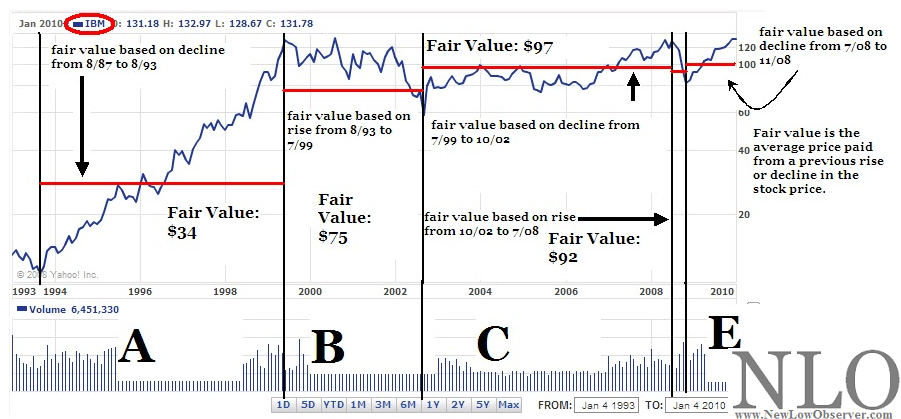
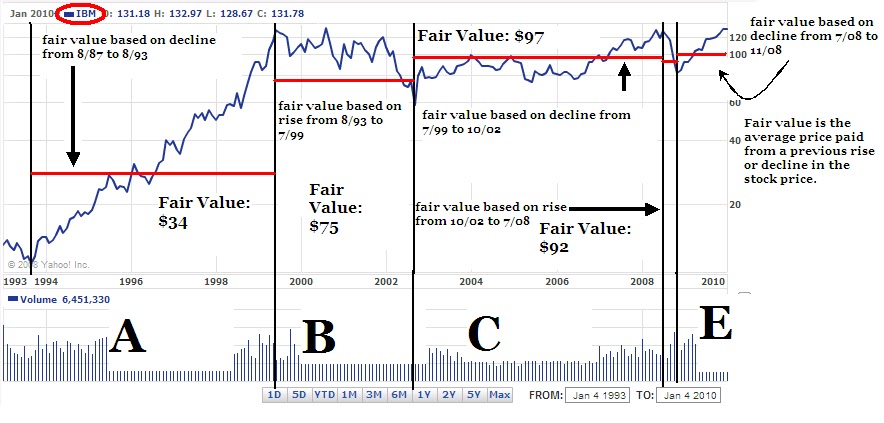
We don’t talk fundamentals much, if at all.  However, the chart below says a lot about why Warren Buffett might bother with buying IBM, a technology company, when the stock is trading near an all time high.

image

Buffett's latest annual report goes to great length in citing IBM's stock repurchase plan among other reasons why he bought the company's shares.  Buffett says the following:

"Let’s do the math. If IBM’s stock price averages, say, $200 during the period, the company will acquire 250 million shares for its $50 billion. There would consequently be 910 million shares outstanding, and we would own about 7% of the company. If the stock conversely sells for an average of $300 during the five-year period, IBM will acquire only 167 million shares. That would leave about 990 million shares outstanding after five years, of which we would own 6.5%.

"If IBM were to earn, say, $20 billion in the fifth year, our share of those earnings would be a full $100 million greater under the 'disappointing' scenario of a lower stock price than they would have been at the higher price. At some later point our shares would be worth perhaps $1.5 billion more than if the 'high-price' repurchase scenario had taken place." (Source: 2011 Berkshire Hathaway Annual Report. page 6)

In order for IBM to make ever increasing dividend payments and massive stock repurchases, IBM has to be generating serious cash flow.  The combination of the two are creating an undervalued situation that may not exist for quite some time in the future.

As we’ve said before, Edson Gould’s Altimeter is a summary of relative values for a stock's price which only requires additional fundamental information for support.  We saw a similar undervalued Altimeter in Transatlantic Holdings (TRH) and Wesco Financial (WSC) which prompted our articles titled "Transatlantic Holdings: A Value Proposition Worth Consideration" and "Wesco Financial: Fundamentals and Technicals Are Aligned" before Buffett made a bid for both companies.

In this case, the dividend has been rising much faster than the stock price, among the many reasons that Buffett might be interested in a technology stock near an all-time high.

Now, just imagine what the stock will look like after falling to a 52-week low.

Transaction Alert: Sold NUGT at the Market

We sold NUGT at the market this morning at a minor gain. Two factors played in the decision to sell even though we just had a buy signal the day before:

  •  Last night, the Industrial Production Index (found here: St. Louis Federal Reserve Bank) declined for the first time since the Dow Theory Bear Market signal on August 2, 2011.  This may be the nail in the coffin in the bear market rally (Our call on a market bottom and bear market rally found here: August 9, 2011).
  • Yesterday, April 17, 2012, gold fell while gold stocks rose.  Either gold has to increase or gold stocks need to fall.  Today gold is sliding confirming that the run in gold stocks must be false.  We make specific reference to false indications of when gold falls and gold stocks rise (found here: November 2, 2011)

This is the nature of speculation.  We'll re-enter our speculative position at another time.

Transaction Alert: Buying NUGT at the Market

We are buying Direxion Daily Gold Miners Bull 3X Shares (NUGT) at the market on April 17, 2012 as our Gold Stock Indicator was triggered just before the close on April 16, 2012.

As we’ve mentioned in the past, we are only seeking gains of +7.5% in NUGT.  Our involvement in NUGT is highly speculative and only for short-term gains/losses.

Nasdaq 100 Watch List: April 13, 2012

Below are the Nasdaq 100 companies that are within 20% of their respective 52-week lows. Stocks that appear on our watch lists are not recommendations to buy. Instead, they are the starting point for doing your research and determining the best company to buy. Ideally, a stock that is purchased from this list is done after a considerable decline in the price and rigorous due diligence.

Symbol Name Price P/E EPS Yield P/B % from Low Div/Share
CHRW CH Robinson Worldwide Inc. 64.13 24.48 2.62 2 8.45 2.94% 1.32
CTRP Ctrip.com International Ltd. 21.33 19.01 1.12 0 2.79 3.29% 0
APOL Apollo Group Inc. 36.7 7.99 4.6 0 4.13 3.53% 0
RIMM Research In Motion Limited 12.89 5.81 2.22 0 0.68 3.53% 0
FSLR First Solar, Inc. 20.83 0 -0.46 0 0.52 4.05% 0
EA Electronic Arts Inc. 16.18 0 -0.52 0 2.42 5.34% 0
INFY Infosys Ltd. 49.15 17.01 2.89 1 5.53 6.57% 0.56
GMCR Green Mountain Coffee Roasters 43.59 22.43 1.94 0 3.33 10.58% 0
VOD Vodafone Group plc 26.95 12.36 2.18 3.5 1.04 10.86% 0.95
AMZN Amazon.com Inc. 188.46 137.56 1.37 0 11.19 12.87% 0
ORCL Oracle Corporation 28.5 14.93 1.91 0.8 3.33 15.29% 0.24
SRCL Stericycle, Inc. 86.1 32.01 2.69 0 6.13 17.86% 0
VMED Virgin Media, Inc. 24.2 64.19 0.38 0.7 6.86 17.93% 0.16
WCRX Warner Chilcott plc 15.34 22.9 0.67 0 57.52 18.91% 0
ATVI Activision Blizzard, Inc. 12.42 13.5 0.92 1.4 1.35 19.42% 0.18
^NDX NASDAQ-100 2,846.04 - - - - - -

Watch List Summary

On this week’s list we’re focusing on the stocks that have single digit price-to-earnings ratios (P/E).  Stock investing theory suggests that investors should focus on, among other things, stocks with a low P/E ratio because the higher the ratio the more expensive a price is being paid for the company’s current and future earnings.

In theory, the P/E ratio reflects the number of years it takes to get to break even on the investment.  In the case of C.H. Robinson (CHRW) with a P/E ratio of 24, it would take 24 years to break even on your investment unless CHRW were able to increase their earnings over time.  As a word of warning, a low P/E can be an indication of a lack of confidence in some aspect of the company’s business model or competitive strategy.  Be on the lookout for the reason why these companies have a low P/E ratio.

First up is Apollo Group (APOL)  with a P/E ratio of 7.99.  According to Dow Theory, APOL has no downside risk???! This seems to be confirmed by the fact that the stock is near a 52-week low and slightly above the low set in 2007.  Having no apparent downside risk seems implausible so we’ve used the 2000 low of $10 to the high of $93.49 in 2004 to come up with some kind of assessment of risk.  When considered from these levels, APOL has the following downside targets:

  • $28.55
  • $19.27
  • $13.92
  • $10

image

The next stock with a low P/E ratio on our list is Research In Motion (RIMM) with a ratio of 5.81.  RIMM has been batter due to it’s loss of competitive edge against Apple (AAPL) and Google’s (GOOG) Android operating systems.  Our best guess is that if RIMM isn’t going out of business then it must be the single best investment of the decade.  As with lottery tickets the gains are enormous but the odds against winning are significant, this is the way that we’d treat this company.  However, unlike the lottery, RIMM has the potential to rise from the ashes with its large cash hoard and depressed stock price.

image

Watch List Performance Review

In review of our watch list from April 15, 2011, two of the companies underperformed the Nasdaq 100 index by a wide margin.  However, four of the top five companies on our watch list achieved our goal of +10% within a 1-year timeframe.

Symbol
Name 2011 2012 % change
CSCO Cisco 17.03 19.85 16.56%
URBN Urban Outfitters 30.64 28.67 -6.43%
TEVA Teva Pharma. 50.01 44.19 -11.64%
AMGN Amgen 55.51 65.59 18.16%
MSFT Microsoft 25.37 30.81 21.44%
Average 7.62%
^NDX Nasdaq 100 2408.3 2846.04 18.18%

image