Considering the Downside Prospects for Apple

For the New Low Observer team, it has been an uneventful period in our watch of Apple Inc. (AAPL) stock since February 5, 2012 even though the price has risen nearly 40%.  What in the world would we consider eventful in regards to Apple stock? Well, we’d  like to see Apple hit one of Edson Gould’s speed resistance line downside targets.  The chart below is an update of the one that we submitted earlier this year (found here).

image

The new downside targets are as follows:

  • $424.15
  • $297.43
  • $212.08

Based on the current run in Apple Inc. stock, the Dow Theory fair value is $275.44. (636.23-85.35)/2=275.44

As we said on February 5, 2012, “the rampant enthusiasm for AAPL suggests that the stock isn't likely to decline to the indicated levels any time soon.” This has definitely been the case with the impressive run up since the beginning of the year.

In order to diffuse the legitimate claims that we’re grasping at straws simply to make a bearish case against Apple Inc., we’ve provided the price performance of the stock over a similar 7-year period from December 19, 2000 to December 31, 2007 applying Edson Gould's speed resistance lines, in the chart below.

image

What stands out the most in the period from 2000-2007 is the percentage increase in Apple’s stock price compared to the current run-up as indicated below:

  • 12/19/2000-12/31/2007: +2,300.67%
  • 9/7/2005-4/13/2012: +1,079.56%

If we were to ask the question of what was the likelihood of Apple falling to $133.22 on December 31, 2007, we believe the chorus of Apple investors would say, “not likely, if ever.”  Similarly, we believe that, based on the current speed resistance lines, no one would expect Apple to decline to our conservative downside target of $424 let alone falling to the  $212.08 worst case price.

We’re not advocating that we’ve seen the peak in Apple’s stock price especially when we compare the fundamental data on AAPL between the 2007 peak and the current price:

Apple (AAPL) 2007 2012 % change
Sales per share 27.52 170.2 +518.45
‘‘Cash Flow’’ per share 4.37 46.5 +964.07
Earnings per share 3.93 43.8 +1,014.50
Div’ds Decl’d per share 0 2.65 N/A
Cap’l Spending per share 0.84 5.65 +572.62
Book Value per share 16.66 138.85 +733.43
Common Shs Outst’g 872.33 940 +7.76
P/E Ratio @ high price 43.53 17.23 -60.42
Source: Value Line Investment Survey Oct. 12, 2007 April 6, 2012

However, in 2007, it was justified for a non-dividend paying technology company to have a P/E ratio in the 40’s while a company that could easily become a dividend aristocrat would be considered fairly priced with a P/E ratio of 17.

Since we believe that markets are supremely inefficient, the perceived extremes to the upside are likely to be counteracted to the downside.  Edson Gould’s speed resistance lines provide a progressive downside target as Apple’s price increases.  If the price decline achieves any of the downside targets, we’ll be ready to re-examine the company fundamentals for long and short-term investment opportunities.

Barrick Gold or Newmont Mining?: Edson Gould’s Altimeter Makes the Call

There are few times that we’ll actually recommend individual gold stocks because much of the available statistical data supports the view that gold stocks are inferior investments when compared to products like SPDR Gold Trust (GLD) or the iShares Silver Trust (SLV), let alone the peace of mind with ownership of the physical metals. The following are the three most prominent examples of when gold stocks didn’t make the grade.

First,  in the period from 1925 to 1932, a basket of gold stocks declined as much as  -64.81% when Homestake Mining is included in the index.  In a article titled “The Lessons of Homestake Mining in Gold Bull and Bear Markets,” we’ve outlined a majority of the reasons why Homestake did so well when other gold stocks didn’t. If we exclude Homestake Mining from the 1925-1932 period, gold stocks declined –76.47% in an equal-weighted gold stock index as reflected below.

image

Second, in the period from 1940 to 1960, although interest rates on the 10-year Treasury bond doubled from 2% to 4% and the 3-month Treasury bill increased nearly 800%, Barron’s Gold Stock Index was virtually unchanged in the same period of time.  Additionally, investors who feared “the coming inflation” and stayed out of general equities missed an inflation adjusted gain of  nearly 400% in the Dow Jones Industrial Average (DIA).

Third, in the middle of the raging gold bull market from 1971 to 1980, gold stocks routinely underperformed the price of gold.  In our articles on Seeking Alpha titled “A Strategy Is Needed for Lagging Gold Stocks” and “Why Gold Will Decline More Than the Markets,” we reviewed the instances where gold stocks routinely underperformed the price of gold or the stock market in general.  Worse still, Barron’s Gold Stock Index peaked in 1974 and declined -66% only to return to breakeven five years later, just before the blow-off stage in the gold bull market.  We can now add the selloff from July 2011 to April 2012 to the long list of severe underperformance of gold stocks, during a bull market in gold.

image

With the above facts in mind, it isn’t taken lightly that we would recommend gold stocks at this point.  However, a strategy is needed in order to outmaneuver the gold stock gremlins. In a recent Seeking Alpha instablog, we outlined the short and long-term gold stock price activity using our Gold Stock Indicator (found here) which is nearing a dual “buy” indication.

In our last article on gold stocks to consider, we used Edson Gould’s Altimeter highlighting Agnico-Eagle (AEM) and Gold Fields (GFI).  In this article we’re going to apply Gould’s Altimeter to Newmont Mining (NEM) and Barrick Gold Corp. (ABX). Gould’s Altimeter reflects the relative value of a stock based on the current dividend that is being paid.  Although Newmont Mining and Barrick Gold Corp. are near one year lows and have consistent dividend policies, Gould’s Altimeter sheds a completely different light on matters, leaving only one company a compelling investment opportunity after additional due diligence.

According to Yahoo!Finance, Newmont Mining engages “in the acquisition, exploration, and production of gold and copper properties. The company’s assets or operations are located in the United States, Australia, Peru, Indonesia, Ghana, New Zealand, and Mexico.”  There are a couple of fundamental attributes that are less than redeeming for Newmont Mining.  First, Newmont has a price to earnings ratio of 67.  This exceeds the norm for anyone who would buy a stock only if it had a p/e ratio of 20 or less.  The next issue is Newmont’s dividend which exceeds the trailing twelve months earnings by 91%.  This could be an issue down the road if earnings and the price of gold do not increase fast enough.

Considering these issues, Edson Gould’s Altimeter below suggests that, although the price of Newmont Mining (NEM) could decline from the current level, a purchase of the stock at or below $55 is considered a reasonable value.

image

The most impressive aspect of Edson Gould’s Altimeter for Newmont Mining is the period from 1996 to 2000 when the stock was in a clear downtrend during the entire time.  Despite this fact, the Altimeter gave clear indications of when Newmont was relatively “undervalued” (lowest trend line) and also overvalued (highest trend line).

The next stock is Barrick Gold Corp. (ABX).  According to Yahoo!Finance, Barrick Gold is involved in “…the production and sale of gold and copper. The company has a portfolio of 26 operating mines, and exploration and development projects located in North America, South America, the Australia Pacific region, and Africa.”  With Barrick’s earnings at $4.48 and a dividend of $0.60, the dividend payout ratio sits at a paltry 13.39% of earnings.

image 

However, the reduction of the dividend near the middle of 2010 has had a major impact on how the Altimeter reflects Barrick’s relative value, which has played out in the movement in the stock price.  Had the dividend not been cut, Barrick would be characterized as though it were undervalued at the current price.  However, based on the Altimeter, Barrick is considered to be on a declining trend until the Altimeter falls below the 119 level.

In this instance, Newmont has the redeeming attributes that should carry the price much further than Barrick Gold Corp. based on the Altimeters above.

Note: As a word of warning, anyone compelled to invest in Newmont Mining should be mindful of the periods when the Altimeter declines by a wide margin from the lowest trend line (green).  This suggest that, in the short term, there is considerable downside risk.  However, the data in the chart for each period assumes that an investor were to buy at the moment the Altimeter first crosses below the lowest declining trend line.

Transaction Alert: Sold NUGT at the Market

We are selling Direxion Daily Gold Miners Bull 3X Shares (NUGT) after achieving the goal of +7.5%.

Transaction Alert: Selling CWT, Buying GFI

On April 11, 2012, we will be selling our holdings of California Water Services (CWT) and use the proceeds to purchase Gold Fields (GFI).

Gold Stock Indicator Points Up

Today at 12:10pm EST, our gold stock indicator signaled that gold stocks were reasonably undervalued.  This indication occurred just after the price of gold started a sharp rise in price today and just before gold stocks started to jump, as indicated in the intraday chart below:

image

  As indicated in our Transaction Alert today (April 10, 2012), we bought Newmont Mining (NEM) as a “long term” holding in gold stocks.  Our view of the long term is predicated on the percentage gain that is achieved and the alternative stocks that appear undervalued at the time.  If the gain has been exceptional in a reasonable period of time and there are better values elsewhere then we may jump ship.

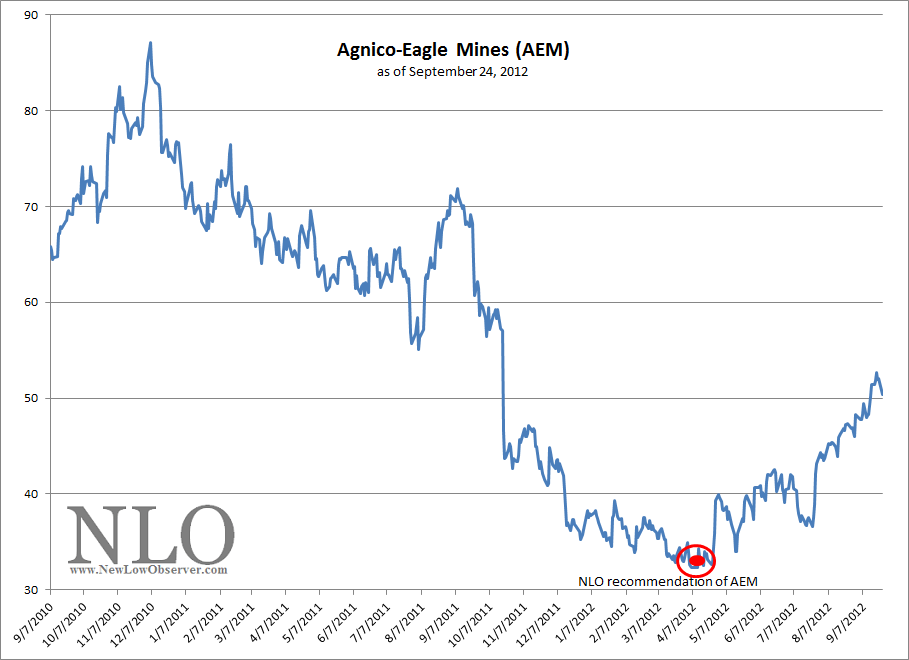
Despite our confidence in the Gold Stock Indicator, we believe that it is necessary to have reasonable expectations for any of the stocks suggested. This means carefully examine the downside risk. As an example, it took Agnico-Eagle (AEM) a little over 1 year to achieve +174%. In that time, AEM traded in a narrow range for a majority of the time and fell almost -30% before reaching such astronomical heights.

Our purchase of the Direxion Daily Gold Miners Bull 3X Shares (NUGT) is strictly a speculation which we will sell soon after it has achieved a gain of +7.5%.  Our examination of 3x gold ETFs (DUST and NUGT) is that a gain of +7.5% is achieved 85% of the time, based on 80 transactions initiated by our Gold Stock Indicator since 1983.  Direxion’s DUST and NUGT ETFs are strictly for speculators (short-term) and should not be entered into for investment (long-term) purposes.  You have been warned.

Our last Gold Stock Indicator signal can be found here: Gold Stock Indicator Points Down

Transaction Alert: Bought NUGT and NEM at the Market

Today our Gold Stock Indicator fell to a level which has yielded at least 7.5% gains in NUGT more than 85% of the time.  We have bought NUGT and NEM at the market and will update this information after the close of the market today.

Gold Stocks to Consider Based on Our Indicator

In light of our Gold Stock Indicator approaching the long term buy signal (found here), we have decided to go over the gold stocks that pay a dividend and are near their respective 52-week lows.  In this review, we’re going to cover Agnico-Eagle Mines Ltd. (AEM) and Gold Fields Ltd. (GFI).  When, and if, the Gold Stock Indicator actually reaches the long term buy indication it will be posted to our site.  The stocks that we cover here are for you to do additional due diligence before taking any action.

Agnico-Eagle Mines Ltd. (AEM) closed at $32.37 on Thursday April 5, 2012.  Agnico-Eagle is currently operating at an annual loss of -$3.36 according to Yahoo!Finance.  Contributing factors to Agnico-Eagle’s decline in price over the last year has been problems with the operation of their mines.

As described in many of our previous articles, Edson Gould’s Altimeter is based on the stock’s price relative to the actual dividend paid.  The Altimeter is a critical real-time assessment of value based on the company’s dividend.  Below is the altimeter for Agnico-Eagle:

image

In our assessment of Agnico-Eagle, we have compared the current level of the Altimeter at 161.85 and compared it to other times when Agnico-Eagle has trade at the same relative level, or below, and traded up to 400 on the indicator.  In the case of Agnico-Eagle there were two periods, before the bull market in gold stocks began, that the stock was selling at a low and was a great buy (based on the altimeter).  In the period from November 2, 1990 to July 3, 1993, Agnico-Eagle rose +174% and in the period from August 25, 1998 to October 4, 1999 rose +157%.

Since the gold bull market began, the only other time that Agnico-Eagle was selling below 161.85 and subsequently traded up to the 400 level was the period from October 21, 2008 to October 6, 2010 for a gain of 103%, this far exceeded the gains of the SPDR Gold Shares (GLD) over the exact same period of time.

Next in our review is Gold Fields Ltd. (GFI).  Gold Fields sports trailing earnings of $1.22 in the last twelve months  and a dividend of $0.61 with a dividend yield of 4.70%.  Yahoo!Finance indicates that Gold Fields operates “in South Africa, Peru, Ghana, and Australia.” Based on the majority of countries that Gold Fields operates, there is some political risk to this investment.  However, Gold Fields has exhibited amazing consistency in the Altimeter below:

image

Presently, Gold Fields is trading at the Altimeter level of 42.38.  The chart depicts the times when GFI was bought at the 42.38 level and sold whenever the Altimeter reached 100.  The results are amazing and provide clear evidence on how gold stocks can outperform the price of gold when combining Edson Gould’s Altimeter with our Gold Stock Indicator.

Our approach to buying these stocks is to purchase in two stages, once at, or near, current levels and a second time only if the stocks fall -20% below the initial purchase price.  As an example, if we have $10,000 that we’d like to invest then we buy $5,000 now and hold the remaining funds unless/until the stock declines by -20%.  We’re basically hedging with cash if we’re wrong.  If we’re right about our first investment (the stock price rises) then we can use the cash to buy another stock near a new low.

Before bothering with the first of many gold stocks that we’ll be covering based on our Gold Stock Indicator, please review the following questions and answers:

  • Is there downside risk to taking positions in gold stocks at this time? Yes, price declines can reach as much as -50% within the first two months of the purchase.
  • Are you comfortable with declines of -50% or more?  If not, then don’t bother with these stocks at this time.  If you’re wondering about the logic of recommending anything that might decline by as much as –50% then please read our view on the topic (found here).
  • Could these stocks have been held for the “long-term?”  Ideally, yes, however, we believe that history is not on the side of gold stocks relative to the price of gold as we described in greater detail in our article titled “A Strategy is Needed For Lagging Gold Stocks”.

We believe that Edson Gould’s Altimeter, when revealing consistent relative values, yields highly favorable results.  While we always seek to purchases at a relative low, we always set a target for selling at higher levels rather than “holding for the long term.”  Our analysis could change if the stocks mentioned above dramatically increase or decrease their dividend.

U.S. Dividend Watch List: April 6, 2012

Watch List Summary

Tootsie Roll (TR) remains at the top of our list this week, making this the 8th weeks (since February 17th, 2012). Although we see potential in Tootsie Roll, the risk/reward we laid out in our March 16 list (found here) pushed us to pass on the name.

C.H. Robinson (CHRW) is second on the list for the fifth straight week. We believe this logistic company is forming a bottom with strong support at $63 (see chart). Trading now at $65 with estimated fair value of $75, you could say the risk/reward is attractive (-3% and +15% respectively). One word of caution is that, CHRW is a component of the Dow Jones Transport index which failed to test and exceed the July 2011 high, thus giving a bearish bias in the market trend.

CHRW_A

Making its way up the list is Matthews International (MATW) which operates in cemetery and funeral home.  MATW was last recommended by us on April 1, 2009 (found here) when the price was near the low at $28.52 (adjusted for dividends $27.79).  We later recommended selling MATW above a gain of 10% on August 3, 2009 (found here).

It sure doesn’t sound very excited but regardless of which direction the economy goes, there’re always need for the products of Matthews International. In fact, this company has been around since 1850, long before the "Great" Depression. The chart below indicates that the stock is showing signs of bottoming with great support at $29, in addition to stronger relative strength (RSI), as indicated by the blue line. More fundamental analysis to come on Matthews International.

MATW_A

Walgreen (WAG) continues to pop up on our list and in our view represents the best investment opportunity yet. Trading at its cheapest valuation ever, we believe shares could rise to the  mid-40s via multiple expansion as well as better than expected earnings. All of the bad news on the fallout from the breakup with Express Script (ESRX) has been priced in and on the day that the deal between Express Script and Medco (MHS) was completed, Walgreen rose +2%. To add icing on the cake, the technical pattern appears to be ripe and ready for WAG to move much higher. Great support at the $30 range will put your downside risk at 10% but a $45 would yield +36%.

Below are the 16 companies that meet our criteria and are within 11% of the 52-week low:

Symbol Name Price % Yr Low P/E EPS (ttm) Dividend Yield Payout Ratio
TR Tootsie Roll Industries Inc  22.33 0.95% 30.18 0.74 0.32 1.43% 43%
CHRW C.H. Robinson Worldwide, Inc.  65.12 4.53% 24.85 2.62 1.32 2.03% 50%
NFG National Fuel Gas Co. 47.12 5.86% 15.10 3.12 1.42 3.01% 46%
CWT California Water Service 17.94 7.75% 19.93 0.9 0.63 3.51% 70%
MATW Matthews International Corp.  30.89 8.12% 12.76 2.42 0.36 1.17% 15%
WAG Walgreen Co. 32.84 8.24% 11.21 2.93 0.90 2.74% 31%
UNS UniSource Energy Corporation 35.99 9.19% 13.09 2.75 1.72 4.78% 63%
ANAT American National Insurance 71.77 9.22% 9.97 7.2 3.08 4.29% 43%
CLX Clorox Co. 68.96 9.36% 16.82 4.1 2.40 3.48% 59%
ATO Atmos Energy Corp. 31.44 10.28% 14.23 2.21 1.38 4.39% 62%
WEYS Weyco Group, Inc.  22.98 10.37% 16.77 1.37 0.64 2.79% 47%
NJR New Jersey Resources Corp. 43.74 10.45% 13.54 3.23 1.52 3.48% 47%
PPL PP&L Corporation 27.63 10.52% 10.23 2.7 1.44 5.21% 53%
HNZ HJ Heinz Co. 53.26 10.57% 17.75 3 1.92 3.60% 64%
JNJ Johnson & Johnson  65.34 10.60% 18.72 3.49 2.28 3.49% 65%
AROW Arrow Financial Corp.  23.8 10.70% 12.73 1.87 1.00 4.20% 53%
16 Companies

Top Five Performance Review

In our ongoing review of the NLO Dividend Watch List, we have taken the top five stocks on our list from April 8, 2011 and have check their performance one year later. The top five companies on that list can be seen in the table below.

Symbol Name 2011 Price 2012 Price % change
TGT Target Corp. 49.53 57.72 16.54%
SJW SJW Corp. 22.94 24.32 6.02%
SYY Sysco Corp. 28.07 29.47 4.99%
HCBK Hudson City Bancorp, Inc. 9.87 7.11 -27.96%
WABC Westamerica BanCorp.  50.73 47.4 -6.56%
Average -1.40%
DJI Dow Jones Industrial 12,380.05 13,060.14 5.49%
SPX S&P 500 1,328.17 1,398.08 5.26%

4.8.2012

Our watch list underperformed the market but 6% mostly due to the weakness from the regional banking sector.  Only Target (TGT) and Sysco Foods (SYY) were able to meet our criteria of achieving a 10% gain within a 1-year period.

Gold Stock Indicator: Nearing a Buy Signal for NUGT

Note: This article was posted on April 4, 2012 during market hours to active subscribers.   Because DUST is trading up today, April 5, 2012, it is still applicable.

On January 26, 2012, our gold stock indicator said that it was time to sell gold stock positions and go short gold stocks in general.  On February 8, 2012, we published an article on Seeking Alpha (article here) that said the trend was definitively down.  Since both the unpublished and published indications, the Direxion Gold Miners Bear ETF (DUST), our preferred vehicle for such a reliable indicator, has gained over +55%.

Being neither bullish nor bearish on gold and gold stocks, if you haven’t done so already WE RECOMMEND SELLING DUST at the market as we are nearing the point where an indication for the purchase of Direxion Gold Miners Bull ETF (NUGT) can be done with a reasonable expectation for substantial gain, as indicated in the chart below.

image

Despite the dramatic decline in gold and gold stocks on April 4, 2012, we must caution that the decline is not over.  The above charts indicate that the dual short and long term gold stock buy indication should occur between now and June 7, 2012.  However, we’re not there yet.

Our worst case scenario for a bottom in gold stocks is the period between June 15, 2012 and August 21, 2012.  While downside risk will be present after the buy indication, we believe that, on a relative basis, our signal will provide the most ideal opportunity to buy NUGT.

Our preference for using Direxion Gold Miners Bull (NUGT) and Direxion Gold Miners Bear (DUST) ETFs aren’t for the risk averse.  As noted in previous articles found on Seeking Alpha,  investors who wish to accumulate gold shares from within the XAU index should benefit from well-timed purchases rather than getting whip-sawed by a wildly gyrating index that will inevitably underperform the price of gold in the "long-term." We have identified the top five stocks that are likely to outperform the XAU index when the next buy signal is given. The five companies are AngloGold (AU), Yamana Gold (AUY), Gold Fields (GFI), Randgold (GOLD) and Royal Gold (RGLD).

Gold stocks are approaching an unprecedented short term buying opportunity.  If you’ve managed to follow our last gold stock indication, you have substantial profits to reallocate towards our preferred long instrument, Direxion Gold Miners Bull (NUGT), when our Gold Stock Indicator registers a buy signal.

Sell DUST at the market and be prepared to buy NUGT.

Canadian Dividend Watch List: April 2, 2012

This is a list of Canadian dividend stocks that currently, or in the past, had a history of consecutive dividend increases.  For those wishing to find the most complete fundamental information on these companies, we recommend visiting one of Canada’s leading financial websites, the Financial Post (found here). However, Yahoo!Finance probably has the better long-term charts and historical dividend data.

Symbol Name Price P/E EPS Price/Book % from Low
GS.TO Gluskin Sheff + Associates, Inc. $14.77 8.98 1.34 5.49 5.50%
EMP-A.TO Empire Co. Ltd. $58.06 10.53 4.39 1.18 11.18%
SNC.TO SNC-Lavalin Group Inc. $40.75 15.01 2.49 3.2 11.46%
TRI.TO Thomson Reuters Corporation $29.13 17.27 -1.68 1.47 11.61%
SJR-B.TO Shaw Communications, Inc. $21.39 20.4 1.44 2.86 11.99%
AGF-B.TO AGF Management Limited $15.63 11.92 1.13 1.22 12.28%
TLM.TO Talisman Energy Inc. $12.90 - 0.38 1.29 13.76%
IGM.TO IGM Financial Inc. $46.71 14.09 3.48 2.76 13.79%
FTS.TO Fortis Inc. $32.48 18.23 1.74 1.57 15.01%
RCI-B.TO Rogers Communications Inc. $40.06 13.95 2.86 5.76 16.96%
TRP TransCanada Corp. $43.63 19.79 2.17 1.88 17.00%
BNS.TO The Bank Of Nova Scotia $56.15 12.27 4.74 2.22 18.11%
  1. stocks are in Canadian dollars except TRP, which is calculated in U.S. dollars.

Watch List Summary

This watch summary will review Edson Gould’s Altimeter when applied to Gluskin Sheff (GS.TO) and SNC-Lavalin (SNC.TO).  First up is the Altimeter for Gluskin Sheff (GS.TO).  According to Yahoo!Finance, Gluskin Sheff “is a publicly owned investment manager. The firm also provides wealth management services.”

Based on the current quarterly dividend of $0.163, GS.TO is bouncing along the undervalued range of $14.11.  Because the middle of the undervalued/overvalued range is $19.42 (fair value), we’re expecting that the next upside target is to the fair valued level or +31% above the closing price of $14.77.

image

As always, we’re primarily concerned with the worst case scenario.  For GS.TO, the downside target is based on the December 2008 low at $6.71.  Any substantial decline below the $14.11 level should result in GS.TO falling to $10.41.  If GS.TO were to fall as low as $6.71 it would be in alignment with our rule of preparing for a decline of -50% or more and allocating our capital accordingly.

Our next stock is SNC-Lavalin (SNC.TO).  According to Yahoo!Finance, SNC.TO “provides engineering and construction, and operations and maintenance services worldwide.”  Edson Gould’s Altimeter, as applied to SNC-Lavalin Group (SNC.TO) presents a pattern that is quite unique.  Again, Edson Gould’s Altimeter compares the current stock price as it relates to the quarterly dividend that is currently being paid.  SNC.TO has a descending Altimeter with the normal undervalued range at $43.60.  The next upside target for SNC.TO is at $55, however, we’re waiting for resolution on the potential downside action.

image

Our worst case scenario is that SNC.TO will continues on the declining trend and reach our downside target of $30.80.  In our assumption, the worst case downside target continues to slide as time passes until proven otherwise.  Again, while there are major upside targets at $55 and $69, we’d rather wait for the final verdict on retracing back above $43.60 or falling to $30.80.

Watch List Top 5 Performance Review

In our ongoing review of the NLO Canadian Dividend Watch List, we have taken the top five stocks from our April 13, 2011 list and have checked their performance, approximately one year later, as compared to the S&P/TSX Composite index.  The top five companies from that list can be seen in the table below.

Symbol Name 4/13/2011 4/2/2012 % change
Rogers Comm. CL. B 34.32 40.06 16.72%
SJR-B.TO Shaw Comm. CL.B 19.64 21.39 8.91%
EMP-A.TO Empire Co. CL.A 53.67 58.06 8.18%
TRI.TO ThomsonReuters 39.1 29.13 -25.50%
POW.TO Power Corp 27.9 26.75 -4.12%
Average change 0.84%
GSPTSE S&P/TSX Composite 13,833.64 12,507.06 -9.59%

Among the top five companies on our watch list from last year, three of the five companies exceeded the return of the Toronto Stock Exchange index.  Power Corp. declined less than the index while ThomsonReuters fell by more than -25%.  Taken as a group, the average return was +0.84% as compared to the –9.59% for the representative index.

Nasdaq 100 Watch List: March 30, 2012

Below are the Nasdaq 100 companies that are within 20% of their respective 52-week lows. Stocks that appear on our watch lists are not recommendations to buy. Instead, they are the starting point for doing your research and determining the best company to buy. Ideally, a stock that is purchased from this list is done after a considerable decline in the price and rigorous due diligence.

Symbol Name Price P/E EPS Yield Price/Book Div/Share % Chg from Low
FSLR First Solar, Inc. 25.05 -0.46 0.6 2.24%
EA Electronic Arts Inc. 16.49 -0.52 2.42 2.71%
CTRP Ctrip.com International Ltd. 21.64 19.29 1.12 2.74 3.00%
APOL Apollo Group Inc. 38.64 8.41 4.6 4.34 4.21%
CHRW CH Robinson Worldwide Inc. 65.49 25 2.62 2.00% 8.48 1.32 5.12%
VOD Vodafone Group plc 27.67 12.75 2.17 3.40% 1.07 0.95 13.82%
SRCL Stericycle, Inc. 83.64 31.09 2.69 5.95 14.50%
ORCL Oracle Corporation 29.16 15.28 1.91 0.80% 3.4 0.24 17.96%
RIMM Research In Motion Limited 14.7 3.46 4.25 0.69 18.07%
GMCR Green Mountain Coffee Roasters Inc. 46.84 24.11 1.94 3.67 18.82%

Watch List Summary*

Update: December 16, 2011 Summary Stocks

Today we’re going to review the price action of the Nasdaq 100 stocks profiled in the summary section of our December 16, 2011 watch list.  First on the list was BMC Software (BMC), we indicated the following about BMC:

  • “If BMC were to replicate the percentage decline from the May 2008 top to the October 2008 low, the stock would decline to a price of $31.11.”
  • “The $40 level seems reasonable within the next year for BMC even though it is 20% above the current price.”

BMC declined from the December 16th price of $33.17 down to the low $31.62 on January 10, 2012.  The actual low of $31.62 was within 1.64% of the projected downside target.  Additionally, BMC managed to close above the $40 level starting on March 26, 2012.

Virgin Media (VMED) was the second stock listed in our summary section.  We projected an initial downside target of $18.29.  This never materialized as the stock reversed its decline at $20.52, we said the following regarding the VMED’s upside target:

  • “The next upside target for VMED is $25.07 which assumes the best case scenario.”

From December 19, 2011 to February 7, 2012 VMED rose as high as $24.49 but struggled to move any higher.  On February 8, 2012, VMED jumped to $25.27 and managed to close as high as $25.93 on February 14, 2012.  This was a gain of +23.77%  in a month and a half.

Ctrip.com (CTRP) was the last stock that we reviewed.  At the time, we said the following about CTRP:

  • “…on a pace to replicate the performance from the high in April 2008 to the low of January 2009 which equaled a loss of -72%. A similar decline in CTRP from the high of $50.57 would bring the price down to $14.16.”
  • “CTRP sits one penny below the 2nd Dow Theory support level of $23.11. Any further deviation below the current price almost ensures that the stock is destined for the $10 range.”

On March 28, 2012, CTRP declined significantly enough below the $22.44 level for us to believe that the stock would fall first to the $14.16 level and possibly to the $10 range.

*Stocks that are in our Watch List Summary section are those that we find the most compelling among all the stocks that appear in the watch list above.

Transaction Alert: AVP, ANAT and TR to be sold at the Market

Today we will be SELLING shares in the following holdings Avon (AVP), American National Insurance (ANAT) and Tootsie Roll (TR) at approximately 2:30pm EST.

  • Avon (AVP) has achieved our target goal of +10% since we bought the stock in November 2011
  • American National Insurance (ANAT) has only gained +1.72% since our September 2011 acquisition
  • Tootsie Roll (TR) has declined by –5% since our January 2012 purchase.

We’re offsetting the gains from Avon (AVP) and American National Insurance (ANAT) with the losses of Tootsie Roll (TR).  It should be noted that the losses of Tootsie Roll are significantly larger than the gains from AVP and ANAT.  However, acknowledging our losses and taking reasonable action in a timely manner is a must.  Additionally, we are taking the opportunity to exit out of undesirable investments and building cash holdings as we recommended in our October 15, 2011 posting.

Transaction Alert: Reinsurance Group of America (RGA)

On Tuesday, March 27, 2012, the New Low Observer team will sell the principal associated with our investment in Reinsurance Group of America (RGA).  Below is a chart of our transactions of RGA to date.

image

We first bought RGA at $59.39 on February 3, 2011.  As the price of RGA increased +6% we sold the principal portion of RGA on May 2, 2011 and let the profits run.  It was just our luck that the price we sold at was the third highest closing price for all of 2011.

After the fallout of the market decline from July 2011, we repurchased additional shares of RGA on September 27, 2011.  After rising +23.30% since September 27, 2011, we will sell the principal portion of our investment in RGA.

The selling of RGA at this time is in keeping with our October 15, 2011 Dow Theory analysis recommending that the bull market rally that has materialized would be a great time to take profits.  This also explains why we have so many positions that are in the 1% range of our portfolio composition, we’ve sold the principal while letting the profits run.

Nasdaq 100 Watch List: March 23, 2012

Below are the Nasdaq 100 companies that are within 20% of their respective 52-week lows. This Nasdaq 100 Watch List is strictly for the purpose of researching whether or not the companies have viable business models or are about to go out of business. These companies are deemed highly speculative unless otherwise noted.

Symbol
Company Price P/E EPS Yield P/B % from Low
FSLR First Solar, Inc. $26.11 0 -0.46 0 0.64 3.24%
CHRW C.H. Robinson Worldwide $64.42 24.59 2.62 2 8.44 3.40%
CTRP Ctrip.com Int'l $22.83 20.37 1.12 0 2.93 3.68%
EA Electronic Arts Inc. $16.86 0 -0.52 0 2.49 5.05%
RIMM Research In Motion $13.66 3.22 4.25 0 0.7 9.72%
VOD Vodafone Group Plc $27.65 12.74 2.17 3.4% 1.07 13.74%
APOL Apollo Group, Inc. $42.41 12.02 3.53 0 4.1 14.37%
ORCL Oracle Corporation $28.55 14.96 1.91 0.8% 3.31 15.49%
SRCL Stericycle, Inc. $84.66 31.47 2.69 0 6.04 15.89%
AMZN Amazon.com, Inc. $195.04 142.36 1.37 0 11.29 16.81%
VMED Virgin Media Inc. $23.98 63.95 0.38 0.7% 6.82 16.86%

Watch List Summary

Because we’re still in a bear market and have had significant divergence between the Dow Industrials and the Dow Transports index, we believe there could be significant downside action in the near term.  With this in mind,  our first stock of interest is Oracle Corporation (ORCL). While the stock is slightly more than 15% above the 1-year low, it is necessary to plan your next purchase of this stock.

image

When viewed from a Dow Theory perspective, the following are the downside targets from the current price:

  • $25.48 (fair value)
  • $21.82
  • $14.48

The low of December 2011 is the exact level of ORCL’s fair value based on Dow Theory.  If Oracle were to fall below the December 2011 low the next downside target is $21.82.  We wouldn’t put it past Oracle to decline to $14.48, however, a 3-part purchase plan with the first at $25.28 would be reasonable.  If you have $10,000 to invest in ORCL then we’d arrange the purchased in the following order:

  • 1st-$5,000 at $25.48
  • 2nd-$3,500 at $21.82
  • 3rd-$1,500 at $14.48

The next stock that we’re considering is Stericycle (SRCL).  Stericycle first appeared on our October 17, 2009 Nasdaq 100 Watch List.  At the time, Stericycle was trading at $52.12.  Since then, SRCL has soared as high as $95.71 on an intra-day basis, a gain of 83.63%.  Don’t be fooled by the fact the Stericycle sports a “high” price relative to the $52 level.  The point of a stock approaching a new low is that it transmits new information on the relative value.

image

According to Dow Theory, Stericycle has the following downside targets:

  • $79.39
  • $71.23 (fair value)
  • $63.07
  • $46.75

We’d structure the purchase of Stericycle (SRCL) into two steps.  The first purchase at $71.23 (or lower) with 75% of the intended amount and the second purchase at $63.07 (or lower) with the remaining funds.

U.S. Dividend Watch List: March 23, 2012

U.S. stocks sold off this week amid weaker-than-estimated housing data. On the upside, jobless claims dropped to its lowest level in several years. The S&P lost 0.5% while the Dow dropped -1.14%. A dividend hike from HP (HPQ) didn't protect the blue-chip stock from losses.

Our watch list expanded slightly and has 10 companies that are within 11% of the 52-week low. A reminder to our readers, these are companies with a long track records of dividend payments.

Symbol Name Price % Yr Low P/E EPS Dividend Yield Payout
TR Tootsie Roll  22.75 2.85% 30.74 0.74 0.32 1.41% 43%
CHRW C.H. Robinson Worldwide 64.42 3.40% 24.59 2.62 1.32 2.05% 50%
CLX Clorox Co. 67.99 7.82% 16.58 4.1 2.40 3.53% 59%
ATO Atmos Energy Corp. 30.8 8.03% 13.94 2.21 1.38 4.48% 62%
CWT California Water Service 18.23 9.49% 20.26 0.9 0.63 3.46% 70%
HNZ HJ Heinz Co. 52.77 9.55% 17.59 3 1.92 3.64% 64%
BDX Becton, Dickinson and Co. 76.4 9.79% 13.94 5.48 1.80 2.36% 33%
JNJ Johnson & Johnson  64.55 9.54% 18.50 3.49 2.28 3.53% 65%
WAG Walgreen Co. 33.56 10.61% 11.34 2.96 0.90 2.68% 30%
UNS UniSource Energy 36.47 10.65% 13.26 2.75 1.72 4.72% 63%
10 Companies

Watch List Summary

New additions to our list this week is HJ Heinz (HNZ), Johnson & Johnson (JNJ), Beckton Dickinson (BDX), and UniSource Energy (UNS). We’d like to highlight Johnson & Johnson which is actually closer to the high than the low but the historical dividend yield suggests it is undervalue at 3.5% yield. In addition, according to the Value Line Investment Survey JNJ should trade at 12x cash flow which  would suggest a fair value of $72. If that isn’t enough, current dividend yield is higher than 30-year T-bill.

C.H. Robinson (CHRW), one of the largest 3rd party logistic companies, remains second on our list this week. Valueline estimates that CHRW trades at a fair value of 22x cash flow which suggests that the stock should be trading for $75. In our recent review of the stock market, we are cautious because the Dow Jones Transportation Index has failed to test and exceed its July 2011 high.  This could impair the ability of transportation companies like CHRW to move higher in the short-term.

Top Five Performance Review

In our ongoing review of the NLO Dividend Watch List, we have taken the top five stocks on our list from March 25, 2011 and have check their performance one year later. The top five companies on that list can be seen in the table below.

Symbol Name 2011 Price 2012 Price % change
SJW SJW Corp. 22.65 24.55 8.39%
SYY Sysco Corp. 27.86 29.84 7.11%
WABC Westamerica BanCorp.  50.13 47.85 -4.55%
PPL PP&L Corporation 24.57 27.67 12.62%
TGT Target Corp. 49.95 58.19 16.50%
Average 8.01%
DJI Dow Jones Industrial 12,220.59 13,080.73 7.04%
SPX S&P 500 1,313.80 1,397.11 6.34%

2012_3_24

Companies on our watch list outperformed the market by 1-2 percentage points. In addition, two of the 5 achieved 10% within the first two months (SYY and PPL). At the same time, SJW and TGT achieved 10% gains within seven months of appearing on our list.

The biggest gainer was Target (TGT), one of the largest retailer in the nation. The biggest loser was WestAmerica (WABC) falling -4.55%. WABC's performance, however, wasn’t terrible when you compared it to the Citigroup (C), the financial sector ETF (XLF), and Bank of America (BAC) which lost -18.19%, -4.90%, and -26.92%, respectively. In addition, WABC raised their dividend 2.8% around October 2011.