Dow Theory

How long does a Dow Theory Primary Bull Market last?

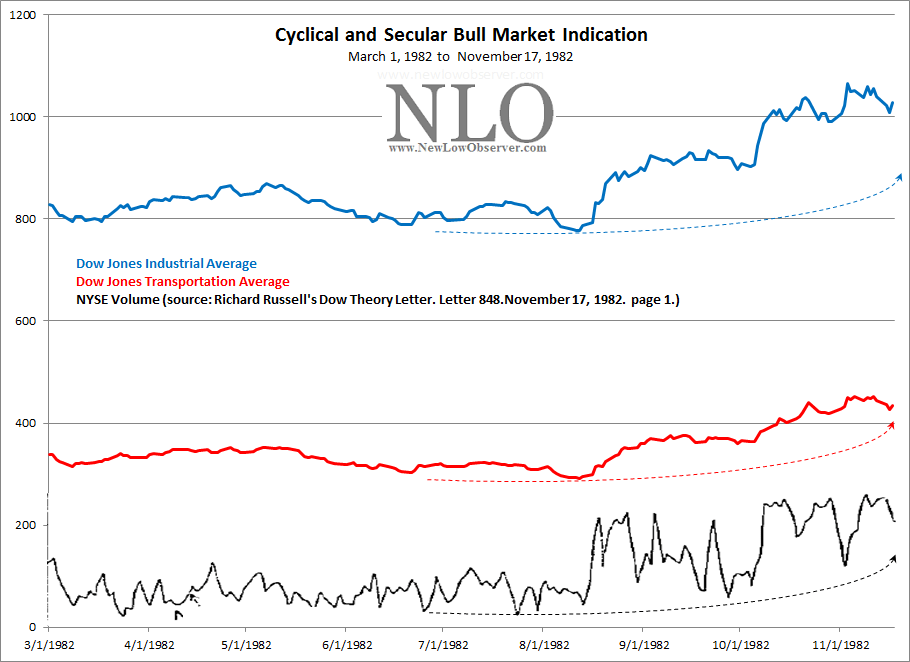
Recently, some followers of Dow Theory had suggested that a new primary bull market began on June 4, 2012. Those same Dow Theorists are now put in the awkward position of changing that primary bull market call to a primary bear market indication as recently as November 11th or 16th of this year.

However, when doing the math, those Dow Theorists who claimed that a primary bull market began on June 4, 2012 have very little to show for it, especially when, by their own account, a primary bear market was signaled on November 11th or 16th. To demonstrate how inaccurate that analysis was, since June 4th, the Dow Industrials has increased +4.02% while the Dow Transports increased +0.90%. Even in the period from June 4th until the respective peaks, the gains were marginal with the Dow Jones Transportation Average gaining +8.31% by June 19th without being able to exceed the 2011 peak. At the same time, the Dow Jones Industrial Average gained +12.47% by October 5th without being able to exceed the 2007 peak. The inability to exceed prior all-time highs is uncharacteristic of what one should expect of any market move deemed a “primary bull market.”

In all of the history of the Dow Industrials and Dow Transportation Averages, primary bull market moves have never lasted for only 5 months. The following examples from renown Dow Theorists suggest that any indication that a primary bull market began in June 2012 and ended in November 2012 was done so in error.

When William Peter Hamilton wrote on the topic of the primary bull market movements in his book Stock Market Barometer, he said the following:

“The average duration of six major bull swings is twenty-five months…(page 44).”

According the Robert Rhea’s book The Dow Theory:

“…a primary bull market is a broad upward movement, interrupted by secondary reactions, and averaging longer than two years (page 44).”

From E. George Schaefer’s book How I Helped 10,000 Investors to Profit in Stocks comes this conclusion:

“…in primary bull markets the duration of a typical primary up-trend might last from four to eleven years…(page 42)”

It is more likely that a primary bear market can last as little as 5 months due to panics and crashes. However, in order for Dow Theory to be worth its weight, a primary bull market should see an investor through an extended period of time (at minimum 12 to 18 months and usually 2 years or more) and not a period of less than 6 months.

Dow Theory: The Backdrop 

On August 2, 2011, Dow Theory provided us with the first primary bear market signal since the primary bull market indication of July 23, 2009.  This bear market indication came with a very interesting backdrop that is worth reviewing. On the very same day as our bear market indication (Aug. 2, 2011), the Senate passed the bill allowing for the extension of the debt ceiling (found here). The Senate vote came one day after the House of Representatives approved legislation to raise the debt ceiling to $14.3 trillion (found here).

The discussion and debate prior to the actual passage of the bill, allowing for the debt ceiling increase, suggested that the country would suffer irreparable damage if Congress didn’t come up with a solution.  Once the bill was passed, Congressional members were as giddy as can be.  There was a lot of back slapping and praise because both sides of the aisle could finally agree on something. 

Suffice to say, only three days (Aug. 5, 2011) after the “bipartisan” agreement to raise the debt ceiling, Standard & Poor's lowered the credit rating of the United States indicating that “…the downgrade reflects our view that the effectiveness, stability, and predictability of American policymaking and political institutions have weakened at a time of ongoing fiscal and economic challenges to a degree more than we envisioned…” (PDF found here).

We wince when politics has to enter our discussion of the markets since we know that there are no winners when it comes to such a debate.  However, we have reminded readers of the backdrop at the time of the Dow Theory bear market indication to suggest that we may actually be sitting on another “buy the rumor and sell the news” scenario when the resolution of the “fiscal cliff” arrives.  From the May 3, 2011 to August 1, 2011, the Dow Jones Industrial Average declined –5.27% and from August 1, 2011 to August 10, 2011, the Dow Jones Industrial Average declined –11.64%.  It appears the stock market anticipated that the debt ceiling would be increased and that ultimately it would be to no avail, resulting in the downgrade from S&P. 

Already, the Dow Jones Industrial Average has declined –7.5% from the October 5, 2012 high.  Are we slated for a similar reaction to the ultimate “resolution” of the “fiscal cliff” that currently overhangs the U.S.?  It is interesting to note that the increase of the debt ceiling and the “resolution” of the “fiscal cliff” will have a negative effect on the U.S. despite the two political parties’ shameless self-promotion for acting in a bi-partisan manner to come to a “resolution.”  If the S&P downgrade of the U.S. came 3 days after the agreement to raise the debt ceiling and a stock market plunge of –11% in seven trading days later, what can we expect when the “fiscal cliff” passes?

Also, keep in mind that with the announcement of QE3 on September 13, 2012, the stock market has declined as much as -7.02%.  All prior announcements of quantitative easing by the U.S. and European Union were not accompanied with almost immediate declines in the stock market. It appears that the quick fixes are having less of the desired short-term impact since it is clear that the long-term effects of such strategies are harmful and possibly irreversible.  Our article on the diminished impact of QE3 can be found here.

We can’t be sure if the past provides any lessons, however, the solution to the “fiscal cliff” may lead to an outcome that is far worse than anticipated.  While everyone in Congress was suggesting that there were going to be dire consequences to not raising the debt ceiling there were few that anticipated that the S&P would downgrade the debt anyway.  Likewise, providing a solution to the “fiscal cliff” cannot hid the fact that the U.S. is a house that is not in order.  Resolving issues like the debt ceiling with increasing the debt “limit” or the “fiscal cliff” with less cutting and more spending than initially planned, with politicians whose goal is to posture until the 11th hour, suggests that S&P’s downgrade of the U.S. debt will be looked upon in retrospect as an understatement.

Dow Theory: Bear Market Confirmation Due

Starting with the movement of the Dow Industrials and Transports, we can seen that the primary bear market began on August 2, 2011.  Since that time, the bear market rally (from the August 8, 2011 or October 3, 2011 low) has been very rewarding to anyone who followed our August 9, 2011 (found here) indication that a temporary bottom had been reached.

image

Now that there has been a substantive decline in the Industrial Average below the April 30, 2012 peak we can see that any decline below the June 4, 2012 low is the level to watch for.  Again, Dow Theory indicates that for any signal to have merit, both the Industrials and Transports must simultaneously rise above prior peaks or decline below prior troughs.  In order for us to get a bear market confirmation, we’d need the Industrials to decline below 12,101.46 and the Transports to fall below 4,847.73 on a closing basis. 

So far, the Industrials are +4.02% above the June 4th low while the Transports are +0.90% above the mid-year level.  If either of the indexes fail to fall below the June 4th level we have to put our bear market thesis on hold.

Dow Industrial Upside Targets

The decline that the Dow Jones Industrial Average has experienced isn’t out of the ordinary.  However, it is our responsibility to review the prospects of an upside target based on Dow Theory.  Taking the most recent intra-day low of 12,471.50 and projecting to the most recent intra-day high of 13,661.90 provides us with the following upside targets:

image

Each move up to the 13,066.69 level carries the risk that at any point the market can easily descend below the 12,471.50.  However, exceeding 13,066.69 and especially the points above the 13,265.10 connotes the prospect that the Dow Industrials can achieve 13,661.90.

Nasdaq 100 Watch List: November 16, 2012

Below are the Nasdaq 100 companies that are within 10% of their respective 52-week lows. Stocks that appear on our watch lists are not recommendations to buy. Instead, they are the starting point for doing your research and determining the best company to buy. Ideally, a stock that is purchased from this list is done after a considerable decline in the price and rigorous due diligence.

Symbol Name Price P/E EPS Yield P/B % from low
BIDU Baidu, Inc. 92.68 20.97 4.42 - 8.87 0.95%
VOD Vodafone Group  25.27 - -0.55 7.9 1.11 1.28%
BBBY Bed Bath & Beyond Inc. 56.4 13.1 4.3 - 3.27 1.48%
MCHP Microchip Technology Inc. 29.37 27.94 1.05 4.8 2.93 1.56%
^NDX NASDAQ-100 2,534.16 - - - - 1.59%
FLEX Flextronics Int’l 5.54 7.55 0.73 - 1.51 1.65%
DELL Dell Inc. 8.86 6.03 1.47 3.3 1.63 1.94%
AMAT Applied Materials Inc. 10.15 118.02 0.09 3.5 1.74 2.01%
NVDA NVIDIA Corporation 11.38 14.21 0.8 2.6 1.53 2.06%
INTC Intel Corporation 20.19 8.81 2.29 4.5 2.03 2.12%
ALTR Altera Corp. 30.45 17.02 1.79 1.3 2.97 2.91%
TEVA Teva Pharmaceutical  38.29 15.6 2.45 2.1 1.46 3.82%
EXPD Expeditors Int'l of WA 35.76 22.35 1.6 1.5 3.62 4.56%
CTXS Citrix Systems, Inc. 59.21 32.34 1.83 - 3.56 4.67%
MRVL Marvell Technology 7.4 12.67 0.58 3.2 0.88 4.96%
NUAN Nuance Communications 20.35 77.38 0.26 - 2.4 5.28%
KLAC KLA-Tencor Corporation 44.33 10.78 4.11 3.6 2.18 5.35%
APOL Apollo Group Inc. 19.51 5.61 3.48 - 2.37 5.69%
ATVI Activision Blizzard, Inc. 11.05 14.26 0.78 1.7 1.08 5.75%
MU Micron Technology Inc. 5.47 - -1.04 - 0.72 6.01%
FFIV F5 Networks, Inc. 86.64 25.11 3.45 - 5.19 6.87%
WCRX Warner Chilcott plc 11.98 8.2 1.46 4.2 -4.48 6.87%
CHKP Check Point Software 43.67 15.21 2.87 - 2.71 7.56%
DLTR Dollar Tree, Inc. 38.82 15.6 2.49 - 5.9 7.71%
GRMN Garmin Ltd. 37.18 12.57 2.96 4.8 2.14 8.05%
XLNX Xilinx Inc. 32.56 17.6 1.85 2.7 3.12 8.53%
FAST Fastenal Company 41 29.71 1.38 2.1 7.29 9.01%
MSFT Microsoft Corporation 26.52 14.34 1.85 3.5 3.26 9.14%

Watch List Summary

In the November 2, 2012 Watch List summary we pointed out NetApp (NTAP) as a viable investment candidate.  In the two weeks since, NTAP has managed to rise +9% while the Nasdaq 100 and Apple Inc. declined –4% and –9%, respectively.  NTAP is sitting at $30.26 price and may have found some support at that level. Although we’re hopeful about the prospects of this company, we recommend putting +9% gains in two weeks into perspective and decide if selling the principle is the most prudent approach to take.

On the November 2, 2012, we discussed the prospects for Dell (DELL).  At the time we felt that the stock had a high probability of going back to the $8 level.  On Friday November 16, 2012, we believe that DELL has fallen through the last line of technical defense against going to the $8 level.  We believe that on a short-term basis DELL will rise on a possible market reaction.  However, the intermediate-term seems to indicate that DELL will go to $8 before any “true” indication of prospects is revealed, unless the company gets acquired which seems possible.  Dell would be one of the best acquistion target of any computer manufacturer since Lenovo bought the personal computer division from IBM.

Apple Inc (AAPL) and short-term Dow Theory analysis

As described in our last Nasdaq 100 Watch List dated November 2, 2012, Apple Inc. (AAPL) is the stock to watch.  Right now, there are many who are suggesting that the bottom is in for AAPL.  For various reasons, we believe that the verdict has not been delivered on this stock.  Especially since AAPL managed to close below the May 2012 low, a previous technical low point for the stock.  Regardless of our view on the matter, we’d like to see what Dow Theory has to say about the upside prospects from the current price.  The chart below outlines the four upside targets for AAPL.

image

Starting with the first upside target is the $572.19 level.  This is an easily attainable level for the stock and would equal an +8.44% gain from the closing price of Friday November 16, 2012.  After coming off of such a dramatic decline that was started on September 17th, we should expect this as the minimum reaction of a declining trend.  There is little in the way to suggest that AAPL is clearly on the ascent when it reaches $572.19.  However, in theory, this would be the easiest money every made in AAPL stock.

The next upside target for Apple Inc. (AAPL) is $605.41.   This level is based on Dow’s 50% principle which indicates the average price paid by long-term investors and would be compelled to continue holding the stock if it rises above this level.  If AAPL can manage to rise above this level then long-term investors are likely to hold their positions in the stock, leaving speculators to push the stock higher.  However, failure to rise above the $605.41 level and falling below the $505 level will be confirmation that the trend of the stock is much lower than the $505 level.

The $638.63 price falls in line with Dow’s assertion that stocks then can retrace 1/3 to 5/8 of the previous move.  In this case, the $638 level is 2/3 of the previous decline.  Rising to such a level almost assures that the stock will rise to the previous high.  However, those wishing to take advantage of such a “guaranteed” move to the upside should be aware of the risk that any gains that are achieved can be quickly taken away.  This would be the hardest money ever made for any speculator in AAPL’s stock.

Finally, rising above the $705 level would be the only indication that the stock is going higher in a meaningful fashion.  We believe that if AAPL manages to exceed prior high then there are great opportunities of other tech companies near a new 52-week low to take advantage of the renewed faith in Apple Inc.

Canadian Dividend Watch List: November 15, 2012

This is a list of Canadian dividend stocks that currently, or in the past, had a history of consecutive annual dividend increases. For those wishing to find the most complete fundamental information on these companies, we recommend visiting one of Canada’s leading financial websites, the Financial Post (found here). However, Yahoo!Finance probably has the better long-term charts and historical dividend data.

symbol Name Price P/E EPS Yield P/B % from low
CCO.TO Cameco Corp. 16.73 13.6 1.23 2.40% 1.34 1.09%
AGF-B.TO AGF Management Limited 9.13 14.27 0.73 11.60% 0.78 1.22%
TIH.TO Toromont Industries Ltd. 19.19 13.42 1.42 2.40% 3.4 3.12%
EMP-A.TO Empire Company Limited 55.24 10.46 5.28 1.70% 1.11 3.35%
FTS.TO Fortis Inc. 32.78 19.4 1.66 3.60% 1.59 4.66%
TRI.TO Thomson Reuters Corporation 27.39 0 -1.07 4.70% 1.33 4.94%
FFH.TO FAIRFAX FINANCIAL HOLDINGS LTD. 354.22 0 0 2.70% 0 5.74%
IGM.TO IGM Financial Inc. 38.98 11.81 3.08 5.50% 2.31 5.90%
GS.TO Gluskin Sheff + Associates, Inc. 13.95 23.25 0.61 5.00% 5.55 5.92%
CNQ.TO Canadian Natural Resources Limited 27.58 10.65 2.16 1.50% 1.27 7.82%
PWF.TO Power Financial Corporation 25.56 10.48 2.43 5.40% 1.55 8.21%
EMA.TO Emera Inc. 33.7 18.93 1.78 4.10% 2.72 8.64%
FTT.TO Finning International Inc. 22.13 12.57 1.76 2.50% 2.69 8.85%
CCA.TO Cogeco Cable Inc. 37.58 8.13 4.59 1.70% 1.57 9.09%
CTC-A.TO Canadian Tire Corp. Ltd. 66.39 10.76 6.14 2.10% 1.19 9.48%
CU.TO Canadian Utilities Ltd. 64.61 15.38 4.19 2.70% 2.63 9.51%
ESI.TO Ensign Energy Services Inc. 14.13 9.74 1.45 3.10% 1.2 9.62%
TRP.TO TransCanada Corp. 44.25 22.69 1.94 4.00% 1.98 9.77%

Analyst Low Earnings Estimate for 2013

symbol Name 2013 low EPS est. # of analysts est. 2013 price est. 2013 % change
GS.TO Gluskin Sheff + Associates, Inc. $0.76 9 $17.67 26.94%
FTT.TO Finning International Inc. $2.03 12 $25.52 14.58%
TRP.TO TransCanada Corp. $2.19 10 $49.69 12.22%
FTS.TO Fortis Inc. $1.75 7 $33.95 4.24%
CU.TO Canadian Utilities Ltd. $4.16 4 $63.98 1.00%
EMA.TO Emera Inc. $1.77 6 $33.51 -0.28%
PWF.TO Power Financial Corporation $2.21 7 $23.16 -9.42%
IGM.TO IGM Financial Inc. $2.91 9 $34.37 -11.81%
TIH.TO Toromont Industries Ltd. $1.26 8 $16.91 -12.16%
CCA.TO Cogeco Cable Inc. $4.03 6 $32.76 -12.72%
ESI.TO Ensign Energy Services Inc. $1.12 10 $10.91 -22.02%
CCO.TO Cameco Corp. $0.96 12 $13.06 -22.05%
CNQ.TO Canadian Natural Resources  $1.86 10 $19.81 -27.63%

Watch List Summary

As can be seen above, only five companies on our watch list are slated to have higher earnings in the coming year, under the assumption that the stocks retain the same P/E ratio that they currently have right now.  An alternative view is that if the earnings expectation improve, these same companies could potentially match or exceed expectations.  This could mean that the stocks slated to decline in price might have the most potential to increase in value.

Gold Stock Indicator: Buy Indication Arrives with Surprising Plunge

On November 14, 2012, our Gold Stock Indicator (GSI) plunged below both the short and long-term buy indications.  The arrival of a buy indication at this point has come five trading days earlier than we anticipated as indicated in our November 10, 2012 (found here). 

image

The first time that the long-term buy indication was triggered on the Gold Stock Indicator (GSI) was on May 3, 2012.  At that time, the Philadelphia Gold and Silver Stock Index (XAU) closed at 156.72.  The XAU index declined another -9.64% before hitting bottom on May 15, 2012.  If an speculator bought the gold stock ETF Market Vectors Gold Miners (GDX) on May 3rd, the speculator would have seen gains of +25% by September 21, 2012.  This matched the performance of the XAU gold stock index in the exact same period of time.

The next instance of the Gold Stock Indicator (GSI) falling below the long-term buy indication was on June 21, 2012 when the XAU index was at 157.04.  The XAU index finally bottomed at 143.11 or -8.88% below the point that was triggered on the GSI.  If a speculator had bought the gold stock ETF Market Vectors Gold Miners (GDX) on June 21st the speculator would have seen gains of +23% by September 21, 2012.  This was just short of the performance of the XAU gold stock index gain of +25 in the same period of time.

We no longer recommend or suggest that NUGT or DUST is used to take advantage of the expected speculative opportunity in gold stocks as we had difficulty stomaching the wild volatility that came with such products.  We strongly recommend setting parameters around what you wish to get out of your speculation in the gold sector, whether through the use of individual gold stocks or gold & silver stock ETFs.  This means that if you can get an exceptional return in a reasonably short period of time then take the gain.  As we have a minimum +10% target for our more conservative dividend and insurance stocks before we consider selling within a year, we recommend having a +20% target for gold stock investments. 

Again, we expect another -8% to -10% decline in the XAU index before we reassess the market conditions for any new investments in the gold sector.

Transaction Alert: Sold MKL at the Market

Today we sold the principal portion in shares of Markel (MKL).

  • On May 7, 2012, we posted a transaction alert indicating that we bought Markel (MKL) at the market (found here). The gain has been +10.29% in six months. The annualized rate of return is nearly 22.83%.

We continue to hold shares of the company (profit portion) allowing us to slowly build a well diversified portfolio and continue to see capital appreciation.

Analyst Estimate: Dividend Watch List

Below is a ranking from our November 9, 2012 watch list based on the analyst’s low earnings estimate for 2013. This list ranks the potential price gain at 10% and above assuming that the analyst’s lowest estimate for earnings materialize and the P/E ratio remains the same as when our original watch list was created.

We chose to utilize the analyst’s low estimates because the mean and high estimates for stocks tend to be too optimistic. By going with the lowest or most pessimistic estimate, we have the ability to “play it safe” for the company prospects going forward.

Symbol
Name Price % Yr Low P/E EPS (ttm) 2013 low EPS est. # of analysts est. price est. % change
UNM Unum Group 19.66 7.55% 23.13 0.85 3.2 16 $74.02 276.48%
JCI Johnson Controls Inc  25.52 9.20% 14.34 1.78 2.76 18 $39.58 55.09%
FRS Frisch’s Restaurants, Inc 17.75 6.29% 16.9 1.05 1.48 n/a $25.01 40.91%
TMP Tompkins Financial Corp. 38.65 7.90% 15.84 2.44 3.38 3 $53.54 38.52%
ABM ABM Industries, Inc. 19.02 6.55% 19.61 0.97 1.32 6 $25.89 36.09%
SON Sonoco Products Co. 30.45 6.43% 17.11 1.78 2.3 14 $39.35 29.24%
FDS FactSet Research Systems 89.83 5.21% 21.8 4.12 5.07 8 $110.53 23.04%
UTX United Technologies Corp. 75.84 7.71% 15.6 4.86 5.98 18 $93.29 23.01%
WGL WGL Holdings, Inc. 38.19 1.43% 19.39 1.97 2.4 7 $46.54 21.85%
MSEX Middlesex Water Company  18.65 7.37% 21.69 0.86 1.04 3 $22.56 20.95%
OMI Owens & Minor, Inc. 29.02 6.03% 16.97 1.71 2.05 7 $34.79 19.88%
STBA S&T BanCorp., Inc.  16.51 5.29% 13.99 1.18 1.4 7 $19.59 18.63%
BUSE First Busey Corp.  4.41 1.38% 20.05 0.22 0.26 5 $5.21 18.21%
EGN Energen Corp. 43.43 8.22% 15.29 2.84 3.35 12 $51.22 17.94%
RAVN Raven Industries, Inc.  27.4 9.21% 18.77 1.46 1.69 1 $31.72 15.77%
NJR New Jersey Resources Corp. 41.21 0.68% 18.23 2.26 2.61 6 $47.58 15.46%
IBKC IBERIABANK Corp.  47.9 8.18% 19.01 2.52 2.9 10 $55.13 15.09%
PEP PepsiCo Inc. 68.85 10.78% 18.31 3.76 4.31 14 $78.92 14.62%
IBM IBM 189.64 7.10% 13.63 13.91 15.88 23 $216.44 14.13%
APD Air Products & Chemicals, Inc. 79.73 4.76% 14.66 5.44 6.2 17 $90.89 14.00%
TNC Tennant Co. 36.96 6.24% 18.12 2.04 2.3 4 $41.68 12.76%
JW-A John Wiley & Sons Inc. CL ‘A’ 42.34 0.76% 13.03 3.25 3.6 2 $46.91 10.79%
CAH Cardinal Health, Inc.  40 8.37% 12.66 3.16 3.49 15 $44.18 10.46%
FNB F.N.B. Corp. 10.65 8.78% 13.83 0.77 0.85 10 $11.76 10.38%

The refinement of our November 9, 2012 watch list should improve the usefulness of that list as a way of determining which companies to concentrate your investment dollars. The very last column is where we believe additional adjustments could be made. As an example, the very first stock on our list is UNM with an expected gain of +276.48% in the coming year (assuming the P/E ratio remains the same with the estimated 2013 earnings). We like to assume that we’d only achieve half of what the potential might be. In the case of UNM, our adjusted expectation is that the stock could gain as much as +138.24% (all thing being equal).

Transaction Alert: Bought Leucadia National Corp. (LUK)

  • We have taken a 10% position in Leucadia National Corp (LUK).

Today it was announced that Leucadia (LUK) was going to acquire the remaining shares of Jefferies (JEF) that it didn’t already own (found here).  LUK has fallen nearly -4.5% on the news of the deal.  Leucadia (LUK) is considered a “mini-Berkshire” due to management success at allocating capital to highly profitable ventures.

U.S. Dividend Watch List: November 9, 2012

Below are the 66 companies on our U.S. Dividend Watch List that are within 11% of their respective 52-week lows. Stocks that appear on our watch lists are not recommendations to buy. Instead, they are the starting point for doing your research and determining the best company to buy. Ideally, a stock that is purchased from this list is done after a considerable decline in the price and rigorous due diligence.

Symbol Name Price % Yr Low P/E EPS (ttm) Dividend Yield Payout Ratio
INTC Intel Corp.  20.80 0.00% 9.08 2.29 0.90 4.33% 39%
NWN Northwest Natural Gas Co. 42.77 0.19% 18.92 2.26 1.82 4.26% 81%
ED Consolidated Edison, Inc.  55.74 0.38% 14.63 3.81 2.42 4.34% 64%
NJR New Jersey Resources Corp. 41.21 0.68% 18.23 2.26 1.60 3.88% 71%
JW-A John Wiley & Sons Inc. CL 'A' 42.34 0.76% 13.03 3.25 0.80 1.89% 25%
MCD McDonald's Corp.  84.74 0.82% 15.96 5.31 3.08 3.63% 58%
WABC Westamerica BanCorp.  41.34 1.08% 13.78 3.00 1.48 3.58% 49%
BUSE First Busey Corp.  4.41 1.38% 20.05 0.22 0.16 3.63% 73%
WGL WGL Holdings, Inc. 38.19 1.43% 19.39 1.97 1.60 4.19% 81%
ADM Archer Daniels Midland Co. 25.39 1.48% 17.76 1.43 0.70 2.76% 49%
SRCE 1st Source Corp.  20.83 1.61% 10.63 1.96 0.68 3.26% 35%
CLC Clarcor Inc. 44.51 2.51% 18.32 2.43 0.54 1.21% 22%
SJW SJW Corp. 23.40 3.17% 19.18 1.22 0.71 3.03% 58%
PNY Piedmont Natural Gas Co., Inc. 29.84 3.25% 19.13 1.56 1.20 4.02% 77%
ATR AptarGroup Inc. 48.02 3.31% 19.76 2.43 0.88 1.83% 36%
CWT California Water Service 17.61 3.35% 16.16 1.09 0.63 3.58% 58%
MATW Matthews International Corp.  28.83 3.41% 12.99 2.22 0.36 1.25% 16%
SJI South Jersey Industries, Inc. 48.31 3.85% 14.25 3.39 1.61 3.33% 47%
SFNC Simmons First National Corp.  23.51 4.26% 15.47 1.52 0.80 3.40% 53%
ETP Energy Transfer Partners L P 42.08 4.70% 9.48 4.44 3.58 8.51% 81%
UBSI United Bankshares, Inc.  23.61 4.75% 14.57 1.62 1.24 5.25% 77%
APD Air Products & Chemicals, Inc. 79.73 4.76% 14.66 5.44 2.56 3.21% 47%
CASY Caseys General Stores, Inc. 49.27 4.90% 16.31 3.02 0.66 1.34% 22%
FDS FactSet Research Systems 89.83 5.21% 21.80 4.12 1.24 1.38% 30%
DBD Diebold, Inc. 29.54 5.27% 11.19 2.64 1.14 3.86% 43%
STBA S&T BanCorp., Inc.  16.51 5.29% 13.99 1.18 0.60 3.63% 51%
WEYS Weyco Group, Inc.  22.90 5.53% 14.87 1.54 0.68 2.97% 44%
THFF First Financial Corp. 28.64 5.80% 11.02 2.60 0.94 3.28% 36%
OMI Owens & Minor, Inc. 29.02 6.03% 16.97 1.71 0.88 3.03% 51%
VVC Vectren Corp. 28.64 6.03% 14.46 1.98 1.42 4.96% 72%
RBCAA Republic BanCorp., Inc.  20.43 6.19% 3.61 5.66 0.66 3.23% 12%
TNC Tennant Co. 36.96 6.24% 18.12 2.04 0.72 1.95% 35%
FRS Frisch's Restaurants, Inc 17.75 6.29% 16.90 1.05 0.64 3.61% 61%
GD General Dynamics Corp. 64.45 6.35% 9.59 6.72 2.04 3.17% 30%
SON Sonoco Products Co. 30.45 6.43% 17.11 1.78 1.20 3.94% 67%
ABM ABM Industries, Inc. 19.02 6.55% 19.61 0.97 0.58 3.05% 60%
DCI Donaldson Co. Inc. 32.58 6.78% 18.83 1.73 0.36 1.10% 21%
AMAT Applied Materials Inc. 10.67 7.02% 12.86 0.83 0.36 3.37% 43%
IBM International Business Machines 189.64 7.10% 13.63 13.91 3.40 1.79% 24%
ANAT American National Insurance 71.35 7.16% 10.46 6.82 3.08 4.32% 45%
TEG Integrys Energy Group Inc 52.00 7.33% 16.40 3.17 2.72 5.23% 86%
MSEX Middlesex Water Company  18.65 7.37% 21.69 0.86 0.75 4.02% 87%
BDX Becton, Dickinson and Co. 75.23 7.39% 13.46 5.59 1.80 2.39% 32%
EXPD Expeditors International 36.73 7.40% 22.96 1.60 0.56 1.52% 35%
PPL PP&L Corporation 28.68 7.50% 11.03 2.60 1.44 5.02% 55%
UNM Unum Group 19.66 7.55% 23.13 0.85 0.52 2.64% 61%
GRC Gorman-Rupp Company 26.50 7.68% 18.79 1.41 0.40 1.51% 28%
UTX United Technologies Corp. 75.84 7.71% 15.60 4.86 2.14 2.82% 44%
TMP Tompkins Financial Corp. 38.65 7.90% 15.84 2.44 1.52 3.93% 62%
IBKC IBERIABANK Corp.  47.90 8.18% 19.01 2.52 1.36 2.84% 54%
EGN Energen Corp. 43.43 8.22% 15.29 2.84 0.56 1.29% 20%
CAH Cardinal Health, Inc.  40.00 8.37% 12.66 3.16 1.10 2.75% 35%
RLI RLI Corp. 67.05 8.39% 12.89 5.20 1.28 1.91% 25%
HRL Hormel Foods Corp. 29.61 8.54% 16.45 1.80 0.60 2.03% 33%
CAT Caterpillar Inc. 84.95 8.56% 8.70 9.76 2.08 2.45% 21%
ERIE Erie Indemnity Company  66.43 8.67% 22.91 2.90 2.21 3.33% 76%
FNB F.N.B. Corp. 10.65 8.78% 13.83 0.77 0.48 4.51% 62%
SBSI Southside Bancshares, Inc.  20.80 9.15% 10.00 2.08 0.80 3.85% 38%
JCI Johnson Controls Inc  25.52 9.20% 14.34 1.78 0.72 2.82% 40%
RAVN Raven Industries, Inc.  27.40 9.21% 18.77 1.46 0.42 1.53% 29%
COP ConocoPhillips 55.67 9.98% 6.84 8.14 2.64 4.74% 32%
CBU Community Bank System, Inc. 26.31 10.18% 13.36 1.97 1.08 4.10% 55%
TRMK Trustmark Corp.  22.18 10.24% 12.67 1.75 0.92 4.15% 53%
HRC Hill-Rom Holdings, Inc. 27.31 10.61% 14.08 1.94 0.50 1.83% 26%
CTWS Connecticut Water Service, Inc.  28.93 10.63% 18.43 1.57 0.97 3.35% 62%
PEP PepsiCo Inc. 68.85 10.78% 18.31 3.76 2.15 3.12% 57%
66 Companies

Watch List Review

Market weakness continued to take stocks down.  Intel broke $21 support level and is right at the 52-week low of $20.80, yielding 4.3% and a P/E below 10.  There were rumors of Apple moving away from Intel based chips for their Mac products.  That may be another catalyst that takes the stock lower but Mac is now a minor part of Apple’s business.  Though the day will eventually come that Apple will not run on Intel chips, they will need a company to manufacture or fabricate their chips and we believe Intel will be the forerunner for that.

The top two through four spots are utility companies, Northwest Natural Gas (NWN), Consolidated Edison (ED), and New Jersey Resources (NJR).  All of them yield more than 3.5% and two (NWN & ED) have yields north of 4%.  While that yield is attractive, utilities typically will reach much higher yield at the bottom of utility cycle.

Fifth on our list is John-Wiley & Son (JW-A), the publishing company.  We here at the New Low Observer are intrigued by this company because of the recent merger between Pearson's Penguin Books with Bertelsmann's Random House (found here).  We believed there are value here and a possible buy point near the low would not be unusual.  The dividend payout ratio is very conservative at 25% but the yield remains quite low compared to other companies on our list.

Top Five Performance Review

In our ongoing review of the NLO Dividend Watch List, we have taken the top five stocks on our list from November 11, 2011 and have check their performance one year later. The top five companies on that list can be seen in the table below.

Symbol Name 2011 Price 2012 Price % change
AVP Avon Products, Inc. 18.23 14.28 -21.67%
WAG Walgreen Co. 32.85 32.66 -0.58%
BDX Becton, Dickinson and Co. 74.12 75.23 1.50%
FRS Frisch's Restaurants, Inc 19.54 17.75 -9.16%
CCBG Capital City Bank Group  10.35 9.44 -8.79%
Average -7.74%
DJI Dow Jones Industrial 12,153.68 12,815.39 5.44%
SPX S&P 500 1,263.85 1,379.85 9.18%

image

Our top five failed miserably to perform in the 1-year time frame, underperforming the market by a wide margin.  Although Avon (AVP) fell 21% year-over-year, the stock spiked in April giving investors a chance to lock in some gains.

We did manage to buy AVP on November 15, 2011 and sell the stock on March 30, 2012 for a +10% gain in over 4 months.  Conceptually, we hope that it is clear that we're targeting 10% gains in short periods of time for the purpose of avoiding the -21% losses in "longer" duration periods that can be incurred as a result of the "buy-and-hold" philosophy being inappropriately applied.

Gold Stock Indicator: Trending Down

So far, our Gold Stock Indicator has been trending from the short-term sell indication to the short-term buy indication.

image

Based on our calculations,  the trend lower, to the short-term buy indication, is slated to last over the next 7-10 trading days.  There is the off chance that the trend could overshoot and actually achieve the long-term gold stock buy indication.  This would be an ideal opportunity to line up your selection of gold stocks or ETFs.

In the News: November 10, 2012

Analyst Estimate: Dividend Watch List

Below is a ranking from our October 26, 2012 watch list based on the analyst’s low earnings estimate for 2013.  This list ranks the potential price gain at 10% and above assuming that the analyst’s lowest estimate for earnings materialize and the P/E ratio remains the same as when our original watch list was created.

We chose to utilize the analyst’s low estimates because the mean and high estimates for stocks tend to be too optimistic.  By going with the lowest or most pessimistic estimate, we have the ability to “play it safe” for the company prospects going forward.

Symbol
Name Price % Yr Low P/E EPS (ttm) 2013 low EPS est. # of analysts est. price est. % change
ABM ABM Industries, Inc. 18.87 5.71% 19.45 0.97 $1.32 6 $25.67 36.06%
SON Sonoco Products Co. 31.06 8.56% 17.45 1.78 $2.30 14 $40.14 29.22%
FDS FactSet Research Systems 90.85 6.41% 22.05 4.12 $5.07 8 $111.79 23.05%
WGL WGL Holdings, Inc. $39.50 4.91% 20.05 $1.97 $2.40 7 $48.12 21.82%
RAVN Raven Industries, Inc.  27.27 8.69% 18.68 1.46 $1.69 1 $31.57 15.77%
EMR Emerson Electric Co. 47.84 9.75% 14.5 3.3 $3.81 18 $55.25 15.48%
NJR New Jersey Resources 44.6 8.49% 19.73 2.26 $2.61 6 $51.50 15.46%
CWT California Water Service 18.43 7.53% 20.94 0.88 $1.01 7 $21.15 14.76%
IBM IBM 193.27 9.16% 13.89 13.91 $15.88 23 $220.57 14.13%
CAH Cardinal Health, Inc.  40.43 9.54% 13.21 3.06 $3.49 15 $46.10 14.03%
APD Air Products & Chemicals $77.92 2.38% 14.32 $5.44 $6.20 17 $88.78 13.94%
TNC Tennant Co. 37.35 7.36% 18.31 2.04 $2.30 4 $42.11 12.75%
ERIE Erie Indemnity Company  $62.59 2.39% 22.27 $2.81 $3.15 2 $70.15 12.08%
MDU MDU Resources Group 21.48 9.31% 19.01 1.13 $1.26 7 $23.95 11.51%
OMI
Owens & Minor, Inc. 28.76 5.08% 15.63 1.84 $2.05 7 $32.04 11.41%
JW-A John Wiley & Sons Inc. $43.20 1.74% 13.29 $3.25 $3.60 2 $47.84 10.75%

The refinement of our October 26, 2012 watch list should improve the usefulness of that list as a way of determining which companies to concentrate your investment dollars.  The very last column is where we believe additional adjustments could be made.  As an example, the very first stock on our list is ABM with an expected gain of +36.06% in the coming year (assuming the P/E ratio remains the same with the estimated 2013 earnings).  We like to assume that we’d only achieve half of what the potential might be.  In the case of ABM, our adjusted expectation is that the stock could gain as much as +18.08% (all thing being equal).

Research Request: Exelon (EXC)

A reader has requested that we give our unconventional take on a stock.  Our analysis will not rely on the typical fundamental analysis since such work is a penny a dozen.  However, our work on this topic may overlap with similar fundamental analysis.

The first thing that we notice about Exelon (EXC) is the all too familiar parabolic move in the stock price since 2002.  This always begs the question, “when will entropy set in?”  According to David Maranette, entropy (going from a state of order to disorder) is most present when a stock goes parabolic, the greater the degree of ascent the greater the subsequent collapse (disorder).  Exelon is no exception in this regard, the rise and fall has been spectacular.  The only question now is, how far to the downside.

The chart below depicts the relative change that has occurred between the Dow Jones Utility Index (^DJU) and Exelon (EXC).  The run that EXC has had in comparison to the average “high quality” index of utilities seems inordinate.  Especially when we consider that we’re at a historic low point for interest rates.  Any sudden change of interest rates to the upside will decimate all utilities, especially those that have had an excessive run to the upside.  As the market has adjusted the view on the prospects for EXC, the possibility exists that a swing to the opposite extreme is in the making for Exelon.

image

According to Dow Theory, EXC has the following downside targets:

  • $27.84
  • $18.68
  • $9.47

Edson Gould’s Speed Resistance Lines [SRL] project the following downside targets:

image

Already, Exelon has declined below the conservative downside target of $40.02 and is presently on course to hit the $30.55 level.  If EXC does not reverse course at the $30.55 level then the next downside target is $9.47.  We’ve added intermediate reversal points where EXC could change direction if the stock were to decline to the $23.53 and $16.50 levels.

According to Value Line Investment Survey, EXC normally trades around 1x the per share dividend divided by the “interest rate” (1x $2.10/interest rate). Value Line doesn’t tell us by which interest rate we should apply to the company, so we have decided to apply the 30, 20, and 10-year U.S. Treasury rate (found here). The following are the mean prices that EXC would trade at for each interest rate scenario:

  • 30-year rate- $72.66
  • 20-year rate- $84.00
  • 10-year rate- $120.00

Based on the 30-year rate, EXC is selling 56.73% below the historical mean value.  When a stock is trading at such an extreme level of undervaluation, we can only infer that there are more problems beneath the surface in spite  of what is already known. 

Keep in mind that we’re talking about a utility company with a price peak that, since January 1998, exceeded that of Dow Jones Industrial Average heavyweight IBM.

image

Although the prospects for Exelon could turn around, we’re concerned that there is more downside risk.  We’d patiently watch what the fallout will be.  At the very least, we’d like to see how close EXC comes into alignment with the Dow Jones Utility Average since 1998.

Insurance Watch List: November 6, 2012

The following is one of our personal favorite watch lists. We started tracking the insurance industry in January 2011 and we’re very impressed with the results so far.

Anyone who wishes to be successful in insurance stocks should read the book The Davis Dynasty by John Rothchild. The book starts with Shelby Collum Davis investing approximately $50,000 to $100,000 that ultimately grew to $900 million after 47 years. The strategies employed by Davis seem more accessible to average investors as opposed to Warren Buffett’s leveraged strategies and education from Benjamin Graham.

Symbol Name Price P/E EPS Yield P/B payout ratio % from low
TWGP Tower Group Inc. 17.68 44.4 0.4 4.2 0.66 187.50% 2.43%
PKIN Pekin Life Insurance Company 10.8 59.67 0.18 1.1 1.56 66.67% 4.85%
ASI American Safety Insurance Holdings Ltd. 17.22 33.17 0.52 - 0.52 n/a 4.85%
FRFHF Fairfax Financial Holdings Limited 372.45 - -34.42 - 1.02 n/a 5.13%
NSEC National Security Group Inc. 8.15 - -3.16 1.2 0.65 -3.16% 6.54%
GTS Triple-S Management Corporation 17.72 9.17 1.93 - 0.68 n/a 6.55%
THG The Hanover Insurance Group Inc. 35.61 10.12 3.52 3.4 0.58 34.09% 6.75%
OB OneBeacon Insurance Group, Ltd. 13.01 51.14 0.26 6.5 1.19 323.08% 6.89%
CRVL CorVel Corporation 42.74 20.64 2.06 - 3.99 n/a 8.03%
MHLD Maiden Holdings, Ltd. 8.54 9.02 0.94 3.9 0.74 34.04% 8.30%
ERIE Erie Indemnity Company 66.3 22.84 2.9 3.3 4.53 76.21% 8.35%
MIG Meadowbrook Insurance Group Inc. 5.72 - -0.33 3.4 0.52 -60.61% 8.40%
TDHOY T&D Holdings, Inc. 5.31 21.99 0.24 - 0.86 n/a 8.59%
WSH Willis Group Holdings Public Limited Company 34.87 16.12 2.17 3.2 2.22 49.77% 9.26%
  • Avoid insurance stocks with payout ratios that are in the negative or exceeding 100%
  • Insurance stocks with low average volume have low liquidity and considered high risk

Watch List Summary

Of interest to us on the Insurance Watch List is The Hanover Group (THG).  In the past year, THG has traded as high as $41.52 and as low as $33.42.  Currently,  THG is trading at a price of $35.66, within 7% of the low.

According to Value Line Investment Survey dated September 14, 2012 (www.valueline.com), The Hanover Group is fairly valued at 12x earnings which, if based on normalized 2010 earnings, would be $39.72.  However, Value Line projects 2013 earnings to be $4.40 which translates into a $52 stock price.  Since 1997, THG has managed to trade at, and above, the 12x earnings level whenever the stock has declined significantly below such a level. 

In 2011, Value Line indicates that The Hanover Group had earnings of $0.70.  This is a considerable drop-off from the 2010 and projected 2012 levels.  The last time that THG experienced such a dearth of earnings was in 2002 when the stock price declined from a 2000 high of $74.30 to a 2002 low of $7.  Already, in the trailing twelve months THG has earned $3.52.  This suggest that Value Line’s assessment for 2012 and 2013 is on track so far.

Our worst case scenario for a downside target for The Hanover Group is based on the 2009 low of $28.  Surprisingly, in the period from 2006 to 2009, THG did not decline as much as most insurance stocks in the same period of time.  According to Dow Theory, THG has the following downside targets:

  • $35.00
  • $32.67
  • $30.34
  • $28.00

The next stock that we’re interested in is Burmuda-based Maiden Holdings Inc. (MHLD).  Like The Hanover Group, MHLD has a low payout ratio of 34% which suggests that the company has a manageable dividend that can weather future earnings volatility.

In looking at the background of Maiden Holdings, it reminds us of the relationship that Transatlantic Holdings (TRH) had with AIG (AIG).  To be specific, MHLD received a significant amount of its business from another insurer, in this case AmTrust Financial Services (AFSI).  According to MHLD’s 2011 annual report,

“AmTrust is Maiden’s largest client relationship and we will continue to derive a substantial portion of our business from AmTrust in the near term. We commenced our reinsurance business by providing traditional quota share reinsurance to AmTrust through the Master Agreement with AmTrust’s Bermuda reinsurance subsidiary AII, assuming initially a 40% quota share portion of the net liabilities less recoveries of the policies written by AmTrust.”

In the last two years, AmTrust Financial Services has been sitting pretty as it has reached a new 52-week high by closing up +14.18% today alone (11/6/2012) while Maiden Holdings has severely underperformed.

image

  However, a side-by-side comparison between the two stocks suggests that MHLD is clearly undervalued, overall.

Valuation Measures AFSI MHLD
Market Cap (intraday): 1.84B 617.83M
Enterprise Value (Nov 7, 2012): 1.92B 883.30M
Trailing P/E (ttm, intraday): 12.15 9.1
Forward P/E (fye Dec 31, 2013): 9.94 7.13
PEG Ratio (5 yr expected): 0.75 1.6
Price/Sales (ttm): 1.03 0.34
Price/Book (mrq): 1.61 0.74
Enterprise Value/Revenue (ttm): 1.23 0.49
Enterprise Value/EBITDA (ttm): 9.05 7.9
     
Financial Highlights AFSI MHLD
Fiscal Year    
Fiscal Year Ends: 31-Dec 30-Dec
Most Recent Quarter (mrq): 30-Jun-12 30-Jun-12
     
Profitability AFSI MHLD
Profit Margin (ttm): 9.87% 3.80%
Operating Margin (ttm): 11.29% 5.84%
     
Management Effectiveness AFSI MHLD
Return on Assets (ttm): 1.94% 1.87%
Return on Equity (ttm): 16.52% 8.65%
     
Income Statement AFSI MHLD
Revenue (ttm): 1.57B 1.80B
Revenue Per Share (ttm): 23.69 24.92
Qtrly Revenue Growth (yoy): 25.50% 16.90%
Gross Profit (ttm): 281.02M 158.57M
EBITDA (ttm): 212.43M 111.81M
Net Income Avl to Common (ttm): 154.29M 68.47M
Diluted EPS (ttm): 2.27 0.94
Qtrly Earnings Growth (yoy): -19.50% N/A
     
Balance Sheet AFSI MHLD
Total Cash (mrq): 390.89M 58.93M
Total Cash Per Share (mrq): 5.85 0.82
Total Debt (mrq): 702.41M 333.79M
Total Debt/Equity (mrq): 65.49 40.47
Current Ratio (mrq): 1.4 0.74
Book Value Per Share (mrq): 14.97 11.41
     
Cash Flow Statement AFSI MHLD
Operating Cash Flow (ttm): 352.27M 304.06M
Levered Free Cash Flow (ttm): 328.54M 64.04M
source: Yahoo!Finance, Captial IQ    

The only problem with the numbers for MHLD is that when and if AMSI falters, as it should, we expect that MHLD will experience a decline in sales and earnings as well.  With this in mind, we’ve run the following downside targets for MHLD, based on Dow Theory:

  • $7.42
  • $5.08
  • $2.75

We’d consider buying MHLD at $7.42 and below.

Investment Strategy: Let Profits Run?

Subscriber M.C. asks:

“I have a couple questions - I know you often let your profit "run" after selling your principal investment in a stock. We're almost certainly investing in different sums, so this is likely a difficult question to answer, but is it worth me hanging to shares if my profit portion is small (maybe only a few K) and only allows me to hang to a handful of shares? Do you always retain your profit portion regardless of %?”

Our Response:

We’re incredibly risk-averse even though we put so much into a single stock and incur transaction fees to buy and sell after a stock has attained a 10% gain (ideally within a year).

The good news is, the amount of the money being invested has little to do with our strategy.  Our approach is calibrated to work with large and small pools of funds since it is based on the percentage of the portfolio and not the dollar amount.  As long as the amount that you’re initially investing is a sizable portion of your overall portfolio (5% and above) for each stock that you buy, then you’re in a good position to see the value of our approach.

Regarding holding on to the profit portion of a couple thousand dollars, more specifically, equaling ½% to 1% of the portfolio, we always recommend taking advantage of the low prices that a stock is acquired. As time has passed we have realized that the best way to do this is to keep the profit portion which allows for compounding by reinvesting the dividend and any capital appreciation that usually occurs after the principal portion is sold.  The added benefit of this strategy is the ability to methodically build a diversified portfolio over time.

There are a couple of nice attributes to this approach that is worth re-iterating.  First, we always participate in any addition increase in the price.  Second, we get to compound our way to long-term wealth.  Finally, the stock that we’ve sold the principal portion on would have to fall to zero in order for us to experience a loss.  This allows us to comfortably wait out the long-term rather than wring our hands about short-term gyrations and possible risk of loss to principal.

The question of whether “…we always retain the profit portion regardless of %…” is not always the case.  The short answer is no, we don’t always retain the profit portion.  With stocks from our dividend list we tend to retain the profit portion while stocks from our Nasdaq 100  list and speculations in gold and silver are usually sold entirely.

Here is a breakdown of the most recent non-speculative transactions that we’ve entered into and actions that we’ve taken once sold (links to articles within stock symbols, if available):

symbol price bought price sold gain/loss % retained current price % change since sold
CRR 64.94 74.18 14.23% 8.16% 77.99 5.14%
WAG 32.94 36.14 9.71% 9.00% 33.95 -6.06%
XEC 54.97 64.15 16.70% 16.00% 63.8 -0.55%
RGA 59.39 62.87 5.86% 6.66% 53.67 -14.63%
RGA 48.42 59.63 23.15% 20.00% 53.67 -9.99%
SYY 27.96 32.14 14.95% 10.00% 30.87 -3.95%
SYY 26.61 29.33 10.22% 9.43% 30.87 5.25%
BOH 38.24 47.15 23.30% 18.91% 44.76 -5.07%
AMAT 11.11 13.8 24.21% 19.21% 11.44 -17.10%
TR 24.05 22.97 -4.49% 3.00% 27.04 17.72%
UNM 18.68 20.63 10.44% 9.33% 21.03 1.94%

Of the stocks listed in our NLO Portfolio, 29.24% is due to acquisitions of INTC, EXPD and MKL that have not yet gained 10% or more.  The Alleghany (Y) position, at 9.52% of the portfolio, is the result of our initial position in Transatlantic Holdings (TRH) being acquired as outlined in our posting dated March 9, 2012.  The remaining shares that we have in the companies listed, comprising 11% of the portfolio, are all strictly the profit portion of our prior investments.  As we’ve said earlier, these stock continue to compound at no additional cost, enjoy the benefit of any additional capital appreciation and would literally have to go to zero before any loss is incurred.

Whenever possible, we hope to eliminate the element of risk when investing in the stock market.  So far, 11% of our portfolio is on that path.  We hope this basic outline demonstrates what we’re trying to accomplish from both a short and long-term perspective.  Thanks for the great question.

Nasdaq 100 Watch List: November 2, 2012

Below are the Nasdaq 100 companies that are within 10% of their respective 52-week lows. Stocks that appear on our watch lists are not recommendations to buy. Instead, they are the starting point for doing your research and determining the best company to buy. Ideally, a stock that is purchased from this list is done after a considerable decline in the price and rigorous due diligence.

Symbol Name Price P/E EPS Yield P/B % from low
WCRX Warner Chilcott plc 11.47 10.07 1.14 0 13.28 0.35%
DELL Dell Inc. 9.15 5.45 1.68 3.5 1.66 0.44%
BBBY Bed Bath & Beyond Inc. 57.1 13.27 4.3 - 3.31 0.67%
FFIV F5 Networks, Inc. 82.59 23.94 3.45 - 5.1 1.87%
ALTR Altera Corp. 30.51 17.05 1.79 1.3 3.1 3.11%
APOL Apollo Group Inc. 19.78 5.69 3.48 - 2.43 3.13%
NTAP NetApp, Inc. 27.74 19.58 1.42 - 2.33 3.39%
INTC Intel Corporation 22.06 9.62 2.29 4.1 2.26 3.96%
ATVI Activision Blizzard, Inc. 11.16 15.9 0.7 1.6 1.18 4.00%
VOD Vodafone Group Public Limited Company 26.91 12.29 2.19 7.4 1.1 4.99%
FLEX Flextronics International Ltd. 5.74 7.81 0.74 - 1.61 5.32%
BIDU Baidu, Inc. 105.09 23.78 4.42 - 10.09 5.40%
MCHP Microchip Technology Inc. 32.14 20.75 1.55 4.4 3.12 6.32%
NVDA NVIDIA Corporation 12.49 16.46 0.76 - 1.75 7.39%
EXPD Expeditors International of Washington Inc. 36.91 21.97 1.68 1.5 3.83 7.92%
AMAT Applied Materials Inc. 10.81 12.98 0.83 3.3 1.62 8.43%
SPLS Staples, Inc. 11.47 8.64 1.33 3.8 1.18 8.51%
GRMN Garmin Ltd. 37.5 12.67 2.96 4.8 2.19 8.98%
MRVL Marvell Technology Group Ltd. 7.98 10.22 0.78 3 0.94 9.02%
DLTR Dollar Tree, Inc. 39.59 17.63 2.24 - 6.11 9.85%
MNST Monster Beverage Corporation 44.03 24.6 1.79 - 6.68 9.91%

Watch List Summary

The top stock on our list is Warner Chilcott (WCRX).  On April 30, 2012, we recommended that investors sell WCRX after a +50% increase in the stock price from our December 16, 2011 watch list.  Since our recommendation to sell WCRX, the stock has declined -47.41%.

image

We believe that WCRX will declined to the $10 level before it is worth reconsidering the value attributes of this company.

On January 12, 2012, we assessed the points at which an investor could take advantage of the decline of NetApp (NTAP).  At the time, NTAP was trading at $36.85 and we suggested that the stock would be a good buy at $30 and $23.47.  Afterwards, NTAP increased +34.5% to the March high and the fell below the Jan. 12th price.  After falling slightly below the $30 level, NTAP rose +20% to the September high.  Anyone who has not participated in the $30 purchase price can do so at the current price and potentially at the $23.47 level.

image

Nasdaq 100 and Apple Inc.

The most important aspect of the movement of the Nasdaq 100 (NDX) is the impact that Apple Inc. (AAPL) has on the index.  Below you can see a comparison between the index and the stock.

image

The high level of correlation that exists between the Nasdaq 100 and Apple, since mid-2011, suggests that the tail is wagging the dog and should result in the index declining further if any negative news comes from Apple.  Strictly from a technical standpoint, it would not be unusual for AAPL to retest the May 2012 lows before recovering in price.  In addition, we believe that Apple Inc. could retest the conservative downside target of $312.87 based on the revised Speed Resistance Line below:

image

In order to understand where the Nasdaq 100 might go, consideration of Apple Inc. (AAPL) is required.

Watch List Performance Review

In our ongoing review of the Nasdaq 100 Watch List, we have taken the stocks from our list of November 4, 2011 (found here) and have checked their performance one year later. The top five companies on that list are provided in the chart below from November 4, 2011 to November 2, 2012.

image