The NLO team executed the following transaction(s): Continue reading
- Japan
- Market Indicator
- Price Momentum Indicators
- Richard Russell
- Silver
- Speed Resistance Lines
- U.S. Dividend Watch List

The NLO team executed the following transaction(s): Continue reading
The following is our critique of a passage of the investment "bible" Security Analysis by Graham, Dodd, and Cottle. This book is credited with providing Warren Buffett with the knowledge and background on how to accurately assess stocks. Although we know this book is basically about number crunching, our concern is how this book treats the question of timing of the purchase of stocks. In this regard, Security Analysis says the following:
“Timing Consideration in Investment Policy- The old rule for the ordinary investor was that he should buy sound securities when he had funds available. If he waited for lower prices he would be losing interest on his money; he might “miss his market,” even if prices declined, in any case, he was turning himself into a stock trader or speculator. Much of this view retains its validity. However, the time when the investor should clearly not buy common stocks is during the upper range of a bull market. (Benjamin Graham, David L. Dodd. Sidney Cottle. Security Analysis, Fourth Edition. 1962. Page 70.).”
Posted in Dow's Value Theory
Below are the price projections based on analyst earnings estimates for the Dow Jones Industrial Average as of October 22, 2016. These estimates project the price change for the respective stocks over the next 12 months and the risk profiles associated with the estimates. We also propose a variation of the “Dogs of the Dow” theme for future analysis.
Posted in Analyst Estimate, dog of the dow, Dow Industrials
Below are the price projections based on analyst earnings estimates for our recent U.S. Dividend Watch List dated October 14, 2016. These estimates project the price change for the respective stocks over the next 12 months and the risk profiles associated with the estimates.
Performance Review
Below is a graphing of the Canadian Dividend Watch List performance from October 2015.

The performance of the watch list from October 2015 shows exactly what we suspected. At the time, we said the following:
“Our best guess is that the analysts are too optimistic. We’d aim for the stocks that are slated to generate average returns going forward.”
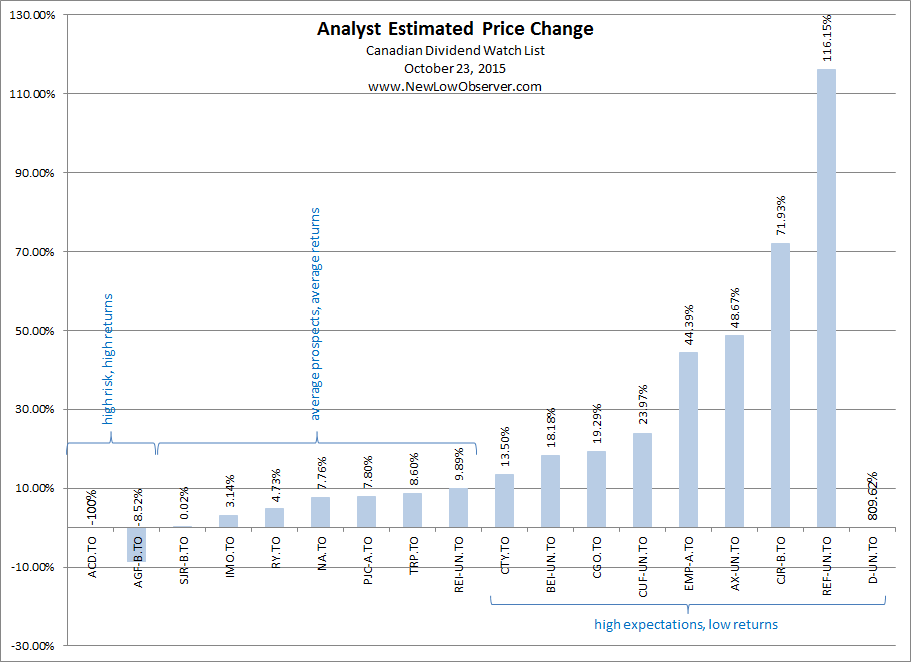
When compared to the other categories, our guess that the group marked as “average” would exceed the analyst expectations was fairly accurate. As luck would have it, our perspective prevailed while exceeding the Toronto Stock Exchange. Click on the above “analyst estimate” chart to see how we ranked the stocks for each category.
The “Setup”
On October 17, 2016, in after hours trading, Netflix (NFLX) stock increased by as much as +19% on news that the company “…beat analyst expectations…” More than a dozen analysts raised their price targets on the stock based on the upbeat news. In one odd case, an analyst who issued a “sell” rating on Netflix also increased the price target, presumably being right about the price increase AND the forthcoming decline (always right, these guys).

Underneath all the excitement, Barron’s cited Citigroup’s Mark May and Kenneth Dorell as saying the results were actually “better than feared” as it was highlighted that:
“Following a disappointing 2Q report (including 3Q guidance below forecasts), Netflix reported 3Q16 results and issued 4Q16 guidance above these lowered expectations. While subscriber net adds remain below year-ago levels and cash burn (including content spend) remains high, revenue growth accelerated to 32% (vs. 28% in 2Q) on subscriber growth of 25% (vs. 27% in 2Q) as the recent price increases benefited growth. We believe the stock’s reaction in the aftermarket may be due to a combination of 1) the set-up and negative sentiment heading into the quarter; and, 2) investors rewarding Netflix’s pricing power, as price increases proved not to have an outsized impact on churn.”
That’s a lot of negatives to reward a company with an increase in the stock price by nearly +20%.
The Problem
There is more to this picture than the apparent good news reported after-hours on October 17, 2016. Regulators, exchanges, institutions and investors are sitting by idly while the credibility of the markets is slowly eroded. I know you’re thinking, “who said the markets had any credibility”. While there is always a question of integrity of the financial markets in general, active participants should question the rhyme and reason for after-hours market activity. Chief among those questions should be, “is it still considered an orderly market if statically insignificant volume can garner outsized gains?”
For example, in the three months prior to October 17, 2016, average daily trading volume for Netflix was 10,204,329. In the period from the close in regular trading on October 17, 2016 to the open of regular trading on October 18, 2016, the after hours and pre-market trading volume for Netflix equaled 10,138,767. Additionally, the change in the stock price was +17.97% from the close on the 17th to the open on the 18th. Finally, the total trading volume on October 18, 2016, excluding the pre-market trading, was 39,968,284 while the actual price change in Netflix stock during regular hours was +1.85%.

So the question remains, is it considered an orderly market when after-hours trading volume does not exceed average daily volume for the last three months but that same volume affects the price so disproportionately? Are investors negatively affected when trading volume is four times the three month average daily volume but the stock only trades up +1.85%? The answer to both questions is no and yes, respectively.
Orderly markets cannot exist when stock exchanges open in after-hours to some investors (those playing the news release in after-hours) and is effectively closed to those who attempt to live outside of the gyrations of the market. What everyone hears is the good news about the stock price going up. However, what is not acknowledged is that short-sellers and good-til-cancel [GTC] orders to buy at a specific price were punished.
The Consequence
Institutional short-sellers (and individuals) with large holdings were hit hard by being squeezed out of the market at any available price while individual investors who had an order to buy at a set price, say at or above $106 (a technical confirmation of the rising trend), had their orders executed at the opening price of $116 and above, shaving off nearly 10% that could have been realized if the stock replicated the same moves as what the after-hours generated. However, this would have been unlikely as trading volume on the 18th would have only moved the price from the October 17, 2016 closing price of $98.77 to $100.59.
Many non-market participants and long-only investors would say, “if short sellers are hurt then that is their fault for playing a risky game.” This seems reasonable until those same investors are on the receiving end of watching their stock get decimated to the downside in the same after-hour market when an otherwise highly liquid stock “gaps down”-5%, –10% or –20%. This was the case with Intel (INTC) on after-hour trading which saw the stock drop more than -5%, on the same low volume that afflicted NFLX the previous after-hour session.
Financial markets have come a long way since the Nipper Panic of 1901 when short sellers in Union Pacific Railroad were squeezed out of the stock as the price increased from as low a $160 up to $1,000 and closed at $325 all in a single trading day. However, when investors, regulators, institutions and exchanges ignore glaring issues such as the impact of after-hour trading, we begin to revert to the market we have attempted to avoid.
A Simple Solution
What is the answer to this problem? Either companies are required to release news during regular trading hours or after-hour activity should be eliminated. The best option is keep the after-hour trading and require all market relevant news to be done at the middle of each trading day. This would promote a more orderly and efficient market without the chaos.
Alternatively, a steep price will be paid (by even those who are not participants) for ignoring a basic issue of market credibility, further undermining an already damaged reputation.
Posted in intc, NFLX, Nipper Panic
Performance Review
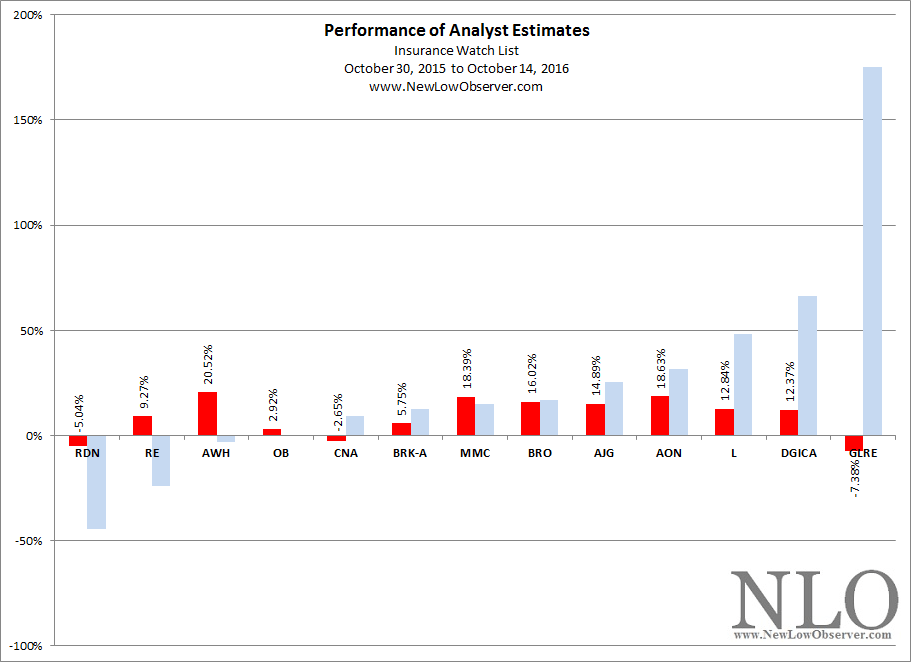
Below is the Insurance Watch List from October 2015 and the subsequent performance. The stocks are listed in the order that they were on the watch list.
| symbol | name | 2015 | 2016 | % chg |
| GLRE | Greenlight Capital Re, Ltd. | 21.96 | 20.34 | -7.38% |
| WEDXF | The Westaim Corporation | 2.11 | 2.00 | -5.21% |
| AWH | Allied World Assurance | 36.36 | 43.82 | 20.52% |
| RDN | Radian Group Inc. | 14.47 | 13.74 | -5.04% |
| KFS | Kingsway Financial Services Inc. | 4.30 | 5.65 | 31.40% |
| AMIC | American Independence Corp. | 10.10 | 24.72 | 144.75% |
| DGICA | Donegal Group Inc. | 14.15 | 15.90 | 12.37% |
| OB | OneBeacon Insurance Group, Ltd. | 14.39 | 14.81 | 2.92% |
| L | Loews Corporation | 36.46 | 41.14 | 12.84% |
| RE | Everest Re Group Ltd. | 177.97 | 194.46 | 9.27% |
| BRK-A | Berkshire Hathaway Inc. | 204596.00 | 216370.00 | 5.75% |
| CNA | CNA Financial Corporation | 36.56 | 35.59 | -2.65% |
| AON | Aon plc | 93.31 | 110.69 | 18.63% |
| BRO | Brown & Brown Inc. | 32.27 | 37.44 | 16.02% |
| AJG | Arthur J Gallagher & Co. | 43.73 | 50.24 | 14.89% |
| MMC | Marsh & McLennan Companies, Inc. | 55.74 | 65.99 | 18.39% |
The entire watch list had an average gain of +17.97%, this is contrasted by the performance of the iShares U.S. Insurance ETF (IAK) gain of +1.74%. A massive gain was achieved by small cap insurer American Independence (AMIC) with an increase of +144.75% after an August 31, 2016 cash offer from Independence Holding Company (IHC). The worst performing stock was Greenlight Captial Re (GLRE) with a decline of –7.38%.
Previous Year Performance Review
In our ongoing review of the NLO Dividend Watch List, we have taken the top five stocks on our list from October 16, 2015 and have checked the performance one year later. The top five companies on that list can be seen in the table below.
| Symbol | Name | 2015 Price | 2016 Price | % change |
| STT | State Street Corp. | 68.51 | 69.01 | 0.7% |
| STR | Questar Corp. | 20.97 | 25.06 | 19.5% |
| WMT | Wal-Mart Stores | 58.89 | 68.45 | 16.2% |
| MSM | MSC Industrial Direct Co Inc | 59.78 | 72.88 | 21.9% |
| LNN | Lindsay Corporation | 64.06 | 78.42 | 22.4% |
| Average | 16.2% | |||
| DJI | Dow Jones Industrial | 17,230.54 | 18,138.38 | 5.3% |
| SPX | S&P 500 | 2,033.11 | 2,132.98 | 4.9% |
The average gain for the top five companies was +16.20% which outperformed the market by a wide margin. The S&P 500 gained less than +5% over the same time frame. the best performer was a farm equipment supplier, Lindsay Corp (LNN). The worst performer was State Street (STT) which was virtually flat. Luckily, our assessment of State Street was not far off from reality. The shares of STT closed the week at $69 when we stated that valuation, based on Value Line Investment Survey, was $71. Below is an excerpt from last year's article.
"Value Line Investment Survey estimates that the company's fair value is at 13x EPS. Applying current estimate of $5.47 for 2016 and we get to $71."
Another company we mentioned last year was Wal-Mart (WMT). Once again, we were lucky enough to have assessed the situation correctly. However, our inaction on the thesis is something we regretted. Below is an excerpt from last year's article.
"Our valuation model suggests that WMT shares below $65 is highly worth considering. However, potential investors should question if Wal-Mart will be around 10 years from now. Would or could Wal-Mart be the next Montgomery Ward, Sears or Woolworths?"
One stock where our assessment didn't quite pan out was Nordstorm (JWN). Our valuation model, at the time, placed fair value at $73 which never came to fruition and is 37% above the current level. On the flip side, we pointed the reader to the possible downside of $35 which we believe is a prudent thing to consider.
U.S. Dividend Watch List: October 14, 2016
Our work of tracking dividend paying company continued this week with 32 companies on our list. Continue reading
Posted in Dividend Achiever Watch List, Dividend Achievers, Dividend Watch List
Tagged members
On January 22, 2016, we posted an Insurance Watch List that highlighted 36 insurance companies. Of the 36 companies we highlighted two that we thought stood out, CNA Financial (CNA) and Endurance Holdings (ENH). Of the two companies we said the following:
“The fact that CNA Financial has fallen below the ascending conservative downside target of $36.13 indicates that the expected range to the downside is $28.57.”
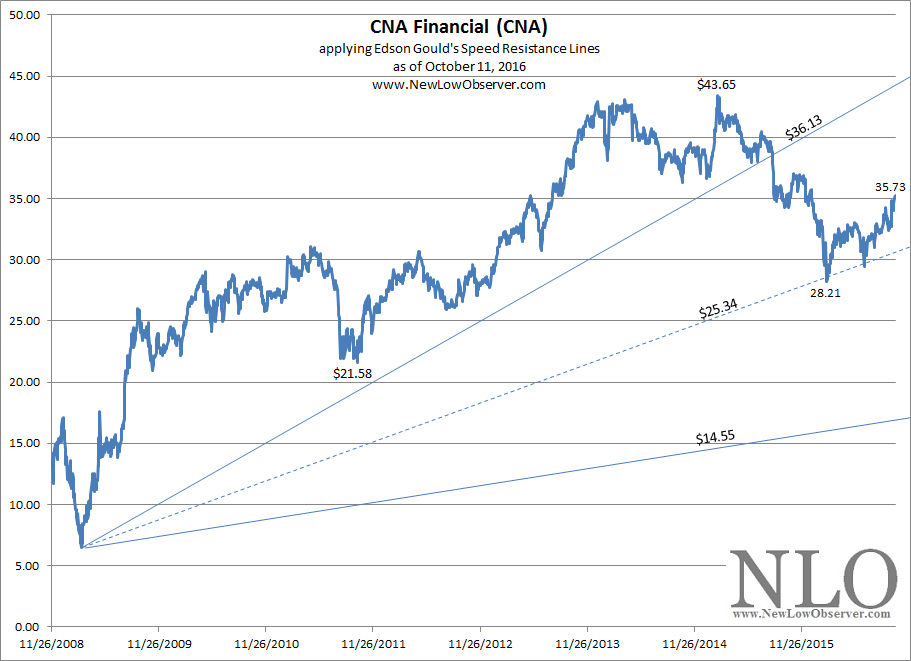
On a closing basis, CNA declined to the $28.21 level before rebounding to the current price at $35.70. Assuming and investment into CNA at $28.57 or below, the gain in the stock price has been +25%. All things being equal, CNA has upside resistance at the ascending $36.13 level, or $43.65.
Regarding Endurance Holdings (ENH), we said the following:
“The fundamentals say the stock is a buy and the technicals indicate that waiting is necessary. If your goal is income at a reasonable price then accumulation of ENH is acceptable at current levels and lower.”
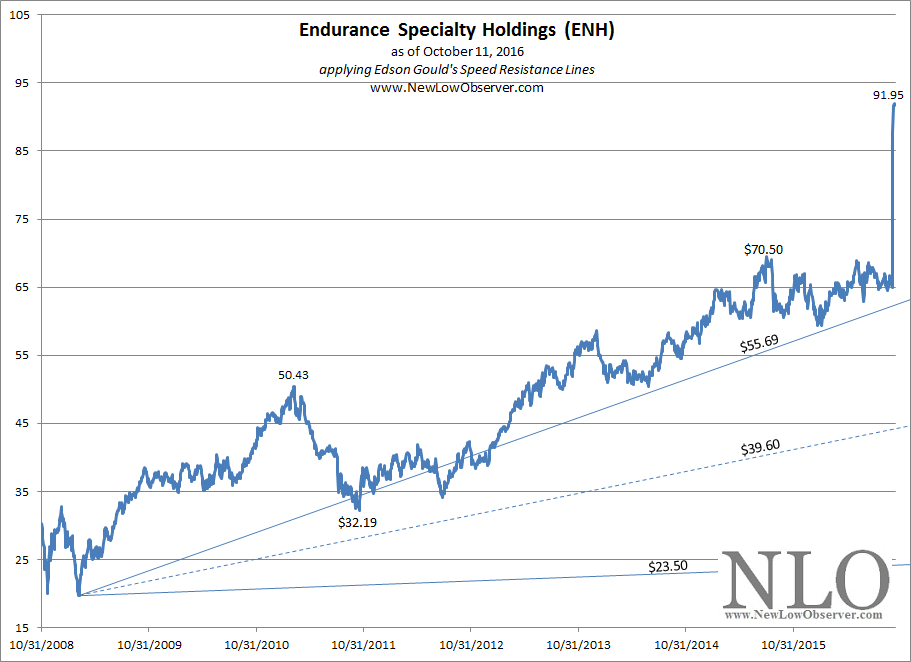
Endurance Holdings fell short of achieving our target of $55.69. However, as the stock was still considered worth acquiring based on the January 22, 2016 posting, it merited consideration as a reasonable holding as ENH is now at $91.95 with a pending $93 all cash acquisition price by SOMPO Holdings out of Japan.
While we managed to select two companies that have managed to achieve exceptional targets, it is worth noting that among all the companies on the January 2016 watch list, 13 companies (or 36% of the entire list) had equal or better performance than the minimum +25% achieved by CNA . Those companies are listed below:
| symbol | name | % chg |
| HTH | Hilltop Holdings Inc. | 56.18% |
| ENH | Endurance Specialty Holdings Ltd. | 52.97% |
| KFS | Kingsway Financial Services Inc. | 51.87% |
| STC | Stewart Information Services | 40.17% |
| RGA | Reinsurance Group of America Inc. | 37.50% |
| AJG | Arthur J Gallagher & Co. | 34.18% |
| RDN | Radian Group Inc. | 33.79% |
| AON | Aon plc | 28.33% |
| BRO | Brown & Brown Inc. | 28.20% |
| MTG | MGIC Investment Corp. | 27.78% |
| HMN | Horace Mann Educators Corp. | 27.44% |
| MMC | Marsh & McLennan Companies, Inc. | 26.75% |
| ANAT | American National Insurance Co. | 26.45% |
Because we always like to err on the side of caution, we have to assume that this is a high level of coincidence on our part, of which we hope to replicate if our analysis is generally accurate.
Posted in CNA, ENH, Insurance Watch List
Below are the price projections based on analyst earnings estimates for our recent U.S. Dividend Watch List dated October 7, 2016. These estimates project the price change for the respective stocks over the next 12 months and the risk profiles associated with the estimates.
The stock market continues to trade sideways with low volume. The S&P 500 ended the week down -0.6% and the trading range is compressing. Another market indicator, the Dow Jones Transportation Average, appears to be on the verge of breaking 8,100 which has been the resistance all through the year. We'll continue to operate under the bull market assumption and use our dividend watch list as our starting point. Continue reading
Posted in Dividend Achiever Watch List, Dividend Achievers, Dividend Watch List
Tagged members
Below are the downside targets based on the work of Edson Gould and the precedent setting periods from 1999 to the present.
Below is the Bloomberg Commodity Index (formerly known as the Dow Jones Commodity Index) with downside targets based on the work of Edson Gould.
Posted in Bloomberg Commodity Index, commodities
Since the Coppock Curve flashed a buy indication at the end of March 2016, the Dow Jones Industrial Average has increased by +3.52% while the S&P 500 gained +5.20%. Our strategy of purchasing Guggenheim S&P 500 Equal Weight ETF (RSP) has proven was well timed and is up +6.40%. Below is an update to the Coppock Curve.
Performance Review
This is the performance from the September 25, 2015 Nasdaq 100 Watch List.
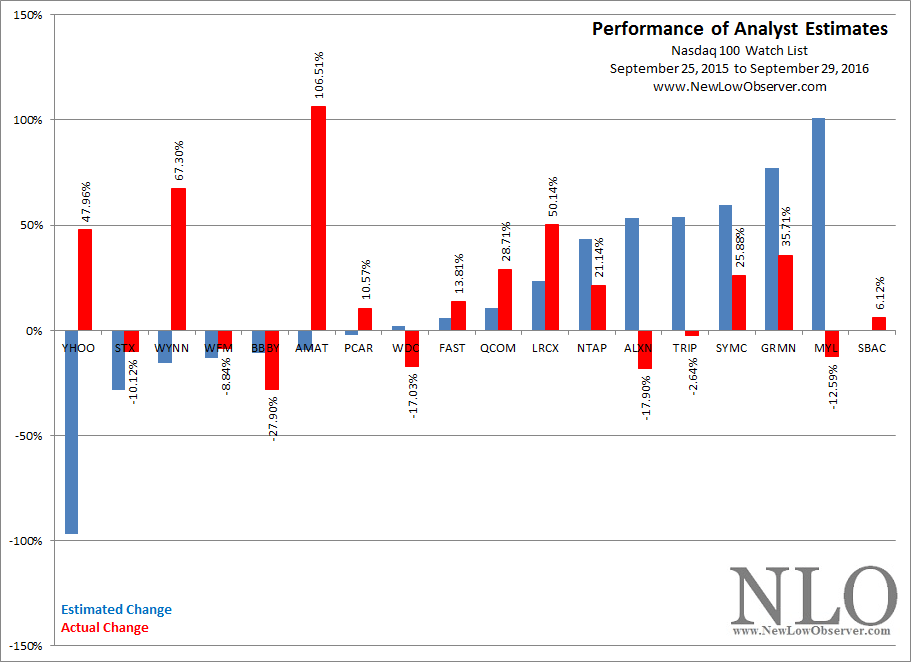
If we exclude the change from Yahoo (YHOO), Wynn (WYNN), Mylan (MYL) and Applied Materials (AMAT) then the analyst performance was mostly on target.