Coppock Curve: March 2016

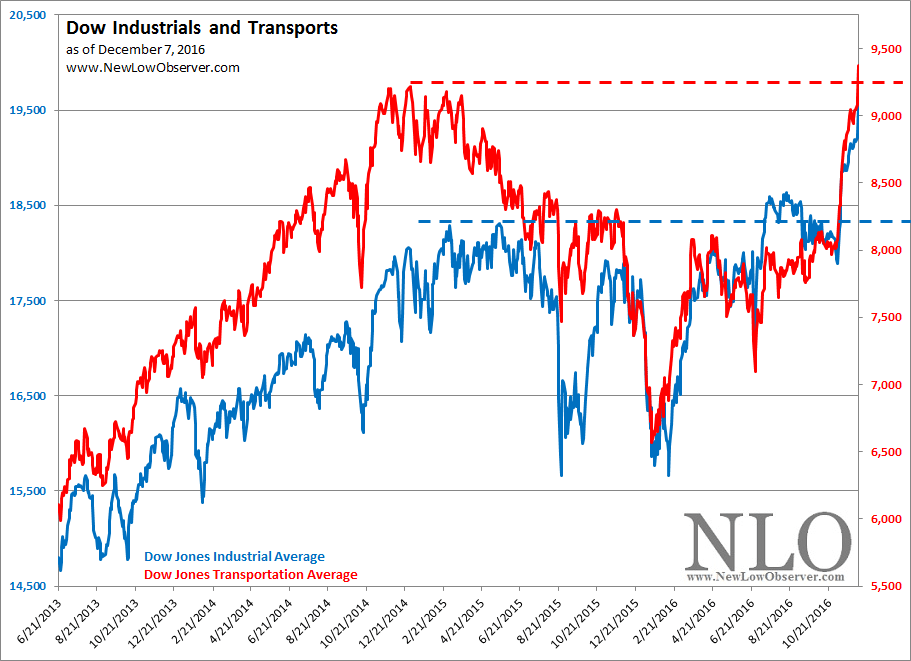
The Dow Jones Industrial average had an outstanding gain in the month of March. The blue chip index rose +7%. Continue reading

Transaction Alert

On April 1, 2016, we executed the following transaction(s):

U.S. Dividend Watch List: March 25, 2016

Prior Year Top Five Performance Review

In our ongoing review of the NLO Dividend Watch List, we have taken the top five stocks on our list from March 27, 2015 and have checked the performance one year later. The top five companies on that list can be seen in the table below.

Symbol Name 2013 Price 2014 Price % change
PM Philip Morris International 76.79 97.57 27.1%
XOM Exxon Mobil Corp. 83.58 83.98 0.5%
CAT Caterpillar 79.67 75.29 -5.5%
MSM MSC Industrial Direct Co Inc 71.21 74.57 4.7%
PX Praxair 120.16 111.74 -7.0%
      Average 4.0%
         
DJI Dow Jones Industrial 17,712.66 17,515.73 -1.1%
SPX S&P 500 2,061.02 2,035.94 -1.2%

Watch List Review

The average gain for the top five companies was +4% which was better than the market. The best performer may be of a surprise to many, Philip Morris (PM) gained +27% in the year. Of the five companies, the largest decline of -7% came from Praxair (PX). We highlighted three companies and would like to bring to light what we said about Exxon Mobile (XOM). Below is an excerpt from that post.

As one look beyond the short term and see what the market has offered us, the investment opportunity looks even more compelling even in the mist of the bad news. Valueline placed a fair value at $75 for 2016 which is roughly 10% below the current level. Although Valueline estimated earning and cash flow per share to fall, dividend is projected to rise 5% and 4% from 2015 and 2016 respectively (head to Valueline for complimentary research report on Exxon). IQTrend estimated that the company is undervalued at 3.2% yield and current yield of 3.3% suggests that we are much closer to the bottom than the top. Don't expect the stock to pop in the short term and may have more downside to go. Multiple purchases is likely the best approach for long-term investor.

U.S Dividend Watch List: March 25, 2016

Below are 26 companies appearing on our dividend watch list for the week. Continue reading

Nasdaq 100 Watch List: March 2016

Performance Review

Below is the performance of the watch list stocks from our March 27, 2015 posting:

image

The watch list averaged an equal weighted loss of –1.32% while the first five stocks averaged a gain of +3.15%.  This compares to the gain for the Nasdaq 100 Index of +0.52% over the last year.  The stocks of interest (STX, QCOM, SNDK, KLAC) had worse than average results with an equal weighted decline of –6.00%.  Our quote at the time was:

“In the chip sector, the recent announcement by Intel that they are interested in buying Altera (ALTR) suggests that further consolidation of the industry is on the way.”

Since that March 2015 posting, all of the companies were involved in some kind of merger/acquisition activity.  Sandisk was supposed to go to Western Digital, Seagate acquired Dot Hill, Lam Research acquired/merged with KLA-Tencor and rumors abounded about Intel actually buying Qualcomm. The mixed results of the stock performance over the last year should not be confused for the long-term reality of this sector.  These stock will be acquired or rendered irrelevant in due time (as is the rule for all stock investments).  However, the odds favor the production, storage/memory and plant assembly in the chip sector.

Richard Russell Review: Letter 1248

On this date in 1998, Richard Russell published Issue 1248 of the Dow Theory Letter.  At the time, the Dow Jones Industrial Average was at the 8,872.79 level and the Transportation Average was at 3,517.52.

image

Russell opens his newsletter by pointing out the distinction between what the market “should be doing” versus what was actually happening.  What was happening?  The market was defying all long-term conventional norms.  In Russell’s word’s, “The conclusion -- always -- is exhaustion.”  Russell felt that the market’s rise was at a mania level and that investing in such a market was clearly a personal choice but that “values will out.”

Continue reading

Insurance Watch List: March 2016

Below is the Insurance Watch List which includes the analyst estimates of price change in the next 12 months.

Performance Review: Family Dollar

On March 31, 2014, we summarized our thoughts on Family Dollar (FDO) in a Quick Take posting with the following:

“Falling below the $55.07 support line suggests that FDO could decline to $47 in the near term.  Investors interested in FDO could break their investment into at least two purchases, the first being 60% of the intended amount now and the second purchase of 40% at either of the two indicated support levels at $44.95 or $34.83.”

Like moths to a flame, we were encouraged by Value Line Investment Survey’s assessment that “…would-be investors to look else-where.” As we saw it, the fundamentals and technicals supported the idea that Family Dollar was worth investing in (at least 60% of funds committed as part of a balanced portfolio).

Continue reading

Canadian Dividend Watch List: March 2016

Performance Review

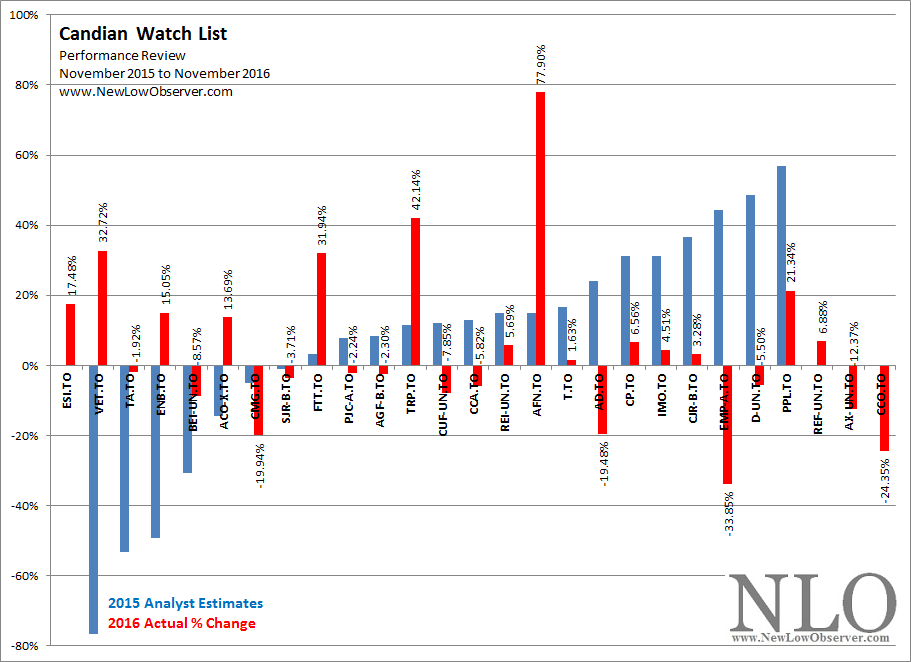
Below is the performance of all the stocks from our March 2015 Canadian list:

symbol name 2015 2016 % chg
BEI-UN.TO Boardwalk REIT 58.27 53.2 -8.70%
TU TELUS Corporation 33.47 30.84 -7.86%
BNS.TO The Bank of Nova Scotia 63.46 62.27 -1.88%
REF-UN.TO Canadian REIT 45.57 43.45 -4.65%
LB.TO Laurentian Bank of Canada 48.3 47.76 -1.12%
CJR-B.TO Corus Entertainment Inc. 18.41 10.75 -41.61%
CM.TO CIBC 93.2 96.99 4.07%
BDT.TO Bird Construction Inc. 10 11.75 17.50%
SU Suncor Energy Inc. 28.2 26.16 -7.23%
RY.TO Royal Bank of Canada 76.39 74.25 -2.80%
HCG.TO Home Capital Group Inc. 42 36.11 -14.02%
CTY.TO Calian Technologies Ltd. 18.55 19.8 6.74%
NA.TO National Bank of Canada 47.03 41.38 -12.01%
AX-UN.TO Artis REIT 14.83 12.65 -14.70%
RCI-B.TO Rogers Communications Inc. 44.06 50.73 15.14%
CUF-UN.TO Cominar REIT 19.3 16.66 -13.68%
TD The Toronto-Dominion Bank 43.06 41.65 -3.27%
CWB.TO Canadian Western Bank 27.63 24.28 -12.12%
IMO.TO Imperial Oil Ltd. 48.35 44.4 -8.17%
D-UN.TO Dream Office REIT 26.14 20.32 -22.26%


The average change was –6.63% as compared to the Toronto Stock Exchange change of –9.60% in the period from March 22, 2015 to March 11, 2016.  The first five stocks on the list averaged a decline of –4.84% excluding the dividend.  Including the dividend for the first five stocks would have resulted in a net decline of –0.78%.

A stock that we had strong interest in from our January 2015 Canadian list was Computer Modelling Group (CMG.TO).  At the time we said the following:

“As Computer Modelling Group is heavily associated with the oil, gas and mining sector, currently experiencing a drubbing at the hands of lower oil prices, there is good reason to believe that the stock could go as low as $7.30.  However, the most compelling element of Computer Modelling Group is the fact that the services they provide are, or could become, applicable to other industries.  Therefore, we wouldn’t rule out this company’s prospects over the long-term.”

According to the available data, CMG.TO managed to trade as low as $7.67 on January 26, 2016, this was within 5% of our targeted worst case scenario of $7.30.  Below is an updated Altimeter for CMG.TO.

image

March 2016 Watch List

Continue reading

Quick Take: Ecolab Inc.

According to Yahoo!Finance, Ecolab Inc. (ECL), “…provides water, hygiene, and energy technologies and services for customers worldwide. The company operates in three segments: Global Industrial, Global Institutional, and Global Energy. The Global Industrial segment provides water treatment and process applications, and cleaning and sanitizing solutions primarily to large industrial customers within the manufacturing, food and beverage processing, chemical, mining and primary metals, power generation, pulp and paper, and commercial laundry industries.”

Since the bottom that occurred in the stock market in March 2009, Ecolab Inc. has outpaced the recovery in the Dow Jones Industrial Average by +94% and the S&P 500 by +66%.  At some point the pendulum needs to swing in the opposite direction.  It is our goal to point out the potential scenarios that are most plausible for the reaction that is to come for ECL.  First, we’ll cover some important fundamentals and what they indicate and then we’ll cover the topic of technical aspects of downside risk.

image

Analyst Estimates: U.S. Dividend Watch List

Below are the price projections based on analyst earnings estimates for our recent U.S. Dividend Watch List dated March 4, 2016. These estimates project the price change for the respective stocks over the next 12 months and the risk profiles associated with the estimates.

Gold Stock Indicator: March 2016

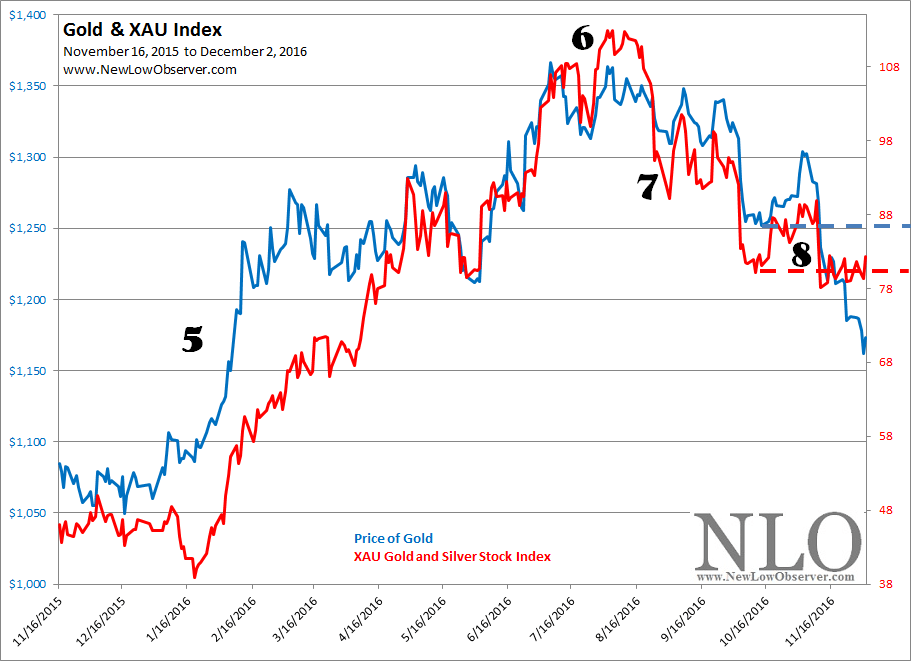
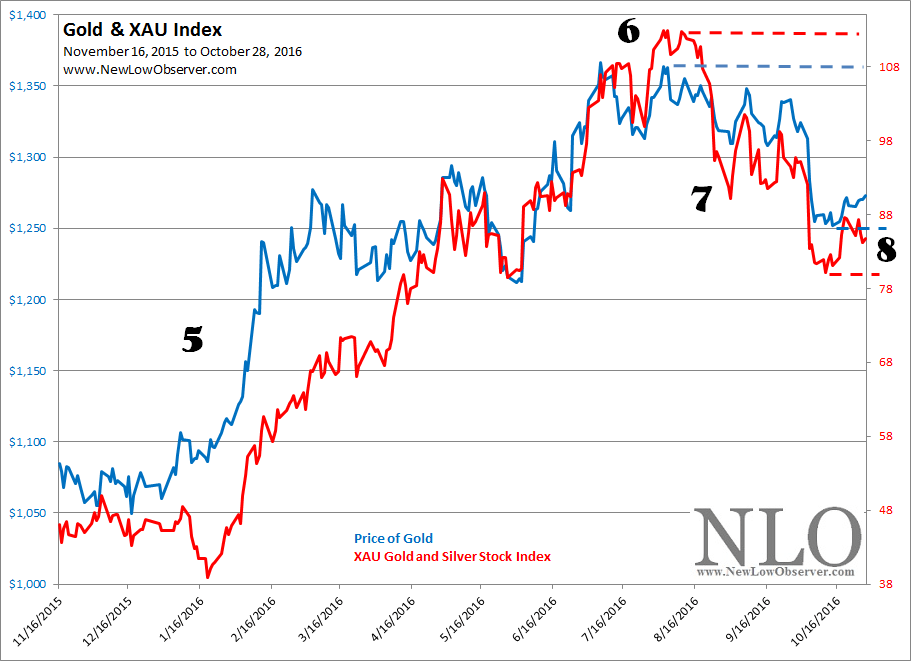
Since our February 12, 2016 posting, the price of gold has increased by +3.04% while the Philadelphia Gold and Silver Stock Index has increased +10.07%. 

image

There is the mistaken view that in order to verify the trend in the precious metals market based on Dow’s Theory, investors should compare the price of gold with the price of silver.  In fact, this is incorrect.

U.S. Dividend Watch List: March 4, 2016

Top Five Watch List Performance Review

In our ongoing review of the NLO Dividend Watch List, we have taken the top five stocks on our list from December 5, 2014 and have checked the performance one year later. The top five companies on that list can be seen in the table below.

Symbol Name 2014 Price 2015 Price % change
XOM Exxon Mobil Corp. 85.63 82.29 -3.9%
MSM MSC Industrial Direct Co Inc 72.16 70.34 -2.5%
GAS AGL Resources Inc. 47.11 64.80 37.6%
GTY Getty Realty Corp. 17.09 18.36 7.4%
SJI South Jersey Industries 26.18 26.44 1.0%
      Average 7.9%
         
DJI Dow Jones Industrial 17,856.78 17,006.77 -4.8%
SPX S&P 500 2,071.26 1,999.99 -3.4%

Watch List Review

Average gain for the top five companies were 7.9% which far exceed the S&P 500 and Dow Jones Industrial. The best performer was AGL Resources (GAS) which gained 37.6% driven by an aquisition by Southern Co. (SO).

Two companies with negative return were Exxon Mobil (XOM) and MSC Industrial (MSM). Our commentary on both companies were bullish and we took positions in Exxon about one year ago. Below are excerpt from last year.

Exxon Mobil (XOM) is the larger oil explorer and producer who need no introduction. The stock not only hit its 1 year low but also trading near its 2 years low. Back in October 2013, the stock marked the low at $84.79. Long-term investor without a position in the stock with focus on income and capital appreciation may want to start their due diligence. The drop in oil price may be one reason the stock has fallen but if you refer back to our post from February 20, we've highlighted that such correlation has little merit than one might believe. However, our view may be bias as we've acquired more Exxon in February.

MSC Industrial Direct (MSM) was founded in 1941 and manufactures and markets various industrial products such as abrasives and fasteners which are part of a larger category known as maintenance, repair, and operations (MRO). While the company isn't a dividend achiever, it has great dividend record which started in 2003. Since 2004, the dividend has grown at an annual rate of 16% excluding two special dividend that was paid out within that time frame. The company earned $3.74 on $20.26 of book value which is equivalent to 18% ROE. Such high ROE is favorable in the economic such as the one we are in because it imply wide economic moat. Charlie Munger once said that owning a great business at a fair price is better than owning a mediocre at a discount price thus we are beginning to look at company that can maintain exceptionally high ROE over a period of time.

Overall, we are content about our assessment of both companies even when they did not outperform the market. Despite oil falling -28%, Exxon was able to weather the storm and managed to loss only -4%. MSM Industrial was virtually flat on price as well as net income. The stock dipped as low as $54.19 and rebounded +30%. The street is expecting net income to grow by 10% over the next year.

U.S. Dividend Watch List: March 4, 2016

The recent rally in the market has taken many companies trading at or near their yearly low upward. Below are 13 companies that made the cut this week. Continue reading

Coppock Curve: February 2016

The Dow Jones Industrial average gained ground in February.   However, that didn’t change the direction of the Coppock Curve which dipped to –23.4.  Below is the current chart of the curve. Continue reading

Nasdaq 100 Watch List: February 26, 2016

Performance Review

Below is the percentage change in the stocks that appeared on our February 22, 2015 watch list:

symbol name 2015 2016 % chg
GRMN Garmin Ltd. 49.42 40.4 -18.25%
MAT Mattel, Inc. 25.77 32.47 26.00%
NUAN Nuance Communications, Inc. 14.02 19.59 39.73%
FAST Fastenal Company 42.76 45.22 5.75%
FOSL Fossil Group, Inc. 85.14 47.04 -44.75%
DISCA Discovery Communications, Inc. 30.93 25.08 -18.91%
KLAC KLA-Tencor Corporation 64.97 67.97 4.62%

The average performance of the entire watch list was –0.83% while the Nasdaq 100 index declined –4.81%.  A stock that we had some interest in was Garmin (GRMN).  In our commentary we said the following:

“There is no hard and fast rule for what has occurred in a generally rising market.  However, it is well worth the time to examine the investment merit of GRMN when the stock has fallen –29% or more.”

In the case of Garmin, falling –29% from the prior peak would have meant that the stock would at $43.80 or lower.  GRMN did not achieve this until early July 2015.  Since that time, GRMN has fallen an additional –31%.  At the current time, GRMN has not achieved the breakeven level of $43.80.

Watch List and Analyst Estimates

Below is the latest Nasdaq 100 Watch List for February 2016.

Richard Russell Review: Letter 449

Bear Market Declines

“Historically, bear markets tend to last 1/3 to ½ as long as the preceding bull markets. Since this bear market is in the process of correcting the 17-year bull market of 1949 to 1966, a rough rule-of-thumb would be that the bear market could last five to eight years (and I will be optimistic in that I hope it lasts nearer to five than eight). However, the interesting part of the picture is that with four years out of the way, the worst the Dow Industrials have done is to decline from their 1966 peak of 995.15 to their 1966 low of 744.32, a total drop of 251 points (Russell, Richard. Dow Theory Letters. January 7, 1970. Letter 449. Page 1.).”

As a “rule-of-thumb”, the 1/3 to ½ (in terms of duration) extent of a bear market decline is pretty good and very consistent. The examples are many and the data is clear. First, let’s take the 1966 peak as the beginning of the bear market. From that time, the ultimate low in the stock market was December 1974. This was eight years from the 1966 peak. True stock market enthusiasts would argue that the bear market for stocks did not end until 1982, when the Dow Jones Industrial Average “permanently” broke above the mythical 1000 level and never looked back. Die hard market historians make a credible claim that the bear market did not end until the inflation-adjusted low achieved in 1978 or 1982.

However, based on the work of Jeremy Siegel (“The Nifty-Fifty Revisited: Do Growth Stocks Ultimately Justify Their Price?” [PDF download]), even if a person had bought the “Go-Go” or “Nifty Fifty” stocks at the 1966 or 1971 peak, investors would have achieved exceptional gains in spite of the high inflation rates until 1982 (by the end of 1995, in support of the “buy-and-hold” strategy).

image

The amount of time that passed from the 2007 peak to the 2009 low was 18 months. This was 38% of the bull market that preceded it from 2003 to 2007. The decline was severe and few would be in the position to stomach the extent of the decline, however, the rebound was inevitable and equally as vicious.

Our default view generally gravitates towards the stock market crash of 1929 to 1932. Even our cautiously optimistic analysis should be thwarted by one of the worst bear markets in history. However, taking note of the fact that the bull market “officially” began in 1921 and unofficially in 1907 or 1915, it is clear that the rule-of-thumb holds up.

Market enthusiasts will often retort that the bear market ends when the market recovers beyond the previous peak as the majority of investors buy near the last market peak. This is a valid point and yet, investing is made better by understanding that the majority is usually wrong and therefore should fight the urge to commit 100% of their investment capital as the market climbs higher and ensure that saved funds are 100% invested as the market falls. There are many benchmarks for determining how low is low enough before 100% of funds are committed so being close enough is better than succumbing to the fear of a falling market.

Continue reading