Shanghai Composite Index: Fighting the Tide and Losing

Stock markets have a way of doing their own thing.  One of those “things” is fighting the forces of manipulation in the long run.  Once such example is the Shanghai Composite Index.  Last year it was claimed by many analysts that the Shanghai index would be propped because the government is too highly vested to allow a significant decline.  On July 8, 2015, we said the following of the downside risks to the Shanghai Index:

“There is more downside risk if there continues to be restrictions on selling. SSE's next downside target is 2,867. Should see a bounce around that level.”

“Only two downside targets left 2,867 and 1,722. With all the rules killing liquidity, the greater the chance for falling to these levels.”

Since that time, the Shanghai Index declined to the anticipated 2,867 level then rebounded and then declined further.  Below is the updated SRL for the Shanghai Composite Index and our recommendation for the upcoming targets.

Elliot Wave Theory: Insights

On September 16, 1970, Richard Russell had the following to say about Elliot Wave Theory:

"Last week I received a letter from a gentleman at a large New York Bank, and the letter raises on important question which deserves answering here. He writes:

'I have been particularly interested in your comments to the effect that we now have seen two of the three major declines that mark a primary bear market. Referring to the chart on Page 4 of your Letter No. 469, two major slides are quite noticeable (one in 1966 and the other in 1969-70). However, there is a third slide (in late 1967 and early 1968) that is very clear in the Transportation Average but not so noticeable in the other two averages. From your letters, it is clear that you do not regard this as one of the three major phases of the primary bear market; however, I would like to hear some more of your reasoning as to why it does not qualify.'

"Now I believe this gentlemen is expressing a common misconception, a misconception which stems from a confusion between Dow Theory and the Elliot Wave Theory. Let me attempt to clarify. Elliot (writing in the 1930’s) believed that bull movements occurred in a five-step series of upward zig-zags, three rising waves and two declining wave-corrections. He believed that bear movements occurred in a three-step downward zig-zag, two declining waves separated by a single corrective rising wave.

"The fact is that Elliot’s observations regarding the wave theory have been born out so many times in actual practice that they must be taken seriously. The problem is that most amateurs do not know how to break the waves down correctly. Each Elliot wave may break down into many sub-waves, and a mere glance at a chart and a cursory dividing of a structure into three-wave and five-wave patterns is usually so far from a true Elliot analysis as to be more deceptive than useful.

"Hamilton Bolton (founder of the Bank Credit Analyst) did some remarkable work on Elliot, and Bolton’s research and interpretations have been carried on by the present editor, Donald Storey.  Storey believes that the first wave of the current bear market started for the Dow Industrials in February, 1966. The first wave ended at the October, 1966 lows  The second wave (and this was the major corrective wave) carried to either the December, 1968 peak or possibly the May, 1969 peak. From there the third leg (which was again a downward leg) began, and Storey believes we are continuing in that leg now. He feels that this leg will ultimately approach or break the 1970 lows, going perhaps as low as the 1962 Dow low (535) or the 1956 and 1957 peaks (520)[Russell, Richard.  Dow Theory Letters. September 16, 1970. Letter 473 page 3.]."

The price action of the Dow Jones Industrial Average from September 1970 and the following years is potentially instructive and presented below.

Continue reading

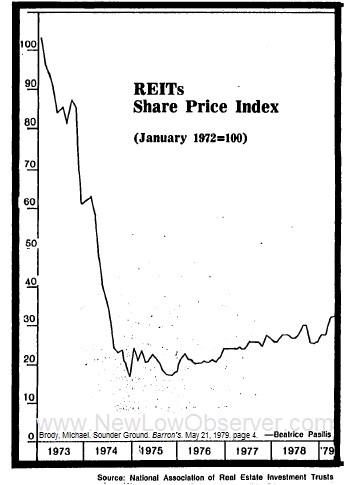
Real Estate Review

On December 9, 2010, we wrote an article titled “Real Estate: The Verdict Is In”.  At the time, we said the following:

“As we come to the close of 2010, it appears that based on the narrow scope of sources that we’ve selected, the bottom in real estate has come and gone.”

Since that time, the real estate market has experienced what we’d consider to be a recovery.  This is a follow-up on the indicators from that 2010 article to see how far along we have come in the current recovery and where we might expect the market to go from here.

Continue reading

Dow Altimeter Review

The Dow Jones Industrial Average Altimeter from 1920 to the present is posted below.

Analyst Estimates: U.S. Dividend Watch List

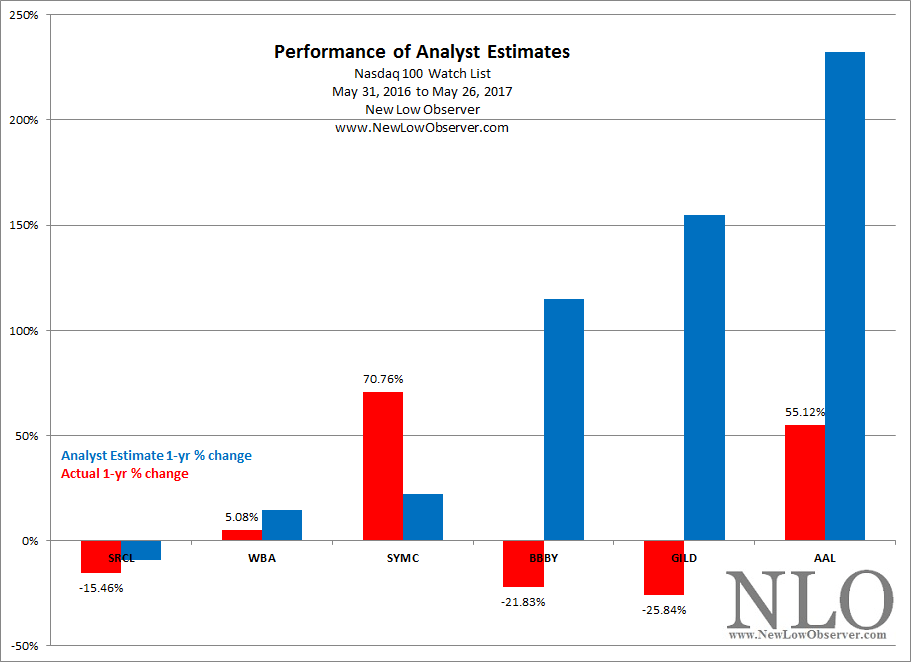
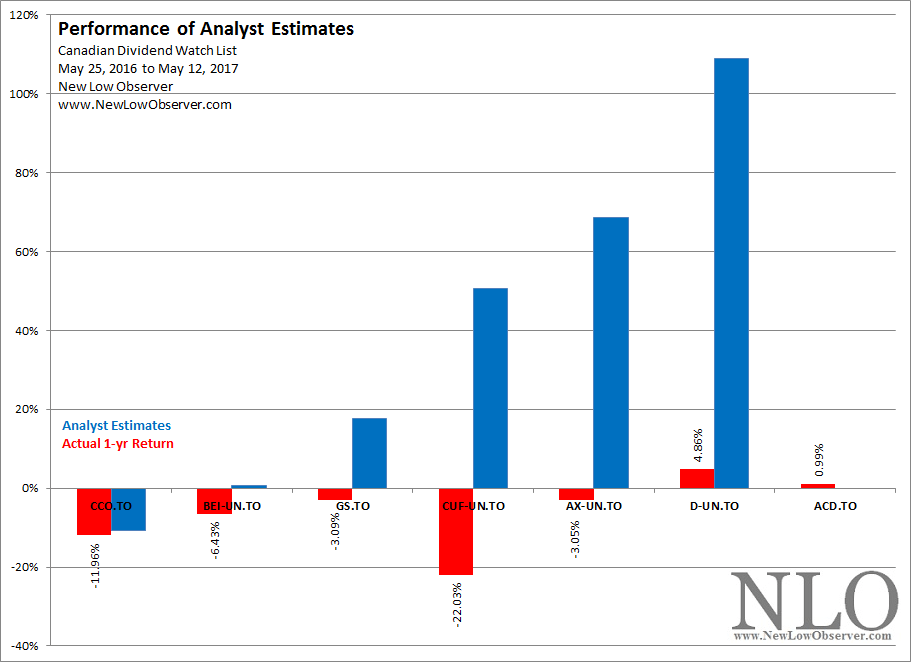
Below are the price projections based on analyst earnings estimates for our recent U.S. Dividend Watch List dated September 9, 2016. These estimates project the price change for the respective stocks over the next 12 months and the risk profiles associated with the estimates.

Continue reading

U.S Dividend Watch List: September 9, 2016

The S&P 500 lost nearly -2% for the week. While the drop on Friday appears to be dramatic (at -2.43%), the market is only about 3% off the all-time high. This is a great opportunity, in our view, to start building your personal watch list. Below are 17 companies on our dividend watch list. Continue reading

Dow Jones Downside Targets

Below are the downside targets for the Dow Jones Industrial Average applying Dow’s Theory and the Dow Jones Transportation Average applying Edson Gould’s Speed Resistance Lines.

Dow’s Theory on Values and Information

"Wall Street offers many opportunities to those who know values and possess some capital. But until people learn that some stocks are cheap at $200 per share an others dear at 2 cents per share, and until people learn that those who really know something about the market do not need to peddle their information for a living, it is to be feared that much money will continue to be lost both in and out of Wall Street (Dow, Charles H. Review & Outlook. Wall Street Journal. September 10, 1902.).”

Gilead Downside Targets

Gilead has the following downside targets:

Greenhill Slopes Downward

In a recent article found on Bloomberg.com titled “Greenhill Adds Ex-Analyst Trone to Revive Wall Street Confidence”.  We’re not so sure that a new investor relations rep is going to be that critical in reviving “Wall Street Confidence.”   On July 22, 2011, we proposed the following to Greenhill & Co. (GHL) to gain greater confidence of investors and employees alike:

“Cutting the dividend would put Greenhill & Co. (GHL) in a better financial position to retain the staff necessary to get the mergers and acquisitions done. We recognize that the dividend, with a payout that exceeds current earnings, would further undermine the current stock price and pay less cash to the largest shareholders. However, maintaining such a high dividend leaves less cash available to pass on to their most valuable asset, the employees.”

In response to our request to cut the dividend, CEO Scott Bok replied by saying, in November 9, 2011:

“‘you’d have to waterboard me’ to persuade [me] to cut the firm’s quarterly dividend.”

Since July 2011, GHL has not cut the dividend and thus far it has been reflected in the stock price.

image

GHL has declined –54% which appears to be the tax on those seeking the dividend at the expense of the future growth of the company.  The company can certainly turn things around, however, with a dividend payout ratio that exceeds earnings, the outcome seems obvious.

Transaction Alert

The NLO team executed the following transaction(s):

Federal Reserve: A Bit Player

When talking to any number of clear headed and knowledgeable market analysts, it often shocks me at the confidence and certainty with which the Federal Reserve Bank is credited with the rebound of financials markets from 2009 to 2016.  It appears as though this assessment is guided by faith alone and yet there are numbers that seem to support the claim.  This article cannot dispel the religious reverence for the Federal Reserve’s apparent powers.  However, it is hoped that we can demonstrate that the Federal Reserve may be a bit player on a grand stage of market forces.

Continue reading

Nasdaq 100 Watch List: September 2016

Performance Review

Below is the performance of our Nasdaq 100 Watch List dated September 11, 2015.   In addition, we have broken out the performance to the various categories that we assigned at that time.

image

The stocks that were favored by analysts to perform the best (high expectations) were unable to exceed the stocks that we highlighted as likely to do better than average.  Stocks highlighted as “average risk” and “high risk” far exceeded the performance of the Nasdaq 100 index and notched better gains than “high expectation” stocks.

The worst three stocks were Western Digital (WDC), Bed Bath & Beyond and Mylan (MYL) at –41.69%, –24.91% and –17.47%, respectively.  the best three stocks were Applied Materials (AMAT), Autodesk (ADSK) and Yahoo (YHOO) at +93.55%, +46.74% and +37.73%, respectively.

Continue reading

Ritchie Brothers: Now What?

In our June 12, 2016 posting titled “Ritchie Brother: Inflection Point?” we said the following:

  • “…it appears that [Ritchie Brothers] RBA is at a threshold that has not been exceeded since early 2011”
  • “…the stock could rise to $48.00.”
  • the stock needs “…some kind of reprieve from the most recent parabolic move in the price”

Since June 2016, RBA has managed to trace out the following price action (in red):

image

As the last bullet point indicated and the price chart has reflected, the parabolic move was resolved with a decline to the recent low of $27.27.  Unfortunately, we now need another parabolic move from $27.27 to the recent jump above $35 to be resolved in some way or another.

Another item that was pointed out was the possibility that RBA could exceed a level in Edson Gould’s Altimeter, a level that had not been exceeded since 2011.  The recent price action since June 2016 has allowed this to occur as well.

image


We’re still thinking that the rise to $48 is possible.  The recent news of the acquisition by RBA of IronPlanet makes it more possible to hit our target.  However, the recent price activity of going from $27 to $35 overnight based on an acquisition simply means that achieving the $48 target will take more time than we had anticipated.

Downside Targets for Craft Brew Alliance

The latest run for Craft Brew Alliance (BREW) from the low set in November 2015 to the most recent peak on August 2016 requires that we check for the downside targets.

image

 A parabolic peak is one thing.  However, having them play out in a consistent fashion is something else.  In the case of BREW, we’ve had two prior parabolic peaks since 2008 that were true to form and function.  In the period from the 2008 low to the 2010 peak, BREW declined to below the mid-range Speed Resistance Line [SRL].  In the period from the 2008 low to the 2013 peak, BREW declined below the extreme downside target.  In the chart above, we have the following downside targets:

  • conservative: $12.57
  • mid-range: $10.02
  • extreme: $7.47

Although there is no assurance that the stock needs to decline to the referenced downside targets, any parabolic move must be watch closely as entropy will kick in at some point.  In this case, we believe that the ascending conservative target is a lock.  With established history as an indication, the mid-range target looks to be a safe “bet” as well.  We’ll check back in on this as more time has passed.