Recently we have been adding 10-Year Targets for estimating the future undervalued, overvalued, and fair valued levels of specific stocks.
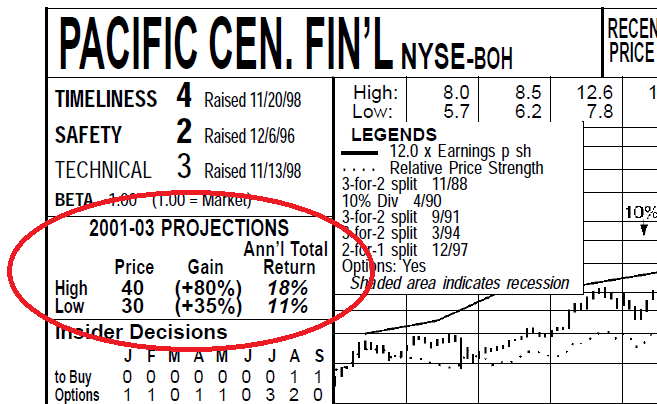
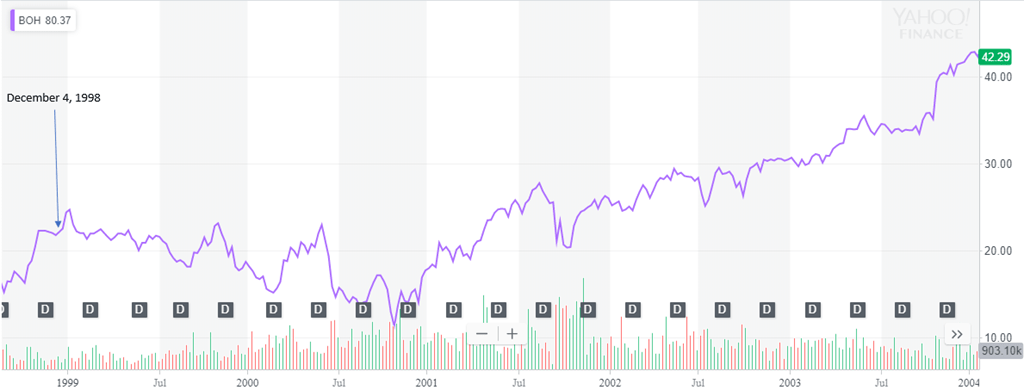
To help clarify the reasons why we have done this, we are providing an example from a Value Line Investment Survey dated December 4, 1998 to capture data from within the two stock market crashes of 1999 to 2001 (03) and 2007 to 2009.
The sample stock that we have used is Bank of Hawaii (BOH) which was known as Pacific Century Financial at the time. In the Bank of Hawaii (BOH) example that we have provided from 1998, we have run exactly the same numbers as in the 10-Year Targets for the stock from 2018 to 2029.
1998 to 2018
For the Bank of Hawaii, based on the December 4, 1998 and priced at $22.00, we have the following targets:
-
$27.03 (overvalued)
-
$21.08 (fair value)
-
$15.81 (undervalued)
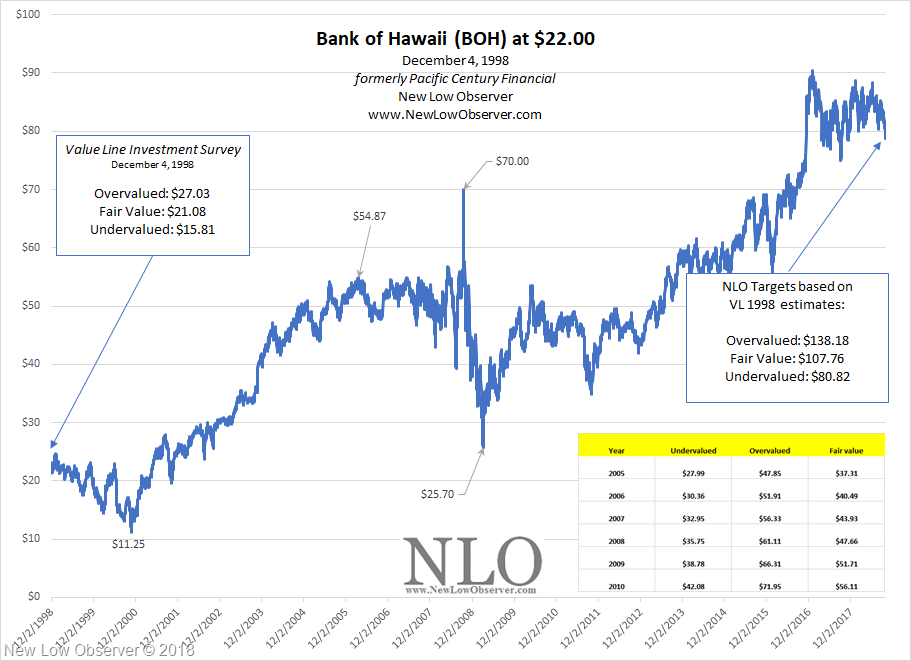
The accompanying stock chart from 1998 to 2018 indicates the estimated valuation levels, and highlights the 2005-2010 & 2018 periods.

Observations
First and foremost, each year has its own valuation level. Second, periods from 1999-2004 and 2011-2017 are excluded for the purpose of focusing on the most relevant periods.
1998-2000
The period from December 1998 to October 2000 saw the Bank of Hawaii decline from $22 to $11.25. The undervalued level was indicated to be $15.81, suggesting that buying BOH at or below that level was ideal.
2000-2007
At the low in 2000, the overvalued price was $31.82, an amount that was nearly double the $15.81 undervalued level of December 1998. As seen in the inset of the chart, by the time 2005 came around, the overvalued level was $47.85. Holding BOH beyond that price was likely to result in subpar returns with the exception of the crash up to $70 in September 2008.
2007-2009
By 2007, it was clear that the housing crisis was going to affect banks. As BOH was already trading close to the overvalued price that was estimated in 1998, there should have been little motivation to buy the stock. Additionally, investors should have been focused on the next time that BOH would approach the undervalued level at $32.95 by 2007. However, by 2009, the undervalued had increased while BOH continued to decline. The question we ask at this point, was BOH a good investment at $32.95 or $38.78?
2018
Again, using the estimated values based on the 1998 Value Line Investment Survey from December 4, 1998, the estimated targets for BOH were:
-
$138.18 (overvalued)
-
$107.76 (fair value)
-
$80.82 (undervalued)
As of October 5, 2018, BOH sits at $80.12. Because the valuation components have changed since 1998, we cannot say that BOH is currently undervalued. However, the valuation levels that have been updated on our site provide reasonable targets for potential investment consideration.
The growing list of stocks that we have generated for the 10-year targets (2019 to 2029) can be found at the following link. Recommendations are accepted and may be furnished but only as time permits.