GE Altimeter

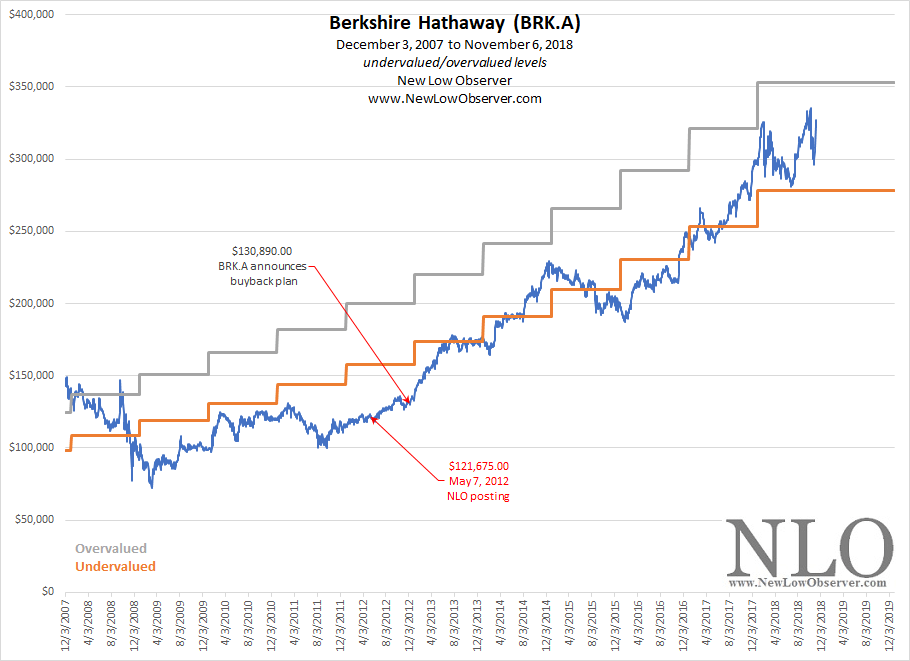
Below is an updated Altimeter for General Electric (GE). 

Continue reading

Harsco Corp: Target Update

According to Morningstar.com, Harsco Corp. (HSC) “… provides industrial mill services to steel and nonferrous metal producers in more than 30 countries, including the United States.”

The history of Harsco’s (HSC) price history is important to the current activity in the stock price.  In the review, we cover the history of the stock price based on the Edson Gould’s Speed Resistance Lines [SRL] with Dow Theory.

Downside Target Review

In the period from 1982 to 1990, the price of HSC rose from a low of $2.50 to a high of $9.66.  Based on this information, we arrived at the following downside targets:

  • $6.39
  • $4.81
  • $3.17

image

We’ve highlighted the point made in Dow Theory that a stock will often retest a previous low after a prior peak in the stock price.  In this case, the retest level was the $5.88 price which was ultimately penetrated to the downside to the ultimate low of $4.50 in 1990.

In the period from 1990 to 2000, HSC had the following downside targets:

  • $13.85
  • $10.85
  • $7.85

image

The Dow Theory retest after a major decline lasted over a period of two years from 1998 to 2000.  All of the downside targets were achieved.

In the period from there was a decline that appears worth mentioning because it occurred within a rising trend that culminated in peak price that was three times the 2002 high.  In the runup from the 2000 low to the 2002 peak, HSC had the following downside targets:

  • $19.24
  • $13.29
  • $7.33

image

The Dow Theory retest after the peak was consistent and could have been at either of the two points indicated on the chart.  If you missed the first indicator then you had a second shot at getting the retest at the second major low in the stock.

Worth pointing out is the fact that the extreme downside target of $7.33, from a technical standpoint, was suggesting much lower levels than could be indicated on this chart.  We wonder if the low of HSC in 2016 at $3.67 might have been indicated in the SRL of 2000 to 2003.

2000-2018: Upside and Downside Targets

Below are the upside and downside targets based on the low of 2000 to the peak of 2016.

Continue reading

Advance Auto Parts: Price Targets

According to Yahoo!Quotes, Advance Auto Parts (AAP) “… provides automotive replacement parts, batteries, accessories, and maintenance items for domestic and imported cars, vans, sport utility vehicles, and light and heavy duty trucks.”

Below are the downside support targets based on the high of $199.38 and the upside resistance targets based on the $79.26 low.

Continue reading

ShotSpotter Inc. : Downside Targets

According to Yahoo!Finance, ShotSpotter Inc. (SSTI) is, “…provides software-as-a-service based gunshot detection solutions for law enforcement officials and security personnel in the United States, South Africa, and internationally.”

ShotSpotter IPO’d on June 7, 2017 and was priced at $11.  In the last 15 months, SSTI has managed to increase the share price +471%. Based on the closing price of $62.81, we have the following downside targets:

  • $35.06
  • $28.55
  • $22.05

image

The downside target for SSTI are included in case the stock were to double for the current level.  SSTI could increase to $85.65 and still be within range of the $35.06 downside target.

Shanghai Index: Failures and Targets

Market Stimulus is Failing, Big Time

On August 25, 2015, we said the following:

“The actions of the Chinese government have not been constructive for a change in the declining trend of the market.  The sooner restrictions intended to stop prices from falling are lifted the better the chance for Chinese stocks to fully recover.”

Since the very first clear intervention by the Chinese government on June 27, 2015, with a surprise interest rate cut, the Shanghai Composite Index has declined –40.77%.  The total decline from the 5,166.35 peak on June 12, 2015 has been –48.09%.

That very first stimulus action of cutting interest rates and the laundry list of interventions (partial list here) since is now being compounded by company buyback of shares.

image

Since 2009, stock buybacks have generally increased over time.  However, the year 2018 has seen a dramatic increase that has overshadowed all prior years of data as referenced from the September 12, 2018 Financial Sense article titled “Chinese Government Encourages Share Buybacks As Bear Market Deepens” by contributor Danielle Park.image

The intervention is actually causing the process of recovery to take longer than it needs to by providing false hope for investors (large and small) that the turnaround is near.  We’ve seen this all before in the Japanese Nikkei Index from 1990 to 2009 when it declined –81% (chart here).

Failure in Our Analysis

On September 26, 2016, we said the following of the Shanghai Composite Index:

“A simple flag or pennant formation seems easy to identify.  Now it is time to see if the direction of the index will do a retest of the late January 2016 low.”

If viewed from the perspective of the pennant formation starting from late January 2016, our analysis was a failure, as seen in the chart below.  Even if we were to extend and enlarge the pennant from the early January 2016 start date to December 15, 2017, the pennant would have been a failure.

image

Based on the original analysis, the index was supposed to drop –13% to achieve a retest of the 2,655.66 low.  Instead, the index increased +16.50% to 3,559.47 before starting the descent to 2,655.66. The idea of a retest of the prior low is based on Dow Theory and has been proven to be very consistent.  However, as analysts, it requires time and patience to see the process through.

Below are the downside targets and the potential upside targets for the Shanghai Composite Index.

Continue reading

AeroVironment: Downside Targets

AeroVironment is described on Yahoo!Quotes as:

“AeroVironment, Inc. designs, develops, produces, supports, and operates a portfolio of products and services for government agencies and businesses.”

Below are the downside targets as a consequence of the parabolic rise that has occurred since the September 2015 low.

image

The conservative downside target of $62.26 is a lock in our view.  To put this in perspective, AVAV would have to increase to $160.62 before the $62.26 level isn’t a normal “dip.”

Tilray Inc.: Downside Targets

The recent IPO and explosion of Tilray Inc. (TLRY) has investors both worried and excited.  Tilray is in the emerging corporate cannabis industry, which has high prospects.  Below we outline the downside targets for both current price of $118 and $236 for when/if the stock doubles from the current price.

image

The conservative downside target is fairly assured to occur in either case.  From the $118 level, a decline to the $66.67 level would be a natural retest of the $77.89 level set on September 7, 2018.

Ethereum: September 2018

When Ethereum was trading at $384.49 on April 2, 2018, we said the following:

“There is a lot on the line for Ethereum.  Currently, the cryptocurrency is slated for the following downside targets:

  • $279.31
  • $188.13
  • $96.95”

All that remains is the last downside target of $96.95.  Based on the fact that Ethereum has achieved the $188.13 level, we are posting our upside target using the May 5, 2018 peak.

Continue reading

Interest Rate Monitor: September 2018

In this posting, we’ll continue on a theme that we’ve outlined since December 16, 2015, when we said:

“A single rate increase by the Federal Reserve in no way makes for a trend.  However, markets often lead the way and what initially seems ‘bizarre’ is only a natural change in regime, a change that we haven’t seen since the early 1940’s.”

The change “…that we haven’t seen since the 1940’s” is the secular trend in interest rates to go from an extremely low level to the opposite end of the spectrum, potentially to high double digit levels.  Our September 4,2014 posting suggested that:

“Investors anticipating a general rise in interest rates should feel some comfort in knowing that most manager in the utility sector are ready for what is to come.  Rising interest rates are not an automatic death sentence for utility stock prices or earnings.   In fact, the early stages of rising interest rates may see utility stocks match or exceed the returns of non-interest rate sensitive stocks, on a total return basis.  Only when the outlook is cloudy will it become difficult to offer projections that are in line with prior expectations.”

We have been consistent in the belief that the secular trend in interest rates is higher instead of lower.  With this in mind, we are presenting our upside targets (resistance levels) for the daily 3-month Treasury rates.  We use the daily 3-month Treasury rates simply because it precedes all Federal Reserve rate increases and decreases since 1934 (100%).

Continue reading

Tesla: Downside Targets

In this posting, we’ll covered the topic of downside targets for Tesla (TSLA).  We’re going to apply Speed Resistance Lines [SRL] and George Lindsay’s “Three Peaks and a Domed House.” 

The SRL downside targets are fairly conservative, in our view, while the 3 Peaks and a Domed House model (3PDh) appears fairly drastic.  We’ll do our best to introduce the 3PDh concept in the most general way possible, leaving out some of the nuances that we believe inhibit the qualitative elements to the overall concept.

Continue reading

U.S Dividend Watch List: August 31, 2018

Previous Year Performance Review

In our ongoing review of the NLO Dividend Watch List, we have taken the top five stocks on our list from September 1, 2017 and have checked the performance one year later. The top five companies on that list can be seen in the table below.

Symbol Name 2015 Price 2016 Price % change
SJM JM Smucker 104.84 103.38 -1.4%
HRL Hormel Foods Corp. 30.92 39.15 26.6%
SKT Tanger Factory Outlet Centers 23.70 24.06 1.5%
SCG SCANA Corporation 60.14 38.34 -36.2%
CAG ConAgra Foods 32.88 36.75 11.8%
      Average 0.5%
         
DJI Dow Jones Industrial 21,987.56 25,964.82 18.1%
SPX S&P 500 2,476.55 2,901.52 17.2%

The average gain from the top five company was mediocre rise of 0.5% compared to 17.2% gain from S&P 500 and 18.1% from Dow Jones Industrial. The largest gain came from Hormel Foods (HRL) which rose 26.6%. We had this to say about Hormel last year.

Another food producer that should be on the radar is Hormel Foods (HRL). The stock has fallen 11% since the year began. Our valuation model imply that additional downside of 25% should be expected but 34% upside is also possible. Similar to the prior company we mentioned, Hormel Coppock indicator dipped into negative territory in April. With that in mind, a change in direction would make Hormel an ideal company to go long. Our study of Coppock on this company is that when applying the strategy, the average return is 31% after one year. Although sample size is small (5 of 309 months), the indicator have not produced negative return. Additionally, Hormel return on equity average 16% which is exceptional.

The biggest decline came from SCANA Corp (SCG) which fell 36.2%. The utility company couldn't raise rate and stock price followed.

J.M. Smucker (SJM) was the other stock that lost value since last year falling 1.4%. Our team believed that valuation was ripe for accumulation. Although shares remain virtually flat, shares actually rose 30% from $100 to $130 in 6 months before giving back all those gain. our team has long position but didn't sell because of tax implication. Perhaps we can explore the use of Put option to lock in majority of the gain. Despite that, we believed shares provide good value at the current level.

U.S. Dividend Watch List: August 31, 2018

The market took out the all-time high and the bull market continued. If we wish to go long, our team would start with companies on the watch list below. Continue reading

Moody’s Investor Service: Cr*me Pays

On August 28, 2018, the Securities and Exchange Commission announced that Moody’s Investors Service agreed to pay  “…a total of $16.25 million in penalties to settle charges involving internal control failures and failing to clearly define and consistently apply credit rating symbols.”

image

Let’s put this most recent “penalty” into perspective.  The mortgage market ratings fiasco peaked in the year of 2006.  It was at this point in time that the truly low quality debt (the kind that anyone could easily identify as garbage) started to collapse.

In 2006, it is estimated that $6 trillion of mortgage-backed securities were issued (1).  According to multiple sources, Moody’s has a 40% market share of the ratings market (2).  This means that Moody’s issued ratings on approximately $2.4 trillion of the $6 trillion of mortgage backed debt.

Assuming that only ⅓ of the $2.4 trillion were wrongly rated, this would mean that the $16.25 million PLUS the January 17, 2017 fine of $865 million (3) equaled 0.12% of the $720 billion in alleged criminal conduct that is worthy of “penalizing” from the SEC.  All this in only the year of 2006.

image

True to form, Moody’s Investor Service added that they “…did not admit or deny the SEC’s charges.”  At 0.12% of the alleged 2006 value of purported mis-ratings, that’s like saying they were making a charitable donation (or bribe, whichever fits best) to the SEC.

sources:

1."Through the mid-2000s, RMBSs and CDOs were attractive investments because even the senior tranches (those rated AAA) offered higher returns than investments in AAA corporate bonds. They also grew explosively during the 2000s. In 2006, the value of mortgage-backed securities in the United States was more than $6 trillion (SIFMA 2007). As of March 2008, Freddie Mac and Fannie Mae alone had issued $4.5 trillion in RMBSs (Yoon 2008). The global market for CDOs was approximately $1.5 trillion by the end of 2005 (Celent 2005) (Rom, Mark Carl. The Credit Rating Agencies and the Subprime Mess: Greedy, Ignorant, and Stressed? Public Administration Review.Jul-Aug 2009. p. 643.)."

2. Steven Scalet and Thomas F. Kelly. The Ethics of Credit Rating Agencies: What Happened and the Way Forward. Journal of Business Ethics. December 2012. pp. 478.

3. Matt Scully and David McLaughlin. Moody’s Reaches $864 Million Subprime Ratings Settlement. Bloomberg. January 13, 2017. accessed August 31, 2018. https://www.bloomberg.com/news/articles/2017-01-13/moody-s-to-pay-864-million-to-settle-subprime-ratings-claims

4. Kool G Rap & D.J. Polo. Live and Let Die. Crime Pays. https://www.youtube.com/watch?v=CW5bVNntye4 accessed August 28, 2018.

Bitcoin: August 2018

To fairly represent our work on the topic of Bitcoin, it is highly recommended that you read through our Bitcoin Archive from 2013 to the present.

Below is the most recent assessment of Bitcoin based on the “closing” price of August 30, 2018.

Continue reading

Bitcoin Archive

Our history with Bitcoin goes back to April 2013.  It is necessary to review our track record to understand that we attempt to be measured in our assessment.

We do not fully understand the bigger picture issues like blockchain which is the innovation that allows Bitcoin to gain traction.  From the beginning we have tracked the price of Bitcoin strictly because all of our previous work has been based on price reflecting human greed, fear, and folly.

Continue reading

Unemployment Rate: August 2018

On April 6, 2018, we said the following:

“As we approach the 3.80% level, it should go without saying that all the signs are in place for an overextended economic boom.”

Just look at the data, the last time the unemployment rate was below 3.80% was way back in 1969.

image

From where we stand, it appears that the direction for the economy is to one extreme or the other.  No longer do we think there will be the gradual sloping (gradual relative to what is coming) to the upside in GDP, stock market and real estate prices. Either a bubble phase or a bust phase.

Unlike the many critics of the stock market and economy who are always saying that we are in a bubble simply because the trend is up,  we have clearly outlined the parameters of what a bubble is within the context of the market conditions.  What has been experienced in the economy and the stock market from 2009 to the present has been a normal reaction to the crushing decline from December 2007 to March 2009.

Continue reading