Below is a chart of Imperial Brands (IMBBY) from 1999 to 2020 reflecting the year-over-year (YoY) percentage change.
-
Topics
Archives
-
-
Recent Posts
-
-
-
-

Below is a chart of Imperial Brands (IMBBY) from 1999 to 2020 reflecting the year-over-year (YoY) percentage change.
Below we outline our technical take on when to consider buying Imperial Brands (IMBBY), if it hasn’t been purchased already. Continue reading
Below are the valuation targets for Imperial Brands PLC (IMBBY) for the next 10 years. Continue reading
Below are the valuation targets for Brookfield Property Partners (BPY) for the next 10 years. Continue reading
This is a follow-up graphical representation of the performance of Morningstar’s Income Bellwethers. In the comparison that we ran, we contrast the high yield with the low yield in a one year period. The period under consideration runs from February 11, 2019 to February 7, 2020.
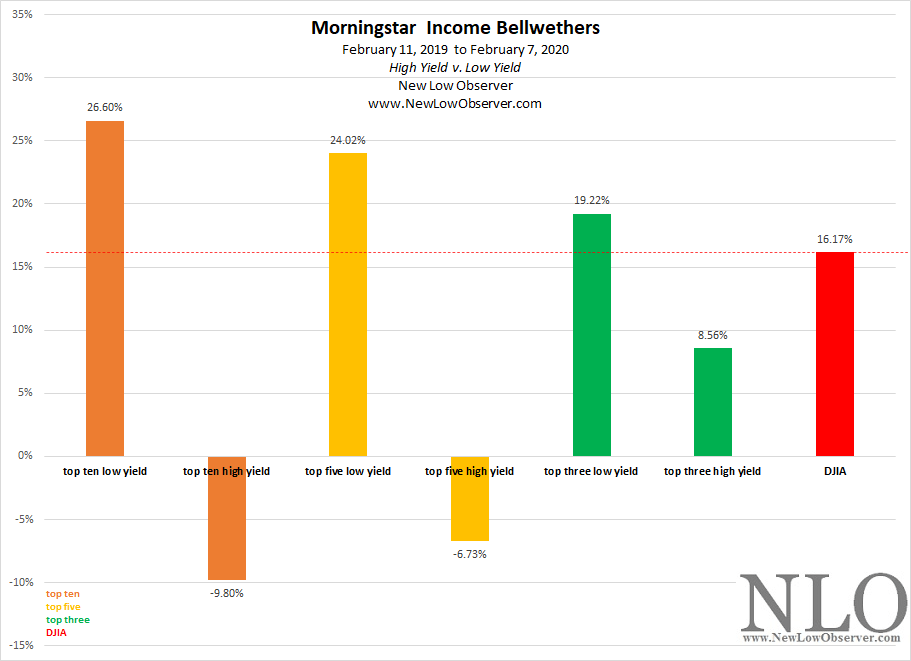
As the data continues to demonstrate, low yield outperforms high yield. This has been resoundingly shown in our Dogs of the Dow in the period from 1996 to 2019.
Posted in Dogs of the Dow, Income Bellwethers, Morningstar
Below are the downside targets for Tesla Inc. (TSLA) as of July 7, 2020.
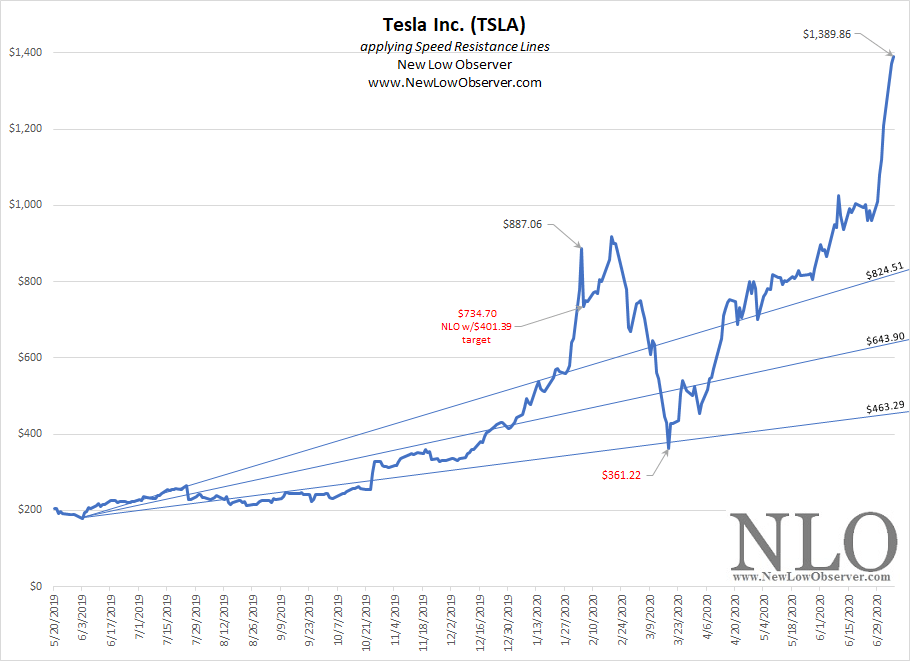
Parabolic increases rarely go unchecked. This typically means that a decline to the conservative downside target is the norm, at minimum. However, Tesla has had a history of defying the “norm” when it comes to price change.
see also: TSLA downside targets achieved
Posted in downside, parabolic, Speed Resistance Lines, SRL, TSLA
On this day, Charles H. Dow of the Wall Street Journal, said the following:
“The true currency of commerce is credit. A part of this credit is represented by cash, but the larger part is represented by book entries on the ledgers of banks and merchants, representing the intangible credit of the borrower.”
-George W. Bishop. Charles H. Dow: Economist. Dow Jones Books. 1967.
Posted in Charles H. Dow, credit, On This Day, WSJ
This from Barron’s on the U.S. stock market dividend yield from 1871-1996:

The Dow Jones Industrial Average dividend yield profile from 1920-2020: Continue reading
Posted in dividends, high yield, Low Yield, relative yield, Yield Profile
This from Dow Theory Letters on July 5, 1974.
"What’s happening, what’s gone wrong? The answer: there's a giant squeeze in world liquidity, and it is scaring the devil out of investors, large and small, from one end of the globe to the other. Last week two German banks declared bankruptcy, while it was revealed (WSJ, June 26) that an oil-drilling "tax write-off" situation has turned into what may be the biggest swindle in US history. On June 27 trading in Westinghouse was halted at 12 1/8 (“you can be short if it’s Westinghouse”), and an hour later the President of the company announced that the outfit was solvent (all this while WX broke its 1962 low) (page 1)."
Those two German banks were Bankhaus I.D. Herstatt of Cologne and Bass & Herz Bankhaus. This was a situation where the failure of Herstatt led to the failure of Bass & Herz and a host of other substantial losses.
Chase Manhattan Bank was in possession of $156 million in Herstatt deposits. This meant that U.S. creditors (namely Citibank’s British banking unit of Hill, Samuel & Co.) were seeking claims on these funds even though Chase Manhattan had no authority to recognize the claims.
Seattle First National Bank (SeaFirst) was caught in a bind when they performed a $22.5 million transaction at their Swiss subsidiary and the funds were not transferred to the parent company hours before Herstatt was forced into bankruptcy.
In classic scam fashion, the oil-drilling "tax write-off" scheme was named Home-stake Production Company of Tulsa Oklahoma. Using the name “Homestake” tied the swindler with the success and stability of Homestake Mining while not having achieved anything of note.
What made this swindle exceptional is the fact that people like Liza Minelli, Candice Bergen, and Buddy Hackett (as well as Congressmen) were involved in the money losing fraud. The motivation for getting into these “tax write-off” schemes might have been inspired, at the peak, by articles like the following from Barron’s in March 1974.
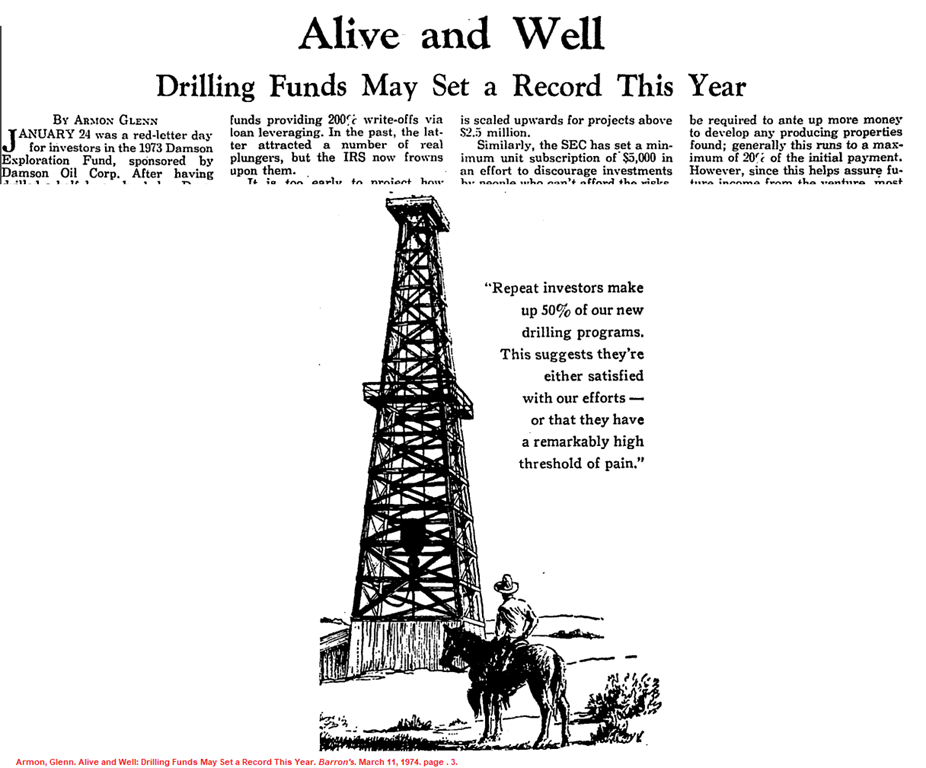
“Bank shares at 10% yields mean that investor are scared of the banks (page 2).”
It was not long before this comment was published on banks that banks were on a mad dash to lure investors and analysts. In a Barron’s article titled “Beautiful Balloon?” it was indicated that the 1970 amendment to the Bank Holding Company Act of 1956 led banks “…into related (and some not-so-related) financial areas.”
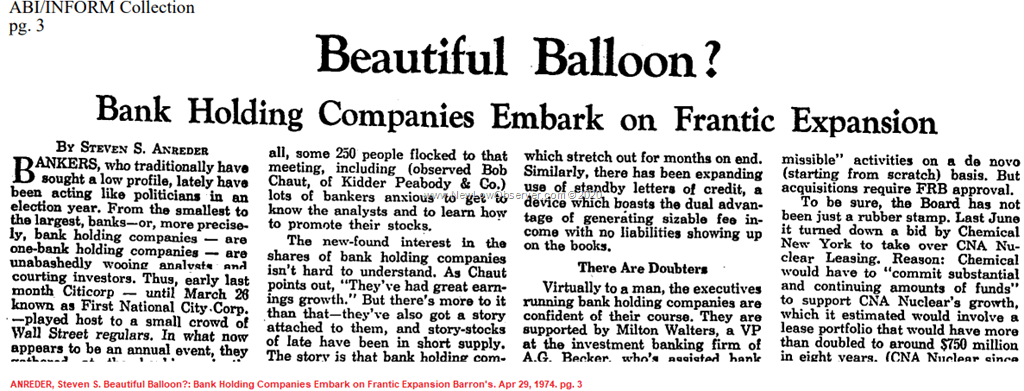
It was those related financial areas that banks had “…been heavily engaged in financing real estate activities, and, despite the debacle among REITs, thus far have escaped essentially unscathed.” It wasn’t long before those banks almost paid the price for their foray into REITs, until the government intervened. This article from Barron’s should have been titled “Beautiful Bubble” as the collapse was in the early stages at this time and by July 5, 1974, there was more pain until December 1974, to the tune of –27.04% in the Dow Jones Industrial Average.
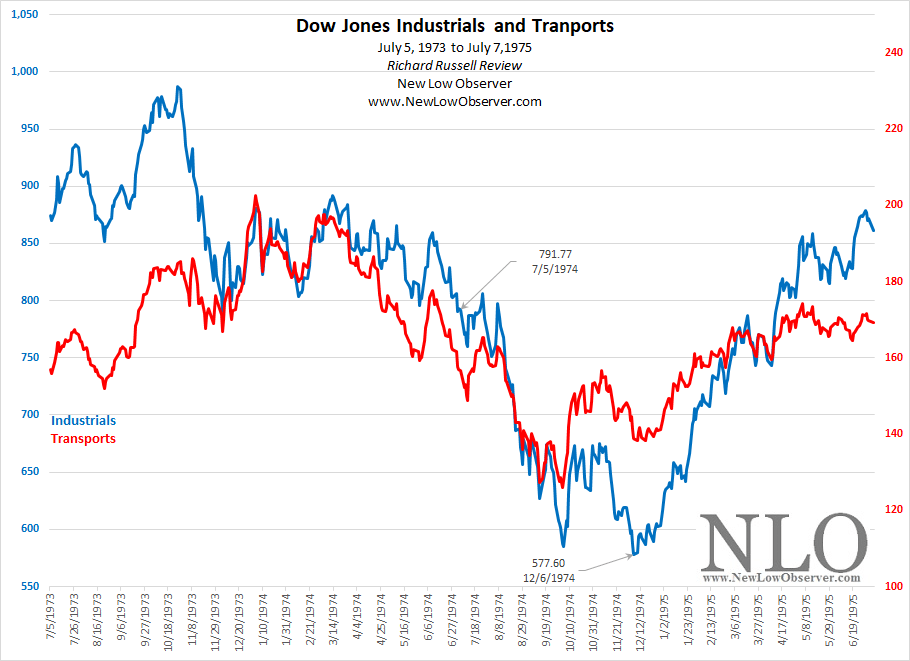
see also: Homestake Mining: The Exception that Proves the Rule
This from Dow Theory Letters on July 3, 1996.
"To conquer the beast, you must first learn to love it (page 1)."
When looking for similar quotes online, we found the following:
The last quote from Sun Tzu seems the most fitting and provides the appropriate context.
“The June 27 WSJ headlined an article, ‘Strong Summer Rally, Then a Plunge, Predicted by Four Technical Analysts.’ Maybe, but that sounds too pat to me. A strong summer rally would allow all those sophisticated analysts (and their followers) to exit the market handily. If, and I say IF, a bear market is just around the comer, it’s not going to happen that way (page 2).”
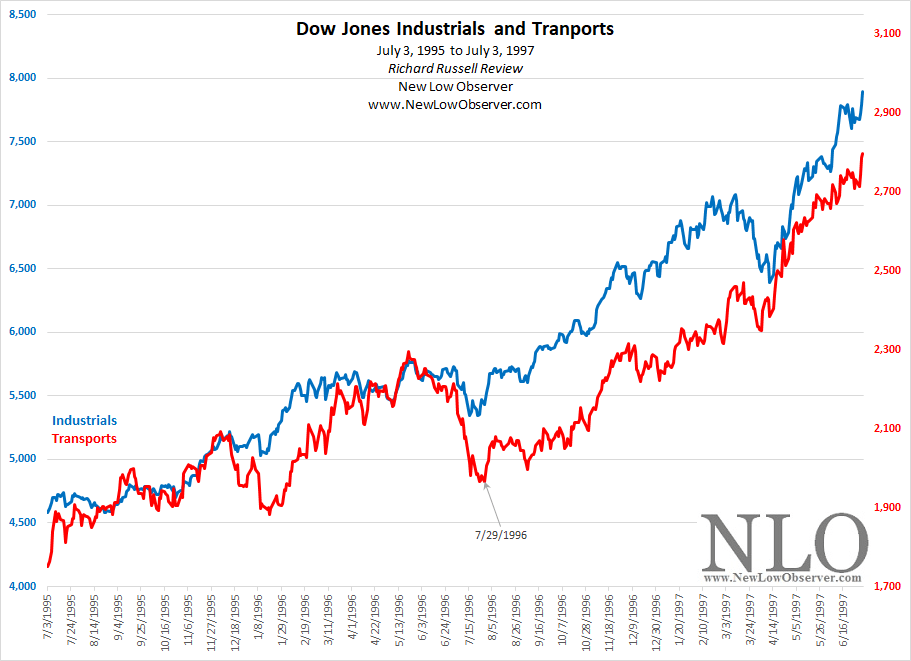
The July 29, 1996 low and subsequent rise proved Russell’s suspicions to be correct.
"Steve Briese, the sophisticated editor of the Bullish Review [(612) 423-4900] in his latest report notes that “turns in both Cotton and Copper have accompanied many important stock market tops -- far more than coincidence alone would explain (except to a bull wearing blinders) (page 3).”
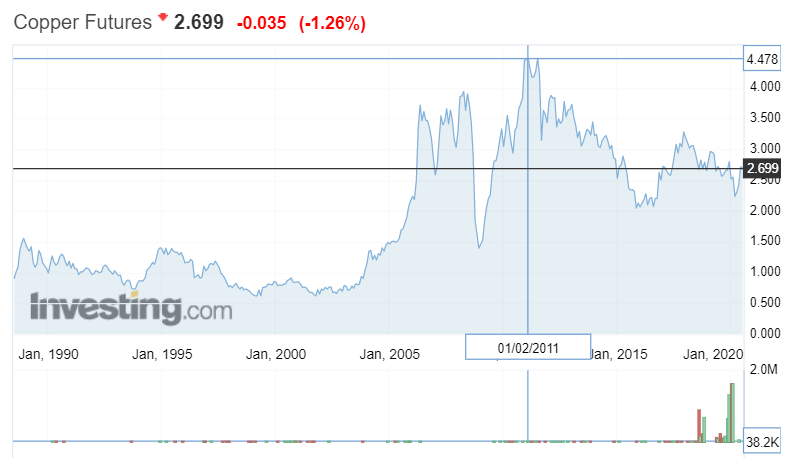
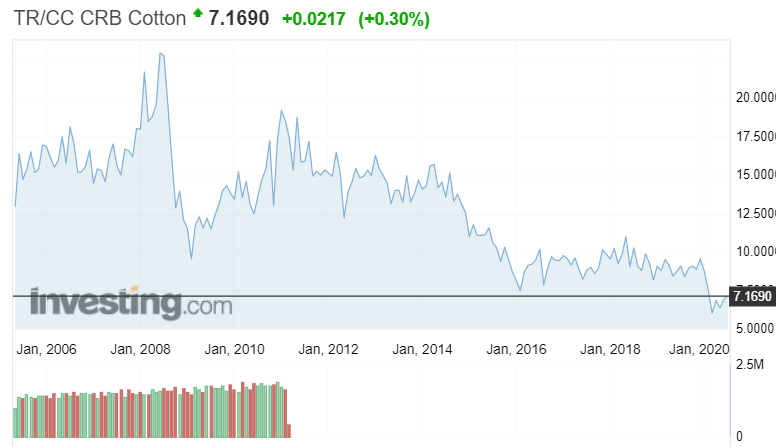
From the charts of cotton and copper below, we can see that copper makes a parabolic move then slowly declines to the low. It is the low that is most characteristic of a turn higher for the stock market rather than the turn lower which can drag out for a long period of time while the stock market continues to climb.
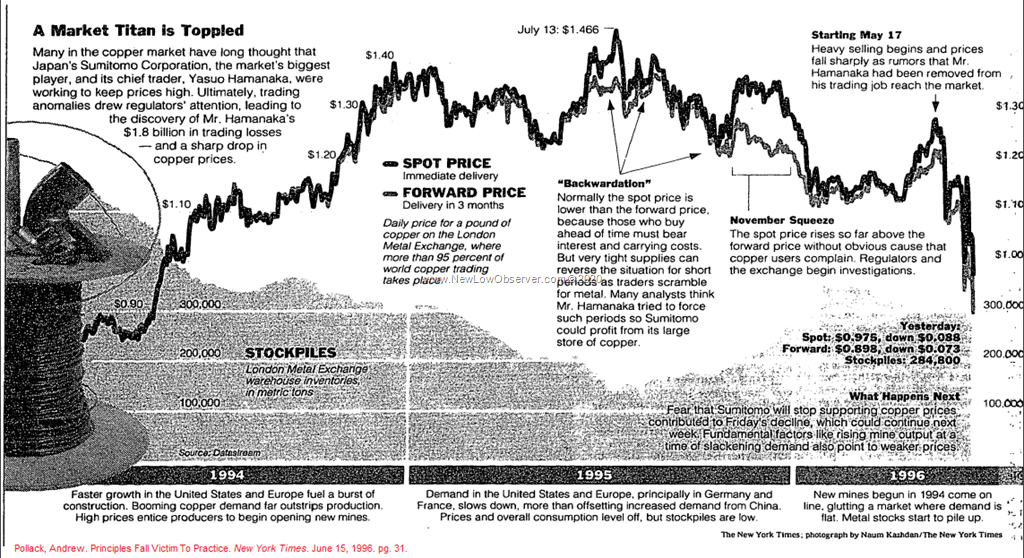
"The commodity world is still in shock from the incredible losses sustained by Sumitomo, losses stemming from 10 years of trading via their rogue trader, Yasuo Hamanaka. How could 10 years of wacky trading be hidden from authorities? Obviously, some people had suspicions (page 5)."
“Conclusion: The bull market appears to be intact. Time after time the market backs off and turns erratic. But each time the PTI bucks the trend and pushes up to a new high. When this pattern in the PTI reverses (and some day it will), the market will be in trouble. Until then. the bull remains in command.”
This conclusion, based on the PTI, was proven to be accurate as noted in the market performance above. There will be more to discuss based on Russell’s PTI going forward.
Posted in Briese, Hamanaka, Richard Russell Review, Sumitomo, Tzu
On this date in 1900, Charles H. Dow, in the Wall Street Journal, said the following:
“The iron trade, while improving from one point of view, is in a position where the surface is unfavorable. When it is decided to reach bedrock prices by allowing everybody to make prices to suit himself, it means the survival of the fittest. The process of crushing out the least fit will be unpleasant for the victims and will make the situation appear worse than the facts really are.”
-Laura Sether. Dow Theory Unplugged. W&A Publishing. 2009.
Posted in Charles H. Dow, On This Day, WSJ
On July 26, 2013, we said the following:
“…the best we could expect for the unemployment rate, on the downside, is for 6.9%. It is important to understand that the 10% and 3.8% unemployment rates are undesirable scenarios. The 10% unemployment rate is in the depths of a ‘recession’ and the 3.8% unemployment rate at the height of a overextend economic boom.”
After falling below 3.80% in December 2019, the unemployment rate skyrocketed with the advent of the coronavirus (COVID). We continue to maintain the view that unemployment above 10% or below 3.80% cannot be sustained for very long.
Below is our expectations for how the unemployment rate will change going forward. Continue reading
Posted in economic forecasting, Unemployment
The last time we updated this indicator in March 2020, the Coppock curve changed directions from an upward bias to a move down. Two months later, the curve now stands in negative territory. This mean that the next meaningful move on the upside of this indicator is a buy signal. Below is a chart of the Coppock at the end of June 2020. Continue reading
On this date in 1997, Richard Russell, in his Dow Theory Letters, said the following:
"The market, April through mid-June, experienced one of the most powerful rallies in recent history. As a rule, such power moves seldom end with a rise. Normally, when a power move finally ends, the market will back-and-fill, perhaps decline somewhat, but in reality it is usually building strength for the next upside assault.
"In other words, primary bull markets don’t normally end with a power move to the upside. They do tend to end with ebbing volume, non-confirmations, declining momentum, and general exhaustion of buying power."
-Richard Russell. Dow Theory Letters. July 2, 1997. page 1.
Posted in On This Day, Richard Russell
On April 11, 2014, in an attempt to project the direction of unemployment and the subsequent economic outcome, we said the following:
“Given our prior experience with Dow Theory and downside projections, any decline in the unemployment rate below 5.87%-5.90% would be exceptional with only the 4.40% and 3.80% levels as mere reflections of an overextended economic boom which should be followed by an equally impressive bust.”
On August 24, 2018, we said the following:
“If the unemployment rate drops further then we would have stretched the capacity of the economy to its 48-year limits on the downside. If the unemployment rate increases from the current level it would, as has been the case in the past, jump dramatically.”
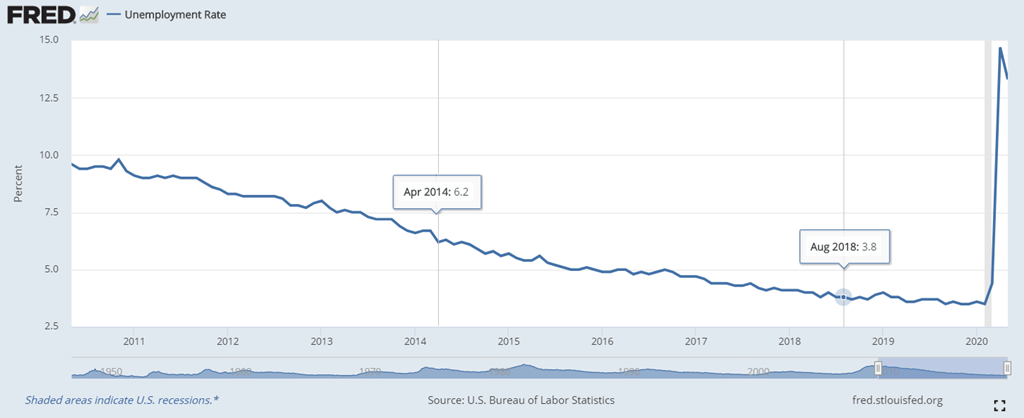
Since August 2018, the unemployment rate declined to 3.50% in December 2019. The dramatic jump in the unemployment rate has followed immediately afterwards.
Up Next: Unemployment Forecast
Posted in recessions, Unemployment