Category Archives: SRL

Review: Oil and Gas Stock Index

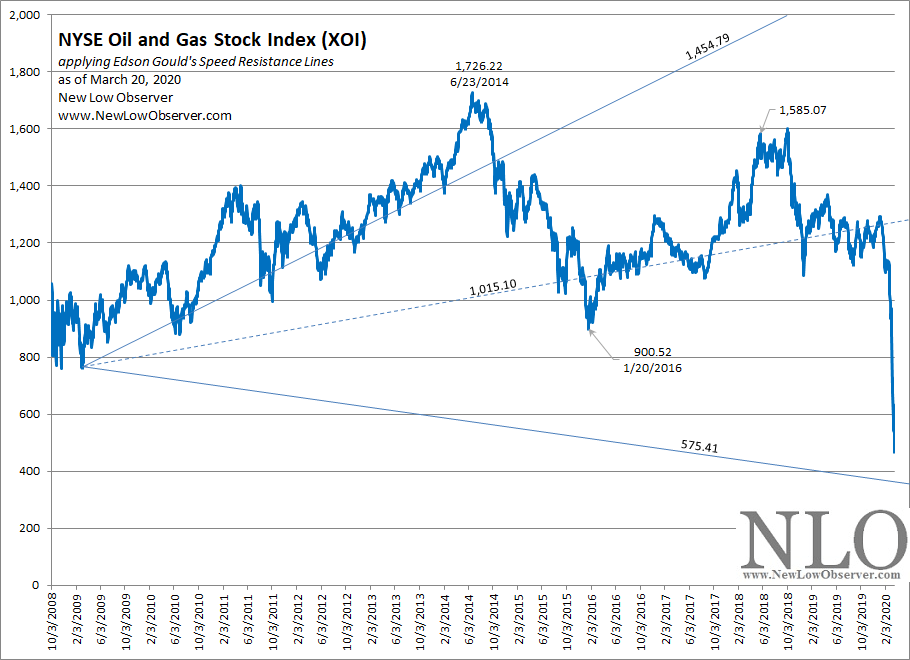
On January 6, 2015, we said the following of the Oil and Gas Stock Index (XOI):

“The conservative downside target of 1,454.79 has been constructed while the mid-point of 1,015.10 is also indicated.  However, we did not include the extreme downside target of 575.41.  We did indicate in red the 812.08 level which was the extent of the decline in the period from the 2008 high to the 2009 low.”

On September 7, 2015, we said the following of the XOI:

“…lurking in the background is the extreme downside target of 575.41.  Since our experience has been that the extreme downside target is commonly achieved, we hazard to guess what would happen globally to the oil market in order to decline to such a low point.”

Unfortunately, we made the following mistake on December 27, 2017 regarding the XOI:

“Assuming that the primary movement is still a bear market, then the expected upside target should have been from 1,210.15 (3/8) to 1,313.37 (½).  With the XOI above the 1,313.37 level, Dow Theory suggests that a bull market is on the way as the balance of losses sustained by the buyers near the previous peak is giving rise to optimism that breakeven on their investment is possible.”

We incorrectly interpreted Dow Theory in the belief that a bull market was on the way.  It could be argued that as the prior peak was not achieved then a bull market wasn’t signaled and therefore the analysis was somehow right.  However, we’d like anyone who uses both Dow Theory and Speed Resistance Lines to know that it is the interpretation that is incorrect and generally not the tools.

XOI Index: 2008 to 2020

image

The descending 575.41 level on the XOI Index is the equivalent of 375 (it continues to decline over time).  That will likely be the point when the XOI bounces.  From the 375 level it is uncharted territory.  However, that is the point when values will come into play and investment can be done with relative abandon.  Keep in mind the effort for many countries to phase out oil consuming vehicles.

Review: Texas Pacific Land

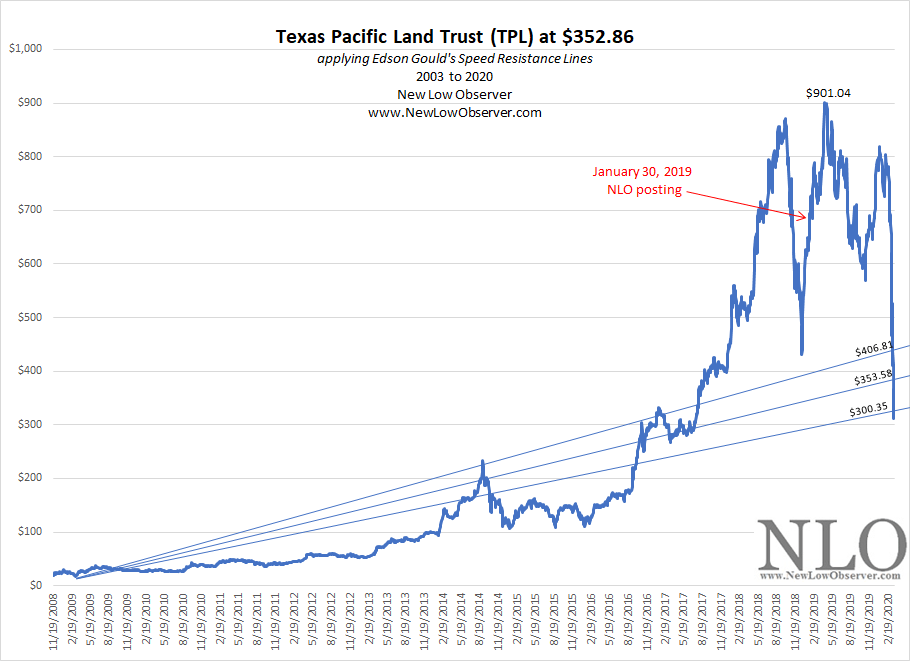
On January 30, 2019, we said the following:

“The rebound has been exceptional but requires one last step in the process of confirming that the trend is actually up.  In order for the trend to be CONFIRMED as up, the price of TPL needs to retest the $409 level and hold.  Without holding at the $409 level, TPL would be expected to test the ascending $290.66 target, at minimum.”

Since January 30, 2019, Texas Pacific Land has had the following activity:

image

We’ve updated the Speed Resistance Lines because the peak in the price increased from our prior level at $871.99 to $901.04.  Unsurprisingly, TPL has achieved our lowest downside target after bouncing at the $410 level.

Now our concern is how far below the $300 level that TPL might go.  We seem to be in the early stages of the current market decline so we’ll have to update the downside risk as we go.

SPDR Gold Shares Downside Targets

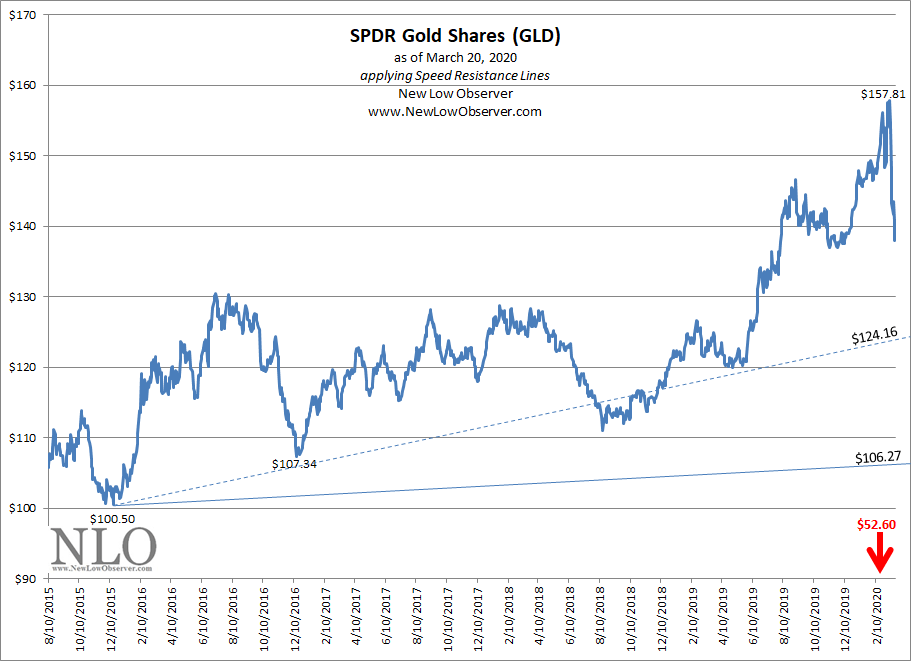
Below are the downside targets for the SPDR Gold Shares (GLD).

image

  • $124.16 (intermediate target)
  • $106.27 (mid-range target)
  • $52.60 (extreme target)

The $124.16 level is not an “official” downside level as it is only an intermediate point on the way to the actual level of $106.27.  As we’ve seen in the past, the extreme downside target is always the concern.  For GLD the extreme downside target is $52.60.

Top three stocks, commodities, or indexes that achieved our downside targets by year:

2020

2019

2018

2017

2016

How do we use Speed Resistance Lines? Once a target is achieved we assess the possibility of investment.  If the target is not achieved we move on to the next stock. 

There are approximately 15% to 20% of the SRLs  that we’ve run that haven’t come to fruition, yet.  However, in this current market decline, many that weren’t fulfilled are now getting completed.

Update: Tesla Inc. Targets

When Tesla (TSLA) was trading at $734.70, we said the following:

“Parabolic increases rarely go unchecked.  This typically means that a decline to the conservative downside target is the norm, at minimum.  However, Tesla has had a history of defying the “norm” when it comes to price change.”

At that time, February 5, 2020, we provided the following downside targets:

  • $507.09 (conservative target)
  • $401.39 (mid-range target)
  • $295.69 (extreme target)

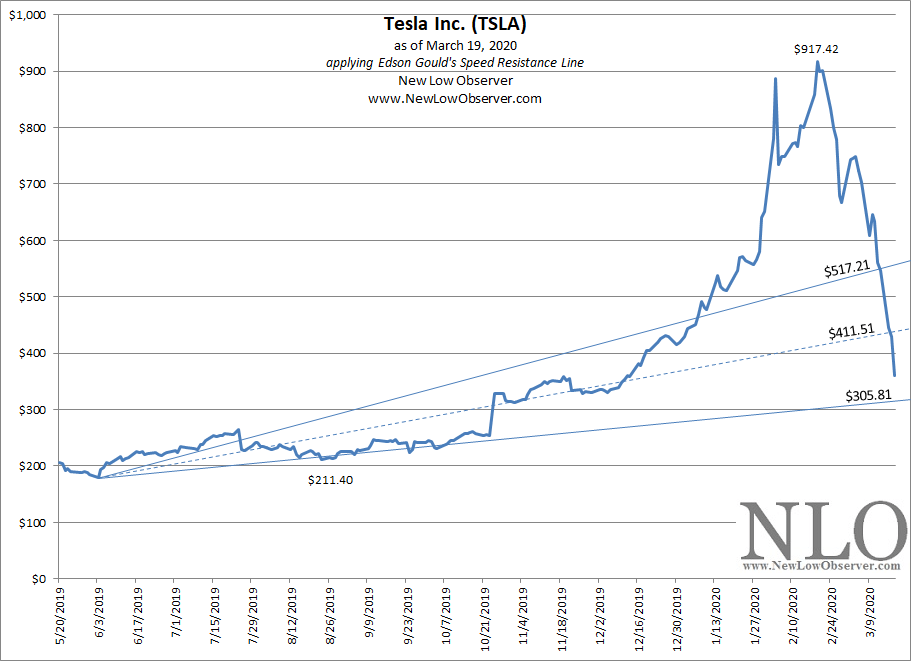
Seventeen days after our downside price targets, the price of TSLA increased as high as $917.42 on a closing basis.  The increase in price marginally affected the downside targets for TSLA.  So far, Tesla has achieved two of the three downside targets and looks to easily achieve the last target (extreme downside target).

Below are the updated downside targets for Tesla Inc. (TSLA).

image

  • $517.21 (conservative target)
  • $411.51 (mid-range target)
  • $305.81 (extreme target)

Pendulums swing from one extreme to another.  We’ll watch to see if the extreme to the upside is matched on the downside.

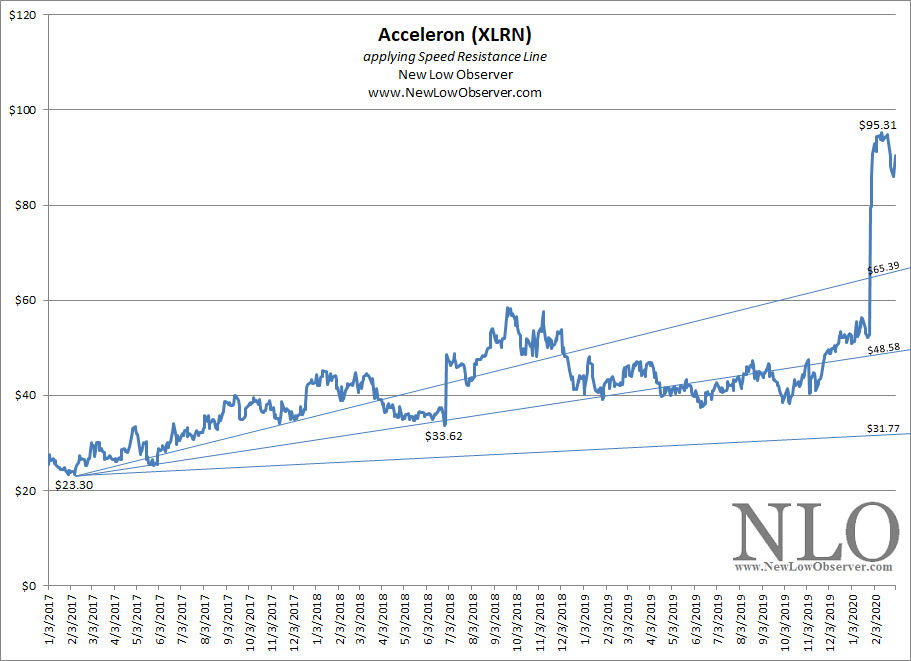
Acceleron Downside Targets

Below are the downside targets for Acceleron Pharma Inc. (XLRN).

image

  • $65.39 (conservative target)
  • $48.58 (mid-range target)
  • $31.77 (extreme target)

Virgin Galactic Downside Targets

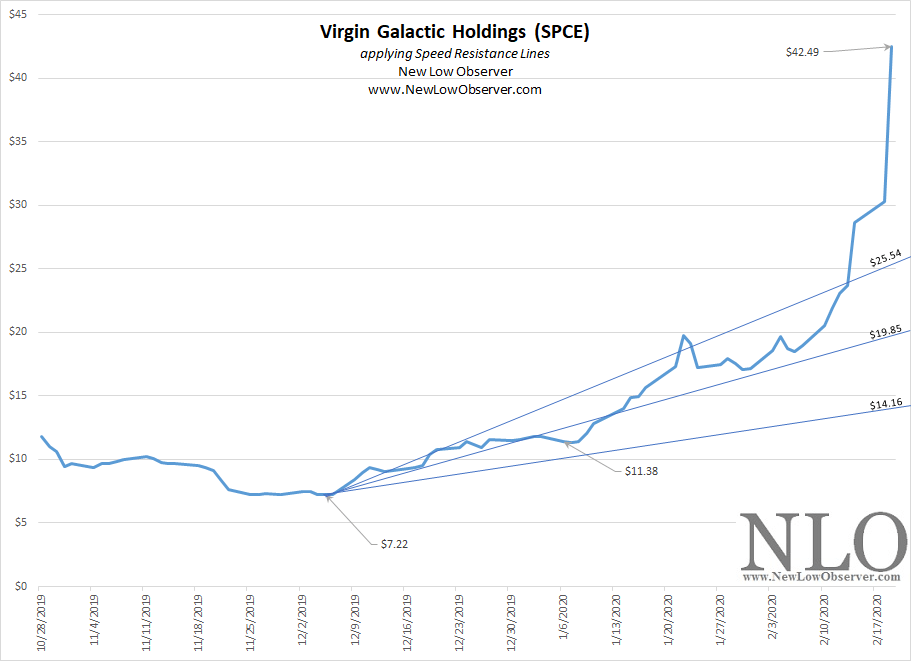
Below are the downside targets for Virgin Galactic Holdings (SPCE).

image

  • $25.54 (conservative target)
  • $19.85 (mid-range target)
  • $14.16 (extreme target)

Virgin Galactic Holdings (SPCE) is creating a scenario where the extreme downside target could easily be achieved while being considered a normal “bounce.” The price would have to rise to above $60 before the above downside targets are no longer valid.

These situations don’t end well but in case the price doubles from the recent peak we provide the following downside targets.

  • $39.71 (conservative target)
  • $34.02 (mid-range target)
  • $28.33 (extreme target)

WorkDay Downside Targets

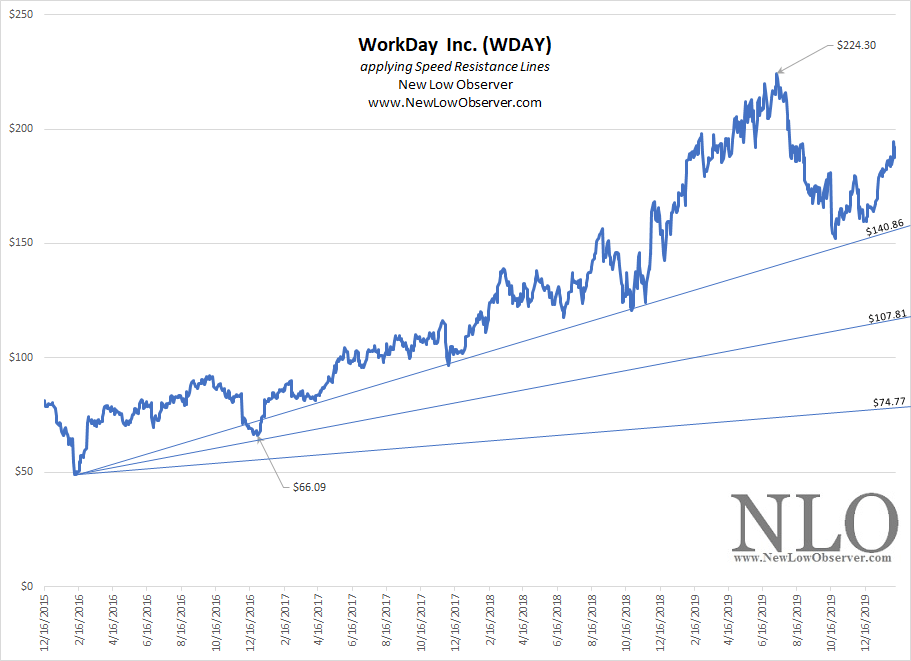
Below are the downside targets for WorkDay Inc. (WDAY).

image

  • $140.86 (conservative target)
  • $107.81 (mid-range target)
  • $74.77 (extreme target)

The downside targets are based on the peak price of $224.30.  In our view, WorkDay failed to achieve the minimum downside target of the ascending level at $140.86.  In many respects, this reflects the strength of buyers.  However, this failure would not have allowed us to take advantage of the reversal that has occurred since the $152.29 low. 

With this in mind, we have posted the upside resistance targets based on the October 23, 2019 low.  These target are meant to confirm the strength of the rise and the potential for additional gains/losses going forward.

Sea Limited Downside Targets

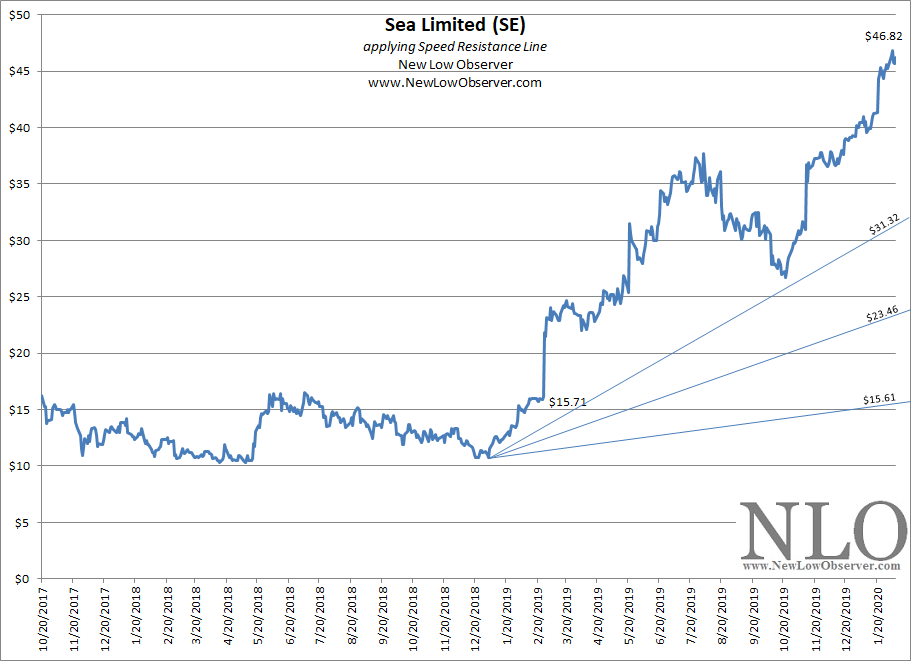
Below are the downside targets for Sea Limited (SE).

image

  • $31.32 (conservative target)
  • $23.46 (mid-range target)
  • $15.61 (extreme target)

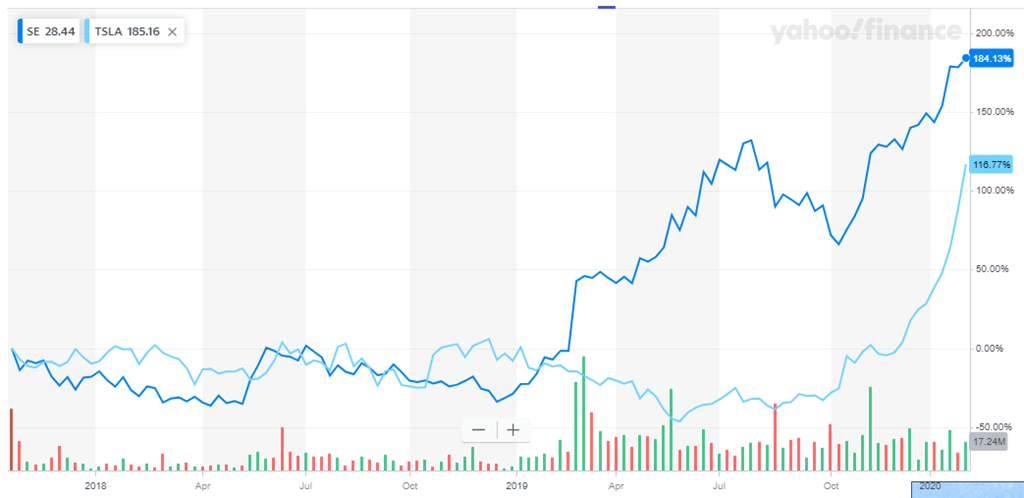
If you’re impressed with the increase of Tesla (downside target here) in the last few months then a look at Sea Limited should put that into perspective.

image

Since the name change of the company from Garena Interactive Holding in 2017 (cough), Sea Limited has outpaced Tesla on the upside.

DexCom Inc. Downside Targets

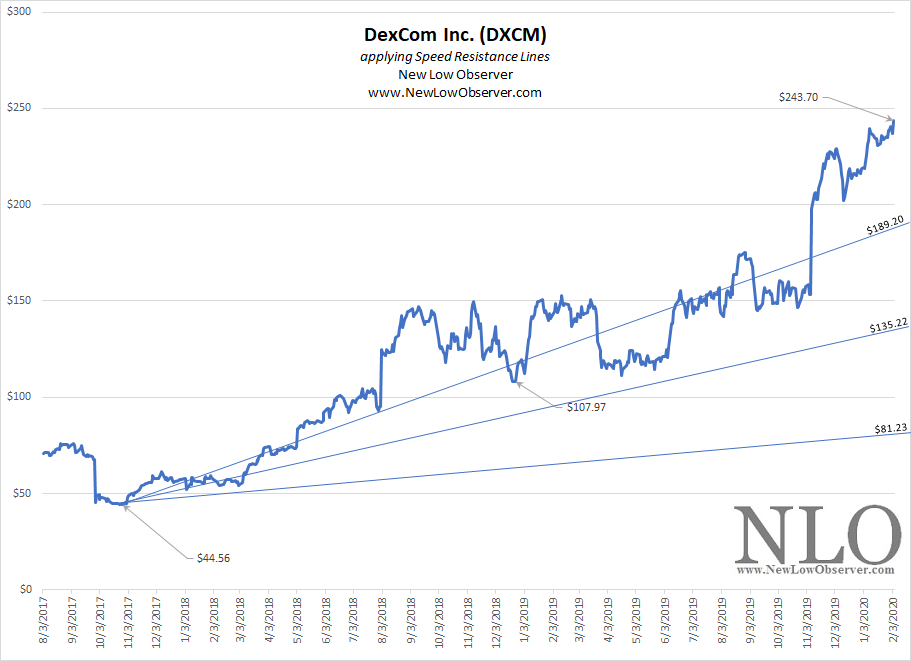
Below are the downside targets for DexCom Inc. (DXCM).

image

  • $189.20 (conservative target)
  • $135.2 (mid-range target)
  • $81.23 (extreme target)

DexCom Inc. has had a healthy increase of the last 2 years and requires a reset.  When will that reset occur? We don’t know, however, we suspect that the conservative downside target is the best level to watch for.

Paycom Software Downside Targets

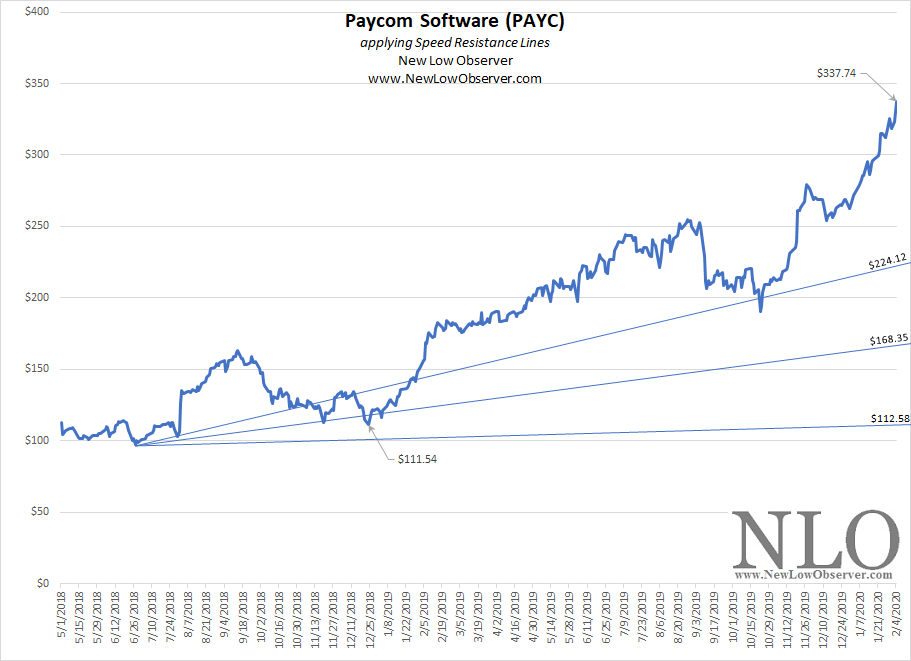
Below are the downside targets for Paycom Software Inc. (PAYC).

image

  • $224.12 (conservative target)
  • $168.35 (mid-range target)
  • $112.58 (extreme target)

If extended to the IPO date in 2014, we would have generated much lower downside targets.  In an effort to be reasonable about expectations, the targets have been set from 2018.  The forecast is that PAYC will decline to the ascending level of $224.12.

Tesla Downside Targets

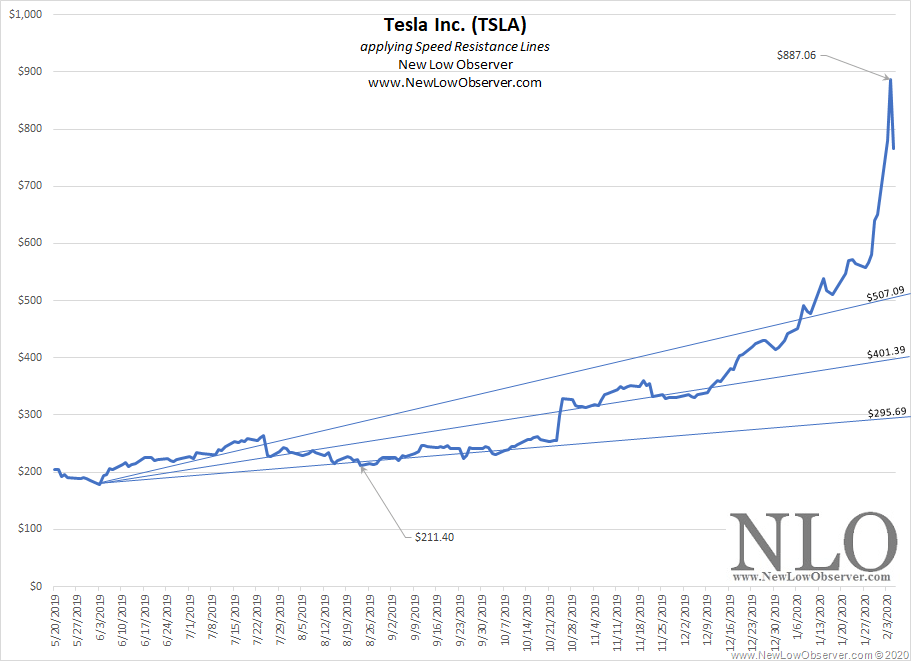
Below are the downside targets for Tesla Inc. (TSLA).

image

  • $507.09 (conservative target)
  • $401.39 (mid-range target)
  • $295.69 (extreme target)

Parabolic increases rarely go unchecked.  This typically means that a decline to the conservative downside target is the norm, at minimum.  However, Tesla has had a history of defying the “norm” when it comes to price change.

Luckin Coffee Downside Targets

Below are the downside targets for Luckin Coffee (LK).

image

  • $34.88 (conservative target)
  • $25.78 (mid-range target)
  • $16.67 (extreme target)

The strong rise in the price from November 2019 to January 2020 is being matched by the current decline.  We expect that the decline to the $25.78 level should be accomplished as a natural reaction to the prior dramatic increase.

Hang Seng Index: November 2019

In our early October 2019 posting, we outlined the parameters for what we expected for the Hang Seng index.  In spite of the recent increases, everything is lining up, so far. Continue reading

Anheuser-Busch InBev SRL

In our previous work, we have outlined the impact of dividends and the historical precedent related to the qualitative elements of Anheuser-Busch InBev (BUD).  Why have we put so much focus on ONLY one fundamental element as it relates to a stock and its future prospects.  As stated by Geraldine Weiss in her book Dividends Don’t Lie:

“The philosophy that the dividend yield of a quality company can reveal volumes about a stock’s future performance does not lend itself merely to a certain tax climate or a particular market cycle.  It is a basic principal. one that serves as a faithful guide through even the most confounding stock market phases (page 10).”

Many argue that such a narrow perspective on esoteric points regarding the dividend doesn’t tell the whole story.  Our writing on this topic since calling the bull market in 2009, and starting this site, highlights the exceptional consistency of the perspective that we have offered.

Price Reveals Fundamentals, Fundamentals Reveal Price

According to Charles H. Dow, co-founder of the Wall Street Journal and creator of the indexes that bear his name:

"The one sure thing in speculation is that values determine prices in the long run. Manipulation is effective temporarily, but the investor establishes price in the end.  The object of all speculation is to foresee coming changes in values. Whoever knows that the value of a stock has run ahead of price and is likely to be sustained can buy that stock with confidence that as its value is recognized by investors, the price will rise (Dow, Charles H. Review and Outlook.  Wall Street Journal. February 25, 1902.)."

With this in mind, we will venture into the indication that are provided by the activity of the price for Anheuser-Busch InBev.

Downside Speed Resistance Lines

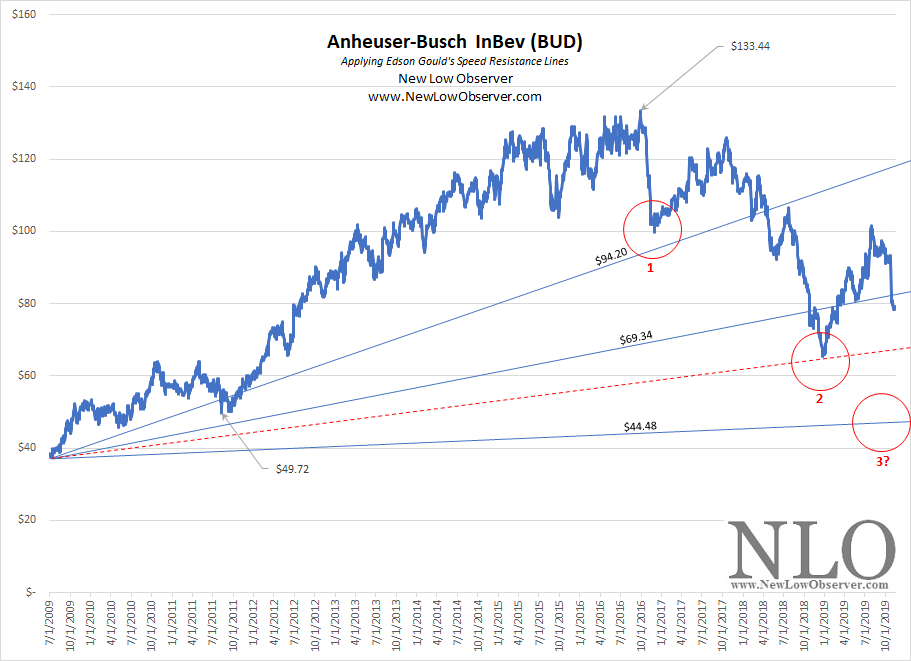
Below are the Downside Speed Resistance Lines (SRL) for Anheuser-Busch InBev (BUD) covering the period from July 2009 to November 2019.

image

The downside targets based on the data from 2009 to the present are:

  • $94.20 (conservative)
  • $69.34 (mid-range)
  • $44.48 (extreme)

We can see that BUD has managed to decline through the conservative and mid-range targets. All that remains is the extreme downside target of between $44.48 and $47.70.  The lack of historical precedent does not allow for the richer analysis of the price that we’d normally like to do.  Such analysis makes for what we believe would be better interpretation of the price activity.

Three Steps Rule

In addition to Gould’s Speed Resistance Lines, there is the theory of the Three Steps Rule.  According to Gould:

Our Three Step Rule (not to be confused with our Three Step and Stumble Rule, Which refers only to monetary conditions) has been helpful over the years in our attempt to project stock market moves and to anticipate stock market tops and bottoms.

Our Three Step Rule says: In any stock market move, up or down, large or small or in between, expect three steps but be prepared for a fourth.

It applies to large moves as well as small moves.

Three steps up in an advancing market and three steps down in a declining market usually exhaust the bullish potential accumulated at the bottoms and the bearish potential accumulated at tops- but sometimes there is a fourth step (Edson Gould Reports. Edson Gould’s 1975 Forecast. November, 1974. page 8. ).

We have included, in the chart above, the Three Steps (red circles).  In this case, the third “step” cannot occur unless it is at some point below the second “step.”

Upside Speed Resistance Lines

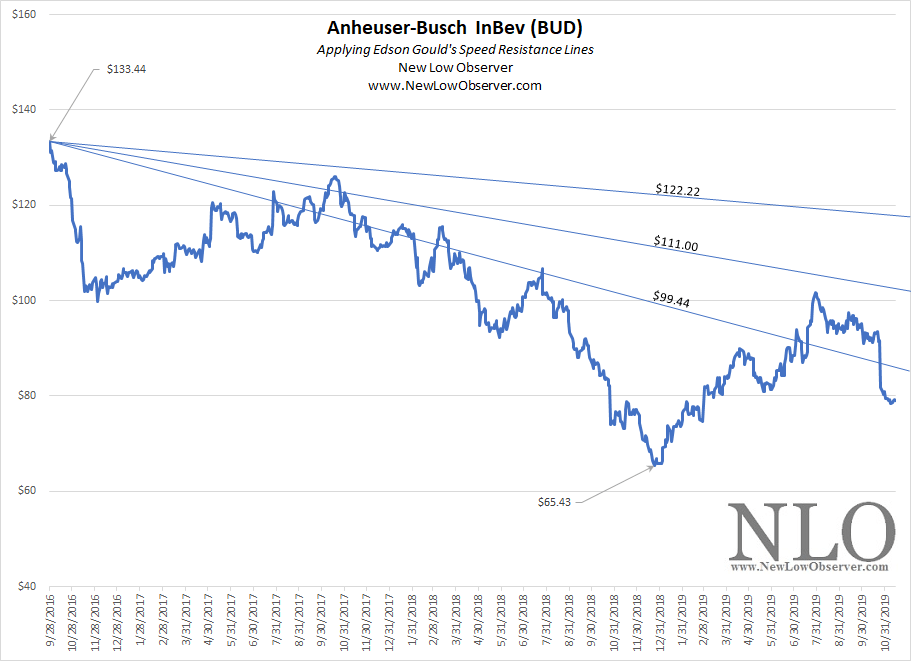
Below are the Upside Speed Resistance Lines (SRL) for Anheuser-Busch InBev (BUD) covering the period from September 2016 to November 2019.

image

The upside targets based on the data from 2016 to the present are:

  • $99.44
  • $111.00
  • $122.22

As with downside prospects there must be upside resistance.  From the all-time low set in late 2018, BUD has managed to climb as high as $101.58.  However, not achieving the $111.00 upside resistance and then falling below the $99.44 upside resistance level suggests, at minimum, a re-test of the $65.43 level.

Speed Resistance Lines are based on the work of Edson Gould who was famous for precisely calling market tops and bottoms and widely quoted in Barron’s throughout the 1970’s.  How powerful are the indications provided by Gould’s SRL?

Among the many posting we have on the topic, our April 26, 2012 on the downside risk for Chesapeake Energy (CHK) titled “A Warning for Chesapeake Shareholders” suggested that although the stock was trading at $18.10, CHK could potentially decline as low $0.67 as a normal reaction to the prior peak.  On November 12, 2019, CHK had a closing price of $0.67.

Shanghai Composite: Upside Targets

Below are the upside resistance targets for the Shanghai Composite Index for both the short and long-term moves.

Short-Term Targets

Based on the price action since January 2019, the Shanghai Composite Index has conformed to the upside resistance targets ranging from 3,012.38 to 3,378.93.

image

The short-term upside resistance target determines market sentiment for achieving the 3,559.47.  So far, the market appears on course to achieve a re-test of the prior low at 2,464.36.  The theory of the re-test is known as a double top, or in this case a double bottom, as described by Charles H. Dow in 1901.

"Another method is what is called the theory of double tops. Records of trading show that in many cases when a stock reaches top it will have a moderate decline and then go back again to near the highest figures. If after such a move, the price again recedes, it is liable to decline some distance (Dow, Charles H. Wall Street Journal. July 20, 1901.)."

The expectation should be that after obtaining a new low or a new peak, the price will trend in the opposite direction and then re-test the prior extreme level.  In this case, it is the 2,464.36.  This makes the 3,012.38 upside resistance level a reasonable level for expectation on the way to the down from the current level as diagramed in the chart above.

Long-Term Targets

The most important factor to watch for is the long-term trend in the Shanghai Composite.  The chart below outlines the long-term prospects for the index. Continue reading