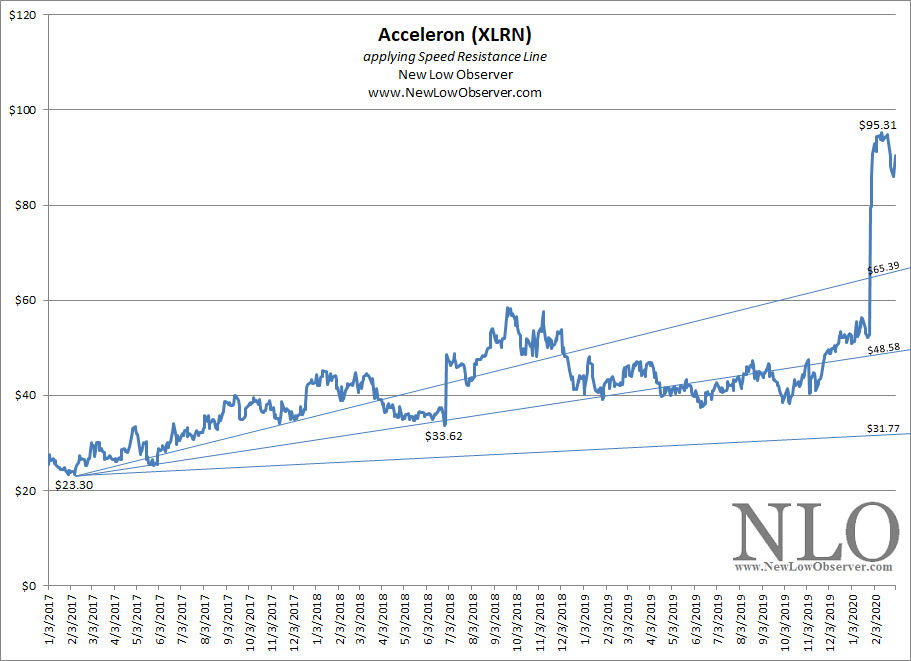
Below are the downside targets for Acceleron Pharma Inc. (XLRN).
-
$65.39 (conservative target)
-
$48.58 (mid-range target)
-
$31.77 (extreme target)

Below are the downside targets for Acceleron Pharma Inc. (XLRN).
Posted in Acceleron, Speed Resistance Lines, SRL, XLRN
In our last Dow Theory assessment on October 4, 2019, we said the following:
“…[the] two indexes [DJIA & DJTA] as exhibiting bearish reversal patterns from the prior trend. The bear market continues until the dashed red and blue lines are exceeded to the upside.”
It didn’t feel like it but we were in a bear market at least since October 2019. How do we know? While the Dow Jones Industrial Average (DJIA) was moving to new highs, the Dow Jones Transportation Average was unable to exceed the prior peak set at 11,570.84 on September 14, 2018.
Below are the downside targets for the DJIA & DJTA based on Dow’s Theory. Continue reading
Posted in Dow Industrials, Dow Jones Transportation Average, Dow Theory
Tagged members
The following is the breakdown of the Dogs of the NLO based on our January 3, 2020 watch list, compared to other fundamental ratios. The purpose of this work is to confirm or deny the claims proposed of the Dogs of the Dow theory as outlined by Michael O’Higgins in his book Beating the Dow. Continue reading
Below is the year-to-date (YTD) performance of various major indexes from December 31, 2019 to February 28, 2020.
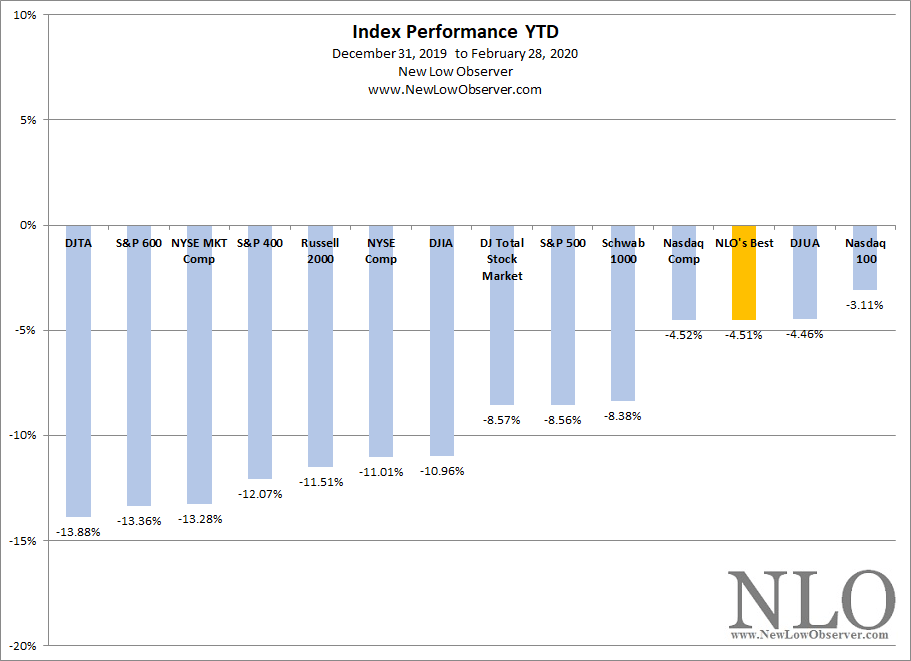
Although NLO’s Best lost –4.51%, the groups that we would have selected declined –7.57% or –7.32%. So while –4.51% is less than half the loss of the Dow Jones Industrial Average (our benchmark), our personal favorites would not have done as well.
There is a need to point out the rationale of investing in the major indexes or choosing to buy an S&P 500 Index fund. The conventional wisdom is that the more broadly diversified the index the lower the volatility and risk. The trade-off of choosing a broadly diversified index is that you’ll achieve relatively diminished returns on the upside.
Along with diversification, quality is a key component to the change in indexes on the way up and down. Conventional wisdom suggests that higher quality will be last to fall and lower quality will be first to fall. Magnitude of change also is assumed to change along the spectrum of quality. Higher quality generally does well in the early stages of a rise and decline. Lower quality generally overperforms in the late stages of a rise and severely underperforms in early stages of a decline.
Although broadly diversified, indexes like the Russell 2000 or S&P 600 hold lower quality stocks which results in a more rapid decline in price. Alternatively, narrowly diversified indexes like the Nasdaq 100 and Dow Jones Utility Average thrive as their quality of holdings leave investors less willing to sell in a general market decline.
We take a certain level of pride in the fact that, on the whole, our stocks of choices reflect higher quality in spite of the extremely low number of positions that are included. We believe that our overall analysis puts investors in a better position when making the choice between buying an S&P 500 Index Fund with zero expense ratios while having limited funds to invest with.
The following is the breakdown of the Dogs of the Dow (found here) in week nine, compared to other fundamental ratios and varying portfolio sizes. Continue reading
The following is the breakdown of the Dogs of the TSX (here) in week nine, compared to other fundamental ratios. Continue reading
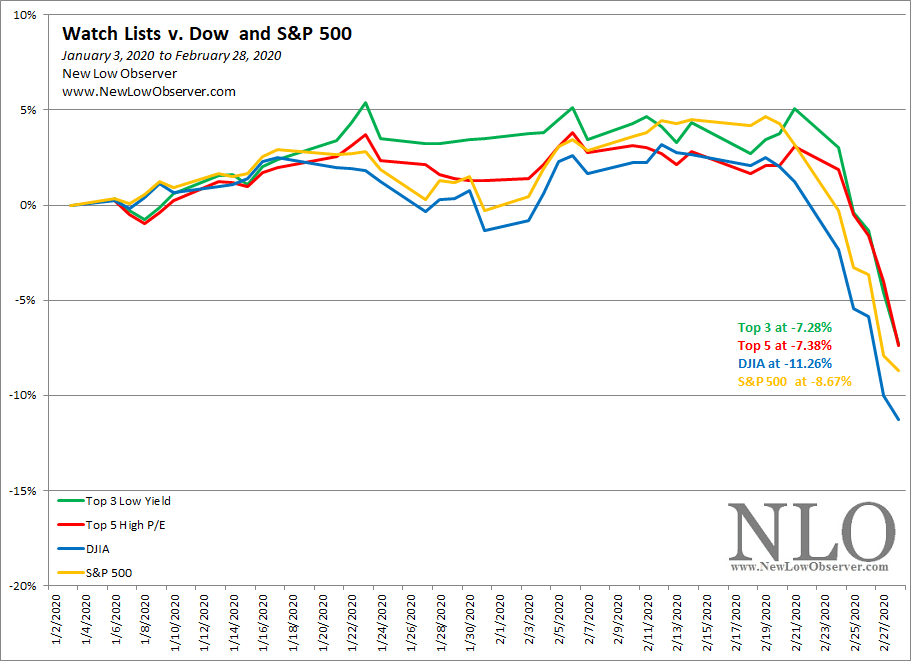
On January 6, 2020, we published our U.S. Dividend Watch List. On that list we broke out the data based on a ranking by fundamentals. Of the stocks that we highlighted, two categories that we liked are the top three low yield stocks and the top five high P/E stocks.
The performance of both groups are shown in contrast to the Dow Jones Industrial Average and S&P 500 from the close of January 3, 2020 to the close of February 28, 2020.
Last week, we said the following:
“We don’t expect this chasm between our lists and the DJIA to persist…”
The difference between our Top 3 stocks and the DJIA was 4.40% (in favor of our list). The difference between the Top 3 and the DJIA is 3.98% (in favor of our list). The tide is quickly shifting in the opposite direction and the change is incrementally gaining ground between the DJIA and the Top 3.
Conventional wisdom is being defied based on the above charts. We’ll withhold our take on this matter until the decline is fully reversed.
Posted in Performance Review
Conventional wisdom suggests that a flu pandemic like COVID-19 would have resulted in a further decline in financial markets rather than a reversal of a long established declining trend. That was not the case for the period from 1918 to 1920.
In the last worst case of a flu pandemic, known as the Spanish Flu from 1918 to 1920, we compare the movement of the Dow Jones Industrial Average (DJIA) to the Dow Jones Transportation Average (DJTA).
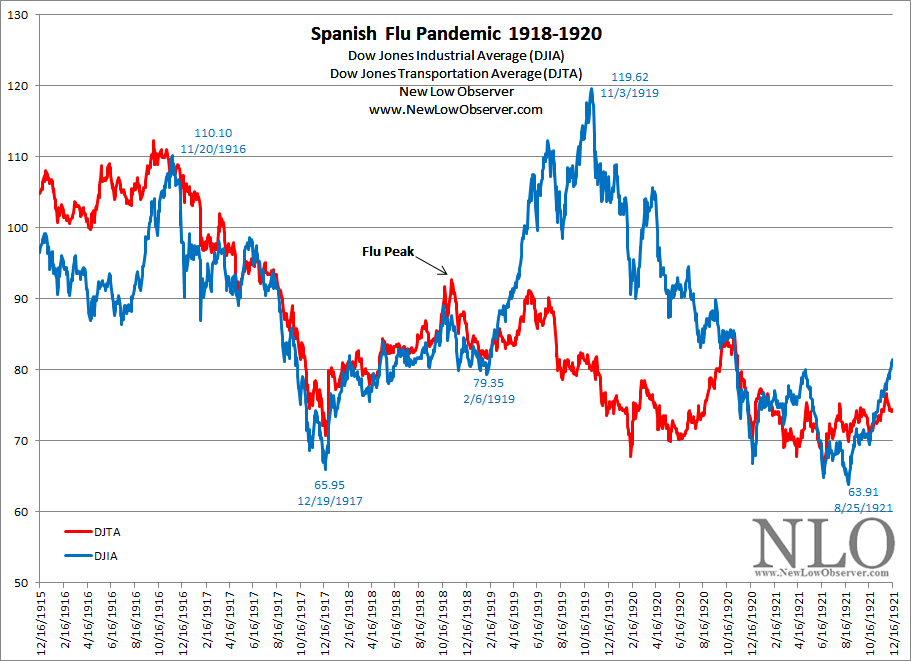
In the period when it was on the ascent (late 1917), the Spanish Flu had seen the Dow Jones Industrial Average come off of a decline of -40.09%. From the December 19, 1917 low, the Dow Jones Industrial Average increased approximately +81.37% by November 3, 1919.
The peak in the Spanish Flu occurred approximately November 1919. This was in the midst of the Dow Jones Industrial Average’s run from the low in December 1917 to the 1919 peak. After the 1919 peak in the Dow Jones Industrial Average, the market declined -46.57% to the August 25, 1921 low. The low in 1921 was the beginning of the monumental runs in the stock market with a market peak in 1929.
How many declines of -3% did the Dow Jones Industrial Average experience in the period from December 16, 1915 to December 16, 1921?
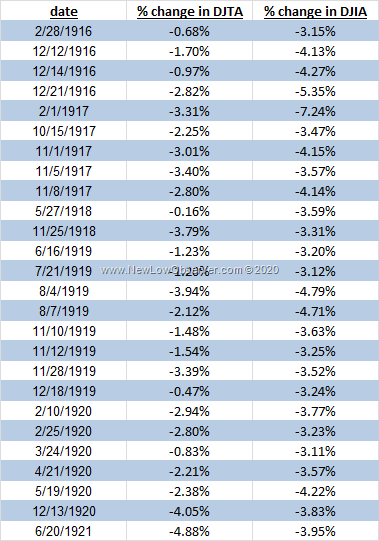
What conclusions can be drawn from the above data? In the period from 1918 to 1920, the Dow Jones Industrial Average experienced 6 declines greater than -3% on the way to the peak in November 1919. After the peak of November 1919, there were a total of 10 declines greater than -3% on the way to the August 1921 low.
Below we have broken the declines into a quarterly basis in the period from December 1915 to December 1921.
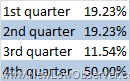
With half of the declines of greater than -3% occurring in the fourth quarter of the year, we should expect that there is going to be more large declines to come.
Below are the valuation targets for Aaron’s Inc. (AAN) for the next 10 years. Continue reading
On January 6, 2020, we published our U.S. Dividend Watch List. On that list we broke out the data based on a ranking by fundamentals. Of the stocks that we highlighted, two categories that we liked are the top three low yield stocks and the top five high P/E stocks.
The performance of both groups are shown in contrast to the Dow Jones Industrial Average from the close of January 3, 2020 to the close of February 21, 2020.
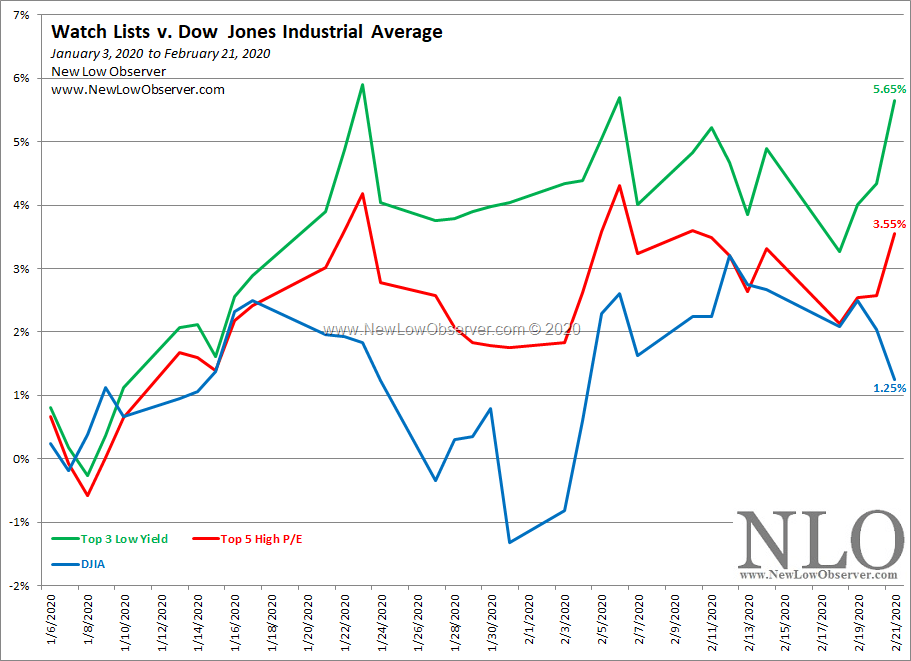
So far there is a wide divergence of our watch lists as compared to the DJIA in the period from the January 3, 2020 close to the February 21,2020 close. We don’t expect this chasm between our lists and the DJIA to persist and will update as we go through the year.
Posted in Performance Review
The NLO team executed the following transaction(s): Continue reading
The following is the breakdown of the Dogs of the TSX (here) in week seven, compared to other fundamental ratios. Continue reading
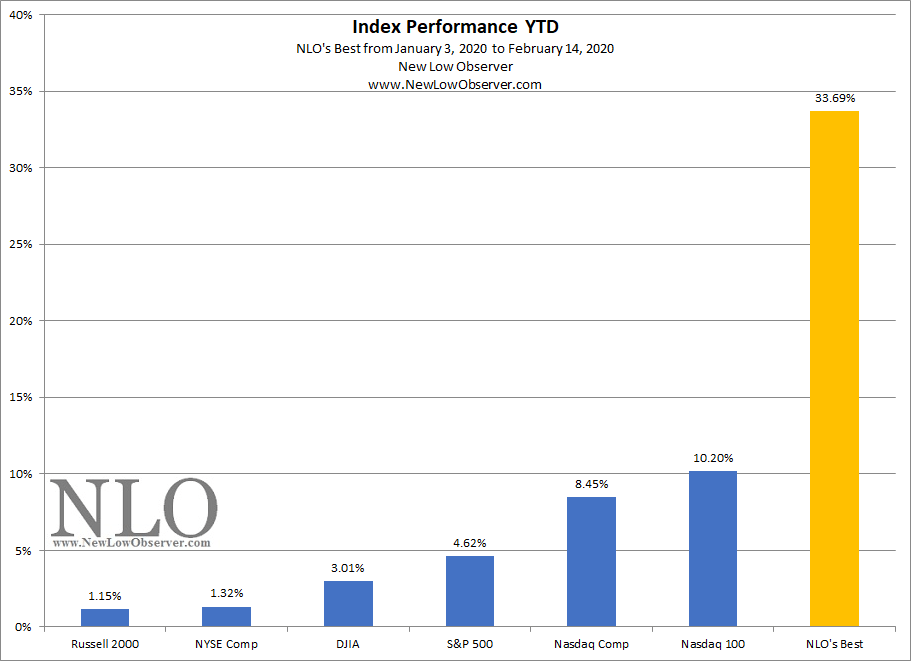
Below is the year-to-date performance of major indexes compared to any one of the top categories that we created and track from January 3, 2020 to February 14, 2020.
The following is the breakdown of the Dogs of the NLO based on our January 3, 2020 watch list, compared to other fundamental ratios. The purpose of this work is to confirm or deny the claims proposed of the Dogs of the Dow theory as outlined by Michael O’Higgins in his book Beating the Dow. Continue reading
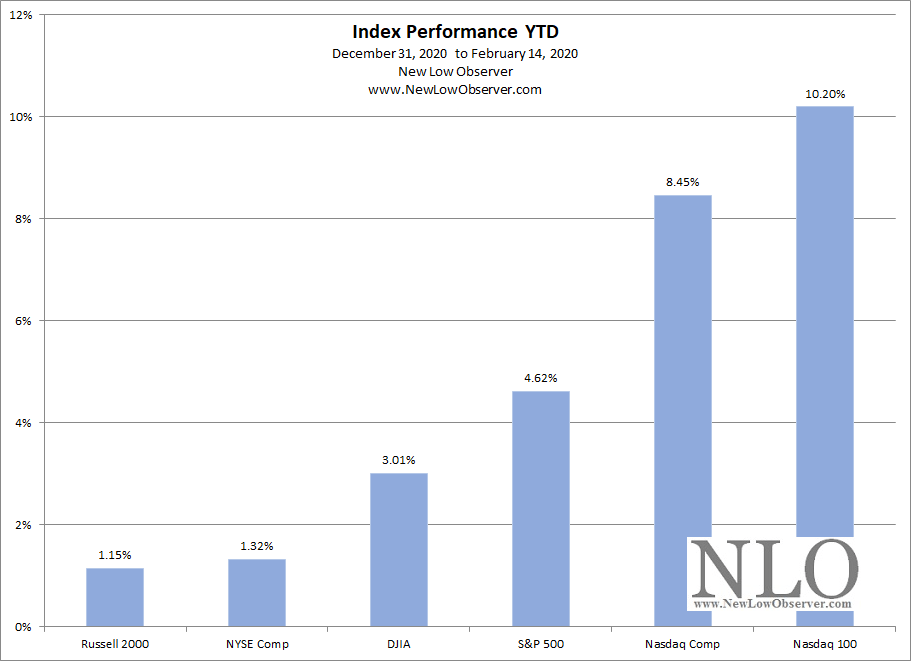
Below is the year-to-date (YTD) performance of various major indexes and from December 31, 2019 to February 14, 2020.
The following is the breakdown of the Dogs of the Dow (found here) in week seven, compared to other fundamental ratios. Continue reading
Below is the performance of the Vicker’s Favorite Fifty OTC stocks as published on October 30, 1961 by Barron’s covering data from September 1, 1961 to September 4, 1962:
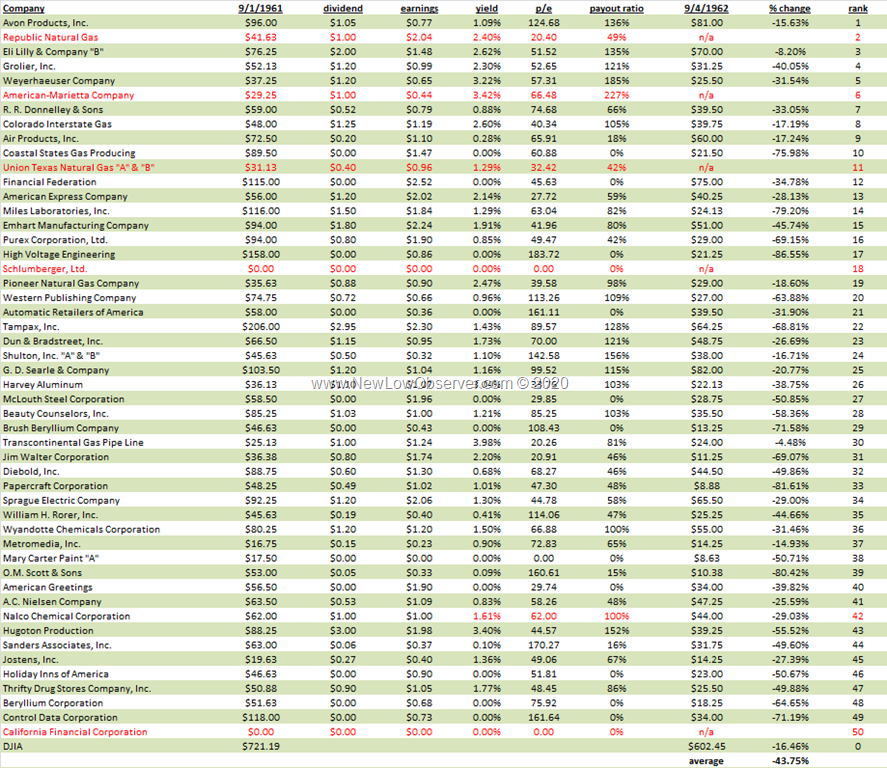
In the period from September 1, 1961 to September 4, 1962, the Dow Jones Industrial Average declined –16.46% compared to the overall change of Favorite Fifty OTC stocks at –43.75%. It is very important to contrast the Favorite Fifty OTC stocks to the Favorite Fifty NYSE stocks. The OTC stocks are small cap companies and favor growth over income which is found in the NYSE list.
The breakdown of the data based on dividend yield, price-to-earnings ratios, and dividend payout ratio.
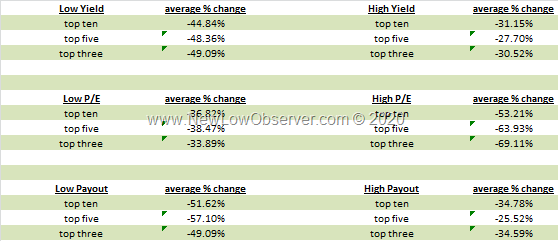
The “best” performance was achieved by no group listed here. With the Dow Jones Industrial Average declining by -16.46%, no single subset of stocks managed to perform better.
Note:
See also:
Posted in Fabulous Fifty, Favorite Fifty, Nifty Fifty, OTC
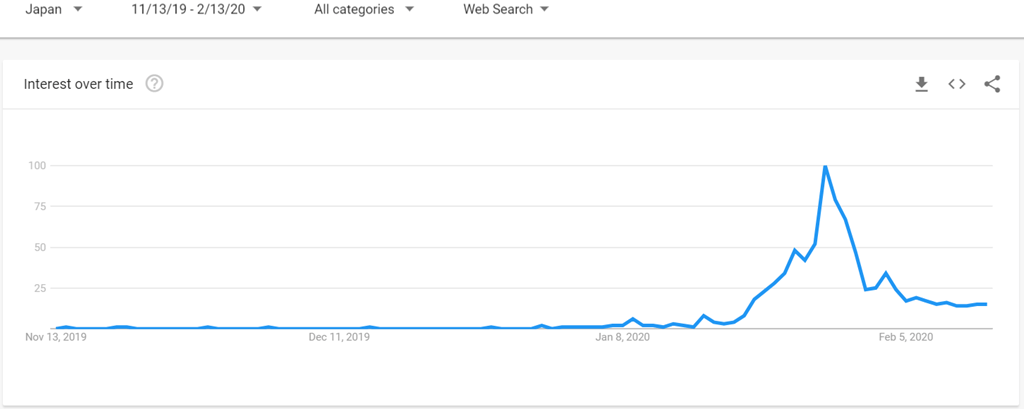
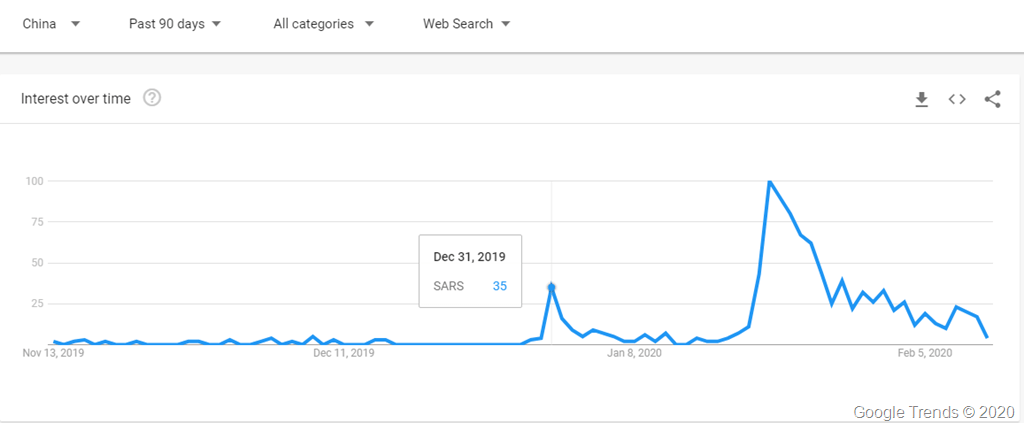
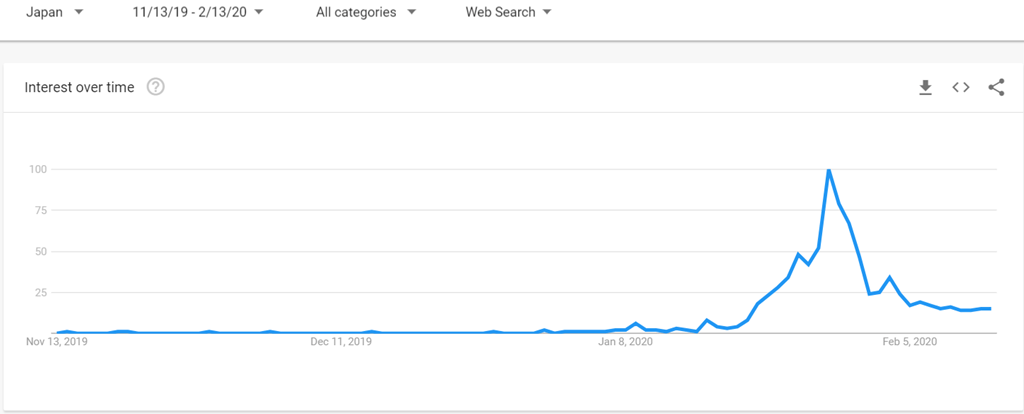
We recently saw an article In Bloomberg News on the possibility of the CoronaVirus (2019-nCoV) or (COVID-19) being known as early as the last week of December 2019. We looked at GoogleTrends to see if there was any correlation to this claim and our results are below.

GoogleTrends: United States SARS last 90 days
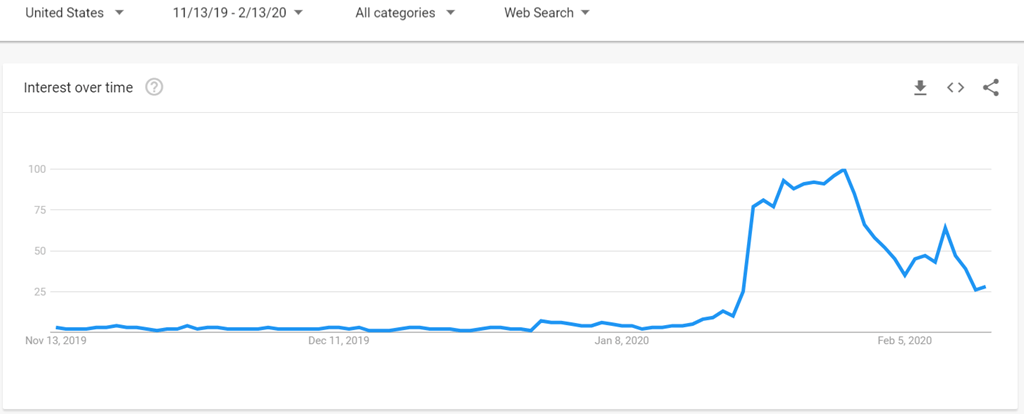
GoogleTrends: Japan SARS last 90 days
GoogleTrends: China SARS last 90 days
GoogleTrends: China SARS last 5 years
January 12, 2020 is the date when the details of genome sequencing triggered a outbreak alert.
We have been able to confirm with GoogleTrends that in China, the December jump in searches was abnormal not only in the last 90-day period but the largest spike in searches in the last five year period.
Posted in coronavirus, COVID-19, Google Trends