Author Archives: NLO Team

NLO in Review: 2020-7

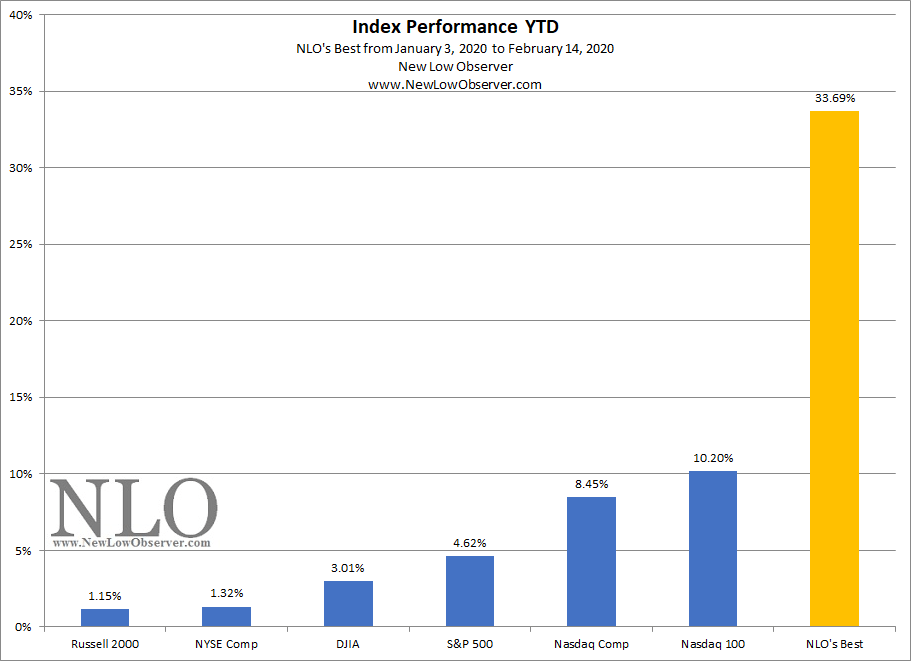
Below is the year-to-date performance of major indexes compared to any one of the top categories that we created and track from January 3, 2020 to February 14, 2020.
image

The following is the breakdown of the Dogs of the NLO based on our January 3, 2020 watch list, compared to other fundamental ratios.  The purpose of this work is to confirm or deny the claims proposed of the Dogs of the Dow theory as outlined by Michael O’Higgins in his book Beating the Dow. Continue reading
DJIA in Review: 2020-7

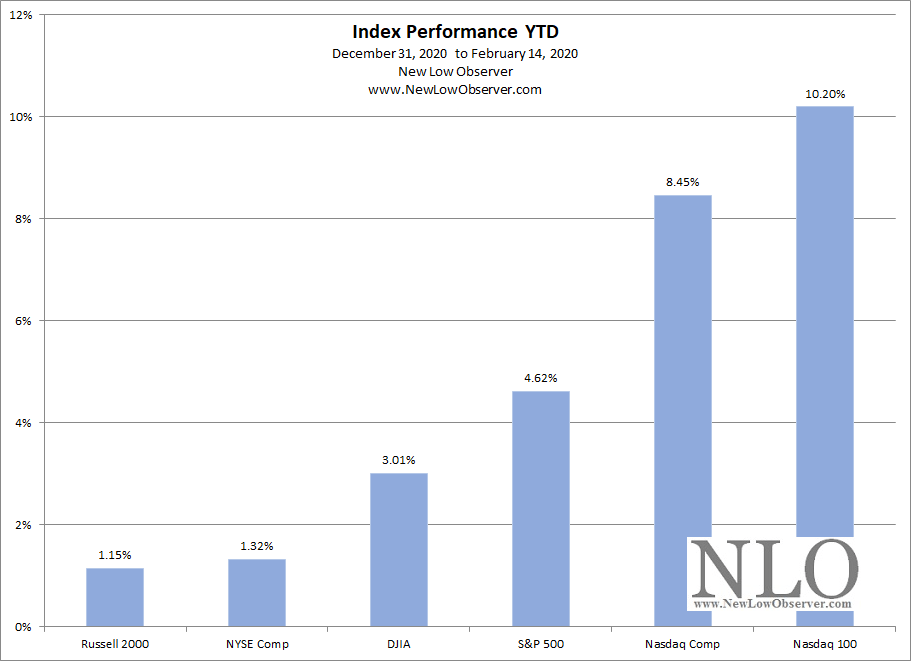
Below is the year-to-date (YTD) performance of various major indexes and from December 31, 2019 to February 14, 2020.

image

The following is the breakdown of the Dogs of the Dow (found here) in week seven, compared to other fundamental ratios. Continue reading

Favorite Fifty: 1961 OTC

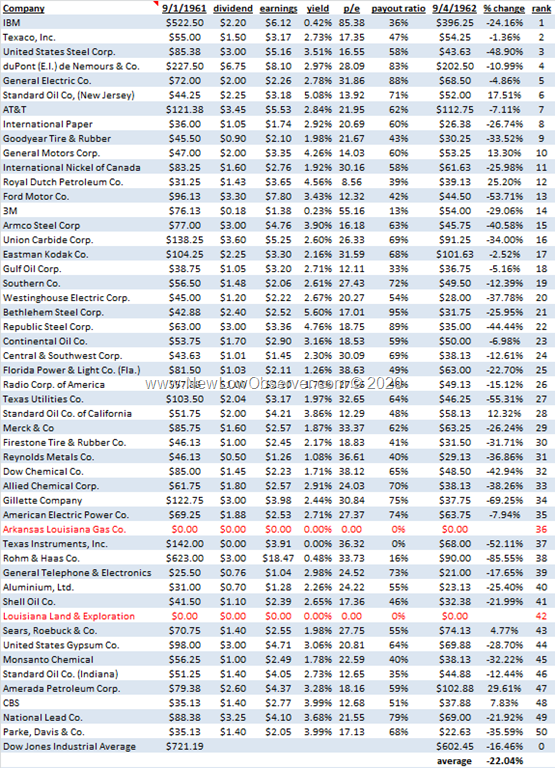
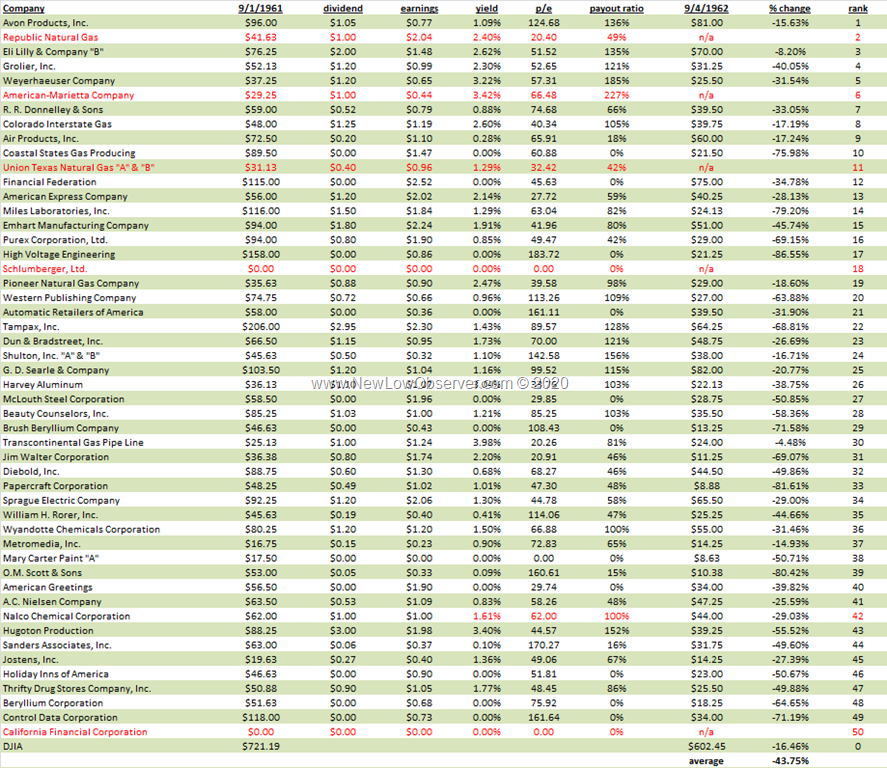
Below is the performance of the Vicker’s Favorite Fifty OTC stocks as published on October 30, 1961 by Barron’s covering data from  September 1, 1961 to September 4, 1962:

image

In the period from September 1, 1961 to September 4, 1962, the Dow Jones Industrial Average declined –16.46% compared to the overall change of Favorite Fifty OTC stocks at –43.75%.  It is very important to contrast the Favorite Fifty OTC stocks to the Favorite Fifty NYSE stocks.  The OTC stocks  are small cap companies and favor growth over income which is found in the NYSE list.

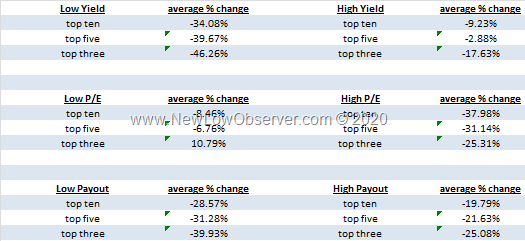
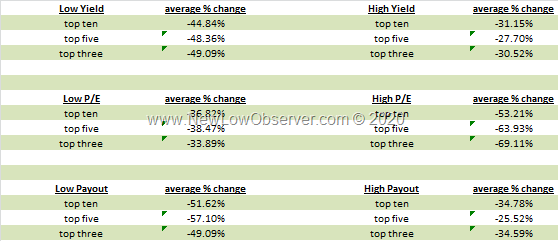
The breakdown of the data based on dividend yield, price-to-earnings ratios, and dividend payout ratio.

image

The “best” performance was achieved by no group listed here.  With the Dow Jones Industrial Average declining by -16.46%, no single subset of stocks managed to perform better.

Note:

  • Rank is determined by the largest number of holdings by closed-end funds and open-end investment companies for listed Over-The-Counter stocks.  Rank number 1 means the stock is held by the most investment companies on a dollar value basis.
  • Armon, Glenn. “Over-The-Counter Favorites.” Barron's. October 30, 1961. page 9.
  • Aigeltinger & Co.
  • Vickers, Sydney. Guide to Investment Company Portfolios. Vickers & Associates. 1960.

See also:

Google Trends and the Coronavirus

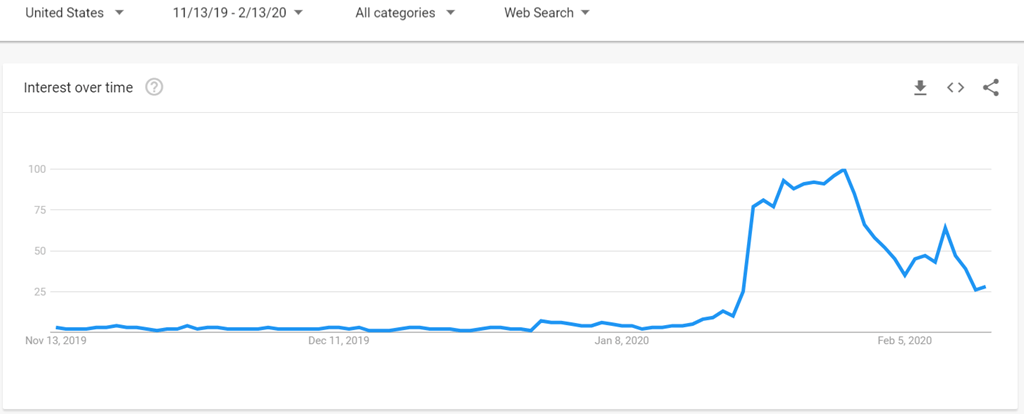
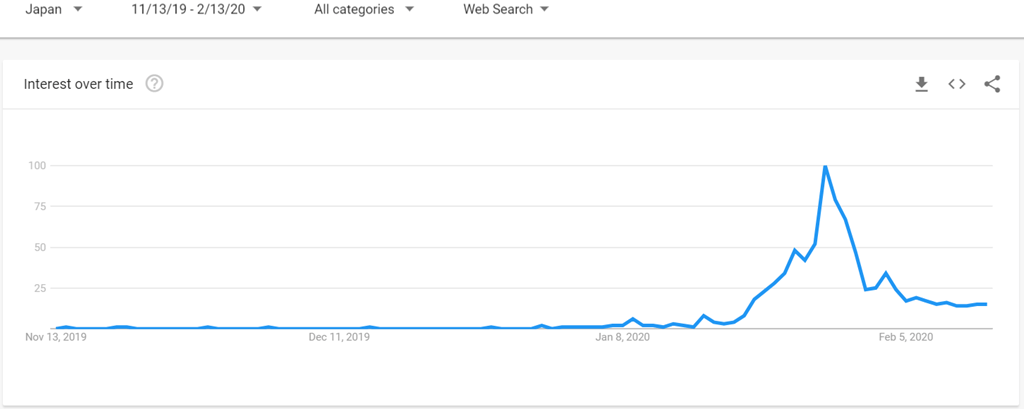
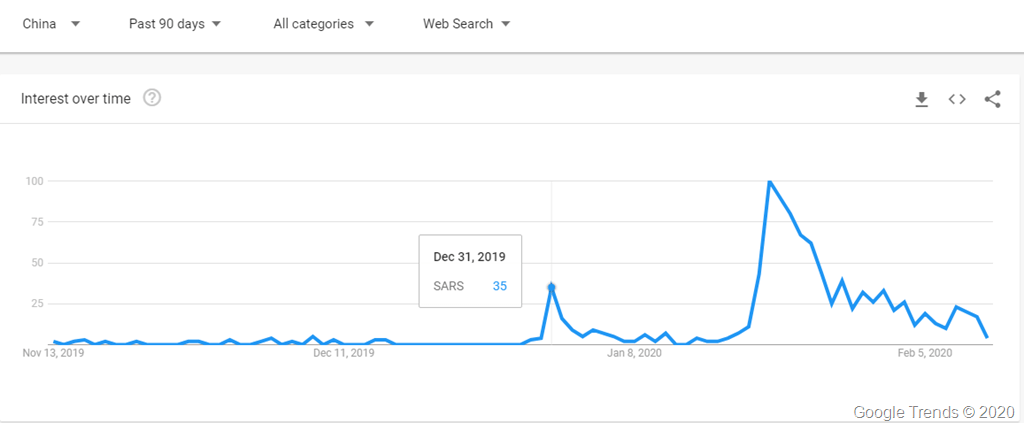
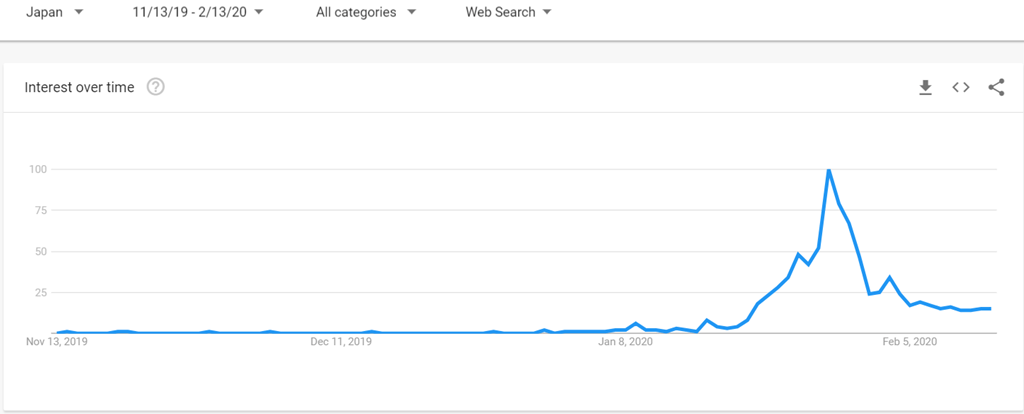
We recently saw an article In Bloomberg News on the possibility of the CoronaVirus (2019-nCoV) or (COVID-19) being known as early as the last week of December 2019.  We looked at GoogleTrends to see if there was any correlation to this claim and our results are below.

image

GoogleTrends: United States SARS last 90 days

image

GoogleTrends: Japan SARS last 90 days

image

GoogleTrends: China SARS last 90 days

image

GoogleTrends: China SARS last 5 years

image

January 12, 2020 is the date when the details of genome sequencing triggered a outbreak alert.

We have been able to confirm with GoogleTrends that in China, the December jump in searches was abnormal not only in the last 90-day period but the largest spike in searches in the last five year period.

Nifty Fifty: 1961

Below is the performance of the Nifty Fifty as published on June 6, 1960 by Barron’s covering data from  September 1, 1961 to September 4, 1962:

image

In the period from September 1, 1961 to September 4, 1962, the Dow Jones Industrial Average declined –16.46% compared to the overall change of –22.04% in the Nifty Fifty.  The breakdown of the data based on dividend yield, price-to-earnings ratios, and dividend payout ratio.

image

The best gain was achieved by the top three stocks in the Low P/E category with an increase of +10.79%.

Note:

  • This list is carried over from the 1960 listing of the Favorite Fifty stocks as published in Barron’s.
  • Rank is determined by 58 closed-end funds and over 100 open-end investment companies and their holdings.  Rank number 1 means the stock is held by the most investment companies on a dollar value basis.
  • “The Favorite Fifty: The First Quarter Saw a Good Many Changes in the Line-Up.” Barron's. June 6, 1960. page 9.
  • Aigeltinger & Co.
  • Vickers, Sydney. Guide to Investment Company Portfolios. Vickers & Associates. 1960.

See also:

Sea Limited Downside Targets

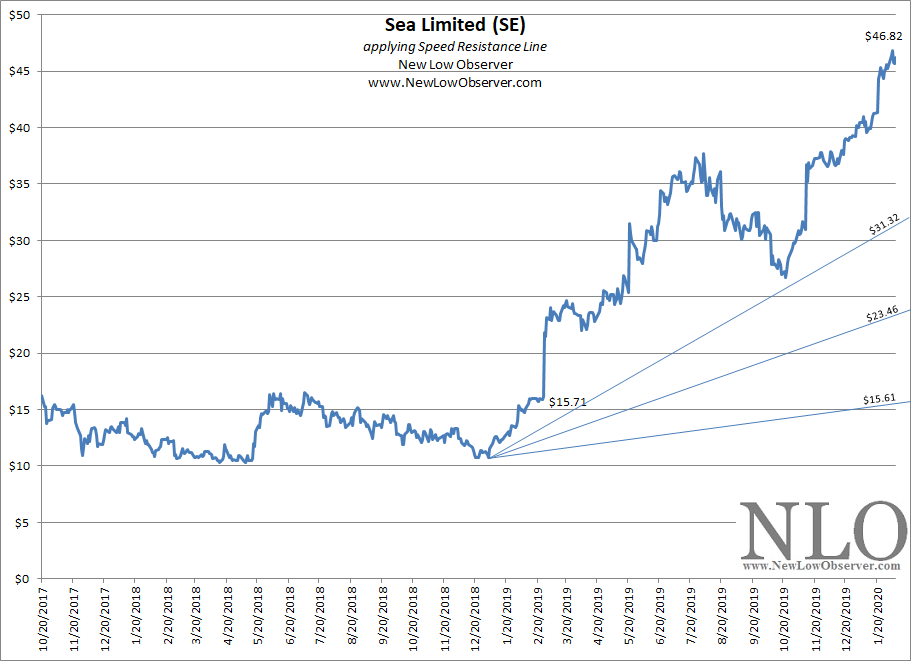
Below are the downside targets for Sea Limited (SE).

image

  • $31.32 (conservative target)
  • $23.46 (mid-range target)
  • $15.61 (extreme target)

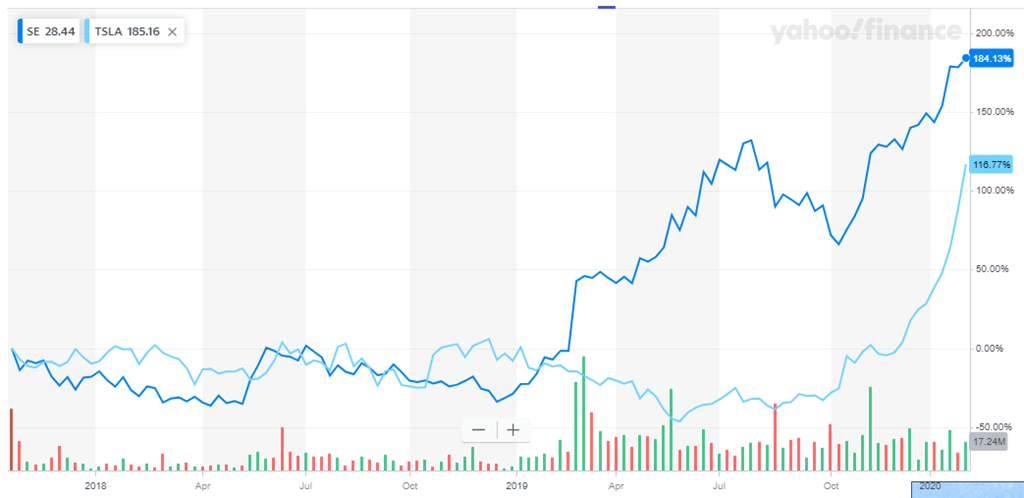
If you’re impressed with the increase of Tesla (downside target here) in the last few months then a look at Sea Limited should put that into perspective.

image

Since the name change of the company from Garena Interactive Holding in 2017 (cough), Sea Limited has outpaced Tesla on the upside.

NLO in Review: 2020-6

The following is the breakdown of the Dogs of the NLO based on our January 3, 2020 watch list, compared to other fundamental ratios.  The purpose of this work is to confirm or deny the claims proposed of the Dogs of the Dow theory as outlined by Michael O’Higgins in his book Beating the Dow. Continue reading
Income Bellwethers

In March 2019, Morningstar published their Income Bellwether Watchlist with data from February 11, 2019.  Below is the performance of the stocks based on the highest and lowest dividend yield from February 11, 2019 to February 7, 2020 (intraday).

image

Based on the data, High Yield stocks severely underperformed the Dow Jones Industrial Average, even in the best case scenario.  Meanwhile, the Low Yield stocks trounced the Dow Jones Industrial Average.  This data confirms our work in the Dogs of the Dow.

Nifty Fifty: 1960

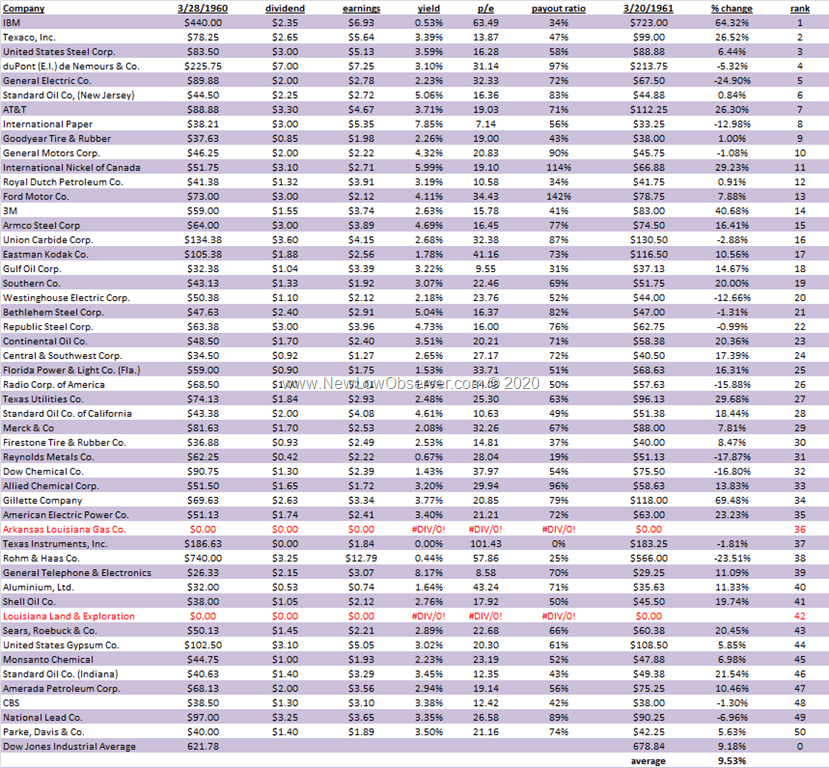
Below is the performance of the Nifty Fifty as published on June 6, 1960 by Barron’s covering data from  March 28, 1960 to March 20, 1961:

image

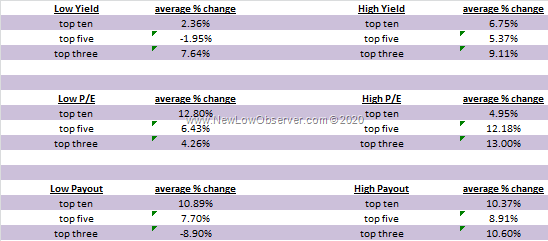
In the period from March 28, 1960 to March 20, 1961, the Dow Jones Industrial Average increased +9.18% compared to the overall change of +9.53% in the Nifty Fifty.  The breakdown of the data based on dividend yield, price-to-earnings ratios, and dividend payout ratio.

image

The best gain was achieved by the top three stocks in the High P/E category with an increase of +13.00%.

Note:

  • Rank is determined by 58 closed-end funds and over 100 open-end investment companies and their holdings.  Rank number 1 means the stock is held by the most investment companies on a dollar value basis.
  • “The Favorite Fifty: The First Quarter Saw a Good Many Changes in the Line-Up.” Barron's. June 6, 1960. page 9.
  • Aigeltinger & Co.
  • Vickers, Sydney. Guide to Investment Company Portfolios. Vickers & Associates. 1960.

See also:

Nifty Fifty: 1953

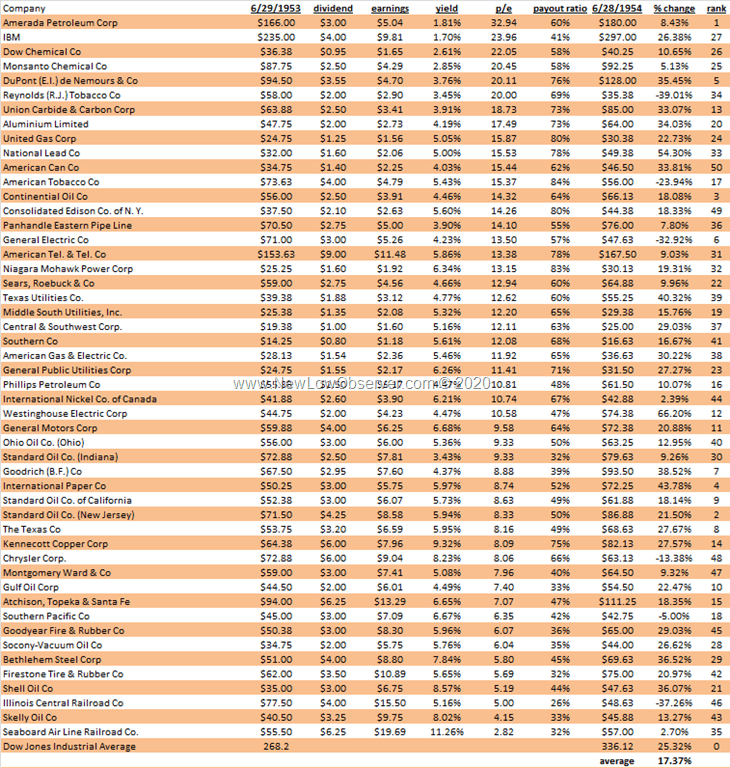
Below is the performance of the Nifty Fifty as published on September 28, 1953 by Barron’s covering data from June 29, 1953 to June 28, 1954:

image

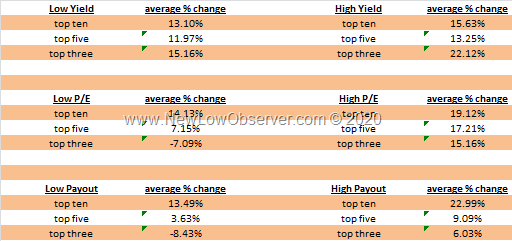
In the period from June 29, 1953 to June 28, 1954, the Dow Jones Industrial Average increased +25.32% compared to the overall change of +17.37% in the Nifty Fifty.  The breakdown of the data based on dividend yield, price-to-earnings ratios, and dividend payout ratio.

image

The best gain was achieved by the top three stocks in the High Payout category with an increase of +22.99%.  On average, best performing group was the High P/E, however, no grouping managed to beat the performance of the Dow Jones Industrial Average.

Note:

  • Rank is determined by 58 closed-end funds and over 100 open-end investment companies and their holdings.  Rank number 1 means the stock is held by the most investment companies on a dollar value basis.
  • Johnston, Paul A. “With the Investor’s Investor: Tobacco Stocks Join List of ‘Favorite Fifty’ Group.” Barron's. September 28, 1953. page 31.
  • Aigeltinger & Co.
  • Sydney G. Vickers.

See also:

Nifty Fifty: 1951

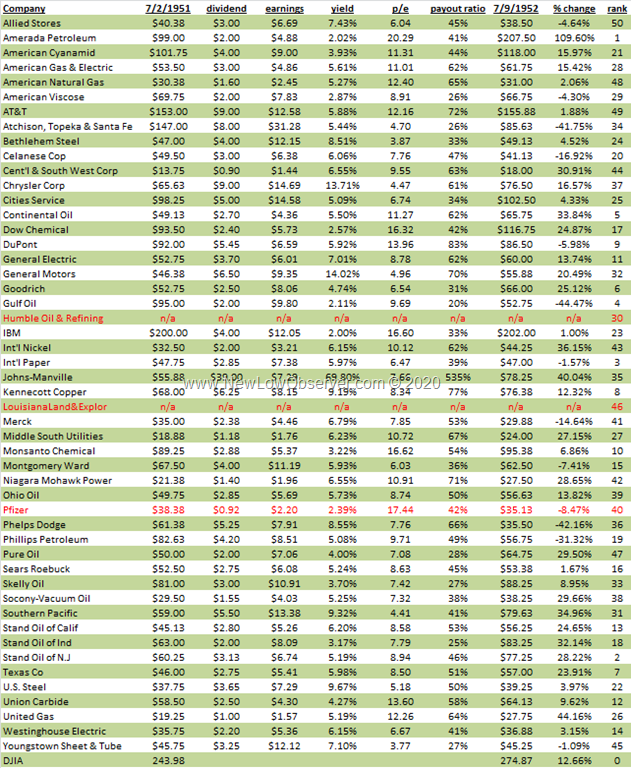
Below is the performance of the Nifty Fifty as published on September 10, 1951 by Barron’s covering data from July 2, 1951 to July 9, 1952:

image

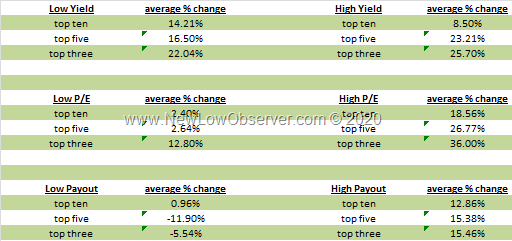
In the period from July 2, 1951 to July 9, 1951, the Dow Jones Industrial Average increased +12.66% compared to the overall change of +11.15% in the Nifty Fifty.  The breakdown of the data based on dividend yield, price-to-earnings ratios, and dividend payout ratio.

image

The best gain was achieved by the top three stocks in the High P/E category with an increase of +36.00%.  The best performing group was the High P/E stocks where all of categories generated gains that beat the Dow Jones Industrial Average.

Note:

  • Rank is determined by 58 closed-end funds and over 100 open-end investment companies and their holdings.  Rank number 1 means the stock is held by the most investment companies on a dollar value basis.
  • Johnston, Paul A. “With the Investor: Oil Holdings Maintain Lead in ‘Favorite Fifty’.” Barron's. September 10, 1951. page 35.
  • Aigeltinger & Co.
  • Sydney G. Vickers.

see also:

NLO in Review: 2020-5

The following is the breakdown of the Dogs of the NLO based on our January 3, 2020 watch list, compared to other fundamental ratios.  The purpose of this work is to confirm or deny the claims proposed of the Dogs of the Dow theory as outlined by Michael O’Higgins in his book Beating the Dow. Continue reading

TSX in Review: 2020-5

The following is the breakdown of the Dogs of the TSX (here) in week five, compared to other fundamental ratios. Continue reading

DJIA in Review: 2020-5

The following is the breakdown of the Dogs of the Dow (found here) in week five, compared to other fundamental ratios. Continue reading

Nifty Fifty: 1977

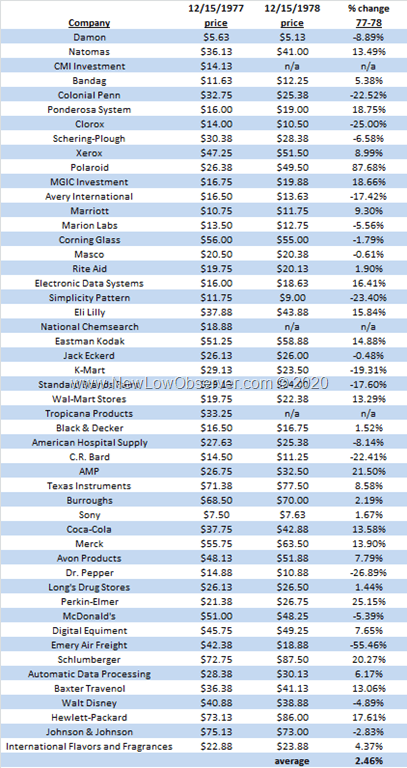
Below is the performance of the Nifty Fifty as published by Forbes from the December 15, 1977 publish date to December 15, 1978:

image

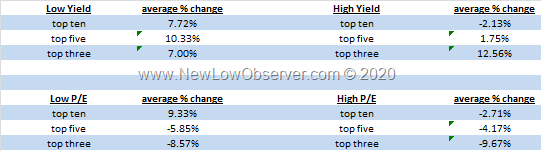
In the period from December 15, 1977 to December 15, 1978, the Dow Jones Industrial Average decline –1.54% compared to the overall change of +2.46% in the Nifty Fifty.  The breakdown of the data based on dividend yield & price-to-earnings ratios.

image

The best gain was achieved by the top three stocks in the High Yield category with an increase of +12.56%.  However, the best performing group was the Low Yield stocks where all of categories generated positive returns.

See also: