According to this critic (SivBum) the purpose of an index is, "not to pick stocks with strength but to reflect the overall market place."
My response was the following:
"I completely agree with your comment that the purpose of the index isn't to pick stocks with strength but to reflect the overall market. However, you need strong companies to last long enough to actually reflect the market. Otherwise, the companies chosen would go out of business and then have to be be replaced. As you'll see below, many other stocks that went in and out of the index never were either obsolescent or bankrupt.
Although AIG has been nationalized it conceivably could still be in the index. After all, even though the railroads were nationalized in 1914 they still were part of the Dow-Jones Transportation Index.
Regarding changes to the Dow it should be noted that many companies have been added and dropped in the fashion of an inexperienced trader. Here are some notable examples:
- American Tobacco was dropped in 1899 and added in 1924, was dropped in 1928 and replace with the American Tobacco B shares, B shares were dropped in 1930
- General Electric was dropped in 1898, added in 1899, dropped in 1901, added 1907.
- IBM was added in 1932, dropped in 1939, added in 1979
- International Paper preferred shares were added in April 1901, dropped July 1901, common shares were added in 1956, dropped in 2004.
- Remington Typewriter was added in 1925, dropped in 1927
- Texaco or Texas Company was added in 1916, dropped in 1924, added in 1925, dropped in 1997.
- Goodrich was added 1916, dropped in 1924, added in 1928, dropped in 1930.
- Coca Cola was added in 1932, dropped in 1935, added in 1987.
The evidence seems to indicate that the managers of indices act like traders rather than trying to reflect the overall economy or market."
I have to thank the critics on Seeking Alpha for forcing me to go the extra mile in my research to make an even better point than I had set out to. Touc.
Please revisit Dividend Inc. for editing and revisions to this post.

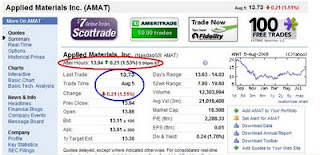
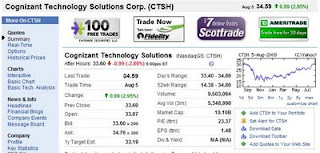 However, during after-hour session we can see that CTSH trades back down by $0.99. It only took 99,202 shares to get the price exactly back to where it started earlier in the day.
 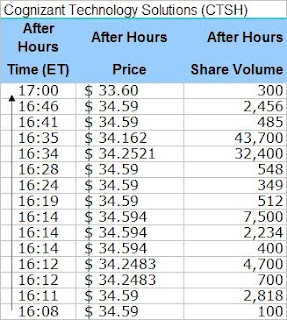 Again, notice that someone with 43,700 shares worth $1,468,966 decided that after-hours was the best time to unload the shares. Not to be outdone, someone else with 32,400 shares valued at $1,109,768 feels like getting rid of their shares.