Author Archives: NLObserver Team

Nasdaq 100 Watch List

Northwest Natural Gas (NWN) at $40.94

As I attempt to gather as much information on Northwest Natural Gas (NWN) before deciding to actually buy NWN, I found one bit of information that was almost astounding. As I have mentioned before, NWN has increased it's dividend every year for 53 years in a row. I have also talked about the fact that NWN will probably do everything in its power to maintain that dividend increasing history. So it is no surprise that the company announced on October 1, 2009 that will be increasing the dividend for the 54th year in a row.

In today's research recommendation of NWN, I will cover the issue of cyclicality, the Coppock Curve, natural gas prices, and Dow's theory as it relates to the stock. I have compiled this information as I consider buying NWN. It is hoped that you thoroughly review NWN from all angles before committing any money to this accomplished Dividend Achiever.

When someone asks me about any cyclical stocks that I might be able to suggest, I often stammer at the thought. In fact, I'm clueless as any true cyclical stocks. However, after a considerable review of NWN, I can prove that it is definitely a true cyclical stock. First, NWN has exhibited a pattern of hitting a relatively low price between the months of January and May since 1970.

The stock hitting a low during the first five months of the year occurred 87% of the time. New lows during the months of February, March and April took place 78% of the time within the period from January to May. The month of February comprised 33% of the new lows between January and May. From the numbers that I ran, February and April are the most optimum month to consider buying this stock.

Next up is the Coppock Curve for NWN. In the chart below, you can seen that the Coppock Curve along with a 14-month trendline. After falling below the zero line, the rise crossing over the trendline indicated a ideal buying point on the first day of November 1994 at an adjusted price of $7.67. Subsequently, the stock reached an adjusted high of $16.74 in December of 1997.
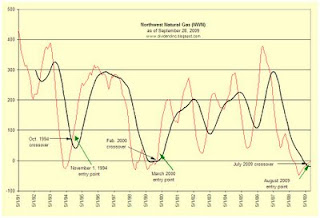
The next point when the Coppock Curve was crossed by the 14-month trendline was in February 2000. If you bought the stock on the first day of March 2000 at the adjusted price of $12.70, you would have seen the shares rise to an adjusted price of $52.19 on September 18, 2008. The rise from March 2000 to September 2008 is in spite of the bear market which began in October 2007. Currently, NWN's Coppock Curve has just crossed above the 14-month trendline. All indications are that this is a buying point based on the Coppock Curve.

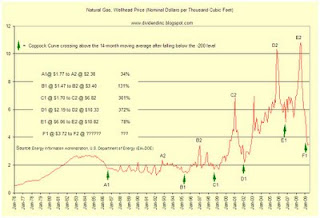
Next up is the natural gas wellhead price from 1977 to the present. In the chart below, I have indicated the points where, based on the Coppock Curve, the price crossed above the 14-month trendline. It appears that the Curve accurately called the bottom in the price, almost to the very lowest point possible. From this indication, it appears that the natural gas wellhead price is about to rise from here.
Finally, we'll look at the prospective upside and downside targets for NWN based on Dow's Theory.

Upside:

  • $42.31
  • $48.01
  • $53.71
Downside:
  • $36.20 (fair value)
  • $30.30
  • $18.50
All of the data points that I have mentioned should be included in your fundamental analysis of this stock. Pay particular attention to the downside targets since this is your best gauge of the risk you might be taking.
It appears that management feels confident about the prospects for the company down the road based on the most recent dividend increase. However, as the number of years of consecutive dividend increases ratchet higher the probability of a dividend cut increases. I am putting this stock on my personal watchlist so that I can buy it at the most optimal price, hopefully lower than the current level. Touc.
related Articles:
Please revisit Dividend Inc. for editing and revisions to this post.

Dividend Achiever Watch List

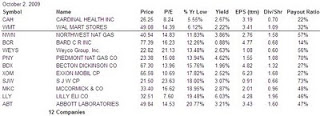
It was another down week for the Dow which gave back 175points (-1.81%) this week. At the end of the week, my watch list has 12 companies compared to 9 from the previous week. Here are the companies on my watch list as of October 2, 2009.
Recent Articles
Stock to Watch: Cardinal Health (CAH)

Research Request: Mylan, Inc. (MYL)

Research Request: Mylan, Inc. (MYL)

A reader request that I do some research on Mylan (MYL) back on 8/7.  On that day, MYL closed at $13.19. Today, it closed at $15.59 which is 18% higher.  Since Mylan used pay dividend but halted distributions in 3Q07 (but kept preferred shares dividend), investor will be investing for capital gain basis. With that, my model is based on earning, cash flow, and book value. My knowledge of pharmaceutical is limited but you don't need to know everything about the business as long as you can place a valuation on a stock. Let's take a look at Mylan.
Mylan engage in the generic pharmaceutical market. They do everything from development, manufacture, marketing, licensing, and distribution of their products. Check out their website for more detail about Mylan.
After obtaining data from Valueline, my model shows that Mylan is approaching fair value of $21.75. My "bargain" price is at $8.25. Another price target is the "buy" price of $16. Given that Mylan is at $15.60, your risk is 47% (8.25/15.60 - 1) and upside of 39% (21.75/15.60 -1). Risk / reward analysis tells me to be a seller not a buyer at this level. Let's dive deeper and see if there are more reasons for me to be a buyer or seller.
A closer look at  the balance sheet revealed a concerning story. Mylan engaged in many acquisitions and I am not the one to tell you if they were in fact good or bad acquisitions. I do not have the ability or capability to estimate what those future cash flow or earning will be. What I do know is that due of those acquisitions, Mylan had to raise  debt and take hit to their cash flow and earning. Not a good combination. Their debt level was $30.6 million in 1999. That figure rose to $51.3 Billion (with a B) in 2009, a 67% increase on a compound annual basis. At the same time their cash flow rose 15%, earning rose 6%, and book value rose 8%.
Currently, Mylan is trading at 17x trailing P/E, 10x F P/E, and 1.7x P/B. It may appeared to be "cheap" but a large debt over hang scares me. Debt due in five years is $145 million. If Mylan doesn't make enough to pay back their debt, they would have to refinance their debt at a time when I expect the interest rate to be at a much higher level. While cutting common stocks dividend, the company kept preferred dividend, issued more stocks, and raised more debt. I can't see why this is good for the common shareholders. As stated above, if price fall to $8.25 then I may consider it.
This is just one man's opinion. To get additional analysis, I recommend you cross check my analysis with Morningstar (report can be obtain freely from your local library), S&P (I get that from TDAmeritrade), or Valueline.

Art

End of September Market Commentary

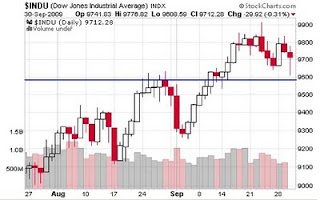
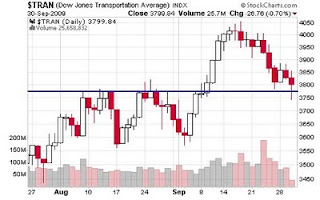
Today's action was a close one for the market. The Transport index, at one point, broke below the previous high from late August. The Industrial Index is still well above the previous high so nothing to worry about there. If the Transports were to closed below the previous high, we would have the first part of the non-confirmation move under the Dow Theory.
Note: If you are not familiar with the Dow Theory, please read a free description from Dow Theory Letter or StockCharts, but I recommend reading Richard Russell's Letter.
Coppock Curve
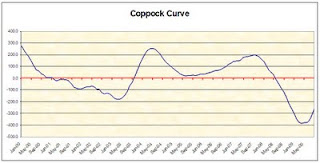
At the end of September, the Coppock Curve or Index remained bullish. People who understand the Coppock Curve may wonder why I still keep track of the curve since the buy signal was given to us in May. My answer is that I don't want to this to be a false buying signal such as the one in 2001. The curve rose by 53.8 points, the highest since the buy signal was triggered.


Summary
We are cautiously bullish on the market. We are looking to purchase Northwest Natural Gas (NWN) and Cardinal Health (CAH). This will depend on what the overall market does when we start October.
Art

Stock to Watch: Cardinal Health (CAH)

Cardinal Health (CAH) is one of the leading wholesale distributors of pharmaceuticals, medical/surgical supplies, and related products to a broad range of health care customers. The company completed a unit spin-off, CareFusion (CFN), on 9/1/09. Any investors with shares of CAH at the end of August received 0.5 shares of CFN. As a result, CAH price was adjusted down to $25.11 on 9/1/09 from $34.58 on the previous day. Two weeks later, Goldman Sachs upgraded CAH to a "buy" rating from "neutral" with a target price of $31. The stock closed at $27.29 on that day.
I pitched Cardinal Health to my readers several times prior to this writing. The first was a simple technical look at this stock on 6/11, 7/11, and 8/20. What I saw then was a stock with great fundamental developing a strong technical pattern called "triple bottom". Today I pitch you Cardinal Health once again with the different view. If you purchased this stock without selling them as I did, you would have done very well. As an added bonus, you would've gained some shares of CareFusion which rose 10.5% since it began trading. So let's dig into the number.
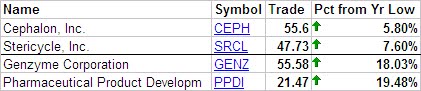
Cardinal Health came back on my radar on 9/18 watch list as because it appeared to be within 20% from the yearly low. A closer look at CAH shows a revealing valuation proposition. CAH is currently trading at 1.11x book value, 12x Forward P/E, 6x Cash, and 2.6% dividend yield. The undervaluation appeared to be because of the split but CFN is also trading at a discount value when you see it is trading at 0.88x book value. CAH is estimated to grow 8.4% (based on low estimate) and with yield of 2.6% that is a good 11% return. The great thing is the top line revenue is expected to stay relatively flat which mean they will be more efficient.
Using dividend as an insurance against price decline, investors will be rewarded with $0.70 per shares or 2.6% yearly. With low earning estimate of $1.89 for 2010, the payout ratio is 37%. Taking the previous year dividend increase rate, I project that CAH will raise payout to $0.74 for 2011. Low end estimate is projected at $2.05 which brings payout ratio down to 36%.
My model shows CAH should be at $40 range but this is based on previous year results including figures from CFN.  Surely I could be wrong and price fall, but as a value investor, I will not get many chances to buy a medical company at or near its book value. Given that all CAH competitors (ABC, MCK, and OMI) are trading at more than 2.3x book value, CAH is deeply discounted at 1.1. My estimate shows any 1.95x book to be low end of CAH and that would bring share price to $47. A 74% gain! That is just crazy. I will probably re-buy this stock in the days ahead.
Art

Disclosure: All figures are from Yahoo! Finance as of 9/29/09

Dividend Achiever Watch List

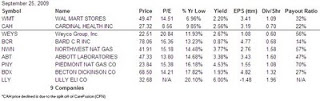
The Dow gave back 153 points (-1.56%) this week. At the end of the week, my watch list has 9 companies compared to 8 from the previous week. Here are the companies on my watch list as of September 25, 2009.
Recent Articles

Stock Checkup: Nacco Industries Inc. (NC)

Stock to Watch: Abbott Laboratories (ABT)

Abbott Laboratories (ABT) is a worldwide health care products provider. This $72.5 billion company, based on market capitalization, employs 69,000 employees worldwide. One of their well known products include FreeStyle, which is a blood glucose monitoring system. There are more products that ABT sell that I do not know but I am less concern about that. What struck me most about ABT is the valuation and its inability to move up during the most recent bull market run. This may be because upside momentum traders are trading name like Research In Motion (RIMM), Apple (AAPL), or Freeport McMoran (FCX). I'm just the opposite of a upside momentum trader, the less upside momentum, the easier it is for me to consider buying.
Fundamentals 

Currently, ABT is trading around $47, has a price-to-earnings (p/e) ratio of 14, sells at 10x cash flow, and has a dividend yield of 3.4%. ABT is less than 15% above its one year low. My model shows ABT is undervalued with a dividend yield of 3% or 13 p/e, 10x Cash flow or below $49. I weight more valuation on dividend yield and thus I believe the shares are relatively undervalued at this price. One of the most impressive things about this company is their ability to raise the dividend by 11% in April. The dividend payout went from $1.44 to $1.60.
Technicals 

The technicals are another aspect I pay strong attention to prior to buying any stock. I wrote about ABT's technical back on 6/8/09 and showed a possible reversal or head-and-shoulderpattern.

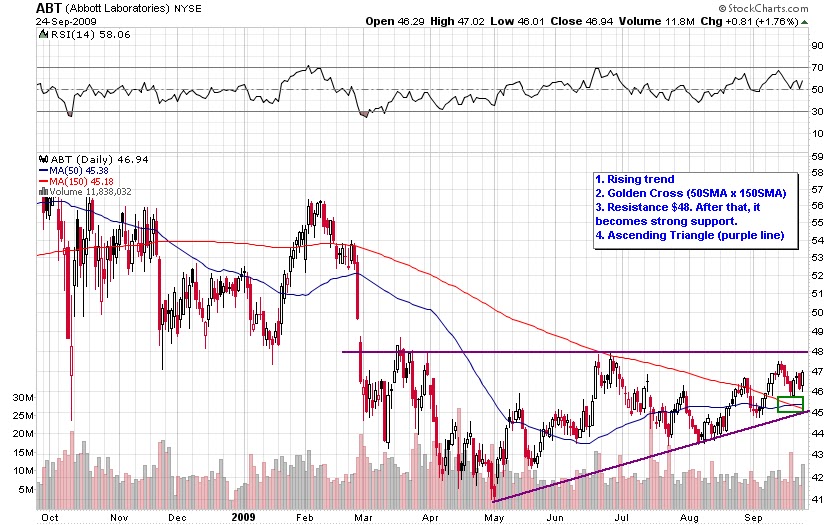
To follow up with what I am seeing today, I have drawn the chart below. Two strong pattern I see are the golden cross which is when short-term moving average crosses mid-term moving average and an ascending triangle.
Finally, in the chart below we have the altimeter for ABT. The altimeter really puts thing in perspective.

As we can see, ABT has a low range at 103 and a high range at 171. In two prior instances, I have circled the areas where ABT went up and then fell back down before rising to a new overvalued level. Currently, ABT is either in the middle of another temporary rise before falling a little bit further or we could be in a full scale move straight to overvaluation. In either case, if you bought now, according to the altimeter, you wouldn't be overpaying for this stock.

I believe Abbott is at the right valuation and urge you to start looking at it. Do your research before committing your capital.

Stock Checkup: Nacco Industries Inc. (NC)

I wrote about Nacco Industries Inc. (NC) back on February 6, 2009 and March 13, 2009 when the stock was trading between the $20 and $40 price range. Please note that during the time of the write up, the market was going through a major breakdown. March 9, 2009 marked the low in the stock market.
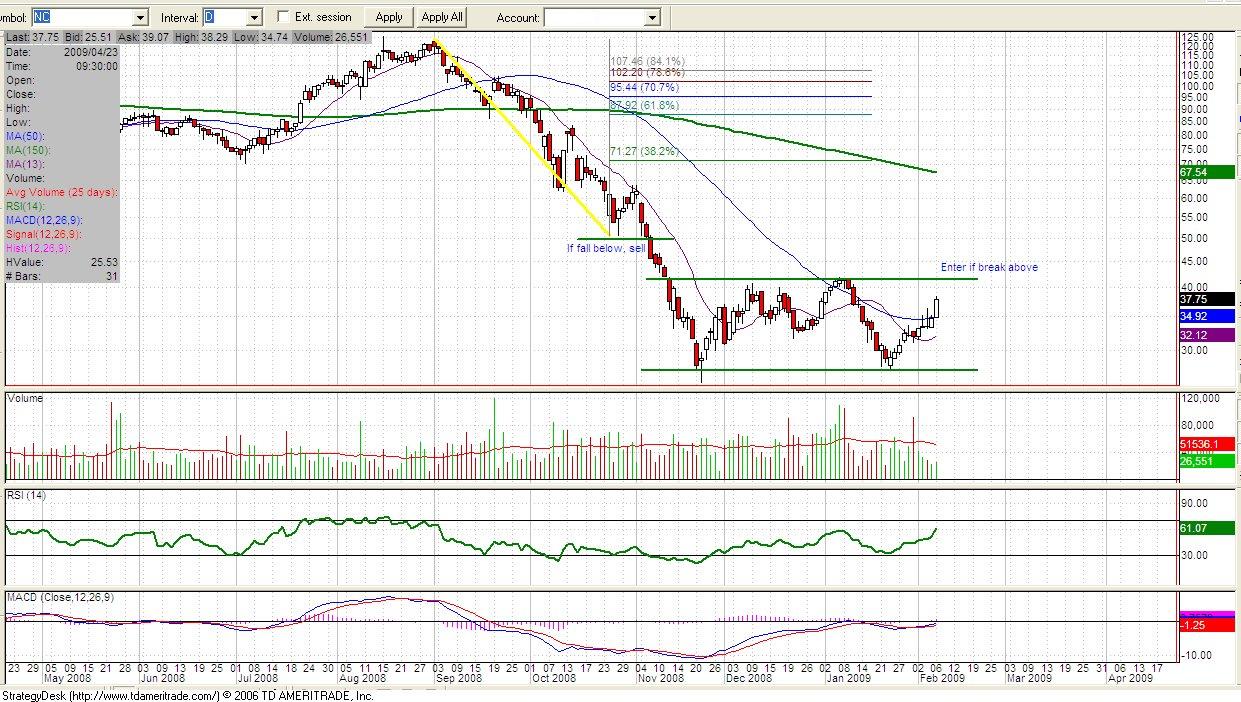
My original article on NC was about its valuation. The company was trading at a ridiculously low valuation based on the book value (assets less liabilities) of $50. The stock was trading at $37.75 or 25% below book value. The dividend yield was 6%. At the time, my concern was the possibility of the dividend being cut and the significant amount of debt. My thesis was also on the prospects for inflation, which didn't really materialize.
On March 13, the company reported a loss of $51.69 per share. The headline might have scared some people but a closer look showed that things weren't so bad after all. Nacco was forced to take an impairment charge because of the extreme amount of the decline in the stock price. Here is a statement from the 4Q08 conference call.

Because the company’s stock price at year-end was significantly below the company’s book value of tangible assets and its book value of equity, accounting rules effectively required that the company take a non-cash write-off of goodwill and certain other intangible assets totaling $436 million or 431.6 million net of taxes of $4.1 million.
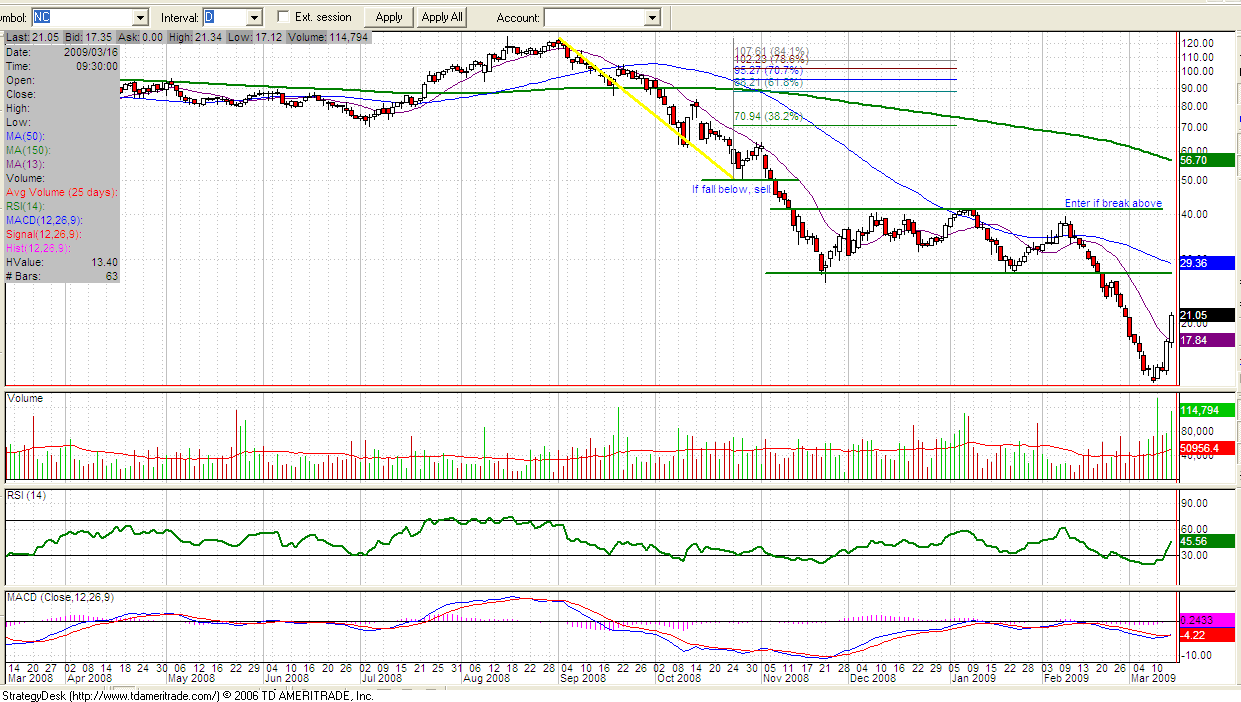
At one point, Nacco was trading a little more than a quarter of their book value ($14 stock price v. $50 book value.) For this reason, accounting rules forced Nacco to write down their asset value. Operations were fine and this change in the book value was just an accounting slight of hand.
So where are we?
Nacco is currently trading around $60 with a book value of $44.85 (1.38x book). The dividend for the last four quarters remained unchanged ($0.5175) and is currently yielding 3.4%. With negative earnings, they are paying their dividend ($4.3 million/qtr) through existing cash of $178.80 million. With large amount of debt and low earnings, we will have to see how Nacco navigate the coming hard times. I expect the dividend to remain unchanged or for the company to raise it by a small amount.
If you purchased this stock based on my writing, I would recommend taking your profits. The risk of the dividends being cut remains a factor at this time. On the upside, if you choose to hold this stock, a possibility of write-up does exist. Those non-cash write-down in fourth quarter could be a catalyst for a NC to pop back to $80 or $100. You have to decide for yourself if you are brave enough to hold on after such nice gains.
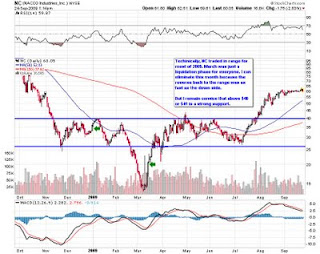
The charts below show where NC was and where it is.
I all my writing, I urged readers to consider the technical pattern. In this case, I recommended buying if, and when, NC broke above $41. I didn't act on my own advice because my attention was diverted to other companies. We will have to see where NC goes from here. For now, let's take the easy money.

Art

Dow Theory

November 4, 2008 is proving to be a significant challenge for the stock market. I have mentioned many times the considerable amount of resistance that November 4th would have on the The Dow Industrials and Dow Transports. However, if viewed from the perspective of a composite index, an index that includes all the stocks in the Dow Industrials, Dow Transports and Dow Utility Indexes, we get a picture that is undeniably negative in the short term.

In the chart below, we see a one year diagram of the Dow Jones Composite index of 65 companies. The composite index briefly exceeded the November 4, 2008 high of 3407.33 by only 1.82 points on September 16, 2009. It is important to know that the high for the day of September 16, 2009 did not exceed the high for the day of November 4, 2008. The fact that the market cannot go above November 4, 2008 so far has much broader implications than just in the financial arena.
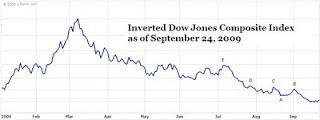
Since the September 16th peak the Dow Jones Composite Index has traced out an interesting pattern lower. This same pattern could not be seen if you looked at any one of the individual indexes alone. In the chart below, we can see where the next destination might be for the markets on the downside.

The following are the prospective downside targets for the Dow Jones Composite Index as represented in the inverted chart above:

  • 3293.86-A
  • 3185.02-B
  • 3151.72-C
  • 3125.28-D
  • 2812.05-E

Why have I inverted the chart of the index? Because there is uniform agreement among all great Dow Theorists that calling a peak is the most challenging thing to do. It is the nature of humans to be positive, otherwise most progress isn't possible. With the chart showing a bottom instead of a peak we can feel comfortable seeing the prospects for the future. In terms of Dow Theory, the inverted chart allows us to see a bear market from the same context that we can see a potential bull market.

Now, to play further mind games on you, I recommend that you look at the most recent trend of the Composite Index. After posting above the 3407.33 on September 16th at 3409.15, the market has exhibited two lower peaks on the September 18th and September 22nd. This indicates that a market breakdown to the 3293.86 level (point A) is a probability.
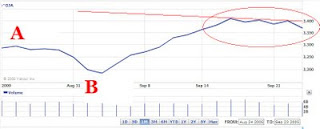
The declines that I have mentioned are in the context of a cyclical bull market within a larger secular bear market. Any of the declines that I have pointed out are all acceptable and constructive for a bull market. Soon after the declines are out of the way we can expect that the market will retest the old high before going higher (both Transports and Industrials) or confirming the previous declining trend.

If you have questions or thoughts then please email me at the following link.

Please revisit Dividend Inc. for editing and revisions to this post.

Northwest Natural Gas (NWN) Altimeter

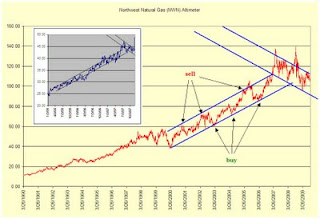
Today's altimeter is on Northwest Natural Gas (NWN) and there is a lot to appreciate when we exam the pattern that has been established so far. NWN has increased its dividend for 53 years in a row. With such a history of dividend increases, I think NWN will do everything it can to avoid cutting or leaving the dividend the same. At the price of $42.29, NWN is within 16% of the 52-week low.

NWN has a challenging altimeter to decipher until you take a closer look. The pattern that has been established since 2000 until the present is an exact replication of the move from the period 1995 to 1997 (shown in the inset.) After the 1995 to 1997 moves we can see that the stock traded in a wide range until the ultimate low in 2000. From the 2000 low the stock traded in a narrow ascending range, offering several clear opportunities to buy and sell the stock.

Although I have taken artistic license on the interpretation of this altimeter, I do believe that the possibility may exist that NWN will not go materially below the March 2009 low. With the recent decline in natural gas prices, NWN offers a reasonable investment opportunity with a long history of dividend increases and a fair payout ratio. NWN is definitely worth investigating at the current levels. Let us hope that the stock price declines while you're doing the research on this company. Touc.

Please revisit Dividend Inc. for editing and revisions to this post.

Weyco (WEYS) Altimeter

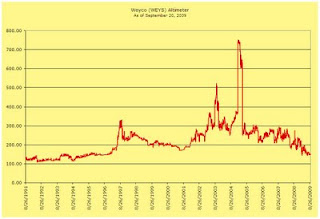
Below is a chart of the Weyco (WEYS) altimeter. As we can see, WEYS trades in a range between 275 on the high end and just above 150 on the low end of the range. Given WEYS balance sheet and the products that it produces (Florsheim shoes) this company is worth investigating.

One consideration is the fact that WEYS has tremendously low trading volume. Additionally, this stock has only increased its dividend 10 years in a row which means that we can't be sure that the company can weather an true economic cycle. However, as mentioned before, this company has no debt and my be worth a second look. Touc.

Bank of Hawaii (BOH) Altimeter

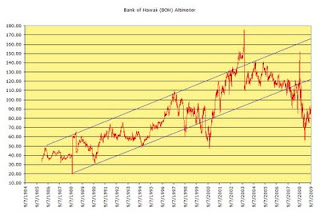
The chart below is a representation of the Bank of Hawaii (BOH) altimeter. BOH has increased its dividend every year for 31 years in a row. As we can see, BOH's altimeter has been in a rising trend for quite some time.That trend was recently broken during the recent banking crisis.
The channel that BOH has managed to fluctuate within suggests that the stock is overvalued at the high end and undervalued at the low end. The period of extreme overvaluation is reflected in 2003 and started to move in a declining trend to undervaluation when BOH increased the dividend from $0.19 to $0.30.

There are two periods of extreme undervaluation in the altimeter. The first level of extreme undervaluation hit bottom in October 2000. The second period was most recently in March of this year. If the stock were to go back to the "historical" low end of the range, BOH would be priced at $54 a share. Although we do not have an extensive history on the periods of extreme undervaluation, it could be inferred that, based on the altimeter, an investment in BOH while not risk free, could be considered low risk.

At least one hitch to my assessment on BOH, in terms of the altimeter, is the fact that the low in March 2009, around the 60 level, could be part of a normal low range that is being established for the stock. If the 60 level is the low end of a new long-term range, my best guess is that the 110 level is the upper end of the range. At the 110 level, BOH stock price would be $49.50.

Only time will tell whether the escalating failure of banks is going to spread even further. However, BOH has managed to fare better than most banks of a similar size. As a further indication of BOH's strength, the dividend increase in November 2008 suggests that management believes the company will survive through the present banking liquidation cycle. Regardless of BOH's strength, I wouldn't be surprised if BOH does not increase the dividend in November. However, if a cut in the dividend takes place then I would be more cautious on the company and the stock. Touc.

related articles:


Please revisit Dividend Inc. for editing and revisions to this post.

Wal-Mart (WMT) Altimeter

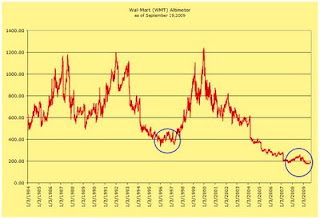
Below is a chart of Wal-Mart's altimeter. As mentioned before, the purpose of the altimeter, created by Edson Gould, is to determine the relative value of a company based on the quarterly dividend payment and the daily price of the stock or index.

Based on the above chart, we can see that WMT is traditionally overvalued between 1100 and 1200 level. Additionally, when WMT falls to the 550 level the company is considered undervalued. What should be noticed is the double bottom that took place in the 1995 to 1997 period. After that time, WMT took off like a rocket.

In the most recent period from 2007 to 2009, we can see that WMT is forming a similar double bottom. From this indication, we should look out for the stock to rise significantly over the next four years. The expected rise in WMT should be in spite of all the economic forecasts of a continued decline in the economy.

The chart below is my own interpretation of WMT if the company pursued a less aggressive policy of increasing the dividend at such a high rate.
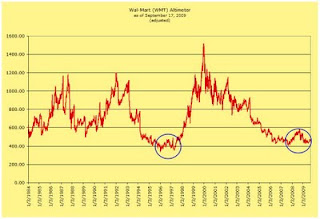
In the first chart, you can see that after 2004 WMT fell to an extreme level of undervaluation. The reason this occur is because WMT continued in increase the dividend at a high rate even though the company didn't have the earnings to support such increases. With diminished earnings, WMT issued more shares to raise capital to fund the dividend payments at the expense of per share earnings.

My model continues to increase the dividend every year but at a rate of 50% less than what WMT did from the period of 2004 to the present. This lowers the number of shares that need to be issued. In fact, my model would not have required the issuance of new shares to cover the dividend.

At the moment, we could consider WMT undervalued. However, keep in mind the fact that the continued issuance of shares in order to keep the dividend history intact undermines future earnings growth.

related article:

Please revisit Dividend Inc. for editing and revisions to this post.

Altria (MO) Altimeter

The following are Altria (MO) charts using Edson Gould's Altimeter indicator for determining if the stock is undervalued or overvalued.

In the first chart we see that MO is considered overvalued when the indicator is at 16 and above and is undervalued when the indicator is at 7 or below.
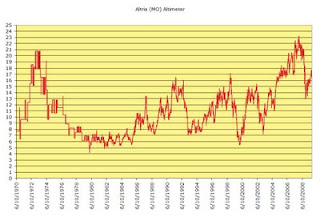
The chart below is also the altimeter for MO however, it reflects the valuation if unadjusted for the spin-off of Kraft (KFT) and Philip Morris International (PM).
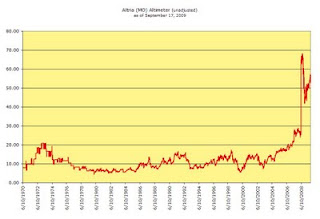
Hopefully these charts give a better understanding of when might be a good time to invest in MO. As you can tell from the first chart, MO is presently considered overvalued. Touc.