Today the Dow Jones Transportation Averaged (DJT) closed at a new all-time high.
- Japan
- Market Indicator
- Price Momentum Indicators
- Richard Russell
- Silver
- Speed Resistance Lines
- U.S. Dividend Watch List

Today the Dow Jones Transportation Averaged (DJT) closed at a new all-time high.
Posted in Charles H. Dow, Dow Theory, Dow Theory Bull Market indication, S.A Nelson, William Peter Hamilton
Tagged members
Carbo Ceramics (CRR) was one of the companies that appeared at the top of our dividend watch list for many weeks beginning in February 2012. The watch list served as a beginning point for our research and we took a position in August (found here) at $65.02 (green arrow on chart below). Within three months, we saw shares of CRR rally to $74, a +13.8% gain. As such, we ‘hedged’ our position by selling the principal (found here) and let the profit run (red arrow on chart below).
Recent activity in Carbo Ceramics price suggests that, on a technical basis, the decline is over. Though a rally to its intraday peak of $180 is not expected, we believed there is a good opportunity for those interested in a short to medium-term speculative position in the stock.
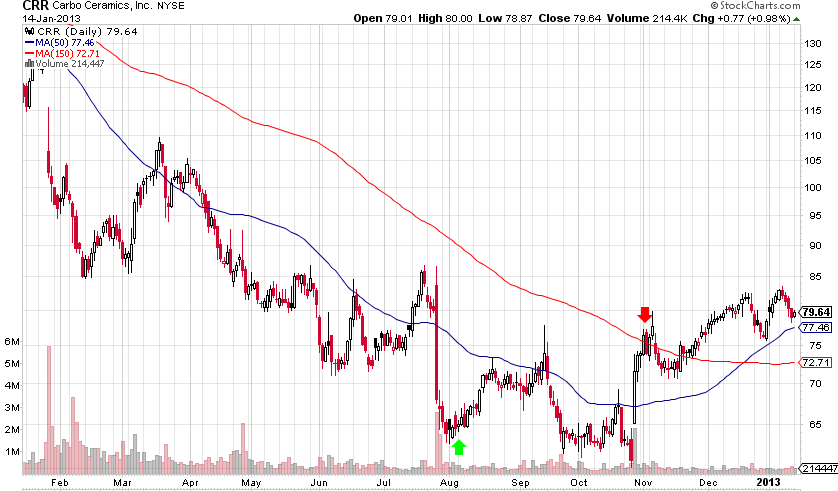
In our view, the biggest bull case, on a technical basis, is that the 50-day moving average has crossed above the 150-day moving average creating what some call a "golden cross." We rely on the 150-day versus the more popular 200-day moving average for the fact that it is the road less traveled and provides an indication ahead of the crowd.
Currently, shares of Carbo Ceramics are trading just above the 50-day moving average, making this an ideal short-term transaction. For those who wish to trade this generally significant technical pattern, we’d consider selling if shares close below the 150-day moving average or if the stock gains +10% or more.
From a fundamental standpoint, Carbo Ceramics (CRR) provides long-term holders of the stock with the following attributes:
What Is the Downside Risk If I Want to Hold CRR for the Long-Term?
Dow Theory has the following downside targets for Carbo Ceramics:
Based on the work of Edson Gould, Carbo Ceramics has the following Altimeter:
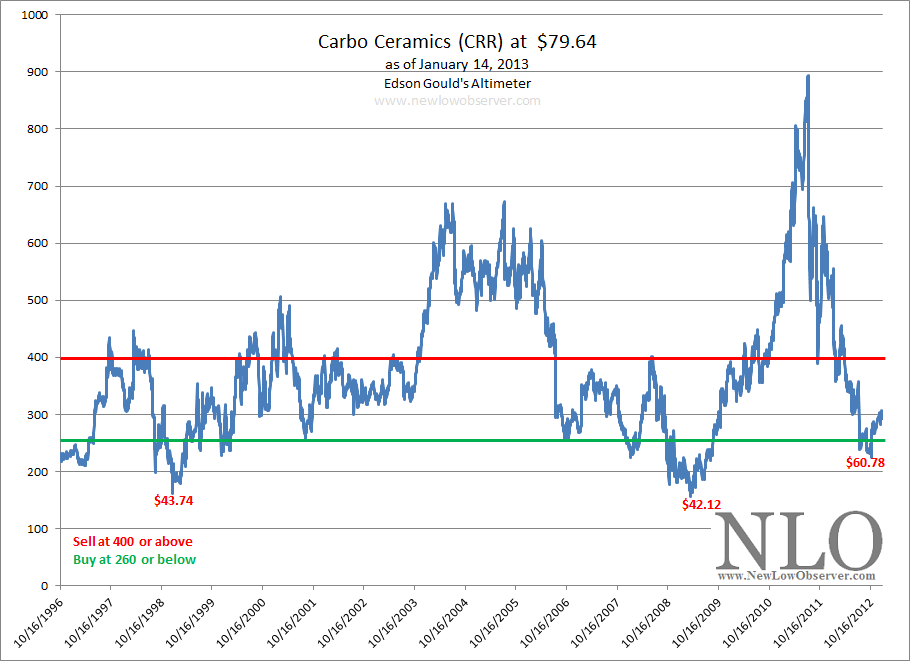
Carbo Ceramics would have to fall to $70.20 in order to be considered a buy using the Altimeter above. However, as has been the case in the past, seldom does the Altimeter decline to the buy level and then immediately reverse to the upside. therefore we’d expect a push below the $70.20 level for good measure.
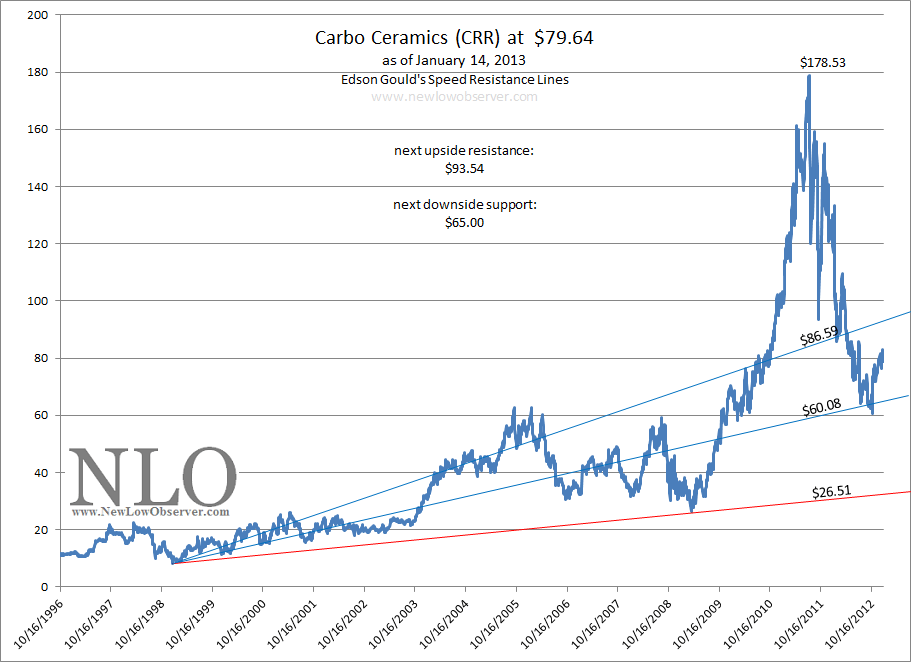
Edson Gould’s Speed Resistance Lines have $65 as the downside support level.
The most conservative of the three downside targets mentioned above is the Dow Theory level of $61. This seems be the most appropriate level to consider a first, or second, purchase if the desire is to hold Carbo Ceramics for the long-term.
Comments Off on Technical Review: Carbo Ceramics (CRR)
Posted in Altimeter, CRR, Dow Theory, downside, Edson Gould, SRL
Below are the 27 companies on our U.S. Dividend Watch List that are within 11% of their respective 52-week lows. Stocks that appear on our watch lists are not recommendations to buy. Instead, they are the starting point for doing your research and determining the best company to buy. Ideally, a stock that is purchased from this list is done after a considerable decline in the price and rigorous due diligence.
Comments Off on U.S. Dividend Watch List: January 11, 2013
Posted in NLO Dividend Watch List
Below are the Nasdaq 100 companies that are within 10% of their respective 52-week lows. Stocks that appear on our watch lists are not recommendations to buy. Instead, they are the starting point for doing your research and determining the best company to buy. Ideally, a stock that is purchased from this list is done after a considerable decline in the price and rigorous due diligence.
Comments Off on Nasdaq 100 Watch List: January 11, 2013
Posted in BBBY, DLTR, MSFT, Nasdaq 100 Watch List, TEVA, Teva Pharmaceutical, VOD
This is a follow-up to our May 2, 2012 piece on downside and upside targets for Green Mountain Coffee Roasters (GMCR).
At the time, GMCR had traded as low as $28.50 (-38.9%) in after-hours trading. We gave a downside target of $22.53 due to the fact that the stock had declined below our projected support level of $37.21, as indicated on October 25, 2011. Since our May 2, 2012 article, GMCR has declined as low as $17.11, see chart below.
Netflix (NFLX) is the first stock under review. Our prior work on this stock can be found here (September 22, 2011).
We’ve reached the beginning of 2013 and here are the 22 companies on our U.S. Dividend Watch List that are within 11% of their respective 52-week lows. Stocks that appear on our watch lists are not recommendations to buy. Instead, they are the starting point for doing your research and determining the best company to buy. Ideally, a stock that is purchased from this list is done after a considerable decline in the price and rigorous due diligence.
In our last posting of Dow Theory we mentioned the need for caution on premature calls of a new bull market. We pointed out that with the Dow Transports and Dow Industrials so close to their respective all-time highs, investors should wait for confirmation of both indexes before getting too excited. Now we’d like to introduce another observation of Charles H. Dow’s with regards to stock market cycles which might be the perfect antidote to further movement higher.
In June 2010, we published an article titled “The 4 to 4 1/2 Year Market Cycle” (found here). In that article, we quoted Dow as saying the following:
Posted in 4 1/2 year, 4 year, Charles H. Dow, cycle analysis, Dow Theory
Tagged members
We may be on the cusp of a Dow Theory cyclical and secular bull market signal. However, where the rubber hits the road when it comes to Dow Theory is discretion and confirmation. Discretion is needed for the purpose of avoiding frequent and erroneous calls. Confirmation is needed to ensure the quality of the analysis. We’re hoping that the chart below clarifies what investors need to know about the recent stock market activity.
Posted in Charles Dow, Charles H. Dow, Dow Theory, Dow Theory Confirmation, Richard Russell, Schannep
Tagged members
On September 19, 2012 (found here), we recommended that investors consider selling Abbott Labs (ABT), at least the principal portion. At the time, ABT was trading at a split-adjusted $33. by October 16, 2012, shortly after our sell recommendation, Abbott rose as high as $34.67 or +5.06%.