Below is a chart of the 10-Year Treasury from 1963 to 2021 reflecting the year-over-year (YoY) percentage change.

-
Topics
Archives
-
-
Recent Posts
-
-
-
-

Below is a chart of the 10-Year Treasury from 1963 to 2021 reflecting the year-over-year (YoY) percentage change.
Review
In our April 27, 2018 posting, we said:
“Bitcoin could achieve a $37,000-$52,000 level before a meaningful downside is experienced.”
As of January 7, 2021, Bitcoin has achieved a price of $39,000. It is at times like these that Bitcoin speculators should consider preserving as least some of their gains. Below are the upside and downside targets. Continue reading
Below is the Dogs of the TSX 60 for 2021 with the breakdown of the other categories that we track. Continue reading
Posted in Dogs of the TSX, High P/B
Below is a chart of the performance of the Dogs of the TSX 60 from December 31, 2019 to December 31, 2020.

The Toronto Stock Exchange increased approximately +2.17%. The Low P/E category lost the most while the High P/E category gained the most. Low Yield did not outperform the High Yield group.
In our January 1, 2020 posting, we said the following:
“…preliminary data suggest that the low p/b and high p/e might give your investments an added boost.”
Clearly we were wrong about the Low P/B category which suggests to us that the call on the High P/E category was luck or a fluke and not due to our correct analysis of the data.
Upon further review, the category that seems to show the most consistency is the High P/B. Although not posting the best gains for 2020, the returns over the years have suggested that High P/B can retain their edge. The stocks in the High P/B category are as follows:

The Toronto Stock Exchange is a completely different realm from the shares that are traded in the U.S. However, as we go along, we will attempt to refine the data collection and analysis to better reflect the realities of the Canadian market.
See Also:
Posted in Dogs of the TSX
Below is the Dogs of the Dow for 2021 with the breakdown of the other categories that we track.
2020 Penultimate Profit Prospect and our Alternative
On January 12, 2020, we published the Penultimate Profit Prospect (PPP) based on the work of Micheal O’Higgins book Beating The Dow. For 2020, Pfizer (PFE) was the stock that was supposed to fit the guidelines of the stock that should have been selected. Additionally, we provided the alternative to the PPP which was Nike Inc. (NKE).
For the year of 2020, we have charted the price change in the Dow Jones Industrial Average, Pfizer, and Nike.

As it can be seen, Nike Inc. ended the year with a gain of over +39% while Pfizer, working on the COVID vaccine but kicked out of the Dow Jones Industrial Average, falling near -1% for the entire year.
2021 Penultimate Profit Prospect and our Alternative Continue reading
Below is a chart of the performance of the Dogs of the Dow from December 31, 2019 to December 31, 2020.
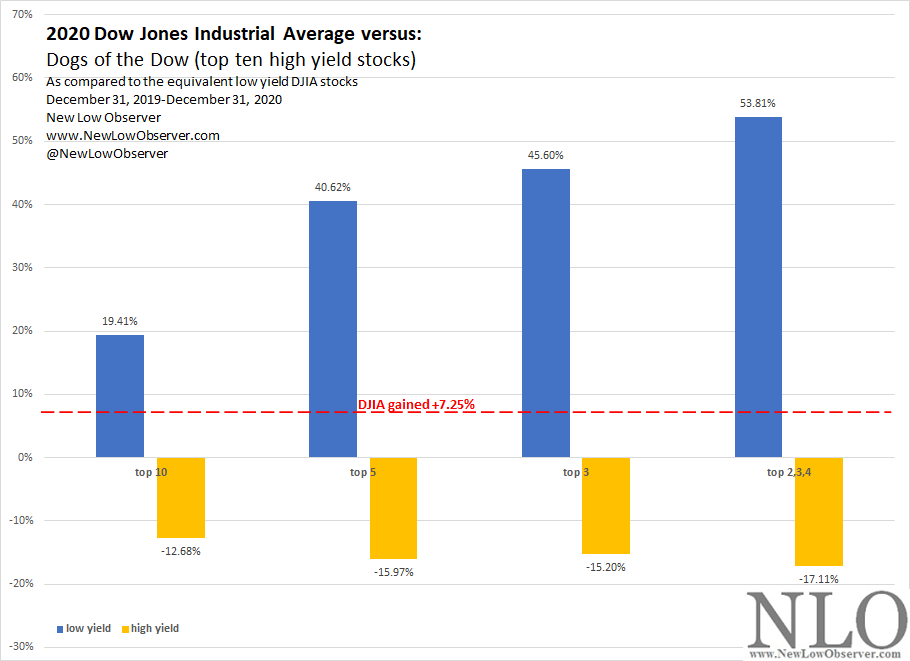
As with 2019, the Dogs of the Dow (ten high yield stocks) failed to exceed the performance of the Dow Jones Industrial Average in 2020. In addition, the Dogs of the Dow (ten high yield stocks) severely underperformed the low yield stocks with a spread of 32 points.
Our commentary from the January 2020 Dogs of the Dow watch list had the following to say:
“…high price to book, high price to earnings, and low dividend yield are the categories that we like the most for outperformance...”
Overall, the performance of the respective categories achieved the stated objective. High price to earnings faltered with only the (2nd, 3rd, & 4th) grouping managing to match the DJIA.

High yield stocks not only underperformed they also led the charge lower. If the DJIA index managers are done with changes to the index, we should see the high yield stocks match or exceed the index as years of exceptional gain must come to an end and the stocks that have already been punished should outperform solely by virtue of not declining as much.
see also:
Posted in Dogs of the Dow, Low Yield
We executed the following transaction(s):
The market ended the year up more than 15%. Last month we published the first list of individual companies using Coppock indicator and the average gain was 5.0%, exceeding the S&P 500 gain of 2.3%.
The table below contains 9 companies that completed the buying indication based on the Coppock Curve at the end of December 2020.
The statistics below are based on a holding period of 1 year. One measure to pay close attention to is the success rate which is the number of times this indicator yielded a positive return within 1 year. The loss columns are there to remind us that investing is not risk free. Continue reading
By the logic of many, the stock market is being propped by the Federal Reserve. How is the Fed propping the stock market? Pushing interest rates down and keeping them down and possibly considering going negative on rates.
As we’ve consistently maintained, the Fed doesn’t matter. The following is an example of when it appeared as though the Fed was doing everything in their power to undermine the rise in the stock market.

The standard arguments to the increase of the Dow Jones Industrial Average include the New Deal programs implemented in 1933 and/or WWII which began in 1939. These claims sound good but don’t quite explain the reversal of the Dow Jones Industrial Average in July 1932.
If the claim is that the Fed is propping the stock market now then it is because an examination of the extensive history of rate increases from 1942 to 1968 hasn’t been reviewed.
Finally, if the claim is that the Fed is bound and determined to use every tool in the playbook to increase the stock market, then by the record of the period from 1934 to 1971, we should see the discount rate increase ten times and a constant fiddling with the margin rate.
It is possible that the low rates and unlimited “stimulus” measure is actually capping the rise of the stock market.
On January 12, 2020, we said the following:
“…we’ve elected to choose the second lowest yielding stock (Nike), regardless of price, to see if it would perform any better than O’Higgins Penultimate Profit Prospect stock.”
For the year of 2020, the Penultimate Profit Prospect stock was Pfizer (PFE) as outlined in Michael O’Higgins book Beating the Dow.
Below is the performance of Nike (NKE) and Pfizer (PFE).

In our last posting on January 16, 2020, we said the following:
“Worth noting is the fact that in periods when the year-over-year (YoY) data on the stock market went negative, as last shown in Q1 2019, the following recovery exceeded 20%, at minimum. Currently, as reported by the Federal Reserve Bank of St. Louis, we’ve seen an increase of approximately +12% from the Q1 2019 y-o-y low.”
At this time, the Wilshire 5000 sits at a +17% increase above the same quarter last year (October 2019). Meanwhile, the GDP data says there is a long way to go before achieving the descending trendline of 2.11% (YoY) from 1975.
Exceeding the 2.11% level in GDP will likely warrant the NBER declaring the recession as ended. However, we will wait to see as the pandemic seems to be resisting even the best of intentions.

Posted in GDP, Wilshire 5000
On June 8, 2020, the National Bureau of Economic Research (NBER) officially declared the U.S. economy in recession. This follows the prior call of a recovery in the U.S. economy in June 2009. What does the New York Times Recession/Depression Index look like as of December 22, 2020?

We have put blue arrows to show the points of interest to us. We believe that we’re in the early stages of the recession which should see an intermediate drop in the indicator before another spike to a new high level. That spike should be at or above the 300 level and the peak would mark the end of the recession (+/- month).
See Also:
Posted in NYT Recession/Depression Index
Below is a list of money standards, starting in 1870. Periods prior to 1870 will be added over time so please check back for updates.

The goal of this list is to update the areas missing with data that informs on why the standard ended. Any contributions to this topic are appreciated, especially if they accompanied with full citations from the sources.