
In theory, MarketAxess (MKTX) is nearly undervalued based on Edson Gould’s Altimeter. However, 2018 and 2020 have managed to show us lower levels.

In theory, MarketAxess (MKTX) is nearly undervalued based on Edson Gould’s Altimeter. However, 2018 and 2020 have managed to show us lower levels.
Posted in Uncategorized
Below are the valuation targets for NewMarket Corp. (NEU) for the next 10 years. Continue reading
The week closed with major indexes approaching record level. S&P 500 ended the week at record high while the Dow and Nasdaq are less than 1% away. The number of companies on our watch list remain stable at 34, 9 of which are Dividend Aristocrat and 22 are Dividend Achiever. Continue reading
Below are the projections for Tata Motors based on the technical price change on a Year-over-Year (YoY) basis.
Year-over-Year Review
In the latest run up for Tata Motors, from the March 2020 low, the price of the shares have increased as much as +368% before peaking on a YoY basis. This does not mean that the shares have run out of momentum to the upside. Instead, it only means that the pace is not going to be as quick in the last year.
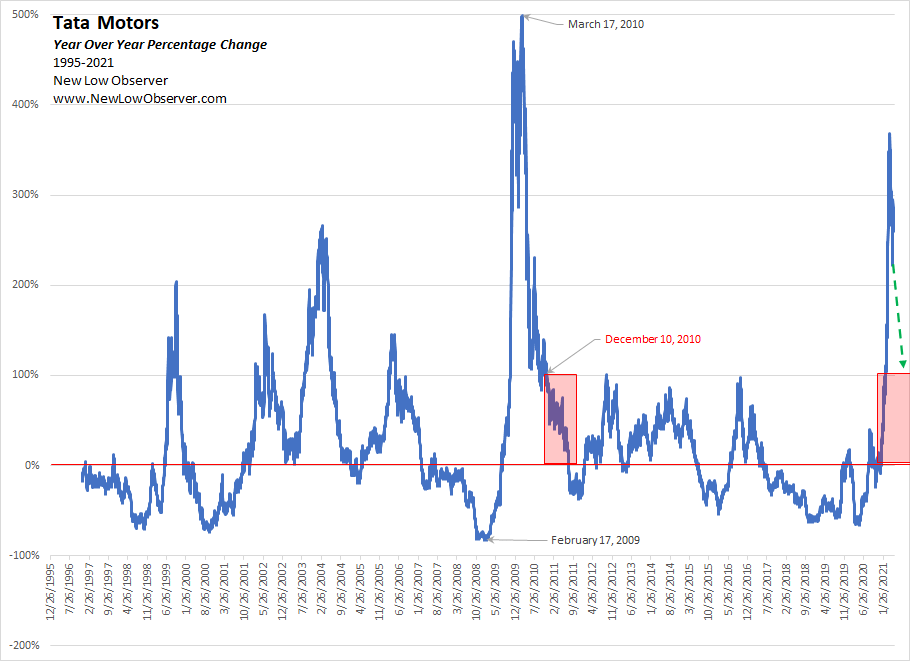
In the last comparable YoY period, from the February 17, 2009 low to the March 17, 2010 peak, Tata Motors increased approximately +499%. After March 17, 2010, Tata Motors rate of increase declined. This means that the share price continued to move higher just not at the same parabolic rate (green dashed line) as seen in the February 2009 to March 2010 period.
Ultimately, as the share price got to the peak, around December 10, 2010, the average rate of increase, although positive, was being brought lower and finally to a negative YoY level (red box). This resulted in a decline of nearly -50% in Tata Motors from December 2010 to August 2011.
If the current run is comparable to the 2009-2010 run, then we could see a new high at approximately 511-600. A decline in the YoY rate below +100% would mean that the shares have peaked and are in for a -30% to -50% decline from the new established peak in the stock price.
Posted in Tata Motors, YoY
Major indexes rallied to end to week a little closer to their all-time high. Both the Dow Industrial and S&P 500 are a fraction of percentage away from reclaiming the peak. However, we are seeing concerning sign from our NLO Market Indicator. We explore the current environment and revisit the financial crisis and dot-com bubble to see the similarities. Continue reading
The S&P 500 and Dow Jones Industrial is attempting to test the new high at the end of the week. Despite that, more companies are appearing on our watch list this week. Continue reading
Posted in Dividend Achiever Watch List, Dividend Achievers, Dividend Watch List
Tagged members
Review
On December 23, 2018 when the Dow Jones Transportation Average (DJTA) was at 8,874.79, based on the work of Edson Gould, we said the following in our closing paragraph:
“We have a range from as low as 6,465.65 to as high as 19,992.65 in period from 2019 to 2023. The Dow Jones Transportation Average is currently undervalued. It is best to expect that it will decline to the extreme level of 6,465.65.”
Since late 2018, the DJTA has had the following price activity:

On March 18, 2020, the DJTA declined as low as 6,481.20, falling short of our 2018 estimated low by 0.24%.
Because the DJTA is slightly above our fair value estimate for 2021 (made in 2018), we expect that even if the Index does not achieve the overvalued level in the current year, the historical precedent is for it to be able to achieve the upper range (overvalued level) that we’ve set for it between now and 2023.
Below are the downside targets based on the work of Edson Gould.

The targets, as noted in the chart above are:
The $821.80 target is generally assured, from all parabolic increases of this nature. There exists the potential to decline as low as $410.90. However, we reserve this target as a backup to achieving the $562.00 price.
Posted in Edson Gould, lumber, Speed Resistance Lines, SRL
It was a volatile week for the market. Despite 3 major indexes (S&P 500, DJI, JIT) reaching all-time high and confirming Dow Theory bull market. There are some sign to keep a look out for. Below is the market indicator at the end of last week. Continue reading
Posted in Market Ratio, NLO Market Indicator, NLO Market Score, Uncategorized
Tagged members
Review
In our April 27, 2018 posting, we said:
“Bitcoin could achieve a $37,000-$52,000 level before a meaningful downside is experienced.”
In our January 7, 2021 posting, we said:
“As of January 7, 2021, Bitcoin has achieved a price of $39,000. It is at times like these that Bitcoin speculators should consider preserving as least some of their gains. Below are the upside and downside targets.”
Downside Targets
Below are the downside targets based on the work of Edson Gould: Continue reading
Posted in Bitcoin
Reliance Industries is now poised to embark on one of three distinct patterns:
To move higher, Reliance would need to do something it has never done before. It would need to break above a fundamental range in the price that has been well established since 2006.
To trade flat would be the most ideal scenario for current stockholders, provided that it doesn’t decline significantly before flat lining as was the case from 2008-2017.
Finally, there is the prospect of Reliance going lower before establishing a new range or returning to the prior overvalued level.
If precedence matters, then value investors would take heed of the possibility of falling to the prior lows before getting involved with the stock. After all, the company has managed to replicated the same run up in price on a relative basis from 2005 to 2008 as it has from 2015 to 2020 (see below).

Notice that in the chart above, Reliance increased 4.62x in the period from 2005-2008. Additionally, the stock increased 4.57x from 2015 to 2020.
The question becomes, is it possible that the shares can be obtained at substantially lower levels? Are there alternatives to Reliance that are being overlooked? We believe the answer is yes.
Regarding the prospects of Reliance going higher than the most recent peak, it is a possible but the valuation and precedent are not in a new investor’s favor.
Can the stock trade flat? At the moment, the stock is trading flat. The question becomes how long will it have to trade at such a level before to returns to new highs. After the 2008 peak, the stock did not break out to a new high until 2017 or nearly 9 years later.
Will the stock trade lower? Already down nearly -17% from the peak, some would say this is a long-term value accumulation opportunity. However, the precedent is for the stock suggests watching closely and waiting. The same investors who bought in the 2005-2015 bull run are the same investors who sold/held during the 2015-2020 bull run. This means that it is reasonable to expect a similar outcome.
At minimum, Reliance is not undervalued at the current price.
Posted in Reliance Industries
It was a volatile week for the market as the S&P dropped as low as 3% but rebounded to close the week virtually flat. The market condition, according to our proprietary market indicator, continue to be bullish. That being said, we are following this signal closely for any sign of divergent.
Below is the dividend watch list for this week. Continue reading
Posted in Dividend Achiever Watch List, Dividend Achievers, Dividend Watch List
Tagged members
Below is the Dogs of the TSX 60 for 2021 with the breakdown of the other categories that we track. Continue reading
Below is the year to day performance of the top high yield stocks versus the low yield stocks from the Toronto Stock Exchange.

All of the groups exceeded the change in the Toronto Stock Exchange Index. The breakdown of the top ten low yield stocks are as follows.

We’re still fans of the low yield group. So far, low yield continues to give high yield a run for the money.
Below is our outlook on the Bloomberg Commodity Index. Continue reading