FTSE 100 Watch List: February 6, 2013

Below is a list of the Financial Times Stock Exchange 100 (FTSE 100) companies that are within 10% of the one year low based what we believe to be reliable sources.

Continue reading

Virgin Media Gets An Offer and Other Important Lessons

On February 5, 2013, Virgin Media (VMED) was given a buyout offer at $47.87 per share by Liberty Global (LBTYA).  Virgin Media is already a member of the Nasdaq 100 Index while Liberty Global was recently added  to the same index on December 14, 2012 (see Nasdaq 100 re-rank here).

Virgin Media was featured in our Nasdaq 100 Watch List Summary section on December 16, 2011 (found here).  Our worst case scenario for the stock was that it might trade as low as $13.28, it never came to be.  In fact, VMED never traded lower and has subsequently gained as much as +117%.

image

There are a couple of important observations about fundamentals that need to be addressed.  First, there weren’t any offers for VMED at the December 2011 low. This suggests that many corporations either cannot identify values at the low or that they are willing to pay nearly twice the price in the name of a “good values.”

According to Liberty Global’s President and CEO, “adding Virgin Media to our large and growing European operations is a natural extension of the value creation strategy we've been successfully using for over seven years.”  As much as the CEO of LBTYA talks of the value that VMED will provide, the chart below suggests that this was an ill-timed purchase or could have taken place at a better point in time.

 image

The chart above shows a time range from December 16, 2010 to the present.  What the chart indicates is that the best time to buy out Virgin Media was on May 15, 2012. At that time, LBTYA shares were at their height compared to VMED, as LBTYA was trading at more than 2 times the price of VMED. Alternatively, LBTYA could have made a similar deal at multiple points before December 2011.

Today, Liberty Global is only buying VMED at 1 ½ times the February 5, 2013 closing price, which is no bargain.  Making an offer for VMED on May 15, 2012 could have saved current shareholders of LBTYA a significant amount of dilution in the stock, as Liberty is going to issue at least 151 million shares to acquire Virgin Media.

Another issue that is worth pointing out is the all too popular valuation metric known as price-to-earnings ratio (definition here). When Virgin Media was on our Nasdaq 100 Watch List on December 16, 2011, the stock was trading at $20.95 with a P/E ratio of 67.58.  Today, Virgin Media trades at a P/E ratio of 33, or exactly half of what the stock traded at when the stock was within 1% of the 1-year low.  This epitomizes the mixed signal that P/E ratios generate for fundamental investors seeking to identify quality companies as indicated in our article titled “P-E Ratios: Lesson From Conflicting Indications”.

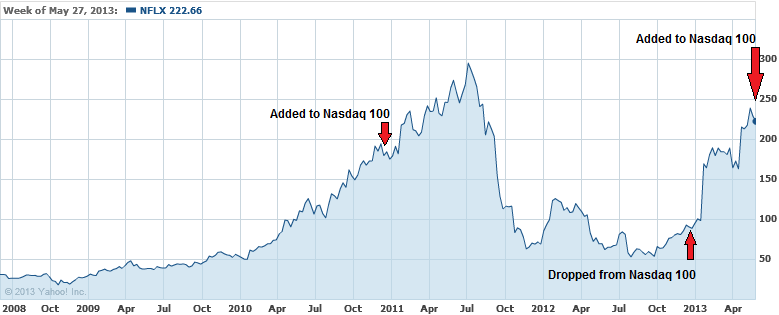
In light of the offer made by Liberty, we’d like to remind you to get your scorecards out because there are going to be at least two new additions to the Nasdaq 100 with the possible departure of Dell (DELL) and Virgin Media (VMED). Look for Netflix (NFLX) to be one of the two stocks added to the Nasdaq 100 index as the stock is twice the price that it was when it was booted from the Nasdaq 100 Index in December 2012, less than two months ago.

February Ex-Dividend Dates

Below are the approximate ex-dividend dates for the month of February 2013 for companies that appear on our U.S. Dividend, Nasdaq 100, Dow Jones Transportation/Industrial Index and International Dividend Watch Lists. All companies are ranked by ex-dividend dates.

Companies that show up on our Watch Lists could be considered the equivalent of the bargain bin of high quality blue chip stocks. Because these companies have increased their dividends every year for at least 10 years in a row (or have had similar dividend policies in the past) or are part of major indexes and within 20% of their respective 52-week low, you know that you’re not overpaying for a company that has demonstrated profitability and the ability to rebound from challenging times.

Symbol Company Price % from yr low Qtrly Yield payout ratio Ex-date
(IBM) International Business Machines $203.19 11.71% 0.43% 23.66% 2/6/2013
(AA) Alcoa Inc. $8.93 12.17% 0.33% 66.67% 2/6/2013
(FNFG) First Niagara Financial Group Inc. $7.98 12.41% 1.00% 80.00% 2/6/2013
(BBT) BB&T Corporation $30.92 15.04% 0.75% 34.07% 2/6/2013
(CWT) California Water Service Group $19.36 14.99% 0.80% 58.72% 2/7/2013
(XOM) Exxon Mobil Corporation $89.79 16.31% 0.63% 23.51% 2/7/2013
(ALTR) Altera Corp. $34.49 16.46% 0.30% 23.26% 2/7/2013
(SJW) SJW Corp. $26.45 17.24% 0.65% 59.84% 2/7/2013
(WBS) Webster Financial Corp. $22.44 18.64% 0.45% 21.51% 2/8/2013
(AAPL) Apple Inc. $455.49 4.44% 0.58% 24.03% 2/11/2013
(STBA) S&T Bancorp Inc. $18.47 17.79% 0.80% 50.85% 2/12/2013
(MSEX) Middlesex Water Co. $19.51 11.96% 0.95% 87.21% 2/13/2013
(UMH) UMH Properties Inc. $10.38 12.45% 1.75% 514.29% 2/13/2013
(BRCM) Broadcom Corp. $32.56 13.81% 0.33% 35.20% 2/13/2013
(BA) The Boeing Company $76.20 13.96% 0.65% 37.96% 2/13/2013
(DD) E. I. du Pont de Nemours $47.77 14.74% 0.90% 58.31% 2/13/2013
(GRC) Gorman-Rupp Co. $29.88 17.13% 0.33% 28.37% 2/13/2013
(RBA) Ritchie Bros. Auctioneers $21.18 18.87% 0.55% 62.03% 2/13/2013
(EGN) Energen Corp. $47.80 19.21% 0.30% 16.52% 2/13/2013
(PRK) Park National Corp. $65.80 8.55% 1.43% 77.05% 2/20/2013
(MHP) The McGraw-Hill Companies, Inc. $46.99 12.91% 0.48% 37.09% 2/22/2013
(BOH) Bank of Hawaii Corporation $48.36 16.74% 0.93% 49.05% 2/26/2013
(CTWS) Connecticut Water Service Inc. $29.38 9.78% 0.83% 61.78% 2/27/2013
(TRMK) Trustmark Corporation $23.48 12.84% 0.98% 50.83% 2/27/2013
(MCD) McDonald's Corp. $95.29 14.33% 0.80% 57.46% 2/27/2013
(AJG) Arthur J Gallagher & Co. $37.88 12.12% 0.93% 88.05% 2/28/2013
 

Watch List Summary

The first stock on our list is IBM (IBM).  After our April 19, 2012 titled “What Does Warren Buffett See In IBM?” (found here) the stock has been in a consolidation pattern.  Despite the critics, IBM managed to fall within 5% of the 52-week low on November 14, 2012.  With the stock currently trading within 12% of the 1-year low and a healthy payout ratio of  24%, the stock is well positioned for those interested in long-term positions.  We’re including an updated version of Edson Gould’s Altimeter which suggests that IBM is significantly undervalued based on the on dividend relative to the stock price.

image

According to Gould’s Speed Resistance Lines, IBM has the downside targets of $137.45 and $72.

Another notable stock on our list is Apple with an ex-dividend date of February 11, 2013.  On April 14, 2012, we projected the conservative downside target for Apple (AAPL) at $424.15 and the extreme downside target of $212.08 (found here).  On an intraday basis, Apple fell within 3% of our April 2012 conservative downside target.  Regardless of the market conditions, according to Dow Theory, Apple has upside targets of $528.28 and $616.68 before re-testing the previous highs.

If you happen to be researching these companies for potential investment, it would be advisable to consider the ex-dividend date prior to possible purchases. Owning the shares of the company that you're interested in before the ex-dividend date entitles you to the upcoming dividend payment.

Owning the shares on or after the ex-dividend date means that you would have to wait at least three months before receipt of the next dividend payment. Please verify the ex-dividend date and payout ratio before committing funds to these stocks. Additionally, do not base your next long or short-term purchase on the dividend payment or yield. Instead, get as much research in as you possibly can before the ex-dividend date "just in case" you're actually interested in buying the stock. Payout ratios that exceed 100% should be considered speculative investments.

Transaction Alert

Continue reading

U.S. Dividend Watch List: February 1, 2013

Below are the 20 companies on our U.S. Dividend Watch List that are within 11% of their respective 52-week lows. Stocks that appear on our watch lists are not recommendations to buy. Instead, they are the starting point for doing your research and determining the best company to buy. Ideally, a stock that is purchased from this list is done after a considerable decline in the price and rigorous due diligence.

Continue reading

Curse of the Magazine Cover

Barron’s exuberance over their ability to predict where we currently are in the market based on an article from October 2012 may come back to bite them, especially when they put it on the magazine cover.  We’ve been sufficiently warned.

image

Carbo Ceramics Explodes to the Upside

On January 14, 2013, we posted a technical review on Carbo Ceramics (CRR) when the stock was trading at $79.64 (found here).  A careful reading of our rationale for why we thought a rise in CRR was coming is worthwhile.  At the time we said the following:

Continue reading

Transaction Alert

Continue reading

Richard Russell Review: Letter 554

Dow Theory Letters Issue 554 was written on February 7, 1973. At the time, the Dow Jones Industrial Average was indicated to be at the 968.32 level.  This was at a point prior to the Dow Industrials declining –40% while the Dow Transports declined –37% to the late 1974 lows.

Continue reading

Transaction Alert

Continue reading

NLO Q&A

Subscriber F.H. asks:

“[Have you] ever consider[ed] constructing a market trend indicator like Richard Russell’s PTI?”

Our Response:

This is a great question and one that we’ve examined in the past.

We are familiar with Russell's Primary Trend Indicator (PTI).  In fact, we know the exact constituents of the indicator.  According to Richard Russell, editor of The Dow Theory Letters since 1958( www.dowtheoryletters.com), the PTI is a “technical spectrum of the stock market” that cannot be manipulated.  Russell goes on to say "...you can fool one or two of these technical items, but you can’t fool all eight of them, and that’s what the PTI is all about."  The goal of the indicator is to provide solid indications of market direction that cannot be manipulated.

As a subscriber to Russell's Dow Theory Letters, you are well aware of the many times that the PTI was right and Russell was wrong about the direction of the stock market. However, we're more concerned with the fact of how much advantage does the PTI provide compared to simply using Dow Theory.

Here is what we’ve found.  According to Dow Theory, on July 23, 2009 a new cyclical bull market began.  At the time we recommended investing in the highest weighted stocks of either the Industrials or Transports index or the purchase of ETFs for the Industrials (DIA) or Transports (IYT) (article found here).

On the other hand, the Primary Trend Indicator (PTI) gave the first hint that we were in a cyclical bull market on August 25, 2009.  In addition, the PTI didn’t give the “all clear”, in terms of being in a bull market, until November 30, 2009 (as seen in chart below).  In fact, a good technical analyst would have had tremendous difficulty in getting a clear indication based on the PTI until after the December 8, 2009 rebound.

image

There is an alternative view on interpreting an earlier signal than the Dow Theory indication using the PTI.  However, you would need to apply Dow’s theory in order to properly achieve the earlier signal based on the PTI movement.  Using the purple line above, an individual could have interpreted that a cyclical bull market tentatively started as early as May 4, 2009, when the PTI exceeded the January 2009 peak.  Subsequent to the May 4th peak, the PTI did not decline below the 89-day moving average on May 27, 2009, suggesting that more upside existed.

However, when we refer back to Russell’s June 3, 2009 issue there is no indication that a tentative new bull market was in play.  No mention that May 4, 2009 or May 27, 2009 were possible indications of a new bull market in stocks.  In fact, Russell commented that “…ridiculous but unseen green shoots is now repeated everywhere. I’ve stated that a true bear market bottom usually requires many weeks or even months before the crowd turns bullish.”  This comment along with the picture of a bear at the top of his newsletter was the only indication that we had that we were still in a bear market, according to Richard Russell.

Because we have studied the PTI in detail, we've determined that it is not worth including in our work.  In fact, we’ve found that it is more noise on the market when compared to correct, albeit conservative, interpretation of Dow Theory.  If we get Dow Theory right, then we don’t need another indicator to follow that could potentially confuse our primary indications based on Dow’s work.  Yes, we will take in as many views as possible, however, we will rely on Dow Theory as the primary indicator for market direction.

Finally, to create an indicator that is supposed to be impervious to manipulation while at the same time practicing Dow Theory is doubling the effort necessary in watching the movements of the market.  We’ve outlined in extensive detail the role that manipulation plays in the stock market and how the interpretation of Dow Theory mitigates the most extensive manipulation possible (found here).

Subscriber F.H. Asks:

In regards to our recent posting of the 2012 Portfolio Performance Review F.H. asks, “…I am wondering if the methodology will allow this streak to continue. the process, as I understand it, is to buy stocks at their lows, hold them for a significant gain, and then sell a portion of the position but retain some % of original principal in the investment. won’t the portfolio eventually have such a large percentage of these residual holdings that the incremental effect on returns from the new positions will be overwhelmed?”

Our Response:

In theory, the primary drawback would be that we’ll be working with the same amount of cash over an extended period of time whenever we sell the principal.  However, we’re comfortable with continually adding new cash to the portfolio so that we are not faced with the very real potential of our residual holdings dwarfing our capital base.

Our strategy is the literal application of a concept that is outlined in the book Rocking Wall Street by Gary Marks.  In an interview on June 2, 2007 with Financial Sense Newshour host Jim Puplava (found here), Marks gives insight as to the reasons why an investor might want to employ the strategy that we’ve outlined with selling the principal and letting the profits run.  The interview is so good that we’ve indexed the various topics covered in the interview below.

minutes topic
3:57-4:57 Art and Craft of Investing
6:48-8:25 Investing is About Less Risk Over Time
16.03-17:13 Emotional Risk causes Gambling Modality
17:15-19:28 Myth of Tax Savings from Buy and Hold
19:29-21:39 Myth of Buy and Hold
25:32-28:10 Risk to Real Estate
28:11-31:57 Cash as a Hedge
38:58-42:05 portfolio construction & life balance

The discussion of the “Art and Craft of Investing,” as described by Marks, is exactly what we’re practicing and what we believe will give any investor the benefits that are claimed that the stock market can offer.  Our approach is in stark contrast to the belief that if you practice Dow Theory you must go all in when the signal is bullish and sell everything when the signal is bearish,  but at the same time you’re supposed to compound your way to investment wealth.

We agree with 95% of the strategies described by Marks in the Financial Sense interview.  After weighing the merits of various investing approaches, we’ve tried to responsibly provide methods for investing while limiting the risk of excessive loss.

Gold Stock Indicator

We rely heavily on our Gold Stock Indicator for signs of when to buy gold stocks.  The reason for this is because we found the alternatives, the Gold/XAU and XAU/Gold ratios, to be highly deficient.  These two ratios were thought to be the bedrock of indications on when to buy and sell gold stocks.  According to well known analyst John Hussman, the Gold/XAU ratio has the following indications:

Continue reading

Nasdaq 100 Watch List: January 25, 2013

Below are the Nasdaq 100 companies that are within 10% of their respective 52-week lows. Stocks that appear on our watch lists are not recommendations to buy. Instead, they are the starting point for doing your research and determining the best company to buy. Ideally, a stock that is purchased from this list is done after a considerable decline in the price and rigorous due diligence.

Continue reading

Transaction Alert

Continue reading

Gold and Natural Inclinations

The dialog below is an interaction between one of our subscriber.

Continue reading