Dow Jones Industrial Average Additions and Deletions 1884-2013

image

Silver: Downside Targets Met

As early as May 5, 2011, when silver was trading at $35 an ounce, we’ve maintained the view that the prospect of silver, in the form of the exchange traded fund iShares Silver Trust (SLV), falling below $20 was well within the realm of possibility (article here).  At the time, we said the following: Continue reading

Precious Metal Stocks: September 7, 2013

Below is a list of gold and silver stocks that are ranked based on their upside potential according to Dow Theory estimates of fair value.  As with any investment consideration, the stocks that have the highest percentage upside potential should be considered the highest risk with the most volatility.   We believe that stocks with upside potential below +143% are the most likely to achieve their Dow Theory fair value targets. Continue reading

Gold Stock Indicator

Continue reading

Baidu: Sell the Principal

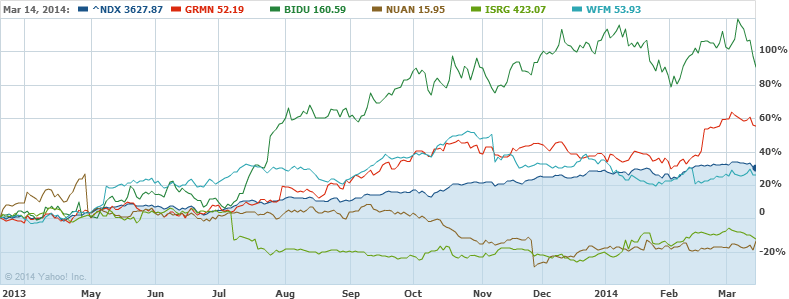
After less than 5 months and a +59% gain, it is now time to recommend selling the principal of BIDU.  Our use of Edson Gould’s Speed Resistance Lines indicates that BIDU could rise to $160, as seen in the chart below:

image

Although $160 appears to be on the horizon, and could nearly double the stock’s price from the $85 level it was recommended (found here), we see that the stock is struggling mightily to get beyond the $135-$140 level.

According to Charles H. Dow, co-founder and former editor of the Wall Street Journal, there is a concept of “seeking fair profits” by buying at good values and selling as market participants are just getting interested in a stock in the following July 20, 1901 Wall Street Journal commentary:

“The best way of reading the market is to read from the standpoint of values. The market is not like a balloon plunging hither and thither in the wind. As a whole, it represents a serious, well-considered effort on the part of farsighted and well-informed men to adjust prices to such values as exist or which are expected to exist in the not too remote future. The thought with great operators is not whether a price can be advanced, but whether the value of property which they propose to buy will lead investors and speculators six months hence to take stock at figures from ten to twenty points above present prices.

“In reading the market, therefore, the main point is to discover what a stock can be expected to be worth three months hence and then to see whether manipulators or investors are advancing the price of that stock toward those figures. It is often possible to read movements in the market very clearly in this way. To know values is to comprehend the meaning of movements in the market. (Source: Wall Street Journal. Review and Outlook. July 20, 1901)”

Our deconstruction of Dow's thoughts are as follows:

First, Charles Dow tells us that the stock prices of today are adjusted for what is expected in the future. The distinction between great operators [Buffett, Einhorn, Paulson, Berkowitz, Icahn etc.] and average traders/investors is the ability to know values enough to project at least six (6) months down the road that, even at higher prices, the investing public will still be willing to buy more of the stock in question.

Next, these great operators are supposed to be willing to accept half the gains that they expect for 6 months and in half the time. At which point, the great operators move on to other undervalued opportunities. Dow believed that not only should the great operators be able to predict the direction of the price of an undervalued asset, they must also accept less than the full amount possible despite their confidence and accuracy of prior investments using the same approach. Again, this idea is based on a concept called “seeking fair profits.”

We think that securing the gains that have been achieved in Baidu (BIDU) in such a short period of time are far better than the prospect of an additional +18.50%.  If the principal is sold then an investor would still be able to benefit from any additional gains and there would be absolutely no loss.

Nasdaq 100 Watch List: August 30, 2013

Below are the top Nasdaq 100 companies that are within 10% of the 52-week low. This list is strictly for the purpose of researching whether or not the companies have viable business models. These companies are deemed highly speculative unless otherwise noted. Continue reading

Gold Stock Indicator

Continue reading

U.S. Dividend Watch List: August 30, 2013

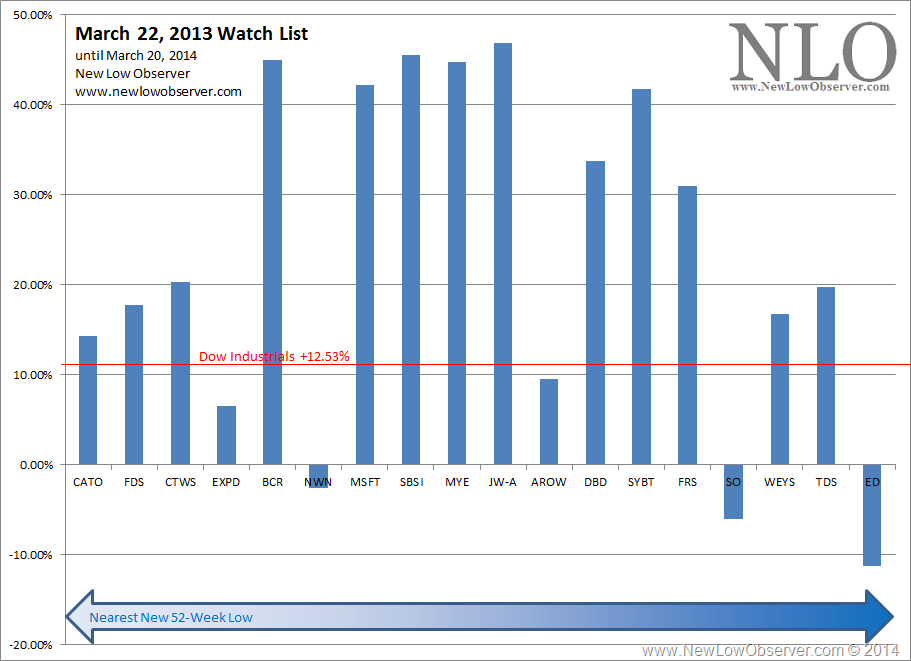
Below are the 26 companies on our U.S. Dividend Watch List that are within 11% of their respective 52-week lows. Stocks that appear on our watch lists are not recommendations to buy. Instead, they are the starting point for doing your research and determining the best company to buy. Ideally, a stock that is purchased from this list is done after a considerable decline in the price and rigorous due diligence.

Continue reading

U.S. Dividend Watch List: August 23, 2013

Below are the 15 companies on our U.S. Dividend Watch List that are within 11% of their respective 52-week lows. Stocks that appear on our watch lists are not recommendations to buy. Instead, they are the starting point for doing your research and determining the best company to buy. Ideally, a stock that is purchased from this list is done after a considerable decline in the price and rigorous due diligence.

Continue reading

Nasdaq 100 Watch List: August 23, 2013

Below are the Nasdaq 100 companies that are within 10% of the 52-week low. This list is strictly for the purpose of researching whether or not the companies have viable business models.

Continue reading

Dow Jones Utility Average Downside Targets

As the Dow Jones Industrial Average and Dow Jones Transportation Average have achieved highs above their respective 2007 peaks, the Dow Jones Utility Average has not fared as well.  In fact, the Utility Average has been in a declining trend since April 2013.

Continue reading

Gold Stock Indicator

Continue reading

Review: Exelon Corporation

On November 7, 2012, we did a research request on Exelon (found here).  At the time we said the following:

The run that EXC has had in comparison to the average “high quality” index of utilities seems inordinate.  Especially when we consider that we’re at a historic low point for interest rates.  Any sudden change of interest rates to the upside will decimate all utilities, especially those that have had an excessive run to the upside.  As the market has adjusted the view on the prospects for EXC, the possibility exists that a swing to the opposite extreme is in the making for Exelon.

Shortly after writing that piece on Exelon (EXC), the stock declined an additional –10%.  However, Exelon had more life in it than we anticipated.  At the low of November 23, 2012, EXC increased a stunning +32.23% by April 29, 2013.  But then came a rise in interest rates.  From April 29th to the present, EXC declined –18% to the level it was at on November 7, 2012.

It should not go unnoticed that on Edson Gould’s Speed Resistance Lines, EXC went up to the extreme downside target of $30.55 and failed.   The  inability of EXC to stay above the $30.55 level suggests that there is still downside risk with the threat of rising interest rates.image

We still have support levels of $23.53 and $16.50.  We wouldn’t be surprised to see the rising interest rate environment persist for the foreseeable future.  Naturally, this should have a exaggerated negative impact on utilities going forward.

Transaction Alert

On August 21, 2013 we BOUGHT the following stocks:

Continue reading

U.S. Dividend Watch List: August 16, 2013

Below are the 17 companies on our U.S. Dividend Watch List that are within 11% of their respective 52-week lows. Stocks that appear on our watch lists are not recommendations to buy. Instead, they are the starting point for doing your research and determining the best company to buy. Ideally, a stock that is purchased from this list is done after a considerable decline in the price and rigorous due diligence.

Continue reading