On September 30, 2013, we posted our Dow Theory analysis. In that assessment, we acknowledged that our June 2013 review of Dow Theory was incorrect. Additionally, we pointed out the importance of using Dow Theory as an asset allocation tool rather that a strict “buy” or “sell” indicator. A couple of excerpts appear below:
“Since June 21st, as indicated in the chart below, the Dow Industrials and Dow Transports have managed to achieve successive new highs in early August 2013 and mid-September 2013. In addition, the call for a bear market came slightly before the bottom in the market in late June 2013.”
“In short, we use Dow Theory indications as asset allocation signals rather than strict buy/sell signals.”
Accepting the reality that we were not in a bear market was challenging. However, realizing it in enough time, along with the fact that Dow Theory is used as an allocation tool, has spared us excessive losses and/or missed opportunities.
Traditional Dow Theory
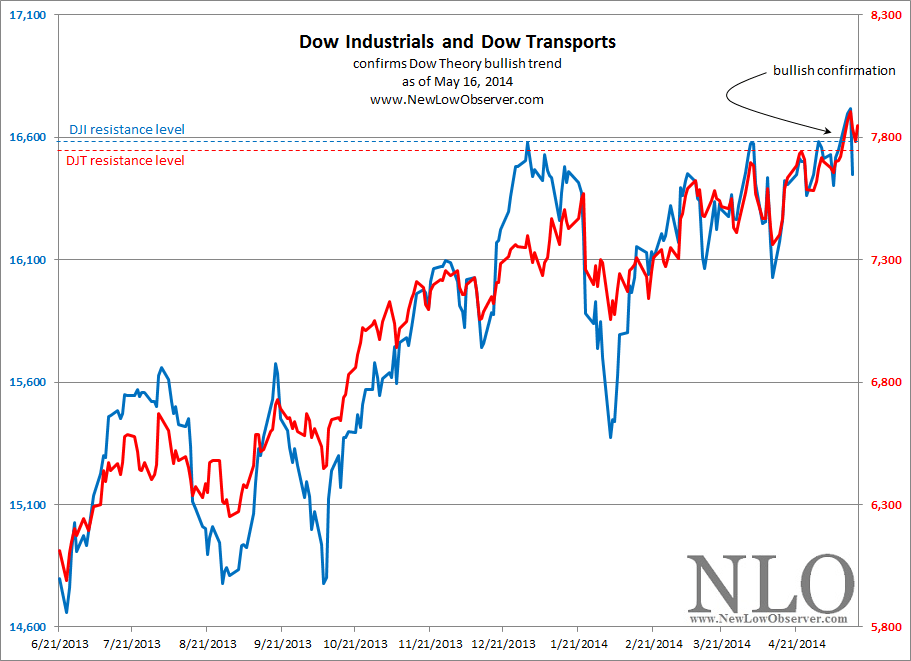
Recently Dow Theory has registered a confirmation of the bullish trend. On May 12, 2014, the Dow Jones Industrial Average confirmed the new highs in the Dow Jones Transportation Average. In fact, on the same day, both indexes made new all-time highs.

That this is still a bull market requires a review of various factors that could be at play, both positive and negative. As an example, already the Dow Jones Industrial Average has increased +151% since the March 9, 2009 low. The amount of the increase is less than the average for the period of 1836 to 1914, a time when the Federal Reserve never existed. As stated in the article titled “Is the Fed Responsible for the Stock Market Rise Since 2009?” the average increase when the Federal Reserve didn’t exist was +167%. This suggests that the current rise may have some room to go on the upside.
Dow Theory Reconsidered
There are many who follow the traditional Dow Theory which is really a refined version of William Peter Hamilton’s writings from his Wall Street Journal and Barron’s newspaper columns as well as his book Stock Market Barometer. The theory itself is generally sound. More often than not it is the interpreter of the theory that gets it wrong. However, we can’t help but feel it necessary to point out the specific words of Charles H. Dow which possibly leads to a market theory slightly different from what the legions of modern Dow Theorists are willing to accept.
The following excerpts from the Wall Street Journal outline Dow’s theory on the role of the industrials as it originally was stated:
“This is preeminently the period of industrial speculation, yet the creation of industrial stocks has become pronounced only within a year.”
“…it follows that there must be a very strong body of [venture] capitalists prepared at present to resist anything like a collapse in the industrial market and to promote by every means in their power firm or advancing prices for the market as a whole. and this effort on their part is being powerfully supported by the excellent conditions of practically all branches of trade.”
Dow, Charles H. Review and Outlook. Wall Street Journal. April 22, 1899.
Our interpretation of the preceding quotes is that industrial stocks were, in 1899, considered to be the equivalent to modern small cap stocks which are more speculative in nature and often prone to manipulation and collapse. The best confirmation of this concept is found in the following New York Times quote:
“Our London correspondent, in yesterday’s Financial Supplement, gave expression to the feeling which the English investor or speculator very naturally has as to the securities that usually go under the title of industrials in our markets. It is one of distrust and hesitation. It would be very strange if it were not.
“As to the investor, we suppose that no one on this side of the water would claim that our industrials, taking them ‘by and large,’ the older with the new, the more solid with the more inflated, can be regarded as ‘investment’ securities.”
New York Times. “The Industrials and The Boom”. March 14, 1899. page 6.
By most measures, the New York Times article, from one month earlier in 1899, confirms our view that industrial stocks were of low quality. Now we need to see what Dow intended for the role of transportation and industrial stocks.
“…railway [transportation] stocks generally occupy a position much stronger than that held by the industrials.”
“The growth of the business of the country accrues on the old stocks [transportation stocks]. The Industrial list occupies an entirely different position. There has been a very large creation of securities [initial public offerings]. Stocks have been bought on very limited information as to the value of the property acquired. Attack of these stocks brings selling from those who know little in regard to the worth of what they have bought; also from those who got in at low figures [company insiders] and who propose to get out as well as they can. This is the ideal condition for bear attacks, checked only by the possibility of not being able to borrow stock [for short selling]. The thoughtfulness of promoters [investment banks] in providing ample capital relieves this danger to great extent and will relieve it altogether when the new Industrials come to be distributed.”
Dow, Charles H. Review and Outlook. Wall Street Journal. May 31, 1899.
Our views is that Dow’s theory was intended to be based on blue chip high quality stocks to be compared against small cap speculative stocks. At the time, railroad stocks were the “old stocks” that had a blue chip status while the industrials were the newer [non-railroad] more speculative stocks. We no longer live in a world where railroad stocks dominate the landscape of companies to invest in. Also, transportation stocks generally don’t provide consistent and/or rising dividend payments as was the case of railroad stocks in the last quarter of the 1800’s.
What would be the equivalent indexes of Dow’s comparison between old blue chip stocks to newer more speculative stocks? We believe that the Dow Jones Industrial Average qualifies as the blue chip barometer and the Russell 2000 small cap index qualifies as the speculative barometer. Using all of the other elements of Dow Theory except for the Dow Jones Transportation Average, we believe that we would be following Dow’s theory exactly as it was intended.
Just to reiterate, Dow was not specifically concerned with the comparison between industrial stocks because they made the goods and transportation stocks because they shipped those same goods, a popular and logical story that is expounded on what Dow had intended. However, based on the quotes above, we believe Dow was comparing companies of older blue chip quality that were well established and could be relied upon for their dividends in contrast to newer companies with little in the way of verifiable earnings, nascent but unstable dividends and highly susceptible to manipulation (i.e. small illiquid stock).
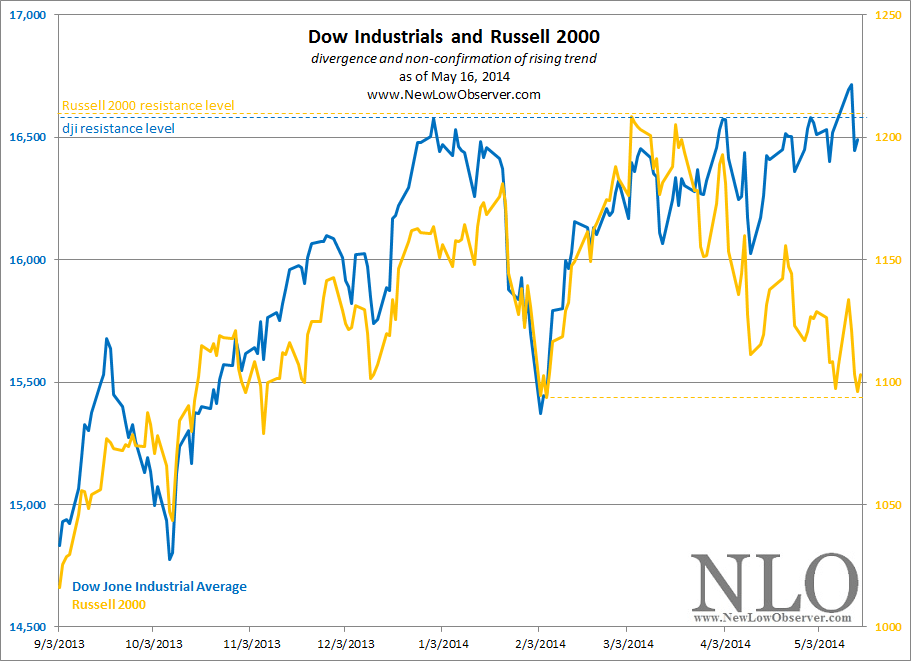
If we look at a comparison between the Industrials and the Russell 2000 index, the picture is very different from the confirmation of the bullish trend in the review of the transportation and industrial index above.

As can be seen above, while the Dow Industrials has managed to exceed the previous peaks of December 2013 and April 2014, the Russell 2000 has not been able to exceed the peak of March 2014. Under the rules of Dow Theory, this would be considered a non-confirmation of the rising trend. However, this does not signal a new bear market. Instead, it only suggests that investors remain cautious about new investments.
A bear market would be signaled if the Dow Industrials and Russell 2000 were to simultaneously decline below the previous retracement levels during the rise from the March 2009 low to the current market levels. In the chart above, the initial warning would come if the Russell 2000 and Dow Industrials declined below their respective February 2014 lows.