Canadian Dividend Watch List: February 2016

Performance Review

On February 18, 2015, we generated the following list of stocks for consideration with their respective performance one year later:

Symbol Name 2015 2016 % chg
BEI-UN.TO Boardwalk REIT 60.69 42.00 -30.80%
IGM.TO IGM Financial Inc. 44.68 33.61 -24.78%
ACO-X.TO ATCO LTD., CL.I, NV 46.76 37.90 -18.95%
CJR-B.TO Corus Entertainment Inc. 21.73 9.32 -57.11%
CM.TO CIBC 95.39 89.01 -6.69%
REF-UN.TO Canadian REIT 47.05 39.90 -15.20%
RY.TO Royal Bank of Canada 77.70 69.41 -10.67%
HCG.TO Home Capital Group Inc. 43.30 29.86 -31.04%

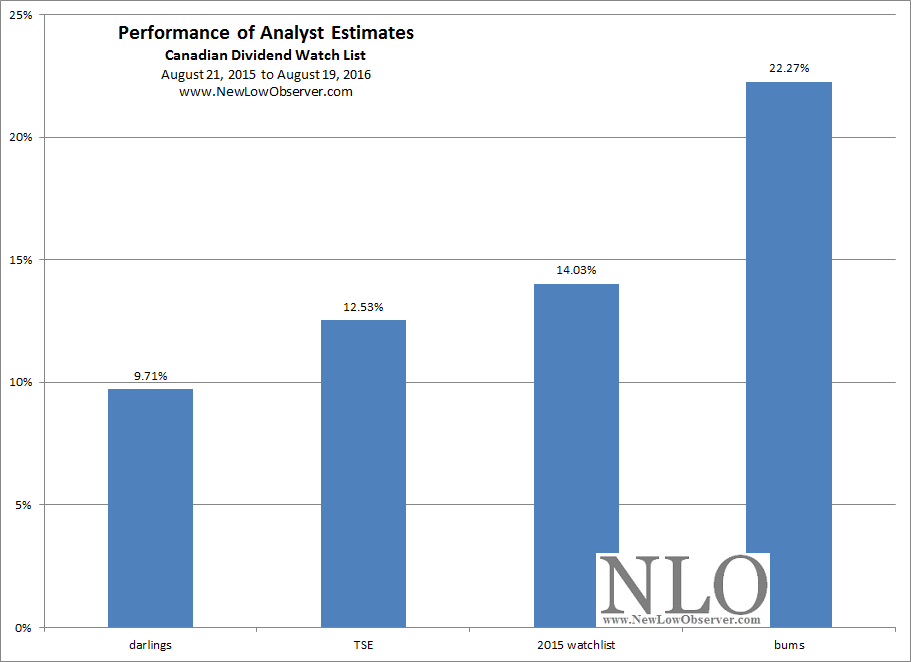
There was little surprise in the performance of the stocks on the watch list.  As a group (equally weighted) the average change was –24.40% compared to the Toronto Stock Exchange decline of –17.49%.

image

The analysts were off target for their 1-year projections.  Only Canadian REIT (REF-UN.TO) and Boardwalk REIT (BEI-UN.TO) came close (somewhat) to the analyst targets.

A stock of particular interest to us was Home Capital Group (HCG.TO).  At the time we said the following of HCG.TO:

“Applying Speed Resistance Lines to HCG.TO, we see that the stock has already declined to the conservative downside target of $37.92.  Because it appears that we are in the early stages of the economic decline in Canada, HCG.TO might be worth watching to see if the stock can decline to the $28.21 level.  The extreme downside target is $18.51 which confirms the Altimeter low of $20.80.  HCG.TO should be considered in three stages starting below the ascending $37.92, $28.21 and $18.51 levels.”

Not surprisingly, HCG.TO declined as low as 23.16 on January 15, 2016.  This has set the stage for our latest risk assessment (as noted below).

Analyst Estimates: U.S. Dividend Watch List

Below are the price projections based on analyst earnings estimates for on our recent U.S. Dividend Watch List dated February 12, 2016. These estimates project the price change for the respective stocks over the next 12 months.

U.S. Dividend Watch List: February 12, 2016

It was another wild week for the market with extreme volatility setting in. The market ended the week down -0.80% and is off by -8.70% year-to-date. USO which is a proxy for oil fell -19% for the year while IAU which is a proxy for gold rose +16.70%. While weakness in the market may bring anxiety to investors, those with a longer-term perspective should embrace the recent trend and move towards a net buyer stance. At the end of the week, there are 30 companies on our watch list. Continue reading

Gold Stock Indicator: February 12, 2016

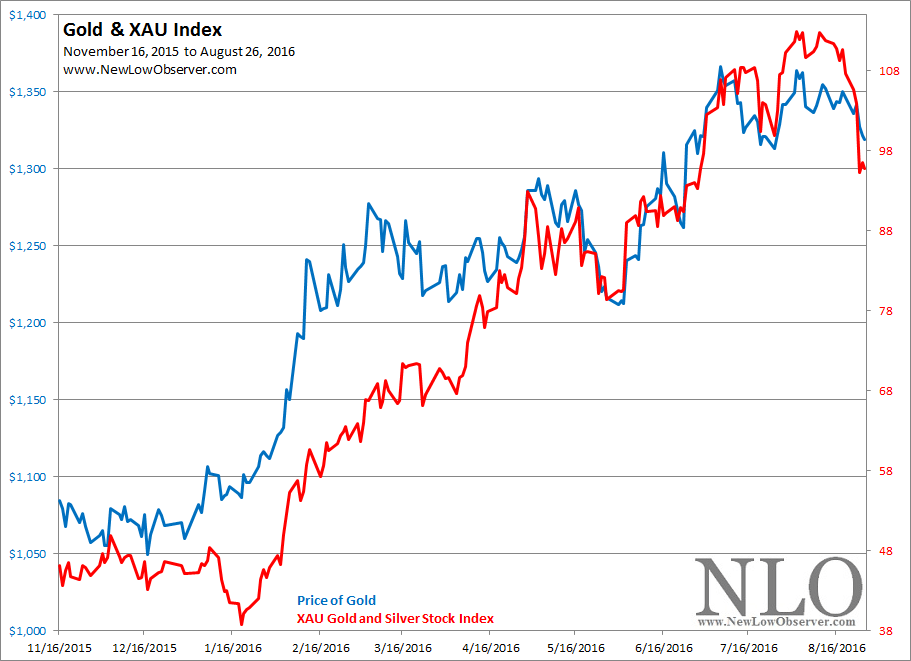
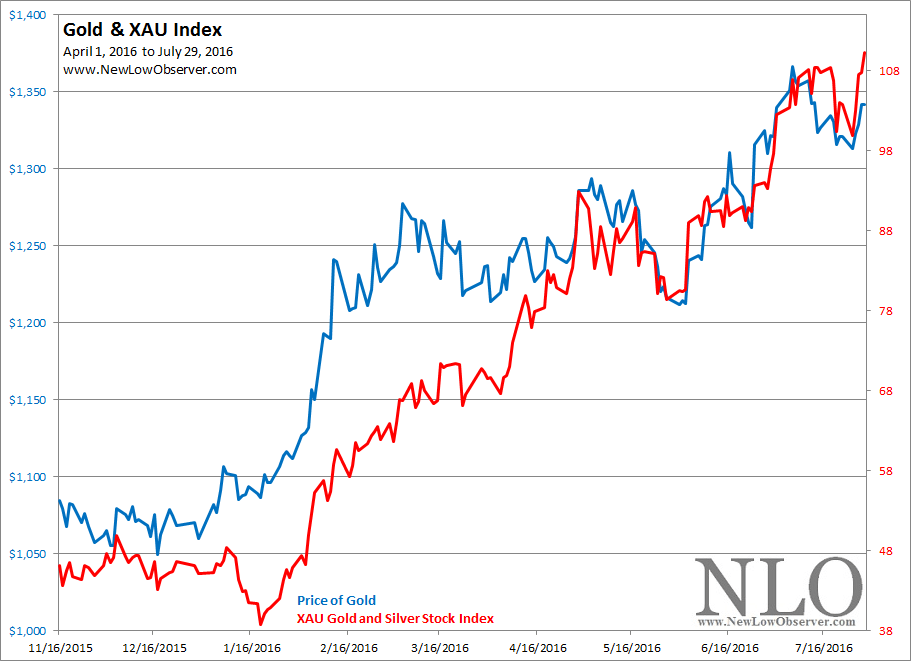
Gold and gold stocks have made a turnaround in the declining trend that has persisted over the last several years.  The reactions to a dramatic rise or fall in commodity prices is usually equal in violence and magnitude.  Gold has increased +15.59% while gold stock has increased +27.90% since our last posting.

image

There is a lot of excitement in the gold investing community as there is the belief that this may be the long awaited bull market in gold which has been attributed by some by the advent of negative interest rate policies in major economies like Japan.  We remain hesitant to believe that all is well in the gold sector as this is the third year in a row that gold has started strong.  The last two years (2014 & 2015) both ended in the loss column for the year, in spite of the early gains.

image

The above chart shows exactly how gold garnered early gains.  For 2014, gold ended the year at a loss of –1.55% while the XAU index declined –21.11%.  For 2015, gold fell –9.55% and gold stocks fell –35.89%.  The early gains for 2016 are nice but new investors should accept what may come if there is a repeat of the last two years.

Coppock Curve: January 2016

We started the year off on with a big market selloff.  The Dow Jones Industrial Average fell -5.4% in January.  For the first time since June 2008, the Coppock Curve dipped into negative territory.  This is a welcoming sign for our team and any long-term investors.  Below is the current chart of the Coppock Curve. Continue reading

Transaction Alert

On February 5, 2016, we executed the following transaction(s):

Continue reading

Review: Boston Beer Company

On February 25, 2015, we posted the following chart for Boston Brewery Company (SAM):

image

Our summarizing commentary at the time was as follows:

“Our expectations for SAM are not very high as the last time that the stock was able to achieve the conservative downside target of $70.13 was in 2011.  Since that time, SAM has faltered but not fallen.  In spite of this fact, we’ve outlined the conservative downside target of $180.12 and the extreme downside target of $107.99.  Investors should note that a decline to the ascending $180.12 level is an ideal buying target with a follow-up purchase below $141.25.”

Fast forward nearly one year later and we’re looking at a pending recession and a declining stock market.  Everything is negative and going to get worse, according to some experts.  With this in mind, As SAM falls below $180, it is time to consider the investment fundamentals of the company.  Below is the updated SRL.

Nasdaq 100 Watch List: January 29, 2016

Performance Review

This is a review of the 1-year performance of the watch list from January 23, 2015.

symbol Name 2015 2016 1-yr % chg
FOSL Fossil Group, Inc. $99.37 $32.60 -67.19%
WYNN Wynn Resorts Ltd. $146.01 $67.34 -53.88%
QCOM QUALCOMM Inc $72.18 $45.34 -37.18%
NWSA News Corporation $15.18 $12.97 -14.56%
DISCA Discovery Comm. $29.84 $27.59 -7.54%
TRIP TripAdvisor Inc. $69.77 $66.76 -4.31%
MAT Mattel, Inc. $28.04 $27.59 -1.60%
PCLN The Priceline Group Inc. $1,037.99 $1,064.97 2.60%
KLAC KLA-Tencor Corp. $65.24 $66.99 2.68%
NUAN Nuance Comm. $13.80 $17.63 27.75%
XLNX Xilinx Inc. $39.28 $50.27 27.98%
FSLR First Solar, Inc. $42.54 $68.66 61.40%

The average performance of an equal-weighted investment of all the above companies was –5.32% compared to a gain of +0.02% for the Nasdaq 100 Index.  The following is a graphical representation of the performance of analyst estimates contrasted with the two methods presented last year.

image

Analyst estimates were on target for Wynn (WYNN), News Corp. (NWSA), Priceline (PCLN) and First Solar (FSLR). Priceline was a stock that we had an interest in at the time.  Overall, PCLN did not change much one year later, however, that does not mean the stock didn’t move throughout the year.  PCLN attained a new all-time high before falling back to the same level as last year.  This should be an interesting stock to watch going forward.  We have added an updated Speed Resistance Line chart below.

Watch List & Analyst Estimates

On Parabolas and Cycles

In looking at the stock price of Union Pacific Corporation (UNP) from 1980 to the present, we find the pattern of a parabolic peak and subsequent decline.  Parabolic peaks are generally alarming to market technicians because they generally indicate that a crash is coming.  Part and parcel with the idea of a crash is the view that such a stock  is either a sell or short-sell candidate, definitely not worth being considered for a long-term investment.

 image

Sometimes lost in this observation of parabolas is the importance of other factors that might be at work.  Observed parabolas are only as good as the experience of the analyst.  In the case of Union Pacific, we don’t believe that the mere presence of a parabola is as meaningful as the pattern of market cycles.

The rule with the above chart pattern is that no parabolic move goes unchecked.  This point has been made with the many charts that we’ve run Speed Resistance Lines (SRL) on, most recently illustrated in our April 26, 2012 chart of Chesapeake Energy (CHK) when the stock was trading at $18.10. 

In the case of Chesapeake Energy, we said that if history was any indication, the stock was on the cusp of repeating a previous pattern that suggested the stock would fall to $4.94.  After applying Gould’s SRL, we arrived at what we thought would likely be the most likely outcome ( as of January 26, 2016, CHK sits at a price of $3.19).  The work of Edson Gould helps us to assess the downside prospects of parabolic patterns in stocks.  However, the use of technicals like Gould’s SRL have their limits.

In assessing the parabolic UNP chart, we noticed a pattern that isn’t as obvious to the uninitiated.  Furthermore, it is a pattern that require a little work.  However, once drawn out, the pattern almost jumps out at you and becomes pivotal in deciding which pattern is more important, the single parabola or the repeated cycle.

Since 1980, all major peaks in the price of UNP have declined between –30% to –66%.  Below is the data that we’ve selected to demonstrate this fact (using Yahoo!Finance adjusted total return data).

Year of peak   % chg   where to from 2015 peak?
1980   -65.55%   $41.69
1983   -41.25%   $71.10
1987   -44.96%   $66.61
1994   -31.33%   $83.11
1997   -46.84%   $64.33
1999   -47.07%   $64.06
2008   -59.44%   $49.08
         
  Avg. -48.06%   $62.85
         
2015   -43.16%   $68.79

The repeated pattern of declines greater than –30% is no coincidence.  These are the apparent cycles that UNP happens to experience. Furthermore, the level of consistency for UNP to decline on average –48% over the period from 1980 to 2008 (7 data points) indicates that this is very useful in determining what is “normal” for the current decline in the stock price.  Already UNP has fallen –43.16% which is generally in the sweet spot as we believe that the 2008 and 1980 declines were outliers in especially painful recessions.

What distinguishes the difference between any stock price pattern is the history and consistency.  A stock like UNP has been around since the late 19th century to the present.  Most stock price patterns for UNP will reflect a deep seated adherence to the overall economy and investors.  A stock like CHK has been around since the late 20th century.  Any stock movement will reflect the recency bias of speculators.

Another important factor when considering the validity of a parabolic move in a stock is the relative movement of a corresponding stock index.  In this case, the corresponding index is the Dow Jones Transportation Average.  As seen in the chart below, Union Pacific has tracked very closely to what a diversified mix of related companies would do.  In fact, UNP has only recently caught up, in terms of performance, with the index that it has been in since inception.

image

Finally, we’d like to close with a parabolic chart of UNP ranging from 1910 to 1987.

image

This chart is dynamic because, for anyone in 1987 alarmed about a parabolic pattern, it should have indicated that a collapse was due.  However, that was hardly the optimal way to view Union Pacific with the compelling fundamentals to support the rise in the stock price over time.  This is contrasted with the absence of fundamental for Chesapeake Energy, which explains why the stock has fallen nearly –90% from its prior peak.

Gould’s SRL for Union Pacific

Below is the Speed Resistance Lines for Union Pacific (UNP) based on the move from 2009 to the present.

Continue reading

Insurance Watch List: January 2016

Performance Review

Below is the performance of the insurance watch list stocks created on August 6, 2014:

Symbol Name 2014 2015 % chg
WSH Willis Group Holdings 40.07 46.90 17.05%
L Loews Corporation 42.14 35.00 -16.94%
AFL AFLAC Inc. 59.02 57.27 -2.97%
PRA ProAssurance Corporation 43.67 48.59 11.27%
ACGL Arch Capital Group Ltd. 54.19 65.31 20.52%
PGR Progressive Corp. 23.42 29.95 27.88%
SAFT Safety Insurance Group Inc. 50.37 54.69 8.58%
RDN Radian Group Inc. 12.75 10.24 -19.69%
ORI Old Republic International 14.5 18.08 24.69%
CB The Chubb Corporation 87.44 110.04 25.85%
CLGX CoreLogic, Inc. 27.04 33.07 22.30%
CINF Cincinnati Financial Corp. 46.53 54.98 18.16%
AXS AXIS Capital Holdings Limited 44.62 53.06 18.92%
CNA CNA Financial Corporation 37.45 32.33 -13.67%
VR Validus Holdings, Ltd. 36.69 42.94 17.03%
STC Stewart Information Services 31.07 32.66 5.12%
TKOMY Tokio Marine Holdings Inc. 30.46 34.75 14.08%
KCLI Kansas City Life Insurance Company 43.45 36.24 -16.59%
AXAHY AXA Group 23.52 24.44 3.91%
PTP Platinum Underwriters Holdings Ltd. 59.87 76.35 27.53%
AJG Arthur J Gallagher & Co. 44.83 37.65 -16.02%
TDHOY T&D Holdings, Inc. 6.38 6.12 -4.08%
SIGI Selective Insurance Group Inc. 23.41 29.98 28.06%
BRO Brown & Brown Inc. 30.49 29.40 -3.57%

The average performance of the entire list was +8.23%.  Of note is the performance of the insurance watch list based on analyst estimated earnings.  As indicated at the time, “Our recommendation is to start with the companies that have the worst prospects, according to the analysts, and through a process of elimination determine which company has the least risks.”  As it turned out the stocks expected to perform the worse (starting on the left side of the chart) did quite well.    The only stock expected to decline in price that didn’t register a gain was Aflac (AFL).

image

Insurance Watch List: January 2016

Below is the watch list of insurance companies that we’re following:

U.S. Dividend Watch List: January 22, 2016

Top Five Watch List Performance Review

In our ongoing review of the NLO Dividend Watch List, we have taken the top five stocks on our list from January 23, 2015 and have checked the performance one year later. The top five companies on that list can be seen in the table below.

Symbol Name 2013 Price 2014 Price % change
NUE Nucor Corp. 43.80 35.36 -19.3%
EMR Emerson Electric 58.12 43.17 -25.7%
ITT ITT Corp 36.08 31.00 -14.1%
MCD McDonald's Corp. 89.56 118.40 32.2%
HY Hyster-Yale Materials Handling, Inc. 64.75 48.95 -24.4%
      Average -10.3%
         
DJI Dow Jones Industrial 17,672.60 16,093.51 -8.9%
SPX S&P 500 2,051.82 1,906.90 -7.1%

Watch List Review

Our top five lost an average of -10.3%. The best performer was McDonald (MCD) which gained an astonishing +32.2%. The driver for their success may be from menu changes (see here). We had some comments on Nucor (NUE) and Hyster-Yale (HY) which lost -19.3% and -24.4% respectively. Excerpts below were taken from our post from last year.

"Nucor (NUE) has lost -6.6% YTD and is trading right at the 52-week low. The company manufactures and sells steel and steel related products. The company recently raised their dividend by +0.05%. The small increase was a wise move because it kept the company on Dividend Achiever list while maintaining their cash position for the rocking time ahead. Interestingly, analysts at Goldman Sachs upgraded the stock to Buy from Neutral but lowered the price target to $52 from $55. The stock is trading at a slight discount to its 5-year average on all matrix (according to Morningstar). The stock is definitely worth considering at this level."

"One company that peaked our interest is Hyster-Yale (HY). The company was a spin-off from another Dividend Achiever, NACCO Industries, in 2012. Hyster-Yale manufactures forklifts. In less than one year, the stock has fallen from the high of $108 to settle at $65 by the end of the week, a -40% decline. Because Hyster-Yale is relatively young as a standalone company, we have little history on its financial. The stock currently trades at just 10x earnings with dividend yield of 1.6%. The company's balance sheet is strong with $39M in total debt while holding $97.9M in cash. Debt to equity ratio sits at 8.25. Hyster-Yale brings in $2.8B in revenue with net income of $109M or 3.9% profit margin. A razor thin margin is a cause for concern given that the company operates in a highly cyclical industry. However, current valuation is worth your consideration. The market cap is at $1B which is just 0.38x of sales."

Even though our speculation that these two would rise didn't come to fruition, this review provided us with an opportunity to reassess these two companies at a lower price. Although Nucor now yield 4.3%, it's payout ratio is high at 77%. Analysts are expecting the company net profits to be at $1.55 for the current year. With current earnings at $1.50, dividend increase will be put to question. Hyster-Yale currently sports a 2.37% dividend yield. Additionally, the payout ratio is 22% which is a large margin for safety for investors. While analysts expect their profits to fall, HY should be able to sustain the dividend if not increase it slightly.

U.S. Dividend Watch List: January 22, 2016

The S&P 500 continued to fluctuate between 1,820 and 1,900. Oil still hasn't hit bottom and commodities continued to slide lower. We see additional bearish sentiment as an opportunity to accumulate shares. Below are 41 companies on our watch list. Continue reading

Canadian Dividend Watch List: January 2016

Performance Review

Below is the performance of the stocks found on our January 13, 2015 watch list:

symbol name 2015 2016 % chg
IMO.TO Imperial Oil Ltd. 44.86 41.68 -7.09%
PSI.TO Pason Systems Inc. 18.45 16.49 -10.62%
FTT.TO Finning International Inc. 21.87 17.66 -19.25%
ESI.TO Ensign Energy Services Inc. 9.44 6.47 -31.46%
TD The Toronto-Dominion Bank 43.41 34.04 -21.58%
BDT.TO Bird Construction Inc. 10.30 11.47 11.36%
AGF-B.TO AGF Management Limited 7.48 4.13 -44.79%
CCO.TO Cameco Corporation 17.65 15.72 -10.93%
PPL.TO Pembina Pipeline Corporation 37.23 28.02 -24.74%
CNQ.TO Canadian Natural Resources 31.94 24.44 -23.48%
GS.TO Gluskin Sheff + Associates, Inc. 24.64 18.19 -26.18%
CWB.TO Canadian Western Bank 28.29 20.23 -28.49%
BNS.TO The Bank of Nova Scotia 61.92 52.27 -15.58%
  Average Change     -19.45%
         
  Toronto Stock Exchange 14187.20 12073.46 -14.90%

Below is the performance of the watch list based on the analyst estimates given at the time.  As can be seen, there was a significant divergence between what was expected and what actually happen.  It appears that for a majority of the list, analysts were over-optimistic.

image

However, when viewed from the perspective of using the same p/e ratio as January 13, 2015 as seen in the following link, the analysts appeared to be a more realistic expectation for the stocks.

Dow Theory: Are We There Yet?

In our last Dow Theory assessment dated May 17, 2015, we said the following:

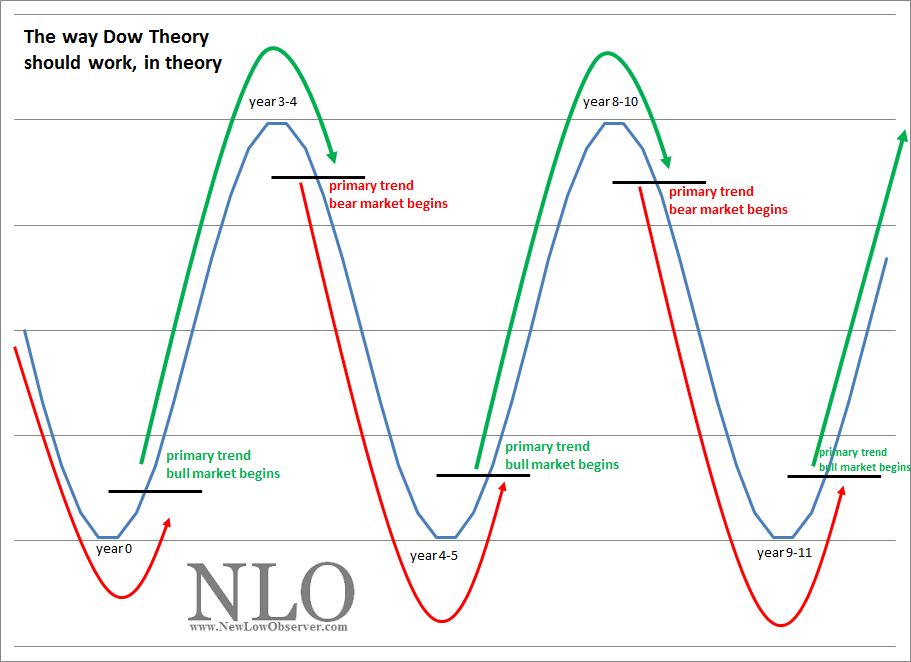
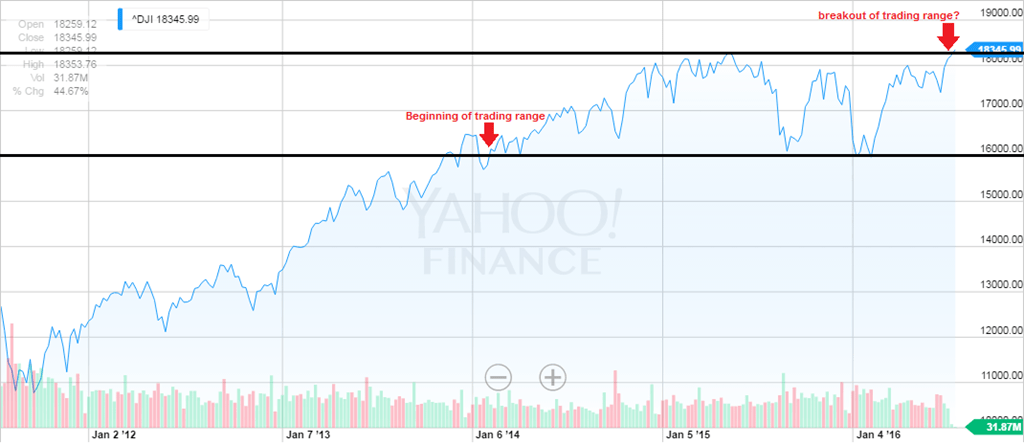
“We’re looking for a bear market indication with a declining of the Industrials, Transports and Russell 2000 below their respective February 2015 lows followed by a decline below the October 2014 lows. In addition, we’re looking for the revised data in the Industrial Production Index to continue in the current declining trend.”

Since May 2015, there has been a lot of action but not a lot of substance.  Below is our Dow Theory update explaining why a bear market was not signaled in August of 2015 and what to watch for going forward.

Continue reading

Transaction Alert

On January 12, 2016, we executed the following transaction(s):

Continue reading

Nasdaq 100: January 8, 2016

Performance Review

Below is the performance of the nine stocks from the January 9, 2015 Nasdaq 100 watch list compared to the performance of the Nasdaq 100 Index in the last year.

symbol name 2014 2015 % chg
NUAN Nuance Comm. 13.51 18.49 36.86%
GOOGL Google Inc. 500.72 730.91 45.97%
GOOG Google Inc. 496.17 714.47 44.00%
MAT Mattel, Inc. 29.1 26.93 -7.46%
DISCA Discovery Comm. 32.03 26.01 -18.79%
PCLN The Priceline Group Inc. 1,051.96 1136.96 8.08%
AMZN Amazon.com Inc. 296.93 607 104.43%
NWSA News Corporation 15.41 12.58 -18.36%
QCOM QUALCOMM 74.42 45.88 -38.35%
  Average change     17.37%
         
         
NDX Nasdaq 100 4213.28 4270.78 1.36%


The nine stocks on our 2015 watch list increased +17.37% while the Nasdaq 100 index gained +1.36%.  The biggest gain was Amazon.com (AMZN) which increased +104.43%.  The largest loss was generated by Qualcomm (QCOM) which fell by –38.35%.  The top five stocks (NUAN, GOOGL, GOOG, MAT, DISCA) gained +20.12%.

The stock that we were most interested in was Nuance Communications (NUAN).  At the time, we said of NUAN:

“NUAN has met all of Gould’s downside targets (extreme at $10.15 and conservative at $24.80.  All that is left for NUAN is to decline to the actual $10.15 price and the 2008 low at $6.18.  Speculators (as opposed to investors) should consider investment into this stock in three stages, once at the current price then the next two at $10.15 and $6.18 levels.” 

The 1-year performance chart for NUAN is below:

image

Right out the gate, NUAN meandered higher and then took off in late April.  For a stock that was left for dead, we believed that the chances favored NUAN going forward.

Continue reading