Transaction Alert

We executed the following transaction(s):

Performance Review: February 7, 2014

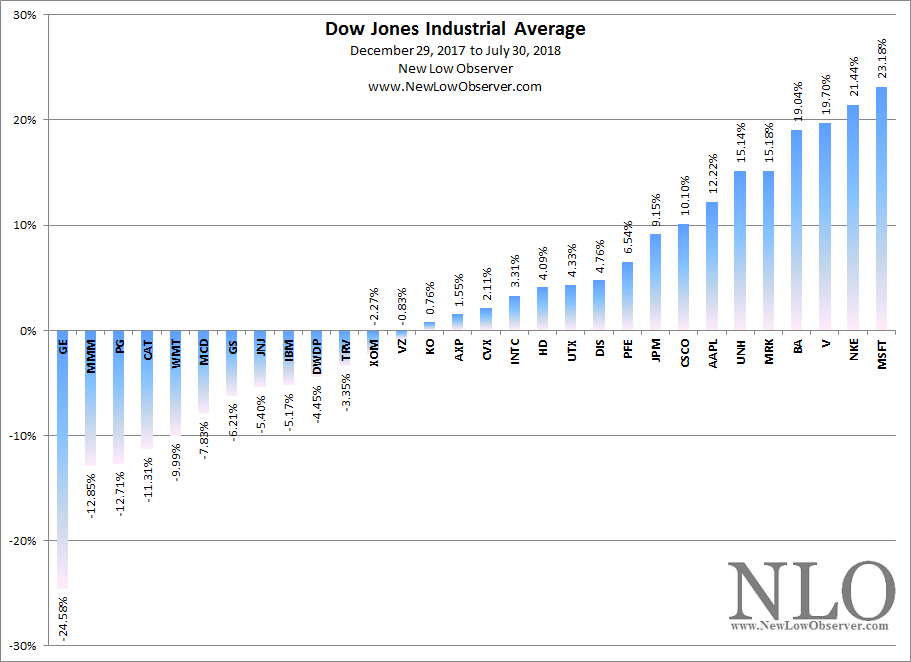
Below is the 4-year & 1-year total return performance of our Dividend Watch List from February 7, 2014  as compared to the Dow Jones Industrial Average.  We have also included the top three stocks in the respective categories from our February 2, 2018 U.S. Dividend Watch List.

Crypto Myth and Market Reality

The Myth

The prevailing theory is that the cause of the decline in cryptocurrencies lately is that the “banks” and Wall Street want to undermine the market for decentralized currencies to either steal the technology like the record industry and Apple (AAPL) did with Napster, or to eliminate a viable competitor to the Wall Street and banking industry cabal.

The Reality

The reality is that, like the introduction of every new technology that turned out to be revolutionary and widely dispersed to the point that it became second nature in its use and profound in it’s application, the price/value of such technologies is only relevant to the use.

In the formative stages (right now), blockchain technology is trying to find its footing in the world.  Make no mistake that blockchain is here to stay and it will likely permeate everyone’s lives, like it or not.  However, as with the canal, railroad, airplane, automobile, computer, biotechnology, and internet bubbles before, there will be thousands of contenders but only a dozen survivors (at most).  The risk of loss is significant when there are more than a thousand different cryptos out there and we all know there should be two dozen, at best.

The Market Reality

Everyone loves a great conspiracy theory.  However,  The last week of market volatility is proof that when everyone wants to sell, it doesn’t matter what they are holding.  Take for example the Dow Jones Industrial Average (DJIA) and Bitcoin (BTC).  The chart below shows the hourly percentage change in BTC  (cryptocurrency) versus the DJIA (Wall Street/bankers) from January 30, 2018 to February 5, 2018.

image

In the last week, it should be more difficult for someone to make the claim that Wall Street is pushing down cryptocurrencies while at the same time, Wall Street is falling as well. 

Our take on the matter is actually quite the opposite of the conspiracy theory, if Wall Street can continue to rise, there will be more money and enthusiasm to fund hair-brained ideas within the crypto space.  However, when the money drains out of Wall Street, it will also drain out of all the cool ventures that support and ensure the organic growth of the crypto environment and at a ridiculous rate.

The question might come up as to why BTC is crashing more than the DJIA if everyone is selling in all markets.  In a nutshell, familiarity.  The DJIA has been around for more than 120 years.  BTC has been around for less than 10 years.  Anyone unfamiliar with the risks of a new venture is naturally going to be more skittish when the old line investment (DJIA) is crashing, on a relative basis, and therefore would put into question the more dubious blockchain ventures, this in spite of blockchain technology possibly becoming bigger than the concept of money as we know it.

In Closing

As indicated above, cryptocurrency investors should embrace the idea that a rising stock market allows more money to go into more wasteful, and potentially lucrative, ventures in the blockchain universe than a falling stock market.  Just for the sake of better understanding the point we’re trying to make, get a copy of the book F’d Companies: Spectacular Dot-com Flameouts by Philip J. Kaplan.  You’d be surprised to know that even though there are some ridiculous concepts for dot-com companies, there are still many that would be incredibly lucrative today if the stock market didn’t crash like it did from 2000-2003.

Ethereum: Downside Targets

In a previous posting titled “Goldman Plays with Numbers,” we did a side-by-side comparison between Bitcoin and Ethereum in two different periods.  The periods in question happens to have the same percentage change, approximately +13,400%.

image

As with the same percentage increase, it is reasonable to expect the same percentage decreased that followed.  For the price of Bitcoin, it plunged –93.07% from June 8, 2011 to November 18, 2011.  Below is our charting of three scenarios for downside risk to Ethereum.

image

Based on the work of Edson Gould, the conservative downside target for Ethereum is at $617.09 (blue line).  However, due to the extremely volatile nature of cryptocurrencies, we have to expect that the extreme downside target is more than likely.  The purpose of putting the conservative downside target at all is to demonstrate that it will be achieved after a given peak in price is established and the trend is clearly to the downside.

In addition to the conservative downside target, we have indicated the level Ethereum would be at if it lost –93% (red line) as Bitcoin did in the period from June 2011 to November 2011 (yeah, it took only five months).  Such a decline in Ethereum would bring the price to $96.95.  We don’t expect this but must be realistic about the prospects regardless of our own personal expectations.

Finally, we have included our own worst case scenario (green line) based on one half the difference between Gould’s extreme downside target at $461 and the –93% experienced by Bitcoin in 2011.  This would bring the price of Ethereum to $279.31.  Although this seems like a dire call for Ethereum, in reality it is not unusual to see an –80% decline in price from such extreme parabolic moves.  Additionally, we don’t expect Ethereum to succumb to the same amount of pressure that Bitcoin did as the concept of blockchain technology is more salient to the general public today than it was in 2011.

Bitcoin: February 5, 2018

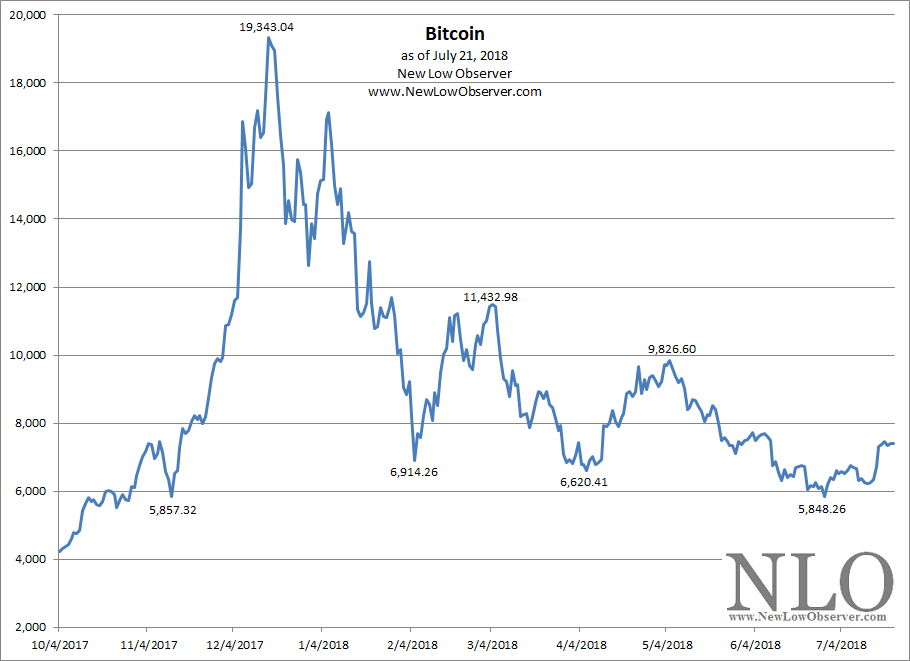
If you’re holding Bitcoin at this point, it is because you are confortable with the projected downside target of $6,684.31 to $5,802.91.

image

Since December 22, 2017, Bitcoin has had these downside targets.  Worth noting is that the rise from the low to the December 2017 peak is equal to the 2011 low to the 2013 peak on a percentage basis.  We’re within striking distance of the exact same percentage decline from the April 2013 peak to the July 2013 low.

image

In the period after the 2013 peak, it is worth noting the “Dow Theory” retest of the 68.36 low at the 66.86 level.  This indicates that whenever the current ultimate low is achieved, there will be an initial spike, not to exceed half of the prior decline, then another decline back to the established low. 

Traders will make lots of money on this “dead cat” bounce.  Alternatively, those willing to accept the downside risk will know they can buy again at a preferable low without all the hysteria attached.

U.S. Dividend Watch List: February 2, 2018

There are some who have described the recent market pullback as "market crash" or "blood bath." Yes the decline is large but to put things into perspective, the market (S&P 500) has risen +47% for the past 2 years. This equates to an annualized return of +23.50% which is close to the return of the best investor in the world, Warren Buffett. The pullback should be expected and welcoming for a healthy bull market. Should one choose to utilize this pullback as an entry point, we urge our reader to start with high quality companies which have consistent dividend payments, as listed below.

Continue reading

The Power and Lessons of Speed Resistance Lines

We are not big fans of charting as a means to make decisions about where the price of a stock or index will go. However, when a charting strategy has a high level of consistency while taking away our own person bias, we have to dig a little deeper.  This is a general overview of the incredible forecasting power and the practical investment lessons that we’ve experienced while employing Speed Resistance Lines.

Speed Resistance Lines, as demonstrated by the writing of Edson Gould, have been of significant aid in tempering our enthusiasm for a stock or index, especially when applied to targeting downside levels.  Within the context of the current bull market since 2009, we’ve seen a large majority of the stocks achieve the conservative downside target (more SRLs we’ve run here).  This means that even when we thought we selected the right stocks to apply to the SRL, we have been wrong.

Below are the earliest three examples of Speed Resistance Lines (SRL) that we introduced with the focus on downside targets.  The first SRL we will review is the Dow Jones Industrial Average from 1949 to 1975. The second SRL is for the Philadelphia Gold and Silver Stock Index (XAU) from 1998 to 2016.  The last one is Netflix (NFLX) from 2007 to 2013.

sources:

  • Scheinman, William X. “1966 and All That: One Stock Market Analyst Sees Some Ominous Parallels Today”. Barron's. March 17, 1969. pg. 5.
  • Scheinman, William X. “600 on the Dow?” Barron's. February 9, 1970. pg. 5.
  • Scheinman, William X. “May to December: The Bear Market, Says One Analyst, Will Hit Bottom This Winter”. Barron's. August 24, 1970. pg. 5.

DJIA: Downside Targets

Based on the nature of the decline in the market on February 2, 2018, it is worth examining the downside targets for the Dow Jones Industrial Average (DJIA).  Below are the downside targets based on the work of Edson Gould’s Speed Resistance Lines.

What If You Don’t Know or Care About Investing?

After we wrote our posting “Work Smart, Not Hard,” many individuals have made the obvious remark, “it sounds good in theory, but how can a person like me, who has no interest or knowledge in stocks, the stock market or investing, get nearly +7% compounded over time?”

We’ll default to the most famous investor in the history of modern time, Warren Buffett.  According to Buffett:

“Over the 35 years, American business has delivered terrific results. It should therefore have been easy for investors to earn juicy returns: All they had to do was piggyback Corporate America in a diversified, low-expense way. An index fund that they never touched would have done the job (Buffett, Warren. Berkshire Hathaway Annual Report. February 28, 2005. page 4.).”

There you have it.  If you have no interest in following the stock market, stocks or investing, then all you need to do is buy the S&P Index Fund, preferably a “low cost” fund.  Start at the Consumer Reports link and pick one and do the same in your retirement accounts at work.

image

Read our article titled “Work Smart, Not Hard” showing how compound interest is the key to your financial success.

image

Bitcoin: February 1, 2018

On December 22, 2017, we said the following of Bitcoin:

  • “We believe that there is going to be limited upside in the near term.”
  • “We think that the conservative downside target ($6,884.31) will be achieved before a new high is seen.”
  • “In all prior booms, the subsequent bust AVERAGED –70% (data found here).”

Below is the updated chart for Bitcoin along with our expected downside target.

Gold Stock Indicator: January 2018

On September 17, 2017, we said the following:

“We’re still in the diabolical no-man’s land where, according to Dow Theory, the previous trend (bear market) is in place until proven otherwise.”

The price of gold continues to confound even the most bullish gold analyst.  However, as we can see below, it is make-or-break time for the precious metal.

Nasdaq 100 Watch List: January 2018

Performance Review

Below is the performance of the Nasdaq 100 watch list from January 25, 2017 compared to the analyst estimates for the respective stocks.

image

Although we expect that the analysts will miscalculate which stocks will do the best, it is necessary to actually see how the stocks did in comparison.  We’re not seeking an exact match in the performance expectations, just that the general trend was correct. 

For example, the analysts got the expectations of Gilead (GILD) and Mylan (MYL) generally corrects.  However, the analysts projected equivalent gains that did not exceed that of the Nasdaq 100 index at +34.90%.  Likewise, the analysts projected a significant loss for Vodafone (VOD) while the stock was among the top performers on the list.

Looking at the performance from the following respective categories helps to narrow down the best strategy to apply when we don’t know which stocks to select.  Below is the performance based on the top three stocks in the respective categories:

image

None of the listed categories managed to beat the Nasdaq 100 index (NDX) in the last year.  However, there is still a lot to learn from the ranking of performance.  As with our Dogs of the Dow studies, the conventional wisdom keeps getting overturned with the low p/e and low p/b stocks underperforming the high p/e and high p/b stocks.  We believe that there is a perfect explanation for this as we have outlined in our recent studies posted on our site.

Nasdaq 100 Watch List January 2018

GE Altimeter

Below is the historical range of the Altimeter for General Electric (GE) from 1962 to the present.  The green line represents the mean, which sits at the 143.5 level.  If GE were to achieve the historical high of the range then the stock would be priced at $22.44.  That would be a +37.84% increase to the all-time high of the longstanding range.  Meanwhile, the downside risk, based on the Altimeter, is $11.76 or a decline of –27.76%.  A declining stock price with a rising Altimeter is not a good sign.

image

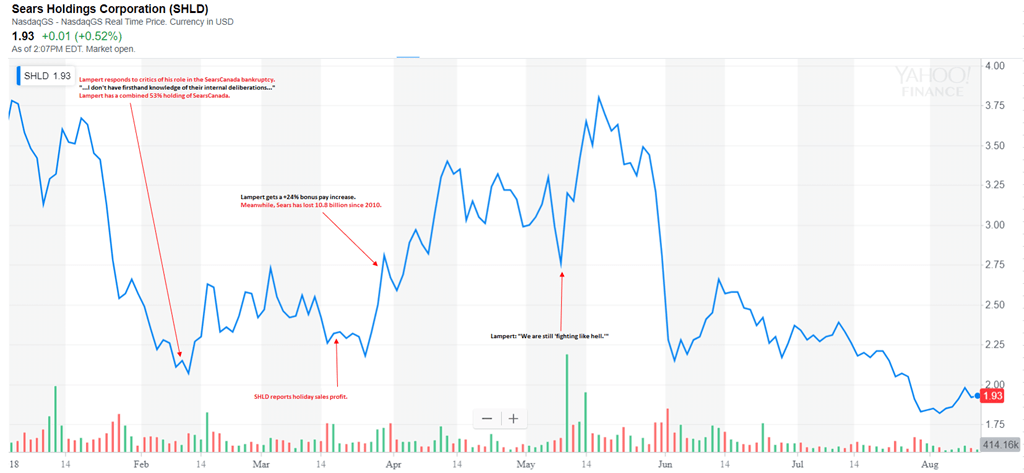
Sears Holdings: “Going Concern” Update

On March 21, 2017, Sears Holdings issued the following statement in their 2016 annual report:

“Our historical operating results indicate substantial doubt exists related to the Company's ability to continue as a going concern (page 48).”

If you were to invest in a company, would you consciously put your money into a stock that executives have to say something like this?  Naturally, a company needs to cover their tracks with commentary that dampens over enthusiasm for stock investors.  To contrast our bias against SHLD, we looked at the 2016 annual report for Target (TGT).  Nowhere is there any indication of a “going concern” risk expressed by management.  Maybe TGT is in denial or maybe Sears Holdings management is onto something.

Guess what happens when a company is honest about the risks to their viability?  Well, in the short term, the stock jumped over +52% from March 21, 2017 to April 19, 2017.  Even better was the increase of +101% after our February 10, 2017 article titled “Sears CEO: ‘We’re Cutting Costs, Ignore Conflict of Interest’” to the April 19, 2017 peak.  The more speculative traders out there probably didn’t believe the CEO but saw the short squeeze opportunity that was available and profited handsomely.

However, time is the arbiter of truth, and not even one year later we see that Sears Holdings (SHLD) is finding its footing at a price that is more reflective of a company that has “substantial doubts” about their “ability to continue as a going concern.” As of January 26, 2018, SHLD has declined –63.50%.

image

The good news for Sears executives is that while they engage in practices that appear to be questionable, they have sufficiently absolved themselves of the inevitable lawsuits that will likely follow their eventual bankruptcy.

So what do we expect from SHLD management in the short-term?  We believe that the stock will experience another short squeeze with news that is supposed to reflect that the company has “turned the corner.”  The temporary boost will rout the short-sellers and buy some time for management.  However, as we said in our February 10, 2017 posting, “…anyone who continues to hold their position in Sears will not be rewarded for the value that has been lost since Lampert came on board.”

Transaction Alert

On January 23, 2018, we executed the following transaction(s): Continue reading